The state of the Internet in France - EDITION - Arcep
←
→
Page content transcription
If your browser does not render page correctly, please read the page content below
FRENCH REPUBLIC
                      JuNE 2018

          The state of
          the Internet
          in France

EDITION

                  arcep
ARCEP
                                                                                      2018 edition - The state of the internet in France

Table of contents
Introduction.  .  .  .  .  .  .  .  .  .  .  .  .  .  .  .  .  .  .  .  .  .  .  .  .  .  .  .  .  .  .  .  .  .  .  .  .  .  .  .  .  .  .  .  .  .  .  .  .  .  .  .  .  .  .  .  .  .  .  .  .  .  .  .  .  .  .  .  .  .  .  .  .  .  .  .  .  .  .  .  .  .  .  .  .  .  .  .  .  .  .  .  .  .  .  .  .  .  .  . 3

Part 1
Ensuring the Internet functions properly ������������������������������� 7
1. Improving Internet quality of service measurement. .  .  .  .  .  .  .  .  .  .  .  .  .  .  .  .  .  .  .  .  .  .  .  .  .  .  .  .  .  .  . 8
          1. A
              need to characterise the measured environment
             and for transparency on the adopted methodology.  .  .  .  .  .  .  .  .  .  .  .  .  .  .  .  .  .  .  .  .  .  .  .  .  .  .  .  .  .  .  .  .  .  .  .  .  .  .  .  .  .  .  .  . 8

          2. A n innovative co-construction approach .  .  .  .  .  .  .  .  .  .  .  .  .  .  .  .  .  .  .  .  .  .  .  .  .  .  .  .  .  .  .  .  .  .  .  .  .  .  .  .  .  .  .  .  .  .  .  .  .  .  .  .  .  .  .  . 12

          3. Work being done on developing complementary tools in-house .  .  .  .  .  .  .  .  .  .  .  .  .  .  .  .  .  .  .  .  .  .  .  .  .  .  .  . 25

2. Monitoring Data interconnection market . .  .  .  .  .  .  .  .  .  .  .  .  .  .  .  .  .  .  .  .  .  .  .  .  .  .  .  .  .  .  .  .  .  .  .  .  .  .  .  .  .  .  .  .  .  .  .  .  . 30
          1. A variety of stakeholders in an evolving ecosystem.  .  .  .  .  .  .  .  .  .  .  .  .  .  .  .  .  .  .  .  .  .  .  .  .  .  .  .  .  .  .  .  .  .  .  .  .  .  .  .  .  .  .  .  .  . 30

          2. A n extension of collected data for better supervision and support .  .  .  .  .  .  .  .  .  .  .  .  .  .  .  .  .  .  .  .  .  .  .  .  . 33

          3. Results that confirm market trends.  .  .  .  .  .  .  .  .  .  .  .  .  .  .  .  .  .  .  .  .  .  .  .  .  .  .  .  .  .  .  .  .  .  .  .  .  .  .  .  .  .  .  .  .  .  .  .  .  .  .  .  .  .  .  .  .  .  .  .  .  .  .  .  .  . 35

3. Accelerating the transition to IPv6.  .  .  .  .  .  .  .  .  .  .  .  .  .  .  .  .  .  .  .  .  .  .  .  .  .  .  .  .  .  .  .  .  .  .  .  .  .  .  .  .  .  .  .  .  .  .  .  .  .  .  .  .  .  .  .  .  .  .  .  . 42
          1. The transition to IPv6: a growing imperative .  .  .  .  .  .  .  .  .  .  .  .  .  .  .  .  .  .  .  .  .  .  .  .  .  .  .  .  .  .  .  .  .  .  .  .  .  .  .  .  .  .  .  .  .  .  .  .  .  .  .  .  .  .  . 42

          2. A rcep observatory, or a heavy dose of transparency to accelerate the transition .  .  .  .  .  . 46

          3. The ecosystem galvanised around an IP 6 workshop.  .  .  .  .  .  .  .  .  .  .  .  .  .  .  .  .  .  .  .  .  .  .  .  .  .  .  .  .  .  .  .  .  .  .  .  .  .  .  .  .  .  .  . 51

PART 2
ENSURING INTERNET OPENNESS. .  .  .  .  .  .  .  .  .  .  .  .  .  .  .  .  .  .  .  .  .  .  .  .  .  .  .  .  .  .  .  .  .  .  .  .  .  .  .  .  .  .  .  .  .  .  . 53
4. Guaranteeing network neutrality.  .  .  .  .  .  .  .  .  .  .  .  .  .  .  .  .  .  .  .  .  .  .  .  .  .  .  .  .  .  .  .  .  .  .  .  .  .  .  .  .  .  .  .  .  .  .  .  .  .  .  .  .  .  .  .  .  .  .  .  .  .  . 54
          1. Net neutrality around the world.  .  .  .  .  .  .  .  .  .  .  .  .  .  .  .  .  .  .  .  .  .  .  .  .  .  .  .  .  .  .  .  .  .  .  .  .  .  .  .  .  .  .  .  .  .  .  .  .  .  .  .  .  .  .  .  .  .  .  .  .  .  .  .  .  .  .  .  . 54

          2. European regulators continue to enact their powers,
             within a now stable legal framework . .  .  .  .  .  .  .  .  .  .  .  .  .  .  .  .  .  .  .  .  .  .  .  .  .  .  .  .  .  .  .  .  .  .  .  .  .  .  .  .  .  .  .  .  .  .  .  .  .  .  .  .  .  .  .  .  .  .  .  .  .  . 62

         3. In France, Arcep is fully committed to its three-stage action plan. .  .  .  .  .  .  .  .  .  .  .  .  .  .  .  .  .  .  .  .  .  .  .  .  .  .  . 64

5. Fostering the openness of terminal equipment.  .  .  .  .  .  .  .  .  .  .  .  .  .  .  .  .  .  .  .  .  .  .  .  .  .  .  .  .  .  .  .  .  .  .  .  .  .  .  .  .  .  . 72
          1. A rcep scrutinises terminal equipment, present and future .  .  .  .  .  .  .  .  .  .  .  .  .  .  .  .  .  .  .  .  .  .  .  .  .  .  .  .  .  .  .  .  .  .  .  .  . 72

          2. Successful mobilisation of digital players .  .  .  .  .  .  .  .  .  .  .  .  .  .  .  .  .  .  .  .  .  .  .  .  .  .  .  .  .  .  .  .  .  .  .  .  .  .  .  .  .  .  .  .  .  .  .  .  .  .  .  .  .  .  .  .  . 74

          3. Courses of action to ensure an open Internet and users’ freedom of choice .  .  .  .  .  .  .  .  .  .  .  .  . 76

Lexicon.  .  .  .  .  .  .  .  .  .  .  .  .  .  .  .  .  .  .  .  .  .  .  .  .  .  .  .  .  .  .  .  .  .  .  .  .  .  .  .  .  .  .  .  .  .  .  .  .  .  .  .  .  .  .  .  .  .  .  .  .  .  .  .  .  .  .  .  .  .  .  .  .  .  .  .  .  .  .  .  .  .  .  .  .  .  .  .  .  .  .  .  .  .  .  .  .  .  .  .  .  .  .  . 80

Annexes.  .  .  .  .  .  .  .  .  .  .  .  .  .  .  .  .  .  .  .  .  .  .  .  .  .  .  .  .  .  .  .  .  .  .  .  .  .  .  .  .  .  .  .  .  .  .  .  .  .  .  .  .  .  .  .  .  .  .  .  .  .  .  .  .  .  .  .  .  .  .  .  .  .  .  .  .  .  .  .  .  .  .  .  .  .  .  .  .  .  .  .  .  .  .  .  .  .  .  .  .  .  .  . 84

                                                                                                                                                             2
Introduction
What was it like before? It is often difficult to                        and illnesses and potential future threats that
remember what life was like for people and                               fall under its purview, and takes action to heal or
businesses before the phenomenal rise of the                             prevent them. A neutral and vigilant expert at the
Internet, because it so thoroughly permeates                             Internet’s (bed)side, Arcep monitors changes over
every inch of our lives today that it has become                         time, performing a complete annual check-up to
invisible. Ubiquitous at home and at work, but also                      ensure that this network of networks remains an
in the streets and on transportation, ever since                         inclusive public resource.
we’ve been able to slip it into our pockets, the
Internet has gone everywhere we do. In 2017, the                         There are fundamental issues attached to the
smartphone became the device most commonly                               digital divide. In 2017, only two thirds of the people
used to connect to the Internet in France, now                           in France believed they were capable of using a
outranking computers 1. In a matter of years, this                       computer 2 . If Arcep is not in charge of matters
planetary network has become the “beating heart”                         relating to digital technology training, it does keep
of the economy, and of society as a whole. It has                        a close watch over the second essential facet of
become an infrastructure that is vital to freedom                        the issue: infrastructure rollouts. The work it
of enterprise, of expression, freedom to innovate                        does on accessibility and coverage are available
and to access knowledge. The technical, economic,                        in Volume 2 of its annual report, “Arcep regulation
social and democratic issues surrounding this by                         in support of smart territories” 3 .
now vital global common good are colossal. And
there is no guaranteed outcome.                                          Volume 3 of Arcep’s annual report is this document
                                                                         on the state of the Internet in France. Beyond its
The endless controversies over data privacy                              main purpose of an annual report, it seeks to
and fake news, cyberattacks, challenges to net                           be a didactic presentation of the current state
neutrality, market concentration around a handful                        of networks and the work being done to best
of digital platforms, unequal access: the steady                         guarantee users’ ability to exchange information.
stream of headlines are a constant reminder of                           Arcep is devoted to keeping its finger on the
the Internet’s upheavals. All tantamount to a                            Internet’s pulse, and a watchful eye on its overall
series of health scares, and reasons to consider                         operation and openness: quality of service,
what treatments to prescribe to maintain it over                         data interconnection, the transition to IPv6, net
time as an engine of innovation and freedoms that                        neutrality and the openness of devices. Arcep’s
upholds our values.                                                      first line of action is to improve the instruments
                                                                         available to x-ray the networks and determine
As architect and guardian of communication                               the symptoms, to then work on remedying the
networks in France, Arcep has its share of                               situation when necessary, by writing up the most
responsibility. As such, Arcep identifies accidents                      appropriate prescription.

1   ttps://www.arcep.fr/uploads/tx_gspublication/barometre_du_numerique-2017-infographie-271117.pdf
   h
2  https://www.arcep.fr/uploads/tx_gspublication/barometre_du_numerique-2017-infographie-271117.pdf
3 https://www.arcep.fr/uploads/tx_gspublication/rapport-GRACO-2018_dec2017.pdf

                                                                     3
ARCEP
2018 edition - The state of the internet in France

                        4                            5
ARCEP
2018 edition - The state of the internet in France

                        6
part 1

Ensuring
the Internet
functions
properly

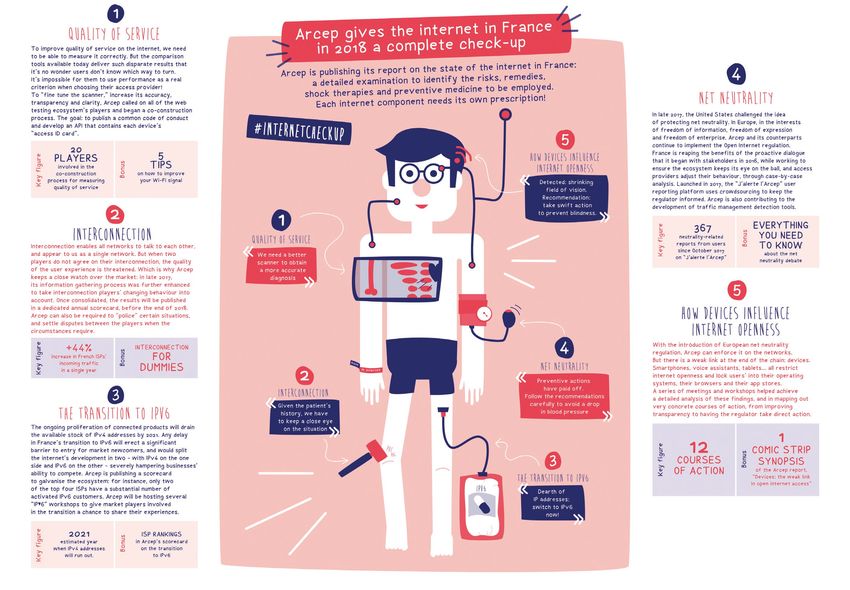
Given how central the Internet has become to society, it is vital to
guarantee that its constituent networks function properly.
This is why Arcep supervises the Internet ecosystem, to ensure that
progress continues to be made in measuring performance and
quality of service, in monitoring the data interconnection market’s
development, and in furthering the transition to IPv6.

1. Improving Internet quality of service measurement8
2. Monitoring Data interconnection market30
3. Accelerating the transition to IPv642

                              7
ARCEP
                                                    2018 edition - The state of the internet in France

          1. Improving Internet
              quality of service
              measurement
          P’S
     CE
AR

                 N
                TIO

                          A better scanner
 RE
      S C RI
P

                P

                          is needed to obtain
                          a more accurate
                          diagnosis

          How healthy is quality of service on the Internet in                            1. A need to characterise
          France? If a body need only be at 37° to be considered                             the measured environment
          at the “right” temperature, measuring and analysing the                            and for transparency on
          networks’ ability to relay traffic under the right conditions                      the adopted methodology
          is a more complex affair: not only are indicators required
          to perform this assessment, but relative measurements                           There are two main types of observatory around the world:
          are more relevant than absolute ones. A connection                              those based on direct measurements and those based
          speed 4 that may have been entirely satisfactory a few                          on statistics (e.g. percentage of Internet subscriptions
          years ago no longer enables certain uses that have                              that are broadband) such as the European Commission’s
          appeared since then. To evaluate how well France is                             Digital Economy and Society Index 5 or the Organization
          performing on Internet service quality, an interesting                          for Economic Co-operation and Development’s (OECD)
          first step would be to take a look at the analyses that                         Broadband PortalPortal. Instructive in many respects,
          seek to compare the situation in the different European                         these scoreboards are devoted more to national
          countries.                                                                      coverage than to quality of service issues – a topic that is
                                                                                          addressed in the Arcep report on smart territories 6 , and

          4   ee lexicon.
             S
          5  T he Digital Economy and Society Index (DESI) : https://ec.europa.eu/digital-single-market/en/desi
          6 w ww.arcep.fr/graco

                                                                                      8
Part 1 • chapter 1
                                    Improving Internet quality of service measurement

will thus not be examined here. It should also be noted                   One such observatory is the one devoted to measuring
that scoreboards on Internet quality of service based on                  Internet quality of service on fixed networks, run by
actual measurements reflect the average quality of the                    GESTE, a consortium of content and service providers. It
connections that were tested, regardless of the number                    puts France in the bottom half of the rankings in terms of
of lines deployed across the country.                                     average web page load times.

                                                       GESTE OBSERVATORY 7

                                                                                                           Total load time
                                                                                                              < 5.5 seconds
                                                                                                              5.5 – 6 seconds
                                                                                                              6 – 6.5 seconds
                                                                                                              6.5 – 7 seconds
                                                                                                              7 – 8 seconds
                                                                                                              8 – 10 seconds
                                                                                                              > 10 seconds

                                                                                                           Source : Observatory "GESTE/Cedexis
                                                                                                           de la qualité de service internet"
                                                                                                           (July 2017)

Two points warrant being made here. First, the web                        connections will top the rankings, even though its fibre
pages chosen to perform the speed tests are from GESTE                    products may not necessarily be of a higher quality than
members’ websites. This scoreboard can therefore                          the access products sold by its competitors that also use
not provide any conclusions about quality of service                      cable or ADSL.
for the Internet as a whole. Moreover, it is currently
impossible for testing tools to qualify the fixed access                  Measuring Internet quality of service on mobile networks
technology (fibre, ADSL, etc.) on which the tests were                    is an easier matter. As the following 4G speed comparison
performed. Observatories are thus forced to aggregate                     scorecard from the UK’s OpenSignal demonstrates,
measurements from all of the technologies combined,                       crowdsourced 8 mobile testing apps are able to identify
which can give an idea of the technology mix in the                       the technology being employed. This scorecard sets itself
country (and so the choices that have been made, e.g. to                  the tasks of comparing countries from across the globe on
upgrade cable networks or give priority to fibre rollouts)                two main metrics: the proportion of time that users have
but not an accurate measure of the quality of these                       access to a 4G network (and so looking at connectivity,
connections for any one access technology in particular.                  which is very closely bound up with coverage) and 4G
The problem is the same when it comes to publishing a                     download connection speeds. Here again, France fares
comparison of operators’ findings: by way of illustration,                relatively poorly in its results for Q4 2017 9: ranking 36th
an operator whose base is made up solely of fibre                         out of 77, with a 4G download speed of 25 Mbit/s.

7  he base map of the original diagram has been modified.
  T
8 Crowdsourcing tools are mechanisms that centralise QoS and/or QoE measurements taken by actual users.
9 https://opensignal.com/reports/2018/02/state-of-lte#coverage-lte

                                                                      9
ARCEP
                                        2018 edition - The state of the internet in France

We may be surprised to find that other scoreboards
provide significantly different average 4G speeds for                                    OBSERVATORY OPEN SIGNAL
France than the one given below. One case in point is
the nPerf speed test that revealed a speed of around
33 Mbit/s 10 which would put France in 11th spot in the
OpenSignal rankings. This disparity is not surprising,
however: studies conducted by Arcep in 2017 revealed
that the choice of methodology used by the testing tools
had a considerable impact on the results 11. The location
of the test server, the indicator testing protocol, as well
as the number and representativeness of the measures
taken all had a direct influence on the measured value.

If the diversity of the crowdsourcing ecosystem is
beneficial, it nevertheless needs to be coupled with a
requirement of transparency over the methodological
choices made, so that any third party is able to explain the
differences observed between two tools, and to question
the relevance of making one choice over another. In
addition, there are already plans for co-construction
work to be done on characterising the fixed network
access technology being used, so that the results can be
delivered in more useable formats.

Testing tools could therefore be more finely tuned,
to be able to obtain a more accurate assessment of
Internet quality of service in France and, if necessary, to
recommend the most suitable remedies.

                                                                                                  Source: Open Signal - The State of LTE (February 2018)

10   umber calculated based on data published by nPerf in the following report: https://media.nperf.com/files/publications/FR/2018-01-16_Barometre-
    N
    connections-mobiles-metropole-nPerf-2017-T4.pdf. Average 4G speed, all operators combined: 0.24 x 21.5 + 0.27 x 39 + 0.25 x 37.3 + 0.24 x 31.3 =
    32.5 Mbit/s.
11 https://www.arcep.fr/uploads/tx_gspublication/rapport-etat-internet-france-2017-mai2017.pdf, p. 28 to 40.

                                                                       10
Part 1 • chapter 1
                                   Improving Internet quality of service measurement

A high quality Internet
to support innovation

                     Jonathan Ardouin,
                     Country Manager, France, KRY

Remote medical consultations are increas-                                     The one proviso, however, is that the
ingly prevalent across Europe. They are                                       video needs to be of high enough quality
helping to overcome permanent care                                            to allow the doctor to identify the patient’s
issues and medical deserts that France                                        visible symptoms with certainty. To ben-
also has to deal with. This new channel         “To benefit fully from        efit fully from video consultations, a fast
of care is still only nascent in France, as                                   and stable Internet connection is crucial
the 2018 Social Security Financing Act has
                                                video consultations,          for both the patients and the doctors.
only just enshrined the ability to be reim-        a fast and stable          Today in France, it is common for this
bursed for remote medical consultations.                                      type of consult to end on the phone
                                                Internet connection           because the Internet connection is not
KRY is the leading provider of video              is crucial for both         fast enough. And this even in major cities,
medical visits in France. Now in our third                                    and with users who have a “high-speed”
year of operation, we conduct close to 3%
                                                    the patients and          connection.
of all first aid consultations via video in            the doctors.
Sweden, a country where video consulta-             Today in France,          The implication then is that a poor quality
tions are already a common practice and                                       Internet service equals lost opportunities
reimbursed by national health insurance.            it is common for          for patients: in areas where connections
The hindsight we have gained from our          this type of consult to        are too slow, patients will be deprived of
experience in Sweden proves that video is                                     rapid access to care. Common patholo-
the best channel – better than the phone           end on the phone           gies, which can easily be diagnosed via
or sending photos – for remote consulta-         because the Internet         video, will need to be rerouted to already
tions, and can guarantee the same quality                                     overtaxed physical channels (doctors’
as an in-person visit. It allows the medical          connection is           office, clinics, A&E). Having a high quality
practitioner to establish ties with the            not fast enough.”          fixed Internet service is thus vital when it
patient and confidently make a diagnosis.                                     comes to telemedicine.
                                                                                                                       © KRY

                                                          11
ARCEP
2018 edition - The state of the internet in France
2. An innovative co-construction
approach
FYI
On 19 January 2016, Arcep presented the conclusions of its
strategic review, and announced the implementation of
data-driven regulation, a greater push for co-constructed J’alerte l’Arcep
regulation, and Arcep’s development around a role of
Launched in October 2017, the “J’alerte l’Arcep”
neutral expert on digital issues. platform is available to any citizen wanting to
report an actual problem encountered with their
The work devoted to Internet quality of service is fully in mobile Internet, fixed Internet or postal services.
The platform has logged 22,500 reports since it
line with this new modus operandi. first launched. Of these reports, 68%* concern
a quality or availability issue with fixed or
In this data-driven approach to regulation, Arcep wants mobile services. And, among them, two thirds
to use information regarding quality to stimulate concern the fixed market, and one third the
mobile market.
competition that is not based solely on price, but also This valuable feedback helps fuel the work that
on the quality of the services being sold, with a view to Arcep is doing on quantifying and identifying the
monetising network investments. problems that users are encountering, to then
steer its actions towards the most appropriate
solutions possible. It is on issues relating to
To be both more efficient and more relevant, Arcep is thus Internet quality of service that the co-construction
seeking to co-construct this regulation: approach, the work being done on the BEREC tool
and the monréseaumobile (my mobile network)
• On the one hand, with “the crowd” by giving every scorecard described in Chapter 1, Section 3 come
citizen the power to become a mini-regulator. This fully into play.
was the impetus behind the launch of the “J’alerte * ercentage obtained through reports logged between October
P
l’Arcep” platform in October 2017, through which 2017 and May 2018.
any consumer can report problems with their
Internet access to Arcep (see inset). In addition to
reporting, users can also input the results of QoS
tests performed on their line using crowdsourced 2.1. Bringing together stakeholders
tools, and so contribute to the data used when
publishing benchmarks of ISPs’ performance; Up until the end of 2016, Arcep’s scorecard on the quality
of fixed services was based on a system operating
• and, on the other, through a partner-centric
in a controlled environment. This type of testing was
approach with the ecosystem’s stakeholders,
abandoned in early 2017 – largely because the real-life
for both the reporting and testing aspects
situations encountered by users were not being properly
referred to above. In the area of reporting, in
represented – and replaced by a system that would be
addition to launching its own platform Arcep is
based on crowdsourced testing tools.
examining the possibly of initiating a data-sharing
scheme with consumer protection advocates 12 .
The 2017 report on the state of the Internet in France
This “unbundling” of the reporting process
presented the findings of the two studies that initiated the
could help dismantle existing silos, and drive a
co-construction approach: the map of the ecosystem of
better, collective understanding of the issues
the tools available in the marketplace, and a comparison
at hand. Arcep’s partner-centric approach to
of the results of different online testing tools. This report
crowdsourced testing is described below.
had stressed the need for a concerted community effort
on several top priority issues. Arcep has since launched
Alongside these co-construction efforts, Arcep is working
six courses of action as a direct result.
to develop its own tools for collecting measurements that
can enhance the data from its partners’ third-party tools.
These projects are detailed in Section 3 of this Chapter.
12 In accordance with existing regulation, notably regarding data privacy.
12Part 1 • chapter 1
Improving Internet quality of service measurement
PARTICIPANTS: A RICH AND VARIED ECOSYSTEM
PROJECT A PROJECT B
PROJECT C OTHER PROJECTS
Online testers tools
Academia
Consumer protection organisations
ISPs
Source: Arcep
To bring them to completion, Arcep is acting as a neutral • ISPs: Bouygues Telecom, Free, Orange, SFR;
expert that brings the community together and fosters
the work being done on matters of general interest.
• academia and R&D: CNES, Inria;
These initiatives were carried out in collaboration with a • consumer protection organisations: INC, UFC
wide spectrum of stakeholders from the crowdsourced Que-Choisir, which have also developed their own
metrology ecosystem13 : tools.
• testing tools: ASSIA, Case on IT (medUX), Cedexis,
Directique, Ip-label, Gemalto, M-Lab, Ookla, nPerf,
QoSi, SamKnows, V3D;
13 Arcep invites any players who are not listed and who would like to take part in the co-construction efforts to get in touch.
13ARCEP
2018 edition - The state of the internet in France
Alongside the working groups, Arcep also consulted with a clear explanation of the methodological choices
with other national regulatory authorities (notably made, so that any outside party is able to understand the
AGCOM, BnetzA, COMREG, Ofcom and RTR) to pool their potential differences observed between tests performed
experience in measuring the quality of fixed services. with different tools. Second, to set out the best practices
that are vital to obtaining reliable measurements.
The goal that cuts across all of these initiatives is to enable Although most of the choices that have been made have
the tools to meet consumers’ and the Authority’s needs merit, some practices do seem more questionable, and
as fully as possible, in terms of obtaining information on warrant being modified.
quality of service on the fixed and mobile Internet.
The first version of the code of conduct will be published
To be more specific, Project A seeks to address the before the end of 2018. And it will evolve over time: every
technical problem raised in the previous section, namely year, in theory, Arcep will publish successive, continually
the lack of characterisation of the user environment improved versions, which include not only changes to
when measuring the quality of fixed services. The other Projects A, B and C, but also the fruit of the projects that
projects (B, C and those currently in the planning stage) are currently in the planning stage.
address the need for greater transparency that was also
identified in the previous section. In particular, they A beta version of the maiden code of conduct can be
seek to establish a “code of conduct” for testing tools. found in Annex 1. Stakeholders are heartily encouraged
This future code of conduct concerns two aspects: first, to share any remaining feedback on the matter with
inviting the tools to back the publication of their results Arcep before 15 July 2018.
CO-CONSTRUCTION APPROACH
2016 2017 2018
AUTUMN
MAY MAY 2018
CONTROLLED
CONTROLLED
ENVIRONMENT CO-CONSTRUCTION ADAPTATION
ENVIRONMENT
FINDINGS
CODE OF CODE OF
CONDUCT CONDUCT
(BETA)
TOOL
MAPPING
REPORT ON THE STATE REPORT ON THE STATE
OF THE INTERNET OF THE INTERNET
IN FRANCE - 2017 IN FRANCE - 2018
COMPARISON
OF TEST RESULTS
PROJECT SOLUTIONS SPECIFICATION OF
CHARACTERISE
A THE USER ENVIRONMENT MAP
MULTILATERAL
THE CHOSEN SOLUTION
PROJECT
ESTABLISH TRANSPARENCY CRITERIA
B TESTING METHODOLOGY
AND BEST PRACTICES
PROJECT ESTABLISH TRANSPARENCY CRITERIA
C
TEST TARGETS
AND BEST PRACTICES
OTHER COMBATTING FRAUD,
PROJECTS STATISTICAL REPRESENTATIVENESS PLANNING STAGE
AND THE WI-FI ENVIRONMENT
Source: Arcep
14Part 1 • chapter 1
Improving Internet quality of service measurement
2.2. Project A: Characterising
the user environment
The project dedicated to characterising the user The following diagram recaps the main properties of the
environment on a fixed line, and notably the technology user environment that will influence the test results.
being used, has a dual purpose: first, it is vital to being
able to create a truly relevant scorecard for consumers The current characterisation of the different elements
and, second, it is of significant value when establishing varies depending on the type of testing tool being used.
an accurate diagnosis of a quality of service issue. Some hardware probes 14 are, for instance, capable of
For instance, it is important to know whether a poor testing a LAN 15 connection and even estimating cross-
connection is due to the ISP’s access network, the Wi- traffic 16 on the local network. On the flipside, while it
Fi network’s quality or the simultaneous use of other is true that web testers 17 can be rapidly deployed on a
connected devices on the local network when performing large scale, they are only able to detail a small number of
the test. elements (web browser used, etc.).
THE USER ENVIRONMENT:
A SET OF CHARACTERISTICS WITH HIGH IMPACT ON MEASUREMENTS
CROSS-TRAFFIC USER’S PLAN
Headline speed
Other connected
devices
ISP INTERNET
COMPUTER LAN CONNECTION BOX ACCESS
TECHNOLOGY
CPU Ethernet or Wi-Fi Hardware
Software (OS) Link capacity Software
Web browser and signal quality Model Source: Arcep
14/15/16/17 See lexicon.
15ARCEP
2018 edition - The state of the internet in France
This project centred around the work coordinated the ISPs (e.g. list of plans available for a given technology)
by Arcep involving testing tools, ISPs and academia. or by an API 18 deployed between the tools and ISPs’
The community began with an exploratory phase information systems (IS). At this stage in the discussions,
during which seven solutions attempting to satisfy the it appears that another solution may seem to offer the
requirements were examined. One proposed path was to best compromise between exhaustiveness, reliability,
characterise the measurements through a questionnaire security and development costs for most stakeholders.
completed by the person performing the test, and more Arcep thanks them for their dynamic and constructive
or less guided by the information given ahead of time by contributions.
AN “ACCES ID CARD” API
FOR CHARACTERISING THE USER ENVIRONMENT
1
Calls the API OPERATOR’S
TOOL BOX IS
Web tester, 3
probe, 2
software, agent Data transmission
Data retrieval:
access technology, from the IS:
cross-traffic, headline speed
LAN connection, box
Source : Arcep
A diagram of the solution is presented above. When a test This ambitious project should thus enable the tools
is performed, the tool (whether a web tester, hardware used to test fixed networks to achieve degrees of
probe, software agent on a box, software that can be characterisation that are virtually equivalent to those
installed on a device) simultaneously sends a request obtained natively by mobile apps – which are already
to the “access ID card” API located on the tester’s box 1 . capable of identifying the access network (2G, 3G or
If the tool queries this API, the box will send it the 4G), for instance, and the strength of the signal since
characteristics of the line at the time of testing 2 . Most they are tied directly to the mobile operating system
of the information is available natively on the box: access (OS) and there is no intermediary between the device
technology, information on the LAN connection and the and the network – contrary to a fixed network where the
box and — for most ISPs – a WAN 19 port traffic counter that connection is supplied through a box.
makes it possible to detect cross-traffic. Other properties,
such as headline speed, are not available locally on the By establishing API specifications and the list of tools
box but on the operator’s IS: through another API, if the authorised to access them, in concert with stakeholders,
ISP transmits them to the box often enough to ensure Arcep will continue to create the environment of trust
that the information is always up to date 3 . It should needed for collaboration with the different players. Taking
be noted that operators’ IS – the system at the heart of the State-as-a-platform approach to the fullest extent,
their internal processes’ operation which may not be very Arcep will thus fulfil its mandate to inform consumers
reactive – never interacts directly with the tools. while leaving it up to its partners to develop innovations
based on the information that has been collected.
Moreover, this solution is invisible to the person
performing the test, and in no way diminishes the user
experience. Further details on the solution’s technical
features can be found in Annex 2.
18/19 See lexicon.
16Part 1 • chapter 1
Improving Internet quality of service measurement
Web testers’ characterisation
of the user environment
Renaud Keradec,
CEO/CTO and Founder, nPerf SAS
The ability to characterise the user envi- with more relevant comparisons of the actually obtaining their ISP’s headline
ronment is an important issue for nPerf. performances provided by the different speed!
It will be a positive thing for everyone operators, according to the technologies At nPerf, we are certain that the solution
who uses nPerf tools. Operators will available to French Internet users. End that was co-created with Arcep, testing
benefit from having more complete users will thus have a clearer picture of tool designers and operators will eventu-
data, which will enable a better diagno- the quality of the service provided by ally deliver all of the elements needed to
sis of abnormal situations. nPerf will be the different ISPs. nPerf will also be able better characterise the collected data, to
able to publish more detailed studies to simply tell users whether they are everyone’s benefit.
Adam Alexander,
VP Strategic Partnerships, Ookla LLC
Ookla, the company behind Speedtest, relative to the subscription offered to the performance of a connection relative to
realizes the importance for consumers, end user, and the need to isolate the end the consumer’s expectations. While there
regulators and service providers to user’s environment to ensure the service is an investment required by both the
understand the performance of con- provider is being appropriately measured service provider to supply the API, and by
sumer Internet access through accurate based on factors within their control. Ookla to consume the API, we believe the
benchmarking. As part of our efforts with Ookla sees the value in the proposed richness of the data and accuracy of the
Arcep, we’ve focused on the value in char- solution of being able to call an API to benchmarking to be a net positive return
acterizing the end user’s environment to reconcile the technical and the end on investment.
ensure speed and quality benchmarking user’s subscription speed in reconciling
Arnaud Bécart,
Senior Solutions Engineer, CEDEXIS (NOW PART OF CITRIX)
Cedexis – which was recently acquired The introduction of an API that provides does not require any alterations to be
by Citrix – measures the performance this information would be very useful for made to the box or to the tool. Operators
of cloud and CDN platforms through distinguishing access times (DNS, TCP, would be able to implement a secured and
over a billion user sessions a day. This latency or bitrate). Although it offers a automated exchange with our servers,
actual crowdsourced data enable these technical response to the lack of charac- that we would be able to integrate easily
platforms to improve their network con- terisation, the solution proposed by Arcep into our platform, given that this approach
nectivity. They can also be used by ISPs involves a number of technical constraints does not require any major adjustment to
to measure and compare their Internet as it requires developments from the our tool that collects more than 14 billion
users’ ability to access platforms such as operator (API between its IS and the box, measurements a day.
Google, Amazon or Akamai. and API in the box) and for the testing tool Alongside this project, we are examining
GeoIP bases make it possible to identify (integration of the box’s API). other characterisation methods such
the Internet user’s network and region, Cedexis believes that a direct interface as API Network Information and direct
but are not terribly precise with regard to (API between operators’ IS and the tools’ exchanges with ISPs.
the type of network (fixed, mobile) or the IS) would be simpler to develop, maintain
access technology (3G, 4G, FttH, xDSL, etc.). and reproduce in other countries as it
17ARCEP
2018 edition - The state of the internet in France
2.3. Project B: Testing methodologies
As explained in the findings of the study on “mapping To define these transparency criteria and best practices
tools”, every choice of protocol serves a different purpose: for speed and latency testing methodologies, Arcep
the current expansion is therefore a good thing for the relied on the “Net Neutrality Regulatory Assessment
ecosystem. To give an example: testing single thread Methodology” 20 report that BEREC published in
speeds, i.e. with a single TCP connection, measures the October 2017 and which contains recommendations
speed one can hope to achieve when loading a web on the methodologies to be used to test these technical
page, whereas a multithread measurement (with several indicators.
parallel TCP connections) tests a saturated line and so
comes closer to measuring capacity. Arcep plans on including transparency criteria and
best practices regarding web page load times and
However, as mentioned earlier, it seems vital that, video streaming quality in the code of conduct, even
when publishing the results of a test, there needs to be if BEREC did not issue any guidelines on the – more
transparency over the methodology used, so that any complex – process of measuring these usage indicators.
third party is able to explain the results obtained. It is As mentioned here, in the combined views of UFC and
also useful to seek to eradicate practices that are likely to INC, these indicators are particularly worthwhile: first,
introduce a heavy bias. To this end, Arcep has instigated they speak more to consumers and, second, they make
work on a code of conduct for those players involved in it possible to monitor the actual quality of increasingly
measuring quality of service and quality of experience on demanding new applications.
the Internet, which contains two dimensions:
The beta versions of these two lists can be found in
•a list of “transparency criteria” which should
Annex 1.
accompany all results publications;
• a list of best practices that Arcep would like to see
associated with certain criteria in particular.
© Fotolia/alfa27, Fotolia/Julien Eichinger
20 ttp://berec.europa.eu/eng/document_register/subject_matter/berec/regulatory_best_practices/methodologies/7295-berec-net-neutrality-
h
regulatory-assessment-methodology
18Part 1 • chapter 1
Improving Internet quality of service measurement
Quality of experience:
essential information
for consumers
Thierry MARTIN,
Study engineer at the Centre for comparative testing,
Institut National de la Consommation
INC, the publisher of “60 Millions de mation that takes more systematic collection on performance indicators.
consommateurs” (60 million consumers), account of the “felt user experience”. Our But ensuring the reliability of the meas-
has been committed to improving the solution, which has been available since urements is only one of the purposes of
quality of Internet access services since 2002, is the Internet connection tester our work, whose ultimate aim is to help
1990, by publishing a benchmark of ISP that allows users to test the performance informed consumers choose their access
tests in its magazine. The INC’s testing of their fixed Internet connection. Over products thanks to comprehensible and
centre designed testing methodologies time, the unique speed tester has been truly useful information.
after having concluded in early 2000 that fleshed out with a series of performance
measurements taken in a controlled envi- indicators: download speed, web brows- Other ideas for services are already being
ronment did not sufficiently reflect that ing, video streaming, etc. explored, designed to help consumers in
diversity of user experiences. The slew their connected lives – a sign that INC
of mail from customers who were dis- Pushed by informed consumers with continues to work for and with informed
satisfied with their Internet access only growing connectivity needs, INC has been consumers.
confirmed this conclusion. This approach working for two years on overhauling
led us to offer more personalised infor- its tools to achieve more reliable data
Antoine Autier,
Deputy head of the study department, UFC-QUE CHOISIR
When a consumer is choosing their could thus be especially mindful of speed The situation is very different with fixed
Internet service provider or mobile ser- to the extent that, a sizeable disparity services, where we find a relative dearth
vice operator, price is naturally a major between the speeds being offered today, of indicators being produced, both tech-
consideration. But it is far from being the which for now makes no real difference, nical and especially use-related ones. If
only one: quality of service remains an will very likely have a real impact on the this can be attributed to the existence of
essential criterion. quality of the user experience on future a great many biases, it must not discour-
bandwidth-hungry services. age any future initiatives, given what is at
The indicators that interest consumers stake for consumers.
most are of course those relating to usage. As concerns the production of indicators,
A consumer that uses a video streaming and even if UFC-Que Choisir may not This is why UFC-Que Choisir recently
service often will thus pay a great deal have always agreed with Arcep’s choices launched its observatory for fixed Internet
of attention to the performance offered of methodology, it should be emphasised quality. Based on the results collected
on this type of service. But technical indi- that, in the current environment, Arcep’s from a panel of testers, this observatory
cators matter as well, especially when it publications on mobile services are a reli- aims to establish benchmark indicators
comes to the fixed Internet whose market able and illuminating source of reference for consumers, to enable them to make
is not known for its liquidity. A consumer for consumers. informed choices when selecting their ISP.
19ARCEP
2018 edition - The state of the internet in France
2.4. Project C: Test servers
THE TEST SERVERS’ LOCATION: A CHOICE THAT STRONGLY IMPACTS THE RESULTS
Speed test
launch TIER 1
(using web tester,
probe, etc.) WEB HOSTS
CDN
IXP
TRANSIT PROVIDER
ISP
OTHER
ISPs
Test servers: potential servers at which speed tests are aimed
Source: Arcep
In addition to methodologies, another factor that has • on the transit provider’s network: the test will
a considerable impact on results is the server used to only be relevant if the transit provider exchanges
perform the test, otherwise known as the test target or a great deal of traffic with the user’s ISP. It should
target server. The bitrate being measured is therefore be noted that the observatories produced by
the bitrate available between the test device (computer, transit providers (e.g. the one from Akamai) only
probe or other) and the target server. represent quality of service towards a specific
point on the Internet;
As detailed in the following diagram, the test target can
be in different locations:
• on a Tier 1 network: the tested network extends
21
beyond just the ISP’s network performance, and
• on the user’s ISP network: the results of the the measurements are even more representative
test depend only on the ISP but it is not terribly of the actual user experience if the test targets
representative of the actual experience of using are located at an IXP;
Internet services, which are often hosted outside
this simple network;
• close to CAPs’ servers: the tested network is the
one employed end-to-end up to a given web host.
• on another ISP’s network: the test takes into The tests are thus very representative of one
account not only the user’s ISP’s network but also particular type of use (the Netflix speed index,
the quality of the network and interconnection for instance, only measures the quality of the
with another ISP. This test is scarcely connection to its own service).
representative of the actual experience of using
Internet services; Given the potential impact of the test target’s properties
(location, as well as server capacity, etc.), transparency
• at an Internet Exchange Point (IXP): the tested criteria have also been included in the first draft of the
network depends almost only on the ISP and
more closely matches the actual user experience, code of conduct (cf. Annex 1). As with project B, these
with a portion of Internet traffic transiting through criteria are accompanied by best practices for controlling
the IXP; the impact that test targets have on QoS measurements.
21 Tier 1 networks are the networks that are capable of interconnecting directly with any other Internet network. See lexicon.
20Part 1 • chapter 1
Improving Internet quality of service measurement
2.5. Other projects: combatting fraud,
statistical representativeness
and the Wi-Fi environment
As an adjunct to these three projects, work devoted to Particular attention should also be given to the
combatting fraud, to the statistical representativeness number and profile of the users performing the tests,
of tests and the impact of the Wi-Fi environment is also to guarantee the statistical representativeness of the
being undertaken. resulting measurements. Several solutions have already
been put into place by certain players, such as test drive
Once they have progressed to a certain point, these three campaigns that seek to make up for the lack of tests being
projects are also meant to enhance the code of conduct, performed in certain locations, or the creation of more
whose beta version can be found in the annexes. The advanced statistical models.
project on combatting fraud is vital to achieving reliable
measurements, notably with a view to detecting and Lastly, because Wi-Fi can have a significant impact on
excluding automatic tests. Following through on a users’ actual connection speed, it is important to work
proposal made by several of the ecosystem’s players, on taking it into account and diminishing its impact. As a
Arcep is examining the possibility of a charter, whereby first step, Arcep believed it would be useful to list several
the signatories would commit to complying with a certain best practices for consumers on how to optimise their
code of ethics. Wi-Fi signal (see next page).
© IStock/undefined
21ARCEP
2018 edition - The state of the internet in France
FIVE TIPS FOR IMPROVING YOUR WI-FI SIGNAL QUALITY
1 PLACE THE BOX IN A CENTRAL ROOM IN THE HOME
It is recommended that the box be placed in a central location in the home to limit the number of obstacles that
the Wi-Fi signal encounters when connecting to devices. Walls weaken the wireless signal and substantially decrease
the internet speed available to the devices located in the most distant rooms. Placing the box at one end of
the home or in a closed room therefore prevents you from getting the most out of the Wi-Fi network.
2 PUT THE BOX IN THE MOST UNCLUTTERED LOCATION POSSIBLE
For the same reasons, it is recommended to place the box in as uncluttered a location as possible, ideally high off
the ground. Putting the box on the ground, between books, in a TV cabinet or close to tall furniture will diminish
the Wi-Fi signal and the user experience.
3 KEEP THE BOX AWAY FROM OTHER WIRELESS EQUIPMENT
To achieve your connection’s maximum capacity, it is also
recommended to leave a space of around two metres
between the box and any other wireless equipment,
2m 2m
such as the base station for a wireless phone, a baby
monitor, microwave oven, etc. This will limit any interference
between the different radio waves and the Wi-Fi signal
is optimised.
4 OPT FOR 5 GHZ WI-FI FREQUENCIES
For boxes that are capable of transmitting at frequencies of 2.4 GHz
and 5 GHZ (which is the case with the latest generation of boxes), 2.4 GHz 5 GHz
it is recommended to configure the box to transmit on 5 GHz frequencies.
5 WHEN BUYING A NEW COMPUTER, MAKE SURE IT IS WI-FI 802.11 AC COMPATIBLE
It is recommended to choose computers that are compatible with the 802.11 standard.
This standard is more powerful than 802.11n, which also exists on certain new
computers. Moreover, there is no risk of incompatibility with the box since
it is backwards compatible with all of the older standards.
Source: Arcep
22Part 1 • chapter 1
Improving Internet quality of service measurement
Hardware probes and
Wi-Fi performance measurement
Luis Molina,
Co-founder, Case on IT
Fixed Internet networks enable Ethernet Wi-Fi 802.11 a/b/g/n/ac interface. This Because most users employ Wi-Fi on their
and Wi-Fi connections with technically makes it possible to measure Ethernet fixed network, MedUX addresses their
different properties, and different quality and Wi-Fi quality of service concurrently, needs with a combination of targeted
of service potential. Wi-Fi connections are in real time. Wi-Fi measurements, and additional ones
facing two main difficulties: interference provided by the ecosystem. Fully covering
between channels which are aggravated MedUX 2018 seeks to create an ecosystem the end user’s home, MedUX can thus
by proximity, and a weakened signal that improves fixed sensors with mobile obtain an exhaustive measurement of the
inside the home caused by walls and apps. The apps could thus: talk to the impact of Wi-Fi quality on both technical
obstacles. probe to make local adjustments, run Wi-Fi and use-related indicators.
coverage checks inside the home, extract
This is why MedUX designed probes Wi-Fi performance indicators (channel and
equipped with both an Ethernet and a neighbouring channel use), etc.
Sam Crawford,
CTO and founder, SamKnows
In recent years there has been a signifi-
cant rise in both Internet access speeds
and the number of Wi-Fi connected
devices in the home that connect to the
Internet. However, the quality of in-home
connectivity has not kept pace with this
trend; instead factors within the home are
often the cause of Internet performance Source: SamKnows
or reliability issues for users. Indeed, even
the latest generation Wi-Fi networks and
smartphones will not be able to saturate These two sets of results can be paired
a 1Gbps link unless under perfect lab con- together and used to infer whether the
ditions. Moreover, there is often no easy bottleneck lies in the user’s device, in the
way for a user or even the ISP to reliably home network, or in their Internet con-
discern whether the issue is caused by nection. This information can be used for
factors inside or outside of the home. “factors within a number of options, including driving a
support workflow, which allows the user
the home are often to self-diagnose and resolve an in-home
SamKnows has developed a two-step
performance test that actively measures the cause of Internet issue, without ever contacting their ISP.
These performance measurements are
performance from the user’s device to the performance also not constrained to just speed tests;
Internet and performance from the user’s
SamKnows-enabled router (or Whitebox) or reliability issues any of the SamKnows metrics can be com-
to the Internet. for users.” pared in this fashion, including the video
streaming and gaming tests.
23ARCEP
2018 edition - The state of the internet in France
Wi-Fi performance measurement
Dr John Cioffi,
President and CEO, ASSIA Inc
Superfast access is becoming a reality for from speed/latency issues at the Wi-Fi Over the past 15 years, the way we “con-
a growing number of people. Skyrocketing station/access point, which affects users. sume” the Internet at home has changed
access speeds are going hand in hand This figure drops to 10% when using the dramatically: from a desktop computer
with an increase in the number of wireless 5GHZ band. On the 2.4 GHZ band, 40% of connected to a modem with an Ethernet
devices connected to the networks. For base stations provide a bitrate of less than cable, we now have a plethora of con-
fixed networks, this revolution has meant 50Mbit/s (1% of base stations run at below nected devices, virtually all of which use
new constraints on home networks that 3 Mbit/s); on the 5 GHZ band, this figure Wi-Fi (an average of 12 per home in North
are relying more and more heavily on drops to 20%. At the same time, we have America).
Wi-Fi, which has thus become a vital ingre- observed that, when employing the same
dient in the quality of the user experience. Wi-Fi technology, users’ devices play a key The methods used to measure quality of
role in determining the available Wi-Fi service based on speed also need to take
Studies that ASSIA has conducted on its speed, and that performances will vary these realities into account, and especially
customers’ networks reveal that 30% of considerably depending on the hardware the impact that Wi-Fi has on the results.
the lines on the 2.4 GHZ Wi-Fi band suffer being employed.
For more information: https://www.assia-inc.com/defining-next-wi-fi-revolution/
SPEEDS MEASURED BY ASSIA ACCORDING TO WI-FI FREQUENCY BAND
BAND 2G BAND 5G
5.5% 8.2% 18.1%
5.9%
10.4%
30.9% 33.8%
48%
9.2%
11.7% 10.4%
– 3 Mbit/s
3 Mbit/s - 5 Mbit/s – 3 Mbit/s 100 Mbit/s - 150 Mbit/s
5 Mbit/s - 10 Mbit/s 3 Mbit/s - 5 Mbit/s 150 Mbit/s - 200 Mbit/s
10 Mbit/s - 30 Mbit/s 5 Mbit/s - 10 Mbit/s 200 Mbit/s - 250 Mbit/s
30 Mbit/s - 50 Mbit/s 10 Mbit/s - 30 Mbit/s 250 Mbit/s - 300 Mbit/s
50 Mbit/s - 100 Mbit/s 30 Mbit/s - 50 Mbit/s 300 Mbit/s - 500 Mbit/s
100 Mbit/s - 150 Mbit/s 50 MMbit/s - 100 Mbit/s 500 Mbit/s
150 Mbit/s
Source: ASSIA
24Part 1 • chapter 1
Improving Internet quality of service measurement
3. Work being done on developing
complementary tools in-house
3.1. BEREC’s common tool
In October 2017, BEREC published two reports that methodologies for assessing the different QoS indicators,
laid the groundwork for a common tool for measuring and “Net neutrality measurement tool specification” 23 ,
quality of service: “Net neutrality regulatory assessment which specifies the tool’s architecture.
methodology” 22 which provides recommendations on
SPECIFICATION OF THE NET NEUTRALITY QoS MEASURING TOOL ARCHITECTURE
Results Repository Data exportation BEREC Portal
(raw data/open data) (Open data)
(open data only)
Data storage
Controller Collector
Control protocol Report protocol
Measurement Agent/MA Measurement traffic
Measurement Peer / MP
(Measurement client) (Measurement server)
Source: Net neutrality regulatory assessment methodology
Following through on this work, in March 2018 BEREC tool could also measure key performance indicators (KPI)
issued a call to tender to select the service provider that such as web page load time and video streaming quality,
would develop the tool. along with net neutrality-related indicators such as proxy
detection and DNS manipulation 24 . An installable version
The specifications include three essential components: of the tool (Windows, Mac and/or Linux) may also be
an open source software programme for measuring the made available.
different indicators, and which could be used by national
regulatory authorities (NRA) wanting to implement the The development of all three components is due to be
tool; a reference measurement tool that would execute complete in Q3 2019, after which NRAs could, if they
the open source software and deliver the results as open choose to do so, implement the tool in their country, after
data (the proof of concept that will serve as the reference having adapted it to their national market (translated
implementation); and a BEREC portal that will collect the user interface, installed local test servers, added
and process the results of the measurements, to then additional indicators to test, etc.).
generate statistics, maps and reports.
A sizeable percentage of NRAs, of which some already
The exact properties of the tool will depend on the options have a national measurement system in place, see
proposed by the selected vendor. At the very least, the great merit in adopting this tool. Among other things,
BEREC tool will include a mobile application (Android and it would guarantee a harmonised measurement
iOS) and a web tester capable of measuring the usual methodology in the different European countries, and
technical indicators (speed, latency, etc.) as well as any provide cross-border measurements that would be more
port blocking. If the vendor does propose to do so, the representative of actual Internet connectivity (which is
22 ttp://www.berec.europa.eu/eng/document_register/subject_matter/berec/regulatory_best_practices/methodologies/7295-berec-net-
h
neutrality-regulatory-assessment-methodology
23 http://berec.europa.eu/eng/document_register/subject_matter/berec/reports/7296-net-neutrality-measurement-tool-specification
24 D omain Name System; See lexicon.
25ARCEP
2018 edition - The state of the internet in France
rarely only national) across Europe. It would also facilitate 3.2. Arcep’s monitoring of mobile QoS
knowledge and expertise sharing between the different
NRAs that have adopted the tool. Every year since 1997, Arcep has performed a QoS
audit on the mobile services provided by operators in
However, as with existing crowdsourced tools for fixed Metropolitan France. The goal is to assess the quality
networks, there is a real lack of characterisation of the of the services that mobile operators provide to users
user environment. Project A in Arcep’s co-construction on a comparative basis, and thereby reflect the user
efforts would thus prove vital here, and serve to experience in various situations (in the city, in rural areas,
complement the work being done on the BEREC tool, on different forms of transport, etc.), and for the most
which Arcep is also invested in. popular services (calling, texting, web browsing, video
streaming, file downloads, etc..). In 2017, more than a
million measurements were taken in every department
across the country on 2G, 3G and 4G systems, both
indoors and outdoors and on transportation systems
(TER, Transiliens, RER, metro, TGV, roadways).
To make the most of these findings, in 2017 Arcep
FYI
launched a new, interactive mapping tool called
monreseaumobile.fr (my mobile network), which allows
users to view all of the data collected through this
Operators’ transparency QoS audit, as well as data on operators’ coverage. If
obligations operators’ coverage maps – which are produced based
on digital simulations – provide necessary information
Article 4.1 d) of the European Open Internet
for the country as a whole, they only provide very basic
Regulation* requires ISPs to provide a “clear and
comprehensible explanation” of any upload and information on the actual availability of mobile services
download speed parameters attached to their in France. These maps are completed by QoS data
Internet access plans. In accordance with the obtained under real life conditions: they do not provide
Regulation, ISPs are thus required to include, for
fixed networks: the minimum, usually available an exhaustive picture of the country, but do make it
and maximum bitrates included in their contracts, possible to obtain an accurate view of the level of service
and for mobile networks, maximum bitrates. provide by each operator in the tested locations.
BEREC guidelines for NRAs’ implementation of
the European Regulation** provide an initial set of
details on defining each type of bitrate. To achieve Arcep’s annual audit also makes it possible to track the
harmonised commitments from ISPs, Arcep and progress that each of the operators’ networks has made
France’s Directorate-General for Competition, in improving service quality. Arcep’s monitoring of 4G
Consumer Affairs and Fraud Repression (DGCCRF)
performance has proven especially vital here: at the end
are working on the practical implementation
of these provisions. At the same time, Arcep of 2017, 4G users accounted for around 90% 25 of total
is examining the possibility of an oversight mobile data traffic. To keep pace with the explosion of
mechanism for assessing disparities between mobile traffic, 4G has indeed become the lynchpin of
actual performances and the performances
operators’ investments.
advertised in the contract.
* ttps://eur-lex.europa.eu/legal-content/FR/TXT/PDF/?uri=
h
CELEX:32015R2120&from=FR
** ttps://www.arcep.fr/fileadmin/uploads/tx_gspublication/
h
2016-10-21-Lignes-directrices-NN-version-francaise.pdf
25 Data taken from the scorecard on electronic communications in France for Q4 2017: https://www.arcep.fr/index.php?id=13921
26You can also read


