The U.S. Postal Service Five-Year Strategic Plan - Ready-Now Future-Ready - United States Postal Service
←
→
Page content transcription
If your browser does not render page correctly, please read the page content below
Ready-Now ➔ Future-Ready

 The U.S. Postal Service
Five-Year Strategic Plan
               FY2020-FY2024

                                508-1/7/2020-mh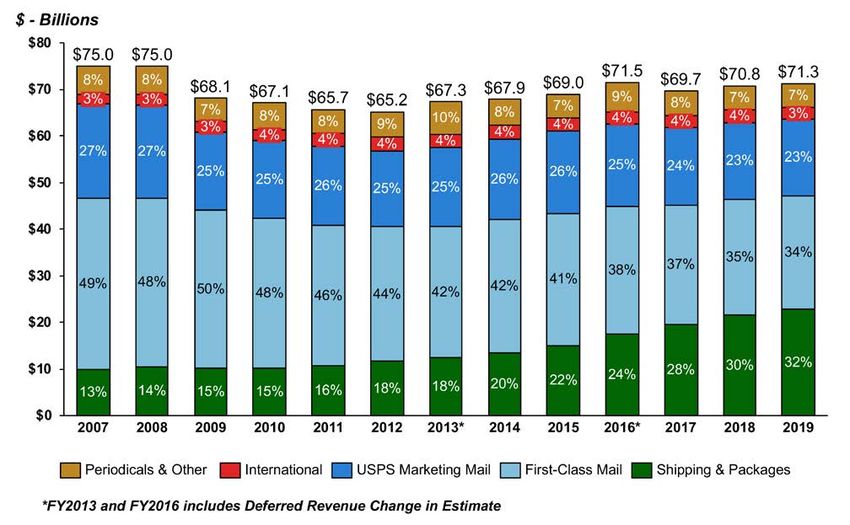
Page intentionally left blank

2   Ready-Now ➔ Future-Ready — The U.S. Postal Service Five-Year Strategic Plan FY2020-FY2024
Contents
Contents . . . . . . . . . . . . . . . . . . . . . . . . . . . . . . . . . . . . . . . . . . . . . . . . . . . . .3

       Letter From the Postmaster General and the Chairman of the Board of Governors                                                        .  .  .  .  .  .  .  .  . 5

Executive Summary .  .  .  .  .  .  .  .  .  .  .  .  .  .  .  .  .  .  .  .  .  .  .  .  .  .  .  .  .  .  .  .  .  .  .  .  .  .  .  .  .  .  .  .  .  .  . 7

       Purpose of This Document  .  .  .  .  .  .  .  .  .  .  .  .  .  .  .  .  .  .  .  .  .  .  .  .  .  .  .  .  .  .  .  .  .  .  .  .  .  .  .  .  . 7

       Postal Service Mission  .  .  .  .  .  .  .  .  .  .  .  .  .  .  .  .  .  .  .  .  .  .  .  .  .  .  .  .  .  .  .  .  .  .  .  .  .  .  .  .  .  .  . 7

       Vision for 2024  .  .  .  .  .  .  .  .  .  .  .  .  .  .  .  .  .  .  .  .  .  .  .  .  .  .  .  .  .  .  .  .  .  .  .  .  .  .  .  .  .  .  .  .  .  .  . 7

       Current Business Environment and Key Trends .  .  .  .  .  .  .  .  .  .  .  .  .  .  .  .  .  .  .  .  .  .  .  .  .  .  .  .  .  .  . 8

U.S. Postal Service’s Mission, Current Business Conditions, and Vision for the Future .  .  .  .  .  .  .  .  .  .  10

       Mission — Bind the Nation Together .  .  .  .  .  .  .  .  .  .  .  .  .  .  .  .  .  .  .  .  .  .  .  .  .  .  .  .  .  .  .  .  .  .  .  . 10

       Governance . .  .  .  .  .  .  .  .  .  .  .  .  .  .  .  .  .  .  .  .  .  .  .  .  .  .  .  .  .  .  .  .  .  .  .  .  .  .  .  .  .  .  .  .  .  .  . 10

       Overview of the U.S. Postal Service Today .  .  .  .  .  .  .  .  .  .  .  .  .  .  .  .  .  .  .  .  .  .  .  .  .  .  .  .  .  .  .  .  . 10

       Our Vision for 2024 — A Financially Sustainable Postal Service
       that Delivers Products and Services that Customers Value in a Digital Economy  .  .  .  .  .  .  .  .  .  .  .  .  .  . 17

USPS Ready-Now – Future-Ready Goals and Key Strategies for FY2020-FY2024 .  .  .  .  .  .  .  .  .  .  .  .  .  20

       Goal 1: Deliver World-Class Customer Experiences                               .  .  .  .  .  .  .  .  .  .  .  .  .  .  .  .  .  .  .  .  .  .  .  .  .  .  . 20

       Goal 2: Equip, Connect, Engage, and Empower Employees to Best Serve USPS Customers  .  .  .  .  .  . 22

       Goal 3: Innovate Faster to Deliver Value  .  .  .  .  .  .  .  .  .  .  .  .  .  .  .  .  .  .  .  .  .  .  .  .  .  .  .  .  .  .  .  .  .  . 23

       Goal 4: Invest in Our Future Platforms .  .  .  .  .  .  .  .  .  .  .  .  .  .  .  .  .  .  .  .  .  .  .  .  .  .  .  .  .  .  .  .  .  .  . 25

       Goal 5: Support the Legislative and Regulatory Changes to Enable This Vision .  .  .  .  .  .  .  .  .  .  .  .  .  . 28

       How We will Measure Success  .  .  .  .  .  .  .  .  .  .  .  .  .  .  .  .  .  .  .  .  .  .  .  .  .  .  .  .  .  .  .  .  .  .  .  .  .  . 28

       Conclusion: Delivering Excellent Service Today Is the Key to Future Success .  .  .  .  .  .  .  .  .  .  .  .  .  .  . 33

Appendices  .  .  .  .  .  .  .  .  .  .  .  .  .  .  .  .  .  .  .  .  .  .  .  .  .  .  .  .  .  .  .  .  .  .  .  .  .  .  .  .  .  .  .  .  .  .  .  .  .  .  34

       Appendix A: USPS National Performance Assessment System .  .  .  .  .  .  .  .  .  .  .  .  .  .  .  .  .  .  .  .  .  . 35

       Appendix B: Postal Service Strategic Planning Stakeholder Outreach Efforts .  .  .  .  .  .  .  .  .  .  .  .  .  .  . 37

       Appendix C: Postal Service Products and Services .  .  .  .  .  .  .  .  .  .  .  .  .  .  .  .  .  .  .  .  .  .  .  .  .  .  .  . 39

       Appendix D: Selected Links to Learn More or Provide Feedback  .  .  .  .  .  .  .  .  .  .  .  .  .  .  .  .  .  .  .  .  . 41

Additional Information .  .  .  .  .  .  .  .  .  .  .  .  .  .  .  .  .  .  .  .  .  .  .  .  .  .  .  .  .  .  .  .  .  .  .  .  .  .  .  .  .  .  .  .  . 43

Trademarks  .  .  .  .  .  .  .  .  .  .  .  .  .  .  .  .  .  .  .  .  .  .  .  .  .  .  .  .  .  .  .  .  .  .  .  .  .  .  .  .  .  .  .  .  .  .  .  .  .  .  43

Year References  .  .  .  .  .  .  .  .  .  .  .  .  .  .  .  .  .  .  .  .  .  .  .  .  .  .  .  .  .  .  .  .  .  .  .  .  .  .  .  .  .  .  .  .  .  .  .  . 43

The U.S. Postal Service Five-Year Strategic Plan FY2020-FY2024 — Ready-Now ➔ Future-Ready                                                                             3
Page intentionally left blank 4 Ready-Now ➔ Future-Ready — The U.S. Postal Service Five-Year Strategic Plan FY2020-FY2024
Letter From the Postmaster General and the Chairman of the Board of Governors
Nearly every person in America experiences the Postal Goal 4. Invest in future platforms.
Service brand every day — by saying hello to their mail
Goal 5. Pursue legislative and regulatory changes
carrier; passing postal vehicles on the street; visiting
necessary to achieve financial sustainability.
a Post Office or usps com; using a USPS mobile
application; conducting mailing and shipping business; You will also find a discussion of the current financial
or just by the simple act of reading one’s mail challenges facing the organization The most significant
issue facing the Postal Service today is that our
This daily brand experience — and the value the Postal
business model is unsustainable This is due to
Service delivers — continue to evolve for our residential
increasingly conflicting mandates to be self-funding,
and business customers as we provide more services
compete for customers, and meet universal service
and offerings that keep pace with their ever-changing
obligations under highly regulated and legislated
needs From fueling America’s e-commerce economy
constraints Resolving these conflicting mandates
with next-day and Sunday delivery, to delivering digital
requires a national public policy discourse that hinges
and mobile tools like Informed Delivery, or providing
on a basic question for the American public: What
real-time mailing data that allows senders to improve
would you like the Postal Service to become and how
the efficiency of their marketing, the organization is
would you like to pay for it?
always on a transformative journey to better serve the
nation Because the Postal Service is an independent
entity of the executive branch, the Postal Service
This five-year strategic plan describes the next stage
today operates like a large business, but with
in our organizational journey It provides Congress, the
a public service mission Our mission and our
Administration, postal stakeholders, and the American
role in America’s economy and society remain
public with a clear understanding of our mission, our
indispensable — but we can only continue to
business, our financial condition, and the strategies
compete effectively and meet the high expectations
that will carry the organization forward over the next five
of the public with an improved business model
years The title “Ready-Now — Future-Ready” reflects
a mindset that shapes postal decision-making: prepare Surveys continue to find the Postal Service is America’s
relentlessly for today’s opportunities and those ahead most trusted and well-regarded government entity The
633,000 men and women of the Postal Service — who
In this document, we discuss the core strategies
live, work, and serve in every community in America
necessary for the Postal Service to be a financially
— earn that trust every day through regular delivery
sustainable organization that delivers services the
services that are secure, reliable, affordable, and
American public values in an increasingly digital
universal We intend to continue to earn their trust and
economy We also identify the initiatives we plan to
high regard over the next five years
implement to achieve the following goals:
We hope you find this strategic plan informative and
Goal 1. Deliver world-class services and customer useful The goals and strategic initiatives identified in
experiences.
this five-year plan are subject to change by the Board of
Goal 2. Equip, connect, engage, and empower Governors as changes in strategy become necessary or
employees to serve our customers. business conditions warrant Thank you for your interest
and engagement in the future of the Postal Service
Goal 3. Innovate faster to deliver value.
Megan J Brennan Robert M Duncan
Postmaster General and Chief Executive Officer Chairman, Board of Governors
United States Postal Service United States Postal Service
The U.S. Postal Service Five-Year Strategic Plan FY2020-FY2024 — Ready-Now ➔ Future-Ready 5Page intentionally left blank 6 Ready-Now ➔ Future-Ready — The U.S. Postal Service Five-Year Strategic Plan FY2020-FY2024
Executive Summary
Purpose of This Document We are also required to fulfill this universal service
obligation (USO), and meet other statutory obligations,
The Postal Service’s Five-Year Strategic Plan, covering in a self-sufficient manner, by covering our costs through
the fiscal years (FYs) 2020 to 2024, is intended to revenues generated from the sale of our products and
provide our stakeholders, including the President, services To help ensure the funding needed to meet the
Congress, the American people, our employees, USO, the law establishes the Private Express Statutes
business partners, and customers with the following: and the mailbox access rule, which together comprise
A comprehensive mission statement covering the the postal monopolies Since any obligation must be
major operations of the Postal Service. matched by the capability to meet that obligation, the
USO, the Private Express Statutes, and the mailbox
An identification of the key factors external to the access rule are inextricably linked
Postal Service and beyond our control that could
significantly affect the achievement of our overall
goals and objectives.
Vision for 2024
In 2024, we envision a financially sustainable Postal
A description of the Postal Service’s overall goals Service that enables all Americans to connect,
and objectives, aligned with National Performance
businesses to grow, and communities to thrive in
Assessment (NPA) goals and annual performance
an increasingly digitally-connected world, including
targets.1
individuals in rural or urban communities that are
A description of the program evaluations used digitally underserved Specifically we envision a Postal
in establishing or revising overall goals and NPA Service grounded in its core public service mission
system objectives. of providing universal, affordable, high-quality mail
and parcel delivery to all Americans, and expanding
This document satisfies the reporting requirements
that public service mission to include the provision
articulated in 39 United States Code (USC) Section
of essential e-government services We envision a
2802 The goals and strategic initiatives identified in
business model that enables the flexibility to best serve
this five-year plan are subject to change by the Board
the changing needs of our customers and respond to
of Governors (BOG) as changes in strategy become
marketplace trends, including continued and significant
necessary or business conditions warrant
declines in mail volumes due to electronic diversion and
continued, but lower growth, in parcel deliveries due to
Postal Service Mission increased last-mile competition We envision a Postal
The Postal Service is an essential part of the fabric of Service that is an employer of choice able to attract,
our great country and continues to serve a vital role in retain, and develop high-quality, customer-focused
our society and in the economy The Postal Service is a employees And finally, we envision that the Postal
basic and fundamental service provided to the people Service will maintain its position as the world’s most
by the government of the United States, with a mission efficient and affordable postal operator and the most
to provide prompt, reliable, and efficient services to our trusted federal agency
customers in all areas and all communities By providing
To realize this vision, we intend to make the following
universal mailing and shipping services to all Americans,
broad transformations over the next five years:
regardless of where they live, we help to bind the
nation together through the delivery of the personal, Transform our services from only providing a physical
educational, literary, and business correspondence delivery into a service that also enables a digital
of the people, and we help to make the fruits of the connection and provides other value-added services.
American economy accessible to everyone through our
Transform our last-mile operations from the most
package delivery offerings
efficient last-mile mail delivery service provider into
the most efficient local logistics and e-commerce
1
The FY2020 Integrated Financial Plan (IFP) information contained in this document delivery platform.
will be revised if needed upon approval by the Board of Governors.
The U.S. Postal Service Five-Year Strategic Plan FY2020-FY2024 — Ready-Now ➔ Future-Ready 7 Transform our middle-mile operations from a fixed (to $22 8 billion in FY2019) and more than triple the
processing and transportation network into an contribution provided by packages to institutional costs
adaptive and resilient national and international (to 24 7 percent in FY2019) Innovations, such as
logistics ecosystem. Informed Delivery, are enhancing the utility of mail as an
advertising medium in the digital age and are used by
One thing will remain the same: we will maintain the
more than 20 million Americans
trust of the American people by delivering excellent
services every day We are consistently rated the most favorable and
trusted U S federal agency (a 2019 Pew Opinion Poll
The Postal Service cannot realize this vision alone
reported 90 percent of Americans have a favorable
Though this five-year plan lays out our efforts to make
view of the Postal Service) and the most affordable and
this vision a reality, creating a financially sustainable
efficient postal operator across the world’s 20 largest
Postal Service requires changes to existing laws and
economies (G20 economies) Oxford Consulting reports
regulations as well as new agreements with our labor
in 2012 and 2017, Delivering the Future: How the G20’s
unions Ultimately, Congress determines the contours
Postal Services Are Meeting the Challenges of the 21st
of the Postal Service’s statutory business model and
Century, ranked us the highest overall rated postal
therefore has the unique authority to enable this vision
provider and noted that we deliver more parcels and
or direct the Postal Service toward a different vision
letters per full-time equivalent employee than any other
We will continue to do all that we can within our current
G20 Post
authorities to effectively manage the Postal Service
while we work with the Administration, Congress, and The Postal Service operates in a very dynamic and
the Postal Regulatory Commission (PRC) to identify competitive mail and package delivery marketplace
options and implement the necessary changes that will Total volume of First-Class Mail and Marketing Mail has
enable financial sustainability and best meet the needs declined by 34 percent (approximately 66 billion pieces)
of the American public since 2007 due to the proliferation of electronic bill
presentment and payment, social media platforms, and
Current Business Environment e-mail Package volumes, which have almost doubled
and Key Trends since 2007 and have been the Postal Service’s primary
source of revenue growth, began to demonstrate
To fulfill our USO in 2019, we provided access slowing growth beginning in 2017, with growth ceasing
through 26,362 Postal Service-managed Post Offices; entirely in the last two quarters of 2019, as commercial
4,960 stations, branches, and carrier annexes; and customers insourced more of their last-mile deliveries
55,000 other access points comprising a network of These trends are projected to continue over the next
commercial outlets which sell stamps on our behalf five years
Many of our services can also be accessed through our
website, usps com On an average day, our 633,000 The following statutory and regulatory constraints have
employees processed and delivered 471 million limited our ability to respond to market forces:
mailpieces to nearly 160 million delivery points, utilizing A Consumer Price Index-based price cap for mail
approximately 204,000 delivery vehicles, 8,500 pieces products, representing 67 percent of revenues,
of automated processing equipment, and a variety of results in prices that are insufficient to provide
transportation methods to move mail and packages adequate revenue to pay for fixed universal service
through this large network, including contracted obligation costs and other legally mandated costs
highway and air transportation amid secular volume declines.
Over the last decade, the Postal Service has deployed The universal service obligation to maintain six-day-
market-leading innovations in the mail and parcel a-week mail delivery to all geographies and to keep
delivery services and improved productivity We unprofitable retail locations open results in a large
pioneered Sunday package delivery and became a proportion of costs being devoted to delivery and
leader in providing last-mile package delivery services retail operations that deliver less mail to an ever-
These innovations and product expansions have increasing number of delivery points.
enabled us to more than double package revenues
8 Ready-Now ➔ Future-Ready — The U.S. Postal Service Five-Year Strategic Plan FY2020-FY2024 Federally-mandated retiree and employee benefit deliver excellent and efficient services to every customer
programs result in high benefit costs that are every day That is why we titled our plan, Ready-Now
growing faster than the rate of inflation. — Future-Ready Our ability to prepare for an uncertain
tomorrow while delivering excellent services today
In combination, these factors have led to a large
requires that we focus on the following five strategic
financial deficit Since 2007, we have suffered 13 years
goals:
of consecutive net losses, totaling $77 8 billion Our
financial challenges reflect the simple dynamic that our Goal 1. Deliver world-class services and customer
largely fixed and mandated costs continue to rise at a experiences.
faster rate than the revenues we are able to generate
Goal 2. Equip, connect, engage, and empower
in the competitive marketplace Though the lump-sum
employees to serve our customers.
and amortization expenses for prefunding retiree health
benefits (RHB) (excluding normal costs) account for Goal 3. Innovate faster to deliver value.
approximately 74 percent of our cumulative net losses
Goal 4. Invest in future platforms.
over the last 13 years, these losses were partially offset
by revenue growth from growing package volumes, Goal 5. Pursue legislative and regulatory changes
a temporary exigent price increase for mail, and cost necessary to achieve financial sustainability.
reductions As we look to the next five years with the These five Ready-Now — Future-Ready goals will
prospect of continued price caps on mail, increased drive everything we do We will measure our progress
competition for package deliveries, and rising USO against them using our NPA performance measurement
costs, resolving only the RHB funding issue will not fill system and incent employee efforts through our pay-
our projected financial gap for-performance (PFP) system A focus on the customer
Our financial condition can be improved, and the Postal experience — delivered by an equipped, connected,
Service can continue to be self-reliant The Postal engaged, and empowered workforce — enables us to
Service’s problems are readily identifiable, and their innovate faster and invest strategically in our future to
solutions are implementable While it is incumbent meet the needs of our customers and the communities
upon Congress and the PRC to address structural and we serve We will publish our progress against the
business model deficiencies before the deficit grows goals contained in this plan, describe lessons learned,
even larger and requires more drastic and politically and identify how we plan to improve every year in
difficult solutions, the Postal Service will continue to our “Annual Performance Plan” as part of the Postal
implement all cost-reduction and revenue-generation Service’s Annual Report to Congress The strategic
measures available under existing law initiatives identified in the USPS Five-Year Strategic
Plan for FY2020–FY2024 are subject to change
Postal Service Ready-Now — Future-Ready Plan
by the Board of Governors if revisions in strategy
for FY2020-FY2024
become necessary or business conditions warrant
This strategic plan describes our mission, vision, and
strategic goals, and how they are enabled by our
strategic initiatives, NPA metrics, and related annual
performance targets This plan also describes in greater
detail our current and projected challenges, defines how
the Postal Service will respond to these challenges, and
identifies where we will need support from Congress
and the PRC
While our financial challenges remain significant, we
remain committed to building our vision of the Postal
Service Therefore, while we work with external
stakeholders, Congress, the Administration and the
PRC, we will continue to do everything within our
authority to make our vision a reality and to continue to
The U.S. Postal Service Five-Year Strategic Plan FY2020-FY2024 — Ready-Now ➔ Future-Ready 9U.S. Postal Service’s Mission, Current Business
Conditions, and Vision for the Future
Mission — Bind the Nation Together Executive Officer The Board of Governors of the Postal
Service (the Board) directs the exercise of its powers
Title 39 Section 101(a) of the USC states that the through management that is expected to be honest,
United States Postal Service shall be operated as a efficient, economical, and mindful of the competitive
basic and fundamental service provided to the people business environment in which the Postal Service
by the Government of the United States, authorized by operates The Board is authorized to consist of 11
the Constitution, and created by an Act of Congress members: nine Governors appointed by the President
The Postal Service shall have as its basic function (with the advice and consent of the Senate, to
the obligation to provide postal services to bind the represent the public interest generally), the Postmaster
nation together through the personal, educational, General, and the Deputy Postmaster General
literary, and business correspondence of the people It
shall provide prompt, reliable, and efficient services to
patrons in all areas and shall render postal services to all
Overview of the U.S. Postal Service Today
communities The costs of establishing and maintaining The Postal Service delivers a unique service to the
the Postal Service shall not be apportioned to impair the American people and the economy alike by delivering
overall value of such service to the people The Postal mail and packages throughout the United States
Service shall provide a maximum degree of effective and In fulfilling its mandate, the Postal Service provides
regular postal services to rural areas, communities, and services across all regions and to all areas of the
small towns where Post Offices are not self-sustaining United States irrespective of population density or
socioeconomics, including rural areas, small towns,
The central tenet of this statutory public service mission and urban areas where Post Offices are not necessarily
is a universal service obligation (USO) to provide financially self-sustaining USPS does not receive tax
prompt, reliable, and efficient postal services to all dollars and relies solely on the sale of postage, products
Americans, regardless of where they live The Postal and services to fund its operations
Service is also required to fulfill its universal service
mission, and meet its other statutory obligations, in a To fulfill our USO in 2019, we provided access
self-sufficient manner, by covering its costs through through 26,362 Postal Service-managed Post Offices;
revenues generated from the sale of its products and 4,960 stations, branches, and carrier annexes; and
services To help ensure the funding needed to meet 55,000 other access points comprising a network of
the USO, the law establishes the Private Express commercial outlets which sell stamps on our behalf
Statutes and the mailbox access rule, which together Many of our services can also be accessed through
comprise the postal monopolies Since any obligation our website, usps com On an average day in 2019,
must be matched by the capability to meet that our 633,000 employees processed and delivered 471
obligation, the USO, the Private Express Statutes, and million mailpieces to nearly 160 million delivery points,
the mailbox access rule are inextricably linked utilizing approximately 204,000 delivery vehicles,
8,500 pieces of automated processing equipment,
Governance and a variety of transportation methods to move mail
and packages through this large network, including
The U S Postal Service was established under the contracted highway and air transportation
provisions of the Postal Reorganization Act (the
Reorganization Act) of 1970, Public Law 91-375, 84 The Postal Service is a powerful marketing and
Stat 719, as amended by the Postal Accountability and communications partner for businesses across
Enhancement Act of 2006 (PAEA), Public Law 109-435, diverse sectors in the United States, including retail,
120 Stat 3198, as an independent establishment of health care, real estate, and financial services
the executive branch of the Government of the United USPS fulfills the essential function of delivering bills,
States, under the direction of a Board of Governors statements, correspondence, packages, catalogs,
(BOG), with the Postmaster General (PMG) as its Chief and a wide range of marketing materials on behalf
10 Ready-Now ➔ Future-Ready — The U.S. Postal Service Five-Year Strategic Plan FY2020-FY2024of these companies, thus facilitating millions of currently generally subject to a price cap based on the
daily transactions for virtually every commercial Consumer Price Index for All Urban Consumers (CPI-U),
entity in America, as well as providing the means though the PRC has the authority to revise or eliminate
for remitting payments for millions of consumers the price cap and create an alternative regulatory
structure for Market-Dominant services Reclassification
Additionally, through its shipping services, the Postal
of services from Market-Dominant to Competitive
Service is a partner to consumers, and to both
requires PRC approval
brick-and-mortar and online retailers in growing
their businesses to meet rising consumer delivery Competitive services, such as Priority Mail, Priority
expectations from e-commerce The Postal Service’s Mail Express, First-Class Package Services, Parcel
last-mile resources deliver to every address to Select, Parcel Return Service, and some types of
satisfy the requirement of the USO, thus enabling International mail, have greater pricing flexibility and
all Americans, no matter how remote their location, are not limited by a price cap By law, prices for each
to have access to parcel delivery, and to therefore Competitive service must be set so that each service
participate fully in today’s e-commerce economy covers its “attributable costs” (meaning the Postal
Service’s costs attributable to such service through
The Postal Service is consistently rated the most
reliably identified causal relationships), and Competitive
favorable and trusted U S federal agency (a 2019
services collectively must contribute an appropriate
Pew Opinion Poll reported 90 percent of Americans
share to the institutional costs of the Postal Service
have a favorable view of the Postal Service) and the
(meaning the Postal Service’s costs that cannot be
most affordable and efficient postal operator across
attributed to specific products) The appropriate share
the G20 economies In 2012 and 2017, the Oxford
is determined by a formula, and is currently 8 8 percent
Consulting report, Delivering the Future: How the G20’s
for FY2019, as determined by the PRC In general, the
Postal Services Are Meeting the Challenges of the 21st
Postal Service attempts to set its prices for Competitive
Century, ranked the Postal Service the highest overall
services at rates that maximize contribution
rated postal provider and noted that it delivers more
parcels and letters per full-time equivalent than any Current Business Conditions
other G20 Post
Over the last decade, the Postal Service has deployed
Postal Service Offerings, Classification, and Pricing market-leading innovations in the mail and parcel
delivery services and improved productivity We have
The Postal Service generates revenues primarily by
been pioneers in Sunday package delivery and became
offering mail and parcel delivery services to domestic
a leader in providing last-mile package delivery services
and international markets It monitors and reports
These innovations and product expansions have
revenue by mail classes, products, and shapes
enabled us to more than double package revenues
Appendix C contains a description of USPS current
(to $22 8 billion in FY2019) and more than triple the
services and the historical mail volumes and revenues
contribution that packages provide to cover institutional
by category of service Prices and fees are established
costs (to 24 7 percent in FY2018) Innovations, such as
by the Postal Service’s Governors and are subject to a
Informed Delivery, are enhancing the utility of mail as an
review process by the Postal Regulatory Commission
advertising medium in the digital age and are used by
(PRC) The Postal Service offers two categories of
more than 20 million Americans
products, which are classified for regulatory purposes
as Market-Dominant services and Competitive Over the same period, we have implemented
services Each category is subject to different pricing aggressive cost controls that have resulted in significant
requirements established by statute and PRC cost savings even as delivery points grew by over 9
regulation million We have reduced the total number of career
employees by more than 84,000 by restructuring
Market-Dominant services account for approximately
delivery routes, reducing lobby hours at 13,000
67 percent of the Postal Service’s annual operating
underutilized retail offices, and consolidating mail
revenues Such services include, but are not limited to,
processing at more than 360 facilities In addition,
First-Class Mail, Marketing Mail, Periodicals, and certain
we negotiated labor agreements which allowed
parcel services Price increases for these services are
us to increase our non-career workforce and to
The U.S. Postal Service Five-Year Strategic Plan FY2020-FY2024 — Ready-Now ➔ Future-Ready 11introduce a lower-tier wage schedule for new career CSRS, and FERS amortization payments We have
employees, which we have maintained through an underfunded balance sheet, significant debt, and
subsequent contracts We have negotiated health insufficient cash to weather unforeseen cyclicality or
benefits contributions with our unions that bring many changes in business conditions
of our employees to parity with the rest of the federal
Growing Package Revenues and Cost Reductions Are
government Through the dedication and hard work of
Insufficient to Offset Growing Mandated Costs
our employees, we have accomplished all of this while
consistently being rated the most favorable and trusted Our revenues have declined almost 5 percent over
federal agency and the most efficient and affordable the last 13 years, with a growing proportion coming
postal operator in the industrialized world from Package Services (from 13 to 32 percent) as
shown in Exhibit 1 Since the low point in 2012, our
However, the combination of unfavorable market total revenues have grown almost 9 percent, when
dynamics, legal restrictions on price increases and cost revenue gains from Package Services began offsetting
reductions, an expanding universal service requirement, the declines in mail revenues Package revenue growth
and growing employee pension and health benefit was driven primarily by volume growth due to the
funding requirements have put the Postal Service in an affordability and scope of our last-mile delivery services
unsustainable financial condition
Mail revenue losses have been due to declines in
Since 2007, we have suffered 13 years of consecutive mail volumes The greatest volume decline has
net losses totaling $77 8 billion, with an $8 8 billion net been experienced in First-Class Mail, our most
loss in 2019 alone Of those losses, $54 8 billion were profitable product, where volumes have declined
directly attributable to Postal Service Retiree Health by more than 40 billion pieces, or 43 percent,
Benefits Fund (PSRHBF) lump sum payments that since 2007 Marketing Mail, which comprises the
were due between 2007 and 2016 An additional $8 7 majority of our mail volumes, declined by more than
billion was attributable to PSRHBF normal cost and 27 billion pieces (26 percent) from 2007 to 2018,
amortization payments due between 2017 and 2019, mainly due to the increasing diversion of advertising
and $8 2 billion due to amortization expenses for the spending from Marketing Mail to digital media
Civil Service Retirement System (CSRS) and Federal (the internet, email, mobile, or social media)
Employee Retirement System (FERS) Altogether, these
retirement-related lump sum payment requirements
totaled $76 3 billion from 2007-2019, or roughly 98
percent of losses Even when PSRHBF normal costs
are excluded, PSRHBF lump-sum payments, plus
FERS, CSRS, and PSRHBF amortization expenses total
$65 5 billion, or 84 percent of 2007–2019 losses
Although the vast majority of the recent net losses are
attributable to the retirement benefit-related lump sum
payments, structural changes in the marketplace have
had a significant impact on our financial results These
include declines in high-contribution mail volume, a
rigid rate structure on Market-Dominant products which
limits our ability to raise prices, limited product freedom
which inhibits our ability to introduce new products, and
high legislatively-mandated costs
Unfortunately, growth in the packages business and
significant cost reductions have not been enough to
forestall 13 consecutive years of net losses As a result,
we have been forced to default on PSRHBF prefunding
payments, PSRHBF normal cost, and PSRHBF,
12 Ready-Now ➔ Future-Ready — The U.S. Postal Service Five-Year Strategic Plan FY2020-FY2024Exhibit 1. Trend in Total USPS Revenue by Product
Also between 2007 and 2019, the number of delivery low postage rates and a lack of pricing flexibility are
points (excluding Post Office Boxes, or PO Boxes) key contributors to our financial situation As a result,
increased by 10 percent, or 12 8 million During this in 2019 the Postal Service lost about 6 1 cents for
same time, pieces delivered per delivery point fell every piece delivered and that gap will widen in the
by 39 percent, and revenue per delivery point fell by future, as costs will continue to grow, especially for
14 percent, but cost per delivery point fell only by 9 mandated federal benefits programs, while revenue
percent In 2019, our large physical footprint required growth is constrained by the Consumer Price
to serve the 160 million delivery points six days a Index (CPI) price cap and competitive dynamics
week amounted to 31,000 Post Offices, stations,
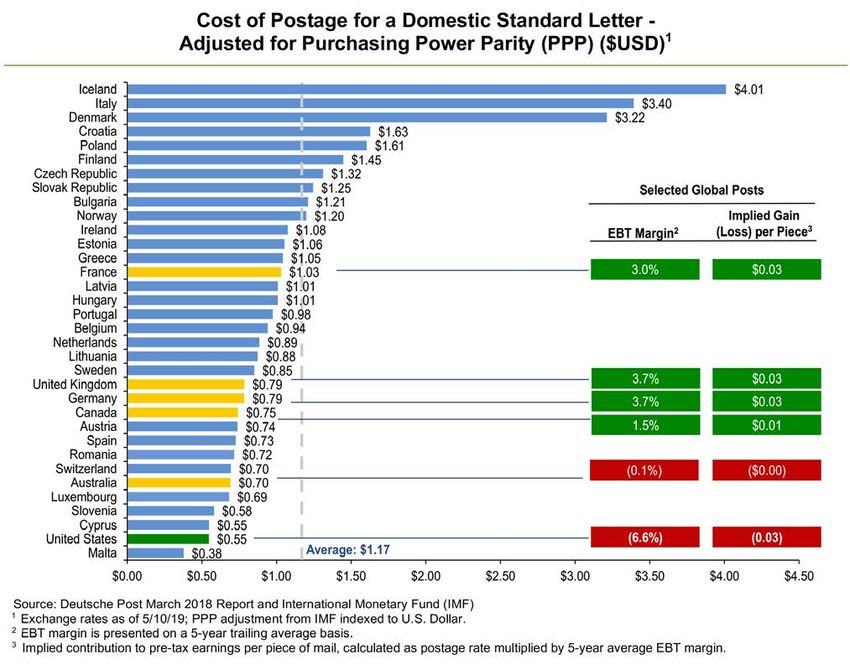
The Postal Service has the lowest price relative to
and branches with approximately 633,000 total
comparable international posts As shown in Exhibit
employees Additionally, approximately 36 percent of
2, our First-Class Mail single-piece postage rates are
retail locations are retained (as required by law) despite
dramatically below the average of other comparable
being unprofitable As a result of a combination of these
global posts Further evidence of the Postal Service’s
factors and price caps on 67 percent of our revenues,
inadequate pricing can be seen by comparing margins
we lost over $62 per delivery point served in 2019
of earnings before taxes (EBT) of the Postal Service to
This is due to the fact that the significant and growing
those of the most comparable global posts The Postal
institutional costs driven by the USO and our large
Service’s average EBT margin over the past five years
retirement-related liabilities are incurred regardless of
was negative 7 percent, in sharp contrast to the break-
the volume delivered
even or positive EBT margins for our foreign post peers
CPI Price Cap Has Resulted in Undersized Revenues for an charging higher rates for products comparable to
Oversized Universal Mail Delivery Service First-Class Mail
The price cap on Market-Dominant products
significantly disadvantages the Postal Service; relatively
The U.S. Postal Service Five-Year Strategic Plan FY2020-FY2024 — Ready-Now ➔ Future-Ready 13Exhibit 2. Rate Comparison of the Postal Service to Other Global Posts
A Competitive Landscape Across all Services digital mobile advertising and social media, are
Notwithstanding the regulatory classification of the most significant forms of competition
Postal Service products as Market-Dominant and The package and express delivery business is highly
Competitive, we compete for business across all competitive, with both national and local competitors
of our different market segments A wide variety of The primary competitors of our Shipping and Package
communications media channels compete for the services are FedEx and United Parcel Service, Inc
same types of transactions and communications that (UPS), as well as other national, regional, and local
are conducted using our mail delivery services These delivery companies and crowd-sourced carriers, many
channels include, but are not limited to, newspapers, of which are also customers of the Postal Service for its
telecommunications, television, email, social last-mile services
networking, and electronic funds transfers
The Postal Service’s Shipping and Package business
The most significant competitor for First-Class competes on the basis of the breadth of our service
Mail is digital communication, including electronic network, convenience, reliability, and affordability of the
mail, and other digital technologies such as online service provided Although the Postal Service competes
bill payment and presentment For Marketing with FedEx, UPS, Amazon, and others when shipping
Mail, digital forms of advertising, including email, packages long distances, our existing door-to-door
14 Ready-Now ➔ Future-Ready — The U.S. Postal Service Five-Year Strategic Plan FY2020-FY2024delivery mandate has historically proven cost-effective Over the next five years, the three trends described in
for competitors to outsource many of their last-mile the following paragraphs are expected to become more
deliveries to the Postal Service The growth in our pronounced and will significantly impact our current
Competitive products revenue over the past five years business model
is largely attributable to our Parcel Select product,
Delivery Points Grow and Mail Volumes Decline
which provides last-mile delivery for parcels deposited
deep into our network (typically at the delivery unit) The transition from print to digital communications and
business transactions will continue Businesses will
However, the Postal Service has more recently seen continue to conduct more transactions electronically
increased competition in last-mile delivery from both with consumers, putting continued downward pressure
current customers and traditional competitors The on First-Class Mail volume, which currently provides the
major Parcel Select customers are actively building out greatest contribution toward covering our institutional
their own last-mile delivery capabilities to enable them costs Digital advertising currently captures more than
to divert volume away from the Postal Service This 50 percent of advertiser spend and is forecast to
resulted in a decline in package growth over the last continue to increase almost 10 percent each year, while
two quarters of FY2019 the portion captured by direct mail (postage costs only)
As other customers insource last-mile delivery is expected to decline by almost 5 percent per year
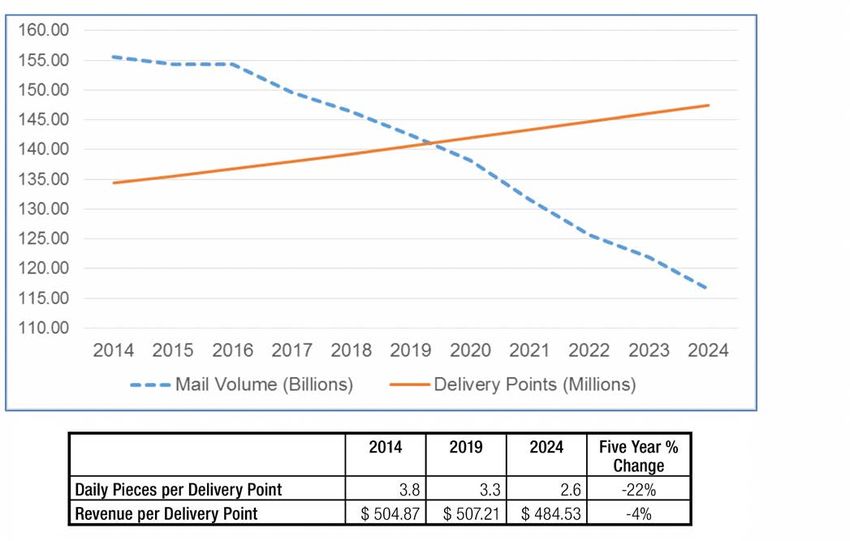
operations in the most profitable geographies, our unit Our forecasts for delivery points (excluding PO Boxes)
costs increase thereby escalating competition and assume a growth of 5 percent, or 6 9 million delivery
reducing reliance on the Postal Service’s network To points by 2024, as shown in Exhibit 3 Meanwhile, our
the extent these programs expand, the Postal Service baseline forecast for total mail volume anticipates a
believes that it could see increasingly negative trends in decline of 18 percent over the same period, leading to
package volumes a decrease in revenue per delivery point of 4 percent
Key Forecasted Trends This will continue to cause declines in daily pieces per
delivery point, which has gone from 3 8 in 2014 to 3 3
The rapidly changing business conditions under which
in 2019, and is forecast to drop to 2 6 daily pieces per
the Postal Service competes, coupled with the evolving
delivery point by 2024
needs of our customers, require us to adapt in order
to maintain our relevance to the American consumer Although our baseline forecast shows continued
and to strengthen our business The next five years are decreases in the demand for mail delivery services,
likely to usher in dramatic technological, social, and there will still be significant demand and the expectation
environmental changes that will fundamentally change that all United States residents will retain the ability
the way we live, work, and relate to one another We to send and receive mail delivery services from
are seeing rapid technological advances across many their homes and businesses We believe there is
areas that include artificial intelligence, advanced an opportunity to reposition the value of mail with
energy storage devices, next-generation broadband, businesses, retailers, and marketers by integrating
autonomous machines, augmented reality, social digital features with the physical delivery experience
networks, internet of things, and quantum computing to enhance their omni-channel communication and
marketing campaigns Successfully repositioning mail
Beyond the dramatic technology advancements, we
as a value-added feature to digital communication
are facing continued and significant environmental and
opens new opportunities to retain existing customers
demographic changes Experts forecast that every year
and reach new ones
the United States will experience more extreme weather
events In addition, the Census Bureau estimates
that the United States will continue to see population
growth, but with more growth in citizens older than 65
than younger than 18 over the next five years Beyond
the trends that are established and significant, these
technological, social, and environmental changes will
drive changes in ways that we do not yet understand
The U.S. Postal Service Five-Year Strategic Plan FY2020-FY2024 — Ready-Now ➔ Future-Ready 15Exhibit 3. Delivery Point (not including PO Boxes) and Mail Volume Forecasts Source: USPS baseline mail volume forecast assumes CPI-U price cap and 6-day-a-week mail delivery. Note: Daily pieces per delivery point = deliveries per day/delivery points (based on 302 delivery days per year). Delivery points exclude PO Boxes. Competition Increases for Last-Mile The following trends will continue to fundamentally Package Delivery Services transform the profile of the shipping market We believe that the growth in domestic mobile Consumer demand for accelerated shipping and e-commerce sales will continue to outpace the growth retailer investment in supply chains will lead to strong in brick-and-mortar retail sales Historically, the growth growth in the one-day and local shipping markets in domestic e-commerce sales has correlated well and increase demand for local entry. with the growth in the number of domestic parcel shipments We see this relationship changing in the The two-day and regional markets will remain future as consumers buy more expensive items online relevant for shippers with fewer distribution centers and e-commerce companies combine more products and stabilize demand for competitive network within a single shipment products. In addition, we envision more downward pressure on The distance that parcels travel for delivery will the growth of parcel volumes shipped via the Postal continue to decline and the 3-day+/national markets Service due to continued growth in competition in first- will shrink. and last-mile delivery services, especially from large Marketplaces will continue to rely on network retailers and other domestic carriers using part-time products but will face increasing pressure for delivery on-demand workers in two days. 16 Ready-Now ➔ Future-Ready — The U.S. Postal Service Five-Year Strategic Plan FY2020-FY2024
Package volumes, which have more than doubled                           Our Vision for 2024 — A Financially
since 2010 and have been the Postal Service’s primary
source of revenue growth, began to demonstrate
                                                                        Sustainable Postal Service that Delivers
slowing growth beginning in 2017, as customers began                    Products and Services that Customers
to insource more of their last-mile deliveries Year-over-               Value in a Digital Economy
year growth declined from a high of 16 2 percent in the                 In 2024, we envision a Postal Service that enables
first quarter of 2016 to negative 2 4 percent in fourth                 all Americans to connect, businesses to grow, and
quarter of 2019 As such, we forecast that package                       communities to thrive in an increasingly digitally-
volumes delivered through the Postal Service network                    connected world, including individuals in rural or urban
may decline slightly in 2020 and 2021 and grow                          communities that are digitally underserved
modestly thereafter
                                                                        Specifically we envision a Postal Service grounded in
In response to these trends, the Postal Service                         its core public service mission of providing universal,
has a parcel strategy that underpins our forecast                       affordable, high-quality mail and parcel delivery to
The strategy is to grow product value by both                           all residents of the United States, and expanding
enhancing our offerings and keeping prices                              that public service mission to include the provision
competitive In summary, the core elements of                            of essential e-government services We envision a
our parcel strategies are to continue to leverage                       business model that enables the flexibility to best serve
the strength of our last-mile delivery services by                      the changing needs of our customers and respond
expanding Sunday deliveries, expanding same-day                         to marketplace trends, including continued and
and next-day deliveries, enhancing return services                      significant declines in mail volumes due to electronic
for business and consumers, and enhancing our                           diversion and continued but lower growth in parcel
end-to-end network to meet the growing demand                           deliveries due to increased last-mile competition
for low cost, reliable, ground shipping Continuing                      We envision a Postal Service that is an employer
to grow profitable parcel delivery operations is key                    of choice able to attract, retain, and develop high-
to supporting the revenue forecast in the baseline                      quality, customer-focused employees And finally,
Absent Legislative and Regulatory Changes, USPS                         we envision that the Postal Service will maintain its
Financial Losses will Continue                                          position as the world’s most efficient and affordable
                                                                        postal operator and the most trusted federal agency
Despite continued innovations across our existing
service offerings, expanded digital offerings, and                      Broad Transformations Required to Achieve
implementation of aggressive cost controls, we project                  this Vision
continued annual losses over the next five years
                                                                        The following paragraphs summarize the broad
assuming no legislative or regulatory reform Volume is
                                                                        transformations we intend to make over the next five
expected to decline while revenues stay relatively flat
                                                                        years to realize this vision
due to a price cap and other marketplace trends
                                                                        Transform from Deriving Value Solely by Providing a
Our financial challenges reflect the dynamic that our
                                                                        Physical Delivery into an Organization that Launches
largely fixed and mandated costs continue to rise at a
                                                                        New Products and Services that Add Value Through a
faster rate than the revenues we are able to generate
                                                                        Digital Connection
in a highly competitive marketplace Without more
flexibility to respond to the changing market in an                     We envision transforming from an organization that
economically rational way, we expect to run out of                      generates its revenues from the physical transport,
liquidity by 2021 if we pay all our financial obligations               processing, and delivery of letters, flats, periodicals,
— and by 2024 even if we continue to default on our                     and parcels into one that also generates significant
year-end, lump sum retiree health-benefit and pension                   revenues from offering digital and other value-added
related payments                                                        features that enhance the value of our physical delivery
                                                                        services Although our projections suggest continued
                                                                        decreases in the demand for mail delivery services,
                                                                        there will still be significant demand and the expectation

The U.S. Postal Service Five-Year Strategic Plan FY2020-FY2024 — Ready-Now ➔ Future-Ready                                       17
that all residents of the United States will retain the equip our employees with the latest technologies and
ability to send and receive mail delivery services predictive analytics tools, connect our employees to our
from their homes and businesses We believe there customers, and empower our employees to deliver the
is an opportunity to reposition the value of mail with best customer experience at every touchpoint
businesses, retailers, and marketers by integrating
Transform From Operating a Fixed Network to
digital features with the physical delivery experience
Managing a Faster, More Efficient and More Resilient
to enhance their omni-channel communication and
Logistics Ecosystem
marketing campaigns Successfully positioning mail as
a value-added feature to digital communication opens Over the next five years, we envision embarking on a
new opportunities to retain existing customers and broad transformation from operating a fixed processing
reach new ones and transportation network to managing an adaptive
domestic and international integrated processing
A key strategy for mitigating the volume decline of and transportation logistics ecosystem that is faster,
our mail delivery services is the enhancement of our more visible, more efficient, more automated, digitally
Informed Delivery platform with features to attract a integrated, and supported by more public-private
wider user base, enable it to operate on all major smart partnerships This logistics ecosystem will enable
devices, and seamlessly connect to key e-commerce our local delivery platforms to provide our customers
and social platforms Another initiative will provide with efficient and visible end-to-end transportation,
businesses that purchase mail and package delivery sorting, and warehousing solutions across the country
services with the ability to communicate with their and across the world Two key elements required to
customers via the Informed Delivery digital platform successfully achieve this transformation will be the
This will allow businesses to combine key features of ability to effectively deploy autonomous and big data
digital and social communication platforms with the technologies at scale and to form new and innovative
visceral experience of a physical delivery partnerships that unleash the innovation capacity of
We will also leverage our infrastructure, retail locations, private companies to meet the needs of our customers
vehicles, and information architecture to explore new One Thing Will Remain the Same: We will Sustain the Trust
digital products and services that help the American of the American People
public to securely communicate, exchange goods, and
No matter what the future holds, one thing will remain
connect to essential e-government services
the same: we will sustain the trust of the American
Transform from Being the Most Efficient Last-Mile Mail people by delivering excellent and secure services
Delivery Service Provider into the Most Efficient Local every day We were the most trusted and favorably
Logistics and E-commerce Delivery Platform rated federal agency in 2019 We will continue
We envision transforming from operating the most to work very hard to sustain that position of trust
efficient mail delivery service to operating the most over the next five years We envision leveraging
efficient, frictionless, and secure local logistics platform our services to enable people and companies to
that will provide all residents of the United States, every more securely interact within the digital economy
small and medium business, and every community with
the maximum degree of access to participate in the
Creating a Financially Sustainable Postal Service
Requires Legislative and Regulatory Changes
ever-increasing e-commerce economy A key to this
vision is the enhancement of our local processing and We cannot realize this vision alone Most of our
delivery network to enable retailers and other logistics efforts to enable this vision over the long run require
companies the capability to deliver e-commerce changes to existing laws and regulations and new
orders securely and affordably within 24 hours from agreements with our labor unions Congress has the
local businesses and within two calendar days from authority to enable this vision or to direct the Postal
businesses located within the contiguous United Service toward a different vision Therefore, we will
States To enable this, we will build out our platform to continue to do all that we can to effectively manage
enable flexible and frictionless returns from every home the Postal Service within our current authorities while
and expand seven-day-a-week parcel delivery service we work with Congress, the Administration, and
This transformation will be enabled by our ability to the PRC to identify and implement legislation and
18 Ready-Now ➔ Future-Ready — The U.S. Postal Service Five-Year Strategic Plan FY2020-FY2024regulations that enable financial sustainability while best meeting the needs of the American public The following sections lay out our five Ready-Now — Future-Ready strategic goals and, for each, the key strategic initiatives we will undertake over the next five years Our plan focuses on those initiatives that are within our control, but also identifies the areas we will work on to inform the public debate and decisions from Congress, the Administration, and the PRC The U.S. Postal Service Five-Year Strategic Plan FY2020-FY2024 — Ready-Now ➔ Future-Ready 19
USPS Ready-Now – Future-Ready Goals and Key
Strategies for FY2020-FY2024
No matter what the future holds, we believe we must excellent customer experiences across all our services
deliver excellent services every day while we work with and channels
Congress, the PRC, and key stakeholders to make this
The key initiatives described in the following paragraphs
vision a reality We cannot expect to sustain the trust of
include the following:
the American public or win new business if we deliver
poor customer service and experiences today That is Improving the way we acquire new customers.
why we titled our Strategic Plan, Ready-Now — Future-
Helping customers select the right products
Ready The term Ready-Now reminds us that our ability and services.
to build new Future-Ready capabilities depends on our
ability to continue to deliver excellent services today Improving how we collect customer feedback.
and every day Improving how we resolve customers’ issues.
To accomplish this vision, we have laid out the following
Key Strategies and Initiatives
Ready-Now — Future-Ready strategic goals and key
initiatives to help focus all that we do Improve Visibility and Control of Mail and Package Delivery
Services for Residential and Small Business Customers
Goal 1: Deliver World-Class We will continue to work to provide a seamless
Customer Experiences experience for sending and receiving mail and
packages Efforts related to this initiative include further
Goal Description enhancements of our Informed Delivery platform
We will endeavor to build a Postal Service culture that Informed Delivery is a notification service that gives
focuses on delivering services that provide excellent residential consumers and small business customers
customer experiences in order to encourage loyal the ability to digitally preview their letter-sized mailpieces
customers and sustain the trust of the American and manage packages that are scheduled to arrive
people We believe that continued growth in soon Informed Delivery makes mail more convenient
e-commerce, customer demands for faster services, by allowing users to view what is coming to their
and advances in autonomous technologies will result mailboxes whenever, wherever — even while traveling
in delivery services continuing to be more competitive — on a computer, tablet, or mobile device Informed
and commoditized in the future Although we will Delivery benefits the entire household, ensuring that
strive to be the low-cost leader for delivery of mail everyone has visibility into mail and package delivery
and parcels, we also see consumers more frequently each day Informed Delivery allows users to take action
choosing businesses based not only on price, but also before important items reach their mailboxes
based on the quality of the overall experience provided We will continue to enable users of the Informed
and the trust that the business has earned from Delivery smart phone application to do more, including
previous customer interactions Only by maintaining providing carriers instructions on where to leave or pick
an obsessive focus on delivering services that provide up packages, notifying the Postal Service to hold mail,
excellent customer experiences and sustain the trust of or scheduling redelivery of packages
the American people will the Postal Service continue to
keep existing customers and earn new ones Improve the Commercial Mailer, Shipper Onboarding, and
Payment Experience
A critical part of our efforts will be to look beyond only
delivering excellent experiences at different touchpoints Commercial mailers and shippers are the Postal
to looking at the end-to-end customer journey with Service’s largest customer segment We will continue
us from the perspective of each of our residential and our efforts to create a frictionless mailing and shipping
commercial customer segments By looking at the entry and payment experience The Postal Service
entire customer journey, we will be best able to develop continues to modernize the payment experience by
20 Ready-Now ➔ Future-Ready — The U.S. Postal Service Five-Year Strategic Plan FY2020-FY2024You can also read


