The Warsaw Integrated Programme of Work (2018-2021): The work plan of the ECE/FAO Forestry and Timber Section
←
→
Page content transcription
If your browser does not render page correctly, please read the page content below

The Warsaw Integrated Programme
      of Work (2018-2021):
   The work plan of the ECE/FAO Forestry
            and Timber Section

                                 UNITED NATIONS
ECE/TIM/DP/76
    Forestry and Timber Section, Geneva, Switzerland

Geneva Timber and Forest Discussion Paper 76

The Warsaw Integrated Programme
      of Work, 2018-2021:
   The work plan of the ECE/FAO Forestry
            and Timber Section

                 UNITED NATIONS
          New York and Geneva, 2017
NOTE

The designations employed and the presentation of material in this publication do not
imply the expression of any opinion whatsoever on the part of the secretariat of the
United Nations concerning the legal status of any country, territory, city or area, or of
its authorities, or concerning the delimitation of its frontiers or boundaries.

                                         DISCLAIMER

The views expressed in this paper are those of the authors and do not necessarily
reflect the views or carry the endorsement of the United Nations.

                                          ABSTRACT

The Warsaw Integrated Programme of Work outlines the expected work
accomplishments and working procedures of the ECE/FAO Forestry and Timber
Section for the period 2018-2021.

                                         ECE/TIM/DP/76

                               UNITED NATIONS PUBLICATION
                                         ISSN 1020-7228

Copyright © 2017 United Nations
All rights reserved worldwide
United Nations publication issued by the Economic Commission for Europe (ECE)
The Warsaw Integrated Programme of Work, 2018-2021 _____________________________ iii

                                         Preface
The staff of the joint United Nations Economic Commission for Europe (ECE) and the Food
and Agriculture Organization of the United Nations (FAO) Forestry and Timber Section are
often asked: “Why does the United Nations carry out activities on forests and forest
products?” The answer is straightforward: forests supply the air we breathe and the clean
water we drink, they absorb carbon dioxide and they provide wildlife habitat and beautiful
scenery. Moreover, forests give us wood products that not only provide building materials,
energy and paper, but also alternatives for more fossil fuel-intensive materials. The
sustainable management of forests and use of forest products is important to the United
Nations and indeed to all inhabitants of our world. Bringing together forest stakeholders and
sharing of information and best practices allows for great strides in managing this important
resource.

The next question that is often asked is: “what does the joint ECE/FAO Forestry and Timber
Section specifically do?” We suggest that you read this publication, which details the Warsaw
Integrated Programme of Work of the joint ECE/FAO Forestry and Timber Section for the
period 2018-2021. The Warsaw Integrated Programme of Work was approved at Las2017 -
the Joint Session of the ECE Committee on Forests and the Forest Industry and the FAO
European Forestry Commission, held in Warsaw, Poland on 9-13 October 2017. It covers the
planned tasks, outputs and operational modalities for the 2018-2021 period.

The content of this publication is the result of a process of consultation amongst member
States and other stakeholders to seek agreement on activities, considering the mandates and
capacities of the FAO and the ECE, and integrating the overarching aim of the member States
to implement the United Nations 2030 Agenda for Sustainable Development. This
publication will provide answers and insight into what the joint ECE/FAO Forestry and Timber
Section does related to forests.

Special thanks go to the member States, partner organizations and stakeholders for
providing valuable input and assisting in producing this programme of work. The joint
ECE/FAO Forestry and Timber Section is particularly grateful to the Government of Poland
for providing leadership as well as an excellent venue and meeting atmosphere for
developing and finalizing the Warsaw Integrated Programme of Work.

                   Paola Deda,                           Ekrem Yazici
                  Chief, ECE/FAO                   Deputy Chief, ECE/FAO
            Forestry and Timber Section          Forestry and Timber Section
iv _____________________________ The Warsaw Integrated Programme of Work, 2018-2021

                                                      Table of Contents

Introduction .................................................................................................................. 1
1 Recommendations and decisions in support of the implementation of the Warsaw
  Integrated Programme of Work.............................................................................. 2
   1.1 Data management .......................................................................................................... 4
   1.2 Private sector .................................................................................................................. 4
   1.3 Funding ........................................................................................................................... 5
   1.4 Outreach ......................................................................................................................... 5
   1.5 Partnerships .................................................................................................................... 5
2 Warsaw Integrated Programme of Work Part I ...................................................... 2
   2.1 Scope .............................................................................................................................. 8
   2.2 Overall goal ..................................................................................................................... 8
   2.3 Objective of the Warsaw Integrated Programme of Work ............................................. 9
   2.4 Structure and work areas ............................................................................................... 9
   2.5 Principles guiding implementation ............................................................................... 13
   2.6 Support to the Warsaw Integrated Programme of Work and related resources ......... 15
   2.7 Expert support .............................................................................................................. 15
   2.8 Terms of Reference of the Joint ECE/FAO Working Party on Forest Statistics, Economics
       and Management ......................................................................................................... 16
3 Warsaw Integrated Programme of Work Part II ..................................................... 8
   3.1 Terms of Reference of the ECE/FAO Teams of Specialists ............................................ 19
   3.2 Guidelines for ECE/FAO Teams of Specialists ............................................................... 35
Annex to the Integrated Programme of Work ........................................................... 39
   Terms of Reference of the ECE Committee on Forests and the Forest Industry................... 40
   Mandate of the FAO European Forestry Commission .......................................................... 41
The Warsaw Integrated Programme of Work, 2018-2021 ______________________________ 1

Introduction
The Geneva-based Forestry and Timber Section is a joint section, with staff and
resources supplied from both the United Nations Economic Commission (ECE) and the
Food and Agriculture Organization of the United Nations (FAO), an ongoing
partnership for more than 70 years. Every four years, the FAO European Forestry
Commission and the ECE Committee on Forests and the Forest Industry meet to
establish work priorities that support member countries and other stakeholders in
their efforts to sustainably manage and use the forests of the region so that they
provide products and ecosystem services to benefit society.

Together, the European Forestry Commission and the Committee on Forests and the
Forest Industry provide oversight of the activities and have the ultimate responsibility
for ensuring that the work of the joint section is implemented. This covers not only
the structure of operation and the individual mandates of the FAO and the ECE, but
also collaboration with each other, other intergovernmental organizations, the private
sector and other stakeholders; and ensuring efficiency, complementarity of work and
avoiding duplication.

This publication contains the work programme that was adopted at Las2017 - the Joint
Session of the ECE Committee on Forests and the Forest Industry (COFFI) and the FAO
European Forestry Commission (EFC), held 9 - 13 October 2017 in Warsaw, Poland.
This work programme, now referred to as the “Warsaw Integrated Programme of
Work”, sets the foundation for work conducted by the joint section for the four-year
period, 2018-2021.

The Warsaw Integrated Programme of Work is an ambitious work programme, which
takes into account the needs of member States and stakeholders, and addresses the
overarching aims of the United Nations, and ensures that the critical role of forests for
achieving the Sustainable Development Goals receives due attention.
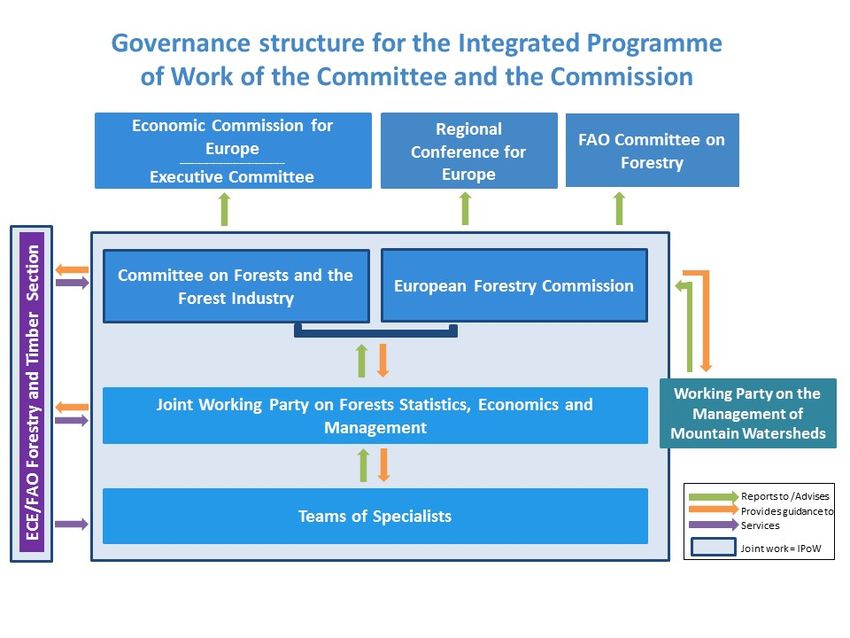
2 _____________________________ The Warsaw Integrated Programme of Work, 2018-2021

1 Recommendations and decisions in support of the
  implementation of the Warsaw Integrated Programme of Work
The “Las2017”, the joint session of the ECE Committee on Forests and the Forest
Industry and the FAO European Forestry Commission, which took place in Warsaw,
Poland from 9 to 13 October 2017, adopted the attached Warsaw Integrated
Programme of Work for the period 2018-2021.

Formal governance is undertaken by the two parent bodies, the ECE Committee and
the FAO Commission, which have the ultimate oversight responsibility for the
implementation of the Warsaw Integrated Programme of Work. The frequency of
meetings is decided in accordance with their respective rules of procedure. According
to established practice, the Committee meets annually. The Commission’s Rules of
Procedure indicate that the Commission in principle meets every second year. The
Committee and the Commission expect to hold joint sessions in 2019 and 2021 with
the aim to further strengthen cooperation, build on synergies and ensure cost
efficiency. During joint meetings, matters of relevance to the Committee or the
Commission only would be considered separately and under specific agenda items
during these sessions. The Joint ECE/FAO Working Party on Forest Statistics,
Economics and Management, a subsidiary body of the Committee and the
Commission, which contributes to the implementation of the Warsaw Integrated
Programme of Work, meets annually.

The Warsaw Integrated Programme of Work will be implemented respecting
mandates of FAO and ECE and based on comparative advantages in order to reach
efficiency and avoid duplication. FAO and ECE will strive to avoid duplication amongst
their respective activities and with other forest-related regional initiatives and
projects.

A specific list of activities to implement the Programme is agreed on an annual basis
by the Working Party and the Committee and the Commission. ECE and FAO are asked,
in line with their governance structures, to present an overview of their forest-related
work in the region to each session of the Working Party in order to facilitate the review
of the proposed list.

The Warsaw Integrated Programme of Work, 2018-2021 ______________________________ 3

The Bureau of the Committee and the Executive Committee of the Commission are
entrusted with providing guidance on the implementation of the Warsaw Integrated
Programme of Work as needed. They should meet jointly at least twice annually and
inform the member States and regional economic integration organizations about
their decisions. The minutes of the meetings will be made available on the websites
of both organizations.

Joint sessions should have the same name for each session – “forest” in the language
of the country hosting the session and then the year of the session, when taking place
outside ECE and FAO Headquarters.

The secretariat should continue and maintain the joint preparation and
implementation of the Warsaw Integrated Programme of Work. The joint secretariat
will service the sessions of the two intergovernmental bodies, the joint meetings of
the Bureaux, produce joint publications and have a joint profile.

4 _____________________________ The Warsaw Integrated Programme of Work, 2018-2021

Member States and regional economic integration organizations are encouraged to
strengthen coordination between delegates of the Committee and of the Commission
at the national level in implementation of the Warsaw Integrated Programme of Work
(for example, by appointing the same Head of Delegation for both).

The Committee and the Commission should encourage their members in linking the
ECE and FAO work to activities at the national level in order to ensure feedback on the
Warsaw Integrated Programme of Work and encourage the cooperation between
countries in this regard.

1.1    Data management
At supranational level, data on forests and forest management are collected through
regular and ad hoc processes. They are often collected, stored and disseminated
separately, through different means and formats. Taking into account relatively long
data collection cycles, this situation seriously hampers continuity, inter-connectivity,
and planning for data collection and its management. This also limits the availability
and usability of the information collected at that level.

It is recommended that the organization and structure of data on forests (collected by
ECE and FAO and retained by the Joint ECE/FAO Forestry and Timber Section), their
management, their functions and their services be analysed. While avoiding any
duplication with existing similar repositories, the results of this analysis would provide
the basis for a potential decision on the establishment of an electronic repository,
enhancing the efficiency of data collection, management and dissemination.

1.2    Private sector
The involvement of the private sector, given its relevance to the work undertaken by
the Committee and the Commission, should be increased, including through the
encouragement of participation in existing subsidiary and expert bodies, and by
maintaining high relevance of the market discussions for the private sector at the
sessions while noting the essential benefits that forests goods and services provide to
the public at large, which could then provide advice to the ECE and FAO regarding
further private sector engagement. The market discussions should at least last one
day.
The Warsaw Integrated Programme of Work, 2018-2021 ______________________________ 5

1.3    Funding
The final list of activities prepared every year should help member States and regional
economic integration organizations to further prioritize the work of the secretariat. A
related budget is prepared and shared with the Joint Bureaux, member countries and
regional economic integration organizations after the approval of the list to
understand the feasibility of activities and identify funding needs. Additional sources
of funding will be sought from relevant global, regional and national donor
organizations.

1.4    Outreach
To the upmost extent possible, communication activities shall be implemented with
due regard to keeping a balance between subregions, Work Areas and between
official languages of the Committee and the Commission in order to increase the
impact and visibility of work.

1.5    Partnerships
Partnerships, within the scope of ECE and FAO relevant policies, should be established
with other sectors, including through cooperation with other ECE Committees and
FAO Commissions. Partnerships should be designed to serve to demonstrate the value
of forests and forest products for other sectors (energy, environment, housing,
employment, climate change, etc.) and consider the impacts of other sectors on the
forest sector.

Cooperation with other intergovernmental organizations and processes, including the
European Union, the Intergovernmental Council on Forestry and the Forest Industry
of the Commonwealth of Independent States, Forest Europe, the United Nations
Forum on Forests, the International Tropical Timber Organization, the International
Union of Forest Research Organizations and the European Forest Institute, amongst
others, should be fostered.

Good examples and best practices of cross-sectoral cooperation should be highlighted
and showcased whenever possible.

Partnerships are expected to enhance synergies of work and cooperation amongst
relevant organizations and processes to avoid fragmentation of regional work on
forests.
The Warsaw Integrated Programme of Work, 2018-2021 ______________________________ 7

2 Warsaw Integrated Programme of Work Part I
The oversight responsibility for the implementation of the Warsaw Integrated
Programme of Work of the Committee on Forests and the Forest Industry and the
European Forestry Commission remains with the members of the Committee and the
Commission.

The implementation and coordination responsibilities for the Warsaw Integrated
Programme of Work of the Committee and the Commission rests primarily with ECE
and FAO through the ECE/FAO Forestry and Timber Section. The implementation is
supported by the Joint ECE/FAO Working Party on Forest Statistics, Economics and
Management, the ECE/FAO Teams of Specialists, as well as relevant units of the ECE
and FAO. The Programme is also implemented with the support of member States and
regional economic integration organizations, in close cooperation with relevant
organizations and processes at all levels and other relevant stakeholders participating
in the Committee and Commission intergovernmental processes.

It will contribute to the implementation of: (i) the United Nations 2030 Agenda for
Sustainable Development and the achievement of the SDGs, (ii) the United Nations
strategic plan for forests 2017-2030, (iii) the United Nations Forum on Forests
Quadrennial Programme of Work 2017-2020, (iv) the Aichi Biodiversity Targets, (v) the
Paris Agreement adopted under the United Nations Framework Convention on
Climate Change and (vi) other international objectives and processed relevant to
8 _____________________________ The Warsaw Integrated Programme of Work, 2018-2021

forests, including the Bonn Challenge and the Rovaniemi Action Plan for the Forest
Sector in a Green Economy.

2.1           Scope
The Warsaw Integrated Programme of Work covers all fifty-six member States of the
ECE region, in line with the Committee’s membership 1. Thirty-nine member States,
which are all ECE member States, and the European Union, are members of the
Commission 2.

The Programme encompasses the following main topics related to forests, sustainable
forest management and the forest sector:

• The state of forests and the state of sustainable forest management;
• The implementation and promotion of sustainable forest management, according
  to the seven thematic elements of the United Nations Forest Instrument;
• Forest related industries, the use of forest products, as raw material, construction,
  and energy; and related innovation perspectives;
• Forest and forest sector policies, institutions and instruments, including the
  linkages between forest and timber policies and other sectoral policies;
• The contribution of the forest sector in the transition towards a green economy,
  forest products and ecosystem services, employment and other socio-economic
  aspects; including economic viability of the sector;and
• To contribute to the implementation of the United Nations 2030 Agenda for
  Sustainable Development and the achievement of the forest-related Sustainable
  Development Goals as well as the implementation of United Nations strategic plan
  for forests 2017-2030, within the existing mandates of ECE and FAO.
2.2           Overall goal
The overall goal of the Warsaw Integrated Programme of Work 2018-2021 of the
Committee and the Commission is to support member States and regional economic

1 Albania, Armenia, Austria, Azerbaijan, Belarus, Belgium, Bulgaria, Canada, Croatia, Cyprus, Czech Republic, Denmark, Estonia, Finland, France, Georgia, Germany, Greece,
Hungary, Iceland, Ireland, Israel, Italy, Kazakhstan, Kyrgyzstan, Latvia, Lithuania, Luxembourg, Malta, Republic of Moldova, Montenegro, Netherlands, Norway, Poland,
Portugal, Romania, Russian Federation, Serbia, Slovakia, Slovenia, Spain, Sweden, Switzerland, Tajikistan, The former Yugoslav Republic of Macedonia, Turkey,
Turkmenistan, Ukraine, United Kingdom, United States and Uzbekistan.
2 Albania, Austria, Belarus, Belgium, Bulgaria, Croatia, Cyprus, Czech Republic, Denmark, Estonia, Finland, France, Germany, Greece, Hungary, Iceland, Ireland, Israel, Italy,
Latvia, Lithuania, Luxembourg, Malta, Netherlands, Norway, Poland, Portugal, Romania, Russian Federation, Slovakia, Slovenia, Spain, Sweden, Switzerland, The former
Yugoslav Republic of Macedonia, Turkey, Ukraine, United Kingdom, Uzbekistan and the European Union.
The Warsaw Integrated Programme of Work, 2018-2021 ______________________________ 9

integration organizations in their efforts to sustainably manage forests so that they
provide forest goods and services to benefit society.

2.3      Objective of the Warsaw Integrated Programme of Work
The Warsaw Integrated Programme of Work aims to assist member countries and
regional economic integration organizations to achieve the overall goal described
above by: providing the best available information; facilitating policy dialogues and
communication; and building capacity.

2.4      Structure and Work Areas
The Warsaw Integrated Programme of Work remains structured around four main
functions, or work areas, as follows:

•     Work Area 1: Data, monitoring, reporting and assessment
•     Work Area 2: Policy dialogue and advice
•     Work Area 3: Communication and outreach
•     Work Area 4: Capacity-building
Actions contained in the Rovaniemi Action Plan and attributed to the ECE/FAO Forestry
and Timber Section are indicated in an annex to the Plan with an asterisk and are
reflected in the annual list of activities as part of the Warsaw Integrated Programme of
Work 2018-2021, subject to availability of financial and human resources.

Specific activities and outputs proposed for the four Work Areas are outlined below.

2.4.1   WA 1: Data, monitoring, reporting and assessment
The data collection and reporting work in the region consists of the following:

• Collection, validation and dissemination of statistics and other information on: forest
  resources, forest products (wood and non-wood), forest functions and services,
  progress toward sustainable forest management, forest policies, institutions and
  instruments, and the contribution of the forest sector to a green economy;
• Analysis and assessment of the state of forests, sustainability of forest
  management and forest products markets; and monitoring the role of the forest
  sector in a green economy; and
• Cooperation and contribution to international processes on sustainable forest
  management, including on the development and use of regional Criteria and
10 ____________________________ The Warsaw Integrated Programme of Work, 2018-2021

    Indicators and collaboration with Forest Europe in the preparation of the report
    on the State of Europe’s Forests.
The monitoring and analysis of developments in various forest-related areas and
cooperation with other relevant organizations working in these areas, while avoiding
duplication. This includes the gathering of comprehensive statistics and data
(quantitative and qualitative), and developing methodologies for data collection,
analysis and assessments on:

• Forest product markets and services;
• Current forest conditions, sustainable forest management, and the functions and
  services forests provide;
• Long-term supply of and demand for wood and other forest goods and services;
• Use of wood energy and its implications for sustainable forest management; and
• Jobs, employment and working conditions.
Data are collected in partnership with member States and regional economic integration
organizations, international organizations and the scientific community, based on
agreed standards and rules. The Team of Specialists will pay particular attention to the
integration and consolidation of reporting activities with other processes in the region
(e.g. Forest Europe, Global Forest Resources Assessment 2020 process). Activities under
Work Area 1 are also expected to improve the quality of information, ensuring
international compatibility, storage, dissemination and analysis of the information, and
to assist member States and regional economic integration organizations in
strengthening their capacity in this area (see Work Area 4 on capacity-building).

Outputs from this Work Area include:

• The Forest Products Annual Market Reviews;
• The State of Europe’s Forests (in collaboration with Forest Europe);
• The Joint Forest Sector Questionnaire (JFSQ);
• The Timber Forecast Questionnaire (TFQ);
• The Joint Wood Energy Enquiry (JWEE);
• The Collaborative Forest Resources Questionnaire (CFRQ);
• Regional input to the FAO Global Forest Resource Assessment (FRA) in cooperation
  with Forest Europe;
• Associated databases of the previously mentioned outputs;
• Market Statement, forecast tables;
The Warsaw Integrated Programme of Work, 2018-2021 _____________________________ 11 • Reporting of progress towards implementation of the 2030 Agenda on Sustainable Development and achievement of forest–related SDGs, and the United Nations strategic plan for forests 2017-2030; • Studies on forest employment and working conditions; • Assessment of the contribution of the forest sector to a green economy; and • Ad hoc enquiries and studies contributing to areas mentioned above in paragraph 30, upon decision by the Committee and the Commission. 2.4.2 WA 2: Policy dialogue and advice This component involves the organization of regional policy dialogues and specific studies and the facilitation of national dialogues on request from member States and regional economic integration organizations. The subjects to be covered will address issues mentioned in the scope of the Warsaw Integrated Programme of Work. This work will contribute to the implementation of the 2030 Agenda and forest related SDGs, the United Nations strategic plan for forests 2017-2030 and the United Nations Forum on Forests Quadrennial Programme of Work 2017-2020, and to the relevant global (mainly the United Nations Forum on Forests and the FAO Committee on Forestry, regional and national forest dialogues. Activities in this Work Area also contribute to efforts to promote cross-sectoral cooperation. Outputs from this Work Area include: • Analyses, guidelines and recommendations to support member States and regional economic integration organizations in implementing the above mentioned initiatives and plans; • Contributions to the Forest Europe Work Programme; • Policy dialogues and workshops for the region; • Forest Sector Outlook Studies; and • Policy-related parts of relevant ECE and FAO joint work/studies, such as relevant reviews and reports on the status and trends in forests and sustainable forest management. 2.4.3 Work Area 3: Communication and outreach Communicating effectively within and outside the forest and forest products sector is essential to promote sustainable forest management. Enhancing the efforts of the Committee and the Commission to reach out to relevant constituencies to draw attention to the regional priorities in the forest sector and to increase the dissemination
12 ____________________________ The Warsaw Integrated Programme of Work, 2018-2021

of the information and tools produced, at the national, regional and global levels, will
make an important contribution to this end. This will be achieved through:

• Providing a regional platform for international cooperation in forest related
  communication (through the Forest Communicators Network Team of Specialists);
• To contribute to the dissemination of information on and the implementation of
  Work Area 1, Work Area 2 and Work Area 4;
• Organizing events and campaigns in support of sustainable forest management
  and forest products and services (e.g. the International Day of Forests, the
  European and Global Forest Weeks);
• Dissemination of information produced under the Warsaw Integrated Programme
  of Work via policy briefs, press briefs, the Forest Information Billboard, social
  media/networks, videos and ad hoc studies, whenever results are available and
  new information released;
• Maintaining and improving the ECE/FAO website especially regarding user-
  friendliness and design;
• Contributing to the organization of relevant events in member States and regional
  economic integration organizations and the dissemination of their forest-related
  announcements (e.g. capacity building workshops, special public relations events)
  in cooperation with member States, regional economic integration organizations
  and other stakeholders;
• Carrying out outreach activities beyond the forest sector for disseminating
  information that highlights the relevance of forests and forest products and
  services to other sectors (e.g. energy events, biodiversity and environment
  meetings, sustainable construction and buildings); and
• Communicating effectively the news and updates from the work at other forest-
  related international fora.
Outputs from this Work Area include:

• Events and campaigns (e.g. contribution to the organization of International Forest
  Day events; contribution to the organization of the European Forest Week, etc.);
• Policy briefs;
• Press briefs;
• Contribution to the Forest Information Billboard;
• Contribution to, and dissemination of, ad hoc studies through communication
  channels; and
• Inputs to the website.
The Warsaw Integrated Programme of Work, 2018-2021 _____________________________ 13

2.4.4    WA 4: Capacity-building
While all member States and regional economic integration organizations benefit
from international cooperation through the Warsaw Integrated Programme of Work,
technical assistance is available to countries in Eastern and South Eastern Europe, the
Caucasus and Central Asia. This work on capacity-building aims at encouraging
sustainable forest management, data collection, monitoring and analysis as well as
promoting the engagement of national experts from the region in activities relevant
to the region. It covers the themes encompassed in the scope of the Warsaw
Integrated Programme of Work, including:

• National systems for forest monitoring and statistical reporting;
• Forest communication strategies;
• Mitigation of and adaptation to climate change;
• Forest landscape restoration (FLR) and the Bonn Challenge;
• The implementation of the United Nations strategic plan for forests 2017-2030 and
  countries’ voluntary national contributions; and
• The contribution of the forest sector to:
  o a green economy;
  o the implementation of the 2030 Agenda for Sustainable Development and the
     achievement of forest-related SDGs;
  o the implementation of the Paris Agreement.
This Work Area also benefits from the implementation of the United Nations
Development Account project on “Accountability Systems for Sustainable Forest
Management in the Caucasus and Central Asia” (2016-2019).

Outputs from this Work Area include:

•     Publications;
•     Capacity building workshops;
•     Training material and recommendations;
•     Technical assistance;
•     Provision of specific, targeted expertise;
•     Enhanced cooperation and development of contacts in the target countries.
2.5      Principles guiding implementation
Implementation should be guided by the following principles.
14 ____________________________ The Warsaw Integrated Programme of Work, 2018-2021 2.5.1 Partnership There will be a strong focus on working in partnerships with international and regional actors as the most effective way of optimizing benefits and avoiding potential duplication of activities. The Committee and the Commission will seek and welcome cooperation for any of the relevant outputs under the four Work Areas. 2.5.2 Outreach to other constituencies In the implementation of the Warsaw Integrated Programme of Work, the Committee and the Commission will look beyond the traditional forest constituency to make sure the relevance of the forest sector and its contribution to other sectors is well recognized and understood. They will coordinate relevant actions with, for example, the environment, biodiversity, energy, water, agriculture, construction and building sectors, using the potentials offered by the ECE and FAO. 2.5.3 Expert advice The work and expected outputs of the Teams of Specialists will be fully aligned with the Warsaw Integrated Programme of Work and its objectives and will support the related areas of work, recognizing the importance of the involvement of the scientific community In this context, the Forest Communicators Network should support other Teams on outreach efforts and for the dissemination of relevant products. Due regard should be given to the Committee and Commission official languages when organizing meetings and issuing publications and documents, as appropriate. 2.5.4 Involvement of the private sector The Warsaw Integrated Programme of Work recognizes the private sector as a key actor for developing sustainable forest management, sustainable forest products and services and the transition towards a green economy. The participation of the private sector in the work of the Committee and the Commission including in the market discussions will be actively sought, in line with the ECE and FAO organizational policies. Increased participation from various relevant stakeholders should be encouraged. 2.5.5 Gender mainstreaming The Warsaw Integrated Programme of Work gives due consideration to making the concerns and experiences of women and men an integral part of the design, implementation, monitoring and evaluation of its activities, so that women and men benefit equally and inequality is not perpetuated (UN ECOSOC, 1997). Gender
The Warsaw Integrated Programme of Work, 2018-2021 _____________________________ 15

mainstreaming is a central part of ECE and FAO’s strategic frameworks and their
policies and programmes.

2.6    Support to the Warsaw Integrated Programme of Work and related resources
Progress in the implementation of the Warsaw Integrated Programme of Work will be
reported annually. The Warsaw Integrated Programme of Work should have the
flexibility to allow addressing from a technical perspective emerging issues of policy
relevance and interest or influence to forestry and the forest industry.

Implementation will depend on regular programme funding levels and to a large extent on
extrabudgetary resources, as well as available human resources. Member States, regional
economic integration organizations and other donors are encouraged to support such
activities in kind and/or with the necessary level of financial resources. The annual list of
activities, which is submitted on an annual basis to the Working Party and subsequently to
the Committee and the Commission for their approval, will show clearly the areas of work
(e.g. capacity-building) or activities where extrabudgetary funding will be needed.

A broader engagement by member States and regional economic integration
organizations should be sought. In particular, resources should be identified to finance
the participation of delegates from eligible countries with economies in transition.

2.7    Expert support
The Teams of Specialists, composed of experts in particular fields, provide advice or
undertake activities that support the implementation of the Warsaw Integrated
Programme of Work. Teams of Specialists may also provide guidance to the ECE/FAO
Forestry and Timber Section on relevant Work Areas, help with outreach activities to
country-level experts, and produce team-specific outputs in support of the Warsaw
Integrated Programme of Work. Teams of Specialists are established by the ECE
Executive Committee and human and financial resources are provided by both ECE
and FAO through their separate budgetary processes for servicing the meetings of the
Teams of Specialists. Their terms of reference are approved by the Committee and the
Commission. The Teams of Specialists report annually to the Working Party on Forest
Statistics, Economics and Management.

Guidelines for the Teams of Specialists clarifying the Teams’ mandates and
procedures, and the role and responsibilities of Team leaders, and deputy leaders,
Team members and the secretariat can be found in Part 2.
16 ____________________________ The Warsaw Integrated Programme of Work, 2018-2021

2.8    Terms of Reference of the Joint ECE/FAO Working Party on Forest Statistics,
       Economics and Management
The Joint ECE/FAO Working Party on Forest Statistics, Economics and Management is
a subsidiary body of the Committee and the Commission and contributes to the
implementation of the Integrated Programme of Work of those two bodies. It does so
by coordinating the Teams of Specialists and the activities of the Integrated
Programme of Work as well as providing technical advice. It takes instructions from
COFFI and the Commission and meets annually to:

• Provide guidance on the implementation of all areas of the Integrated Programme
  of Work;
• Supervise the work of Teams of Specialists and facilitate the exchange of
  information on their work; and
• Identify priorities for action and relevant emerging issues; and transmit suggested
  priorities and specific recommendations to COFFI and the EFC for consideration.
• The Joint ECE/FAO Working Party on Forest Statistics, Economics and Management
  shall, for each Work Area, on the basis of a report from the secretariat, review and
  comment on the activities undertaken during the past year and the plans for the
  forthcoming year.
The Joint ECE/FAO Working Party on Forest Statistics, Economics and Management
shall review, on an ongoing basis, the work of the Teams of Specialists and their
contribution to the Work Areas as well as work between the Teams of Specialists to
ensure the most effective and efficient implementation of their activities. It will:

• Receive and discuss the reports from the Teams of Specialists in order to enhance
  the understanding of their activities and assess their work plans; when needed, the
  Joint ECE/FAO Working Party on Forest Statistics, Economics and Management may
  review and recommend updated mandates for endorsement by the parent bodies;
• Identify possible synergies; and facilitate the exchange of experiences between
  Teams of Specialists and delegations from member States; and
• Increase the visibility and impact of the work of Teams of Specialists among
  member States and within the relevant bodies in the United Nations.
The Joint ECE/FAO Working Party on Forest Statistics, Economics and Management,
as part of its work for the Committee and the Commission, shall:

• Propose priorities for activities in the Work Areas and on relevant emerging issues;
The Warsaw Integrated Programme of Work, 2018-2021 _____________________________ 17 • Provide, upon request from the parent bodies, methodologies for use in economic analysis of the sector, as well as techniques for collecting, validating, analyzing and disseminating information and statistics; • Initiate, upon request from the parent bodies, ad hoc projects in economics and statistics related to forestry, forest products and forest policies and institutions; • Contribute and provide technical advice to the Committee and the Commission on issues under consideration by those bodies, including the preparation of studies on the status and future of forests and on the forest industry such as the Outlooks and the Forest Products Annual Market Reviews; • Inviting other sectors to the sessions to discuss issues related to forest information and management matters of common interest, including best practices in sustainable forestry management and their impact on the overall sustainability of forests, natural resources management, and other issues such as biodiversity and climate change; and • Inviting other international bodies, including the International Tropical Timber Organization, the Conference of European Statisticians, Forest Europe and Eurostat, to the sessions, with a view to coordinating activities and avoiding any duplication of effort. The work of the JWP will be assessed after the next two sessions of this body.
3
The Warsaw Integrated Programme of Work, 2018-2021 _____________________________ 19

4 Warsaw Integrated Programme of Work Part II
4.1    Terms of Reference of the ECE/FAO Teams of Specialists
In order to support the implementation of the Integrated Programme of Work, the
following Teams of Specialists are established for the period 2018-2021.

Name of the Team         Contribution to the Programme of Work
Team of Specialists on   Work Area 1, Work Area 2 and Work Area 4: to focus on
Monitoring               sustainable forest management monitoring for different ECE
Sustainable Forest       and FAO studies and reviews, sustainable forest management
Management               assessment and work on criteria and indicators
Team of Specialists on Work Area 1 and Work Area 4: to focus on forest products and
Sustainable Forest     markets, market statements
Products
Team of Specialists on Work Area 1 and Work Area 4: to support the work on statistics
Forest Products        in the Joint ECE/FAO Working Party on Forest Statistics,
Statistics             Economics and Management, in order for the Joint ECE/FAO
                       Working Party on Forest Statistics, Economics and Management
                       to focus on its coordinating function for Team of Specialists and
                       Work Area review
Team of Specialists on Work Area 1, Work Area 2 and Work Area 4: to support the
Wood Energy            development of data and relevant advice on wood energy in the
                       region
Team of Specialists on Work Area 1, Work Area 2 and Work Area 4: to support the
Forest Sector Outlook development of Outlook Studies
Team of Specialists on Work Area 2 and Work Area 4: to focus on forest policies in the
Forest Policy (Forest region and provide capacity-building
Policy Network)
Team of Specialists on   Work Area 3 and Work Area 4: to provide advice to the
Forest                   ECE/FAO Forestry and Timber Section in support of relevant
Communication            events, campaigns and public relations efforts, support the
(Forest                  dissemination of results of other Teams of Specialists
Communicators’
Network)
20 ____________________________ The Warsaw Integrated Programme of Work, 2018-2021
Name of the Team Contribution to the Programme of Work
Team of Specialists on Work Area 2 and Work Area 4: to focus on green jobs and
Green Jobs in the capacity-building activities in support of sustainable forest
Forest Sector (Joint management
ILO/ECE/FAO Expert
Network)
4.1.1 ECE/FAO Team of Specialists on Monitoring Sustainable Forest
Management
Reference to the Integrated Programme of Work: Work Area 1, “Data, monitoring,
reporting and assessment”, Work Area 2, “Policy dialogue and advice” and Work Area
4, “Capacity-building”
Objectives:
• To strengthen the work on: (i) forest reporting, (ii) assessing the state of forests
and sustainability of forest management and (iii) monitoring the role of the forest
sector in a green economy in the region;
• To advise the ECE/FAO Forestry and Timber Section on the implementation of
activities in Work Area 1 “Data, monitoring, reporting and assessment”, with
regard to the collection, harmonization, review, analysis and dissemination of
quantitative and qualitative information on forests and sustainable forest
management (SFM) in the region.
Activities and functions:
• Contribute to the Global Forest Resources Assessment (FRA) and the Collaborative
Forest Resources Questionnaire 2020, support the data collection process, analysis
of the status and trends, and the drafting and reviewing of the final report.
• Contribute to the work on criteria and indicators for sustainable forest
management agreed by Forest Europe and the Montréal Process.
• Assist the preparatory process of the State of Europe’s Forests 2020: contribution
to the reporting on quantitative indicators, analysis of information, coordination
of inputs, authors’ contributions and dissemination of results.
• Contribute to further work on the assessment of the sustainability of forest
management.The Warsaw Integrated Programme of Work, 2018-2021 _____________________________ 21 • Contribute to the work on the development of global and regional forest indicators to support the implementation of the 2030 Agenda on Sustainable Development and the United Nations strategic plan for forests 2017-2030. • Contribute to the development of the concept and modalities for a statistical data management system on forest resources, functions and services and sustainable forest management. • Provide input to other Work Areas on issues relevant to data, monitoring, reporting and assessment including related capacity-building, in particular to the United Nations Development Account project on “Accountability Systems for Sustainable Forest Management in the Caucasus and Central Asia”. • Support international work and cooperation on monitoring of forest resources and sustainable forest management, including the European Union (i.e. Eurostat, the European Economic Area and the Joint Research Centre) and other organizations (i.e., the International Union of Forest Research Organizations, the International Co-operative Programme on Assessment and Monitoring of Air Pollution Effects on Forests and the European Forest Institute) in this area. Expected major outputs and contributions: • Review of, and input to documents, reports, and meetings related to the global reporting framework – in cooperation with the FAO Forest Resources Assessment Team. • Review of, and input to documents, reports, and meetings, especially those related to the activities “Further development and updating of policies and tools for sustainable forest management” and “Forest monitoring and reporting” under Forest Europe. Provide support in the organization of the workshop for authors and national correspondents in the region; review of and, whenever possible, involvement in writing, support the drafting of report on the State of Europe’s Forests. Involvement in dissemination of results. • Review of, and input to documents, reports, and meetings on the development of global and regional forest indicators to support the implementation of the 2030 Agenda on Sustainable Development and the United Nations strategic plan for forests 2017-2030. • Advice on issues relevant to the criteria & indicators processes in the region. • Advice on designing an improved statistical data management system on forest resources, their functions and services, and forest management. • Advice on the other data-related work within Work Areas 1, 2, 3 and 4, in particular related to the measurement of the forest sector contribution to a green economy and forest sector outlook studies.
22 ____________________________ The Warsaw Integrated Programme of Work, 2018-2021

Background:

Established/          Joint session of the Committee and the Commission, Warsaw,
Approved by:          Poland, 2017.
Duration:             From January 2018 to December 2019. Renewable to 2021.
Methods of work:      Regular Team of Specialists meetings (including steering group
                      and thematic sub-groups meetings).
                      Participation in workshops with Global Forest Resources
                      Assessment 2020 national correspondents.
                      Reviews and consultations, in person, via videoconference and
                      electronic means.
                      Review and, if feasible, preparation of background materials,
                      discussion papers, enquiries.
                      Other forms of work can be determined by the Team of
                      Specialists, if needed.
Reporting:            Annually, to the Joint ECE/FAO Working Party on Forest
                      Statistics, Economics and Management
Team leader:          To be elected at the first Team meeting

4.1.2    ECE/FAO Team of Specialists on Sustainable Forest Products
Reference to the Integrated Programme of Work: Work Area 1, “Data, monitoring,
reporting and assessment” and Work Area 4, “Capacity-building”

Objectives:

• To advise and support work on the sustainable development of forest products
  markets and related policies in the region.
• To raise awareness on the role that sustainable forest products can play in
  greening economies and in providing sustainable products and livelihoods.
Activities and functions:

• Provide guidance and referral to the best available experts and/or sources of
  information for the organization of:
  o Market Discussions; and
The Warsaw Integrated Programme of Work, 2018-2021 _____________________________ 23
o Workshop(s) on all topics related to forest products including the role of forest
products in a green economy, the use of wood for “green buildings”, innovative
wood products and other topics in line with the work programme.
• Provide expertise and outreach to experts for drafting market-related publications
and products, including the technical reviews contained in, and the production of,
the Forest Products Annual Market Review.
• Advise the secretariat on the organization of meetings related to the sustainable
use of forest products.
• Advise the secretariat on strategies to carry out the Programme of Work in the
forest products marketing area, in particular to assist in strengthening the focus
on innovative forest products and on improving knowledge on wood sustainability
credentials.
• Build links with standard/certifying organizations, as well as forest products trade
associations, to promote the use of forest products as a sustainable material for
construction and other uses..
• Build linkages with non-forest bodies within the UN, including with the ECE
Committee on Housing and Land Management.
• Build links, both informal and formal, with other Teams of Specialists in areas
where cross-cutting issues are shared and where assistance and coordination can
be mutually beneficial.
• Build upon the work of previous capacity building workshops and consider
organizing similar events in association with regional bodies.
• Organize an annual awareness raising workshop; subject to availability of funds.
• Work with the secretariat to attract and enhance the involvement of the forest
products industry, aiming at:
o Holding a full day session focusing on market/industry issues;
o Organizing industry visits; and
o Organizing side events that involve the forest products industry sector.
Provide a network of expertise and advice, including on priorities.
Expected major outputs and contributions
• Market Discussions covering forest product market topics that are current and
relevant to the region and contribute to the Market Statement.
• Bi-annual meetings to discuss a list of recommendations on how to improve the
content, structure and focus of the forest products marketing Work Area in
general and the Forest Products Annual Market Review in particular (typically24 ____________________________ The Warsaw Integrated Programme of Work, 2018-2021
during the Team of Specialists meeting that is held at the time of Committee,
Commission and Working Party meetings).
Background
Established/ Joint sessions of the Committee and the Commission, Warsaw,
Approved by: Poland, 2017.
Duration: From January 2018 to December 2019. Renewable to 2021.
Methods of work: Annual meeting. Other methods to be determined by the Team.
Reporting: Annually, to the Joint ECE/FAO Working Party on Forest
Statistics, Economics and Management
Team leader: To be elected at first Team meeting.
Communication: The Team leader and secretary should ensure close
communication and collaboration with the Teams of Specialists
on Forest Products Statistics and Wood Energy
4.1.3 ECE/FAO Team of Specialists on Forest Products Statistics
Reference to the Integrated Programme of Work: Work Area 1, “Data, monitoring,
reporting and assessment” and Work Area 4, “Capacity-building”
Objectives
• To advise and support work on forest products statistics, including data coverage
and collection, validation and classifications used in the region.
• To suggest and support proposals for increasing the reliability and visibility of
forest products statistics.
• To advise on implementation of activities in Work Area 1 relating to forest
products statistics.
Activities and functions
• Review materials such as the Joint Forest Sector Questionnaire and the Timber
Forecast Questionnaire and associated procedures, reviewing items in forest
products statistics.
• Develop methods to expand the scope to include production and trade of
secondary wood products (Engineered Wood Products, furniture, joinery) and
develop methodology for data collection on these products.The Warsaw Integrated Programme of Work, 2018-2021 _____________________________ 25 • Investigate required changes in the Harmonized System classification; prepare for the implementation of 2022 Harmonized System and future potential changes to Harmonized System. • Follow up on the conversion factor questionnaire and study; develop conversion factors for secondary forest products (Engineered Wood Products, joinery). • Assist in the development of a forest food products section in collaboration with the Collaborative Forest Reporting Questionnaire and consider framework and specifications for non-wood forest products. • Support publication of the roundwood balance study and continue to develop methodology. • Strengthen capacities in statistics through a capacity-building workshop. • Disseminate information on forest products statistics further through the Team of Specialists’ network. • Advise on issues to coordinate with other members of the Eurostat/FAO/International Tropical Timber Organization/ECE Intersecretariat Working Group on Forest Sector Statistics. • Consider improving product definitions and collect metadata (including accuracy). • Consider development of price portal. • Recommend improvements to data systems, including data capture. • Review ways to promote data and make it more accessible. • Recommend methods for improving data reliability. Expected major outputs and contributions • Recommendations for revisions to the Joint Forest Sector Questionnaire and the Timber Forecast Questionnaire. • Submission of potential input for 2022 revision of Harmonized System and further revisions in later years. • A paper on the extent of potential double counting problem (including issue of forest/non-forest sources) and how to avoid it. Contact national data users for input. • Proposal for improvements for national and international practices in data validation and, if required, a working paper describing best practices. • A recommended procedure for estimating wood balance, including the desirable level of detail to include and conversion factors to use. • Contributions to studies on conversion factors, roundwood balance and double counting issue, in collaboration with other Teams. • Support to capacity building workshop on statistics.
26 ____________________________ The Warsaw Integrated Programme of Work, 2018-2021

Background

Established/         Joint session of the Committee and the Commission, Warsaw,
Approved by:         Poland, 2017.
Duration:            From January 2018 to December 2019. Renewable to 2021.
Methods of work:     Annual meeting. Further methods to be determined by the Team.
Reporting:           Annually, to the Joint ECE/FAO Working Party on Forest
                     Statistics, Economics and Management.
Team leader:         To be elected at the first Team meeting.
Communication:       The Team leader and secretariat should ensure close
                     cooperation with the Team of Specialists on Sustainable Forest
                     Products, the Team of Specialists on Wood Energy and the Team
                     of Specialists on Sustainable Forest Management. The Team
                     should also seek to communicate and collaborate with other fora
                     working in this area, and to collaborate with others (e.g. Forest
                     Europe on criteria and indicators and the Intergovernmental
                     Panel on Climate Change on harvested wood products).
4.1.4    ECE/FAO Team of Specialists on Wood Energy
Reference to the Integrated Programme of Work: Work Area 1, “Data, monitoring,
reporting and assessment”, Work Area 2, “Policy dialogue and advice” and Work Area
4, “Capacity-building”.

Objectives

• To advise the ECE/FAO Forestry and Timber Section and support activities in Work
  Areas 1 and 2 on the methodology for, the implementation of and the follow-up to the
  Joint Wood Energy Enquiry and specific studies related to wood energy;
• To contribute to a better understanding of wood energy statistics as a basis for
  sound policymaking.
You can also read


