Ticks and Lyme Disease - learn about ticks and prevent tick bites and lyme disease.
←
→
Page content transcription
If your browser does not render page correctly, please read the page content below
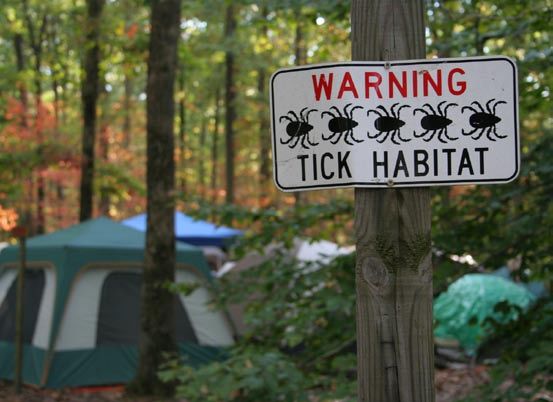
Ticks and Lyme Disease

learn about ticks
and prevent tick bites
and Lyme disease.
Most ticks in the Thunder Bay District are
harmless. However, there are deer ticks in
the area that carry Lyme disease. Although
the risk to humans is low because of THE
small number of deer ticks, the Health Unit
recommends taking safety measures to
prevent tick bites.

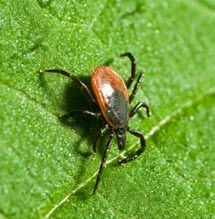
What is the difference between a wood tick and a deer tick?

Wood Tick                           Deer Tick
Wood ticks are the most common      Deer ticks have potential to carry
tick in the Thunder Bay District.   Lyme disease. They are brown
Female wood ticks have a white      or black with no white markings.
hood or shield behind their head.   Females may have a coloured body.
Male wood ticks have a black and    Due to milder winters, an increasing
brown shell. They are harmless to   number of deer ticks have been
humans but can be a nuisance.       identified in the Thunder Bay District.
How can I remove a tick and what do I do with it?

You will need a pair of fine-tipped tweezers, soap and water, some rubbing
alcohol and an empty container.

1.	Remove the tick.
   • Use fine-tipped tweezers
     to grab the head and mouth
     as close to the skin as possible.
   • Pull up slowly until the tick is
     completely removed from the
     skin. Do not twist or turn. Try
     not to damage the tick so it
     can be easily identified.
   • Do not try to burn the tick or
     use anything to smother it
     (e.g. Vaseline®).
                                            Use tweezers to grab the head
   • Make sure the whole
                                            and mouth as close to the skin
     tick is removed.
                                            as possible and pull up until
   • Put the tick in a clean                the tick is completely removed
     container or empty pill bottle.        from the skin.
     Mark down the date and the
     geographic location of where
     the tick bite happened.

2. Treat the bite.
   • Wash the area with soap and water and then apply rubbing alcohol.

3. Bring the tick to the Health Unit for identification.
   • Thunder Bay: Drop off at the 999 Balmoral Street office.
   • Outside of Thunder Bay: Drop off at the nearest Health Unit
     branch office.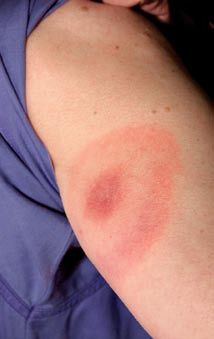
How can I protect myself against ticks and Lyme disease?

Ticks are very hardy, difficult to kill and will survive without feeding
and with little oxygen. If you are planning an outside activity, there are
some tips you can follow. These tips are even more important if you are
planning a trip to an area with lots of ticks, or if you are out in the bush
during the spring when ticks are most active.

• Avoid places with long grasses. If you are hiking or walking, stay
  in the centre of the trail.
• Wear light coloured clothing to make it easier to find the ticks.
• Wear clothing that covers as much skin as possible.
• Wear long sleeved shirts that fit tightly around your wrists.
• Keep long pants tucked into your socks.
• Use an insect repellant with DEET on uncovered skin as well as
  on your clothing.

 Follow these guidelines from Health Canada:
 Infants under 6 months            • Do not use a DEET repellant.

 Children between six              • Use a repellant only if there is a high
 months and two years                risk of insect bites.
                                   • Use a product with 10% DEET or less.
                                   • Do not put the repellant on their face
                                     or hands.
 Children                          • Use a product with 10% DEET or less.
                                   • Do not put on the repellant more
                                     than three times per day.
 Adults                            • Use a product with 30% DEET or less.

 Pregnant women                    • There is no evidence to prove that
                                     DEET will harm pregnant or breast-
                                     feeding women. But, these women
                                     may want to use non-chemical ways
                                     to prevent bites.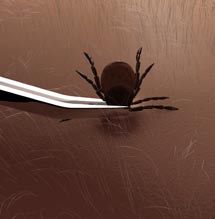
• Check yourself, your children
  and your pets from head to toe
  for ticks before you go indoors.
• Have a hot shower after
  checking for ticks, if possible.
• Wash your clothes with hot
  water and use the hottest
  setting on your dryer to kill any
  ticks that you may have missed.
                                       This is an engorged tick. Make sure
                                       you check your animals for ticks and
                                       remove right away. Use tweezers
                                       and follow the method described
                                       earlier in the brochure.

What is Lyme disease and how is it spread to humans?

Lyme disease is a serious illness
that affects the central nervous
system, the cardiovascular system
(e.g. heart and lungs), and the
joints. Although Lyme disease
in humans can have serious
symptoms, it can be treated if it is
noticed early enough.
Lyme disease is caused by a
bacteria that is spread through the
bite of infected deer ticks. Deer
ticks feed on infected animals
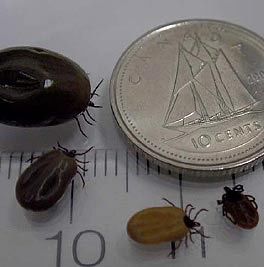
(e.g. mice, squirrels, birds) and      Female deer ticks in different
pick up the bacteria. The deer ticks   stages of feeding. Notice the
then spread the disease to humans      change in both size and colour.
through a bite.                        The largest tick is fully engorged
Lyme disease is not spread directly    after feeding.
from person-to-person or from pet-
                                       Source: Public Health Agency of Canada;
to-person by touching or kissing.      Photographer: Robbin Lindsay, 2006.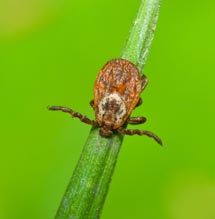
What are the symptoms of Lyme disease and how is it treated?

 Tick bites are usually painless and
 most people don’t even realize
 they have been bitten. The signs
 and symptoms of Lyme disease are
 different from person to person.
 In a few cases, the first sign of infection
 may be a “bulls-eye rash.” This rash
 can show up any time from three days
 to one month after the bite.
 Other symptoms might include:
 • Fatigue or exhaustion
   (e.g. being very tired)
 • Fever
 • Headache
 • Muscle and joint pain
 • Swollen lymph nodes
   (e.g. under the jaw bone,
   in the arm pits)                            The “bulls eye rash” may be the
                                               first sign of an infection. This rash
 If the infection is not found,
                                               can show up any time from three
 the symptoms could get worse
                                               days to one month after the bite.
 and include:
 • Arthritis and arthritic symptoms (e.g. achy, stiff and swollen joints)
 • Heart palpitations (e.g. heart all of a sudden beats very quickly,
   or very slowly)
 • Extreme fatigue or exhaustion
 Many antibiotics are effective in treating Lyme disease, especially
 when treatment starts early.
Where can I get more information? For more information about ticks and Lyme disease, please call a Public Health Inspector in the Infectious Disease program at 625-8318 or 1-888-294-6630, ext. 8318. You can also visit these reliable websites and search under “Lyme disease” or “ticks”: Ontario Ministry of Health and Long-Term Care www.health.gov.on.ca Public Health Agency of Canada www.phac-aspc.gc.ca Health Canada www.hc-sc.gc.ca
District Offices

                    Geraldton
                  P.O. Box 1360
             510 Hogarth Avenue West
             Geraldton, ON P0T 1M0
                  (807) 854-0454

                Manitouwadge
                  P.O. Box 385
        Manitouwadge Health Care Centre
               1 Health Care Cre.
          Manitouwadge, ON P0T 2C0
                 (807) 826-4061

                   Marathon
                  P.O. Box 384
            Marathon Library Building
                24 Peninsula Rd.
             Marathon, ON P0T 2E0
                 (807) 229-1820

                     Nipigon
                   P.O. Box 15
        Nipigon District Memorial Hospital
                 125 Hogan Rd.
              Nipigon, ON P0T 2J0
                 (807) 887-3031

                     Schreiber
                   P.O. Box 698
           Jack Stokes Medical Building
                   501 Scotia St.
              Schreiber, ON P0T 2S0
                  (807) 824-2413

 999 Balmoral Street, Thunder Bay, ON P7B 6E7
Phone: (807) 625-5900 | Toll-Free: (888) 294-6630
                 TBDHU.com
You can also read


