TREASURY INSPECTOR GENERAL FOR TAX ADMINISTRATION - Actions Were Taken to Improve the Identification of Prisoner Tax Returns
←
→
Page content transcription
If your browser does not render page correctly, please read the page content below
TREASURY INSPECTOR GENERAL FOR TAX ADMINISTRATION

            Actions Were Taken to Improve the
          Identification of Prisoner Tax Returns

                               April 15, 2021

                  Report Number: 2021-40-027

            TIGTACommunications@tigta.treas.gov | www.treasury.gov/tigta   1
HIGHLIGHTS: Actions Were Taken to Improve the Identification of Prisoner Tax Returns

Final Audit Report issued on April 15, 2021                                       Report Number 2021-40-027

 Why TIGTA Did This Audit              What TIGTA Found
 This audit was initiated to follow    The IRS implemented corrective actions in response to concerns
 up on prior TIGTA reports that        raised in TIGTA’s prior report, issued in July 2017. For example, the
 identified concerns with the IRS’s    IRS implemented processes to ensure that the Federal Bureau of
 ability to identify and prevent tax   Prisons and State Departments of Corrections comply with the
 refund fraud associated with          requirement to provide the IRS with an annual list of all prisoners
 prisoner Social Security Numbers.     incarcerated within their prison system. Our review did not identify
                                       any prison institutions that did not report their prisoners to the IRS.
 The overall objective of the audit
                                       Other corrective actions included:
 was to evaluate the effectiveness
 of the IRS’s corrective actions to    •   The IRS improved its processes to ensure that it identifies all
 identify and reduce prisoner              paper-filed prisoner tax returns for screening and verification.
 fraud.                                    Our analysis found that no paper-filed tax returns were
                                           processed in January 2020 during the brief time frame when the
 Impact on Taxpayers
                                           Return Review Program was shut down.
 Preventing refund fraud
                                       •   The IRS improved its verification of prisoner records received
 associated with prisoners’ Social
                                           from Federal prisons and State correctional facilities to ensure
 Security Numbers is a challenge
                                           that all valid records are added to the IRS Prisoner File.
 for tax administration. For
 example, the IRS identified more      The IRS can take additional actions to expand participation in the
 than 4,500 fraudulent tax returns     IRS’s Blue Bag Program, which is the program in which the IRS
 using a prisoner Social Security      partners with the Federal Bureau of Prisons and State Departments of
 Number in Calendar Year 2019.         Corrections to identify potentially fraudulent tax returns and refunds.
 The refunds claimed on these tax      The IRS has not established processes to track Federal Bureau of
 returns totaled more than             Prisons’ and State Departments of Corrections’ participation in the
 $14 million.                          Blue Bag Program.
 The IRS must protect tax revenue      In addition, the IRS Prisoner File used in Processing Year 2019
 by implementing processes to          resulted in 906 prisoner returns bypassing the systemic selection for
 avoid issuing refunds to prisoners    fraud analysis. Our further analysis found that eight of these returns
 and individuals who use prisoners’    reported income and withholding amounts that were not supported
 Social Security Numbers to file       by third-party income documents. These filers received potentially
 fraudulent tax returns.               fraudulent refunds totaling more than $24,000.
                                       Finally, 3,984 Tax Year 2018 refund tax returns, filed using prisoners’
                                       Social Security Numbers and claiming refundable tax credits totaling
                                       $4.8 million, erroneously bypassed the Automated Questionable
                                       Credit Program for review.
                                       What TIGTA Recommended
                                       TIGTA made three recommendations to the Commissioner, Wage
                                       and Investment Division, that included ensuring that responses to the
                                       Blue Bag Program letter received from prison institutions are tracked
                                       to enable the IRS to identify and work with those prison institutions
                                       that do not respond or agree to participate in the program.
                                       IRS management agreed with all three recommendations and has
                                       already implemented corrective actions to properly track responses
                                       received to the Blue Bag Program letter, validate data quality, ensure
                                       quality checks, and update its internal procedures.
U.S. DEPARTMENT OF THE TREASURY
                                                  WASHINGTON, D.C. 20220

TREASURY INSPECTOR GENERAL
  FOR TAX ADMINISTRATION

                                              April 15, 2021

MEMORANDUM FOR: COMMISSIONER OF INTERNAL REVENUE

FROM:                        Michael E. McKenney
                             Deputy Inspector General for Audit

SUBJECT:                     Final Audit Report – Actions Were Taken to Improve the Identification of
                             Prisoner Tax Returns (Audit # 202040005)

This report presents the results of our review to evaluate the effectiveness of the Internal
Revenue Service’s (IRS) corrective actions to identify and reduce prisoner fraud. This review is
part of our Fiscal Year 2021 Annual Audit Plan and addresses the major management and
performance challenge of Reducing Fraudulent Claims and Improper Payments.
Management’s complete response to the draft report is included as Appendix III.
Copies of this report are also being sent to the IRS managers affected by the report
recommendations. If you have any questions, please contact me or Russell P. Martin, Assistant
Inspector General for Audit (Returns Processing and Account Services).
Actions Were Taken to Improve the Identification of Prisoner Tax Returns
Table of Contents
Background .....................................................................................................................................Page 1
Results of Review .......................................................................................................................Page 5
Additional Actions Can Be Taken to Expand
Participation in the Blue Bag Program .........................................................................Page 6
Recommendation 1: ...................................................................Page 7
Corrupted Prisoner File Data Resulted in
Some Full-Year Prisoner Tax Returns Bypassing
Systemic Selection for Fraud Analysis ..........................................................................Page 7
Recommendation 2: ...................................................................Page 8
Prisoner Returns With Refundable Credits Are
Not Always Reviewed for Fraud......................................................................................Page 8
Recommendation 3: ...................................................................Page 9
Appendices
Appendix I – Detailed Objective, Scope, and Methodology ................................Page 10
Appendix II – Outcome Measures .................................................................................Page 12
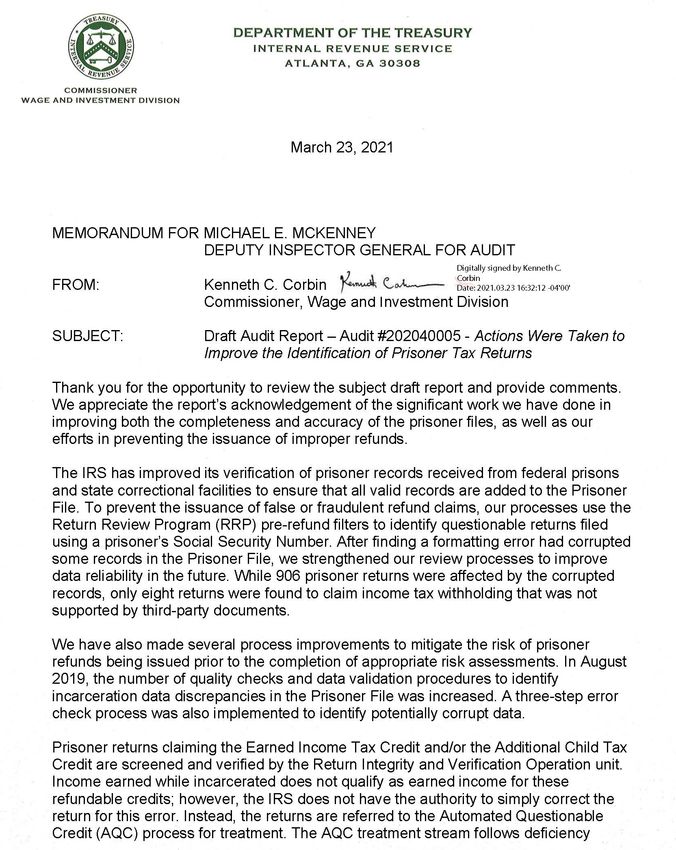
Appendix III – Management’s Response to the Draft Report .............................Page 14
Appendix IV – Abbreviations ...........................................................................................Page.18Actions Were Taken to Improve the Identification of Prisoner Tax Returns
Background
In an effort to prevent the issuance of false or fraudulent refund claims, Internal Revenue Service
(IRS) systems include detection filters that identify returns filed using a prisoner’s Social Security
Number (SSN). The IRS’s Prisoner File is the cornerstone of its efforts to identify and prevent the
issuance of fraudulent refunds to individuals filing false tax returns using a prisoner SSN,
hereafter referred to as a prisoner tax return. This file is compiled each year from information
the IRS receives from the Federal Bureau of Prisons and State Departments of Corrections. In
addition, the IRS uses Prisoner Update Processing System (PUPS) data from the Social Security
Administration (SSA) 1 to identify for additional screening tax returns filed using a prisoner SSN.
Figure 1 provides the number of tax returns filed using a prisoner SSN that the IRS identified
and confirmed as fraudulent in Processing Years 2 2017 through 2019.
Figure 1: Fraudulent Tax Returns Filed Using a
Prisoner SSN in Processing Years 2017 Through 2019 3
Processing Fraudulent Refunds Refunds Refunds
Year Tax Returns Claimed Prevented Issued
2017 8,486 $370,610,544 $370,098,071 $512,473
2018 6,799 $118,600,328 $118,584,639 $15,689
2019 4,547 $14,080,784 $13,648,020 $432,763 4
Source: Wage and Investment Division, Return Integrity and Compliance Services
function.
IRS management attributes the decrease in returns filed using a prisoner SSN to several efforts.
Examples include providing posters to prison officials to advise prisoners of the consequences of
convictions for tax-related offenses and limiting prisoner access to tax forms, instructions, and
publications.
Key legislation enacted in an effort to address fraud perpetrated by prisoners
• The Inmate Tax Fraud Prevention Act of 2008 5 - signed October 15, 2008, requires
the Secretary of the Treasury to provide an annual report to Congress on the filing of
false or fraudulent tax returns by prisoners at Federal and State prison institutions. The
most recent report issued to Congress on the filing of false and fraudulent tax returns
associated with individuals incarcerated in Federal prisons and State correctional facilities
was for Calendar Year 2019.
1
The SSA has the authority to provide incentives to institutions that provide prisoner information. The SSA pays
institutions for each individual identified whose Social Security or Supplemental Social Security Income is suspended
because the individual is incarcerated.
2
The calendar year in which the tax return or document is processed by the IRS.
3
The IRS reported in its annual report to Congress on prisoner fraud that the tax returns included those filed both by
prisoners and unknown individuals using prisoners’ SSNs.
4
The refunds issued amount does not equal refunds claimed minus refunds prevented due to rounding.
5
Pub. L. No. 110-428, 122 Stat. 4839.
Page 1Actions Were Taken to Improve the Identification of Prisoner Tax Returns
• The United States–Korea Free Trade Agreement Implementation Act 6 - signed
October 21, 2011, requires the Federal Bureau of Prisons and State Departments of
Corrections to provide the IRS with an electronic list of all the prisoners incarcerated
within their prison system for any part of the prior two calendar years or the current
calendar year through August 31. The Federal Bureau of Prisons and State Departments
of Corrections are required to provide the list of prisoners to the IRS no later than
September 15 each year.
The IRS compiles a list of prisoners (the Prisoner File) received from the Federal Bureau
of Prisons and State Departments of Corrections. The Prisoner File is the cornerstone of
IRS efforts to identify and prevent the issuance of fraudulent refunds to individuals filing
false tax returns using a prisoner SSN. The IRS also creates the Institution File, which
contains the contact information for each of the prison institutions reporting prisoner
records to the IRS.
• The American Taxpayer Relief Act of 2012 7 - enacted in January 2013, expanded the
Secretary of the Treasury’s authority to share false prisoner tax return information with
Federal prisons and State correctional facilities and gave the IRS permanent authority to
share such information.
• The Bipartisan Budget Act of 2013 8 - enacted in December 2013, amended the
Improper Payments Elimination and Recovery and Improvement Act 9 to give the
Secretary of the Treasury the legal authority to obtain PUPS data from the SSA and make
it available for those programs in which prisoners are ineligible for benefits. The Act
authorizes the IRS to compare SSA prisoner information with any other Personally
Identifiable Information derived from a Federal system of records. The Act further
provides the IRS with the authority to provide information to the head of the Federal
Bureau of Prisons and State Departments of Corrections regarding inmates whom the
IRS has determined either may have been issued an improper payment or somehow
facilitated the payment.
The Return Review Program (RRP) detects potentially fraudulent tax returns filed using
prisoner SSNs
The IRS uses the RRP 10 to detect potentially fraudulent tax returns filed using prisoners’ SSNs.
The RRP includes the capability to review multiple prior years to see if an SSN listed on a tax
return is associated with an individual incarcerated in the prior tax year or at some point in prior
years.
When tax returns are processed, the SSNs on the returns are matched against the IRS’s Prisoner
File filters. The RRP selects all refund tax returns filed using the SSN of a full-year prisoner,
i.e., incarcerated for 335 or more consecutive days in the calendar year, for further screening
and/or verification. This evaluation includes an IRS tax examiner in the Return Integrity and
6
Pub. L. No. 112-41, § 502, 125 Stat 428.
7
Pub. L. No. 112-240, 126 Stat. 2313.
8
Pub. L. No. 113-67, § 204, 127 Stat 1165.
9
Pub. L. No. 112-248, 126 Stat. 2390.
10
An automated system used to enhance the IRS’s capabilities to detect, resolve, and prevent criminal and civil
noncompliance and identity theft, thereby reducing issuance of fraudulent tax refunds.
Page 2Actions Were Taken to Improve the Identification of Prisoner Tax Returns
Verification Operation (RIVO) reviewing the income and withholding amounts reported on the
tax return to determine if those amounts are supported by third-party wage and withholding
information, e.g., Form W-2, Wage and Tax Statement, reported to the IRS. If the tax examiner
concludes that the return is potentially fraudulent, the return is then sent for verification.
Verification is when a RIVO tax examiner attempts to confirm the income and withholding
amounts on the return. For example, tax examiners compare the third-party income and
withholding information on the Information Returns Master File 11 to the income and withholding
information on the tax return. If the tax examiner is unable to verify the income and
withholding, the return remains in a “frozen” status to prevent issuance of the refund.
Beginning in Processing Year 2019, the IRS implemented a systemic process to suspend the
processing of all tax returns with unsupported income and withholding amounts to provide the
IRS with additional time to receive third-party income documents, e.g., Forms W-2. The IRS
suspends these tax returns until either the third-party income documents are received or
June 15. For those tax returns for which a third-party income document is received, the IRS will
determine if the income and withholding amounts reported on the return are supported or will
send the return for further review if the income and withholding do not match. Tax returns for
which the IRS receives no third-party income document by June 15 are selected for a fraud
review.
The Automated Questionable Credit (AQC) Program reviews prisoner returns claiming
refundable credits12
Prisoner returns that are screened and verified by RIVO tax examiners are routed to the AQC
Program for further review if the income and withholding amounts are supported by third-party
income documents, but there is a claim on the return for either the Earned Income Tax Credit
(EITC) or the Additional Child Tax Credit (ACTC). These returns are sent to the AQC Program to
determine if the income reported on the return was received for work performed while a prison
inmate, in a work release program, or while living in a halfway house. This type of income does
not qualify as earned income to claim these refundable credits.13 To qualify for the EITC in Tax
Year 2020, an individual must have earnings of $56,844 or less. The EITC may be worth as much
as $6,660 for a family with three or more children or up to $538 for taxpayers who do not have a
qualifying child. To qualify for the ACTC, the modified adjusted gross income amount on the tax
return must be $400,000 or less for couples and $200,000 or less for individuals. The ACTC is
available for certain individuals who get less than the full amount of the Child Tax Credit of
$2,000 per qualifying child.
Once these claims are received, tax examiners in the AQC Program issue the taxpayer a
Letter 4800C, Questionable Credit 30 Day Contact Letter, informing them that income received
for work performed while a prison inmate, in a work release program, or while living in a halfway
11
An IRS database containing data from Information Returns, also called “payer documents” or “third-party returns.”
12
Refundable credits are designed to help low-income individuals reduce their tax burden or to provide incentives for
other activities. The Earned Income Tax Credit is used to offset the impact of Social Security taxes on low-income
families and to encourage them to seek employment. The Additional Child Tax Credit is used to adjust the individual
income tax structure to reflect a family’s reduced ability to pay taxes as family size increases.
13
The Uruguay Round Agreements Act, enacted on December 8, 1994, states that no amount received for services by
an individual while an inmate at a penal institution shall be considered as earned income for the purposes of
determining the EITC. Pub. L. No. 103-465, 108 Stat. 4809.
Page 3Actions Were Taken to Improve the Identification of Prisoner Tax Returns
house does not qualify as earned income for the refundable credit. The letter asks the taxpayer
to provide documentation that shows the earnings were not for work performed while
incarcerated, in a work release program, or living in a halfway house. If the taxpayer does not
provide this support or respond to Letter 4800C, the taxpayer is issued a Letter 3219C, Statutory
Notice of Deficiency, allowing the taxpayer 90 calendar days to file a petition with the U.S. Tax
Court. If the taxpayer does not respond to either letter, the IRS disallows the refundable tax
credit, in most cases. Figure 2 provides the number of cases closed and revenue protected by
the AQC Program for prisoner returns claiming the EITC or the ACTC in Calendar Years 2017
through 2019.
Figure 2: AQC Program Accomplishments for
Prisoner Returns Claiming the EITC or the ACTC
Calendar Year Cases Closed Revenue Protected
2017 9,643 $7,127,260
2018 4,837 $3,436,017
2019 11,968 $4,994,234
Source: Wage and Investment Division, Return Integrity
and Compliance Services function.
The Blue Bag Program is a partnership with prison institutions
In addition to the previously mentioned information, the IRS also uses its Blue Bag Program to
identify potential tax-related fraud involving prisoners. The Blue Bag Program is intended to
identify potential tax-related fraud through Federal and State prison officials’ monitoring of
prisoner communications, e.g., tax returns and tax-related correspondence. As part of the IRS’s
partnership with prison institutions, the IRS sends a letter each year to officials at the Federal
Bureau of Prisons and State Departments of Corrections. This letter stresses the importance of
their efforts to reduce inmate tax fraud through the Blue Bag Program and explains that their
continued participation in the program is critical to prevent the spread of tax fraud when
inmates move between facilities. The annual letter explains that the program not only benefits
tax administration by preventing fraudulent refunds, but also benefits the institutional system by
reducing gang activity, drug sales, and other criminal activities in prisons that fraudulent refunds
often support.
When prison officials identify potential fraud, they forward the questionable tax return and
refund check image to the IRS’s RIVO Prisoner Lead Program, which identifies and prevents
improper refunds. If the IRS determines that the check is authorized, the IRS notifies the prison
to release the check to the inmate. Figure 3 shows the program’s accomplishments for Calendar
Years 2017 through 2019.
Page 4Actions Were Taken to Improve the Identification of Prisoner Tax Returns
Figure 3: Blue Bag Program Results for
Calendar Years 2017 Through 2019
Calendar Year Tax Returns Refund Checks Revenue Protected
2017 1,391 2,582 Not Available 14
2018 1,220 2,384 $693,266
2019 924 1,991 $239,840
Source: Wage and Investment Division, Return Integrity and
Compliance Services function.
A prior Treasury Inspector General for Tax Administration (TIGTA) report identified that
processes did not ensure that Federal and State prisons comply with prisoner reporting
requirements
TIGTA has issued a number of reports on this issue, and the IRS has taken steps to improve its
processes. In our most recent report, 15 issued in July 2017, we identified the following
conditions and made recommendations to the IRS to address the concerns raised.
• IRS processes did not ensure that the Federal Bureau of Prisons and State Departments
of Corrections complied with prisoner reporting requirements. For example, our
comparison of the PUPS file to the IRS’s Prisoner File identified 861 prisons that reported
prisoner data to the SSA but not to the IRS as required.
• Paper-filed prisoner tax returns were not identified during the IRS’s annual fraud
detection system maintenance period. As a result, 52,687 paper tax returns with refunds
totaling more than $151 million were not screened through IRS fraud detection filters
during processing.
• The IRS’s validation process incorrectly determined that prisoner records received from
Federal prisons and State correctional facilities did not have a valid SSN, name, or date of
birth. Therefore, any return filed using the mismatched prisoner information was not
evaluated for prisoner fraud. As a result, we identified 1,113 prisoner tax returns with
refunds totaling more than $1.7 million that the IRS did not identify as prisoner tax
returns.
Results of Review
In response to the concerns we raised in our July 2017 report, the IRS completed a number of
actions to reduce refund fraud associated with prisoner tax returns. Below are actions that the
IRS completed:
• The IRS implemented processes to ensure that the Federal Bureau of Prisons and State
Departments of Corrections comply with the requirement to provide the IRS with an
14
This amount was unavailable because the IRS did not track the amount of protected revenue until Calendar
Year 2018.
15
TIGTA, Ref. No. 2017-40-041, Actions Need to Be Taken to Ensure Compliance With Prisoner Reporting
Requirements and Improve Identification of Prisoner Returns (July 2017).
Page 5Actions Were Taken to Improve the Identification of Prisoner Tax Returns
annual list of all prisoners incarcerated within their prison system. Our comparison of
the SSA’s PUPS file to the IRS Prisoner File for Processing Year 2020 did not identify any
prison institutions that did not report their prisoners to the IRS. We attribute this
improvement to the IRS compiling a master list of all Federal and State prisons to
evaluate compliance with legislated reporting requirements. As of May 15, 2020, the
master list included 321 Federal and 1,148 State institutions that are required to report
the prisoners incarcerated within their prison system.
• The IRS improved its processes to ensure that it identifies all paper-filed prisoner tax
returns for screening and verification. Our analysis found that no paper-filed tax returns
were processed in January 2020 during the brief time frame when the RRP was shut
down. Figure 4 shows that the IRS now operates the RRP through the last cycle of the
calendar year to prevent paper-filed tax returns from bypassing RRP fraud detection
filters.
Figure 4: End of Year RRP and
Return Processing Activities
Date Activity
12/26/2019 Last day of individual tax return processing
12/30/2019 Last day of RRP processing
1/13/2020 Testing start day for new filing season
Source: Wage and Investment Division, Return Integrity and
Compliance Services function.
• The IRS improved its verification of prisoner records received from Federal prisons and
State correctional facilities to ensure that all valid records are added to the IRS Prisoner
File. Specifically, before adding records to its Prisoner File, the IRS assesses the validity
of the prisoner’s SSN, name, and date of birth provided by the reporting institution. In
addition, the IRS improved its processes to prevent mismatches based on the presence
of special characters and spaces in prisoner records received from the Federal prisons
and State correctional facilities.
Although the IRS’s corrective actions improved detection of potentially fraudulent prisoner tax
returns, addressing the below concerns will further reduce refund fraud.
Additional Actions Can Be Taken to Expand Participation in the Blue Bag
Program
Our review identified that the IRS can take steps to improve its efforts to ensure that all Federal
Bureau of Prisons and State Departments of Corrections participate in the Blue Bag Program. As
previously explained, the IRS sends letters to the heads of the Federal Bureau of Prisons and
State Departments of Corrections to thank them for their participation in the Blue Bag Program,
remind them to promote the program to all institutions in their jurisdiction, and request their
participation in the upcoming year. The annual letter asks each organization to respond by
providing a point-of-contact and the contact’s location, telephone number, and e-mail address.
However, the IRS did not establish a process to track Federal Bureau of Prisons’ and State
Departments of Corrections’ participation in the Blue Bag Program.
Page 6Actions Were Taken to Improve the Identification of Prisoner Tax Returns
When we raised this issue with IRS management, they stated that they updated their process to
track responses from Federal prisons and State correctional facilities in a master list.
Management also stated they will follow up if a response is not received and include the reason
provided by those institutions that do not participate.
An assessment of a sample of tax returns and checks received via the Blue Bag Program
found that the IRS was working these referrals appropriately
Our review of a statistically valid sample 16 of 137 closed Blue Bag Program cases, received from
prison institutions in Calendar Year 2019, found that the IRS properly evaluated the tax returns
and refund checks for fraud and took the appropriate case closure action. For example:
• Our review of 64 cases, in which the program received a tax return, identified that RIVO
tax examiners reviewed the tax returns to ensure that wages and withholding were
supported by third-party income documents. Additionally, the returns were reviewed to
identify improper deductions and erroneous claims for refundable credits. For the
24 returns deemed fraudulent, the tax examiner took steps to ensure that any refund
claimed on the return was not issued. For the 40 returns with no concerns identified, tax
examiners accepted the return for processing.
• Our review of 73 cases, in which the prison intercepted a tax refund check, identified that
RIVO tax examiners reviewed the underlying tax return, and for seven checks totaling
$5,594, they requested that the tax refund check be returned to the IRS for cancellation.
For the 66 checks deemed legitimate, tax examiners notified the prison that the check
could be released to the prisoner.
The Commissioner, Wage and Investment Division, should:
Recommendation 1: Ensure that responses to the Blue Bag Program letter, received from the
heads of the Federal Bureau of Prisons and State Departments of Corrections, are properly
tracked to enable the IRS to identify and work with those prison institutions that do not respond
or agree to participate in the program.
Management’s Response: The IRS agreed with this recommendation and took action in
its most recent mailing of the Blue Bag Program letters. By December 3, 2020, IRS
management included in the master listing the date that each State responded and
identified whether or not it would be participating in the program.
Corrupted Prisoner File Data Resulted in Some Full-Year Prisoner Tax Returns
Bypassing Systemic Selection for Fraud Analysis
Our review of 67,873 Tax Year 2018 refund tax returns, filed using a full-year prisoner’s SSN,
found that 906 were not identified by the RRP as a prisoner tax return and thus, not sent to a
RIVO tax examiner for review. Our further analysis found that eight of the 906 tax returns
16
We selected a statistical sample using a confidence level of 90 percent, an expected error rate of 5 percent, and a
precision factor of ± 5 percent.
Page 7Actions Were Taken to Improve the Identification of Prisoner Tax Returns
reported income and withholding that were not supported by third-party income documents.
These filers received potentially fraudulent refunds totaling more than $24,000.
The 906 returns were not correctly identified as a result of corrupted data in the IRS Prisoner File
that the IRS used in Processing Year 2019 to identify Tax Year 2018 prisoner tax returns.
Specifically, the data were corrupted by employees in the Return Integrity and Compliance
Services function who incorrectly formatted prisoner incarceration and release dates in the
Prisoner File. As a result, the Prisoner File listed some full-year prisoners as partial-year
prisoners or not incarcerated at all in Calendar Year 2018.
To prevent future errors, IRS management stated that they implemented quality checks and now
compare the IRS Prisoner File to previous years to prevent employee errors. IRS analysts also
compare the formatted data in the IRS Prisoner File to the original data in the files received from
the prison institutions.
The Commissioner, Wage and Investment Division, should:
Recommendation 2: Ensure that the quality checks and data validation procedures are
implemented when compiling the list of prisoners received from Federal and State prisons to
prevent future corruption of the IRS Prisoner File.
Management’s Response: The IRS agreed with this recommendation. In August 2019,
IRS management created programming codes to validate the data quality and added
additional error checking procedures to prevent future corruption of the Prisoner File.
Prisoner Returns With Refundable Credits Are Not Always Reviewed for Fraud
Our review of Tax Year 2018 refund tax returns 17 identified 4,533 returns filed using a full-year
prisoner SSN with refundable credits totaling $6.6 million that were not routed to the AQC
Program for review. Our review of a statistically valid sample 18 of 66 returns identified:
• 44 returns (66.7 percent) bypassed the AQC Program as a result of an error by analysts in
the Return Integrity and Compliance Services function not properly identifying these
returns to place them on the list of returns that the IRS uses to update taxpayers’
accounts with the refund freeze marker. This marker prevents the issuance of the refund
while a tax examiner verifies the income and withholding amounts on the return are
supported by third-party income documents. Once these amounts are verified, the
return should be routed to the AQC Program for further review. The AQC Program
reviews the return to determine if the income was earned for work performed while the
taxpayer was a prison inmate, in a work release program, or living in a halfway house.
This type of income does not qualify as earned income to claim the EITC and the ACTC.
In addition, the refund freeze marker list was completed on a weekly, instead of daily,
basis which delayed the marker updates to taxpayers’ accounts. When this marker is not
placed on a taxpayer’s account, the refund will be released and the tax return will not be
17
The filing status on these returns is Single or Head of Household.
18
We selected a statistical sample using a confidence level of 90 percent, an expected error rate of 5 percent, and a
precision factor of ± 5 percent.
Page 8Actions Were Taken to Improve the Identification of Prisoner Tax Returns
sent to the AQC Program for review. Based on our results, we project that 3,022 19
prisoner tax returns erroneously bypassed AQC Program selection resulting in the
issuance of potentially unallowable EITC and ACTC refundable credits totaling
$3.9 million.
When we brought the previously mentioned concern to management’s attention,
officials in the Return Integrity and Compliance Services function changed the weekly
process for marking the tax accounts to a daily process and are documenting the return
identification process in its internal guidelines. The updated guidelines will also address
the timing of when the refund freeze markers must be placed on taxpayers’ accounts.
• 14 returns (21.2 percent) bypassed AQC Program selection due to the corrupted Prisoner
File data that we previously explained in this report. These returns were not identified as
20
prisoner returns. Based on our results, we estimate that 962 tax returns erroneously
bypassed the AQC Program due to the corrupted Prisoner File resulting in the issuance
of EITC and ACTC credits totaling approximately $907,000.
• 8 returns (12.1 percent) were not required to be routed to the AQC Program because
they were reviewed by the IRS’s Examination function or the refund was properly
released by a Return Integrity and Compliance Services function tax examiner while
resolving an inquiry from the taxpayer.
The Commissioner, Wage and Investment Division, should:
Recommendation 3: Develop processes and procedures to ensure that tax returns meeting
AQC Program criteria are timely identified and refund freeze markers are timely placed on the
appropriate taxpayers’ accounts.
Management’s Response: The IRS agreed with this recommendation and updated its
procedures in the Internal Revenue Manual on March 2, 2021, to ensure that
questionable tax returns are identified, refunds are appropriately frozen, and the returns
are referred for treatment.
19
The point estimate projection is based on a two-sided 90 percent confidence interval. We are 90 percent confident
that the point estimate is between 2,539 and 3,453 tax returns.
20
The point estimate projection is based on a two-sided 90 percent confidence interval. We are 90 percent confident
that the point estimate is between 606 and 1,409 tax returns.
Page 9Actions Were Taken to Improve the Identification of Prisoner Tax Returns
Appendix I
Detailed Objective, Scope, and Methodology
Our overall objective was to evaluate the effectiveness of the IRS’s corrective actions to identify
and reduce prisoner fraud. To accomplish our objective, we:
• Determined the adequacy of actions taken to improve the completeness and reliability of
the IRS Prisoner File.
• Evaluated IRS efforts to ensure that all Federal prisons and State correctional facilities
provide information for incarcerated individuals.
• Evaluated IRS actions to supplement the accuracy and completeness of its Prisoner
File using SSA PUPS data.
• Evaluated IRS procedures for screening paper-filed prisoner tax returns for potential
fraud when the RRP is taken down for maintenance and/or filing season updates.
• Determined the effectiveness of IRS actions to prevent prisoner record mismatches
based on the presence of special characters and spaces in the prisoner records received
from Federal prisons and State correctional facilities.
• Assessed the effectiveness of the IRS’s strategy to promote the Blue Bag Program to
increase institution participation.
• Evaluated IRS procedures for processing tax returns and refund checks received through
the Blue Bag Program. To determine if closed Blue Bag Program cases were properly
resolved in accordance with IRS guidelines, we reviewed:
• A statistically valid sample of 64 closed Blue Bag Program tax return cases from a
total population of 924 cases received in Calendar Year 2019.
• A statistically valid sample of 73 closed Blue Bag Program prisoner check cases from
a total population of 1,991 cases received in Calendar Year 2019.
• Determined the adequacy of the IRS’s processes for using prisoner information to
identify fraudulent Tax Year 2018 tax returns filed with an SSN issued to individuals who
are incarcerated.
• Determined if Tax Year 2018 tax returns filed with prisoner SSNs for which a refundable
credit was processed, i.e., the ETIC and the ACTC, were routed to the AQC Program for
review as required. To determine why full-year prisoner tax returns were not routed to
the AQC Program for review, we reviewed a statistically valid sample of 66 returns from a
total population of 4,533 Tax Year 2018 full-year prisoner tax returns.
All statistical samples were based on a confidence level of 90 percent, an expected error rate of
5 percent, and a precision factor of ± 5 percent. Our contracted statistician assisted with
developing sampling plans and projections.
Page 10Actions Were Taken to Improve the Identification of Prisoner Tax Returns
Performance of This Review
This review was performed with information obtained from the IRS Wage and Investment
Division’s Return Integrity and Compliance Services function in Atlanta, Georgia, during the
period of April 2020 through February 2021. We conducted this performance audit in
accordance with generally accepted government auditing standards. Those standards require
that we plan and perform the audit to obtain sufficient, appropriate evidence to provide a
reasonable basis for our findings and conclusions based on our audit objective. We believe that
the evidence obtained provides a reasonable basis for our findings and conclusions based on
our audit objective.
Major contributors to the report were Russell Martin, Assistant Inspector General for Audit
(Returns Processing and Account Services); Allen Gray, Director; Van Warmke, Audit Manager;
Alexis Gomez, Lead Auditor; Ann Ring, Lead Auditor; Jennifer Bailey, Senior Auditor; Erica Law,
Senior Auditor; and Mark Willoughby, Senior Auditor.
Validity and Reliability of Data From Computer-Based Systems
During this review, we relied on data obtained from the Individual Master File and Return
Transaction File, which are stored on TIGTA’s Data Center Warehouse. 1 We also obtained
Forms W-2 wage and withholding information from the Information Returns Master File on the
Data Center Warehouse. In addition, we relied on data from SSA PUPS files, RRP system files,
and the Prisoner File that the IRS provided. Before relying on the data, we ensured that the files
contained the specific data elements we requested and performed testing to ensure the
reasonableness and validity of the data extracts. In addition, we selected random samples from
the data extracts and verified that the data in the extracts were the same as the data captured in
the IRS’s Integrated Data Retrieval System. Based on the results of our testing, we determined
that the data were valid and reliable for the purposes of this audit.
Internal Controls Methodology
Internal controls relate to management’s plans, methods, and procedures used to meet their
mission, goals, and objectives. Internal controls include the processes and procedures for
planning, organizing, directing, and controlling program operations. They include the systems
for measuring, reporting, and monitoring program performance. We determined that the
following internal controls were relevant to our audit objective: processes to improve the
completeness and reliability of the IRS Prisoner File, procedures for screening potentially
fraudulent prisoner tax returns when the RRP is down for maintenance, measures to minimize
the number of prisoner mismatch records, strategy to promote the Blue Bag Program to
increase institution participation, and processes for using prisoner information to identify
fraudulent tax returns filed with the IRS. We evaluated these controls by reviewing the IRS
Internal Revenue Manual containing the policies and procedures on reviewing prisoner tax
returns, interviewing Return Integrity and Compliance Services function staff and management,
and reviewing other key documentation related to the IRS’s corrective actions to identify and
reduce prisoner fraud.
1
A TIGTA repository of IRS data.
Page 11Actions Were Taken to Improve the Identification of Prisoner Tax Returns
Appendix II
Outcome Measures
This appendix presents detailed information on the measurable impact that our recommended
corrective actions will have on tax administration. These benefits will be incorporated into our
Semiannual Report to Congress.
Type and Value of Outcome Measure:
• Revenue Protection – Potential; $24,423 in fraudulent tax refunds issued for eight tax
returns that reported income and withholding that were not supported by third-party
income tax documents (see Recommendation 2).
Methodology Used to Measure the Reported Benefit:
Our review of 67,873 Tax Year 2018 refund tax returns, filed using a full-year prisoner’s SSN,
found that 906 were not identified by the RRP as a prisoner tax return and thus, not sent to a
RIVO tax examiner for review. The 906 returns were not correctly identified as a result of
corrupted data in the IRS Prisoner File that the IRS used in Processing Year 2019 to identify Tax
Year 2018 prisoner tax returns. Specifically, the data were corrupted by employees in the Return
Integrity and Compliance Services function who incorrectly formatted prisoner incarceration and
release dates in the Prisoner File. As a result, the Prisoner File listed some full-year prisoners as
partial-year prisoners or not incarcerated at all in Calendar Year 2018. Our further analysis
found that eight of the 906 tax returns reported income and withholding that were not
supported by third-party income documents. These filers received potentially fraudulent
refunds totaling $24,423.
Type and Value of Outcome Measure:
• Cost Savings (Funds Put to Better Use) – Potential; $4.8 million in unallowable EITC and
ACTC refundable credits for 3,984 prisoner tax returns that erroneously bypassed AQC
Program selection (see Recommendation 3).
Methodology Used to Measure the Reported Benefit:
Our review of Tax Year 2018 refund tax returns 1 identified 4,533 returns filed using a full-year
prisoner SSN with refundable credits totaling $6.6 million that were not routed to the AQC
Program for review. We reviewed a statistically valid sample 2 of 66 returns and identified
44 returns (66.7 percent) bypassed the AQC Program because of an error by analysts in the
Return Integrity and Compliance Services function. The error involved not properly identifying
these returns to place them on the list of returns that the IRS uses to update taxpayers’ accounts
1
The filing status on these returns is Single or Head of Household.
2
We selected a statistical sample using a confidence level of 90 percent, an expected error rate of 5 percent, and a
precision factor of ± 5 percent.
Page 12Actions Were Taken to Improve the Identification of Prisoner Tax Returns
with the refund freeze marker. Based on our results, we project that 3,022 3 prisoner tax returns
erroneously bypassed AQC Program selection resulting in the issuance of potentially
unallowable EITC and ACTC refundable credits totaling $3.9 million.
In addition, we identified 14 returns (21.2 percent) that bypassed AQC Program selection due to
the corrupted Prisoner File data and were not identified as prisoner returns. Based on our
4
results, we estimate that 962 tax returns erroneously bypassed the AQC Program due to the
corrupted Prisoner File, resulting in the issuance of EITC and ACTC credits totaling approximately
$907,000.
In total, we project that 3,984 tax returns (3,022 + 962) erroneously bypassed the AQC Program
resulting in the issuance of potentially unallowable EITC and ACTC refundable credits totaling
$4,839,871 ($3,932,584 + $907,287).
3
The point estimate projection is based on a two-sided 90 percent confidence interval. We are 90 percent confident
that the point estimate is between 2,539 and 3,453 tax returns.
4
The point estimate projection is based on a two-sided 90 percent confidence interval. We are 90 percent confident
that the point estimate is between 606 and 1,409 tax returns.
Page 13Actions Were Taken to Improve the Identification of Prisoner Tax Returns
Appendix III
Management’s Response to the Draft Report
Page 14Actions Were Taken to Improve the Identification of Prisoner Tax Returns
Page 15Actions Were Taken to Improve the Identification of Prisoner Tax Returns
Page 16Actions Were Taken to Improve the Identification of Prisoner Tax Returns
Page 17Actions Were Taken to Improve the Identification of Prisoner Tax Returns
Appendix IV
Abbreviations
ACTC Additional Child Tax Credit
AQC Automated Questionable Credit
EITC Earned Income Tax Credit
IRS Internal Revenue Service
PUPS Prisoner Update Processing System
RIVO Return Integrity and Verification Operation
RRP Return Review Program
SSA Social Security Administration
SSN Social Security Number
TIGTA Treasury Inspector General for Tax Administration
Page 18To report fraud, waste, or abuse,
call our toll-free hotline at:
(800) 366-4484
By Web:
www.treasury.gov/tigta/
Or Write:
Treasury Inspector General for Tax Administration
P.O. Box 589
Ben Franklin Station
Washington, D.C. 20044-0589
Information you provide is confidential, and you may remain anonymous.You can also read


