TURKEY: SELF-RELIANCE AND LIVELIHOODS - UNHCR
←
→
Page content transcription
If your browser does not render page correctly, please read the page content below
TURKEY: SELF-RELIANCE AND
LIVELIHOODS
August 2018
Promoting Livelihoods and Self-Reliance
In line with the strategy developed within the
framework of the Regional Refugee and
Resilience Plan (3RP) for Turkey, expanding
livelihood and job opportunities for Syrians and
refugees of other nationalities in Turkey is a
strategic objective of UNHCR in an effort to
support self-reliance as a prerequisite to any
durable solution.
Turkey’s national asylum framework, as set out in
the Regulation on Work Permits of Foreigners
under Temporary Protection in January 2016 and
the Regulation on Work Permit of International
Protection Applicants and International Protection
Status Holders in April 2016, grants access to
formal employment, thus providing an enabling
environment to achieve self-reliance.
Government statistics indicate that, nearly 22,000
Syrian refugees have been issued work permits,
since the adoption of the Regulation on Work
Permits of Foreigners under Temporary
Protection in January 2016 and the Regulation on
Work Permit of International Protection Applicants
and International Protection Status Holders in
April 2016. These figures give an indication of the
challenge ahead and the need to maintain and
strengthen the efforts to facilitate formal economic participation of refugees. In January 2018, the
fees relating to issuance of work permits have been halved in an attempt to encourage employers
to engage refugees.
2018 Strategy and Priorities
UNHCR’s strategy for livelihood and self-reliance is of a catalytic nature and focuses on several
aspects: the institutional, legal and administrative environment, the capacity and skills of refugees
and the economic absorptive capacity and potential of local labour markets.
Support the implementation of the legal framework on access to employment:
Despite a favourable legal environment in Turkey, several challenges exist for refugees to
access formal employment, not least the substantial number of refugees of working age. Within
the existing legal framework, barriers such as the formal quota for refugees which must not
exceed 10 per cent of the total workforce per enterprise, and the requirement that refugees be
www.unhcr.org 1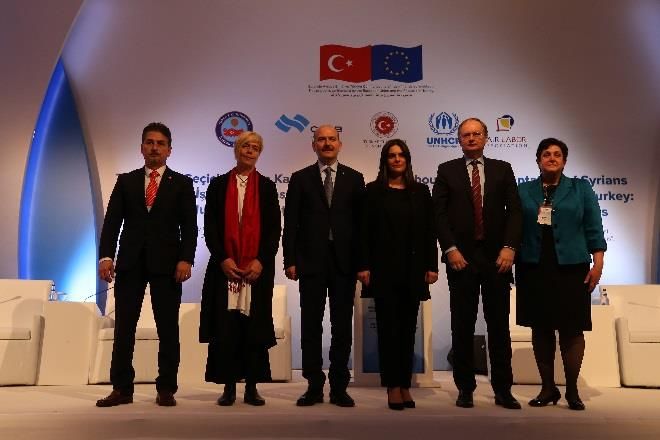
employed in their province of registration, hinder broader access. Support to the authorities in
the implementation of the legal framework is essential to advocate a more flexible and inclusive
approach in order to maximise access by refugees of all nationalities.
This element of strong advocacy requires coordination with other actors in the sector, in
particular FAO, ILO and UNDP with whom UNHCR is collaborating extensively.
Increase the capacity and skills of refugees:
UNHCR aims to support and foster linkages between refugees and state livelihoods and
employment services. In this regard, the Turkish Employment Agency (ISKUR) with the support
of UNHCR engages in joint information dissemination to refugees and in supporting refugee
access to services provided in ISKUR service centres.
Support to the Vocational Qualification Authorities to facilitate the certification of skills.
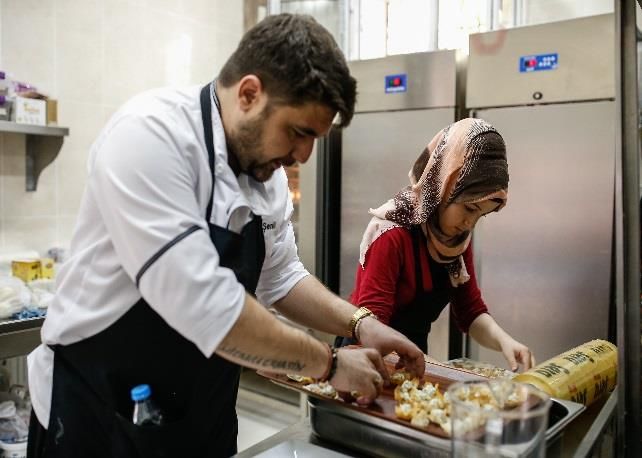
Joint programming with FAO on the first large-
scale project aiming to expand livelihoods
opportunities for Syrian refugees and host
communities in the agricultural sector by
enhancing their agricultural skills. In 2017 and
2018, the project aims to reach some 1,400
people. The project reached 900 beneficiaries
throughout 2017 and is currently ongoing with
500 beneficiaries.
Refugee entrepreneurship is one of the areas © UNHCR/Emrah Gurel
where refugees create added value for the
host economies. Indeed, Turkey currently has nearly 8,000 refugee-owned businesses
operating as formally registered companies. Entrepreneurs from the refugee community may
participate in UNHCR-implemented entrepreneurship activities, including training, mentorship
and financial support, which aim to foster and stimulate refugee entrepreneurship in two ways,
namely though start-up support provided to refugees who wish to establish their own business,
as well as through business development support targeting existing refugee businesses to
develop further. Participants are supported with small grants, productive asset support and
incentives for various types of trainings provided by UNHCR.
Contribute to strengthening the economic absorption and demand aspects:
Advancement of partnerships with development partners, including the International Financial
Institutions, and the World Bank in particular, to find synergies with national development
programmes for longer term solutions, such as through national systems and programmes that
aim to provide opportunities for livelihoods and self-reliance. Joint analytical work to better
understand the economic and absorption capacity in various labour market areas, taking into
account social cohesion considerations, will be undertaken with a view to developing business
models which would accelerate the number of refugees legally employed.
Continuation of collaboration with the private sector, including international brands with supply
chain in Turkey, with the objective of information sharing and awareness raising; support in
work permit application procedures; expanded partnership for job training opportunities and job
matching.
Activities and Progress
UNHCR works closely with ISKUR to ensure uniform service delivery and support the provision
to refugees of quality counselling on services related to job opportunities and issues
www.unhcr.org 2surrounding legal challenges. Project staff are provided to ISKUR for the implementation of joint
programmes. Jointly-established kiosks in ISKUR service centres remain essential contact
points for refugees to receive employment counselling and job-matching support.
A Guide to Employment brochure, published in partnership with ISKUR, responds to the demand
from refugees and other stakeholders on how to join the active labour force in Turkey.
Refugees currently face difficulties to have their qualifications recognised in Turkey. Turkish
national qualifications and standards are being translated into Arabic to enhance refugee
knowledge of the national standards. In coming months, UNHCR will start a pilot project in
support of the Vocational Qualifications Authority (VQA) to facilitate the accreditation process
for refugees.
On 11 May 2018 in Istanbul, UNHCR co-hosted
a conference on “Labour Market Adaptation of
Syrians under Temporary Protection in Turkey:
Challenges and Opportunities”, with the former
Ministry of Labour and Social Security of Turkey
and the Fair Labour Association (FLA). The
conference aimed to bring together public and
private sector stakeholders to create a platform
for exchanging knowledge and experience on
© UNHCR/Emrah Gurel
refugee self-reliance, with a focus on labour
market dynamics. Panel participants represented both public and private sector perspectives
with active contribution from trade unions, associations, chambers, international brands,
Turkish SMEs and refugee-owned enterprises. UNHCR Turkey is currently working closely with
the relevant Ministry counterparts to follow up on action points arising from this meeting.
In 2017, the UNHCR-FAO joint agriculture sector project trained 900 refugees, in five cities in
Turkey. This year, the project continues its second phase and will reach 500 beneficiaries in
Adana, Gaziantep, Izmir, Mardin, Mersin, and Sanliurfa. Training topics include vegetable and
fruit production, poultry, food processing, livestock and greenhouse management.
Currently UNHCR is implementing vocational and language training programmes in 9 provinces
of Turkey in collaboration with municipalities, governorates, sub-governorates and other
partners. As of July 2018, over 1500 beneficiaries were reached through ongoing and
completed trainings provided by UNHCR and its partners.
www.unhcr.org 3August 2018 External and Donor Relations Thanks to UNHCR’s donors for supporting our livelihoods and self-reliance activities in Turkey and for their unrestricted and regional funds in 2018: European Union | Japan | United States | Canada | Norway | France | Germany | Private donors Australia | Finland I Sweden | Netherlands | United Kingdom | Private donors Spain | Denmark | Australia | Switzerland | Private donors Republic of Korea | Italy | Belgium CONTACTS Hilary Bowman, Inter-Agency Coordination Officer, bowman@unhcr.org LINKS Regional Portal - Syria Regional Refugee Response | Regional Portal - Mediterranean | UNHCR Turkey website | Facebook | Services Advisor | UNHCR Help www.unhcr.org 4
You can also read


