Tweeting about Brussels? European governance in the communications of national parties and leaders - RESTEP
←
→
Page content transcription
If your browser does not render page correctly, please read the page content below
Tweeting about Brussels? European
 governance in the communications of
     national parties and leaders
Alban Versailles is a PhD student at the Institut de sciences politiques Louvain-Europe,
UCLouvain, Belgium. His research focuses on political parties’ communication, citizens’
attitudes, and the politicization of European integration. He works primarily with automated
data    collection   online,     quantitative   text    analysis,  and    survey    methods.
alban.versailles@uclouvain.be & @AlbanVersailles

ABSTRACT

                In this paper, I investigate whether national political parties and leaders
       communicate about European governance. According to the neo-functionalist
       argument, I expect them to emphasize European affairs at the time of important
       European governance events and when they are involved in European decision-making
       processes. I use a unique longitudinal dataset of nearly 2 million tweets published over
       eleven years (2009–2019) by 67 political parties and their leaders in 10 western EU
       member states, to track whether European governance increase emphasis on EU affairs.
       I find that emphasis on European affairs increases at the time of European elections,
       referendum, European summits, major speeches of the European Commission president,
       and plenary sessions of the European Parliament. These results suggest that the
       exercise of supranational authority does indeed increase its visibility through the
       communications of political actors. Moreover, these findings have normative
       implications, as visibility is the first key requirement for the accountability of European
       governance.

   The European Commission's support for the production of this publication does not constitute an
endorsement of the contents, which reflect the views only of the authors, and the Commission cannot be
        held responsible for any use which may be made of the information contained therein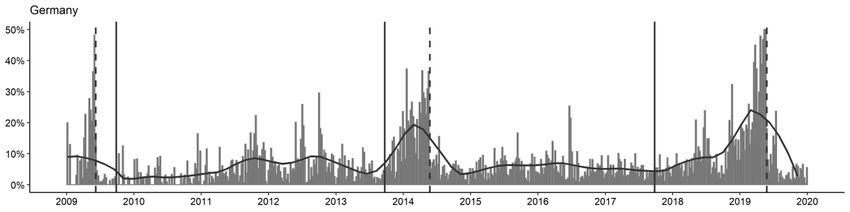
Versailles 2021

INTRODUCTION

        European integration is a unique political process. Sovereign states have decided to
transfer competences and binding authority in certain areas to the supranational level. Over a
few decades, the group of member states and the scope of competences have considerably
widened, while the powers of supranational institutions have deepened. The European Union is
now an encompassing and powerful political system. According to the neo-functionalist
approach, as the authority of the EU grows, European rules and decisions cover a wide range of
areas, and have thus an increasing impact on national actors and societies, intensifying the
functional pressures and incentives for actors to engage with European affairs
(Schmitter 1969). The transfer of authority from member states to the EU is therefore seen as
the initial reason why the EU matters gain visibility and involves more political actors (de Wilde
et al. 2016; de Wilde and Zürn 2012). Moreover, this neo-functionalist idea that supranational
authority should lead to politicization also applies to daily European governance. In other
words, the exercise of authority at the supranational level should increase the engagement of
political actors and the visibility of EU matters as well.

        In addition to the functional pressure, there are also strong normative requirements for
political actors to communicate publicly about European governance. Without visibility,
European governance will remain an opaque and consensual process remote from any public
democratic debate. Indeed, national parliaments, national governments and heads of
governments are all involved at different stages of European decision-making processes. These
political actors must be held accountable for EU governance before the national parliament
and the national voters (Bergman 2000; Strøm 2000). For this purpose, they must give account
for and publicly communicate about their EU-level activity, while the national parliament and
opposition parties have to scrutinize these activities (Bovens 2007; Rauh and de Wilde 2018).

        In this paper, I investigate whether national political parties and leaders communicate
about European governance. According to the neo-functionalist argument, I expect them to
emphasize European affairs at the time of important European governance events and when

                                                                                                2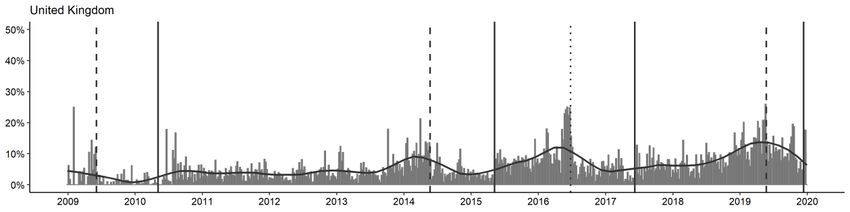
WORKING PAPER

they are involved in European decision-making processes. I use a unique longitudinal dataset of
nearly 2 million tweets published over eleven years (2009–2019) by 67 political parties and
their leaders in 10 western EU member states, to track whether European governance increase
emphasis on EU affairs. I consider Twitter a pertinent data source to analyse the
communication of political actors. Indeed, the particularities of Twitter, which is widely used by
public figures and journalists, make it the ideal place to publish public statements
(Parmelee 2013; Parmelee and Bichard 2011; Verweij 2012). Since Twitter allows continuous
communication without any institutional constraint and almost directly with the public, the
functional pressure and normative requirement to emphasize European governance when it
matters are as strong as ever.

THE FUNCTIONAL POLITICIZATION OF EUROPEAN GOVERNANCE

        In the last two decades, an important debate has emerged about the politicization of
European integration. Although it seems to be a particularly differentiated and multifaceted
phenomenon across times, countries and settings (de Wilde et al. 2016), a widely shared view
considers that “no serious student of European integration can deny that something like
politicization has occurred” (Schmitter 2009:211). This impression that evolution has taken
place, and that European integration is now, more than before, subject to public visibility and
public contestation, is best embodied by the idea that a “constraining dissensus” has replaced
the previous “permissive consensus” (Hooghe and Marks 2009). In their proposition of a
postfunctionalist theory of European integration, Hooghe and Marks argue that public
contestation shaped by identity politics politicize European integration and ultimately leads to
a constraining dissensus hindering further integration. This pessimistic view challenges the
optimism of neo-functionalism that primarily saw politicization as a logical and desirable
consequence of European integration.

        Indeed, influential early thinkers tried to explain the transfer of political competences
from states to supranational institutions as a functional process. This neo-functionalist
approach explained the integration process as a spillover dynamic where advances in one area

                                                                                                3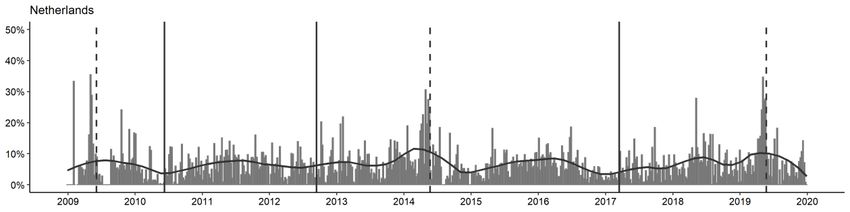
Versailles 2021

create functional incentives and pressures for further advances (Haas 1958). The underlying
functional logic was that either the gains due to cooperation in one area incentivize actors to
extend cooperation to other areas, or the need to handle unexpected side effects of
integration in one area push towards further integration (Schmitter 1969). Pursuing the
functional logic, neo-functionalists expected early on that integration would lead to
politicization. The idea is that the functional logic also applies to the involvement of political
and societal actors. Indeed, as the spillover process widens and deepens the scope of
integration, more policy areas are concerned, and more national actors tend to be involved.
The scope and the depth of supranational authority grows, European rules and decisions cover
a wide range of areas and have thus an increasing impact on national actors and societies,
intensifying the functional pressures and incentives for political and societal actors to engage
with European affairs. Moreover, the integration process progressively extends to more salient
or controversial domains. Hence, “politicization thus refers initially to a process whereby the
controversiality of joint decision-making goes up. This in turn is likely to lead to a widening of
the audience or clientele interested and active in integration” (Schmitter 1969:166).

        Much more recently, scholars have tried to explain why Europe was becoming subject
to salient public debates. Following the neo-functionalist idea that integration leads to
politicization (Schmitter 1969), an influential approach argues that the root cause of
politicization is the increased authority and scope of the European Union. The underlying idea
is that the neo-functionalist argument also applies to the involvement of political and societal
actors. The transfer of authority from member states to the EU is therefore seen as the initial
reason why the EU matters gain visibility and is debated. Politicization is therefore defined as
“growing public awareness of international institutions and increased public mobilisation of
competing political preferences regarding institutions’ policies and procedures” (Zürn et al.
2012:71). And in turn, “The rising politicization of European integration is primarily a reaction
to the increasing authority of the EU over time” (de Wilde and Zürn 2012: 140). This “authority
transfer hypothesis” has been particularly influential in the politicization literature. Scholars
have shown that major integration steps are debated in the public arena. Successive treaty
revisions and new members’ accessions have triggered public and parliamentary debates,

                                                                                                4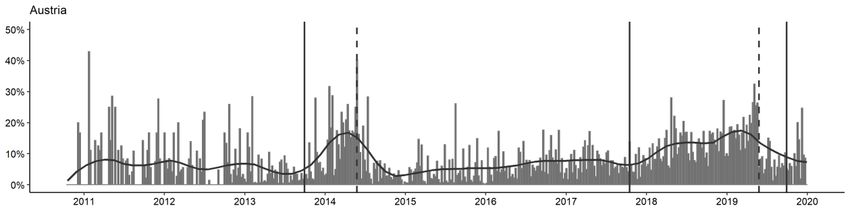
WORKING PAPER

especially when a national referendum was held on the issue (Grande and Hutter 2016; Hutter
and Grande 2014; Rauh 2015; Rauh and de Wilde 2018; Statham and Trenz 2013; de Wilde
2014).

         Moreover, the functional argument of the authority transfer hypothesis does not only
apply to major integration steps such as treaty revisions and new members’ accessions. The
neo-functionalist idea that supranational authority should lead to politicization also applies to
daily European governance. Since the supranational level has been vested with significant
powers, the exercise of that authority effects and concerns numerous societal and political
actors. More actors are directly involved in or indirectly impacted by European governance,
and thus should turn to the European level in order to express their claims and demands, and
to publicly voice their opinions on EU matters (de Wilde 2011; de Wilde and Zürn 2012).
Therefore, there is an important functional pressure for political actors to communicate about
European affairs and European governance.

         In addition, there is also an important normative requirement for public
communications about EU governance. Indeed, from a more normative perspective, authors
have defended the idea that the EU suffers from a democratic deficit. They have first argued
that the EU lacked politicization, whereas a democratic system requires political contestation
over leadership and policy (Follesdal and Hix 2006). They also point out the lack of transparency
and publicity in European decision-making mechanisms such as the trilogues, these informal
inter-institutional negotiations taking place behind closed doors to reach an agreement on
legislative proposals (Curtin and Leino 2017; Laloux 2020; Lord 2013). These considerations
highlight the importance of public communications from political actors involved in European
governance.

         Indeed, national parliaments, national governments and heads of governments are all
involved at different stages of European decision-making processes. These political actors must
be held accountable for EU governance before the national parliament and the national voters
(Bergman 2000; Strøm 2000). For this purpose, they have to give an account for and publicly

                                                                                               5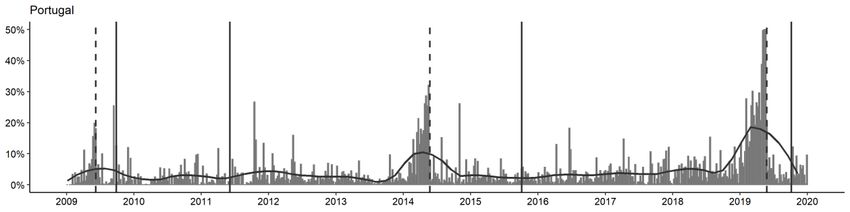
Versailles 2021

communicate about their EU-level activity, while national parliament and opposition parties
must scrutinize these activities (Bovens 2007; Rauh and de Wilde 2018). Indeed, publicity
allows public scrutiny and contestation over decisions and enhances the democratic
accountability of the political system. Hence, it would also be a democratic deficit if political
actors in the national arena were silent about EU affairs. Therefore, the democratic legitimacy
of European governance requires involvement from political actors and publicity. In other
words, political actors face significant functional pressures and normative requirements to
communicate about European governance.

WHEN WILL POLITICAL ACTORS COMMUNICATE ABOUT EUROPEAN
AFFAIRS?

        The question is now to know when these functional pressures and normative
requirements are the strongest. When will political actors such as national parties and leaders
emphasize European governance in their communications?

        The first striking occasion when emphasis on European affairs from political parties is
expected is European elections. European citizens have directly elected members of the
European Parliament since 1979. Therefore, considering that European elections are the most
direct route of delegation and accountability between citizens and the European Union, and
that the European Parliament plays a prominent legislative role in numerous areas, there is a
strong democratic requirement and a functional pressure on political parties to engage in
European elections. A functional politicization of European elections from national political
parties is both desirable and necessary. Yet, the “second-order” model sees European elections
as less salient than national ones and expects political actors to campaign less in them, focusing
debates mainly on national issues (Reif and Schmitt 1980). However, recent findings indicate
that parties dedicate a substantive part of their European elections manifestos to European
constitutive and policy issues, and emphasis on EU issues increases during European elections
campaigns (Braun et al. 2016; Braun and Schmitt 2018; Eugster et al. 2020). Therefore, I expect

                                                                                                6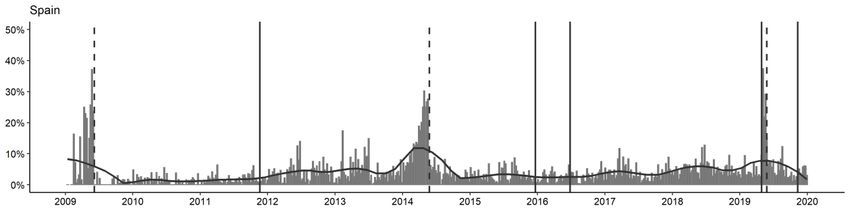
WORKING PAPER

that parties’ communications on Twitter increasingly discuss European matters close to
European elections.

       H1: Parties’ emphasis on European affairs increases as the next European
       election gets closer.

       Less frequent than European elections, when a referendum is held to ratify a new
European treaty or on the question of EU membership, public debates about European affairs
are not only likely to happen, but above all necessary. Indeed, according to the authority
transfer hypothesis, the transfer of authority from member states to the EU is the root cause
and driver of politicization (de Wilde and Zürn 2012; Zürn et al. 2012). Scholars have shown
that major integration steps are debated in the public arena. Indeed, analysing mediatized
public debates around major integration steps, Grande and Hutter (2016) show that authority
transfer leads to politicization. In particular, they investigate whether major steps in the
deepening or widening of European integration such as treaty reforms, enlargement to third
countries and a country’s own accession to the EU trigger public debates. First, they find that
the question of EU membership triggers an important politicization when a country’s own
accession is debated. Then, they also find that within EU members, debates about treaty
reforms can trigger important politicization. However, this was the case on only a few
occasions, particularly when there was a national referendum on the question.

       National referendums on the revisions of European treaties have indeed been
important catalysts for politicization. The experiences of referendums on the Maastricht Treaty
in 1992 and on the Constitutional Treaty in 2005 have demonstrated that questions of further
authority transfer to the supranational level can lead to particularly salient and polarized
debates in the public sphere (Statham and Trenz 2013). In sum, successive treaty revisions and
new members’ accessions have triggered public and parliamentary debates, especially when a
national referendum was held on the issue (Grande and Hutter 2016; Hutter and Grande 2014;
Rauh 2015; Rauh and de Wilde 2018; Statham and Trenz 2013; de Wilde 2014). Therefore,
given that both membership debates and referendums trigger politicization, I expect that

                                                                                             7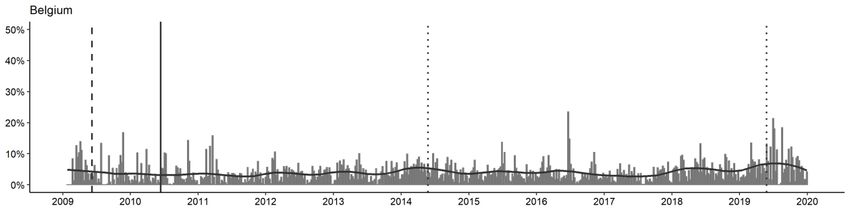
Versailles 2021

parties in the United Kingdom increasingly emphasized European affairs in the campaign before
the 2016 referendum.

        H2a: In the United Kingdom, parties’ emphasis on European affairs increased
        during the campaign before the referendum on EU membership.

        Then, a national referendum on a question as crucial as treaty ratification or Union
membership should trigger emphasis on European affairs in other member states as well. In
the past, scholars have already documented how debates on the Constitutional Treaty in
France were echoed in the British and German media, for example (Statham and Trenz 2013).
Therefore, I also expect that parties in other countries emphasized European affairs at the time
of the referendum in the UK.

        H2b: In other countries, parties’ emphasis on European affairs increased at the
        time of the referendum in the UK.

        Beyond elections and referendums, emphasis on European affairs from national
political actors is also expected when the authority of the EU is exercised. The neo-functionalist
idea that supranational authority should lead to politicization also applies to daily European
governance. Since the supranational level has been vested with significant powers, the exercise
of that authority effects and concerns numerous societal and political actors. More actors are
directly involved in or indirectly impacted by European governance, and thus should turn to the
European level in order to express their claims and demands, and should publicly voice their
opinions on EU matters (de Wilde 2011; de Wilde and Zürn 2012).

        Communication from political actors is also required so that European governance
becomes more visible and can be debated in public. Therefore, political parties should
communicate about European affairs during moments of European governance, when
decisions are taken at the EU level, when EU authority is exercised or when major political
orientations of the EU are discussed. This responsiveness to EU governance and decision-
making moments is indeed an important requirement for the accountability of European
governance (Rauh and de Wilde 2018).

                                                                                                8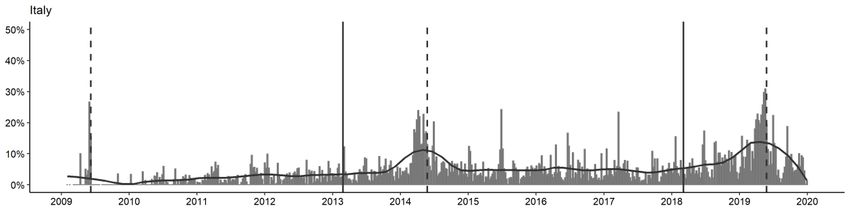
WORKING PAPER

        Hence, scholars have shown that members of national parliaments tend to emphasize
European affairs when EU directives are adopted, close to European summits, or following the
European Council agenda (Rauh and de Wilde 2018; Winzen et al. 2018). These findings tend to
point towards optimism regarding EU accountability, as MPs talk about European affairs when
important issues and decisions are at stake at the EU level. However, these findings only
concern parliamentary speeches where institutional procedures play a predominant role in
triggering or constraining the possibility of EU affairs scrutiny (Auel et al. 2015; Winzen et al.
2018). Indeed, parliaments have an institutionalized central role in the democratic
accountability of supranational governance (Auel 2007; Auel and Raunio 2014; Cooper 2012;
Karlas 2012; Raunio 2011; Winzen 2012). This raises thus the question of whether there is a
linkage to EU decision-making moments in the communications of political actors outside of
the parliamentary arena. Do political parties emphasize European affairs in their
communications on Twitter when an important EU decision-making process takes place?
Although there is no institutional procedure to encourage parties to talk about these matters, I
still expect there to be a linkage between parties’ communications on Twitter and EU decision-
making moments.

        H3: Parties’ emphasis on European affairs increases during important EU
        decision-making moments

        Finally, because they have gained seats and offices, some parties face an even stronger
pressure to emphasize European affairs, as they are involved—through governments and/or
elected representatives—in European governance. Hence, members of national government
should communicate about executive-dominated European governance events. While scholars
have warned of a possible opposition deficit in parliamentary scrutiny over European affairs
(Rauh and de Wilde 2018), there is still a need for national governments to communicate
publicly about their involvement in decisions at the European level. This can lead to an
imbalance in the emphasis on Europe between government and opposition parties at the time
of executive-dominated European governance events. On these occasions, this imbalance does
not seem to be a problem since it would demonstrate that governments do indeed give a
certain public visibility to these decision-making moments. Therefore, I expect parties in

                                                                                                9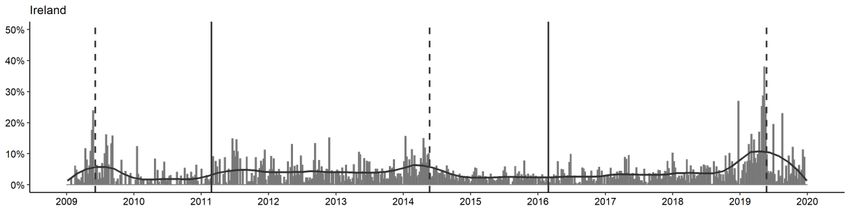
Versailles 2021

government to increase even more their emphasis on European affairs during the European
Council’s summits, and when their country holds the EU Council presidency.

        H4a: Parties’ emphasis on European affairs increases even more for parties in
        the national government during the European Council’s summits.

        H4b: Parties’ emphasis on European affairs increases even more for parties in
        the national government when their country holds the rotating presidency of
        the EU Council.

        Then, through European elections, national parties gain seats in the European
Parliament. Having elected representatives involved in the EU legislative process should trigger
an emphasis on European affairs. Indeed, having elected MEPs give to political parties the
possibility as well as the responsibility to communicate publicly about European affairs.
Considering that European elections are the most direct route of delegation and accountability
between citizens and European decision-making (Norris 1997), and that the European
Parliament plays a prominent legislative role in numerous areas, there is a strong democratic
requirement and functional pressure for MEPs and their parties to emphasize EU affairs.
Moreover, I expect this effect to grow with the size of the party’s delegation in the European
Parliament. This is because having more MEPs allows them to specialize in different policy
areas and take part in different committees, in turn extending the possibility and responsibility
to communicate about different European issues, topics and legislative files.

        H5: Parties’ emphasis on European affairs increases when they hold a larger
        share of seats in the European Parliament.

DATA AND OPERATIONALIZATION1

        In order to study political parties’ communications about Europe, I collected the
messages they have published on Twitter. Circumventing the classical limitations of data
collection on Twitter thanks to a web-scrapping approach, I have collected a unique

        1
            For more details on the data collection and analysis, see my upcoming PhD dissertation.

                                                                                                      10
WORKING PAPER
longitudinal dataset of nearly 2 million tweets published over eleven years (2009–2019) by 67
political parties and their leaders in 10 western EU member states.2 These are Austria, Belgium,
France, Germany, Ireland, Italy, Netherlands, Portugal, Spain, and the United Kingdom. In each
country, I selected all the parties who won at least 5% of votes in any national or European
election since 2009.
Twitter is a particularly promising source to study political actors’ communications.
Indeed, it has become a major medium for political communications in the last decade, offering
an unmediated platform for political actors to make public statements. They are constrained
neither by the institutional rules of parliamentary interventions nor by the editorial and agenda
choices of the media (Peteers et al. 2019). Most political leaders, organizations and parties use
this social media and publish relatively frequent messages on the platform. It is arguably a
“place to be” for political actors to take part in public debates and get attention. Some are
much more active than others and styles vary, but most are aware that it is an important
medium to get their messages out to a wider audience. There is, of course, the audience of
Twitter users, but tweets have an even greater audience when they are picked up by other
media. Indeed, tweets from political actors strongly attract journalists’ attention
(Parmelee 2013; Parmelee and Bichard 2011; Verweij 2012). Nowadays, we often see tweets
from public figures being quoted in the news. As such, tweets from political leaders or parties
serve as short press releases. Political actors therefore use Twitter to make public statements,
to state their position or emphasize specific issues.
This large corpus of collected tweets allows a longitudinal and fine-grained analysis of
emphasis on European affairs from political parties. I follow a text-as-data approach and
perform automated content analysis techniques to measure issue emphasis (Grimmer and
Stewart 2013). I measure emphasis as the extent to which parties refer to European affairs in
their communications. I use the straightforward approach of dictionaries. The principle is that
the computer assigns words, or other text units such as multi-word expressions, to a priori
defined categories (the dictionary). I use two different dictionaries, the first one is the
2
Description of the dataset in the appendix.
11Versailles 2021
“European dictionary,” and it matches all occurrences of “the EU,” “Europe” and
“European(s)”. It is a very short dictionary with relatively vague entries. There is therefore a risk
of having false positives and false negatives. However, I still consider this dictionary to be a
relevant indicator of emphasis on European affairs because it suits well the style of
communication on Twitter. Indeed, the brevity of tweets (with a maximum of 140 characters
until November 2017 and 280 since then) forces to be concise and to go straight to the point
while making sure that the topic is clear for the public audience. Tweets are more likely to
include general keywords such as “Europe” rather than technical vocabulary such as the full
names of institutions and procedures.
Second, I measure the share of tweets referring to EU governance using a more
detailed dictionary developed by Rauh (Rauh 2015; Rauh and de Wilde 2018). This dictionary
includes a much larger list of more precise entries. It covers references to the EU polity, such as
“the EU,” “Lisbon treaty” or “European institutions,” the EU politics (political actors and
institutions), such as “ECB,” “European Council” or “MEP,” and the EU policies, such as “CFSP,”
“European directive” or “Eurozone.” The risk of false positives is therefore much lower than
with the first dictionary, because here each dictionary entry is a precise reference to an
element of European governance. Finally, I validate these measurements, showing that they
significantly correlate3, as well as with existing indicators of party emphasis on European
integration (Chapel Hill Expert Survey and Manifesto Project). In the subsequent analyses, I use
the measurement from the simple first dictionary, keeping the second for robustness checks.
I run regression models to test my hypotheses. My dependent variable is computed as
the number of tweets referring to European affairs (European dictionary) published by a party
over one week. I study weekly variations because most of my hypotheses concern the
occurrence of specific events and therefore require a fine-grained analysis. Since the
dependent variable is a count variable, I use binomial negative regressions and I add the total
number of tweets published by a party during the week (Activity) as a control variable because
3
Correlation matrix in the appendix
12WORKING PAPER
the number of tweets referring to Europe obviously depends on the total number of tweets
published by the party during that week.
The first independent variable is the proximity of the next European election. It is
computed as the number of weeks until the next election, log transformed to account for the
exponential salience of the electoral campaign in the public agenda. Indeed, the effect of the
proximity of the election on the public agenda increases much more between weeks W-5 and
W0 than between weeks W-25 and W-20, for example. Finally, I reverse this variable so that
higher values express proximity to an election. Then, I include a binary variable for the last
three months of the campaign before the referendum on EU membership in the United
Kingdom and one for the week of 23 June 2016 in other countries, to test its effect abroad.
Then, I expect parties to emphasize European affairs in their tweets at the time of
important European governance events. I have chosen to test the effect of four types of events,
all important steps in decision-making at the European level, one for each of the major EU
institutions. Moreover, I have only selected events with clearly identifiable time limits because
it would be more difficult to assess the attention to processes more diluted over time, like
budgetary negotiations. I therefore include binary variables for these events of European
governance: the weeks when a European Council summit was held, the weeks when the
president of the Commission gave an inaugural or State of the Union speech before the
parliament, the semester when a country held the presidency of the European Council and the
weeks when there was a plenary session of the European Parliament. Eventually, I add a binary
variable for parties that are members of their national government and a variable for the share
of seats that parties have in the European Parliament. I compute this last variable as the
number of elected MEPs from one party divided by the total number of MEPs from this party’s
country.
13Versailles 2021
FINDINGS
Descriptive analysis
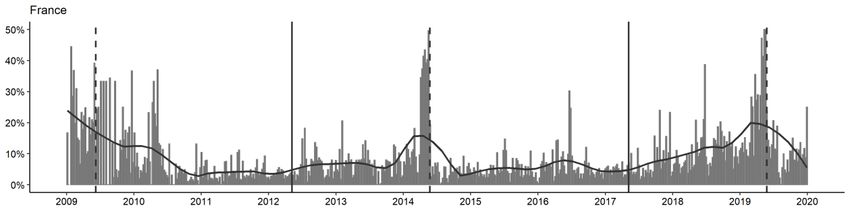
First, figure 1 displays parties’ emphasis on Europe in longitudinal perspective, showing
the national average weekly percentage of tweets mentioning Europe or the European Union
(result of the European dictionary). It is therefore possible to make some early observations
regarding when and how much parties refer to EU affairs in their tweets. I make some
preliminary observations regarding the effects of European elections, as well as of the EU
membership referendum in the UK both internally and abroad.
It is clear that political parties and their leaders publish a lot more messages referring
to Europe during the weeks close to European elections. In nearly all cases, the share of tweets
mentioning the EU or Europe clearly peaks at the time of the 2009, 2014 and 2019 EP elections.
This confirms recent findings highlighting that EU election campaigns have finally become also
about some EU issues (Eugster et al. 2020). Belgium is the exception here, as European
elections were held simultaneously with the Belgian federal legislative elections in 2014 and
2019, their impact on emphasis seems less clear.
Then, the referendum on EU membership in the United Kingdom has clearly increased
EU emphasis. During the campaign in the months preceding the referendum, we can see that
British parties published many more EU-related tweets than usual. Moreover, it seems that we
witness an effect of the referendum outside the borders of the United Kingdom. In June 2016,
parties in other countries also tweeted more about European affairs. This is clearly observable
in Belgium, France, Germany, and Portugal, for example.
14WORKING PAPER
Figure 1: Average national weekly emphasis, European dictionary results
(Solid lines = National elections, Dashed lines = European elections,
Dotted lines = simultaneous elections in BE and referendum in the UK)
15Versailles 2021
16WORKING PAPER
While I observe that events such as EU elections and the Brexit referendum have
triggered discussions of EU topics, parties also continuously communicate about EU affairs
outside of these specific times. In all 10 countries investigated, political parties published EU-
related tweets almost every week for more than a decade. Moreover, there are important
variations in the extent of this “daily emphasis” on European issues. According to my other
hypotheses, this could be an indication that parties communicate more about Europe following
the European governance agenda, for example close to EU summits or during plenary sessions
of the EP.
I therefore turn to regression models to test these hypotheses. Table 1 displays the
results of the binomial negative regression models. The first model tests all the hypotheses
with independent variables strictly related to timing, i.e., H1, H2 and H3. Then, the second and
third models test hypotheses H4a and H4b with interactions between the government variable
and the timing of executive-dominated European governance events. Eventually, the fourth
model tests hypothesis H5 in a separate model because it includes only a subset of the dataset,
excluding the parties that did not participate in the last European election, and for which it is
therefore not possible to compute the share of EP seats.
17Versailles 2021
Increased Emphasis During EU Elections and Referendum
First, as the descriptive approach suggested, I find strong support for hypothesis H1.
The number of parties’ tweets referring to European affairs sharply increase as the next
European election approaches. Holding other variables at their mean value (average activity =
60 tweets/week), model 1 predicts that 4.1% of tweets refer to European affairs one year
before the election, while more than 10% of tweets are about Europe in the last month and
even 16.6% in the last week of the campaign. In other words, this means that emphasis at the
time of the election is four times higher than one year earlier. If we look at the raw data, this
can even reach more than 85% of the messages, as was the case for the PS (Fra) in 2019, the
CSU (Ger) is 2009, 2014, 2019 and the CDU (Ger) in 2019, the PS (Por) in 2019 and the CDS-PP
(Por) in 2019, and the D66 (Nl) in 2019.
18WORKING PAPER
Table 1: Results of binomial negative regressions
Emphasis on European affairs
Model 1 Model 2 Model 3 Model 4
Intercept 4.712*** 5.029*** 4.993*** 3.703***
(0.112) (0.111) (0.112) (0.149)
European elections 2.227*** 2.240*** 2.239*** 2.188***
(0.063) (0.062) (0.062) (0.062)
Referendum in the UK 5.213*** 5.183*** 5.189*** 4.876***
(0.226) (0.231) (0.230) (0.179)
Referendum abroad 3.692*** 3.689*** 3.708*** 3.602***
(0.135) (0.129) (0.129) (0.141)
European summits 1.419*** 1.350*** 1.426*** 1.432***
(0.030) (0.029) (0.029) (0.032)
Commission speeches 1.125** 1.125** 1.123** 1.121**
(0.037) (0.036) (0.037) (0.039)
Council presidency 1.199 1.211 1.146 1.164
(0.154) (0.154) (0.195) (0.151)
European Parl. plenary 1.183*** 1.184*** 1.183*** 1.178***
(0.024) (0.024) (0.024) (0.025)
Government 0.843 0.861
(0.136) (0.133)
Gov x European summit 1.192***
(0.051)
Gov x Council presidency 1.167
(0.325)
Share of EP seats 3.333*
(0.550)
Activity 1.010*** 1.010*** 1.010*** 1.010***
(0.001) (0.001) (0.001) (0.001)
Observations 32533 32533 32533 29896
R2 Nagelkerke 0.547 0.550 0.549 0.563
Binomial negative regressions. The dependent variable is the number of tweets referring to European affairs
published by each party every week, measured by the European dictionary. Incidence rate ratios with, in
brackets, robust clustered standard errors (at party level). P values: ***Versailles 2021
Conversely, some parties dedicated very few messages to EU issues in the last week
before European elections (less than 2%). But these were almost exclusively Belgian parties,
and this is because national elections were being held simultaneously with European elections.
This may seem logical; nevertheless, it demonstrates how this simultaneity prevents discussing
European issues at the time of European elections, compared to other countries.
Then, as the descriptive approach suggested, hypotheses H2a and H2b are confirmed
as well. The 2016 referendum on EU membership in the United Kingdom indeed triggered
emphasis on the EU both from British parties throughout the campaign and from parties in
other countries at the time of the referendum. During the last three months before 23 June
2016, model 1 predicts that 17.5% of the tweets published by British parties referred to the EU
or Europe, compared to 3.3% otherwise. And during the week of the referendum, it predicts
that 12.4% of tweets from parties abroad referred to the same topics, compared to 3.4%
otherwise.
Communicating European Governance
Now I turn to the analysis of hypothesis H3. This hypothesis concerns the effect of
European governance events on emphasis in tweets. As these events were much more
numerous and dispersed over time than the elections and the referendum, it was impossible to
get an idea with the descriptive approach. Here, with the binomial negative regression model, I
find support for three out of the four events. The model predicts that the number of tweets
mentioning European affairs increases during European summits, at the time of major
speeches from the president of the Commission and during plenary sessions of the European
Parliament. Only the rotating presidency of the Council does not seem to trigger attention to
EU matters from domestic parties. These are novel findings. We already knew that European
decision-making processes and events triggered attention in domestic parliaments, where
institutional procedures play a predominant role in triggering or constraining the possibility of
EU affairs scrutiny (Auel et al. 2015; Rauh and de Wilde 2018; Winzen et al. 2018). Now it also
seems that political parties emphasize European affairs on Twitter at the time of important
20WORKING PAPER
European governance events. This nuance is important since, first, these are public
communications from political parties and not from individual MPs inside the legislative
process. Statements on Twitter from parties and their leaders are likely to have a wider
resonance than most plenary speeches. In addition, Twitter allows mainly unconstrained
communications. There are virtually no institutional incentives or constraints to talk about the
EU in a tweet, compared to legislative speeches. Consequently, when a party or a leader tweets
about European affairs during an EU summit or an EP plenary session, it is because they have
chosen to give some sort of visibility to these matters.
That being said, the effects predicted by model 1 are relatively small. Holding other
variables at their mean value, it predicts that 4.6% of tweets mention EU affairs during
European summits, compared to 3.2% otherwise; 3.8% at the time of major speeches from the
Commission’s president, compared to 3.4% otherwise; and 3.8% during plenary sessions of the
EP, compared to 3.2% otherwise. Hence, while they are significant, these variations remain
limited. The limited scale of these effects makes it necessary to be cautious before
unequivocally concluding that parties always emphasise European affairs during European
governance key moments.
However, the important number of events analysed may explain these small variations.
Over the 11 years studied (2009–2019), there have been 13 inaugural or State of the Union
speeches from the president of the Commission, 77 European summits and 178 plenary
sessions of the European Parliament. On average, they might have a limited—albeit
significant—effect on emphasis, but some EU summits, EP plenaries or EC speeches might
attract much more attention than others. In other words, the extent to which parties
communicate about these events probably varies as some of them may be much more salient
and decisive than others. For example, the five European summits during which parties on
average published more tweets about European affairs were the following: (1). The informal
meeting in Sibiu on 9 May 2019 (30.1% of tweets), held on “Europe Day” and two weeks before
European elections, and where they discussed the EU strategic agenda for 2019–2024. (2) The
Special European Council on 10 April 2019 (17.5% of tweets), where they agreed to delay Brexit
21Versailles 2021
after UK PM Theresa May had asked for a further extension of the Article 50 period. (3) The
European Council on 28 and 29 June 2018 (15.6% of tweets), where they mainly focused on
migration issues before discussing Brexit (without the UK) and the eurozone (Euro summit). (4)
The special meeting on 30 June 2019 (14.8% of tweets), where nominations for the EU’s top
jobs were decided, one week after the 2019 European elections. (5) The European Council on
28 and 29 June 2016 (14.7% of tweets), where they discussed Brexit without the UK, a few days
after the referendum was held. Similarly, the Commission’s speeches that attracted the most
attention were the two inaugural speeches delivered in July 2014 and 2019. With respectively
10.6% and 9.3% of tweets, emphasis on European affairs was higher than at the time of any
state of the Union speech, usually delivered in September.
The effect of governments’ and MEPs’ involvement in European governance
Then, in models 2 and 3, I tested hypotheses H4a and H4b with interactions between
the government variable and the timing of executive-dominated European governance events. I
only find support for hypothesis H4a. Parties in governments are more likely to communicate
about EU summits. As I have argued, this imbalance is not necessarily problematic since it
demonstrates that governments do indeed give a certain public visibility to these decision-
making moments.
Finally, the fourth model predicts that parties having a larger share of national MEPs
are on average more likely to emphasize European affairs, as hypothesized in H5. Holding other
variables at their mean value, model 4 predicts that a party having 5% of national seats in the
EP publishes only 2% of tweets about European affairs, while this goes up to 3.9% of tweets for
a party having 30% of national seats. This suggests that parties that have more elected
representatives at the EU level dedicate a larger share of their public communications to
European matters.
22WORKING PAPER
Results With the Second Measurement
I have replicated the same analyses with my second measurement of emphasis on
European affairs. I have run similar binomial negative models4 with the dependent variable
measured with the EU governance dictionary (Rauh 2015; Rauh and de Wilde 2018). Since this
second dictionary only includes explicit references to European affairs, I expect it is particularly
successful in detecting political actors’ attention to European governance. Indeed, almost all
findings are confirmed in this second analysis. I find that the proximity of European elections,
the referendum in the UK and abroad all trigger emphasis on European affairs. I also find that
parties communicate more about EU affairs during European summits, Commission speeches
and EP plenaries, but not when their country holds the presidency of the Council. And
government parties also communicate more about European summits. However, the positive
relationship between the share of EP seats and emphasis is not confirmed here.
CONCLUSION
The neo-functionalist idea that supranational authority should lead to politicization also
applies to daily European governance. The exercise of authority at the supranational level
should increase the engagement of political actors and the visibility of EU matters. Therefore,
political elites are expected to communicate publicly about European affairs. They face
significant functional pressures and normative requirements to do so. We already knew that
European governance garnered attention in domestic parliaments, where institutional
procedures play a predominant role in triggering or constraining the possibility of EU affairs
scrutiny (Auel et al. 2015; Rauh and de Wilde 2018; Winzen et al. 2018). This raises thus the
question of whether there is a linkage to European governance in the communications of
political actors outside of the parliamentary arena. In particular, Twitter has become an
important platform for political communications, and statements on Twitter from parties and
their leaders are likely to have a wider resonance than most plenary speeches (Parmelee 2013;
4
Results in the appendix
23Versailles 2021
Parmelee and Bichard 2011; Verweij 2012). Therefore, in this paper, I have investigated to what
extent political parties’ tweets emphasize European affairs.
Most of my findings are relatively positive concerning the functional politicization of
European governance. Confirming previous works, I find that parties emphasize European
affairs when the next European election gets closer and during referendum campaigns.
Moreover, I find that the number of tweets mentioning European affairs increases during
European summits (even stronger for government parties), at the time of major speeches from
the president of the Commission and during plenary sessions of the European Parliament. I also
find that parties having a larger share of MEPs are more likely to emphasize European affairs,
although this is not confirmed with the second measurement. These are novel findings. Political
parties emphasize European affairs on Twitter at the time of important European governance
events and when they are involved, through offices or seats, in European decision-making
processes.
However, these elements should be interpreted with caution. Yes, there is some
emphasis on EU matters when it is required; visibility does not necessarily equal politicization
(Dupuy and Van Ingelgom in Palonen et al. 2019). Politicization requires public visibility and
contradictory debate. Visibility and debate are indeed the two key features making previously
unpolitical matters political (Kauppi and Trenz in Palonen et al. 2019; Zürn 2016). Without
them, European governance would remain an opaque and consensual process remote from any
public democratic debate. Here, the fact that I find that political actors do communicate about
European affairs does not mean that there is a contradictory public debate. These
communications could be consensual or framed to avoid any debate, and to present decisions
as necessary and without alternatives. Such a situation of non-politicization would be
characterized by a perception of absence of choice because there would be no public
discussion of European decisions and alternatives (Hay 2007). In fact, scholars have shown how
political elites can indeed use discursive depoliticization to create the impression that there is
no choice (Borriello 2017; de Wilde and Zürn 2012). When this is the case, the public visibility of
24WORKING PAPER
European governance does not serve the required functional politicization, but rather
jeopardizes it.
Therefore, further research is necessary to investigate whether the content of political
actors’ communications about European governance actually discuss policy alternatives and
allows a contradictory debate on European affairs. In addition, using a similar longitudinal and
fine-grained approach, further research could also investigate precisely what type of European
governance moments attract more attention. I have already mentioned the fact that the level
of emphasis varies from one event to another. One may therefore wonder, for example, which
European summits or plenary sessions of the Parliament attract more visibility than others?
Does it depend on the topics discussed or the actors involved? These questions are important
to understand the extent of politicization of the European decision-making process, and by
extension its democratic legitimacy.
25Versailles 2021
REFERENCES
Auel, Katrin. 2007. “Democratic Accountability and National Parliaments: Redefining the Impact
of Parliamentary Scrutiny in EU Affairs.” European Law Journal 13(4): 487–504.
Auel, Katrin, and Tapio Raunio. 2014. “Introduction: Connecting with the Electorate?
Parliamentary Communication in EU Affairs. The Journal of Legislative Studies 20(1): 1–
12.
Auel, Katrin, Olivier Rozenberg, and Angela Tacea. 2015. “To Scrutinise or Not to Scrutinise?
Explaining Variation in EU-Related Activities in National Parliaments.” West European
Politics 38(2): 282–304.
Bergman, Torbjörn. 2000. “The European Union as the next Step of Delegation and
Accountability.” European Journal of Political Research 37(3): 415–29.
Borriello, Arthur. 2017. “‘There Is No Alternative’: How Italian and Spanish Leaders” Discourse
Obscured the Political Nature of Austerity’. Discourse & Society 28(3): 241–61.
Bovens, Mark. 2007. “Analysing and Assessing Accountability: A Conceptual Framework.”
European Law Journal 13(4): 447–68.
Braun, Daniela, Swen Hutter, and Alena Kerscher. 2016. “What Type of Europe? The Salience of
Polity and Policy Issues in European Parliament Elections.” European Union
Politics 17(4): 570–92.
Braun, Daniela, and Hermann Schmitt. 2018. “Different Emphases, Same Positions? The
Election Manifestos of Political Parties in the EU Multilevel Electoral System
Compared.” Party Politics 26(5): 640–50.
Cooper, Ian. 2012. “A ‘Virtual Third Chamber’ for the European Union? National Parliaments
after the Treaty of Lisbon.” West European Politics 35(3): 441–65.
Curtin, Deirdre, and Päivi Leino. 2017. “In Search of Transparency for EU Law-Making : Trilogues
on the Cusp of Dawn.” Common market law review 54(6): 1673–1712.
Eugster, Beatrice, et al. 2020. “When Do European Election Campaigns Become about Europe?”
West European Politics 0(0): 1–25.
Follesdal, Andreas, and Simon Hix. 2006. “Why There Is a Democratic Deficit in the EU: A
Response to Majone and Moravcsik”. JCMS: Journal of Common Market Studies 44(3):
533–62.
26WORKING PAPER
Grande, Edgar, and Swen Hutter. 2016. “Beyond Authority Transfer: Explaining the
Politicisation of Europe”. West European Politics 39(1): 23–43.
Grimmer, Justin, and Brandon M. Stewart. 2013. “Text as Data: The Promise and Pitfalls of
Automatic Content Analysis Methods for Political Texts.” Political Analysis 21(3): 267–
97.
Haas, EB. 1958. The Uniting of Europe: Political, Social, and Economic Forces, 1950–1957.
Stanford University Press.
Hay, Colin. 2007. Why We Hate Politics. Cambridge: Polity Press.
Hooghe, Liesbet, and Gary Marks. 2009. “A Postfunctionalist Theory of European Integration:
From Permissive Consensus to Constraining Dissensus.” British Journal of Political
Science 39(1): 1–23.
Hutter, Swen, and Edgar Grande. 2014. “Politicizing Europe in the National Electoral Arena: A
Comparative Analysis of Five West European Countries, 1970–2010.’ JCMS: Journal of
Common Market Studies 52(5): 1002–18.
Karlas, Jan. 2012. ‘National Parliamentary Control of EU Affairs: Institutional Design after
Enlargement.’ West European Politics 35(5): 1095–1113.
Laloux, Thomas. 2020. ‘Informal Negotiations in EU Legislative Decision-Making: A Systematic
Review and Research Agenda.’ European Political Science 19(3): 443–60.
Lord, Christopher. 2013. ‘The Democratic Legitimacy of Codecision.’ Journal of European Public
Policy 20(7): 1056–73.
Norris, Pippa. 1997. ‘Representation and the Democratic Deficit.’ European Journal of Political
Research 32(2): 273–82.
Palonen, Kari et al. 2019. ‘Rethinking Politicisation.’ Contemporary Political Theory 18(2): 248–
81.
Parmelee, John H. 2013. ‘Political Journalists and Twitter: Influences on Norms and Practices.’
Journal of Media Practice 14(4): 291–305.
Parmelee, John H., and Shannon L. Bichard. 2011. Politics and the Twitter Revolution: How
Tweets Influence the Relationship between Political Leaders and the Public? Lexington
Books.
Peteers, Jeroen, Peter Van Aelst, and Stiene Praet. 2019. ‘Party Ownership or Individual
Specialization? A Comparison of Politicians’ Individual Issue Attention across Three
Different Agendas.” Party Politics.
27Versailles 2021
Rauh, Christian. 2015. “Communicating Supranational Governance? The Salience of EU Affairs
in the German Bundestag, 1991–2013.’ European Union Politics 16(1): 116–38.
Rauh, Christian, and Pieter de Wilde. 2018. ‘The Opposition Deficit in EU Accountability:
Evidence from over 20 Years of Plenary Debate in Four Member States.’ European
Journal of Political Research 57(1): 194–216.
Raunio, Tapio. 2011. ‘The Gatekeepers of European Integration? The Functions of National
Parliaments in the EU Political System.’ Journal of European Integration 33(3): 303–21.
Reif, Karlheinz, and Hermann Schmitt. 1980. ‘Nine Second-Order National Elections—a
Conceptual Framework for the Analysis of European Election Results.’ European Journal
of Political Research 8(1): 3–44.
Schmitter, Philippe C. 1969. ‘Three Neo-Functional Hypotheses about International
Integration.’ International Organization 23(1): 161–66.
———. 2009. ‘On the Way to a Post-Functionalist Theory of European Integration.’ British
Journal of Political Science 39(1): 211–15.
Statham, Paul, and Hans-Jörg Trenz. 2013. The Politicization of Europe : Contesting the
Constitution in the Mass Media. Routledge.
Strøm, Kaare. 2000. ‘Delegation and Accountability in Parliamentary Democracies.’ European
Journal of Political Research 37(3): 261–90.
Verweij, Peter. 2012. ‘Twitter Links Between Politicians and Journalists.’ Journalism
Practice 6(5–6): 680–91.
de Wilde, Pieter. 2011. ‘No Polity for Old Politics? A Framework for Analyzing the Politicization
of European Integration.’ Journal of European Integration 33(5): 559–75.
———. 2014. ‘The Operating Logics of National Parliaments and Mass Media in the
Politicisation of Europe.’ The Journal of Legislative Studies 20(1): 46–61.
de Wilde, Pieter, Anna Leupold, and Henning Schmidtke. 2016. ‘Introduction: The
Differentiated Politicisation of European Governance.’ West European Politics 39(1): 3–
22.
de Wilde, Pieter, and Michael Zürn. 2012. ‘Can the Politicization of European Integration Be
Reversed?’ JCMS: Journal of Common Market Studies 50(s1): 137–53.
Winzen, Thomas. 2012. ‘National Parliamentary Control of European Union Affairs: A Cross-
National and Longitudinal Comparison.’ West European Politics 35(3): 657–72.
28WORKING PAPER
Winzen, Thomas, Rik de Ruiter, and Jofre Rocabert. 2018. ‘Is Parliamentary Attention to the EU
Strongest When It Is Needed the Most? National Parliaments and the Selective Debate
of EU Policies’. European Union Politics 19(3): 481–501.
Zürn, Michael. 2016. ‘Opening up Europe: Next Steps in Politicisation Research.’ West European
Politics 39(1): 164–82.
Zürn, Michael, Martin Binder, and Matthias Ecker-Ehrhardt. 2012. ‘International Authority and
Its Politicization.’ International Theory 4(01): 69–106.
29Versailles 2021
APPENDIX
Table A: Tweets dataset
Countries Parties Twitter accounts N JeanLeonetti 142
Austria FPO norbertghofer 3273 ChJacob77 77
GRÜNE Gruene_Austria 10779 LREM EmmanuelMacron 7073
WKogler 2385 enmarchefr 4412
NEOS neos_eu 41012 MoDem MoDem 18814
matstrolz 11767 bayrou 3992
BMeinl 2454 PS partisocialiste 51407
OVP volkspartei 7068 jccambadelis 6076
sebastiankurz 3046 faureolivier 865
MitterlehnerR 794 RachidTemal 669
SPO SPOE_at 7246 fhollande 518
KernChri 970 MartineAubry 431
rendiwagner 367 harlemdesir 174
Belgium CD&V cdenv 11769 RN RNational_off 30439
wbeke 4189 MLP_officiel 18185
YLeterme 346 Germany AfD AfD 7735
joachimcoens 21 FraukePetry 2036
CDH lecdh 3624 Joerg_Meuthen 1275
prevotmaxime 72 DrKonradAdam 16
BenoitLutgen 57 Tino_Chrupalla 3
Ecolo Ecolo 5755 CDU CDU 14431
PatrickDupriez 3040 akk 236
jmjavaux 748 CSU CSU 10492
jmnollet 443 Markus_Soeder 234
RajaeMaouane 100 FDP fdp 7612
Sarahturine 64 c_lindner 6881
Groen groen 13491 philipproesler 229
MeyremAlmaci 1512 Grüne Die_Gruenen 9722
WouterVanBesien 204 peter_simone 8535
MR MR_officiel 5991 cem_oezdemir 2555
CharlesMichel 3220 ABaerbock 648
dreynders 2045 Linke dieLinke 11399
OChastel 620 katjakipping 4489
GLBouchez 96 b_riexinger 3949
NVA de_NVA 48434 LoetzschMdB 257
Bart_DeWever 282 ernst_klaus 175
VLD openvld 8000 SPD spdde 20462
RuttenGwendolyn 4894 sigmargabriel 2398
alexanderdecroo 1276 MartinSchulz 443
PS eliodirupo 5906 AndreaNahlesSPD 208
PSofficiel 3406 ManuelaSchwesig 168
PaulMagnette 450 EskenSaskia 124
PTB RaoulHedebouw 11182 muentefering 128
ptbbelgique 8430 NowaboFM 47
PVDA pvdabelgie 8598 OlafScholz 35
peter_mertens 3699 Ireland FF fiannafailparty 20323
SPA sp_a 13458 MichealMartinTD 1021
johncrombez 3234 FG FineGael 16165
conner_rousseau 25 LeoVaradkar 1513
VB vlbelang 11233 EndaKennyTD 531
tomvangrieken 3707 Greens greenparty_ie 10177
gannemans 2306 EamonRyan 5629
France EELV EELV 9469 JohnGormley 63
CecileDuflot 4000 Lab labour 19850
DavidCormand 2284 BrendanHowlin 2043
emmacosse 1836 joanburton 402
PDurandOfficiel 338 EamonGilmore 177
julienbayou 38 SF sinnfeinireland 44211
LFI JLMelenchon 25126 GerryAdamsSF 10589
FranceInsoumise 12831 MaryLouMcDonald 809
FDG 10212 Italy FdI FratellidItalia 25094
LR lesRepublicains 15780 GiorgiaMeloni 7392
NicolasSarkozy 6100 Ignazio_LaRussa 597
jf_cope 4269 FI forza_italia 23589
laurentwauquiez 2455 berlusconi 3649
30You can also read


