Understanding Factors Driving Share of Wallet Among Key Canadian Demographic
←
→
Page content transcription
If your browser does not render page correctly, please read the page content below
Understanding Factors Driving Share of
Wallet Among Key Canadian Demographic

    In the Grocery Aisle:
    South Asian & Southeast Asian Canadians

             Product Selection, Price, Quality, &
             Brand Preference
             are Key Drivers

Get better business insights, faster, with Caddle. Contact us today.
                                                                       01
Contents
     Introduction
03
04   Get to Know Canada’s South &
     Southeast Asian Population

     How Do Shopping Habits of South &
05   Southeast Asian Canadians Differ
     from Others?

     How Two Popular Grocery Retail
07   Chains Compare in Meeting
     the Needs of Diverse Canadian
     Shoppers
     • T&T Supermarket
     • Voilà by Sobeys

     How Do Canada’s Top Grocery
13   Retail Banners Stack Up against
     South & Southeast Asian Canadian
     Shoppers’ Wants & Needs?

16   Key Takeaways

                                         02
J
June 27 is officially Canadian Multiculturalism Day. Yet for Canadians living in all but the most rural
of areas, every day of the year offers unique opportunities to interact with people from ethnic
backgrounds, cultures and origins different from their own.

We’ve previously explored how immigration is driving Canada’s growth rate. And though attitudes
toward multiculturalism vary from region to region, the Canadian government has made long-
established efforts to bring newcomers to our cities. As a matter of fact, Canada welcomed
341,000 immigrants (0.9% of the total population) in 2019 alone—exceeding its federal targets by
more than 10,000.

These days, Canadian residents come from more than 250 different ethnic origins and ancestries
and, as of the last census (conducted in 2016) about 22% were born outside of Canada—including
more than 48% who immigrated from Asia. Among those, South and Southeast Asians make up
about a third of Canada’s immigrant numbers every year,
including people from India (25% of all newcomers), people
of Filipino origin (a further 8%), and people from Pakistan
(another 3+%) in 2019.                                              Did you know? While
                                                                    Toronto, Vancouver and
It’s little wonder, then, that stores across the country offer a    Montreal are considered
wide array of international food products that cater to a range     to be gateway cities for
of Canadians—from the newly immigrated to second- and               newcomers to Canada, other
third-generation residents and otherwise.                           communities across the
                                                                    country pull far above their
So, let’s explore the key levers that drive Canadian consumers’     weight in bringing immigrants
decision-making on international and specialty foods.               into their folds. This includes
Specifically, we dive deeper into the shopping patterns and         cities like Charlottetown, P.E.I.
preferences of South Asian and Southeast Asian Canadian             and Regina, Saskatchewan,
consumers, to uncover how two retail banner extensions—T&T          both of which welcomed
Supermarket (a Loblaw’s company) and Voilà by Sobeys (the           2.4% of their total per capita
new online grocery arm of Empire, currently being tested in 3       populations in 2019.
markets)—deliver against purchase drivers including selection,
price and quality to influence share of wallet of ethnic
populations. Finally, we review our In-Store Grocery CX Tracker data—where we outlined the Net
Promoter Scores (NPS) and associated attributes for 12 of the top grocery retail banners across the
country—to shed additional light on how well these banners are meeting the particular needs of
Canada’s South and Southeast Asian consumers.

                                                                                                          03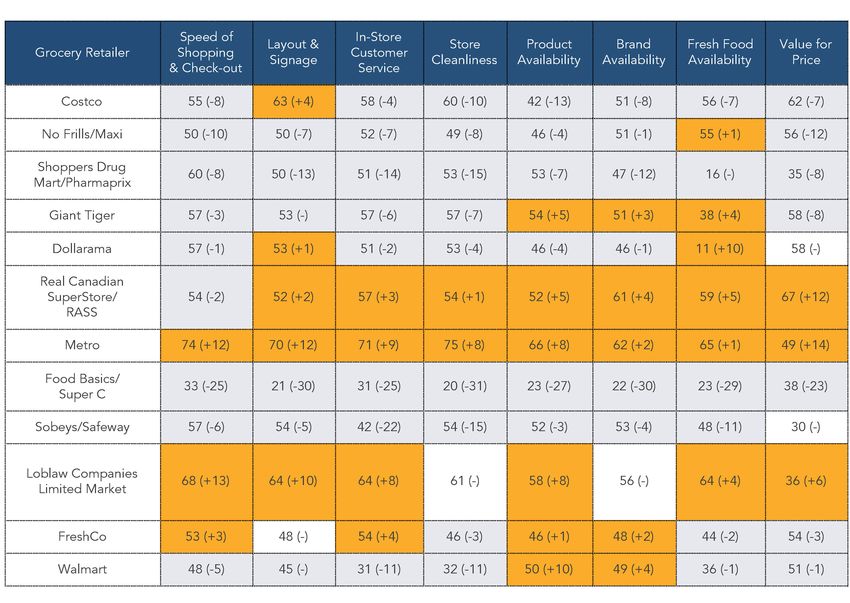
Get to Know Canada’s South & Southeast Asian Population
       									                                                     (Source: 2016 Census Profile)

                    South Asian Canadians {origins: Bangladesh, Bhutan, India,
                    the Maldives, Nepal, Pakistan, Sri Lanka; also known by cultural backgrounds,
                    e.g., Bengali, Goan, Gujarati, Punjabi, Tamil, etc.}

                    Nearly 2 million people of South Asian descent live in Canada (5.6% of the
                    total population), making them the country’s third-largest pan-ethnic group
                    after Europeans and East Asians.

                    The majority (67%) live in Metro Vancouver and Greater Toronto areas;
                    together, they make up nearly 30% of the combined populations of the cities.
                    Other notable South Asian Canadian communities can be found in Calgary
                    (123,000), Edmonton (92,000) and Montreal (91,000).

Southeast Asian Canadians {origins: Cambodia, Laos,
Myanmar, Peninsular Malaysia, Thailand, Vietnam, and countries of the Malay
Archipelago (Andaman and Nicobar Islands, Brunei, East Malaysia, East Timor,
Indonesia, the Philippines, and Singapore)}

People of Filipino and Vietnamese origin comprise a sizable portion of Southeast
Asians living in Canada (837,000 and 241,000, respectively), followed by
Cambodians (39,000), Laotians (25,000), Indonesians (21,000) and other, smaller
communities.

The majority of Southeast Asians live in urban centres in Ontario (Toronto,
Mississauga) and Quebec (Montreal), while smaller percentages live in Alberta
(Calgary, Edmonton), Manitoba (Winnipeg) and British Columbia (Vancouver).

                                                                                                     04
How Do Shopping Habits of South & Southeast Asian
          Canadians Differ from Others?

While Canadian consumers of all backgrounds tend to prioritize larger retail stores in their weekly
shopping plans—including 50% of consumers who shop at supermarkets and 43% who shop at
superstores—South and Southeast Asian Canadians report shopping at discount grocery stores the
most, followed by superstores. And they put just about equal weight on local independent grocery
merchants and chain supermarkets. This suggests that, by and large, these consumers are looking
for value from their grocery spend just as much as product and brand selection.

          Q: What type of grocery store(s) do you shop at on a weekly basis? (select all)
                                          December 14, 2020

                   General Population vs. South & Southeast Asian Population

          What Factors Do Canadian Shoppers Value Most in Their
          Grocery Journey?

Among the general population, everyday grocery product availability far outweighs any other
considerations (77.8%, compared to
Q: Which of the following factors do you consider when deciding where to purchase groceries?
                                           (select all)
                                          December 14, 2020

                   General Population vs. South & Southeast Asian Population

This trend continues when we look at South and Southeast Asian consumers, who slightly over-
index on the availability of everyday grocery items. What’s more, though, ethnic/international food
selection is at least 2x more important to them than the general population. Meanwhile, packaged
product selection, including snacks, also ranks slightly higher than for the general population.

         How Often Do Canadians Purchase International/Speciality
         Foods?
Nearly two-thirds of South and Southeast Asian Canadian consumers purchase ethnic,
international or speciality foods at least weekly.

(This includes 16% who make such purchases “daily”/“multiple              Which generation
times per day”—perhaps indicating that they choose these                  purchases ethnic
types of products for snacks).
                                                                          foods most
                                                                          frequently? Gen Z!
Compare this to the general population, about 1 in 5 of whom
purchase ethnic/international foods “a few times a month,”
“less often than monthly” or not at all.                                  • 16% shop weekly
                                                                          • 8% shop multiple
                                                                            times per day

                                                                                                      06
Q: How often do you purchase international/specialty foods?
                                           December 14, 2020

                               foods

                    General Population vs. South & Southeast Asian Population

Meanwhile, 82% of South and Southeast Asian Canadian consumers purchase ethnic or
international foods on the same trip as their regular grocery shopping.

Interestingly, among this segment of the population, 4% indicate that they don’t purchase ethnic/
international foods at all. This contrasts with 56% of the general population who combine their
ethnic food purchasing with the rest of their grocery shopping, while almost 1 in 5 don’t make
ethnic/international food purchases at all.

       How Two Popular Grocery Retail Chains Compare in Meeting the
       Needs of Diverse Canadian Shoppers

We learned in our retail report “The Great Divide: One Country, Multiple Cohorts” that consumer
demographics greatly influence shopping decision-making. This is particularly evident when we
consider what different generations are looking for from their customer experiences (CX). So, for
instance, we know that Millennials are especially critical of the online CX being delivered by most
retail stores, while Baby Boomers are far more forgiving of both in-store and online CX snafus.

Yet, overall, across all measures—including speed to shop and checkout, layout and signage, in-
store CX, cleanliness and hygiene, product availability and more—big box behemoth Costco came
out on top for both Millennial and Boomer generations, while their competitor Walmart finished
last among 12 of Canada’s top grocery retailers.

Because we’re a curious lot at Caddle, we’ve continued to dig deeper, using ethnicity as a lens
to understand how well two specific retail banner extensions—T&T Supermarket (a Loblaw’s
company) and Voilà by Sobeys—are delivering against Canadian consumers’ expectations, wants
and needs.

Haven’t downloaded your free copy of Caddle’s cross-generational comparison of
retail chains and their associated Net Promoter Scores (NPS)? View here!                              07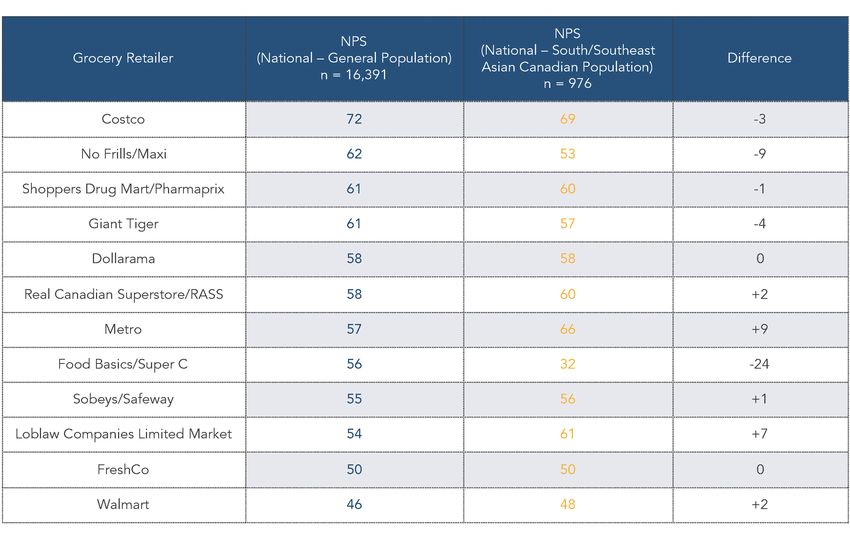
T&T Supermarket

Background

•   Canada’s largest Asian grocery chain
•   Founded by Taiwanese-Canadian Cindy Lee in 1993
•   Acquired by Loblaw Companies in July 2009
•   Currently runs 28 stores that span across British Columbia, Alberta and Ontario (10 more stores are
    reportedly in the works for Eastern Canada)
•   Launched an eCommerce platform in 2020 to facilitate online ordering and delivery of Asian food products
    across most Canadian provinces and territories

                                 Among our 10,000-strong Daily              Southeast Asian Canadian consumers
                                 Panel respondents, nearly 1 in 5           shop at T&T Supermarket less than
                                 consumers had shopped at T&T               monthly, while 1 in 5 consumers shop
                                 Supermarket in the past 6 months.          the banner anywhere from weekly to
                                 However, 49% of consumers indicated        monthly.
                                 that they don’t shop at T&T Supermarket
                                 and about 44% have never heard of          Of all consumers who shop at T&T
                                 the banner—particularly Baby Boomers       Supermarket—including the general
                                 (55%) and a reasonable proportion of       population as well as the South and
                                 Gen Xers (46%).                            Southeast Asian Canadians segment—
                                                                            the #1 reason for shopping there is
                                 In comparison, close to 40%                to purchase specialty foods they
                                 of South and Southeast Asian               can’t get elsewhere, thus reinforcing
                                 Canadian consumers had shopped             the driving mission behind the banner.
                                 at T&T Supermarket in the last 6           (Millennials are especially likely to
                                 months, while about 32% do not shop at     shop at T&T for items they can’t find
                                 the banner and 19% had never heard of      anywhere else, while Baby Boomers are
                                 the retailer. A further 31% of South and   least so.)

                                        Q: What is the main reason you shop at T&T Supermarket?
                                                                December 15, 2020

                                       General Population vs. South & Southeast Asian Population
                                                                                                                     08
South and Southeast Asian                     second, followed by “store cleanliness”
                                 Canadian consumers who shop at                in third spot.)
                                 T&T Supermarket value product
                                 availability over 2x more than any            Yet, based on these results, 70% of
                                 other factor. (Other considerations,          this influential ethnic segment would
                                 including “product value,” “speed of          recommend T&T Supermarket to friends
                                 shopping and check-out,” and “layout          or family.
                                 and signage,” all equally rank a distant

                                                    South & Southeast Asian Population

                                  Q: Which of the following factors do you consider when shopping at
                                                      T&T Supermarket? (select all)
                                                                      December 15, 2020

                                  Q: Based on your experience, how likely are you to recommend T&T
                                                 Supermarket to friends or family?
                                                                  December 15, 2020
                                                               1.7%

                                                                        2.6%

*Disclaimer: data presented on T&T Supermarket is reflective of the markets they operate in.
                                                                                                                         09
Voilà by Sobeys

Background:

•   Last-mile grocery delivery available in Ontario, from Kitchener to Oshawa and Newmarket to Lake
    Ontario; also offer curbside pickup in select locations across Nova Scotia and Alberta
•   Launched by Sobeys’ parent company, Empire Co. Ltd., in June 2020
•   Sobeys partnered with British grocery retailer Ocado to build automated warehouses that facilitate
    safer picking, packing and delivery
•   In addition to Sobeys’ usual product assortment, the service also offers select Farm Boy and Well.ca
    products to Ontario customers

                                  As of December 16, 2020, only a small       likely to have shopped the service
                                  percentage of the general population        than the general population. This
                                  (8%) had used Voilà by Sobeys’ services     demonstrates greater likelihood from
                                  in the last 6 months. At the same           ethnic consumers to try Voilà—perhaps
                                  time, South and Southeast Asian             meeting a need that was previously
                                  Canadian consumers are 2x more              unmet.

                                    Q: Have you done any grocery shopping at Voilà by Sobeys in the
                                                           past 6 months?
                                                                   December 16, 2020

                                       General Population vs. South & Southeast Asian Population

                                  Among all consumers who shop                Asian Canadian consumers are slightly
                                  with Voilà by Sobeys—as with T&T            more likely to prioritize this factor than
                                  Supermarket—we find that availability       the general population of Voilà by
                                  of speciality foods ranks at the top        Sobeys users (38% vs. 32% respectively).
                                  in priority, though South and Southeast

                                                                                                                           10
Q: What is the main reason you shop at Voilà by Sobeys?
December 16, 2020
General Population vs. South & Southeast Asian Population
Q: Which of the following factors do you consider when shopping at
Voilà by Sobeys? (select all)
December 16, 2020
General Population vs. South & Southeast Asian Population
11What other factors do shoppers and-mortar locations), the third-most
prioritize most? In contrast to T&T important consideration for South and
Supermarket shoppers, who most Southeast Asian Canadian consumers
valued product availability, Voilà is “layout and signage.” (Perhaps this
by Sobeys shoppers identify “speed is indicative of a well-thought-out and
of shopping and check-out” as top tested digital platform? Or that easy
considerations. And interestingly, as the site navigation is equally important to
service is digital (i.e., there are no brick- physical store layout and signage?)
Q: Based on your experience, how likely are you to recommend Voilà
by Sobeys to friends or family?
December 16, 2020
General Population South & Southeast Asian
2.4%
3.8%
n = 154 n = 28
Finally, Voilà by Sobeys shoppers population and a whopping 77% of
agree—the majority would recommend South and Southeast Asian Canadian
the retailer’s services to their friends consumers.
or family, including 71% of the general
*Disclaimer: data presented on Voilà by Sobeys is reflective of the markets they operate in. 12How Do Canada’s Top Grocery Retail Banners Stack Up against South
& Southeast Asian Canadian Shoppers’ Wants & Needs?
In an update to our earlier In-Store Grocery CX Tracker data—where we reviewed the Net
Promoter Scores (NPS) and associated attributes for 12 of the top grocery retail banners across the
country—we took a closer look at how these banners are meeting the particular needs of Canada’s
South and Southeast Asian consumers.
Net Promoter Score (NPS) is a trusted research methodology that provides an
index to measure the willingness of consumers to recommend a company’s
products and/or services to others based on their experience.
Net Promoter Score = % Promoters (9-10 ratings) minus % Detractors (0-6 ratings)
13Of note, LCL Market and Metro show the most positive increase between national and South
and Southeast Asian Canadian consumer scores. In contrast, Food Basics/Super C, No Frills/
Maxi, Giant Tiger and Costco are least likely to be recommended by South and Southeast Asian
Canadian consumers.
Attribute Ratings = % Promoters (9-10 ratings) minus % Detractors (0-6 ratings)
South & Southeast Asian Population
n = 976
When it comes to specific attributes that consumers look for
most from their grocery retailer, Metro, LCL Market and RCSS/
Metro, LCL Market and
RASS were the most popular among South and Southeast
RCSS/RASS were the
Asian Canadian consumers (when compared to the national
most popular among
average).
South and Southeast
Asian Canadian
• Metro scored especially well on “value for price,” “layout
consumers.
and signage” and “speed of shopping and check-out”—all
considerations that this influential consumer segment value
in their shopping journey.
• LCL Market scored equally well on “speed of shopping and check-out,” and also upped their
“product availability” score, compared to the national average. (Keep in mind: LCL Market is
14owned by the same parent corporation as T&T Supermarket, and as a result, T&T products are
listed in many Loblaw and sister stores across the country.)
• RCSS/RASS beat out all other banners on “value for price,” something we know many
consumers are increasingly concerned about these days.
In contrast, Food Basics/
Super C, Shoppers Drug Mart/ Food Basics/Super C, Shoppers Drug Mart/
Pharmaprix, Sobeys/Safeway, Pharmaprix, Sobeys/Safeway, Costco and No Frills/
Costco and No Frills/Maxi were Maxi were least popular among South and Southeast
least popular among South Asian Canadian consumers.
and Southeast Asian Canadian
consumers (when compared to
the national average).
• Food Basics/Super C in particular under-delivered on “cleanliness and hygiene,” “brand
availability,” “layout and signage,” “fresh food availability,” as well as other attributes—
indicating that they need to do a much better job of attracting and retaining this key Canadian
demographic.
• Shoppers Drug Mart/Pharmaprix and Sobeys/Safeway also under-delivered on the majority
of key shopping attributes, but less so than Food Basics/Super C. This suggests that these
banners also have a distance to go to growing their share of basket from South and Southeast
Asian Canadian consumers.
*Disclaimer: all data presented is owned by Caddle and has a Margin of Error of 1% or lower.
15Key Takeaways
01 Ethnic Consumers Know What They Want From Their Grocery
Shopping Experience and Will Shop Different Banners to Get it
The Canadian grocery market is brimming with unique food products that cater to just about
every one of our country’s 250 different ethnic origins and ancestries (and no doubt, more!). And if
consumers can’t find them on your store shelves, they’ll go elsewhere to find them.
With speciality food availability a clear priority for the general population, as well as South and
Southeast Asian Canadian consumers in particular, the opportunity is ripe for major retail brands
as well as product manufacturers to give Canadians more of what they want—more specialty food
items; better product and brand assortment (including fresh food options); and overall, better
value for their grocery dollars.
02 Voilà by Sobeys Could Be South & Southeast Asian
Canadians’ New Favourite Online Grocery Channel South and Southeast
Asian Canadian
The service has had several challenges out of the gate, not the least of consumers in particular
which is that it’s a young upstart in a reasonably mature eCommerce are 2x more likely to shop
arena and it’s still a regional player with a limited scope of services. Yet, at Voilà by Sobeys, with
Voilà by Sobeys checks a handful of important boxes for many Canadian top attributes including
consumers, including its broad-based product and brand assortment—no its specialty food
doubt aided by its stocking of Farm Boy, Well.ca, Sobeys Compliments, assortment, as well as its
and other coveted brands. speed of shopping and
check-out.
South and Southeast Asian Canadian consumers in particular are 2x
more likely to shop the service than the general population. We have no
doubt that as the offering expands to other regions of Canada, other ethnic
populations will catch on to the service’s top attributes, including its specialty
food assortment, as well as its speed of shopping and check-out.
03 In Ethnic-Oriented Grocery Retail, Geography Matters
When we segment the data geographically to provinces with brick-and-mortar stores, familiarity,
frequency of shopping and other measures all tend to move in positive directions. This suggests
that though T&T Supermarket ships nationally, their main consumer base is still regionally focused.
This bodes well for smaller but regionally significant grocery players, who have an edge on
attracting ethnic consumers; once they get shoppers in their stores, and if they’re able to offer a
decent product and brand assortment, they’ll be more likely to steal a greater share of wallet
away from larger and/or more prominent banners.
16About Caddle Inc.
Launched in 2015 by former consumer
packaged goods (CPG) leader and Canadian
Grocer 2016 Generation Next award winner
Ransom Hawley, Caddle® is the largest daily
and monthly active panel in the Canadian
marketplace. Our mobile-first insights platform
rewards Canadians for sharing data and
engaging with brands.
Designed to help brands make better decisions,
faster, Caddle has grown into Canada’s
largest daily active consumer research panel
of 10,000+, 6-figure monthly active panel, and
growing every day.
Macro and niche data verticals include:
• New Moms • Luxury Shoppers
• Costco Shoppers • Shopper Dads
• Amazon Prime • Repeat Purchasers
Members • Vegan Buyers
• Cannabis Consumers • Smokers/Non-
• Health Professionals Smokers
Now working with almost every major CPG
company and making inroads with Canada’s
largest grocery retailers, Caddle provides
access to rapid insights at every stage of the
consumer journey across every type of shopper,
country-wide.
Learn more at www.getcaddle.com.
Contact us today.
insights@caddle.ca
getcaddle.com
17You can also read


