UPDATE ON EMERGING SARS-COV-2 VARIANTS AND COVID-19 VACCINES - HEATHER SCOBIE, PHD, MPH ACIP MEETING AUGUST 13, 2021 - CDC
←
→
Page content transcription
If your browser does not render page correctly, please read the page content below
Update on Emerging SARS-CoV-2
Variants and COVID-19 vaccines

 Heather Scobie, PhD, MPH
 ACIP Meeting
 August 13, 2021

                                 cdc.gov/coronavirus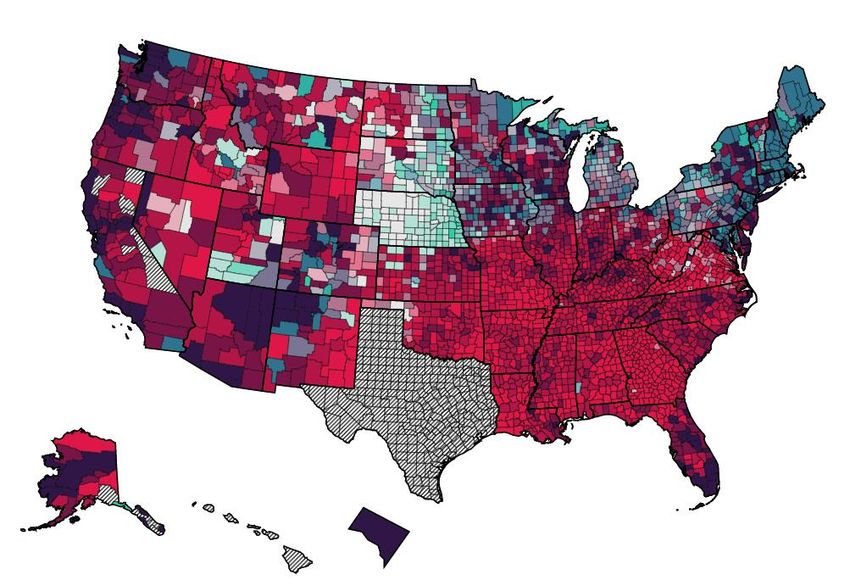
Impact of COVID-19 Vaccination
Percent of People Fully Vaccinated and Cases per 100,000
Population by Age, United States (Dec. 28, 2020 – Aug. 11, 2021)

                                       https://covid.cdc.gov/covid-data-tracker/#vaccinations-cases-trends
COVID-19 Reported Cases per 100,000 Population (last 7 days)
and Percent of Total Population Fully Vaccinated, United States

https://covid.cdc.gov/covid-data-tracker/#vaccination-case-rate (Updated 8/12/21)   4
Cases
Hospitalizations
Emerging SARS-CoV-2 Variants & Vaccines:
What do we know now?
Variants of Concern

WHO label                         Alpha                       Beta                   Gamma                       Delta
PANGO Lineage                     B.1.1.7                    B.1.351                     P.1                    B.1.617.2
First detected                United Kingdom               South Africa             Japan / Brazil                 India
No. of spike                        10-13                       10                        11                      11-15
mutations
Receptor binding                   N501Y                      K417N                     K417T                    (K417N*)
domain mutations                                              E484K                     E484K                      L452R
                                                              N501Y                     N501Y                      T478K
Attributes                • 50% increased            • 50% increased            • Significantly         • Increased transmission
                            transmission               transmission               reduced efficacy of   • Potential reduced
                          • Minimal impact on        • Significantly reduced      some antibodies         antibody efficacy
                            neutralization by          efficacy of some         • Reduced               • Potential reduced
                            convalescent or            antibodies                 neutralization by       neutralization by
                            vaccine sera             • Reduced neutralization     convalescent or         vaccine sera
                          • No impact on               by convalescent or         vaccine sera
                            antibody therapies         vaccine sera
                                                                                                                                   8
SARS-CoV-2 Variants Classifications & Definitions | CDC                          (*) = detected in some sequences but not all
Estimated Proportions of SARS-CoV-2 lineages in the US
                                                  April 25 – July 31, 2021 with NOWCAST

                                                                                          Variants of Concern
                      Percent of Viral Lineages                                               Alpha (B.1.1.7) 2%
                                                                                              Gamma (P.1) 1%

                                                                                              Delta (B.1.617.2) 94%
                                                                                                          Sub-lineages:
                                                                                                          AY.3 13%
                                                                                                          AY.2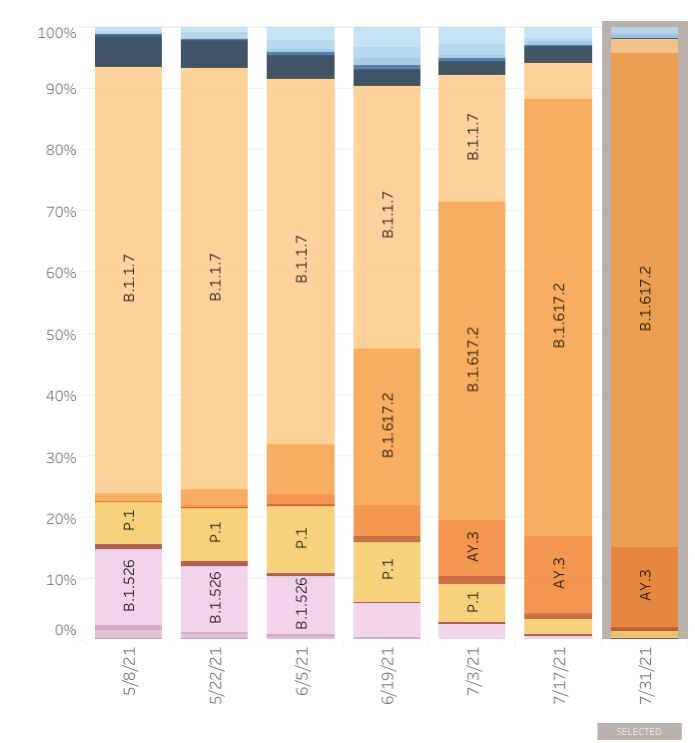
Types of evidence for monitoring vaccine efficacy
▪ Antibody neutralization — laboratory
   – Correlate of protection not yet established
   – Good correlation of vaccine efficacy with resulting neutralizing antibody levels
   – Likely first evidence we will get on impact of variants on vaccines
▪ Vaccine efficacy in clinical trials and real-world effectiveness
   – Greater protection against severe disease > symptomatic illness > confirmed infection
     (including asymptomatic)
   – Protection against severe disease requires lower antibody levels & less affected by
     differences in vaccine efficacy

▪ Vaccine breakthrough infection

Khoury et al. Nature Medicine (2021)
Reduced antibody neutralization activity of vaccine sera relative
to wildtype/dominant strain by study (n=50)
See reference list at end 11Duration of immunity ▪ To date, available data demonstrate antibody persistence at least: – 8 months after COVID-19 infection – 6 months after 2nd mRNA vaccine dose; 8 months after receiving single Janssen dose ▪ May maintain long-term protection from severe illness by antigenically similar strain, even if become susceptible to mild infection ▪ Two studies show combined impact of waning immunity and reduced variant neutralization — ~50% protected against ancestral strain have undetectable neutralizing titers against Beta/Gamma at 6 months after Moderna vaccine – Small study 8 months post-receipt of Janssen vaccine — minimal decline in neutralizing titers & improved protection against Beta/Gamma/Delta vs. 1-month post-vaccine Gaebler, C. et al. Nature 591, 639–644 (2021); Dan, J. M. et al. Science 371, (2021); Choe et al. Emerg Infect Dis. 2021;27(3):928-931. ;Doria-Rose et al. N Engl J Med 2021; 384:2259-226 Khoury et al. Nat Med (2021).; Pegu et al. bioRxiv preprint; Wu et al. medRxiv preprint (2021): Luo, Hu, Letterio, medRxiv preprint (2021): Barouch et al. medRxiv preprint (2021): Thomas et al. medRxiv preprint 12
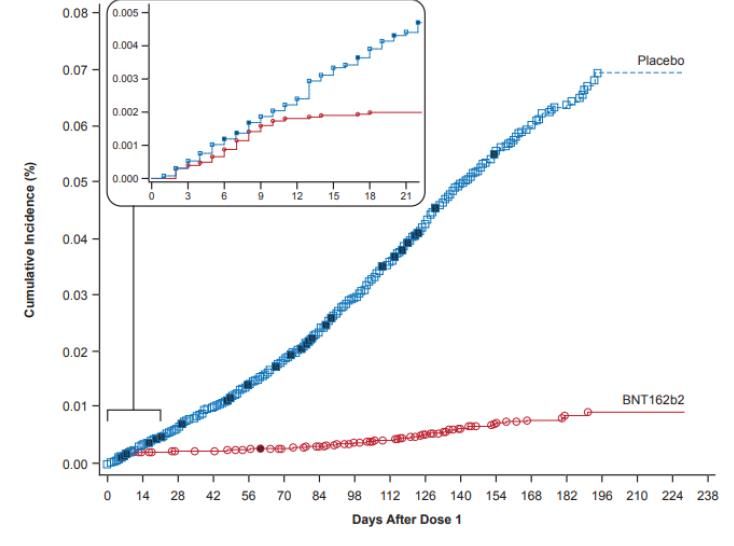
Pfizer vaccine 6-month efficacy
VE against infection: 91% (89, 93)

Period after dose 2                      % VE (95% CI)
≥7 days to
Vaccine efficacy and effectiveness (VE) against variants

▪ Alpha (B.1.1.7) — mRNA vaccines >85% real-world VE against confirmed infection in
  United States and multiple other countries
▪ Gamma (P.1) — mRNA vaccines 84%–88% real-world VE against symptomatic
  infection and 79% against confirmed infection when P.1 in wide circulation in Canada
▪ Beta (B.1.351)
  – Moderna (96%) & Pfizer (75%) real-world VE against confirmed infection in Qatar
  – Janssen 52% VE against moderate/severe disease in South Africa (vs. 74% in US)
  – High VE against severe disease — 96%–100% for mRNA vaccines in Qatar,
    73% at ≥14 days and 81% at ≥28 days for Janssen in South Africa

  CDC Science Brief : https://www.cdc.gov/coronavirus/2019-ncov/science/science-briefs/fully-vaccinated-people.html
  Abu-Radad and Butt. NEJM (2021); Andrejko et al. medRxiv preprint (Apr 10 2021); Chemaitelly et al. Nature Med (2021): https://doi.org/10.1038/s41591-021-01446-y; Sandoff et al. NEJM
  (2021); Chung et al. medRxiv preprint (May 28 2021); Yassi et al. medRxiv preprint (May 25 2021)); Nasreen et al.medRxiv preprint: https://doi.org/10.1101/2021.06.28.21259420;
Delta variant: What we know
▪ Nearly twice as contagious as previous variants
▪ Some evidence of increased illness severity vs. previous strains in unvaccinated
persons
▪ Greatest risk of transmission still among unvaccinated people
▪ Fully vaccinated people with Delta breakthrough infections can spread virus to others
– However, vaccinated people with Delta appear to be infectious for a shorter period
than unvaccinated persons with Delta
https://www.cdc.gov/coronavirus/2019-ncov/variants/delta-variant.html
Fisman & Tuite. medRxiv; Ong et al. SSRN Journal. 2021 ; Sheikh et al. Lancet (2021); Dagpunar J. medRxiv.; Li et al. medRxiv. ; Lopez Bernal et al. NEJM (2021); Stowe et al. PHE preprint:; Riley et15
al.
medRxiv : Micochova et al. Research Square preprint ; Musser et al medRxiv; Brown et al. MMWR (2021); Riemersma et al. medRxiv; Chia et al. medRxiv;Pfizer & Moderna 2-Dose Effectiveness for Alpha vs. Delta
England/Scotland Canada Israel* Qatar*
Pfizer Moderna
100 100 100
96
90 91 90
88
85 85
80 79
70
60
54
50
40 39 41
30
20
10 Infect Symp Hosp Symp Hosp/Death Infect Symp Severe Symp Hosp/ Symp Hosp/
Death Death
0
Alpha Delta *Note earlier analysis period for Alpha vs Delta
Sheikh et al. Lancet (2021): https://doi.org/10.1016/S0140-6736(21)01358-1; Lopez Bernal et al. medRxiv preprint; https://doi.org/10.1101/2021.05.22.21257658; Stowe et al. PHE preprint: https://khub.net/web/phe-
national/public-library/-/document_library/v2WsRK3ZlEig/view/479607266; Nasreen et al.medRxiv preprint: https://doi.org/10.1101/2021.06.28.21259420; Haas et al Lancet (2021):
https://doi.org/10.1016/S0140-6736(21)00947-8 ; Israel MOH: https://www.gov.il/BlobFolder/reports/vaccine-efficacy-safety-follow-up-committee/he/files_publications_corona_two-dose-vaccination-data.pdf
16
Abu-Radad and Butt. NEJM (2021); Chemaitelly et al. Nature Med (2021): Tang et al medRxivDifferences in COVID vaccination program by country with
potential impact on comparability of VE results
Country U.S. Israel Qatar U.K. Canada
Vaccines Pfizer Pfizer Pfizer Pfizer Pfizer
used Moderna [Moderna] Moderna AstraZeneca Moderna
[authorized] Janssen [Moderna] AstraZeneca
[Janssen] [Janssen]
Interval 3-4 weeks 3 weeks 3-4 weeks 12 weeks 16 weeks
Note - Tight cohort - Mix-and-match
▪ Extended intervals between doses (12 weeks) shown to improve immunogenicity and VE for Pfizer and
AstraZenaca vaccines compared with standard interval, including ages ≥80 years
▪ Pfizer has lower mRNA dosage and accelerated schedule (3 weeks) compared with Moderna (4 weeks)
Parry et al. https://www.medrxiv.org/content/10.1101/2021.05.15.21257017v1 ; Flaxman et al. Lancet (2021) https://papers.ssrn.com/sol3/papers.cfm?abstract_id=3873839
; Amirthalingam et al. https://www.medrxiv.org/content/10.1101/2021.07.26.21261140v1; Carazo et al. : https://doi.org/10.1101/2021.07.19.21260445 17Declines in VE against infection
Preprint and unpublished data from Israel
▪ Ministry of Health analysis — higher breakthrough rates and lower Pfizer VE against
infection for persons vaccinated in Jan–Feb 2021 more recent months for persons
aged 16–59 and ≥60 years
▪ Two retrospective cohort studies of persons vaccinated with Pfizer in large
healthcare systems :
– 2.3-fold increased risk for breakthrough infection among persons vaccinated with
Pfizer in January vs. April 2021 (n=1.35 million)
– Higher breakthrough infection rate (2.4% v. 1.1%, OR=2.2) among those who
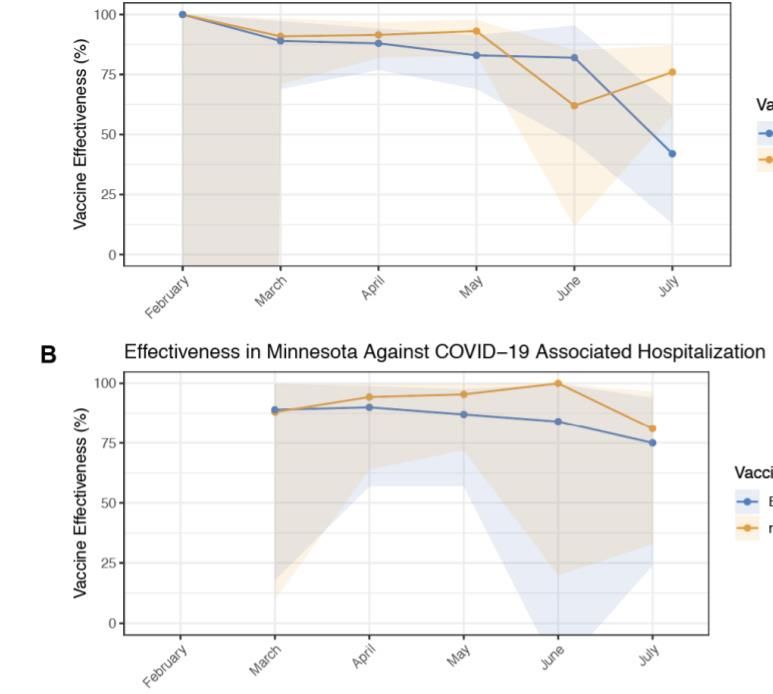
received 2nd dose ≥5 months ago compared toVE against Infection and Hospitalization July vs. Jan-May
Mayo Clinic Health System, Minnesota, n=25,589
Moderna: 76% (95% CI: 58%-87%)
SARS-CoV-2
Infection Pfizer: 42% (95% CI: 13%- 62%)
Delta prevalence increased from
0.7% in May to >70% in July
Moderna: 81% (95% CI: 33%-96%)
COVID-19 Pfizer: 75% (95% CI: 24%- 94%)
Hospitalization
Puranik et al. medRxiv: 19
https://www.medrxiv.org/content/10.1101/2021.08.06.21261707v2U.S. COVID-19 Vaccine Breakthrough Cases ▪ Despite high vaccine efficacy, vaccine breakthrough cases* are expected – Some will be caused by variants, even if vaccine has similar effectiveness against variants – CDC monitors nationwide vaccine breakthrough resulting in hospitalization or death ▪ As of August 2, among more than 164 million fully vaccinated in U.S., there have been 7,101 hospitalizations & 1,507 deaths with vaccine breakthrough reported to passive surveillance** – Among hospitalized or fatal breakthrough cases, 74% among persons aged ≥65 years – Variants of concern (%) among breakthrough cases similar to national genomic surveillance ▪ COVID-NET data on COVID-19-associated hospitalizations among aged persons ≥18 years — ~32% of all vaccinated cases are immunocompromised vs. 11% of unvaccinated cases * Vaccine breakthrough case: Person with SARS-CoV-2 RNA or antigen detected in respiratory specimen collected ≥14 days after completing primary series of an FDA-authorized COVID-19 vaccine ** CDC website as of 8/5/21; 1,816 hospitalizations and 316 fatal cases reported as asymptomatic or not related to COVID-19. CDC. MMWR (2021); COVID-NET: https://www.cdc.gov/coronavirus/2019-ncov/covid-data/covid-net/purpose-methods.html 20
Summary of Preliminary Data: Implications of SARS-CoV-2
Variants of Concern on Vaccine Effectiveness
 B.1.1.7     • Low prevalence in United States
 (Alpha)     • Minimal impact on VE; attention needed for additional substitutions in
               receptor binding domain (RBD), e.g., E484K
 B.1.351     • Low prevalence in United States
 (Beta)      • Moderate impact on VE against infection, but appear to protect against
               severe disease
 P.1         • Low prevalence in United States
 (Gamma)     • Moderate impact on VE for some vaccines; more data needed

 B.1.617.2   • High prevalence in United States
 (Delta)     • Moderate impact on VE for infection, but appear to protect against severe
               disease; more data needed, especially for Janssen

                                                                                           21
Boosters and Second-Generation Vaccines Against SARS-
CoV-2 Variants
▪ Manufacturers conducting booster studies of current vaccines and/or second-
generation vaccines against Beta (B.1.351)
▪ Moderna — preliminary phase 2 results of single 50 µg booster of authorized (mRNA-
1273) and variant-specific vaccine (mRNA-1273.351)
– Both vaccines — acceptable safety; boosted immunity to wild-type, Beta, Gamma
▪ Pfizer has also submitted preliminary data on booster of original vaccine to FDA
▪ No Delta-specific booster vaccine studies shared to date
Wu et al. medRxiv preprint (May 6, 2021): https://doi.org/10.1101/2021.05.05.21256716
https://investors.modernatx.com/news-releases/news-release-details/moderna-announces-positive-initial-booster-data-against-sars-cov/
https://www.pfizer.com/news/press-release/press-release-detail/pfizer-and-biontech-initiate-study-part-broad-development 22
https://www.cdc.gov/vaccines/acip/meetings/downloads/slides-2021-06/06-COVID-Oliver-508.pdfSummary
▪ Currently authorized vaccines offer protection against known variants — important
to increase vaccine uptake in eligible populations
▪ CDC is closely monitoring real-world vaccine effectiveness and breakthrough
infections using multiple methods, populations, and outcomes
▪ CDC continues to monitor emerging variants — prevalence and impact on disease
incidence, severity, and vaccine breakthrough
▪ ACIP will review evidence submitted for boosters and any next-generation vaccines
▪ Changing landscape — CDC will communicate promptly about new evidence
23For more information, contact CDC 1-800-CDC-INFO (232-4636) TTY: 1-888-232-6348 www.cdc.gov The findings and conclusions in this report are those of the authors and do not necessarily represent the official position of the Centers for Disease Control and Prevention.
You can also read


