Walla Walla Valley Metropolitan and Sub-Regional Transportation Planning Organization Metropolitan and Regional Transportation Improvement Program ...
←
→
Page content transcription
If your browser does not render page correctly, please read the page content below
Walla Walla Valley
Metropolitan and Sub-Regional
Transportation Planning Organization

Metropolitan and Regional
Transportation Improvement Program
2017-2022

                Final – October 5, 2016
              Adopted by the Policy Board
         April 21, 2017 – Administrative Update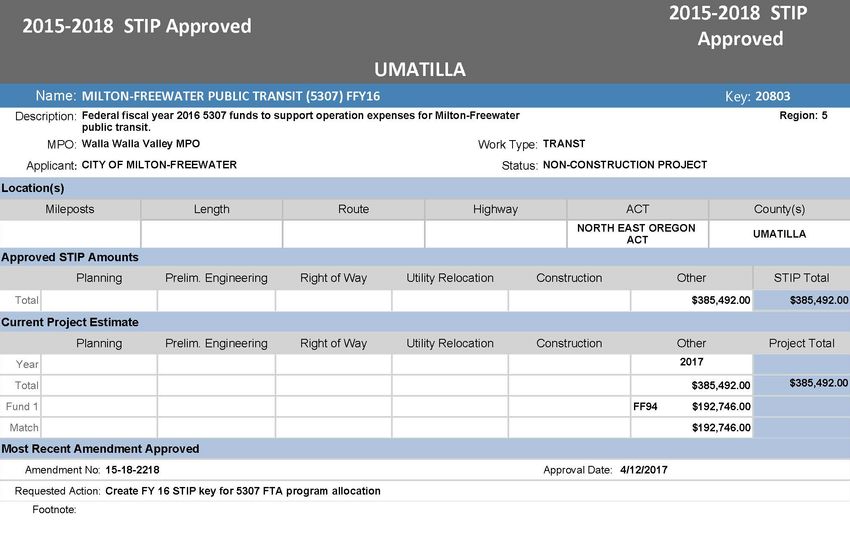
Acknowledgements
This report is the product of a study financed in part by the U.S. Department of Transportation (Federal Highway
Administration and Federal Transit Administration), the Oregon and Washington State Departments of
Transportation, and local government contributions.

The contents of this report reflect the views of the Walla Walla Valley Metropolitan Planning Organization/
Sub-Regional Transportation Planning Organization (WWVMPO/SRTPO), which is responsible for the facts and the
accuracy of the data presented herein. The contents do not necessarily reflect official views or policy of the
U.S. Department of Transportation.

Approval of the report by federal or state agencies constitutes acceptance of the report as evidence of work
performed, but does not imply endorsement of the report’s findings or recommendations. This report does not
constitute a standard, specification, or regulation.

Please Contact the WWVMPO/SRTPO for
Questions, Concerns, or Comments
107 South Third Avenue
Walla Walla, WA 99362
Phone 509-876-8001
Fax 509-876-8003
wwvmpo.org
Walla Walla Valley Metropolitan Planning Organization
         and Sub-Regional Transportation Planning Organization (WWVMPO/SRTPO)
                           A Resolution Adopting the 2017-2022
              Metropolitan and Regional Transportation Improvement Program

                                  RESOLUTION NO. 07-2016

WHEREAS, the Walla Walla Valley Metropolitan Planning Organization and Sub-Regional
Transportation Planning Organization (MPO/SRTPO) is the federal-designated Metropolitan
Planning Organization and state-designated Regional Transportation Planning Organization and
has the responsibility for developing and adopting a Transportation Improvement Program (TIP)
for each organization; and

WHEREAS, local jurisdictions, transit agencies, and Washington State Department of
Transportation (WSDOT) have submitted projects for inclusion in the 2017-2022 Metropolitan
and Regional Transportation Improvement Program (M/RTIP), which are based on reasonably
available financial resources; and

WHEREAS, transportation improvement projects must be included in the M/RTIP to be eligible
for federal assistance under Federal Highway Administration and Federal Transit Administration
funding programs; and

WHEREAS, a public comment period for review of the 2017-2022 M/RTIP was provided
between September 21, 2016, and October 4, 2016, and appropriate notice was given to the
public of such public comment period; and

WHEREAS, the Walla Walla Valley MPO/SRTPO certifies that the requirements of 23 USC 134
are met, such certification being a joint MPO/WSDOT statement concerning the planning
process and is updated annually; and

WHEREAS, the Walla Walla Valley MPO/SRTPO Technical Advisory Committee (TAC)
recommends adoption of the 2017-2022 M/RTIP for the Walla Walla Valley MPO and SRTPO
areas; and

WHEREAS, the Walla Walla Valley MPO/SRTPO Policy Board, in its review of the 2017-2022
M/RTIP on October 5, 2016 finds:
  1. The projects contained in the 2017-2022 M/RTIP to be a suitable and viable program of
      projects to be implemented by local jurisdictions, transit agencies, and the Washington
      State Department of Transportation;
  2. The 2017-2022 M/RTIP to be within appropriate financial constraints;
  3. The development of the 2017-2022 M/RTIP to have involved public input;
  4. The projects contained in the 2017-2022 M/RTIP to be consistent with regional goals,
      policies, and recommendations as set forth in the Walla Walla Valley Metropolitan and
      Regional Transportation 2040 Plan.

2017-2022 M/RTIP Resolution 07-2016                                            Page 1 of 2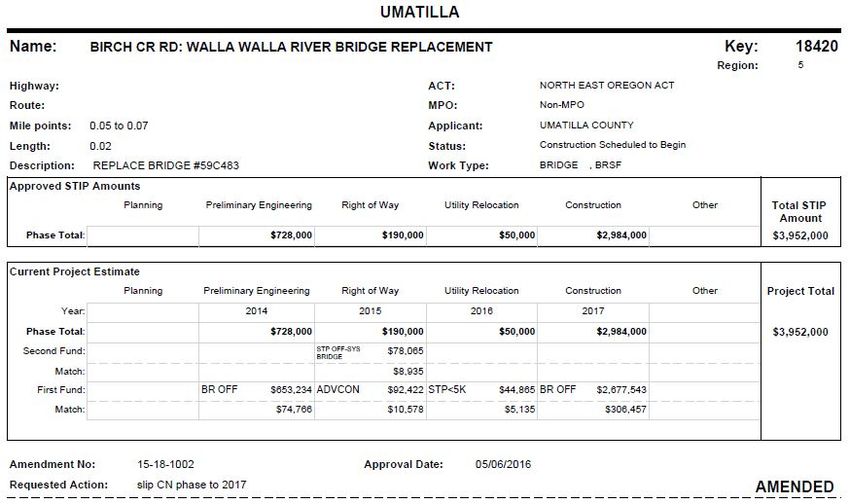
Walla Walla Valley Metropolitan Planning Organization/Sub-Regional
Transportation Planning Organization Membership and Committee Roster
Walla Walla Valley Metropolitan Planning Organization (WWVMPO) Member Agencies
City of College Place (WA) • City of Milton-Freewater (OR) • City of Walla Walla (WA) • Umatilla County (OR) •
Walla Walla County (WA) • Port of Walla Walla (WA) • Valley Transit (WA) • Oregon Department of
Transportation (OR) • Washington State Department of Transportation (WA)

Walla Walla Sub-Regional Transportation Planning Organization (SRTPO) Member Agencies
City of College Place (WA) • City of Prescott (WA) • City of Waitsburg (WA) • City of Walla Walla (WA) • Port of
Walla Walla (WA) • Valley Transit (WA) • Walla Walla County (WA) • Washington State Department of
Transportation (WA)

WWVMPO/SRTPO Policy Board (PB)
Harvey Crowder, Mayor, City of College Place
Linda Hall, City Manager, City of Milton-Freewater
Steve Heimbigner, Mayor, City of Prescott
Randy Hinchliffe, City Administrator, City of Waitsburg
Allen Pomraning, Mayor, City of Walla Walla
Larry Givens, County Commissioner, Umatilla County
Jim Johnson, County Commissioner, Walla Walla County
Ron Dunning, Commissioner, Port of Walla Walla
Dick Fondahn, General Manager, Valley Transit
Craig Sipp, Region Manager, ODOT Region 5
Todd Trepanier, Regional Administrator, WSDOT South Central Region

WWVMPO/SRTPO Technical Advisory Committee (TAC)
Paul Hartwig, Public Works Director, City of College Place
Gina Hartzheim, City Planner, City of Milton-Freewater
Steve Heimbigner, Mayor, City of Prescott
Randy Hinchliffe, City Administrator, City of Waitsburg
Neal Chavre, City Engineer, City of Walla Walla
Tamra Mabbott, Planning Director, Umatilla County
Randy Glaeser, Public Works Director, Walla Walla County
Jeanine Gordon, Transit Program Manager, Confederated Tribes of the Umatilla Indian Reservation
Paul Gerola, Economic Development Director, Port of Walla Walla
Ed McCaw, Deputy General Manager, Valley Transit
Teresa Penninger, Planning and Program Manager, ODOT
Paul Gonseth, Planning Engineer, WSDOT

Bi-State Coordination Workgroup
(Vacant), Federal Highway Administration
Jeremy Borrego, Federal Transit Administration
Teresa Penninger, Planning and Program Manager, ODOT
Linda Howell, Public Transportation Community Liaison, WSDOT
Paul Gonseth, Planning Engineer, WSDOT
Doug Cox, Tribal and Regional Coordination Liaison, WSDOT

WWVMPO/SRTPO Staff
Andrea Weckmueller-Behringer, Executive Director
Elaine Dawson, Planning Assistant
WWVMPO/SRTPO 2017-2022 Metropolitan and Regional Transportation Improvement Program

Table of Contents
Introduction ................................................................................................................................................ 1
   Walla Walla Valley Metropolitan Planning Organization .......................................................................................1
   Walla Walla Sub-Regional Transportation Planning Organization .........................................................................1
Program Overview and Summary ............................................................................................................... 3
Regulatory Background ............................................................................................................................... 4
   Federal Requirements ............................................................................................................................................4
   State Requirements ................................................................................................................................................4
Program Purpose and Scope ....................................................................................................................... 4
   M/RTIP Purpose and Scope in Washington State...................................................................................................4
   MTIP Purpose and Scope in Oregon State ..............................................................................................................5
   Public Involvement .................................................................................................................................................5
   Title VI Assurance ...................................................................................................................................................6
   Intermodal/Multimodal Provisions ........................................................................................................................6
   NHS Facility Certification ........................................................................................................................................6
Major Projects Implemented Since the Previous TIP ................................................................................. 6
Financial Plan .............................................................................................................................................. 7
   Funding Sources .....................................................................................................................................................7
   Financial Constraint ................................................................................................................................................7
M/RTIP Amendment Process ...................................................................................................................... 8
   Amendment to WA MPO/SRTPO Projects..............................................................................................................8
   Amendment to OR MPO Projects ........................................................................................................................ 10
M/RTIP Projects ........................................................................................................................................ 11
   Funded Projects ................................................................................................................................................... 11
   List of Illustrative Projects (Planned - Funding is not Secured) ........................................................................... 12
Appendices
   Appendix A - WA MPO/SRTPO Funding Summary by Source
   Appendix B - WA MPO/SRTPO Fiscal Constraint Overview by Year
   Appendix C - WA MPO/SRTPO Projects, Cost and Funding
   Appendix D - OR MPO Projects, Cost and Funding
   Appendix E - Transportation Improvement Program Policies as
               Adopted by the WWVMPO/SRTPO Policy Board on June 1, 2016
   Appendix F - Criteria and Process Used for Prioritization of Projects
   Appendix G - Project Funding Source Overview
   Appendix H - Public Comments

                                                                                                                                                                         i
WWVMPO/SRTPO 2017-2022 Metropolitan and Regional Transportation Improvement Program
Introduction
Metropolitan and regional transportation planning organizations facilitate the coordinated planning and
implementation of a seamless transportation system for all users. This effort requires cooperation and close
collaboration among all entities involved in implementing, maintaining, and improving individual network
segments.
In the Walla Walla Valley, this facilitation responsibility is assigned to the Walla Walla Valley Metropolitan
Planning Organization and Sub-Regional Transportation Planning Organization (WWVMPO/SRTPO), which
includes representation from Oregon and Washington State, Valley Transit, the Port of Walla Walla, as well as
the cities and counties in the region.
Walla Walla Valley Metropolitan Planning Organization
Established on March 27, 2013, the Walla Walla Valley Metropolitan Planning Organization (WWVMPO) is a
bi-state transportation planning agency located in the Walla Walla Valley region. As the federally designated
MPO for an urbanized area with a population greater than 50,000, the WWVMPO carries out the
continuing, cooperative, and comprehensive (3C) multimodal transportation planning process that encourages
and promotes the safe and efficient development, management, and operation of surface transportation
systems to serve the mobility needs of people and freight and to foster economic growth and development,
while minimizing transportation-related fuel consumption and air pollution. (23 USC 134)
Federal regulations require the WWVMPO to develop a regionally coordinated long-range transportation plan
and short-range improvement program to ensure consistency and efficient use of federal transportation funds.
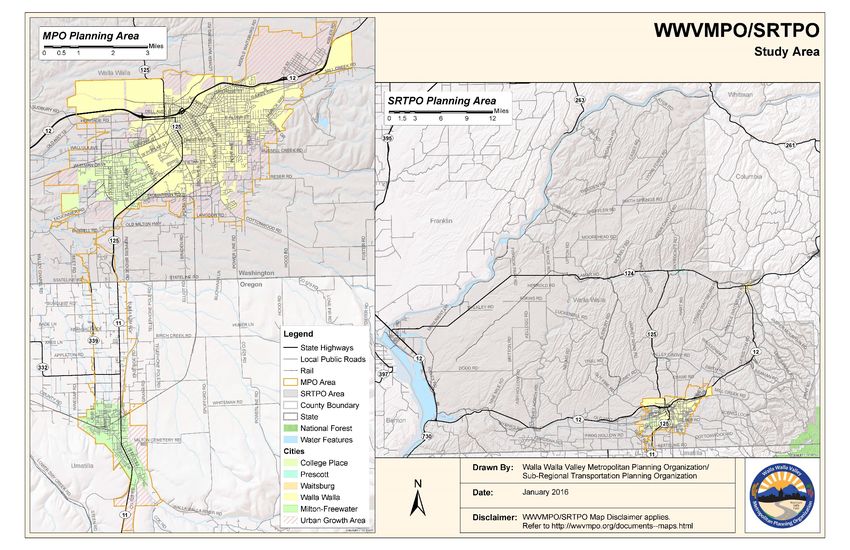
The MPO’s bi-state planning area, shown in the figure on Page 2, includes the cities of College Place,
Milton-Freewater, and Walla Walla, and portions of the counties of Umatilla and Walla Walla.
The majority of funding for the WWVMPO is provided through transportation planning grants from the Federal
Highway Administration (FHWA) and Federal Transit Administration (FTA), administered and supported by the
Oregon and Washington State departments of transportation (ODOT and WSDOT).
Walla Walla Sub-Regional Transportation Planning Organization
The Walla Walla Sub-Regional Transportation Planning Organization (SRTPO) was created by an agreement,
effective July 1, 2013, between the Benton-Franklin-Walla Walla Regional Transportation Planning Organization
(RTPO) and the WWVMPO as a means to make regional planning efforts with the new MPO more efficient.
The SRTPO boundary, also shown in the figure on Page 2, assigns almost all of Walla Walla County to the
WWVMPO, as the area covered under the newly established SRTPO. The Burbank area, a small portion of
western Walla Walla County, is by U.S. Census determination within the Kennewick-Pasco-Richland urbanized
area. Therefore, this portion of Walla Walla County is part of the Benton-Franklin RTPO and MPO planning area.
The Walla Walla SRTPO activities comply with Washington State’s RTPO requirements (RCW 47.80), which call
for transportation planning, at all jurisdictional levels, to be coordinated with local comprehensive plans in
order to achieve both statewide and local transportation goals.
Instead of creating a separate Policy Board and Technical Advisory Committee (TAC) for the SRTPO, the
WWVMPO chose to expand the current MPO Policy Board and TAC to include additional members. Agencies
participating as members of the SRTPO include the MPO members in Washington State and representatives
from the cities of Prescott and Waitsburg.
State funding for the SRTPO, appropriated through WSDOT, is used to carry out the regional transportation
planning activities.
1WWVMPO/SRTPO 2017-2022 Metropolitan and Regional Transportation Improvement Program
Figure: Walla Walla Valley MPO and SRTPO Study Area
2WWVMPO/SRTPO 2017-2022 Metropolitan and Regional Transportation Improvement Program
Program Overview and Summary
Federal and state regulations require the WWVMPO/SRTPO to develop a short-term Transportation Improvement
Program (TIP) for its metropolitan and regional study areas. Federal requirements call for a four-year, financially
constrained list of projects, whereas Washington State regulations stipulate a six-year list of projects.
In lieu of producing two separate documents, the combined Walla Walla Valley Metropolitan and Regional
Transportation Improvement Program (M/RTIP) is a six-year programming document, which demonstrates
financial constraint for federal funds throughout the first four years of the integrated financial plan.
The projects within the M/RTIP are derived from the WWVMPO/SRTPO managed call for federally funded
improvements; the cities’ and county’s six-year Comprehensive Transportation Programs, developed and
adopted by each of the local Washington State member entities; the Transportation System Plans, developed by
Oregon member entities; the six-year Transit Development Plans, developed and adopted by the local public
transportation agencies; and the project lists developed by the Departments of Transportation with jurisdiction
in the planning area. All projects contained in the M/RTIP must also be consistent with policy and project
recommendations included in the Walla Walla Valley Metropolitan and Regional Transportation - 2040 Plan.
The M/RTIP is updated annually and functions as a project programming document and financial plan that
identifies all federally funded and prioritized projects, as well as other transportation improvements of regional
significance, regardless of their funding source. General steps in the development of the M/RTIP include:
• The WWVMPO/SRTPO issues a Call for Projects, based on anticipated federal funding availability.
Member entities select projects from the fiscally constrained project list contained in the 2040 Plan
for consideration in the M/RTIP.
The submitted projects are prioritized using the adopted project selection process and criteria.
Projects are awarded within the limits of available federal funding.
• Local city and county governments and public transportation agencies prepare and submit their local six-
year programs to WSDOT and the WWVMPO/SRTPO.
Based on local comprehensive plans, these programs also contain non-federally funded, but regionally
significant projects.
• The WWVMPO/SRTPO coordinates with ODOT and WSDOT regarding anticipated state-managed projects.
• The public and interested parties are afforded early and reasonable opportunity for involvement and a
public hearing is held to obtain the views of the public on the proposed program of projects.
• Prior to program adoption, the WWVMPO/SRTPO reviews all projects to ensure the following –
All projects scheduled for federal funding are included in the TIP;
Federally funded projects are fiscally constrained by year and funding source;
All regionally significant projects are included, regardless of funding source; and
The M/RTIP projects are consistent with the current metropolitan and regional transportation plan.
Table 1 shows a summary of funding included in the 2017-2022 M/RTIP for Washington State projects.
Table 1. 2017-2022 M/RTIP Summary on Secured Projects (Washington)
Projects Federal Funds State Funds Local Funds TOTAL
MPO 6 $14,393,071 $3,900,000 $6,698,562 $24,991,633
MPO - Public Transportation 5 $5,020,428 293,761 $1,328,548 $6,642,737
SRTPO 17 $17,023,739 $148,556,250 $2,809,533 $168,389,522
Total Projects 28 Total Funding $200,023,892
3WWVMPO/SRTPO 2017-2022 Metropolitan and Regional Transportation Improvement Program
Once adopted, the M/RTIP is included in the respective Statewide Transportation Improvement Programs (STIP).
ODOT and WSDOT are responsible for the statewide coordination of their STIPs. Following federal approval of
the STIPs, local jurisdictions may begin obligating federal funds for their projects.
Regulatory Background
WWVMPO/SRTPO staff assembles the M/RTIP in full compliance with the following federal and state laws.
Federal Requirements
According to 23 USC 134 (j), the Metropolitan Transportation Improvement Program must –
• Be cooperatively developed by the MPO, cities, counties, transit agencies, and state DOT;
• Include regionally significant and all federally funded transportation capital and non-capital projects;
• List prioritized projects with description, total cost, and implementing agency;
• Encompass four years of programmed projects;
• Be updated regularly – at least once every four years;
• Include cooperatively determined funding estimates;
• Demonstrate fiscal constraint by year and funding source;
• Be consistent with the adopted Metropolitan Transportation Plan; and
• May include a list of illustrative (unfunded) projects.
In compliance with 49 USC 53 (c), the TIP also satisfies the public participation requirements pertaining to
Section 5307 grant funding received from the Federal Transit Administration.
State Requirements
According to RCW 47.80.023 (5), the Regional Transportation Improvement Program must –
• Be cooperatively developed by the RTPO, cities, counties, transit agencies, and state DOT;
• Include regionally significant transportation projects and programs, transportation demand
management (TDM) measures, as well as projects that advance special needs coordination
transportation as identified by the Agency Council on Coordinated Transportation;
• Provide a priority list of projects, programs, and TDM measures;
• Encompass six years of programmed projects;
• Be updated at least every two years;
• Include a financial plan that demonstrates how programmed projects can be funded;
• Be based on the local 6-year programs, projects, and TDM measures of regional significance identified
by transit agencies, cities, and counties, as well as WSDOT; and
• Be consistent with the adopted Regional Transportation Plan.
Program Purpose and Scope
Each year the WWVMPO/SRTPO prepares the M/RTIP in coordination with local jurisdictions, public
transportation agencies, ODOT, and WSDOT. All projects in the 2017-2022 M/RTIP have been reviewed and
found to be consistent with the goals and objectives in local comprehensive plans, the 2040 Plan, and the
respective State Transportation Plans.
M/RTIP Purpose and Scope in Washington State
The WWVMPO/SRTPO is required by federal and Washington State regulations to develop a Metropolitan and
Regional Transportation Improvement Program (M/RTIP) for its metropolitan and sub-regional transportation
planning areas. The Metropolitan TIP spans a 4-year period, whereas the Regional TIP spans a six-year period.
4WWVMPO/SRTPO 2017-2022 Metropolitan and Regional Transportation Improvement Program
In lieu of producing two separate documents, the combined M/RTIP functions as a six-year document, which is
updated annually and identifies prioritized, regionally significant transportation projects, and demonstrates
financial constraint in using federal funds for the first four years of the financial plan.
The M/RTIP aids in the coordination of transportation planning throughout the region. The program provides
the public, elected officials, state and local staff, transit providers, tribes, and other interested parties the
opportunity to review projects for consistency with regional and local plans, goals, and policies. The M/RTIP
requires approval by the WWVMPO/SRTPO Policy Board, the Federal Highway Administration and Federal
Transit Administration, the Washington State Department of Transportation, and the Washington State
Governor’s Office. The approved M/RTIP is then included in the Statewide Transportation Improvement
Program (STIP). WSDOT is responsible for the statewide coordination of the STIP. The Washington STIP process
and project list can be found at: http://www.wsdot.wa.gov/LocalPrograms/ProgramMgmt/STIP.htm.
Once local agency projects are programmed, WSDOT manages the local portion of the federal highway funds on
a first-come first-served basis. Following federal approval of the STIP, local jurisdictions may begin obligating
federal funds for their projects. The regional procedures allow any federal project included in the STIP to be
advanced or delayed without STIP amendment contingent upon the financial balance being maintained for each
fiscal year.
MTIP Purpose and Scope in Oregon State
The timing for the Washington State and Oregon Statewide Transportation Improvement Program (STIP)
development activities are generally not concurrent.
• The current 2015-2018 TIP for WWVMPO Oregon members was developed ahead of the
WWVMPO/SRTPO 2017-2022 M/RTIP, and the Oregon-specific projects are included in this M/RTIP to
inform the public.
• At this time, the 2018-2021 Oregon STIP is under development and a draft release for public comment is
anticipated in January 2017. Upon adoption of the Oregon STIP, Oregon-specific TIP projects will again
be included in the WWVMPO/SRTPO M/RTIP.
The Oregon-specific TIP projects require approval by the WWVMPO/SRTPO Policy Board, the Federal Highway
Administration and Federal Transit Administration, as well as the Oregon Department of Transportation, and the
Oregon Governor’s Office. ODOT is responsible for the statewide coordination of the Oregon STIP. The Oregon
STIP process and project list can be found at: http://www.oregon.gov/ODOT/TD/STIP/Pages/STIPDocs.aspx.
Once local agency projects are programmed, ODOT manages the local portion of the federal highway funds on a
first-come first-served basis and, in coordination with local jurisdictions, may choose to exchange the federal
funds for state funds. If local jurisdictions are recipients of federal funds, following federal approval of the STIP,
local jurisdictions may begin obligating federal funds for their projects. The regional procedures allow any
federal project included in the STIP to be advanced or delayed without STIP amendment contingent upon the
financial balance being maintained for each fiscal year.
Public Involvement
Citizens and interested parties are provided opportunity to comment on the draft M/RTIP as required under the
Fixing America’s Surface Transportation (FAST) Act. The public review period for the draft 2017-2022 M/RTIP
was held from September 21, 2016 through October 4, 2016. Furthermore, a public hearing, conducted as part
of the regular Policy Board meeting on October 5, 2016, provides an opportunity to obtain the views of the
public on the proposed projects.
5WWVMPO/SRTPO 2017-2022 Metropolitan and Regional Transportation Improvement Program
Public notices announcing the availability of the draft were published in the newspaper of record and on the
WWVMPO/SRTPO website. A copy of the draft 2017-2022 M/RTIP was also available for public viewing at three
physical locations in Walla Walla County: the Walla Walla Library, Waitsburg City Hall, and the WWVMPO/SRTPO
office. An electronic copy was posted on the WWVMPO/SRTPO website at http://wwvmpo.org/public-
participation.html. All public comments received are included in Appendix H.
It is important to note that public involvement activities and time established for public review and comment
on the M/RTIP satisfies Program of Projects (POP) public involvement requirements of the Federal Transit
Administration Section 5307 Program as they relate to Valley Transit public transportation projects.
Title VI Assurance
As a recipient of federal and state funds, the WWVMPO/SRTPO is subject to the provisions of Title VI of the Civil
Rights Act of 1964 and the Civil Rights Restoration Act of 1987. In compliance with the requirements, the agency
assures that no person shall, on the grounds of race, color, national origin, or sex, be excluded from participation
in, be denied the benefits of, or be otherwise subjected to discrimination under any program or activity
conducted by the WWVMPO/SRTPO.
The agency has an approved Title VI Plan on file. Any Title VI issues discovered during the development of the
M/RTIP will be corrected in the first available 2017-2022 M/RTIP amendment in January 2017.
Intermodal/Multimodal Provisions
The WWVMPO/SRTPO and its member entities recognize that quality of life, which is highly valued by regional
stakeholders and the public, is inherently improved through the advancement of pedestrian and bicycle related
transportation projects.
Therefore, all projects listed in the 2017-2022 M/RTIP considered context-sensitive provisions for pedestrian and
bicycle transportation modes to the extent possible.
NHS Facility Certification
Following the adoption of the Moving Ahead for Progress in the 21st Century (MAP-21) Act in 2012, the National
Highway System (NHS) was greatly expanded. Accounting for 37.99 miles in the WWVMPO/SRTPO area, local
agencies with NHS routes are responsible for maintaining those roadway segments. Because of their national
and strategic significance, NHS routes are deemed to be of greater importance than non-NHS routes.
The WWVMPO/SRTPO certifies that NHS routes have been given priority by agencies throughout their six-year
programming process.
Major Projects Implemented Since the Previous TIP
Since the previous M/RTIP was approved, the following projects have either been completed or all associated
funding has been obligated and the project is still under construction:
• 2015 Walla Walla Pedestrian Improvements – City of Walla Walla
• E. 7th Street Sidewalk (WA-06419) – City of Waitsburg
• Waitsburg Sidewalk Improvements (waits15) – City of Waitsburg
• Foster Road MP 1.0 to 2.0 – Walla Walla County
• Middle Waitsburg Road – Walla Walla County
• Mill Creek Road MP 3.96 to 4.36 – Walla Walla County
• US 12/McNary Pool to Dodd Road & Nine Mile Creek to Old Highway 12 – WSDOT
• SR 124/Monument Road/RR Xing – Construct Bridge – WSDOT
6WWVMPO/SRTPO 2017-2022 Metropolitan and Regional Transportation Improvement Program
Financial Plan
Fiscal feasibility is a significant priority in determining the final list of 2017-2022 M/RTIP transportation
improvements. Federal and state requirements mandate that this document be fiscally constrained and only
include projects that can reasonably be expected to have adequate funding
Funding Sources
The 2017-2022 M/RTIP is funded from a variety of federal, state, and local sources. A list of the most common of
funding programs is shown in Appendix G. It is important to note that not all state and locally funded projects
have to be programmed in the M/RTIP, unless one or more of the following conditions apply:
• State or local funds are used to match federal dollars;
• Projects that require federal approval or other formal federal action; or
• The state or locally funded projects are of regional significance.
Financial Constraint
The M/RTIP covers six years of projects from 2017-2022. Placement of M/RTIP projects are based on priority;
projects to be obligated in 2017 are the highest priority. Carry-over projects from 2016 are included with the
high priority projects.
The financial constraint for federal Surface Transportation Block Grant (STBG) and Transportation Alternatives (TA)
funding is tied directly to the anticipated allocations to the WWVMPO/SRTPO provided through WSDOT.
Close coordination between WSDOT and the agency allowed the estimation of STBG and TA funding from 2017
through 2020. The table below summarizes the associated funding assumptions.
Table 2. WWVMPO/SRTPO 2017-2020 STBG and TA Projected Allocations (for WA projects)
STBG (WA) 2017 2018 2019 2020 Total 2017-2020
Urban $586,880 $586,880 $586,880 $586,880 $2,347,520
Rural $125,746 $125,746 $125,746 $125,746 $502,984
Any Area $509,381 $509,381 $509,381 $509,381 $2,037,524
Yearly Total $1,222,007 $1,222,007 $1,222,007 $1,222,007 $4,888,028
Funding Carry-Over to 2017 ($1,622,566) (1,622,566)
2016-2021 Carry-over Projects ($52,000) ($207,450) ($259,450)
STBG Available for Obligation $3,006,012
TA (WA) 2017 2018 2019 2020 Total 2017-2020
Urban $35,244 $35,244 $35,244 $35,244 $140,976
Rural $7,552 $7,552 $7,552 $7,552 $30,208
Any Area $23,860 $23,860 $23,860 $23,860 $95,440
Yearly Total $66,656 $66,656 $66,656 $66,656 $266,624
Funding Carry-Over to 2017 $6,258 $6,258
2016-2021 Carry-over Projects
TA Available for Obligation $272,882
Source: WSDOT
STBG and TA funding not tied to 2016-2021 M/RTIP carry-over projects, is assigned to new projects through a
regionwide STBG and TA call for projects, which took place in June and July of 2016. Placement of the projects
within the first four years of the M/RTIP is based on project priority as well as available funding for the
respective urban, rural, and any area categories; carry-over projects retain their original timing whenever
possible.
7WWVMPO/SRTPO 2017-2022 Metropolitan and Regional Transportation Improvement Program
Appendix A provides a funding summary by source for all projects within the MPO/SRTPO area in Washington
State. Appendix B expands upon this financial information and demonstrates fiscal constraint for each source of
federal funding by year.
Appendix C provides detailed project descriptions and financial information by project phase and source for all
projects within the MPO/SRTPO area in Washington State, whereas detailed information on Oregon MPO area
projects is shown in Appendix D. It is important to note that although this M/RTIP discloses project description
and financial details for all WWVMPO/SRTPO projects, it does not include Oregon-specific project funding in the
fiscal constraint calculation.
M/RTIP Amendment Process
The WWVMPO/SRTPO will develop the calendar year (CY) 2017 internal amendment schedule for Washington
State and Oregon projects by November 2016. Each member agency’s request for an M/RTIP amendment must
include the project title, description, cost, funding sources, implementation schedule, and reason for the
amendment. The project amendment will undergo the same review process of the original project submittal to
assure compliance with federal and state laws and consistency with the 2040 Plan.
Amendment to WA MPO/SRTPO Projects
Local jurisdictions or agencies located in Washington may submit a request for an M/RTIP amendment according
to the internal schedule, which is based on guidance given by WSDOT:
http://www.wsdot.wa.gov/LocalPrograms/ProgramMgmt/STIP.htm
The M/RTIP is required to be amended for a project within Washington State, if it meets any of the conditions
listed in the table on the following page. (Please note, the table has been extracted from Appendix C of WSDOT’s
most recent STIP document.)
8WWVMPO/SRTPO 2017-2022 Metropolitan and Regional Transportation Improvement Program
9WWVMPO/SRTPO 2017-2022 Metropolitan and Regional Transportation Improvement Program
Amendment to OR MPO Projects
Local jurisdictions or agencies located in Oregon may submit a request for an M/RTIP amendment according to
the internal schedule. Although ODOT accepts amendments to the STIP on a daily basis, the WWVMPO must
follow the established schedule prior to the ODOT STIP submission process to allow for approval of TIP
amendments by its Technical Advisory Committee and Policy Board.
The M/RTIP is required to be amended for an Oregon project, if it meets any of the conditions in the following
amendment categories listed in the STIP Users Guide:
1. Full Amendment
Adding a state or federally funded (FHWA or FTA) project, or a project that requires an action by
FWHA or FTA (any funding source), to the STIP;
Adding a regionally significant project to the STIP (any funding source);
Cancelling a state or federally funded project, or a project that requires an action by FHWA or FTA
(any funding source), from the STIP;
Moving an approved project to a NEEDS status, releasing funding from the project;
Major change in scope of a project;
Adding or deleting a construction phase to an approved STIP project;
Changing Project Eligibility Criteria conditions on a project for which the OTC has applied conditions
of approval; or
Advancing the PE phase of a project from a Draft STIP to the current STIP.
2. Administrative Amendment
Adding a federally funded project that is funded with discretionary/earmark funds;
Adding a non-federally funded project that doesn’t impact air quality conformity or require FHWA or
FTA action to the STIP;
Advancing an approved project or phase of a project from year two, three, or four into the current
year of the STIP;
Adding or deleting any phase (except construction) of an approved project;
Combining two or more approved projects into one project;
Splitting an approved project into two or more projects, or splitting part of an approved project into
a new one;
Breaking a new project out of an approved program-specific pool of funds (but not reserves for
future projects) or adding funds to an existing project from a bucket or reserve;
Minor technical corrections to make the printed STIP consistent with prior approvals (such as
typographic errors or missing data);
Changing name of project due to change in scope, combining or splitting of projects, or to better
conform to naming convention;
Increasing or decreasing the federal funds of an FTA-funded project, without affecting fiscal
constraint of the STIP;
Adding FHWA funds to an approved FTA-funded project; or
Obligating funds that exceed 20% or $100,000 of the phase cost, whichever is greater, as compared
to the current STIP
3. Project Control System (PCS) Database Changes
Moving an approved project or phase of a project from the current year of the STIP to a later year; or
Increasing or decreasing the federal funds of an FHWA-funded or state-funded project, without
affecting fiscal constraint of the STIP
10WWVMPO/SRTPO 2017-2022 Metropolitan and Regional Transportation Improvement Program
M/RTIP Projects
The 2017-2022 M/RTIP summary lists 1 for projects in the WWVMPO/SRTPO contain all federally funded or
regionally significant transportation improvements. Details for each project are found in Appendices C and D for
Washington State and Oregon projects, respectively.
Funded Projects
WA MPO Area Regionally Significant Projects
• Isaacs Avenue Improvements – Division Street to Wilbur Avenue (401WWC01.2 / WA-09465) – City of
Walla Walla – 2017-2020
• Wilbur-University Pedestrian and Stormwater Improvements Project (WA-09455) – City of Walla Walla –
2017-2020
• Asphalt/Chip Seal Preservation Walla Walla Valley MPO (BPWWV) – WSDOT – 2017-2021
• SR 125 Spur/N 13th Ave to Myra Rd – ADA Compliance (512501Z36) – WSDOT – 2019-2020
• SR 125/Oregon State Line to 12th Ave N – ADA Compliance (512501Y36) – WSDOT – 2017-2019
• SR 125/Plaza Way Intersection Improvements (512502C36) – WSDOT – 2017-2019
Public Transportation
• Replace up to Four (4) Heavy-Duty Transit Buses (1610) – Valley Transit – 2017
• Replace up to Two (2) Heavy Duty Transit Buses (1204) – Valley Transit – 2017
• Purchase up to Two (2) Heavy Duty Transit Buses (1507) – Valley Transit – 2017
• Purchase up to Three (3) Expansion Paratransit Vehicles for ADA Accessible Service in the Walla Walla
Valley (1307) – Valley Transit – 2017
• Increasing Access to Transportation in Southeastern Washington with ITS Information Technology (1209)
– Valley Transit – 2017
WA SRTPO Area Regionally Significant Projects
• Arnold Lane Sidewalks (WA-09574) – City of Waitsburg – 2017-2021
• Mill Creek Road MP 8.00 To MP 9.40 (WA-01832) – Walla Walla County – 2016-2017
• Blue Creek Bridge on Mill Creek Road MP 6.3 (WA-01884) – Walla Walla County – 2016-2017
• Mill Creek Road At 5 Mile Road MP 1.10 to MP 1.96 (WA-06147) – Walla Walla County – 2018-2019
• Mill Creek Road MP 1.96 to MP 3.96 (WA-04640) – Walla Walla County – 2018
• Mill Creek Road MP 1.10 to MP 3.96 (401WCR14 / WA-09572) – Walla Walla County – 2020
• US 12/Nine Mile Hill to Frenchtown Vic – Build New Highway (501213X36) – WSDOT – 2017-2019
• US 12/Walla Walla - Crawford Dr to Fraizier Dr Noise Walls (501215V36) – WSDOT – 2019-2021
• US 12/Walla Walla River Bridge - Scour Repair (501207O36) – WSDOT – 2021-2023
• US 12/Wallula to Nine Mile Hill – Build New Highway (501203A36) – WSDOT – 2018-2022
• SR 730/0.2 miles North of Oregon Border_Rockfall Prevention (573001D36) – WSDOT – 2017
• SR 730/0.9 miles North of Oregon Border_Rockfall Prevention (573001E36) – WSDOT – 2017
• SR 730/1.8 miles North of Oregon Border_Rockfall Prevention (573001F36) – WSDOT – 2017
• SR 730/3.0 miles North of Oregon Border_Rockfall Prevention (573001G36) – WSDOT – 2017-2019
• SR 730/4.1 miles North of Oregon Border_Rockfall Prevention (573001H36) – WSDOT – 2016-2018
• SR 730/4.4 miles North of Oregon Border_Rockfall Prevention (573001I36) – WSDOT – 2016-2018
• SR 730/5.2 miles North of Oregon Border_Rockfall Prevention (573001J36) – WSDOT – 2016-2018
Oregon MPO Area
• Birch Cr Rd: Walla Walla River Bridge Replacement (18420) – Umatilla County – 2014-2017
Public Transportation
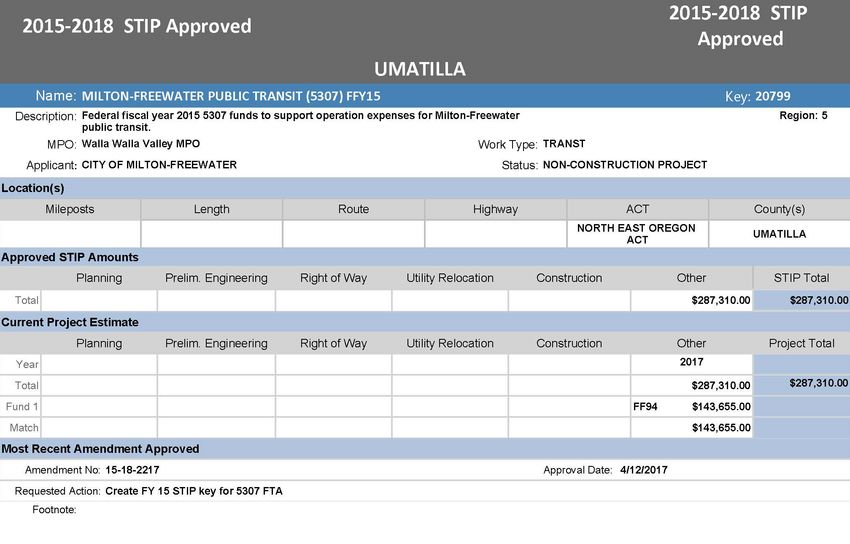
• Milton-Freewater Public Transit (5307) FFY15 (20799) – City of Milton-Freewater – 2017
• Milton-Freewater Public Transit (5307) FFY16 (20803) – City of Milton-Freewater – 2018
1
Projects (or phases) planned for implementation in 2021 and 2022 extend beyond the 2017-2020 fiscally constrained TIP.
11WWVMPO/SRTPO 2017-2022 Metropolitan and Regional Transportation Improvement Program
List of Illustrative Projects (Planned - Funding is not Secured)
WA MPO Area
• West Side School District Bicycle and Pedestrian Improvements (401CPR04 / WSDPED-1) – City of
College Place – 2017-2018 (High Priority – Partially Funded)
• Plaza Way-Tietan Street Intersection Improvements (NEW) – City of Walla Walla – 2017 (High Priority)
• 2nd Avenue - US 12 to Rose (NEW) – City of Walla Walla – 2016-2018 (Prioritized)
• Berney Drive MP 0.00 To MP 0.75 (WA-01879) – Walla Walla County – 2017-2019 (Prioritized)
• Reser Road MP 0.97 to MP 1.22 (WA-01888) – Walla Walla County – 2022
• Mojonnier Road MP 0.14 to MP 1.07 (WA-01889) – Walla Walla County – 2018-2019
• Mojonnier Road MP 1.07 to MP 2.30 (WA-01932) – Walla Walla County – 2020-2021
• 3rd Avenue South Paxton Bridge MP 2.30 to MP 2.77 (WA-01944) – Walla Walla County – 2020-2021
• Russell Creek Road MP 0.0 to MP 0.86 (WA-02112) – Walla Walla County – 2022
• 3rd Avenue South MP 1.61 to MP 1.90 at Prospect Avenue (WA-02312) – Walla Walla County – 2022
• Plaza Way MP 0.251 to MP 0.80 (WA-02321) – Walla Walla County – 2022
• Plaza Way MP 0.0 to MP 0.251 (WA-02323) – Walla Walla County – 2022
• Reser Road MP 0.50 to MP 0.97 (WA-04766) – Walla Walla County – 2020-2021
Public Transportation
• Facility Renovation and Energy Efficiency Improvements (1304) – Valley Transit – 2018
• Replace up to Five (5) Vanpool Vehicles (1502) – Valley Transit – 2018
• Maintenance Facility Improvements - CNG Mitigation and Energy Improvements (1511) – Valley Transit
– 2017
• Replace up to Two (2) Heavy-Duty Transit Buses (1602) – Valley Transit – 2018
• Replace up to four (4) Paratransit Vehicles (1609) – Valley Transit – 2017
• Purchase and Install Charging Station(s) (1611) – Valley Transit – 2017
• Replace Fuel and Waste Oil Underground Storage Tanks (1705) – Valley Transit – 2018
• Valley Transit Main Facility Security Fence (1707) – Valley Transit – 2017
• General Labor Operating (1708) – Valley Transit – 2017
• Purchase One (1) Compressed Natural Gas Compressors and Control Equipment (1803) – Valley Transit –
2019
• Dial-A-Ride Storage Facility Expansion (1804) – Valley Transit – 2017
• Expand the Main Facility Parking Lot (1806) – Valley Transit – 2019
• General Labor Operating (1807) – Valley Transit – 2018
• Replace up to Three (3) Paratransit Vehicle (1901) – Valley Transit – 2021
• Replace One (1) Heavy-Duty Transit Bus (1902) – Valley Transit – 2020
• Replace Two (2) Heavy-Duty Transit Bus (1904) – Valley Transit – 2019
• General Labor Operating (1905) – Valley Transit – 2019
• General Labor Operating (2001) – Valley Transit – 2020
• General Labor Operating (2102) – Valley Transit – 2021
• Replace up to Two (2) Heavy Duty Transit Buses (2201) – Valley Transit – 2022
• Replace One (1) Heavy Duty Transit Bus (2202) – Valley Transit – 2022
• Replace up to Three (3) Paratransit Vehicles (2203) Valley Transit – 2022
• General Labor Operating (2204) – Valley Transit – 2022
12WWVMPO/SRTPO 2017-2022 Metropolitan and Regional Transportation Improvement Program
WA SRTPO Area
• Mill Race Rd Grade Crossing (Waitsburg6) – Waitsburg – 2018 (Prioritized)
• Coppei Creek Bridge Replacement (Waitsburg7) – Waitsburg – 2020-2021
• Taggart Road Extension (WA-08036) – Waitsburg – 2017-2018
• Bolles Road Overlay (WA-08037) – Waitsburg – 2019
• J B George Road MP 0.10 to MP 0.74 (WA-01883) – Walla Walla County – 2022
• Reser Road MP 1.22 to MP 2.40 (WA-01886) – Walla Walla County – 2019-2020
• Peppers Bridge Road MP 0.30 to MP 1.60 (WA-01920) – Walla Walla County – 2019-2020
• Reser Road MP 3.00 to MP 5.17 (WA-01922) – Walla Walla County – 2018-2019
• Lyons Ferry Road MP 1.50 to MP 3.20 (WA-01926) – Walla Walla County – 2019-2020
• Harvey Shaw Road MP 2.0 to MP 3.0 (WA-01935) – Walla Walla County – 2019-2020
• Lewis Peak Road MP 0.00 to MP 9.24 (WA-01939) – Walla Walla County – 2020-2021
• Stateline Road Pine Creek No. 2 Bridge MP 2.10 To MP 2.60 (WA-01942) – Walla Walla County – 2018-
2019
• Pemberton Bridge on Barney Road MP 2.20 to MP 2.40 (WA-01945) – Walla Walla County – 2017
• Harvey Shaw Road Drainage MP 3.3 to MP 3.5 (WA-02094) – Walla Walla County – 2022
• Hart Road MP 6.80 to MP 7.80 (WA-02100) – Walla Walla County – 2020-2021
• Lower Waitsburg Road MP 8.6 to MP 9.0 (WA-02106) – Walla Walla County – 2022
• Lower Waitsburg Road MP 3.00 to MP 4.25 (WA-02108) – Walla Walla County – 2022
• Lower Waitsburg Road MP 13.0 to MP 14.4 (WA-02115) – Walla Walla County – 2022
• Lower Waitsburg Road MP 4.30 to MP 5.20 (WA-02119) – Walla Walla County – 2022
• Lower Dry Creek Road MP 1.10 to MP 2.30 (WA-02120) – Walla Walla County – 2022
• Middle Waitsburg Road MP 6.10 to MP 7.32 (WA-02121) – Walla Walla County – 2018-2019
• Smith Spring Road MP 3.3 to MP 3.6 (WA-02123) – Walla Walla County – 2022
• Fredrickson Bridge MP 1.13 to MP 1.21 (WA-02325) – Walla Walla County – 2022
• Scenic Loop Road MP 3.10 to MP 4.12 (WA-04643) – Walla Walla County – 2018-2019
• Scenic Loop Road MP 2.0 to MP 3.1 (WA-04644) – Walla Walla County – 2020-2021
• Scenic Loop Road MP 1.53 to MP 2.00 (WA-04645) – Walla Walla County – 2020-2021
• Whitman Drive West MP 1.01 To MP 3.10 (WA-04764) – Walla Walla County – 2017-2018
• Beet Road MP 0.71 to MP 1.33 (WA-06146) – Walla Walla County – 2018-2019
• Pflugrad Bridge on Biscuit Ridge Road MP 6.0 to MP 6.2 (WA-06149) – Walla Walla County – 2017-2018
• Cottonwood Road at Hood Road MP 2.8 (WA-06916) – Walla Walla County – 2018-2019
• Seven Mile Bridge on Seven Mile Road MP 2.20 to MP 2.55 (WA-06919) – Walla Walla County – 2018-
2019
• Fishhook Park Road MP 0.00 to MP 1.28 (WA-06922) – Walla Walla County – 2018-2019
• Wallula Ave. MP 0.07 To MP 1.84 – Stormwater (WA-08460) – Walla Walla County – 2022
• Reinken Blvd. MP 0.00 To MP 0.42 (WA-08463) – Walla Walla County – 2022
• Second Avenue (B) MP 0.00 To MP 0.61 (WA-08466) – Walla Walla County – 2021
• Fletcher Road MP 0.00 to MP 0.10 (WA-08467) – Walla Walla County – 2020
• School Avenue MP 0.00 To MP 1.10 (WA-08469) – Walla Walla County – 2022
• Whitely Road MP 0.20 to MP 0.40 (WA-08471) – Walla Walla County – 2022
• Middle Waitsburg Road MP 7.32 to MP 8.20 (WA-08475) – Walla Walla County – 2022
• Scenic Loop Road MP 0.85 To MP 1.53 (WA-08476) – Walla Walla County – 2022
• Depping Road MP 0.00 To Berney Road Drive MP 0.00 (WA-08477) – Walla Walla County – 2022
• Columbia School Road N. (B) MP 0.00 To MP 0.17 (WA-08478) – Walla Walla County – 2017-2019
13WWVMPO/SRTPO 2017-2022 Metropolitan and Regional Transportation Improvement Program Appendices Appendix A - WA MPO/SRTPO Funding Summary by Source
WWVMPO/SRTPO 2017-2022 Metropolitan and Regional Transportation Improvement Program

Source: October 13, 2016 excerpt of the WSDOT online Statewide Transportation Improvement Program (STIP) database
WWVMPO/SRTPO 2017-2022 Metropolitan and Regional Transportation Improvement Program

 Appendix B - WA MPO/SRTPO Fiscal Constraint Overview by Year
 The M/RTIP for the WWVMPO/SRTPO demonstrates that it is a financially realistic program. Projected revenues
 by program are equal to or greater than the estimated cost of programmed projects for each year.

 Table: 2017-2020 Financial Feasibility Summary Table (WA)

Fund Type               Year       Starting         Annual           Total Available Total Amount    Ending
                                   Balance          Allocation       Revenue         Programmed      Balance
                                   (carryover)                                                       (carryover)
STBG Regional           2017        ($1,622,566)       $1,222,007         ($400,559)           $0      ($400,559)
(US, R, Any Area)
                        2018          ($400,559)       $1,222,007           $821,448     $275,024        $546,424
                        2019            $546,424       $1,222,007         $1,768,431     $207,450      $1,560,981
                        2020          $1,560,981       $1,222,007         $2,782,988    $2,772,859        $10,129
TA Regional             2017               $6,258         $66,656            $72,914           $0         $72,914
(US, R, Any Area)
                        2018             $72,914          $66,656           $139,570           $0        $139,570
                        2019            $139,570          $66,656           $206,226           $0        $206,226
                        2020            $206,226          $66,656           $172,882     $171,788        $101,094
FTA 5307                2017                           $4,712,832         $4,712,832    $4,712,832
                        2018                                                                   $0
                        2019                                                                   $0
                        2020                                                                   $0
FTA 5310                2017                             $307,596           $307,596     $307,596
                        2018                                                                   $0
                        2019                                                                   $0
                        2020                                                                   $0
FTA 5339                2017                                                                   $0
                        2018                                                                   $0
                        2019                                                                   $0
                        2020                                                                   $0
Discretionary           2017                           $5,400,000         $5,400,000    $5,400,000
                        2018                                                                   $0
                        2019                                                                   $0
                        2020                                                                   $0
HSIP                    2017                                                                   $0
                        2018                                                                   $0
                        2019                                                                   $0
                        2020                                                                   $0
WWVMPO/SRTPO 2017-2022 Metropolitan and Regional Transportation Improvement Program
Fund Type Year Starting Annual Total Available Total Amount Ending
Balance Allocation Revenue Programmed Balance
(carryover) (carryover)
NHPP 2017 $3,859,407 $3,859,407 $3,859,407
2018 $620,109 $620,109 $620,109
2019 $6,381,053 $6,381,053 $6,381,053
2020 $1,385,060 $1,385,060 $1,385,060
STBG WSDOT 2017 $3,906,639 $3,906,639 $3,906,639
2018 $3,561,399 $3,561,399 $3,561,399
2019 $1,396,419 $1,396,419 $1,396,419
2020 $47,603 $47,603 $47,603
STBG (BR) 2017 $1,432,000 $1,432,000 $1,432,000
2018 $0
2019 $0
2020 $0
TIB, CRAB 2017 $0
2018 $1,916,000 $1,916,000 $1,916,000
2019 $0
2020 $0
State, CWA 2017 $16,811,733 $16,811,733 $16,811,733
2018 $30,719,289 $30,719,289 $30,719,289
2019 $98,689,489 $98,689,489 $98,689,489
2020 $4,613,500 $4,613,500 $4,613,500
Local (includes 2017 $3,693,272 $3,693,272 $3,693,272
match)
2018 $1,038,380 $1,038,380 $1,038,380
2019 $194,830 $194,830 $194,830
2020 $5,910,161 $5,910,161 $5,910,161
TOTAL $200,135,115 $200,023,892WWVMPO/SRTPO 2017-2022 Metropolitan and Regional Transportation Improvement Program Appendix C - WA MPO/SRTPO Projects, Cost and Funding Please refer to the following pages for detailed information on projects programmed for funding. Source: October 13, 2016 excerpt of the WSDOT online Statewide Transportation Improvement Program (STIP) database
Six Year Transportation Improvement Program
                                                                                                                                                                                      From 2017 to 2022
             Agency: Valley Transit
             County: Walla Walla
  MPO/RTPO: WWV                                                                                  Y Inside                                                              N Outside

                                                                                                                                                                                                                                                                                                               Environmental Type
                                                                                                                                                                                                                                            Improvement Type
                   Priority Number

                                                                                                                                                                                                                        Resolution No.

                                                                                                                                                                                                                                                                                                                                    RW Required
                                                                                                                                                                                                                                                               Utility Codes

                                                                                                                                                                                                                                                                                    Total Length
                                                                                                                                                                                                    Amendment
                                         A. PIN/Project No.                                                                                  B. STIP ID
Functional

                                         C. Project Title

                                                                                                                                                                                   Adopted
                                                                                                                                                             Hearing
                                         D. Road Name or Number
    Class

                                         E. Begin & End Termini
                                         F. Project Description                                                                         G. Structure ID
    00                               1701 N/A                                                                                                       1610 08/18/16            08/18/16                               2016-16               23                                                       0.000 CE                         No
                                         Replace up to Four (4) Heavy-Duty Transit Buses
                                         N/A
                                         N/A to N/A
                                         Replace up to four (4) heavy-duty transit buses with thirty five foot (35') heavy-duty                      N/A
                                         battery-electric powered rubber-tire trolley- replica buses.

Funding
         Status                             Phase           Phase Start Year (YYYY)          Federal Fund Code               Federal Funds             State Fund Code                       State Funds                    Local Funds                                        Total Funds
              S                                 ALL                    2017                          5307                               2,356,608                                                               0                        589,152                                                   2,945,760
                                                                                                               Totals                   2,356,608                                                               0                        589,152                                                   2,945,760

Expenditure Schedule
                  Phase                                         1st                            2nd                                3rd                        4th                               5th & 6th
                   ALL                                                2,945,760                                0                              0                                    0                                0
                                           Totals                     2,945,760                                0                              0                                    0                                0

    Report Date: October 13, 2016                                                                                                                                                                                                                                                                              Page 1
Six Year Transportation Improvement Program
From 2017 to 2022
Agency: Valley Transit
County: Walla Walla
MPO/RTPO: WWV Y Inside N Outside
Environmental Type
Improvement Type
Priority Number
Resolution No.
RW Required
Utility Codes
Total Length
Amendment
A. PIN/Project No. B. STIP ID
Functional
C. Project Title
Adopted
Hearing
D. Road Name or Number
Class
E. Begin & End Termini
F. Project Description G. Structure ID
00 1702 1204 08/18/16 08/18/16 2016-16 23 0.000 CE No
Replace up to Two (2) Heavy-Duty Transit Buses FFY 2013-2014
N/A
N/A to N/A
Replace two (2) heavy-duty transit buses which have exceeded their useful life with N/A
thirty five foot (35') battery-electric powered rubber-tire trolley-replica buses.
Funding
Status Phase Phase Start Year (YYYY) Federal Fund Code Federal Funds State Fund Code State Funds Local Funds Total Funds
S ALL 2017 5307 1,178,112 0 294,528 1,472,640
Totals 1,178,112 0 294,528 1,472,640
Expenditure Schedule
Phase 1st 2nd 3rd 4th 5th & 6th
ALL 1,472,640 0 0 0 0
Totals 1,472,640 0 0 0 0
Report Date: October 13, 2016 Page 2Six Year Transportation Improvement Program
From 2017 to 2022
Agency: Valley Transit
County: Walla Walla
MPO/RTPO: WWV Y Inside N Outside
Environmental Type
Improvement Type
Priority Number
Resolution No.
RW Required
Utility Codes
Total Length
Amendment
A. PIN/Project No. B. STIP ID
Functional
C. Project Title
Adopted
Hearing
D. Road Name or Number
Class
E. Begin & End Termini
F. Project Description G. Structure ID
00 1703 1507 08/18/16 08/18/16 2016-16 23 0.000 CE No
Replace up to Two (2) Heavy-Duty Transit Buses FY 2014-2015
N/A
N/A to N/A
Replace two (2) heavy-duty transit buses that have exceeded their useful life with N/A
thirty five foot (35') battery-electric powered rubber-tire trolley-replica buses.
Funding
Status Phase Phase Start Year (YYYY) Federal Fund Code Federal Funds State Fund Code State Funds Local Funds Total Funds
S ALL 2017 5307 1,178,112 0 294,528 1,472,640
Totals 1,178,112 0 294,528 1,472,640
Expenditure Schedule
Phase 1st 2nd 3rd 4th 5th & 6th
ALL 1,472,640 0 0 0 0
Totals 1,472,640 0 0 0 0
Report Date: October 13, 2016 Page 3Six Year Transportation Improvement Program
From 2017 to 2022
Agency: Valley Transit
County: Walla Walla
MPO/RTPO: WWV Y Inside N Outside
Environmental Type
Improvement Type
Priority Number
Resolution No.
RW Required
Utility Codes
Total Length
Amendment
A. PIN/Project No. B. STIP ID
Functional
C. Project Title
Adopted
Hearing
D. Road Name or Number
Class
E. Begin & End Termini
F. Project Description G. Structure ID
00 1704 1307 08/18/16 08/18/16 2016-16 23 CE No
Purchase up to Three (3) Expansion Paratransit Vehicles for ADA Accessible
Service in the Walla Walla Valley
N/A
N/A to N/A
Purchase up to three (3) minibuses to expand the number of vehicles available to N/A
provide ADA accessible service in the Walla Walla Valley.
Funding
Status Phase Phase Start Year (YYYY) Federal Fund Code Federal Funds State Fund Code State Funds Local Funds Total Funds
S CN 2017 5310 307,596 0 76,899 384,495
Totals 307,596 0 76,899 384,495
Expenditure Schedule
Phase 1st 2nd 3rd 4th 5th & 6th
ALL 384,495 0 0 0 0
Totals 384,495 0 0 0 0
Report Date: October 13, 2016 Page 4Six Year Transportation Improvement Program
From 2017 to 2022
Agency: Valley Transit
County: Walla Walla
MPO/RTPO: WWV Y Inside N Outside
Environmental Type
Improvement Type
Priority Number
Resolution No.
RW Required
Utility Codes
Total Length
Amendment
A. PIN/Project No. B. STIP ID
Functional
C. Project Title
Adopted
Hearing
D. Road Name or Number
Class
E. Begin & End Termini
F. Project Description G. Structure ID
00 1706 1209 08/18/16 08/18/16 2016-16 23 0.000 CE No
Increasing Access to Transportation in Southeastern Washington with ITS
Information Technology
N/A
N/A to N/A
Purchase ITS information Technology to provide passengers with real-time schedule N/A
and bus location, automated ADA stop and location announcements, enhanced web
services for trip planning.
Funding
Status Phase Phase Start Year (YYYY) Federal Fund Code Federal Funds State Fund Code State Funds Local Funds Total Funds
S CN 2017 0 WSDOT 293,761 73,441 367,202
Totals 0 293,761 73,441 367,202
Expenditure Schedule
Phase 1st 2nd 3rd 4th 5th & 6th
ALL 367,202 0 0 0 0
Totals 367,202 0 0 0 0
Federal Funds State Funds Local Funds Total Funds
Grand Totals for Valley Transit 5,020,428 293,761 1,328,548 6,642,737
Report Date: October 13, 2016 Page 5You can also read


