Welcome to the College of Arts and Science! - New York University - NYU CAS
←
→
Page content transcription
If your browser does not render page correctly, please read the page content below
Welcome to the College
of Arts and Science!
New York University
I.     College Cohort Program
                                    II.    Academic Advisors
Table of                            III.   The Big Four
Contents                            IV.    College Core Curriculum
Virtual Advising and Registration   V.     Exploring Majors
                                    VI.    Planning your Academic Program
                                    VII. Albert & Additional Resources
                                    VIII. Next Steps
College Cohort Program

•   A co-curricular initiative that
    gives a four-year shape to
    student life in CAS

•   Helps you acclimate during
    your first year through cohort
    meetings and activities

•   One of your academic
    courses—your First-Year
    Seminar—will be taken with
    your cohort members

•   Led by a College Leader (an
    upper-class student) and an
    Academic Advisor
Academic Advisor

•   Serves as your primary advisor until you declare a
    major
    ○ After you declare your major, you will be assigned
      an advisor within your major department
•   Serves as a mentor and resource helping you to:
    ○ Navigate CAS requirements
    ○ Explore major options
    ○ Explore study abroad options
    ○ Provide info on university resources
    ○ Find your niche
The Big Four Degree Requirements

 128 Credits               2.0 GPA

             +   completion of

                       College Core
   1 Major
                        Curriculum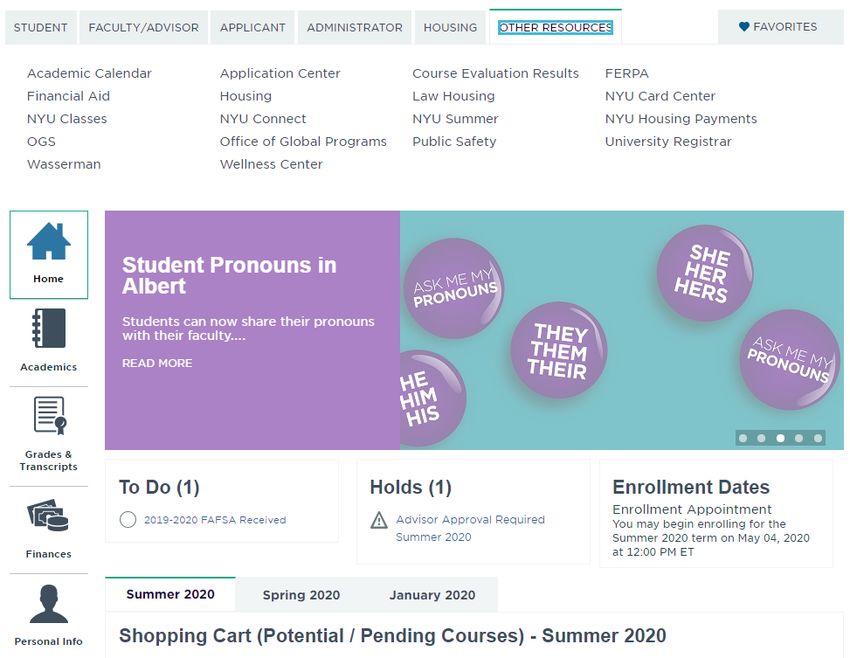
I. 128 Credits

You must complete 128 credits in order to graduate.

                      Average course = 4 credits per course
4 courses per semester x 4 credits per course = 16 credits per
                                                     semester

     16 credits per semester x 8 semesters =   128 credits
II. Grade Point Average - 2.0

 Students must have a cumulative GPA of
       2.0 or higher to graduate.

   Students must also have a GPA of 2.0 or
       higher in their major courses.
III. Major

   All students must complete a major
          before they graduate.

You must declare a major prior to completing
    64 total credits (by the end of your
             sophomore year).

 Students declare their major by visiting the
department of the major they wish to declare,
  and they can change their major at any
          time prior to graduation.
The College Core
Curriculum
NYU’s liberal arts core
IV. The College Core Curriculum

  There are five parts to the Core Curriculum:

  First-Year      Expository          Foreign
   Seminar         Writing           Language

        Foundations of   Foundations of
        Contemporary       Scientific
           Culture          Inquiry
Core Curriculum Part 1: First-Year Seminar
First-Year Seminars are small, discussion-based classes (15-
17 students) taught by top faculty members and leaders in
their fields.
• Feature a wide range of topics in natural science, social
science, and humanities
• Students in your seminar will be your fellow cohort
members
• All students will take in fall or spring of first year (except
for students who take Writing the Essay: Science)
• You’ll select your seminar preferences later in the portalCore Curriculum Part 2: Expository Writing
Writing the Essay International Writing Workshops
• Stresses exploration, inquiry, • Writing courses for international
reflection, analysis, and students
collaboration
• Students must complete both I &
• Instruction in analyzing and II
interpreting written texts
Writing the Essay: Science Writing I & II Sequence
• Tailored for students interested in • Writing courses for Opportunity
science or medicine Programs (HEOP & CSTEP)
• Read and respond to essays by students
prominent scientists • Students must complete both I &
• Can be taken instead of First-Year II
Seminar
Writing the Essay: Goddard/Rubin
• Part of the Themed Engagement
Community options for residence
halls
• Students participate in professor-
led programs and eventsCAS Presentation Part 1: Complete! Please proceed to Part 2 on the following page.
Core Curriculum Part 3: Foreign Language

Show proficiency through:
•   Placement exam
•   Certain AP, IB, or SAT Subject
    Test scores
•   Completing coursework in a
    language through the
    Intermediate II level
Core Curriculum Part 4: Foundations
of Contemporary Culture
Texts & Ideas Societies & the Social
• Diverse group of humanities Sciences
courses covering challenging • Understanding social,
and influential texts political, and economic
• Courses explore themes or transformations
investigate the relationship • Study societal structures
between two periods of and human behavior
intellectual history
Cultures & Contexts Expressive Culture
• Examine the ways cultures • Explore complexities of
interact through colonization, artistic expression
immigration, and • Topics focus on sound,
representation in media images, words,
• How groups define themselves performance, or film
through beliefs, values, and
customsCore Curriculum Part 5: Foundations
of Scientific Inquiry
Quantitative Reasoning
• Provides students with
mathematical foundations
and to evaluate, and draw
conclusions from numerical
evidence
Physical Science
• Examine the foundations of
physics and chemistry
Life Science
• Focuses on the areas of
biology, neuroscience, and
physical anthropologyReviewing Core Requirements: Parts 1, 2, & 3
1. First-Year Seminar
a. All students take a seminar or Writing the Essay: Science during first
year (fall or spring) along with your cohort members
b. You will select your preferences for this course later in the portal
2. Expository Writing
a. Cannot be exempted, and must be taken in your first year
b. Expository Writing Options: WTE, WTE Science, WTE Goddard/Rubin,
International Writing Workshops, Writing I & II
c. Students who take WTE: Science will not take a First-Year Seminar and
will take a comparable seminar later in their CAS career
3. Foreign Language
a. Proficiency must be demonstrated by either:
1. Taking a placement exam and exemption exam
2. Completing coursework in a language through the Intermediate II
level
3. Certain AP, IB, A Level, or SAT Subject Test foreign language
scores (consult with your academic advisor)Reviewing Core Requirements: Part 4
4. Foundations of Contemporary Culture
a. Texts & Ideas
i. There are no exemptions from Texts & Ideas
ii. Students should plan to take it in their first year
b. Cultures & Contexts
i. There are no exemptions from Cultures & Contexts
ii. Students should plan to take it in their first year
c. Societies & the Social Sciences
i. Completion of a designated major or minor program in the social
or behavioral sciences; or
ii. Completion of an approved departmental course within the Core
Curriculum department listings
d. Expressive Culture
i. Completion of a designated major or minor program in the
humanities; or
ii. Completion of a designated course within the Core Curriculum
department listingsReviewing Core Requirements: Part 5
5. Foundations of Scientific Inquiry
a. Quantitative Reasoning b. Physical Science & Life Science
Can be satisfied by: Can be satisfied by:
▪ AP Credit for Calculus (AB or BC) or Statistics ▪ Completion of a designated Core
with a score of 4 or 5 Curriculum Physical Science (CORE-UA
▪ IB (HL 6 or 7) or A Level (B or higher) credit in 2xx) and Life Science (CORE-UA 3xx)
Mathematics course or approved departmental courses
▪ SAT Subject Tests in Mathematics (Levels 1 or ▪ Year-long sequence of Chemistry or
2) with a score of 700 or above Physics I & II
▪ Completion of one of the following courses: • AP, IB, or A Level credit in one of the
▪ QR course listed in Core Curriculum classes following areas:
▪ BIOL-UA 42, Biostatistics • Biology
▪ ECON-UA 18, Statistics • Chemistry
▪ ECON-UA 20, Analytical Statistics
▪ ENVST-UA 310, Environmental Quantitative • Physics 1 and Physics 2
Methods • Physics B
▪ LING-UA 6, Patterns in Language • Physics C-Mech and Physics C-E&M
▪ MATH-UA 121, Calculus I
▪ MATH-UA 143, Calculus I for Biological and
Life Sciences
▪ MATH-UA 211, Mathematics for Economics I
▪ MATH-UA 221, Honors Calculus I
▪ MATH-UA 17, Calculus for the Social
Sciences
▪ POL-UA 850, Introduction to Research
Methods for Politics
▪ PSYCH-UA 10, Statistics for the Behavioral
Sciences
▪ SOC-UA 302, Statistics for Social Research
▪ UGPH-GU 20, Biostatistics in Public HealthExploring Majors
Exploring Majors
College majors and minors, and cross-school
and pre-professional programsPlanning Your Academic Program
In order to complete your degree, you will complete the
course requirements for
The Core Curriculum & Your Major
as well as additional
Elective CoursesThe CAS Bulletin
The College Core Curriculum Website
CAS Majors and Minors
NYU Albert

https://www.nyu.edu/students/student-information-and-resources/registration-records-and-
                   graduation/registration/registering-on-albert.html
What’s Next • Review additional advising presentations to learn about specialized student populations and programs at CAS (available in the portal and at the CAS New Student Center): o Engineering Program o International Students o Opportunity Programs o Prehealth Program o Prelaw Program • Select the “Next Section” button on the page to go to the CAS Advising Portal Checkpoint
You can also read


