Welcome to the launch of the European COVID-19 Scenario Hub!
←
→
Page content transcription
If your browser does not render page correctly, please read the page content below
Welcome to the launch of the
European COVID-19 Scenario Hub!
Funded by ECDC, an agency of the European Union

With special thanks for the scientific leadership to LSHTM; the support from
the US COVID-19 Scenario hub team, and all participating modelling teams!

25 May 2022, 15:30-16:30 CET
ECDC’s COVID-19 Modelling Hubs

2021:                                                       https://covid19forecasthub.eu

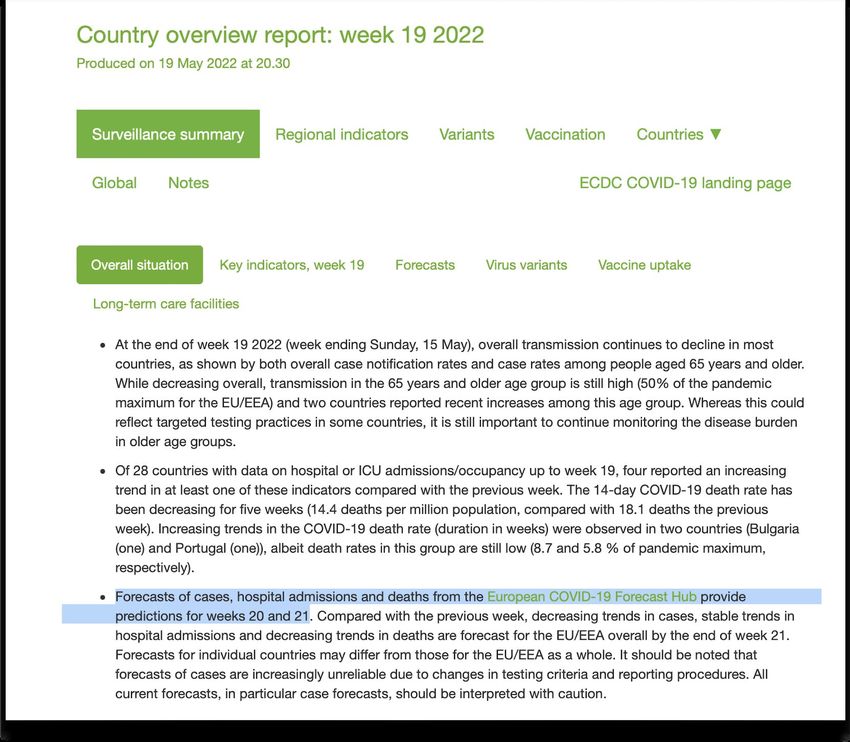
● European COVID-19 Forecast hub with 30+
  modelling teams globally forecasting COVID-19
  outcomes in Europe to inform policy advice
                                                      Observed data                 4-week forecast (with
● Focus on short-term forecasts over 1-4 weeks;                                     uncertainty ranges)
  ensemble forecasts from multiple models performed
  reliably well!

                                                                                                            2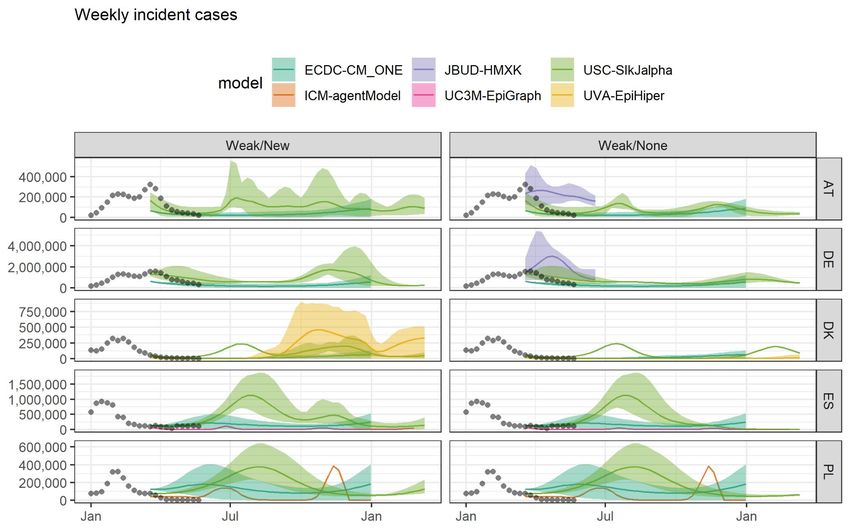
ECDC’s COVID-19 Modelling Hubs

2021:                                                           https://covid19forecasthub.eu

● European COVID-19 Forecast hub with 30+
  modelling teams globally forecasting COVID-19
  outcomes in Europe to inform policy advice
                                                          Observed data
● Focus on short-term forecasts over 1-4 weeks;
  ensemble forecasts from multiple models performed
  reliably well!
                                                                                           https://covid19scenariohub.eu

2022/Today:
● European COVID-19 Scenario hub for longer-
  term projections of scenarios over 6-12 months
  to explore leading causes of uncertainty about future
  COVID-19 outcomes
                                                            Observed data
                                                                                           ?
                                                                                          ?? ?                  Different
                                                                                                                scenarios

                                                                                                                       3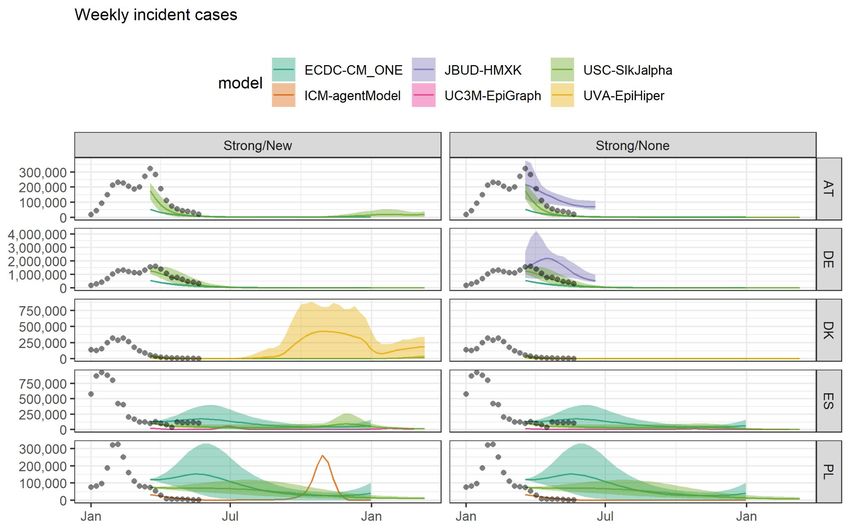
ECDC’s COVID-19 Modelling Hubs

2021:                                                           https://covid19forecasthub.eu

● European COVID-19 Forecast hub with 30+
  modelling teams globally forecasting COVID-19
  outcomes in Europe to inform policy advice
                                                          Observed data
● Focus on short-term forecasts over 1-4 weeks;
  ensemble forecasts from multiple models performed
  reliably well!
                                                                                           https://covid19scenariohub.eu

2022/Today:
● European COVID-19 Scenario hub for longer-
  term projections of scenarios over 6-12 months
  to explore leading causes of uncertainty about future
  COVID-19 outcomes
                                                            Observed data
                                                                                           ?
                                                                                          ?? ?                  Different
                                                                                                                scenarios

● Both hubs have focussed on building a collaborative
  community of modellers
                                                                                                                       4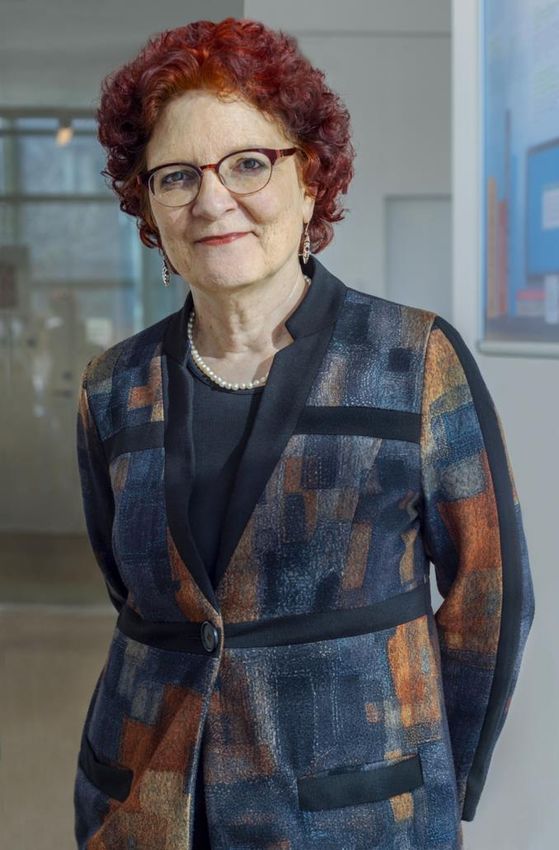
Event aims today & agenda

    • Highlight the potential of collaborative modelling
    • Give context to the new European COVID-19 Scenario Hub
    • Reach out to modellers interested in participating
Part    Time    Topic                                    Speaker
1       15:30   Welcome and introduction                 Frank Sandmann (ECDC)
        15:35   European COVID-19 Forecast Hub           Sebastian Funk (LSHTM)
        15:40   US COVID-19 Scenario Modelling Hub       Katriona Shea (Penn State)
        15:50   European COVID-19 Scenario Hub           Katharine Sherratt (LSHTM)
        16:00   Address by the Chief Scientist of ECDC   Mike Catchpole (ECDC)
2       16:05   Q&A                                      All
        16:10   Technical discussion with modelling      All modellers interested in participating
                teams intending to submit to Round 1
                                                                                                5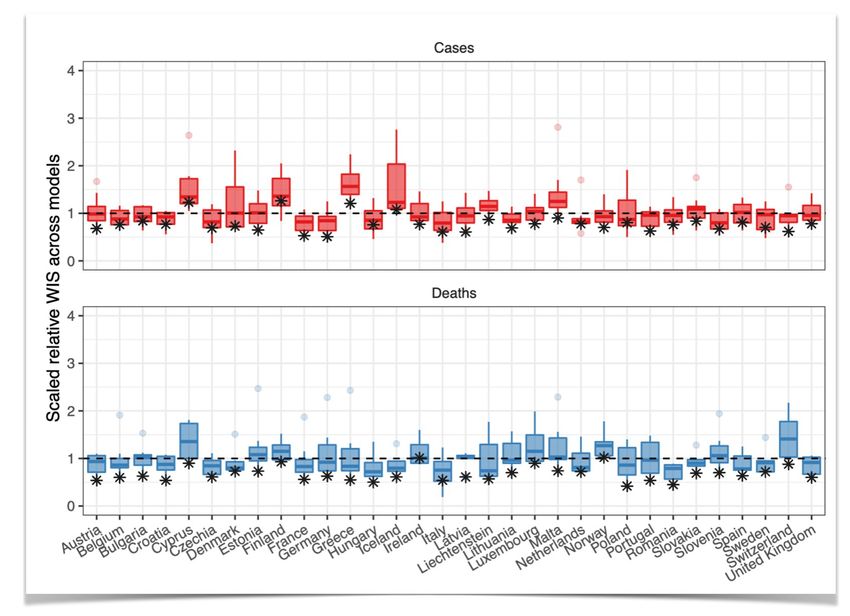
Address by the Director of ECDC - Dr Andrea Ammon

“The launch of the COVID-19 Scenario hub today underlines ECDC’s
value of using infectious disease modelling for public health decision
making to strengthen Europe's health security.

As we transition into new phases of the COVID-19 pandemic, the results
of this hub will support ECDC's risk analysis, assessment of public health
advice, and strategic planning for anticipatory action in the EU/EEA
Member States in 2022/2023.

This is an exciting initiative to advance scientific collaboration and our
understanding of possible future developments of COVID-19.

My heartfelt thanks to everyone being here today, and to everyone in the
modelling community who has been engaging in ECDC’s COVID-19
Forecasting and Scenario hubs.”

European Covid-19 Forecast Hub
                       25 May 2022
       Kath Sherratt, Hugo Gruson, Sebastian Funk
                  https://epiforecasts.io
      London School of Hygiene & Tropical Medicine
                           with
         Helen Johnson, Rene Niehus, Rok Grah,
        Frank Sandmann, Bastian Prasse (ECDC)
              Johannes Bracher + team (KIT)
           Nick Reich + team (UMass-Amherst)
Forecast hub set up
- started in March 2021
- collates weekly forecasts (4 weeks ahead) of COVID-19
  cases, hospitalisations and deaths in 32 European
  countries from modelling teams worldwide
- 58 unique models
  (currently: 18)
  from 37 teams
- ca. 5 million forecast
  values (incl. uncertainty)
- Model inputs combined
  into “ensemble forecast”
                                https://covid19forecasthub.eu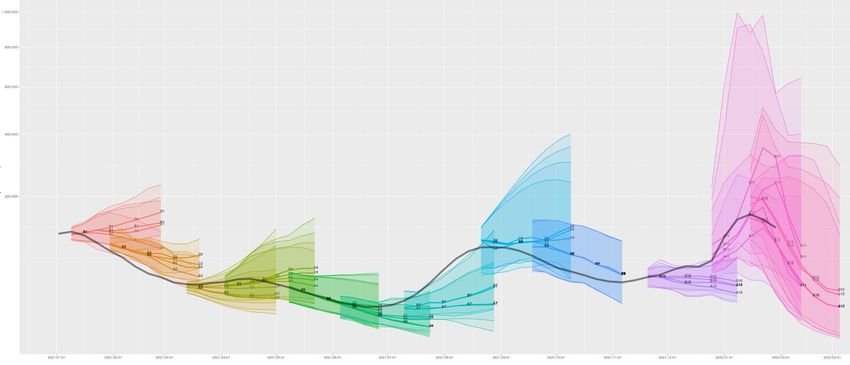
Central goals of Forecast Hub
1. Provide decision-makers and general public with reliable
   information about where the pandemic is headed in the
   next month.
2. Gain insight into which modelling approaches do well.
3. Assess the reliability of forecasts for different measures of
   disease severity.
4. Create a community of infectious disease modelers
   underpinned by an open-science ethos.

 Taken from: Reich, 2021, https://covid19forecasthub.org/talks/202102-ECDC.pdf
Central goals of Forecast Hub
1. Provide decision-makers and general public with reliable
   information about where the pandemic is headed in the
   next month.

   Weekly ECDC surveillance report   Weekly report on forecast performance
Central goals of Forecast Hub
2. Gain insight into which modelling approaches do well.
   ○ ensemble outperforms individual models
Central goals of Forecast Hub
3. Assess the reliability of forecasts for different measures of
   disease severity.
Central goals of Forecast Hub
4. Create a community of infectious disease modelers
   underpinned by an open-science ethos.
   ○ 58 unique models (currently: 18) from 37 teams
   ○ ca. 5 million forecast values (incl. uncertainty)
   ○ all openly available at
       https://github.com/covid19-forecast-hub-europe/covid19-forecast-hub-europe
Thanks to all contributors! Agata Migalska, Ajitesh Srivastava, Akhil Sai Peddireddy, Alberto Cascajo Garcia, Alexander Kuhlmann, Alfio Quarteroni, Álvaro Ortiz, Amanda Ziemann, Andrea Kraus, Anil Vullikanti., Aniruddha Adiga, Anna Gambin, Antoine Flahault, Antoni Moszyński, Antonietta Mira, Arne Rodloff, Artur Kaczorek, Ashlynn Daughton, Barbara Pabjan, Barbara Tarantino ., Benjamin Bejar Haro, Benjamin Hurt, Berit Lange, Beth Hornbein, Blażej Miasojedow, Brad Suchoski, Brian Weaver, Bryan Lewis, Carrie Manore, César Pérez, Christine Choirat, Clara Prats, Courtney Shelley, Dan Sheldon, Dan Sheldon, Nick Reich, Daniel Israel, Daniel López, Daniel Rabczenko, Dave Osthus, David E. Singh, David Kraus, David Moriña, Dax Gerts, Dean Karlen, Deborah Shutt, Dimitris Bertsimas, Dorina Thanou, Dr. Dirk Beckmann, Ekaterina Krymova, Elisa Manetti, Enric Álvarez, Evan Ray, Ewa Rafajłowicz, Ewa Szczurek, Ewaryst Rafajłowicz, Fernando Blat, Francesco Bartolucci, Franciszek Rakowski, Frost Tianjian Xu, Fulvia Pennoni, Gavin Lee, Geoffrey Fairchild, Giovanni Ardenghi, Giovanni Ziarelli, Graham Gibson, Grzegorz Redlarski, Guillaume Obozinski, Hamza Tazi Bouardi, Heidi Gurung, Holger Kirsten, Isti Rodiah, Jakub Zieliński, Jan Fuhrmann, Jan H. Meinke, Jan Kisielewski, Jan Mohring, Jan Pablo Burgard, Jan Trnka, Janez Zibert, Jędrzej Nowosielski, Jesus Carretero, Jiangzhou Chen, Johannes Bracher, Jonas Dehning, José Almagro, José L. Aznarte, Jozef Budzinski, Julie Spencer, Karol Niedzielewski, Katharine Sherratt, Krzysztof Gogolewski, Lauren Castro, Lenka Pribylova, Lijing Wang, Loïc Pottier, Lori Dauelsberg, Luca Dede', Łukasz Górski, Maciej Radwan, Madhav Marathe, Magdalena Gruziel-Słomka, Magdalena Rosińska, Manhong Smith, Marcin Bodych, Marcin Semeniuk, Marco Mingione, Marek Bawiec, Maria Cristina Marinescu, Maria V. Barbarossa, Markus Scholz, Martí Català, Martin Camitz, Martin Šmíd, Michael Helmling, Michael Lingzhi Li, Miguel Guzman Merino, Milan Zajíček, Morgan Gorris, Neele Leithäuser, Nick Reich, Nicola Parolini, Nidhi Parikh, Nikos Bosse, Pablo Montero Manso, Paolo Giudici, Pedro Álvarez - Roxu, Pierfrancesco Alaimo Di Loro, Pierre Nouvellet, Pratizio Vanella, Przemyslaw Biecak, Przemyslaw Biecek, Przemyslaw Porebski, Rafał Bartczuk, Rene Niehus, Robert Walraven, Rok Grah, Sam Abbott, Sangeeta Bhatia, Sara Del Valle, Sebastian B. Mohr, Sergio Alonso, Sharon Kuhlmann-Berenzon, Sid Baccam, Sophie Meakin, Srinivasan Venkatramanan, Stefan Heyder, Stefan Krieg, Steve Stage, Tao Sun, Thomas Hotz, Tom Zimmermann, Tomasz Ozanski, Travis Pitts, Tyll Krüger, Veronika Eclerova, Viktor Bezborodov, Viola Priesemann, Vít Tuček, Wojciech Rafajłowicz, Wolfgang Bock, Yuri Kheifetz
The (US) COVID-19
  Scenario Modeling Hub
Katriona Shea, The Pennsylvania State University
       on behalf of all Hub collaborators
Open Hub collects and aggregates projections from multiple modeling teams of US public health outcomes (cases, hospitalizations and deaths) over ~6 months at the state and national level.
Both operational and
research goals

Addresses uncertainty
• Multiple scenarios
• Multiple models
• Probabilistic
  projections
Coordination Team
    Katriona Shea, Justin Lessler, Cécile Viboud, Rebecca Borchering, Emily Howerton, Shaun Truelove, Claire Smith, Michelle Qin, Nicholas
    Reich, Michael Runge, Lucie Contamin, John Levander, Jessica Salerno, Wilbert van Panhuis, Harry Hochheiser, Luke Mullany

    Modeling Groups Contributing Projections
•    Columbia University – Age-Stratified Model: Marta Galanti, Teresa Yamana, Sen Pei, Jeffrey Shaman
•    Institute for Health Metrics and Evaluation – IHME COVID
•    John Hopkins University-APL: Matt Kinsey, Kate Tallaksen, R.F. Obrecht, Laura Asher, Cash Costello, Michael Kelbaugh, Shelby Wilson,
     Kaitlin Lovett
•    John Hopkins University-IDD-COVIDSP: Joseph C. Lemaitre, Juan Dent Hulse, Kyra H. Grantz, Joshua Kaminsky, Stephen A. Lauer,
     Elizabeth C. Lee, Justin Lessler, Hannah R. Meredith, Javier Perez-Saez, Shaun A. Truelove, Claire P. Smith, Lindsay T. Keegan, Kathryn
     Kaminsky, Sam Shah, Josh Wills, Pierre-Yves Aquilanti, Karthik Raman, Arun Subramaniyan, Greg Thursam, Anh Tran
•    North Carolina State University-COVSIM: Erik Rosenstrom, Jessica Mele, Julie Swann, Julie Ivy, Maria Mayorga
•    Northeastern University MOBS GLEAM COVID: Matteo Chinazzi, Jessica T. Davis, Kunpeng Mu, Xinyue Xiong, Ana Pastore y Piontti,
     Alessandro Vespignani
•    University of Florida – ABM: Thomas Hladish, Alexandar Pillai, Kok Ben Toh, Ira Longini Jr.
•    University of North Carolina at Charlotte – UNCC-hierbin: Shi Chen, Rajib Paul, Daniel Janies, Jen-Claude Thill
•    University of Notre Dame - FRED: Guido Espana, Sean Cavany, Sean Moore, Alex Perkins
•    University Southern California SlkJalpha: Ajitesh Srivastava, Majd Al Aawar
•    University of Texas at Austin-ImmunoSEIRS: Anass Bouchnita, Spencer Fox, Michael Lachmann, Lauren Ancel Meyers, UT COVID-19
     Modeling Consortium
•    University of Victoria: Dean Karlen
•    University of Virginia-adaptive: Przemyslaw Porebski, Srini Venkatramanan, Anniruddha Adiga, Bryan Lewis, Brian Klahn, Joseph Outten,
     James Schlitt, Patric Corbett, Pyrros Alexander Telionis, Lijing Wang, Akhil Sai Peddireddy, Benjamin Hurt, Jiangzhou Chen, Anil Vullikanti,
     Madhav Marathe
•    University of Virginia-EpiHiper: Jiangzhuo Chen, Stefan Hoops, Parantapa Bhattacharya, Dustin Machi, Bryan Lewis, Madhav Marathe

    Collaborators: Matthew Biggerstaff, Michael Johansson, Rachel Slayton, Jessica Healey (CDC); Nicole Samay (Northeastern)
                                                                  https://github.com/midas-network/covid19-scenario-modeling-hub
    scenariohub@midasnetwork.us                                   https://covid19scenariomodelinghub.org/
Fourteen model rounds since Dec 2020, open call, 6-10 models projected 4 scenarios per round:
1. Vaccine supply and non-pharmaceutical interventions [2020-12-22]
2. More transmissible variant (B.1.1.7) and NPIs [2021-01-22]
3. Vaccine supply and NPIs [2021-3-5]
4. Vaccine supply and NPIs [2021-3-28]
5. Vaccine hesitancy and NPIs [2021-5-2]
6. More transmissible variant and vaccine hesitancy [2021-06-08]
7. Delta variant and vaccine hesitancy [2021-07-06]
8. Immune waning and severity of re-infection [2021-08-17, training round]
9. Childhood vaccination and variant of increased transmissibility [2021-09-14]
10. Immune waning and boosters [2021-11-09]
11. Omicron emergency round I
12. Omicron emergency round II
13. Waning and new variant
14. Boosters and new variant
https://github.com/midas-network/covid19-scenario-modeling-hub
https://covid19scenariomodelinghub.org/Multiple rounds of scenario projections
1,000,000
Weekly US hospitalizations (sqrt)
800,000
600,000
Omicron rounds
400,000
Ground truth hospitalizations
200,000
Wild type
Delta
Alpha Omicron
0
Jan-21 Mar-21 May-21 Jul-21 Sep-21 Nov-21 Jan-22 Mar-22
Projections shared with CDC, WH, CFA, CSTE, WHO, local
health departments, public website, mediaRound 4: Vaccination and Nonpharmaceutical
Intervention (NPI) scenarios
White House
COVID-19 press
briefing on May
5th, 2021, by Dr.
Walensky, CDC
Director.
2 x 2 scenario design
• Uncertainty
• DecisionRound 9: Childhood vaccination Sep 12, 2021 – Mar 12, 2022 This information was presented to the CDC’s advisory committee (ACIP) as it considered authorization and guidance on vaccinating 5-11 year olds
2 Omicron rounds
Reported on Dec 31, 2021 and Jan 20, 2022

                           Round 12: 10 teams
Hub Benefits Making decisions is challenging for highly uncertain, time- sensitive, consequential situations • Multiple models help us to deal rapidly with uncertainty • Careful scenario design allows us to address both uncertainty and decisions • The ensemble performs consistently better than any individual model • Aggregated long-term projections provide clear guidance for decision makers We look forward to learning from the new EU Scenario Modelling Hub!
Questions? Comments?
                                                   k-shea@psu.edu
                                    1,000,000

Weekly US hospitalizations (sqrt)
                                     800,000

                                     600,000

                                                                                                           Omicron rounds
                                     400,000
                                                         Ground truth hospitalizations
                                     200,000

                                                 Wild type
                                                                                                  Delta
                                                                           Alpha                                            Omicron
                                          0
                                                Jan-21         Mar-21         May-21     Jul-21   Sep-21       Nov-21         Jan-22   Mar-22
The European
COVID-19 Scenario Hub
Katharine Sherratt, London School of Hygiene and Tropical Medicine
with Hugo Gruson, Sebastian Funk (LSHTM), Rene Niehus, Rok Grah, Frank
Sandmann (ECDC)The European COVID-19 Scenario Hub
Aim Outcomes
To explore and bound the uncertainty around ● Policy relevant knowledge: Scenarios
future COVID-19 outcomes, for 32 European relevant to inform long-term public health
countries over 3-12 months planning for COVID-19
○ Output: ECDC policy recommendations
Process
● Scenario modelling methods: Insight into
● Scenarios isolate fundamental drivers of how varying modelling approaches relates
COVID-19 dynamics to variation in outcomes
● Models encode the influence of these ○ Output: joint-authorship Hub paper
drivers on COVID-19 outcomes ● Collaborative open science: Create a
● Projections demonstrate the relative community of infectious disease modelers
impact of different variables, given current underpinned by an open-science ethos
knowledge ○ Output: public, accessible data, supported
by open source softwareScenarios: Round 0
Introduction of a new variant
No new variant New variant X
● Projections are ● Introduction: From May 1st 2022 is a continuous
initialized with the influx of 50 weekly infections of variant X over 16
mix of strains weeks
circulating at the ● Characteristics: Variant X has 30% immune
start of the escape, and the same intrinsic transmissibility
projection period and severity as Omicron.
Optimistic waning of protection Scenario A Scenario B
● Speed: 10 months median time to
transition to partial immunity
Immunity to infection
● Plateau: 40% reduction in protection
from baseline (protection immediately
after exposure) at plateau
Pessimistic waning of protection Scenario C Scenario D
● Speed: 4 months median time to
transition to partial immunity
● Plateau: 60% reduction in protection
from baseline level at immune plateauScenarios: Round 1
Timing of a booster vaccination
Slow summer booster campaign Fast autumn booster campaign
- 2nd booster recommended for 60+ - 2nd booster recommended for 60+
- Uptake reaches 50% of 1st booster - Uptake reaches 50% of 1st booster
coverage by 15th December coverage by 15th December
- Uptake starts 15th June - Uptake starts 15th September
Optimistic waning of protection Scenario A Scenario B
- 60% reduction in immunity
Immunity to infection
against infection
- 8 months median transition
time to reduced protection
Pessimistic waning of protection Scenario C Scenario D
- 60% reduction in immunity
against infection
- 3 months median transition
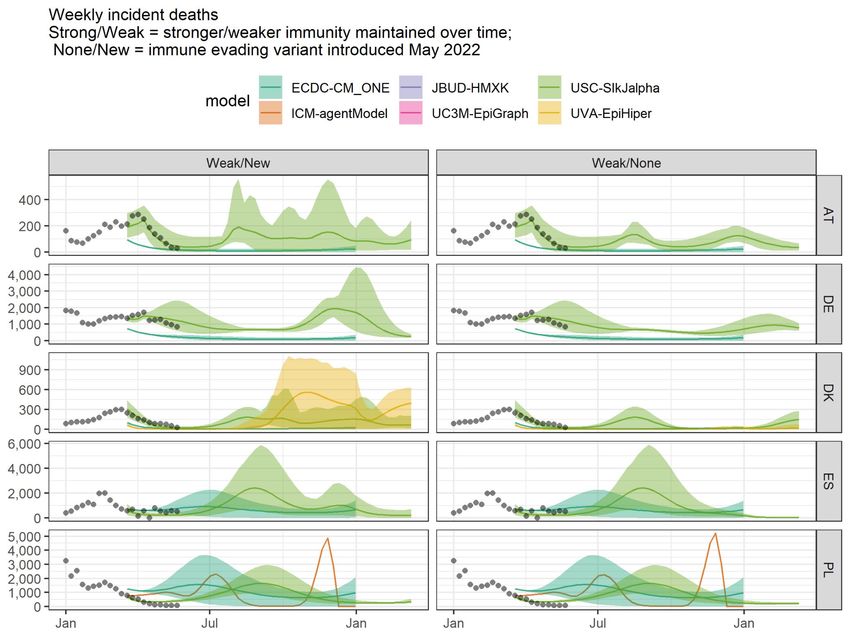
time to reduced protectionRound 0: multi-model projections
● 20 independent teams joined calls and/or submitted models
● 8 teams started working on Round 0; 5 teams contributed results
● Five countries with >2 model projections
Optimistic waning of protection Pessimistic waning of protectionRound 0: challenges
Issues with the Hub set up Issues with interpretation
● Few multi-country models ● Scenario specification and overlap
○ Limited team capacity ○ Waning protection: asymmetrical
● Quantile format prevents deeper analysis parameter values in terms of plausibility of
optimistic and pessimistic scenarios
○ Unclear to what extent quantile
○ New variant: sensitivity to 30% immune
submissions blur the frequency/magnitude
escape?
of epidemic cycles among many model
simulations
● Technical challenge of immune waning
○ Cannot deduce cumulative counts, so can’t parameters
estimate the overall impact of each ○ For some models this meant re-estimating
scenario transmissibility between waning scenarios
○ Mitigation: submissions can now use
samplesRound 0: conclusions
Scientific interpretation Policy relevance
● Results consistent with the speed of ● Greater consideration for the timing
waning protection against infection of vaccination programmes relative
as a more significant factor in future to waning protection, rather than as a
outbreaks, compared to a new response to new variant
variant with some immune escape introductions
Interpret with caution:
● Models intended as experimental for the pilot round, and we found substantial
variation between models as well as between countries and scenarios
● Results may be biased by both submission constraints and scenario confoundingYou can also read


