What do users think of the UK's three COVID-19 contact-tracing apps? A comparative analysis
←
→
Page content transcription
If your browser does not render page correctly, please read the page content below
Open access Original research
What do users think of the UK’s three
COVID-19 contact-tracing apps? A
comparative analysis
Vahid Garousi ,1,2 David Cutting1
To cite: Garousi V, Cutting D. ABSTRACT
What do users think of the UK’s Summary
Objectives Our goal was to gain insights into the user
three COVID-19 contact-tracing reviews of the three COVID-19 contact-tracing mobile
apps? A comparative analysis. What is already known?
apps, developed for the different regions of the UK: ‘NHS
BMJ Health Care Inform ►► As of January 2021, more than 64 countries and re-
2021;28:e100320. doi:10.1136/
COVID-19’ for England and Wales, ‘StopCOVID NI’ for
gions have developed contact-tracing apps to limit
bmjhci-2021-100320 Northern Ireland and ‘Protect Scotland’ for Scotland.
the spread of COVID-19.
Our two research questions are (1) what are the users’
►► Many articles in the academic literature and also
Received 03 February 2021 experience and satisfaction levels with the three apps?
the media have questioned the public adoption and
Accepted 24 June 2021 and (2) what are the main issues (problems) that users
quality of the COVID-19 contact-tracing apps.
have reported about the apps?
►► By the end of 2020, more than 25 583 user reviews
Methods We assess the popularity of the apps and
were submitted for the UK’s three COVID-19 contact-
end users’ perceptions based on user reviews in app
tracing mobile apps: ‘NHS COVID-19’ for England
stores. We conduct three types of analysis (data mining,
and Wales, ‘StopCOVID NI’ for Northern Ireland and
sentiment analysis and topic modelling) to derive insights
‘Protect Scotland’ for Scotland.
from the combined set of 25 583 user reviews of the
aforementioned three apps (submitted by users until the What does this paper add?
end of 2020). ►► In this paper, we derive empirical insights from the
Results Results show that end users have been generally user reviews of the aforementioned three COVID-19
dissatisfied with the apps under study, except the Scottish contact-tracing apps.
app. Some of the major issues that users have reported ►► Our two research questions are (1) what are the us-
are high battery drainage and doubts on whether apps are ers’ satisfaction levels with the three apps? and (2)
really working. what are the main issues (problems) that users have
Discussion Towards the end of 2020, the much-awaited reported about the apps?
COVID-19 vaccines started to be available, but still,
analysing the users’ feedback and technical issues of
these apps, in retrospective, is valuable to learn the right
lessons to be ready for similar circumstances in future. In the UK, three different apps have been
Conclusion Our results show that more work is needed developed and publicised by the regional
by the stakeholders behind the apps (eg, apps’ software and national governments for different
engineering teams, public-health experts and decision constituent countries: the NHS COVID-19
makers) to improve the software quality and, as a result, app (for England and Wales), the Stop-
the public adoption of these apps. For example, they COVID NI app for Northern Ireland and
should be designed to be as simple as possible to operate the Protect Scotland app for Scotland.
(need for usability). Reports1 indicate that the total cost of the
NHS COVID-19 app alone is expected to
© Author(s) (or their
employer(s)) 2021. Re-use
top £35 million.
permitted under CC BY-NC. No INTRODUCTION The apps have been promoted as a prom-
commercial re-use. See rights As of January 2021, more than 64 countries ising tool to help bring the COVID-19
and permissions. Published by and regions have developed contact-tracing outbreak under control. However, there are
BMJ.
1
apps to limit the spread of COVID-19.1 many articles in the academic literature2
School of Electronics, Electrical
These apps use Bluetooth signals to log and also the media questioning the effi-
Engineering and Computer
Science (EEECS), Queen's when smartphone owners (users) are close to cacy and public adoption of these apps. For
University Belfast, Belfast, UK each other; so if a user later tests positive for example, a systematic review3 of 15 studies
2
–, Bahar Software Engineering COVID-19, an alert can be sent to the other in this area found that ‘there is relatively
Consulting, Belfast, UK users that have recently been in close contact. limited evidence for the impact of contact-
Correspondence to
Figure 1 shows several screenshots from an tracing apps’. A news search for ‘what went
Dr Vahid Garousi; example app, depicting the typical features wrong with UK contact-tracing apps’ would
vgarousi@gmail.com of these apps. return a few hundred hits.
Garousi V, Cutting D. BMJ Health Care Inform 2021;28:e100320. doi:10.1136/bmjhci-2021-100320 1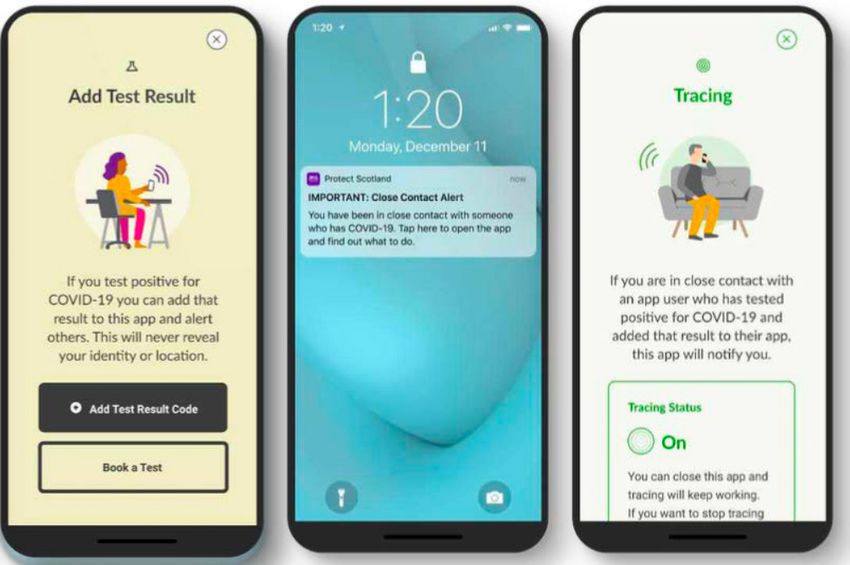
Open access
issues (problems) that users have reported about the
apps? While some studies8 have shown that there may
be some inherent negative bias in public app reviews
(in app stores), many researchers6 and practitioners are
widely using app reviews to derive improvement recom-
mendations on the apps.
User feedback has long been an important approach
for understanding the success or failure of software
systems, traditionally in the form of direct feedback or
focus groups and more recently through social media
(eg, tweets about a given app in Tweeter) and reviews
submitted in app stores.9. A systematic literature review6
of the approaches used to mine user opinion from app
store reviews identified a number of approaches used to
Figure 1 Screenshots of the Protect Scotland app’s user analyse such reviews and some interesting findings such
interface method and data collection. as the correlation between app rating and downloads.
Several related papers, similar to this work, have
been published, for example, a recent paper10 focused
One cannot help but wonder about the reasons on sentiment analysis of user reviews of the Irish app.
behind low adoption of the apps by the general public Another recent paper11 analysed the user reviews of
in the UK and many other countries. The issue is multi- apps of a set of 16 countries (UK was not included). The
faceted, complex and interdisciplinary, as it relates paper presented thematic findings on what went wrong
to fields such as public health, behavioural science,4, with the apps, for example, lack of citizen involvement,
epidemiology, information technology (IT) and soft- lack of understanding of the technological context of
ware engineering. Since these apps are essentially soft- users and ambitious technical assumptions without
ware systems, we investigate them from a ‘software in cultural considerations.
society’ lens5 in this paper. Software in society means the As another related work, we have published online
role of position of software systems (eg, mobile apps) a recent comprehensive technical report12 by analysing
in society, as they are used by billions of people in the the review data of nine European apps from (1)
society. Software systems should be of high quality and England and Wales, (2) Scotland, (3) Northern Ireland,
should be usable/useful for end users who are mostly (4) Ireland, (5) Germany, (6) Switzerland, (7) France,
non-technical people. (8) Finland and (9) Austria. In this current paper, our
The software aspects of these apps are also quite goal was to go in depth and focus on the three UK apps.
diverse in themselves, for example, whether the app In addition to the academic (peer-reviewed) litera-
software would work as intended (eg, will it send the ture, in the grey literature (such as news articles and
alerts to all the recent contacts?) and whether different technical reports), there are plenty of articles on the
apps developed by different countries will cooperate/ software engineering aspects of contact-tracing apps.
integrate (when people travel between counties). A For example, an interesting related news article was
related news article reported that a large number of entitled ‘UK contact-tracing app launch shows flawed
developers worldwide has reported a large number of understanding of software development’ (www.verdict.
defects in the NHS app (bit.ly/FlawsInNHSApp). co.uk/contact-tracing-app-launch/). The article argued
An interesting source of knowledge about the that ‘In a pandemic, speed is critical. When it comes to
user experiences is through the availability of a large developing high-quality software at speed, using open-
number of user reviews in the two major app stores: the source is essential, which other nations were quick to
Google Play Store for Android apps and the Apple App recognize. The article also criticised the approach taken
Store for iOS apps. A review often contains information by the UK healthcare authorities in developing their
about a user’s experience with the app and opinion of app from scratch: ‘Countries such as Ireland, Germany,
it, feature requests or bug reports.6 Many insights can and Italy used open- source to build [develop] their
be mined by analysing the user reviews of these apps to own applications months ago. Sadly the UK did not
figure out what end users think of contact-tracing apps, follow suit, and wasted millions of pounds and hours of
and that is what we analyse and present in this paper. resources trying to build its own version’.
The nature of our analysis is ‘exploratory’,7 as we Another motivating factor for this study is the
want to extract insights from the app reviews which consulting engagement of the first author in relation
could be useful for different stakeholders, for example, to the NI’s StopCOVID NI app, in the summer of 2020.
app developers, public-health experts, decision makers Some of his activities included peer review and inspec-
and the public. The two research questions (RQs) that tion of various software engineering artefacts of the
we explore are (1) what are the users’ satisfaction levels app, for example, design diagrams, test plans and test
with the three UK apps? and (2) what are the main suites; see page 13 of an online report by the NI’s Health
2 Garousi V, Cutting D. BMJ Health Care Inform 2021;28:e100320. doi:10.1136/bmjhci-2021-100320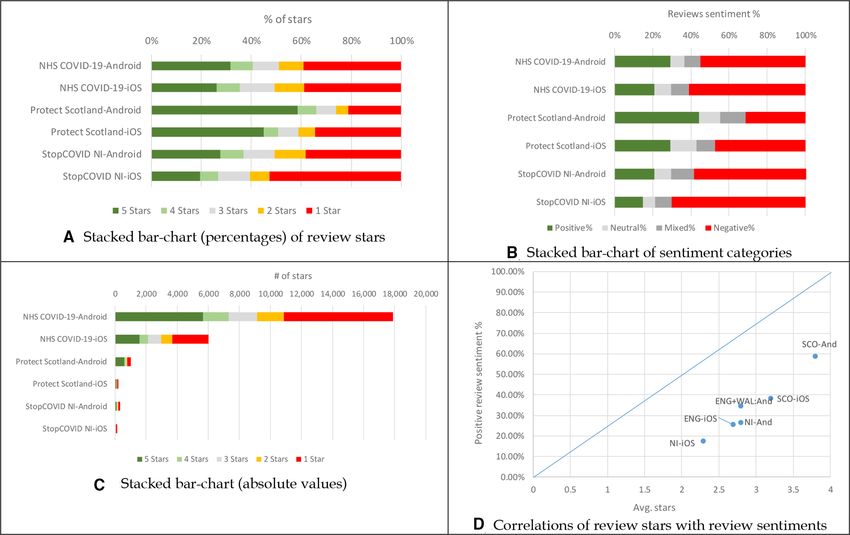
Open access
and Social Care authority (https://covid-19.hscni.net/
wp-content/uploads/2020/07/Expleo-StopCOVIDNI-
Closure-Report-V1.
0.pdf) In the project, a need was
identified to review and mine insights from user reviews
in order to be able to make improvements in the app.
In the rest of this paper, we first review our method
and data collection approach, and then present the
results of our analysis. We then conclude the paper with
discussions and conclusions.
METHOD AND DATA COLLECTION
To retrieve the review data of the three apps, we used a
commercial app–analytics tool named AppBot (https://
appbot.co/). This is a widely used tool and, according
to its website, is in use by companies such as Microsoft,
Twitter, BMW, LinkedIn and the New York Times.
We conducted the data collection on 26 December
2020. Therefore, all the reviews data of the apps until
that date were included in our dataset. We provide
all the data extracted and analysed for this paper in
an online repository (http://www.doi.org/10.5281/
zenodo.4059087). We also think that some readers may
be interested to explore the dataset and reviews by their
own and possibly conduct further studies like ours. To
help with those, we have recorded and provide a brief Figure 2 Region populations versus number of downloads
(10 min) video of live interaction with the dataset (to (estimated) and reviews results. (Short terms: ENG: England;
be analysed in this paper) using AppBot, which can be WAL: Wales; NI: Northern Ireland; SCO: Scotland)
found online (youtube/qXZ_8ZTr8cc).
Table 1 lists the names, some key information, and with regions’ population sizes. We visualised each
descriptive statistics of both platform versions of the region’s population versus the number of downloads
regional apps. Each app had received somewhere and reviews as XY plots in figure 2. We observed reason-
between 127 and 17 905 reviews, as of the data collec- able correlations between each pair of the metrics, that
tion date. is, for a region with a larger population, as one would
The number of versions since first release are quite expect, there were more downloads and more reviews.
different. The NHS app had 16 updates, while the NI We show two scatter plots in figure 2 depicting the
and Scotland apps each had 6 updates only. This could population to download, and download to reviews ratios
have a variety of root causes, for example, the NHS app for the three apps, that is, a download per 4.7 citizens
team is more responsive to feedbacks and thus have on average for the NHS app. This metric is 4.3 and 5.1,
updated it more often, or the app had more issues and respectively, for the Scotland and NI apps. One could
thus had to be fixed more frequently. analyse such slight differences based on the level of
Given the different scale of downloads for the three healthcare authorities’ aggressiveness in publicity and/
apps (table 1), we wondered about their correlations or social fabric of each region, but we do not investigate
Table 1 The three apps and their descriptive statistics
Operating Versions Reviews (so far)
System since first Reviews Average
App (OS) First release date Downloads (n) (est.) release (n) stars
NHS Android 13 August 2020 12 500 000+ (www.bbc.co.uk/news/ 16 17 905 2.8
COVID-19 iOS technology-54326267) 6021 2.7
Protect Android 10 September 2020 1 270 000+ (prod.news.stv.tv/scotland/ 6 1018 3.8
Scotland iOS more-than-a-million-download- 195 3.2
scotlands-tracing-app)
Stop COVID Android 28 July 2020 375 000+ (play.google.com/store/apps/ 6 317 2.8
NI iOS details?id=net.hscni.covidtracker) 127 2.3
OS, operating system.
Garousi V, Cutting D. BMJ Health Care Inform 2021;28:e100320. doi:10.1136/bmjhci-2021-100320 3Open access
Figure 3 Distribution of review stars and review sentiment categories.
them further as we want to instead focus on technical dissatisfied with the apps under study, except the Scot-
(IT) aspects in this work. tish app. Based on the average stars metric, the Scottish
app is the highest starred (3.8 and 3.2 out of 5.0). The
NHS and NI apps have received 2.75 and 2.55 out of 5.0,
RESULTS respectively, on average.
We present the results in the next two subsections. One would wonder about the factors that have led
to the Scottish app being ranked the highest in terms
Users’ experience and their satisfaction with the apps
of stars. Reviewing a subset of its reviews reveals that
Our first exploratory analysis is to assess the ratios of users
the app is quite effective and easy to use; for example,
who, as per their reviews, have been happy or unhappy
one user said, ‘Brilliant app. It collects zero personal
with the apps.
data, no sign ups, no requirement to turn on location,
To gauge satisfaction with an app, the built-in rubric
nothing! All you have to do is turn on Bluetooth, that’s
of app stores is ‘stars’, a rating feature also used in many
it’ (http://bit.ly/ScoAppPosReview).
other online systems, such as Amazon. A user can choose
between one and five stars, when shehe submits a review We would expect that stars and the reviews’ senti-
as well as optionally provide text. Another more sophis- ments would be correlated, that is, if a user leaves one
ticated way to derive users’ satisfaction with an app is to star for an app, she/he would most probably leave
look at the positive/negative ‘sentiment’ score of their a negative (critical) review. We show in figure 3D a
textual reviews. Sentiment analysis13 refers to the use scatter plot of those two metrics, in which six data
of natural language processing (NLP) to systematically points correspond to both versions of the three apps
quantify the affective state of a given text. Our chosen under study. The Pearson correlation coefficient
tool (AppBot) derives four possible types of sentiments of the two measures is 0.97, thus showing a strong
for a given review text: positive, negative, neutral and correlation.
mixed sentiments. ‘Neutral’ reviews lack strong senti-
ment, for example, ‘I have used this app’. ‘Mixed’ Main issues that users have reported about the apps
reviews have conflicting sentiments (both positive and As per table 1, the three apps have in total more than
negative). 25 000 reviews, and thus, manual analysis of such a
We show in figure 3 the distribution of reviews’ senti- large and diverse textual feedback was not an option.
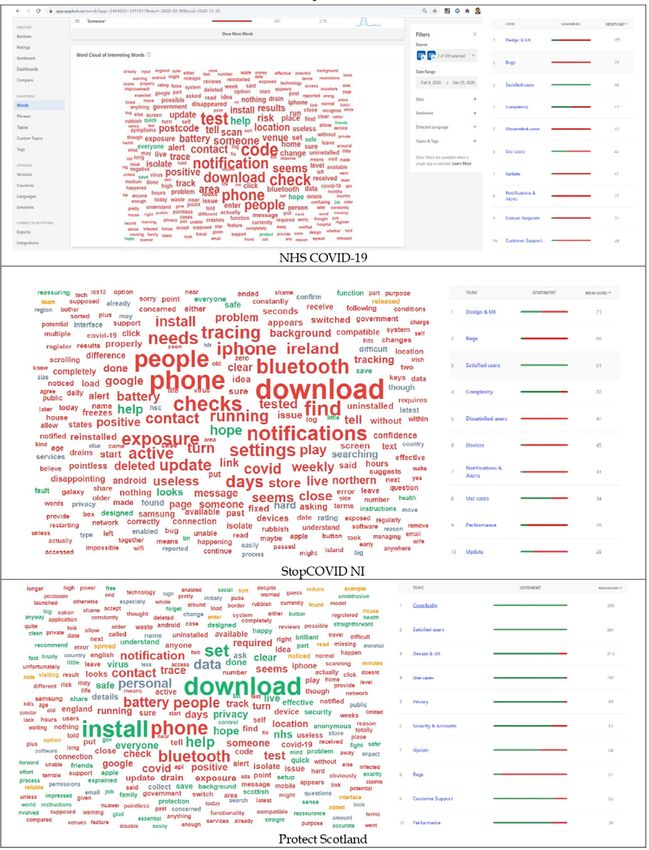
ment categories and also the distribution of stars in the The AppBot tool provides features such as word clouds
dataset. We show both a 100% stacked bar and a stacked and ‘topic modelling’ to make sense of review texts,
bar of absolute values for the stars. which we show in figure 4. Topic modelling is an NLP-
We can see from these charts and also the average based statistical semantic technique for discovering the
stars of each app (table 1) that users are generally abstract ‘topics’ that occur in a given textural dataset.
4 Garousi V, Cutting D. BMJ Health Care Inform 2021;28:e100320. doi:10.1136/bmjhci-2021-100320Open access
Lesson learnt/recommendations
There seems to be rather trivial usability issues with some of the apps
(eg, the case of exposure notification errors). This raises the question of
the inadequate usability testing of the apps and possibility of releasing
them on a ‘rush’.
will not notify those contacts. This issue has been
reported in a large number of reviews, for example,
►► ‘Complete and utter waste of space. Only works if I
come into contact with someone else using the same
backstreet application, who has managed to get
tested without being turned away, and inputs a code
into their app. If I bump into someone from England,
Wales, Ireland, or anywhere else for that matter
with COVID-19 then this app does diddly squat -
What’s the point??’ (https://app.appbot.co/apps/
2437310-protect-scotland/reviews/1957885880/or
directly in Google Play store: https://play.google.
com/store/apps/details?id=gov.scot.covidtracker&
hl=e n_G B&r eviewId=g p%3 AAOq pTOH VDLw 1vC
ASIapQQmiyem1xyhXCw4SQBcOPdRXy0v1YPz95_
hcZ5CUz7kWFe8004v5TbARTEjYyuEJoGw)
Also a number of users, understandably, compared
the features of the three apps, and complained about
one of them not having the feature provided by another
Figure 4 Word cloud, sentiment analysis and topic UK-based app, for example, a review of the Scottish app
modelling of the app reviews. was
►► ‘Looks great, easy to use but oh how they missed
out some useful features such as a [NHS] COVID-19
We also include in figure 4 the AppBot tool’s user inter- [app’s] alert state notifier, scanning business QR
face as a glimpse into how it works. Codes, etc. so user’s data needn't be handed over in
Words in the word clouds of figure 4 are coloured pubs, etc’. (https://app.appbot.co/apps/2437310-
according to the sentiment of the review in which protect-scotland/reviews/1961498492)
they are contained: green for positive sentiments, One of the frequent words with negative sentiment for
grey for neutral, yellow for mixed and red for negative NHS and NI apps was ‘notifications’, which appeared in
sentiments. more than 2000 negative reviews, for example,
In the topic models of figure 4, we can see that certain ►► ‘Want to get people to uninstall it? Don’t produce
issues have varying degrees of sentiment (positive or audible notifications you haven’t been exposed this
negative) in different apps. Topics are ordered by the week at 6am on a Fri morning, waking people up’.
number of ‘mentions’ (occurrence) in reviews. For (https://a ppbot.c o/a pps/2 392818-s topcovid-n i/
example, with the NHS app, ‘design & UX’ was widely reviews/1950428641)
discussed in negative sentiments by the users. A valu- ►► ‘I am getting a warning that exposure notifications
able feature of AppBot is that it groups the topics under may not work for the area I am in. As this is Northern
similar groupings, for example, topics such as ‘bugs’ Ireland I am unclear why it is saying this. The expo-
and design & UX occur in almost all three topic models. sure log does not appear to have made any checks
We review next a subset of the common problems since early August. This does not give confidence
reported for all three apps and then some of the issues that the app is working properly. I do hope the
designers are reading these reviews as this appears
reported for each.
to be a recurring issue’. (https://appbot.co/apps/
2392818-stopcovid-ni/reviews/1950428665)
Common problems reported for all three apps
One major issue reported by users is the lack of NHS COVID-19 app
‘interoperability’ between the apps; that is, if a user As visualised in figure 4, one of the frequent words
from one nation of the UK visits another, the app will with negative sentiment for this app was ‘code’, which
not record the contact IDs in the new region, and in has appeared in 2604 of the 13 803 (18.8%) negative
case of entering a positive COVID-19 result, the app reviews. This phrase referred either to a QR code which
Garousi V, Cutting D. BMJ Health Care Inform 2021;28:e100320. doi:10.1136/bmjhci-2021-100320 5Open access
Protect Scotland app
Lesson learnt/recommendations
One of the common words with negative sentiments for the
A large number of users reported issues related to mobile device ‘frag- app is ‘people’, which appeared in 99 of the 1249 negative
mentation’, that is, the app being incompatible with older phone mod- reviews, for example,
els. To maximise the installation coverage of the apps, it was important ►► ‘Think about this… What’s the point unless 100% of
to make the apps compatible with as many devices as possible. people have this app? I could be in a supermarket with
100 people. One person has COVID-19 in said Super-
market, but is the only one who does not have the app.
That person inflects several people, but they won't know
is used in the app to identify physical locations, for
where they caught it – because that one person didn't
example, restaurants, or the code (ID) of users who
have the app’. (https://appbot.co/apps/2437310-
want to enter their positive/negative test results in the
protect-scotland/reviews/1951729752): the user stresses
app. There were a great number of criticisms, and the
the need for wide adoption of the app, which is a valid
following are some examples:
issue.
►► “Well, as a business we are directed to register for track and
Just like for other apps, there were also multiple reviews
trace. Having registered for a QR code and subsequently
about high battery usage and other issues related to when the
printed said code. I thought, in good naval tradition, ‘Lets
phone’s Bluetooth is on, for example,
give it a test before we put the poster up’. So download the ►► ‘This app requires Bluetooth to be permanently on. A
app from Play Store. Scanned the code and a message pops real battery killer, I also get bombarded by nearby devices
up ‘There is no app that can use this code’. Next move, that see my Bluetooth is on. Google location is accurate
open the application. What do we find!! Currently only to around 1 m, why is this not enough? Uninstalled until
for NHS Volunteer Responders, Isle of White and Newham something better comes up’. (https://appbot.co/apps/
residents’. What is the point of publicizing this if it does not 2437310-protect-scotland/reviews/1951722760)
have basic functionality? Measure twice cut once… Also
there should be an option for no Star as it appropriate for DISCUSSONS
this application!” (https://appbot.co/apps/2411517- We believe that our work in this paper makes useful contribu-
nhs-covid-19/reviews/1951839432) → poor align- tions to the literature on this topic by presenting a compar-
ment of publicity timing. ative analysis what users think of the UK’s three COVID-19
►► “QR location doesn’t seem to work for me. Used a standard contact-tracing apps.
QR reader on my phone and it took me straight to venue Our results provide various lesson learnt, recommen-
but the QR reader in the app said QR code not recognized.” dations and implications to different stakeholders of the
(https://a ppbot.c o/a pps/2 411517-n hs-c ovid-1 9/ apps (eg, software developers of the apps,and public-health
reviews/1994520039) → poor testing of that soft- experts managing the develop projects): (1) the end users
ware module. are generally dissatisfied with the apps under study, except
►► ‘I move about a lot with my job. I can’t change the the Scottish app; this issue is perhaps the most clear and the
post code to the area I'm in unless I uninstall the most important message of our study, which should be inves-
app’ (https://appbot.co/apps/2411517-nhs-covid- tigated by stakeholders; (2) future studies could look into
19/reviews/1993233064) → the need for better what factors has made the Scottish app different from others
software requirements engineering. in the pool of apps under study; and that could be an RQ to
be studied by researchers in future works; and (3) contact-
StopCOVID NI app tracing apps should be designed to be as simple as possible
Many users reported having problems installing the to operate (for usability), as we cannot expect layperson citi-
app. Many of those complaints were about the incom- zens to review the online frequently asked questions pages of
patibility of the apps with certain (mostly older) the app to properly configure it, especially for a safety-critical
phone models. For example, one review was ‘Tried health-related app.
to download on an elderly relative’s Samsung phone
but the app isn’t compatible. Nowhere can I find a
list of compatible devices or Android versions. Sadly
the app won’t help the most vulnerable’ (https:// CONCLUSIONS
appbot. c o/ a pps/ 2 436851- s topcovid- n i/ r eviews/ The initial exploratory analysis of COVID-19 contact-tracing
1950429102). app reviews reported in this paper is only a starting point. As
the COVID-19 pandemic has paralysed most of the life and
businesses around the globe, contact-tracing apps, if devel-
oped and managed properly, may have the potential to help
Lesson learnt/recommendations bring the COVID-19 outbreak under control. It is vital for
governments and health authorities, including those in the
Reviews reveal that not enough testing has been done on all possible
UK, to develop and offer effective apps that all citizens can
types of QR codes.
use.
6 Garousi V, Cutting D. BMJ Health Care Inform 2021;28:e100320. doi:10.1136/bmjhci-2021-100320Open access
Mining user reviews of contact-tracing apps seem like a REFERENCES
useful analysis towards providing insights to various stake- 1 Rahman M. "The countries using Google and Apple’s COVID-19
contact tracing API,". Available: https://www.xda-developers.com/
holders, for example, app developers, public-health experts, google-apple-covid-19-contact-tracing-exposure-notifications-api-
decision makers and the public. Of course, such an analysis app-list-countries/ [Accessed Jan 2021].
2 Martuscelli C, Heikkilä M. "Scientists cast doubt on effectiveness of
and software engineering aspects can only provide some coronavirus contact-tracing apps,". Available: https://www.politico.
pieces of the ‘big picture’. Therefore, collaborations with eu/article/scientists-cast-doubt-on-the-effectiveness-of-contact-
other important disciplines, including public health and tracing-apps/ [Accessed Oct 2020].
3 Braithwaite I, Callender T, Bullock M, et al. Automated and partly
behavioural science,4 shall be continued. automated contact tracing: a systematic review to inform the control
of COVID-19. Lancet Digit Health 2020;2:e607–21.
Acknowledgements The authors thank Austen Rainer for the discussions at an 4 The British Psychological Society. "Behavioural science and success
of the proposed UK digital contact tracing application for COVID-19"
early stage of this project.
Technical report, 2020.
Contributors DC conducted about 40% of the analysis and writing. 5 Kazman R, Pasquale L. Software engineering in society. IEEE Softw
2019;37:7–9.
Funding The authors have not declared a specific grant for this research from any 6 Genc-Nayebi N, Abran A. A systematic literature review: opinion
funding agency in the public, commercial or not-for-profit sectors. mining studies from mobile app store user reviews. J Syst Softw
Competing interests None declared. 2017;125:207–19.
7 Runeson P, Höst M. Guidelines for conducting and reporting
Patient consent for publication Not required. case study research in software engineering. Empir Softw Eng
2009;14:131–64.
Provenance and peer review Not commissioned; externally peer reviewed. 8 Yin D, Mitra S, Zhang H. "Mechanisms of negativity bias: an
Data availability statement Data are available in a public, open access repository. empirical exploration of app reviews in Apple’s app store". In:
Empirical data for project: Mining user reviews of COVID-19 contact-tracing apps: International Conference on information systems, 2012.
9 Morales-Ramirez I, Perini A, Guizzardi RSS. An ontology of online
www.doi.org/10.5281/zenodo.4059087. Licence: Creative Commons Attribution 4.0
user feedback in software engineering. Appl Ontol 2015;10:297–330.
International. 10 Rekanar K. "Sentiment analysis of user feedback on the HSE contact
Open access This is an open access article distributed in accordance with the tracing app", 2020. Available: https://www.researchsquare.com/
Creative Commons Attribution Non Commercial (CC BY-NC 4.0) license, which article/rs-96174/v1
11 Bano M, Zowghi D, Arora C. Requirements, politics, or individualism:
permits others to distribute, remix, adapt, build upon this work non-commercially,
what drives the success of COVID-19 Contact-tracing apps? IEEE
and license their derivative works on different terms, provided the original work is Softw 2021;38:7–12.
properly cited, appropriate credit is given, any changes made indicated, and the use 12 Garousi V, Cutting D, Felderer M. "Mining user reviews of COVID
is non-commercial. See: http://creativecommons.org/licenses/by-nc/4.0/. contact-tracing apps: an exploratory analysis of nine European apps",
2020.
ORCID iD 13 Liu B. Sentiment analysis and opinion mining. Synth Lect Hum Lang
Vahid Garousi http://orcid.org/0000-0001-6590-7576 Technol 2012;5:1–167.
Garousi V, Cutting D. BMJ Health Care Inform 2021;28:e100320. doi:10.1136/bmjhci-2021-100320 7You can also read


