What is MIPS? - HealthInsight.org
←
→
Page content transcription
If your browser does not render page correctly, please read the page content below

What is MIPS?
                                                                                       The Merit-based Incentive Payment System (MIPS) is one of the two
                                                                                       tracks of the Medicare Quality Payment Program (QPP), which
                                                                                       implements provisions of the Medicare Access and Children’s Health
                                                                                       Insurance Program (CHIP) Reauthorization Act of 2015 (MACRA).

                                                                                       What must be submitted to successfully
                                                                                       participate in MIPS?
                                                                                       If you are participating in QPP through MIPS, you must submit a full year
                                                                                       of Quality measures, full year of Cost measures, 90 days of Promoting
                                                                                       Interoperability measures and 90 days of Improvement Activities
     Merit-based Incentive                                                             measures. Your MIPS payment adjustment in 2022 will be based on
     Payment System                                                                    submitting data and your performance for the following MIPS categories
                                                                                       in 2020:
     Measures
                                                                                                                                            Quality
     For Radiologists
                                                                                                                                            Promoting
     Visit QPP.CMS.gov to understand program basics, including
                                                                                                                                            Interoperability
     submission timelines and how to participate.
                                                                                                                                            Improvement
                                                                                                                                            Activities

                                                                                                                                            Cost
This material provided by Comagine Health, the Medicare Quality Innovation Network -
Improvement Organization, was prepared by Mountain-Pacific Quality Health, under
contract with the Centers for Medicare & Medicaid Services (CMS), an agency of the
U.S. Department of Health and Human Services. The contents presented do not
necessarily reflect CMS policy. 12SOW-GEN-20-QIN-014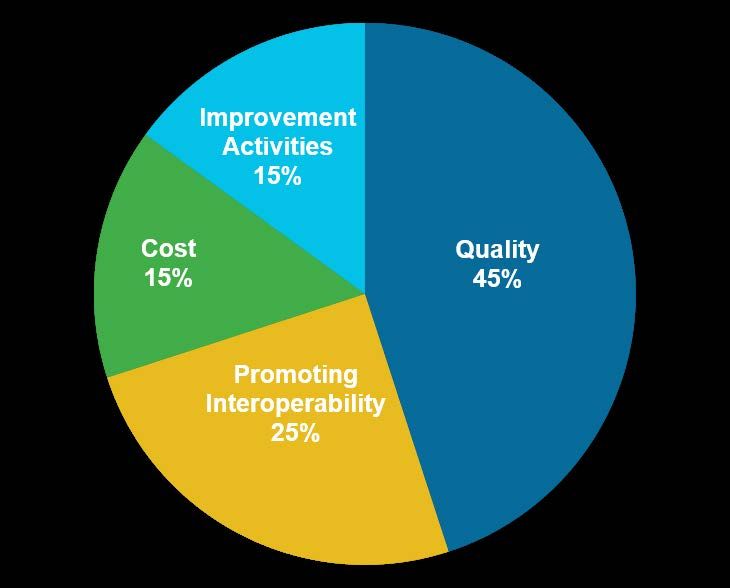
Quality Category - 45%
The reporting period for the Quality category is a 12-month period (January 1 through December 31, 2020). During this 12-month period, six
measures must be reported and at least one outcome measure or another high-priority measure.

Clinicians may choose measures on which they may report from a list. Some include:
Diagnostic Radiology Measures                                             Interventional Radiology Measures
 • Quality ID-145: Radiology: Exposure Dose or Time Reported for           • Quality ID-076: Prevention of Central Venous Catheter (CVC)-Related
   Procedures Using Fluoroscopy                                              Bloodstream Infections
 • Quality ID-146: Radiology: Inappropriate Use of “Probably Benign”       • Quality ID-145: Radiology: Exposer or Dose Time Reported for
   Assessment Category in Screening Mammograms                               Procedures Using Fluoroscopy
 • Quality ID-147: Nuclear Medicine: Correlation with Existing Imaging     • Quality ID-374: Closing the Referral Loop: Receipt of Specialist Report
   Studies for All Patients Undergoing Bone Scintigraphy                   • Quality ID-409: Clinical Outcome Post Endovascular Stroke
 • Quality ID-195: Radiology: Stenosis Measurement in Carotid Imaging        Treatment
   Reports                                                                 • Quality ID-413: Door to Puncture Time for Endovascular Stroke
 • Quality ID-225: Radiology: Reminder System for Screening                  Treatment
   Mammograms                                                              • Quality ID-420: Varicose Vein Treatment with Saphenous Ablation:
 • Quality ID-360: Optimizing Patient Exposure to Ionizing Radiation:        Outcome Survey
   Count of Potential High-Dose Radiation Imaging Studies: Computed        • Quality ID-421: Appropriate Assessment of Retrievable Inferior Vena
   Tomography (CT) and Cardiac Nuclear Medicine Studies                      Cava (IVC) Filters for Removal
 • Quality ID-364: Optimizing Patient Exposure to Ionizing Radiation:      • Quality ID-437: Rate of Surgical Conversion from Lower Extremity
   Appropriateness: Follow-Up CT for Incidentally Detected Pulmonary         Endovascular Revascularization Procedure
   Nodules According to Recommended Guidelines                             • Quality ID-465: Uterine Artery Embolization Technique:
 • Quality ID-405: Appropriate Follow-up Imaging for Incidental              Documentation of Angiographic Endpoints and Interrogation of
   Abdominal Lesions                                                         Ovarian Arteries
 • Quality ID-406: Follow-Up Imaging for Incidental Thyroid Nodules in    Radiation Oncology
   Patients                                                                • Quality ID-102: Prostate Cancer: Avoidance of Overuse of Bone Scan
 • Quality ID-436: Radiation Consideration for Adult CT: Utilization of      for Staging Low-Risk Prostate Cancer Patients
   Dose Lowering Techniques                                                • Quality ID-143: Oncology: Medical and Radiation - Pain Intensity
                                                                             Quantified
                    Red: high-priority measures                            • Quality ID-144: Medical and Radiation - Plan of Care for Severe Pain

                                                       Learn more at qpp.cms.gov.
Improvement Activities - 15%
The reporting period for the Improvement Activities category is a 90-day to a full-calendar-year period (January 1 through December 31,
2020).
Clinicians choose activities in which they may participate from a list. Some activities include:
• IA_BE_6: Collect and follow up on patient experience and satisfaction data
• IA_BE_7: Participate in a Qualifying Clinical Data Registry (QCDR)
• IA_BE_16: Evidence-based techniques to promote self-management into usual care
• IA_CC_1: Implementation of use of specialist reports back to referring clinician or group to close referral loop
• IA_CC_2: Implementation of improvements that contribute to more timely communication of test results
• IA_PSPA_1: Participate in an Agency for Healthcare Research and Quality (AHRQ)-listed patient safety organization
• IA_PSPA_2: Participate in Maintenance of Certification (MOC) Part IV
• IA_PSPA_16: Use of decision support and standardized treatment protocols
• IA_PSPA_19: Implement formal quality improvement methods, practice changes or other practice improvement processes
• IA_EPA_1: Provide 24/7 access to eligible clinicians or groups who have real-time access to a patient’s medical record
Blue: medium-weighted measures
Green: high-weighted measures
Learn more at qpp.cms.gov.Cost - 15% Total per Capita Cost (20 case minimum)
• Risk-adjusted per capita Part A and B costs
• Attributed based on primary care service volume
Why report cost?
• Assesses the primary care clinician’s overall care for a Medicare
For the 2020 performance year, the Cost category is 15 percent of patient during the performance period
the MIPS final score. Reporting on Cost measures in 2020 will help
you understand the Cost category before the percentage increases Episode-Based Measures
in future performance years.
• Electronic Outpatient Percutaneous Coronary Intervention (PCI)
• Knee Arthroplasty
No Cost category? What happens?
• Revascularization for Lower Extremity Chronic Limb Ischemia
If you do not meet either or the case minimums for either measure • Routine Cataract Removal with Intraocular Lens (IOL)
of the Cost category, it will be reweighted to the Quality category. Implantation
This will then result in the Quality category being worth 60 percent • Screening/Surveillance Colonoscopy
of your MIPS final score, instead of 45 percent. • Acute Kidney Injury Requiring New Inpatient Dialysis
• Elective Primary Hip Arthroplasty
How will you be scored? • Femoral or Inguinal Hernia Repair
• Hemodialysis Access Creation
• If only one measure can be scored, that score will be the
• Lumbar Spine Fusion for Degenerative Disease, 1-3 Levels
performance score.
• Lumpectomy Partial Mastectomy, Simple Mastectomy
• There is no reporting required. The Centers for Medicare &
• Non-Emergent Coronary Artery Bypass Graft (CABG)
Medicaid Services (CMS) automatically calculates from claims
• Renal or Ureteral Stone Surgical Treatment
submitted for payment.
• Intracranial Hemorrhage or Cerebral Infarction
• No score will be given to eligible clinicians who are not attributed
• Simple Pneumonia with Hospitalization
any cost measures because of case minimum requirement or lack
• ST-Elevation Myocardial Infraction (STEMI) with Percutaneous
of benchmark.
Coronary Intervention (PCI)
• Inpatient Chronic Obstructive Pulmonary Disease (COPD)
Medicare Spend per Beneficiary Clinician (35 case minimum)
Exacerbation
• Risk-adjusted Part A and B costs per inpatient admission • Lower Gastrointestinal Hemorrhage (applies to groups only)
• Attributed based on service volume during hospitalization
• Assesses the cost of care for services related to qualifying in
Total points scored
patient hospital stay (immediately prior to, during and after) for on each measure
Medicare patient COST PERFORMANCE =
• Includes all Part A and Part B claims Total possible points
available
Learn more at qpp.cms.gov.Promoting Interoperability (PI) - 25%
The Promoting Interoperability (PI) performance category score is now performance-based (100 points with optional 10 bonus points). The score
is based on “objectives” that have measures included in them.
Submit YES to: Certified Electronic Health Record Technology (CEHRT)
• Prevention of Information Blocking Attestation Requirements:
• Office of the National Coordinator (ONC) Direct Review • 2015 edition
Attestation • Be in place for the 90-day reporting period chosen
• Security Risk Analysis (SRA) Completion: • Be certified to 2015 edition by the last day of the selected
– No score attached reporting period
– Must be during calendar year in which reporting
– Required to receive PI score
How is PI scored?
Learn more at qpp.cms.gov.You can also read


