Worcestershire Rail Investment Strategy - Supporting Development of Worcestershire's Local Transport Plan 4
←
→
Page content transcription
If your browser does not render page correctly, please read the page content below
Worcestershire County Council

Worcestershire Rail
Investment Strategy
Supporting Development of Worcestershire’s
Local Transport Plan 4

Autumn 2017
Contents
An Evidenced Rail Vision For Worcestershire                              4

1.   Executive Summary                                                   7

2.   Introduction                                                       12

3.   Stage 1 – Current Travel Markets, Train Services & Accessibility   15

4.   Stage 2 – Review of Worcestershire’s Development Proposals         39

5.   Stage 3 – Rail Industry Plans & Gap Analysis                       52

6.   Stage 4 – Economic Testing Of Connectivity Options                 78

7.   Stage 5 – The Prioritised Conditional Outputs                      84

8.   Stage 6 – Making It Happen                                         96
An Evidenced Rail Vision
For Worcestershire
Worcestershire is an attractive, thriving County of                        The Rail Industry’s Plans
566,000 people, set to grow by 47,200 new homes
2030 and 25,000 new jobs by 2025 which will result                         The industry forecasts up to 97% growth in
in a £2.9bn growth in Gross Value Added (GVA)                              passenger volumes on Worcestershire routes by
from £9bn to £11.9bn per annum 1 . The County’s rail                       2043 2 .
services will not match these ambitions without
signifcant earlier development and investment                              The industry has an emerging vision, shared in
beyond that committed by the rail industry.                                Worcestershire, for a faster 2 trains per hour (tph)
                                                                           Worcestershire to London service, supported by
The Challenge                                                              enhancements to the North Cotswold Line, the
                                                                           Great Western electrifcation scheme and new
Connectivity to London is slow and of limited                              Intercity Express Programme (IEP) trains.
frequency, with many Worcestershire passengers
using the M5-M42-M40 to access better Birmingham                           However its planning processes do not include
International and Warwick Parkway services. The                            additional Cross Country or southbound
opening of Worcestershire Parkway in early 2019 will,                      connectivity beyond current commitments to
however, begin to address this issue by providing                          serve the new Worcestershire Parkway in 2019, and
enhanced accessibility to the North Cotswold Line                          its long-distance and local services are planned
and Cardiff – Nottingham Cross Country services.                           by different Network Rail routes and multiple
However, other strategic UK-wide Cross Country                             operators. Worcestershire County Council seeks the
services will continue to pass through but not call                        support of the industry in planning Worcestershire’s
in Worcestershire, limiting connectivity to the                            rail services in a fully integrated manner, refecting
economies of South-West, North-West and North-                             our vision of “One-Economy-One Railway” for
East England.                                                              Worcestershire.

The growing University City of Worcester suffers                           Addressing capacity restrictions caused by the
poor connectivity due to restricted rail                                   County’s several single line sections and outdated
infrastructure, outdated signalling and limited                            signalling systems is being considered by Network
historic investment in its 2 stations.                                     Rail but with no committed timescales. The County
                                                                           is a key partner in the newly-established North
Kidderminster and Redditch (and Bromsgrove after                           Cotswold Line Task Force which seeks to bring
introduction of the new electrifcation timetable                           forward capacity upgrades on this route and in the
in May 2018) are well served by local services into                        Worcester area; the evidence underpinning our
Birmingham, but have limited connectivity to                               Vision set out in this Strategy strongly supports the
London or southwards. These services also face                             work of the Task Force.
challenges of overcrowding, particularly during peak
periods - both issues can have a profound effect in                        Electrifcation of the Bristol-Birmingham and
suppressing demand.                                                        Snow Hill Lines, capable of increasing capacity for
                                                                           new services for Worcestershire under previous
                                                                           Department for Transport (DfT) consideration, is
                                                                           not now included in active industry plans following

1
    Worcestershire Local Enterprise Partnership, Strategic Economic Plan; March 2014
2
    Network Rail Long Term Planning Process, Long Distance Market Study; October 2013
                                                                       4
the Government’s July 2017 announcement of the                            Worcestershire is keen to gain from new UK-wide
cancellation of major UK rail electrifcation schemes,                     journeys offered by HS2 from 2026 and 2033,
and proposing future reliance on ‘bi-mode’ electric/                      all of which will, however, be by connection at
diesel powered trains. Alternative ways of increasing                     Birmingham Curzon St. or interchange (See section
connectivity and capacity will therefore need to be                       5.9.2 for further information regarding HS2).
found on this corridor.
                                                                          This Strategy thus focuses on new, direct
Worcestershire’s Evidenced Proposals                                      connectivity on the ‘Classic Network’, connectivity
                                                                          being achieved via local and long-distance rail
Worcestershire County Council (WCC) has prepared                          services, to both regional and UK-wide economies
this Rail Investment Strategy to evidence its                             in order to promote the County’s sustainable
economic case – in terms of GVA and jobs – for                            economic growth and success (the concept of “One
enhanced County rail connectivity.                                        Economy / One Railway”).

The Strategy proposes 4 overarching Conditional                           Infrastructure To Support
Outputs for rail service development which would
                                                                          Worcestershire’s Vision
deliver £50.42m GVA per annum, and 1,151 new jobs
in the County 3:                                                          The Conditional Outputs also cover key aspirational
                                                                          infrastructure schemes essential to facilitate this
•         2 Trains Per Hour Worcester-Oxford-
                                                                          new connectivity, including:
          Paddington – £21.22m GVA p.a. and 475 new
          jobs;                                                           •    North Cotswold Line Capacity Upgrade;
•         1 Train Per Hour Kidderminster-Droitwich                        •    Worcester Area And Droitwich Spa To Stoke
          Spa-Worcester-Paddington – £13.8m GVA p.a.                           Works Capacity Upgrade;
          and 273 new jobs;
                                                                          •    New Car Park Capacity And/Or New
•         Calls At Worcestershire Parkway In Bristol-                          Stations;
          Manchester And Plymouth-Newcastle
          Services – £9.6m GVA p.a. and 250 new jobs;                     •    Worcester Shrub Hill Station Regeneration;

•         Regional Service Between Kidderminster/                         •    Electrifcation Of Both The Bristol To
          Bromsgrove, Worcester And Cheltenham                                 Birmingham And Snow Hill Lines. 4
          Spa, Gloucester And Bristol – £5.73m GVA
          p.a. and 153 new jobs.

3
    JMP, Worcestershire RIS GVA Analysis: Wider Impacts Note; June 2016
4
 Although in light of the recent Secretary of State for Transport’s announcement putting on hold all future electrifcation schemes, these
Conditional Outputs will need to be carefully considered with regards to delivery.
                                                                      5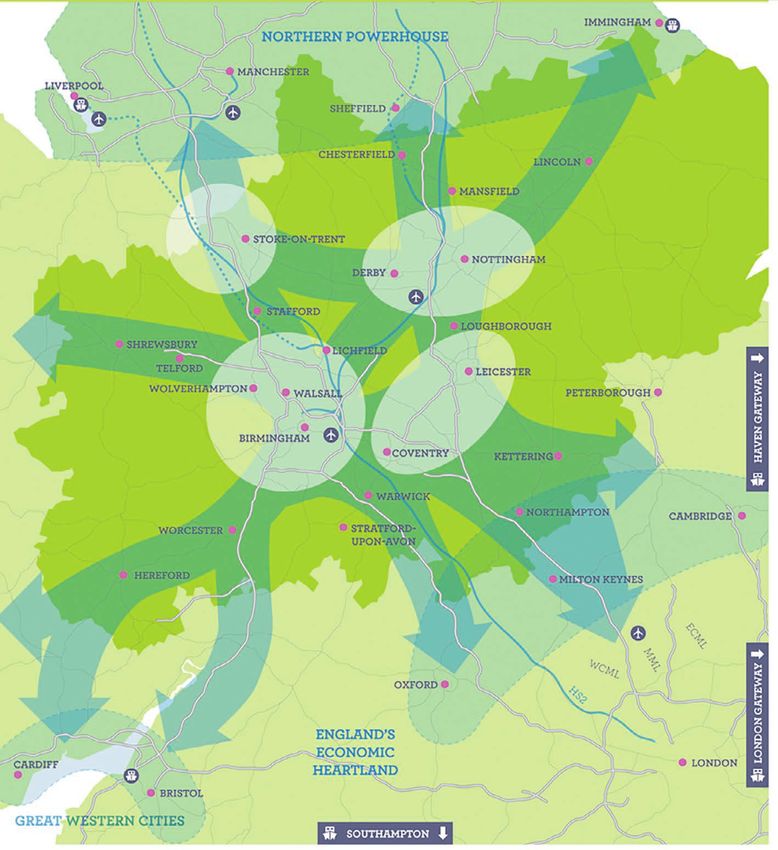
Taking The Vision Forward                                   •   DfT and Network Rail on the Long Term
                                                                Planning Process to 2023 and 2043;
Worcestershire recognises that its aspirations
require planning within the medium and long-term            •   Midlands Connect on its ‘Powering the
rail industry investment framework to 2023 and                  Midlands Engine’ Transport Strategy (ensuring
2043.                                                           Worcestershire’s Rail Vision is fully integrated
                                                                with the Midlands Connect proposals); and
This Vision will thus form the basis for the County’s
active and ambitious engagement with stakeholders           •   Neighbouring Local Enterprise Partnerships
and partners including:                                         and local authorities with common interests.

•     The North Cotswold Line Task Force on ways
      to quickly develop and deliver the shared
      Joint Vision for the North Cotswold Line;

•     DfT on investment within industry Control
      Period 6 (2019-2024) and upon re-franchising
      specifcations;

                                                        6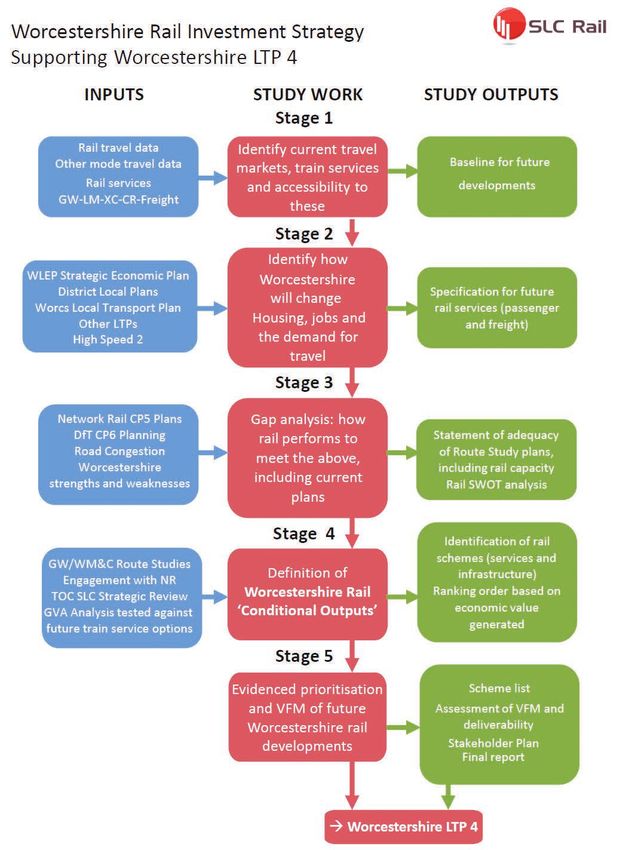
1. Executive Summary
1.1       In 2016 Worcestershire County Council                                between Redditch and Birmingham (during
          commissioned SLC Rail to develop a                                   peak periods) and between Worcester –
          Worcestershire Rail Investment Strategy                              Bromsgrove – Birmingham (all day).
          (WRIS), to form part of the County’s fourth
          Local Transport Plan (2017 – 2030). The WRIS                   1.4   Stage 2: Change In Worcestershire
          is split into 5 key stages, designed to; baseline
                                                                               The Strategic Economic Plan (SEP) produced
          the current rail situation in the County;
                                                                               by the Worcestershire Local Enterprise
          assess the scale of growth expected; identify
                                                                               Partnership (WLEP) sets out ambitious growth
          gaps and solutions; model the economic
                                                                               targets for the County. By 2025 the SEP
          benefts of these solutions, and; prioritise the
                                                                               proposes the creation of 25,000 new jobs,
          investment to achieve maximum value for
                                                                               construction of 47,200 new dwellings by 2030
          money.
                                                                               and an increase in GVA from £9bn to £11.8bn
1.2       Investing in the rail network of the County                          per annum. This growth is focused around
          is important in order to achieve sustained                           the rail corridors in the three areas of Wyre
          economic growth, increased connectivity                              Forest, Bromsgrove & Redditch and South
          and reduced reliance on motor vehicles. The                          Worcestershire. Further housing development
          outputs of this WRIS can be used to lobby                            is expected to ‘overspill’ from the Greater
          the rail industry for prioritised improvements                       Birmingham housing allocations and, although
          up to 2043. A summary of the Strategy’s                              numbers are still to be quantifed, it is thought
          fndings is found below.                                              around 37,900 new houses will need to be
                                                                               shared between the nine adjacent local
1.3       Stage 1: Baseline                                                    authorities (including Worcestershire) by 2031.
                                                                               Key policy documents for the region (e.g. the
          Worcestershire is crossed by two nationally                          SEP, WCC’s LTP3 and the West Midlands LTP)
          important rail lines – the North Cotswold                            all cite the benefts of prioritising rail travel as
          line from London Paddington to Worcester,                            a means to achieve sustainable growth.
          Great Malvern and Hereford and the Bristol
          to Birmingham Line. Local services operate                     1.5   Stage 3: Rail Industry Planning
          to Birmingham along the Kidderminster,
          Bromsgrove and Redditch routes. Passengers                           The rail industry is currently engaged in its
          make 9.2 million trips to and from the                               ‘Long Term Planning Process’ which looks to
          County’s stations each year (2015/16) 5 and                          shape a vision for the National Rail network to
          Network Rail is projecting this to grow by 97%                       2043. In parallel Network Rail (NR) is working
          by 2043 6 (against a 2013 baseline). However,                        to defne its specifc investment proposals for
          direct connectivity from Worcestershire                              ‘Control Period 6’ (CP6) – 2019 to 2024 – and
          is currently poor. Cross Country services                            various rail franchises are being renewed.
          between South-West England, Birmingham
                                                                               If the recommended outputs from this WRIS
          and the North-West and North-East pass
                                                                               are to be realised their development will
          through but do not call in Worcestershire, and
                                                                               need to align with these industry processes.
          the County’s network suffers from various
                                                                               There also exists the opportunity to capitalise
          constraints such as mechanical signalling and
                                                                               on benefts from HS2 over the same period.
          single line tracks which have a direct impact
                                                                               Finally, this Long Term Planning Process
          on train service timetables. Overcrowding
                                                                               presents the opportunity for the County
          on services is also a problem, particularly

5
    ORR Estimates of Station Usage; November 2016
6
    Network Rail Long Term Planning Process, Long Distance Market Study; October 2013
                                                                     7
to lobby for, and secure, key infrastructure                          •      To South-West, North-West And
          improvements during the industry’s Control                                   North-East England – with calls at
          Period 6 2019-2024 and beyond that remove                                    Worcestershire Parkway in Bristol-
          existing bottlenecks such as mechanical                                      Manchester and Plymouth-Newcastle
          signalling and single line sections of railway.                              services: £9.6m GVA p.a. and 250 jobs;

1.6       Stage 4: Connectivity – Economic Tests                                •      Between Worcestershire And
                                                                                       Cheltenham, Gloucester And
          Combining the fndings of stages 1 – 3 of the                                 Bristol – with a regional service via
          WRIS led to the identifcation of 10 new train                                Kidderminster-Worcester Shrub Hill
          service options enhancing Worcestershire’s                                   and/or Bromsgrove-Worcestershire
          connectivity with other UK economies. These                                  Parkway offering up to £5.73m GVA and
          were modelled by consultants SYSTRA using                                    153 new jobs.
          a bespoke economic model consistent with
          that used by Network Rail in its 2013 Markets                         If fully realised, the combined benefts of
          Studies. This model produces a forecast of                            the ‘Conditional Outputs’ would generate
          both GVA increase and jobs creation resulting                         a total of £50.42M GVA per annum for
          from improvements to generalised journey                              Worcestershire and would create 1,151 new
          time and the enhanced business to business                            jobs.
          activity generated by the new services.
                                                                         1.8    The Conditional Outputs also cover key
1.7       Stage 5 – Conditional Outputs                                         aspirational schemes essential to facilitate this
                                                                                new connectivity, including:
          The new service options are termed
          ‘Conditional Outputs’, as used by the rail                            •      North Cotswold Line Capacity
          industry in its Long Term Planning Process                                   Upgrade – Doubling of part or all of
          (LTPP). These are later shown in Table 1.1.                                  the Norton Junction-Evesham and
          The County’s new rail connectivity and                                       Charlbury-Wolvercote Junction sections
          relationship to other UK economies that                                      (as now championed by the North
          would be released by these Conditional                                       Cotswold Line Task Force);
          Outputs is shown at Figures 1.2 and 1.3.
                                                                                •      Worcester Area And Droitwich Spa
          The Conditional Outputs that would deliver                                   To Stoke Works Capacity Upgrade
          the greatest uplifts in GVA and new jobs 7 for                               – Providing additional capacity for
          the County are enhanced rail connectivity:                                   services passing through Shrub Hill
                                                                                       and Foregate Street and doubling of
          •      Between Worcestershire And London                                     the Droitwich-Stoke Works single line
                 And The Thames Valley – along the                                     (together with re-signalling);
                 North Cotswold Line with a 2 trains per
                 hour and faster service: £19.04m GVA                           •      New Car Park Capacity And/Or New
                 p.a. and 421 new jobs, with a further                                 Stations – Addressing the structural
                 £2.18m GVA and 54 jobs via connections                                shortfall of current car parking capacity
                 at Oxford to East-West Rail to a total of                             and providing capacity for up to 100%
                 £21.22m and 475 new jobs;                                             passenger growth by 2043, either at
                                                                                       existing or new stations;
          •      Between Wyre Forest/Kidderminster
                 And London Paddington – extending
                 Paddington-Worcester services to
                 Droitwich Spa and Kidderminster:
                 £13.8m GVA p.a. and 273 new jobs;

7
    Data sourced from JMP, Worcestershire RIS GVA Analysis: Wider Impacts Note; June 2016
                                                                     8
•     Worcester Shrub Hill Station                    •   North Cotswold Line (NCL) Task Force
             Regeneration – enabling Shrub Hill to               – to ensure effcient development
             support both current train services                 and delivery of the substantive
             and new services proposed in this Rail              train timetable and infrastructure
             Investment Strategy and leading to a                improvements proposed for the NCL;
             step-change in economic regeneration
             of the Shrub Hill Opportunity Zone and          •   Midlands Connect – to ensure that
             the areas to the east of the City Centre;           Worcestershire’s Rail Vision is fully
                                                                 integrated with, and supported by,
       •     Electrifcation – Of both the Bristol to             the evolving “Powering the Midlands
             Birmingham and Snow Hill Lines.                     Engine” Strategy;

1.9    Ticketing And Fares                                   •   Committed Industry Schemes – to
                                                                 ensure schemes such as Great Western
       A further Conditional Output also suggests                Main Line electrifcation are delivered;
       revision of the County’s highly complex
       ticketing and fares structure to refect both          •   Prospective Industry Schemes – to
       existing train services and those proposed in             seek industry commitment to deliver
       this Strategy.                                            schemes such as electrifcation and
                                                                 North Cotswold Line Capacity upgrade;
1.10   Next Steps
                                                             •   Worcestershire Rail Investment
       To realise a rail network that is capable                 Strategy’s Conditional Outputs – to
       of supporting Worcestershire’s growth                     include the County’s Conditional
       ambitions, WCC and WLEP will need to                      Outputs in CP6 2019-2024 and Long
       engage with Government, the rail industry,                Term Industry Planning Process.
       politicians and other stakeholders across fve
       areas:

                                                         9
Table 1.1 – Worcestershire Rail Investment Strategy Conditional Outputs

              Worcestershire Rail Investment Strategy
     Ref                                                                                             GVA           Jobs        When
              Conditional Outputs
    NCL 1     Provision of 2 trains per hour between Worcester and London                          £19.04m          421          CP6
              Paddington, with 1 train per hour having fast journey time of 1
              hour 50 minutes or less
    NCL 2     Provision of 1 train per hour between Kidderminster and                              £13.8m          273           CP6
              London Paddington via Droitwich Spa, Worcester and Oxford
    NCL 3     Provision of additional infrastructure capacity on the North                             -             -           CP6
              Cotswold Line to support a 2 trains per hour Worcester to
              London Paddington service
    WAB 1     Provision of a new direct train service between Kidderminster,                      £5.73m*          153*          CP6
              Worcester, Cheltenham Spa, Gloucester, Bristol Parkway and
              Bristol Temple Meads
    WAB 2     Provision of new direct train service between Bromsgrove and                        £5.66m*          145*          CP6
              Worcestershire Parkway, Cheltenham Spa, Gloucester, Bristol
              Parkway and Bristol Temple Meads
    WAB 3     Provision of additional infrastructure capacity at Worcester                             -             -           CP6
              and Droitwich Spa – Bromsgrove to support train service
              growth and development
    WPK 1     Introduction of calls at Worcestershire Parkway in the hourly                        £4.4m**        108**          CP6
              Cross Country Bristol to Manchester service
    WPK 2     Introduction of calls at Worcestershire Parkway in the hourly                       £9.6m**         250**          CP6
              Cross Country Plymouth to Newcastle service
    ELC 1     Electrifcation of the Bristol to Birmingham Line, Snow Hill                              -             -        CP6/7 8
              Lines and the North Cotswold Line to support train service
              growth and development
    ACS 1     Provision of additional car park capacity at existing stations                           -             -         CP5/6
              and/or new stations to accommodate forecast passenger
              growth to 2043
    WOS 1     Worcester Shrub Hill Station Regeneration to support current                             -             -         CP5/6
              and proposed new train services and frequencies to London
              and South-West England
    TKT 1     Cross-industry review of ticketing and fares structures to                               -             -         CP5/6
              match new and developing train services
      -       GVA/jobs value of East-West connectivity at Oxford                                   £2.18m           54           CP6
              TOTAL GVA AND JOBS                                                                  £50.42m          1151
              * An ‘either / or’ option
              ** An ‘either / or’ option
              CP5 2014-2019 / CP6 2019-2024 / CP7 2024-2029

8
 CP6/7 is an aspiration that will need to be carefully explored with rail industry partners following the recent Government announcement
regarding the future of electrifcation schemes in the UK.
                                                                    10
Figure 1.2 – Worcestershire Rail Connectivity With Rail Investment Strategy Conditional Outputs
LDS NCL
LIV MAN
SFD
WVH
NOT
BHM
KID
BIA LEI
BMV SOL
COV CBG
HFD WOR SAV
WPK
MKC
EVE
CNM
OXF
CDF MYB
SWI
BRI
RDG
PAD
2 trains per hour or more
PLY EXD 1 train per hour
LHR
Less than 1 train per hour
Figure 1.3 – Worcestershire Connectivity To UK Economies With Conditional Outputs (Source: ONS)
WORCESTERSHIRE
GVA £11.9bn
112. Introduction
2.1 In 2016 Worcestershire County Council travel rather than solely operational
commissioned SLC Rail to assist in capability and capacity;
developing its rail aspirations into an
ambitious investment strategy to inform • The shift in balance of power in the rail
Worcestershire’s emerging Local Transport industry towards locally defned and
Plan 4 (LTP4) which is proposed for adoption delivered investments led by LEPs and
during 2017. local authorities, adding value to those
funded by central Government via
Worcestershire County Council’s aspirations the Department for Transport’s 5 year
are for: ‘Control Period’ plans;
• Train service enhancements; and • The growing credibility of
Worcestershire County Council in
• Supporting infrastructure including the rail industry given its leading role
existing and new stations and station in projects such as Worcestershire
car parks. Parkway, Bromsgrove Station relocation
and station facility upgrades at
Both of which will signifcantly enhance the
Worcester Foregate Street and Malvern
County’s level of rail accessibility to key
Link;
regional and national economic centres and
encourage sustained modal shift from road to • The wider regional context, particularly
rail, thus reducing reliance on private motor the plans for High Speed 2 from 2026,
vehicles; reducing congestion and improving and for shared and incrementally
air quality. It is important to note that WCC devolved decision making in respect
does not support any reduction in level of of the West Midlands Rail franchise,
train service frequency or capacity and that within which WCC is an informed and
no such reductions are promoted within the infuential player.
WRIS.
2.3 Putting WCC at the heart of the railway
2.2 Development of an investment strategy for planning process is important as the
Worcestershire refects fve strategic themes industry works towards an Initial Industry
shared by the County, UK Government and Plan for Control Period 6 (2019-2024), due
UK rail industry: December 2017, and an Indicative Train Service
Specifcation for 2043.
• The ambition of WCC, the
Worcestershire and Greater Birmingham These plans are under ongoing development
& Solihull Local Enterprise Partnerships following publication of the Western and
and the County’s Borough, City and West Midlands & Chiltern Route Studies in
District Councils for transformative but summer 2017. In addition, the West Midlands
sustainable economic growth within Rail franchise is now in the mobilisation stage
what is an increasingly competitive following award to Abellio in August 2017
environment between regions, LEPs and and extended Direct Award periods are now
local authority areas; in place for the Great Western and Cross
Country franchises. Work on assessing the
• The recognition at Government level
potential impact of HS2 on the classic rail
of the economic value of the National
network is underway, as are plans for future
Rail network, refected in the focus of
phases of the East-West Railway between
long-term planning by the rail industry
Oxford, Milton Keynes and Cambridge.
towards growing, changing markets for
12Work on the East-West Railway was given a • To support WCC and WLEP in
substantial boost in December 2016 following developing deep, productive
the announcement by Transport Secretary, Rt relationships with DfT, Network Rail,
Hon Chris Grayling MP, that the scheme will Transport for West Midlands (TfWM) /
now be developed, owned and operated by a West Midlands Rail (WMR) – particularly
private company, separate from Network Rail. through the development of their
The DfT’s and Network Rail’s electrifcation own Rail Investment Strategy – train
programme has been updated following the operators and potentially Third Party
2015 Hendy Review. Each of these had the investors, in developing the County’s rail
potential to beneft Worcestershire directly, services;
although the impact has now been lessened
following the Government’s July 2017 decision • To provide a ‘translation and
to put on hold all future electrifcation interpretation’ service for senior
schemes. politicians, MPs and offcers, to assist
in their engagement with Government
Taking additional account of the delays to regarding investment in the County’s rail
Great Western electrifcation, the Hendy and services;
Shaw reviews of the structure and funding
of the industry and Network Rail, and the • To function as a driver in supporting
Hansford Review regarding aspirations to innovative, affordable and relevant rail
enable more Third Party investment in regeneration in the County.
the railway (which the County particularly
2.5 The development of the strategy has been
welcomes), 2017 is a highly appropriate
undertaken via the following 5 stages, which
moment for the publication of this Rail
are further illustrated at Figure 2.1:
Investment Strategy. This document provides
the County with the economic evidence • Stage 1 – Chapter 3
to support the principles, prioritisation and Current travel markets, train services
prospective investment programme for its and accessibility – the Baseline;
aspirations, and hence a powerful tool within
the County and wider West Midlands and • Stage 2 – Chapter 4
with central Government, both in terms of Review of Worcestershire’s
infuencing policy and funding bids. Development Proposals;
2.4 The specifc rationale for preparing a • Stage 3 – Chapter 5
prioritised Rail Investment Strategy thus has 6 Rail Industry Plans and Gap Analysis;
key components:
• Stage 4 – Chapter 6
• To form part of the Local Transport Economic Testing of Connectivity
Plan (LTP4) and to proactively relate Options;
train services and connectivity to the
County’s economic drivers; • Stage 5 – Chapter 7
The Prioritised Conditional Outputs.
• To provide an evidence base which
enables projects to be assessed and Chapter 8 describes recommendations for
prioritised in terms of Gross Value ‘Making It Happen’.
Added to the economy and jobs – in an
industry recognised format;
• In doing so, to match the expectations
of the Department for Transport that
rail investments will increasingly be local
economy led and justifed;
13Figure 2.1 – SLC Rail 5 Stage Rail Investment Strategy For Worcestershire
Worcestershire Rail Investment Strategy
Supporting Worcestershire’s LTP4
Rail travel data
Other mode travel data
Rail services
GWR-LM-XC- CR-Freight
WLEP Strategic Economic Plan
Borough, City and District
Local Plans
Worcs Local Transport Plan
Neighbouring LTPs
High Speed 2
Network Rail CP5 Plans
DfT CP6 Planning
Road Congestion
Worcestershire
strengths and weaknesses
GWR/WM&C Route Studies
Engagement with NR
TOC SLC Strategic Review
GVA Analysis tested against
future train service options
143. Stage 1 – Current Travel Markets,
Train Services & Accessibility
3.1 The Worcestershire Rail Network
The rail network in Worcestershire has a the preserved Gloucester and Warwickshire
complex history which resulted by the late Steam Railway (GWSR) which is due to provide
19th Century in routes both separately and a connection with Broadway in 2018. The
jointly operated by the Great Western only part of Worcestershire’s network which
Railway and Midland Railway. At the core is currently electrifed is the ‘Cross-City’ line
of these routes were the Midlands line north from Redditch towards Birmingham.
between Birmingham New Street and Bristol
Temple Meads (now known as the ‘Bristol to There is one station in the County on the
Birmingham Line’), and the Great Western Stratford-upon-Avon to Birmingham Snow Hill
route from London Paddington to Oxford, Line at Wythall; as the route is otherwise
Worcester, Great Malvern and Hereford wholly within Birmingham, Solihull and
(the section from Oxford to Worcester now Warwickshire its signifcance for Worcestershire
known as the ‘North Cotswold’ line), which is restricted. However, it will still be subject to
continued onto Birmingham Snow Hill via the same growth potential as other stations in
Kidderminster. the County and as a result needs to be similarly
considered in the context of appropriate
The core network in 2017 is shown at Figure service and station facility enhancements. Any
3.1 below, including the new Worcestershire such investigations will need to be agreed and
Parkway station (due to open in early 2019), coordinated with West Midlands Rail and
the preserved Severn Valley Railway (SVR) and Warwickshire County Council.
Figure 3.1 – Rail Map Of Worcestershire
Birmingham
Hagley
Blakedown
Wythall Key:
Bewdley Kidderminster Barnt Green
Hartlebury Rail network
Alvechurch
Bromsgrove
Stations
Redditch
Droitwich Spa New station
Heritage railway
Worcester Foregate
Street Worcester Shrub Hill County Boundary
Worcestershire Parkway
Malvern Link Pershore
Honeybourne
Great Evesham
Malvern
Broadway
Hereford
London
Bristol
15It is important to note that the opening of 3.2 The Current Worcestershire Travel Market
Worcestershire Parkway will serve to add And Dynamics Of Travel
capacity on the network (a ‘net gain’) and
will compliment and enhance the provision Table 3.2 below summarises passenger
of stations in the County. It will not result volumes at Worcestershire stations (sources:
in the closure of any other station as a Offce of Rail and Road’s [ORR] latest
direct, or indirect, consequence of opening Estimates of Station Usage data for 2015/16,
(similar recent examples being the opening and National Rail Enquiries [NRES] for car park
of Stratford-upon-Avon Parkway less than 1 capacity). Figure 3.3 illustrates the relative
mile from Stratford-upon-Avon Town Station position of the County’s stations, and Figure
and Warwick Parkway within a few miles of 3.4 their growth in the past 6 years.
Warwick Town station).
Table 3.2 – Passenger Usage And Car Park Capacity (Sources: ORR And NRES)
Annual Daily Car Park Passengers Growth Growth
Station Usage return Capacity per Car since since
2015/16 passengers 2017 Park Space 2014/15 2009/10
Worcester Foregate Street 2,293,021 3,572 0 n/a 4% 54%
Kidderminster 1,619,928 2,523 224 11 4% 22%
Redditch 1,002,294 1,561 156 10 16% 17%
Bromsgrove 619,880 966 251 4 9% 41%
Worcester Shrub Hill 618,467 963 121 8 4% -28%
Droitwich Spa 561,908 875 45 19 5% 19%
Great Malvern 557,012 868 122 7 3% 20%
Hagley 544,318 848 33 26 13% 16%
Malvern Link 344,232 536 96 6 10% 38%
Barnt Green 270,142 421 60 7 8% 22%
Evesham 255,476 398 70 6 3% 25%
Alvechurch 167,154 260 70 4 15% 21%
Pershore 100,690 157 17 9 6% 71%
Blakedown 97,028 151 10 15 5% 14%
Honeybourne 57,978 90 42 2 4% 65%
Wythall 55,044 86 0 n/a 6% 23%
Hartlebury 50,088 78 20 4 28% 108%
Total COUNTY 9,214,660 14,354 1,337 11 7% 24%
16Figure 3.3 – Passenger Usage By Station (Source: ORR)
Figure 3.4 – Passenger Growth At Worcestershire Stations Since 2009/10 (Source: ORR)
17Key features illustrated and • Patronage is low at stations such as
Blakedown, Hartlebury, Pershore and
suggested by these 3 fgures include:
Honeybourne, and, surprisingly so, from
• Overall passenger growth of 24% between Evesham;
2009/10 and 2015/16 in Worcestershire (and
• At the same time patronage has grown from
growth of 7% between 2014/15 and 2015/16)
the least used stations, albeit from their very
– strong in itself – but lower than the UK
low base.
average of 31%, highlighting the constraints of
the County’s current network;
Features particular to 2015/16 which
• Two stations, Worcester Foregate Street and may have infuenced passenger
Kidderminster, dominate rail usage in the numbers include:
County;
• The 2015/16 data follows the North Cotswold
• Worcester’s 2 stations together manage 2.9 Line improvements, which came into effect
million passenger trips per annum – around from May 2015, and which saw a broadly
4,535 return passengers per day – and c. 32% hourly service introduced to replace the
of all rail travel in the County; previous c. 2 hourly off-peak London service;
• Worcester Foregate Street attracts a large • The Redditch route’s usage follows full re-
mix of journeys, especially as a destination opening of the line after a new passing loop
because of its location in the centre of the was constructed at Alvechurch in order to
City with considerable school travel from increase timetable capacity.
Evesham, Kidderminster and Malvern;
In the case of the substantial 28% fall in passenger
• Worcester Shrub Hill has a lesser role due to numbers at Worcester Shrub Hill this relates
its lesser position as a destination at the edge to changes in the ORR’s passenger counting
of the City Centre and limited car parking methodology which splits ticket sales between
capacity restricting its role as an origin; Worcester Shrub Hill and Foregate Street based
on an algorithm rather than actual ticket sales
• Journeys to/from Kidderminster represent
data. Shrub Hill’s annual passenger numbers have
nearly 20% of all rail travel in the County,
been reduced from 968,000 in 2013/14 to 595,000
dominated by commuter fows into
in 2014/15; a substantial ‘correction’. However, the
Birmingham; however it is also important
station did experience 4% growth in 2015/16 and
to recognise the value of inbound visitor
ways in which to further improve demand through
movements to Kidderminster visiting 2 of
Shrub Hill have been examined in the Business Case
the County’s biggest tourist attractions – the
work for the ‘Worcester Shrub Hill Masterplan’
Severn Valley Railway and the West Midlands
which was completed by SLC in March 2017.
Safari Park;
Options to progress development and delivery
• Malvern’s two stations together manage over
of the Masterplan recommendations are being
900,000 passenger trips per year - around
explored at the time of writing and (in headline
1,400, return trips per day - and approximately
terms) include transformation of the station
10% of all rail travel in the County. Growth
forecourt, accessibility arrangements and
since 2010/11 has been strong at nearly 40%.
sustainable links to the City Centre. This underlines
the important future role that the station will play
in serving the City following the completion &
opening of Worcestershire Parkway in 2019.
183.3 Current Train Services
3.3.1 Passenger train services operating through or within Worcestershire in the December 2016 –
December 2017 timetable are shown in Table 3.6 below (some intermediate stations are not
shown for brevity):
Table 3.6 – Worcestershire Train Services Summary – December 2016-December 2017 Timetable
Service Frequency Operator Rolling Stock
Hereford Broadly hourly between Worcester and London, GWR HST
Great Malvern with some services extended to/from either Class 180
Worcester Hereford or Great Malvern Class 165/166
Oxford
London Paddington
Worcester 2 AM peak trains per day towards Paddington and 1 GWR HST
Cheltenham PM peak return
Swindon
London Paddington
Kidderminster 4 AM peak services to London and 4 PM peak return Chiltern Class 68+
Birmingham Snow Hill services Railways Mark III
Birmingham Moor St coaches
Banbury Class 168
London Marylebone
Hereford Hourly with some additional peak services London Class 170
Great Malvern Midland
Worcester
Bromsgrove
Birmingham New St
Great Malvern Half-hourly from Worcester; most services terminate London Class 172
Worcester at or start from one of the Worcester stations, but Midland
Kidderminster a small number extend to/from Great Malvern.
Birmingham Snow Hill 2 per hour terminate or start at Kidderminster
Birmingham Moor St providing a 4 trains per hour Kidderminster service
to Birmingham. All services operate through
Birmingham to either Dorridge or Whitlock’s End.
Bristol Temple Meads Every two hours GWR Class 150
Gloucester Class 158
Cheltenham
Worcester
Great Malvern
Redditch 3 tph calling at all stations London Class 323
Birmingham New St Midland
Lichfeld
Cardiff Central 2 trains call at Bromsgrove in each direction in the Cross Class 170
Cheltenham peak periods (0640 & 0710 – northbound and 1610 & Country
Bromsgrove 1710 southbound).
Birmingham New St
Nottingham
19There are 4 service groups on the Bristol to
Birmingham Line, the 2 noted at Figure 3.6 (Great
Malvern to Bristol and Cardiff to Nottingham), plus a
further two strategic Cross Country services which
pass through but do not call in Worcestershire:
• 1 train per hour between Bristol Temple
Meads and Manchester via Birmingham;
• 1 train per hour between Plymouth and Exeter
and Newcastle/Edinburgh via Birmingham.
For clarity Snow Hill lines services are
diagrammatically illustrated at Figure 3.7 below (note
this does not show the services that also operate
between Birmingham, Bromsgrove, Worcester, Great
Malvern and Hereford).
Figure 3.7 – Snow Hill Lines Train Service Structure 2016/17 Timetable
203.3.2. Freight 3.4 Connectivity
The Bristol to Birmingham Line is a Figure 3.8 illustrates the limited connectivity
major freight artery, with 2 freight of Worcestershire to other UK economic
paths per hour in each direction. Some centres, not only adjacent Bristol and South
of these are occasionally routed via Wales, but those in the East Midlands
Worcester Shrub Hill. and north-east and north-west England.
Direct connections are shown, illustrating
The Worcester-Kidderminster- services with 2 trains per hour or more e.g.
Stourbridge-Round Oak or Birmingham towards Birmingham from Worcester and
route has 9 to 10 freight paths per day. Kidderminster, those with an hourly service
such as Worcester to London Paddington,
There is one freight train path per day
and those with a lower frequency such as
along the North Cotswold Line serving
the 2 hourly Great Malvern-Worcester-Bristol
the Long Marston depot. The WRIS will
service and the peak direct Kidderminster
continue to support the use of rail to
to London Marylebone service. All other
transport freight for the congestion
connections must be made by at least 1
reduction and air quality benefts that it
change either at Birmingham New Street or
brings.
Cheltenham Spa.
21Figure 3.8 – Direct Rail Connectivity To And From Worcestershire – 2017
LDS NCL
LIV MAN
SFD
WVH
NOT
BHM
KID
BIA LEI
BMV SOL
COV CBG
HFD WOR SAV
MKC
EVE
CNM
OXF
CDF MYB
SWI
BRI
RDG
PAD
2 trains per hour or more
PLY EXD 1 train per hour
Less than 1 train per hour
Key For Figures 3.8, 3.16, 7.8, 7.9 And Executive Summary Figure 1.2
223.5 Current Worcestershire Rail Infrastructure – • Between Barnt Green and
Capability And Constraints Redditch (although a dynamic
passing loop was installed at
3.5.1 Most of Worcestershire’s rail network Alvechurch in 2015);
is operating at capacity. The constraints
to future development without • Between Droitwich Spa and Stoke
investment are extensive, including: Works junction, just south of
Bromsgrove;
• Infrastructure (single line sections
and antiquated signalling); • Between Evesham and Norton
Junction, 3 miles south of
• Timetable (frequency, regularity Worcester (and of direct
and journey time); relevance between Charlbury
and Wolvercote Junction in
• Capacity (rolling stock and car
Oxfordshire at the eastern end of
parking).
the North Cotswold Line);
Each of these is discussed in more detail
• There are two independent single
below.
lines through Worcester Foregate
3.5.2 Infrastructure Street station, one from the
Birmingham direction and one
The rail network around Worcester is from the Shrub Hill direction,
under-invested in and is still suffering which only connect at Henwick
from the rationalisation undertaken by (a simplifed diagram is shown at
British Rail in the 1960s and 1970s. There Figure 3.9 below);
are single line sections in the following
locations: • West of Malvern Wells as far as
Shelwick Junction, just north of
Hereford.
Figure 3.9 – Simplifed Route Diagram Through Shrub Hill And Foregate Street Stations
23There are 8 mechanically operated signal The consequences of continued dependence
boxes within the County, principally on mechanical signalling are that,
controlling the Snow Hill, Hereford and North notwithstanding its reliability and safety, the
Cotswold Lines: headway (spacing of trains) is often far below
modern standards, for example:
• Droitwich Spa (fringes to West Midlands
Signalling Centre for both Snow Hill • There can only be one train between
lines and towards Bromsgrove and Droitwich and Worcester at any one
Birmingham New Street); time, a distance of fve miles;
• Worcester Tunnel Junction, at the north • There can only be one train between
end of the Worcester triangle; Newland East and Malvern Wells at
any one time, in the northern direction
• Worcester Shrub Hill; and two in the southbound direction,
a distance of c. 4 miles, which includes
• Norton Junction;
two station stops;
• Evesham (fringes to Moreton-in-Marsh
• Trains terminating at Great Malvern
– the next mechanical signal box on the
Station, of which there are currently
North Cotswold Line);
18 per weekday, are unable to reverse
• Henwick (Norton Junction to Evesham at Great Malvern due to signalling
on the North Cotswold Line and constraints and instead they have to
Gloucester Power Signal Box on the continue onto Malvern Wells where
Bristol route); they can reverse (the closest point
where this is permissible on the
• Newland East; network).
• Malvern Wells (fringes to Ledbury Signal Even where the infrastructure is more
Box – also a mechanical signal box – modern, the volume of traffc on the main
towards Hereford). Bristol to Birmingham Line creates signifcant
constraints to growth. For example, the three
trains an hour from Redditch need to join the
main line at Barnt Green on a fat junction,
cutting across southbound traffc fows. Just
north of Bromsgrove, the Lickey Bank, at 1
in 37 towards Birmingham, still imposes a
constraint on traffc and some freight trains
still need a banking engine.
Figure 3.10 over illustrates the extent of these
constraints throughout the County.
24Figure 3.10: Rail Infrastructure Constraints In Worcestershire
Hagley
Blakedown
Wythall
Bewdley Kidderminster Barnt Green
Hartlebury Alvechurch Single line:
Bromsgrove
Redditch Manual signalling
Droitwich Spa constraints:
Dual track, digital
Worcester Foregate signalling:
Street Worcester Shrub Hill
Worcestershire Parkway Heritage Line:
Malvern Link Pershore
Great Evesham Honeybourne
Malvern
Broadway
3.5.3 Train Service Timetables • The long distance between signals
between Worcester and Malvern
Many of the defciencies in the 2016/17 Wells, and the single line west
timetable are a direct consequence of towards Hereford, means that
the infrastructure constraints described the number of train services that
above, meaning that unless these can be accommodated on this
constraints are addressed the scope for section of line at any one time is
more frequent and faster train services very limited and, as a result, they
is severely limited. Examples include: follow an irregular timetable;
• The single line sections between • The single line section between
Norton Junction and Evesham Droitwich Spa and Stoke Works at
and between Charlbury Bromsgrove limits the frequency
and Wolvercote Junction in of Worcester to Birmingham New
Oxfordshire effectively limit Street services.
the service between Worcester,
Oxford and London to one
train per hour in each direction.
Further limited services could be
accommodated, but with a high
level of performance risk;
253.5.4 Journey Times
Journey times to and from the County are slow, as per Tables 3.11, 3.12 and Figure 3.13 below,
summarising average rail speeds on Worcestershire routes 9, against other UK locations and
against some key road journeys.
Table 3.11 – Average Speeds Of Train Services To And From Worcestershire Stations
Average Speed
Origin and Destination
mph
Worcester Shrub Hill – London Paddington 55
Worcester Shrub Hill – Oxford 10 44
Worcester Foregate Street – Hereford via Great Malvern 36
Worcester Foregate Street – Birmingham New Street via Bromsgrove 57
Kidderminster – Birmingham Snow Hill 33
Table 3.12 – Average Speeds Of Train Services To And From Comparable Uk Cities And / Or Towns
Trains per hour Miles Fastest Best rail Average Speed
City/Town Population
to London Road (AA) journey time mph
Bath Spa 90,100 2 116 1h 25m 82
Cambridge 131,400 5 63 50m 75
Cheltenham Spa 110,013 2 96 2h 01m 47
Chesterfeld 100,900 2 149 1h 55m 78
Gloucester 136,200 0.5 115 1h 51m 62
Redditch 84,200 0 119 - -
Stafford 63,600 3 142 1h 20m 106
Warwick/Leamington 84,900 2 100 1h 18m 77
Worcester 98,800 1 137 2h 09m 55
York 137, 500 4 210 1h 54m 110
9
Data calculated from train times on National Rail Enquiries Website and AA route map journey planning tool.
10
The average speed between Oxford and London is 66mph
26Figure 3.13 – Comparative Journey Times (Minutes) Rail-Rail (Top) And Rail-Road (Bottom)
273.5.5 Connectivity • Northbound journeys from
Kidderminster require a change either
The structure of the train service also means between Birmingham Snow Hill/Moor
that there are some signifcant gaps in Street and Birmingham New Street or at
Worcestershire’s connectivity: Smethwick Galton Bridge;
• Given Worcester is on a loop off the • Services between Great Malvern -–
Bristol to Birmingham Line, long distance Worcester – Birmingham are limited to a
UK-wide Cross-Country services neither typically hourly service due to signalling
serve the City of Worcester nor the constraints West of Worcester;
County. The journey time penalty from
other locations for doing so would be • Evesham and East Worcestershire
up to 20 minutes and has been deemed have no direct rail connectivity to
unacceptable by the rail industry Birmingham.
since the 1980s. In effect the County’s
566,000 population is excluded from 3.5.6 Capacity
direct access to the strategic Cross
Country network other than via Capacity (the maximum amount of passengers
connections at Birmingham New Street that can be accommodated on a train or
and Cheltenham Spa; through a station) is an issue across a number
of routes and stations in the County. Where
• The constraints of the mechanical they are already at, or exceeding, capacity
signalling and single line between it suppresses demand and limits future
Droitwich Spa and Bromsgrove impose opportunity for growth unless interventions
signifcant performance risks and are made. Routes and stations currently at, or
thus limit the connectivity between over, capacity are detailed as follows:
Worcester and Birmingham via
Bromsgrove; • Peak Redditch – Birmingham services
are overcrowded and passengers are
• Southbound journeys from Bromsgrove expected to stand for part, or all, of the
other than to Worcester, Great Malvern journey;
and Hereford require travel northwards
to Birmingham New Street; • Worcester – Bromsgrove – Birmingham
services are overcrowded for most parts
• Southbound journeys from Redditch of the day, frequently with standing
similarly require travel northwards passengers;
to Birmingham New Street, and the
town has no realistic connectivity • Worcester Foregate Street station is at
with Worcester (due to the inability of capacity in terms of passenger through-
providing a new line south of the town put, particularly during peak periods;
(constrained by major developments)
or at Barnt Green (prohibitive cost of a • Peak services on the North Cotswold
new chord from the Cross-City to the Line suffer from overcrowding;
Birmingham – Bristol line);
• Peak Cross-Country services are often
• Whilst having a good service overcrowded between Birmingham –
to Birmingham and Worcester, Bromsgrove and the south-west.
Kidderminster’s connectivity
southwards from Worcester depends
upon the 2-hourly frequency Great
Malvern-Bristol service and connectivity
at Cheltenham Spa;
283.5.7 Car Parking Capacity At Worcestershire Station), with a poor ratio of 1 space per 11
Stations passengers (Figure 3.2 above). This is 147 spaces
fewer than the number of spaces available
Previous work by WCC on Worcestershire between Lapworth and Leamington Spa on
Parkway identifed the lack of station car the Chiltern Line, as illustrated at Figure 3.14
parking as a major constraint on access to (Warwick Parkway alone has 959 spaces)
the National Rail network for the County,
upon future passenger volume growth, and Worcestershire Parkway will add a further
a perverse incentive for high volumes of 500 car park spaces, bringing the total to 1,837
highway use to access London services at from 2019, and allowing (on average) 1 car park
Birmingham International, the newly opened space for every 8 passengers. If the Network
Oxford Parkway or Warwick Parkway via the Rail Markets Studies growth forecasts are
M5/M42/M40/A34. realised, even to maintain this 1:8 ratio, the
County would need a further 1,700 plus new
Indeed, the busiest station in the County car park spaces between 2018 and 2043, at
Worcester Foregate Street has no car parking existing or new stations, as shown at Table
at all. Across the County’s stations, a total of 3.15. This is a major challenge to the County
1,337 parking spaces are currently available requiring fuller assessment at a further stage
(there was a net gain of 296 new spaces in of this Rail Investment Strategy.
2016 following the relocation of Bromsgrove
Figure 3.14 – North Cotswold – Chiltern Lines Car Park Capacity Against Population
COTSWOLD CHILTERN
Great Malvern
Malvern Link
P Lapworth
Hatton
Worcester FS 2017 Warwick Pkwy
Worcester SH Warwick
Pershore
Evesham
437 1,453 Leamington
Spa
spaces spaces
Honeybourne
301,000 262,000
Warwick and Stratford Districts - Population
Worcester, Malvern Hills, Wychavon Districts - Population
(Office of National Statistics 2016 mid-year estimates) (Office of National Statistics 2016 mid-year estimates)
1/688
Ratio of station car park spaces against population
1/180
Ratio of station car park spaces against population
29Table 3.15 – Car Parking Capacity Growth At Worcestershire Stations To 2043
(Table Is A Development Of Figure 3.2) 11
Passengers Daily Car Park Number
Daily Car park
per Car Return Spaces of New
Station Return Capacity
Park Space Passengers Needed Spaces
Passengers 2018
2018 2043 2043 Needed
Worcester Foregate Street 3,572 0 n/a 7037 n/a n/a
Kidderminster 2,523 224 11 4971 441 217
Redditch 1,561 196 10 3076 384 188
Bromsgrove 966 251 4 1902 494 243
Worcester Shrub Hill 963 121 8 1898 238 117
Droitwich Spa 875 45 19 1724 89 44
Great Malvern 868 122 7 1709 240 118
Hagley 848 33 26 1670 65 32
Worcestershire Parkway 597 500 1 1176 985 485
Malvern Link 536 96 6 1056 189 93
Barnt Green 421 60 7 829 118 58
Evesham 398 70 6 784 138 68
Alvechurch 260 70 4 513 138 68
Pershore 157 17 9 309 33 16
Blakedown 151 10 15 298 20 10
Honeybourne 90 42 2 178 89 47
Wythall 86 0 n/a 169 0 0
Hartlebury 78 20 4 154 39 19
Total COUNTY 14,951 1,877 8 29,454 3,702 1,825
3.5.8 Worcester Foregate Street And City, providing access for the County to
Worcester Shrub Hill its retail, administrative and educational
facilities – the last representing a large
Given the size of the City of if low-yield market for rail. As an access
Worcester’s population (98,500 – 2011 point, however, it is in the middle of
Census) and its strong forecast growth the City’s congested highway network
in population and developing role as and has no car parking of any sort,
a University City, the locations and nor any set-down/pick-up capability,
facilities of its 2 stations represent a although a number of bus services pass
signifcant constraint to access. and a city centre taxi-rank is adjacent.
In the absence of Worcester Shrub Hill
Worcester Foregate Street, recently
it would be wholly insuffcient for the
benefting from facility enhancements
City as an access point to the National
made by WCC, is well-placed as a
Rail network.
destination station in the heart of the
11
The fgures in this table are calculated on the assumption that the current ratio of car parking spaces vs. passengers is maintained under the
2043 scenario.
It is noted that GWR, WCC and Wychavon District Council are currently working on a detailed business case for car park expansion at
Pershore Station that will refne these estimates of future year car parking requirements.
Wythall Station is landlocked between residential houses. Options to enhance the station will be explored as part of subsequent
development phases of the WRIS. However, one alternative option may be to expand car parking at the nearby Whitlocks End station than
to attempt to provide parking at Wythall.
30Worcester Shrub Hill is a poor gateway some capacity for those who access
both into and out of the City of Shrub Hill from the edges of the City
Worcester, experienced as ‘outside of and its rural hinterland, or who currently
the City Centre’, hidden behind offces use Birmingham International or
(most particularly Elgar House) and Warwick Parkway, but this will not offer
other buildings, in a run-down former the City-based capacity for the scale
industrial part of the City, with poor of growth forecast to 2043 by Network
highway access, limited car parking Rail or passengers attracted to the more
capacity, limited bus services with regular and faster IEP services from
no formal interchange and no clear, 2018 (IEP being the DfT’s programme to
attractive pedestrian route to the City replace the existing InterCity 125 feet
Centre. on the Great Western & East Coast
Mainlines with new Class 800 / 801 bi-
Shrub Hill has poor passenger facilities mode or electric only trains).
which, whilst updated to basic modern
standards, provide limited heated Access to either station from west of
waiting-rooms, toilets only on one the River Severn is particularly diffcult,
platform, dark, non-transparent canopy requiring use of the City’s one central
glazing, and no fully accessible route river bridge and the congested one way
between platforms, with passengers highway system. Notably, much of the
with disabilities, heavy luggage or new housing development in Worcester
children’s pushchairs needing to be is projected to be built on that side of
assisted by station staff across a barrow the City. One of the ways to address
crossing. this issue would be to construct a
new station west of the City in order
The overall quality of the station to provide access from the A4440
neither meets the expectations of and to mitigate the effects of new
modern passengers, nor the standards development in the area (see table 5.16
and aesthetics of the City of Worcester, for more details).
and this is being addressed through
the fndings of the Shrub Hill Station 3.5.9 Rolling Stock Availability
Masterplan, to be published in late 2017.
It is expected that this Masterplan will Rolling stock availability to
act as a catalyst for regeneration of the accommodate growth sits within
whole Worcester Shrub Hill area of the a complex and mixed context of
City. It will also then serve to act as a partial Government leadership and
point of sustainable access for residents specifcation, a private-sector ‘supply
wanting to reach Worcestershire side’ and a highly regulated end-user in
Parkway without having to rely on use the form of the ‘limited life’ franchised
of the private car. Train Operating Companies.
Taken together the 2 stations provide Worcestershire has benefted from a
only 121 car parking spaces for a joint range of rolling stock upgrades both
passenger volume of circa 4,535 return in quality and capacity and will do
passengers per day, or a ratio of 1 space so further from direct Department
for every 37 passengers, and Shrub for Transport investment via the
Hill’s car parking capacity is usually full Great Western Main Line (GWML)
before the end of the morning peak. electrifcation:
Worcestershire Parkway will provide
31• Snow Hill Lines – Class 172 to enable the rolling stock to
Turbostar stock introduced by operate beyond 2020.;
London Midland in 2011 replacing
the Class 150 ‘Sprinters’; • London Paddington-
Worcestershire – new InterCity
• Birmingham-Hereford And Express bi-mode (diesel and
Nottingham-Cardiff – Class 170 electric) trains which will replace
Turbostar units formerly operated GWR High Speed Trains on the
by Central Trains (now London North Cotswold and South
Midland) and by Cross Country on Cotswold routes from 2018/19 –
Nottingham-Cardiff routes after these procured directly by the
2004; DfT.
• Chiltern Lines – Class 168 The key issue for Worcestershire is that
Turbostar introduced in 2002 and it remains a non-electrifed network,
loco/Mark III ‘InterCity’ types other than between Bromsgrove,
sets on Kidderminster-London Redditch and Birmingham, for the
Marylebone services introduced foreseeable future with electrifcation
in 2011 (in this case procured planning for other routes tentative and
commercially by Chiltern uncertain (see Section 5.9 below for a
Railways); fuller discussion of DfT and Network
Rail electrifcation planning).
• Cross City Lines From Redditch –
Class 323 electric units introduced The case for electrifcation is very much
in 1993, operated by London driven by 1) long-term operating cost
Midland – these units will operate savings and 2) the secondary beneft of
to Bromsgrove when electrifed in electric trains being able to accelerate
2018; more swiftly than diesels and provide
capability for more frequent train
• Great Malvern-Worcester- services and hence more passenger
Bristol – allocation of some capacity. For Worcestershire a number
regional Class 158 trains and of the train service Conditional Outputs
refurbished Class 150 Sprinters, discussed at Section 7 may either
operated by GWR; these may depend upon, or become signifcantly
be supplemented or replaced by more feasible with, electrifcation.
Class 165 / 166 units released by
GWR after electrifcation of the It had previously been assumed
Thames Valley portions of the that, in advance of any further
GWML is completed; electrifcation of routes within the
County, the previously committed
• Cross Country – new Voyager GWML, Midland Main Line and
units introduced in 2001 which TransPennine electrifcation schemes
form the base provision of would have released diesel rolling
Cross Country services between stock which could ‘cascade’ to areas
South-West, North-West and such as Worcestershire, in particular
North-East England. Also a on routes such as Hereford, Great
number of loco-hauled MKIII Malvern and Worcester to Birmingham
coach ‘intercity’ trains operate where on-train passenger capacity is
between Plymouth and already at a premium on peak services.
Edinburgh. This feet is currently However, the Government’s July 2017
undergoing modifcations to announcement that put on hold all
enable legislative compliance and
32You can also read


