YELLOWSTONE ACADEMY FAMILY AND STUDENT HANDBOOK 2019- 2020
←
→
Page content transcription
If your browser does not render page correctly, please read the page content below
YELLOWSTONE ACADEMY
         2019- 2020
FAMILY AND STUDENT HANDBOOK
TABLE OF CONTENTS
Welcome Letter
o Executive Director, Ryan Dolibois, 3
o Head of Schools, Deidra Lawson, 4
School Calendar, 5
Yellowstone Academy Beliefs and Commitments, 6-7
Parent Engagement Opportunities, 8
o Campus Wide Events
Dress Code and Uniform Policy, 9-10
School Supplies List, 11
Communication Systems, 12-13
o Communicating Concerns
A Day in the Life of a Yellowstone Academy Student, 14
Campus Academic Information
o Academic Honor Code, 15-16
o Grading Policy and Procedures, 16-17
o Corrections, 21
o Assessments, 17
o Homework, 18
o Grading, 19-20
o Make-up Work, 21
o Promotion Standards, 23-24
Attendance Policy, 24-25
Code of Student Conduct
o Drug/Alcohol Free Campus, 26
o Cell Phone Policy, 26
o Levels of Offenses, 28-29
o Disciplinary Interventions, 30
o Expulsion, 31
Transportation Policy, 31-33
Food Services, 34-36
Student Enrollment Information
o Required Documentation, 36
o Maintenance of Records, 36
o Immunizations, 36-37
o Request for Withdrawals, 36
o Records Request, 36
Front Office Procedures
o Visitor Policy, 39
o Visitor Dress Code, 39
o Front Office Decorum, 39
Student and Family Handbook Acknowledgement (signature required), 40
2
August 2019

Yellowstone Academy Families,

On behalf of our Board of Trustees and our faculty and staff, we want to welcome you to the 2019-20 school
year! This year marks our 17th year of school operation. Whether this is your first year with us or you are a
returning family, we are thrilled that you have made the choice to enroll your child at Yellowstone Academy.

At Yellowstone, we believe that all students are born with purpose and destined for success. In many ways,
this handbook is a reminder of that promise and our commitment to help make that promise a reality. As
you will see, we take this work very seriously. From Ms. Lawson’s inspiring welcome letter on the next page
to the important policies and procedures that follow, we encourage you to familiarize yourself with this
handbook. You play a critical role in helping us realize our collective mission: to inspire, empower, and invest
in our students to achieve their highest potential and fulfill their intended purpose.

The Board of Trustees and School Leadership will be working alongside you to make this the best year yet
for the entire Yellowstone family. Yellowstone has assembled an exceptional faculty and staff, with deep
knowledge, experience, and passion for our mission. As a community school, you will be invited to be part of
our mission in a variety of ways, along with numerous community volunteers and leaders who will all
support the teaching and learning in our classrooms.

We are blessed to have you as part of the Yellowstone family and we look forward to all that we will
accomplish together this year.

Sincerely,

Brad Childers                        Ryan Dolibois

Chair, Board of Trustees             Executive Director

                                                                                                              3
Yellowstone Family,

It is my honor to serve as the principal for Yellowstone Academy. Our belief that every child is
born with purpose and destined for success is the reason you’ve entrusted us with your child. I
was called to the field of education because of my passion to inspire, empower, and invest in a
community of children connected to my past, my present, and my future. I assure you that
together we will create an environment for our scholars that encourages them to be their
greatest selves and achieve their greatest purpose. We will work hard to keep your children safe,
create and facilitate effective instruction, model great culture and citizenship, and foster true
relationships throughout our school community. We will need you! We will need you to
encourage your child, to assure them they can do great work, to push them when they want to
give up, and to demand the best of them every day. We will need you to support the policies and
procedures we put in place as a campus knowing they are in the best interest of all children. Our
scholars will achieve great academic success this year. We will also accomplish some other
things together, like building a strong school family. This is going to mean that we emphasize
open communication, encouragement, and problem solving. I’m so excited about what that
means for the days and weeks ahead. I look forward to serving you this year.

Deidra Lawson
Principal

                                                                                                    4
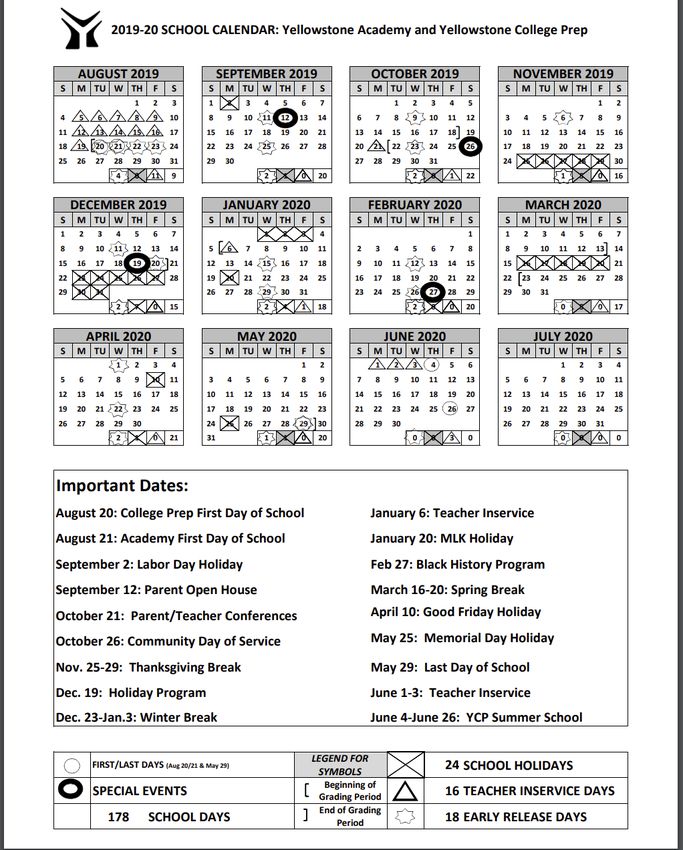
5

Yellowstone Academy Beliefs

               We believe all students are born with purpose and destined for success.

                                          Mission Statement

 We seek to inspire, empower, and invest in our students to achieve their highest potential and fulfill
                                     their intended purpose.

                                              Core Values

Positivity: At Yellowstone, we smile first. We are a positive presence on campus and extend a good-
natured grace and enthusiasm in all personal interactions.

Responsibility: We follow through on our promises and commitments. We own our actions and will
never settle for less than our best effort.

Integrity: We demonstrate integrity in all circumstances and always put the best interests of the
Yellowstone community first. We “walk the talk” and lead by example.

Determination: We anticipate and overcome challenges. We are resilient in the face of obstacles and
are committed to the success of every member of the Yellowstone community.

Excellence: We hold everyone (families, students, colleagues) to the highest standard of excellence
and constantly look for ways to enhance the Yellowstone experience.

                                            Student Pledge

As a Yellowstone Lion I pledge to make positive and responsible choices while respecting myself and
                                                  others.
           I am determined to do my personal best and live life with purpose and integrity.
                            Today, I will learn more so that I can be more.
                Today, I will strive for excellence with the help of God. Lions, PRIDE!

                                                                                                          6
Yellowstone Academy Commitment to PRIDE Values
Teacher Commitments
Teachers are committed to set a positive and structured classroom environment to support student
success.
Teachers are committed to responsibly plan out lessons that result in student mastery of taught
skills and provide a safe learning environment.
Teachers are committed to walk in integrity while leading by example.
Teachers are determined to challenge students using higher order thinking throughout the daily
lesson cycle.
Teachers are committed to exemplify professional excellence on campus.
Parent Commitments
We will ensure that our children attend school every day and are on time.
We will send our children to school in uniform, prepared to learn each day.
We will be responsive to school communication and will initiate communication with the school.
We will track one academic goal at home that is tied to our children’s success.
We will develop a healthy home habit to start and end our day with our children.
Student Commitments
Students are committed to following directions of the adults at Yellowstone Academy, helping their
peers and building everlasting relationships.
Students are committed to being prepared to learn, holding each other accountable to the core
values of Yellowstone Academy and maintaining a safe learning environment.
Students are committed to academic honesty and to following all of the Yellowstone Academy rules
and policies.
Students are determined to give 100% effort, overcome obstacles and to be their best selves.
Students are committed to exemplify academic and behavioral excellence on and off campus.
7Parent Engagement Programming
August Meet the Teacher August 16th and August 17th
September Open House Thursday, September 12th
October Community Day of Service Saturday, October 26th
November Yellowstone Family Lunch Thursday, November 14th
December Christmas Program Thursday, December 19th
February Black History Program Thursday, February 27th
May Lemonade Day Friday May 1st
May End of Year Awards Wednesday, May 27th
Throughout the year, Yellowstone will provide a variety of additional opportunities for parent
engagement. This will include shadow days, workshops, round tables, student showcases, and other
programming.
Parent Academy
The goal is to create and provide a Parent Academy that will bring together Yellowstone staff, parents,
and the community as equal partners in the education of Yellowstone students. These sessions will
occur in the evening, and include childcare, transportation, and dinner. The sessions will be facilitated
by our Director of Campus Services, Damon Gunn, and include campus staff based on the session
topic. The Parent Academy is based on framework that will create a community in which parents and
teachers collaborate to transform students’ educational environment, both at home and at school, so
that all students can achieve their highest potential. Participants will explore how to succeed at
Yellowstone, the importance of building relationships with school staff, and supporting students at
home.
Dates Topic
September 26th Welcome to Parent Academy & Home School Collaboration
October 24th Motivation & Self Esteem (Elementary)
November 14th Motivation & Self Esteem (Middle)
January 16th Communication & Discipline (Elementary)
February 20th Communication & Discipline (Middle)
March 26th How the School System Functions & Road to College (Elementary)
April 23rd How the School System Functions & Road to College (Middle)
Campus Wide Events
Parents, when participating in on-campus events, it is important that we maintain the excellence of our
school environment. Please adhere to the following:
Refrain from taking phone calls during the event. (hallways and other private areas are
available)
8 Refrain from holding conversations during times where faculty, staff, students, or other
presenters are speaking.
Set an example of audience decorum for our scholars.
Uniform Policy and Dress Code
All YA items can be purchased through our provider’s website: www.kaleidoscopeuniforms.com.
Yellowstone Academy
Tops Light Blue, Navy or Goldenrod Yellow polo-style
All tops are to have the Yellowstone logo properly shirt (Previously purchased white shirts may be
adhered to the top left chest area of the shirt. worn)
White Oxford-style dress shirt (required
Students can wear solid color undershirts or long- for Mondays)
sleeved shirts under their school shirt.
Yellowstone Sweatshirt
Yellowstone Spirit T-shirt (Fridays only)
College Shirt (Fridays only)
Bottoms NAVY OR KHAKI IN COLOR
Uniform-style bottoms of appropriate material (khaki Shorts
dress) are found in the uniform section of all local Skorts
stores. Bottoms are worn at the waist. Skirts
Belts are to be worn if belt loops are present Dresses
Jean, spandex, and sweat suit style material are
not allowed.
Pants should be free of embellishments, tears, or holes.
**Skirts, skorts or shorts must come to a minimum
length of just above the knee.
Solid color leggings, tights, or knee high socks are
permitted as under layers
Shoes Must be closed toe and closed heel
Heelys, crocks, high heels, sandals, slides, houses shoes, Must not have a heel greater than 1 inch
slippers, flip flops and similar footwear are unsafe and not
allowed.
Outerwear Solid navy colored
Non-Yellowstone outerwear must be solid navy in sweatshirt
color and free from writing or designs. Solid navy colored jacket
Yellowstone Sweatshirt
Headgear Religious
Scarves
Headbands
Hairbands
*No Bandanas/Wave Caps/Bonnets Allowed*
Accessories and other Hairstyles and accessories which are distracting
to students are not permitted.
Body piercings other than earrings are not
allowed.
To be purchased from school Through website:
Shirts
Failure for students to be in dress code is considered a Level One offense and are
subject to Level One consequences.
Below you will find a visual representation of the dress expectations for students on a
daily basis.
9Yellowstone Academy Yellowstone College Prep
Monday
Peter Pan Blouse/Short Sleeve Long/Short Sleeve Oxford
Oxford
Uniform pants/shorts/skirt/dress
Uniform pants/shorts/skirt/dress
Tuesday -
Thursday
Light blue/gold polo style shirt Navy blue/gold polo style shirt
Uniform pants/shorts/skirt/dress Uniform pants/shorts/skirt/dress
Friday
Uniform/Yellowstone spirit/College Uniform/Yellowstone spirit/College
shirt shirt
Jeans Jeans
10School Supplies- Yellowstone Academy
We ask our families to support the creation and implementation of excellent learning
environments. We provide a variety of supplies to students, but there are some items we use in
substantial amounts and request support with. Please assist us with providing the following items
to the school:
PK3 Backpack
HandSanitizer
PK4 Clorox Wipes
Kleenex
Kinder Backpack
1st and Pencils
2nd Grade HandSanitizer
Clorox Wipes
Kleenex
EXPO Dry Erase Markers
3rd and 4th Backpack
Grade Pencils
4 Composition
Books
Hand Sanitizer
Kleenex
EXPO Dry Erase Markers
At Home Supplies
We ask parents to keep the following supplies at home to ensure students can complete all necessary
homework tasks:
Writing utensils (pens and pencils)
Notebook paper
Crayons, Map colors and Markers
Poster Board/Display Board
Scissors
Glue
Rulers
11Communication Systems- Yellowstone Academy
Remind: Yellowstone Academy utilizes Remind texting service to communicate with our
families upcoming events, school closures, assignment reminders or transportation delays. It
is required that all parents subscribe to this service. Text @yacademy to 41010.
Class Dojo: a free app, to communicate positive behavior inside and outside the classroom.
We also use this tool to invite parents into the classroom, as we post student completed
assignments, projects or performances.
Weekly Newsletter/Homework Every Monday (or first day of the school week), teachers
will send home a bulletin explaining what’s taking place in class for the week, including
homework instructions.
Take Home Folders (Yellowstone Academy) Vinyl take home folders will be provided to
each student. Folders will come home every night with information from the school.
Graded Papers: Graded papers will be sent home with students every Wednesday. See the
grading policy for additional information
Behavior Reports Yellowstone Academy reports will be sent home every Friday. If
additional concerns present themselves, communication will be made directly with
parents.
Email: At Yellowstone, every family will need an email address. This email address will be
used to connect families to our student information system Skyward. Families will be expected
to maintain this email address during their student’s time of enrollment. Teachers and staff can
be reached via email and are expected to respond to email communication within 48 hours.
Skyward: Skyward is the student information system that Yellowstone will utilize to keep
track of family information, student academics and behavior. Parents will have access to view
academic information as well as be contacted with any behavior information.
Phone: At Yellowstone, we utilize phone calls to develop personal relationships with our
families. When major academic/behavior concerns or emergencies arise, our primary form of
contacting families will be through phone calls. It is imperative that families update their
contact information as needed with the front office.
Social Media: Please follow our Twitter, Instagram and Facebook page to stay connected to
Yellowstone.
Monthly Newsletters: Monthly newsletters will be used to inform families of the happenings
at Yellowstone. The newsletters will be distributed through email, our website and some
paper copies will be available in our main office.
12Communicating Concerns
Our front office staff wants to ensure that all concerns are addressed in a timely manner. Their first
step will always be to provide you with the person and procedures necessary to resolve your problem.
Step 1: Review school handouts or communications.
Step 2: Reach out to your child’s teacher. Email or ClassDojo are the best methods. (You
should expect a response within 2 business days.)
Step 3: Reach out to your child’s Dean. Email is the best method. (You should expect a
response within 1 business day.)
Step 4: If you have not received a response or your concern has not been resolved, reach out to
our Principal via email. (You should expect a response within 1 business day.)
Teacher Responsiveness
We encourage open communication throughout the school year. Please know that between the hours
of 7:30 a.m. and 4:00 p.m. our teachers’ primary responsibilities are the safety and supervision of our
scholars. Secondary to this, they are to provide excellent instruction in a safe learning environment.
Please know that during instructional time, teachers will not be available. All teachers have a daily
planning period and a weekly/bi-weekly conference schedule. Feel free to reach out to our teachers via
email, voicemail, Class Dojo etc. You should expect a response to any concerns communicated within
48 hours (2 school days.) If at any time this presents a concern, please communicate with your child’s
Dean.
Administrator Responsiveness
Administrators will try their best to be available to parents as needed. Please understand our ultimate
priority is student safety and supervision. Secondary to this, we are ensuring all students are receiving
an excellent education in a stellar learning environment. Administrators are not available between the
hours of 7:30 a.m. and 8:30 a.m. or 3:30 p.m.-4:15 p.m. If you have a concern that needs immediate
attention, you may leave a message via voicemail, in person, or through email. The expectation of
administrators is that all parent concerns are addressed within 24 hours. If at any time this presents a
concern, please email our Office Manager at kbrisbane@yellowstoneschools.org
Question/Concern Staff Contact
Enrollment documents, Withdrawals, Request
Ms. Hope
for Records, Attendance
Tuition Questions Mrs. Cross
Food services, Transportation, New student
Mr. Gunn
admissions, Returning student re-enrollment
Academic Concerns Ms. Lapid or Mrs. Wardroup
Social/emotional concerns, Family resources,
Mrs. Kerr
Counseling services
Student discipline Mrs. Wardroup and Ms. Lapid
Athletics, Practices Coach Davis
Please see the Staff List to determine email addresses for the staff listed above. The email format is
first initial, last name and @yellowstoneschools.org. Example: shope@yellowstoneschools.org.
13A Day in the Life Components- Yellowstone Academy
Grades PK3 - 2 Students arriving before 7:30 a.m. will report to the library each morning.
Morning Routine Assistants on duty will supervise until teachers arrive for pickup at 7:30 a.m.
Grades 3 - 4 Students arriving before 7:30 a.m. will report to the art
Morning room. Assistants will supervise until teachers arrive for pickup at 7:30 a.m.
Routine
Grades PK3 - 4 Teachers will take students through designated breakfast pickup area
Breakfast and return to their classroom to eat.
Mindfulness Teachers will model mindfulness routines with class and conduct
School Family routines before Bible lesson.
Bible Teachers will use CCFP lessons to teach weekly virtue and Bible stories.
Teachers will adhere to the scope and sequence. Additional curriculum
materials may be supplied by Dean(s). Teachers will close daily lesson
with prayer requests and prayer.
End of Day Teachers will provide closure to students’ day, share celebrations, and
Routine discuss areas of improvement for the next day. Students will gather
materials for dismissal and wait for end of day song to signal transition.
Monday Chapel Classes will report to the cafetorium at 8:10 to begin worship and chapel
programming. Chapel will conclude by 8:45.
Honors Students with perfect attendance, A/B honor roll, and A honor roll will be
Celebration recognized quarterly during a designated Honors Chapel.
PRIDE Awards Students exhibiting PRIDE values and/or CCFP virtues will be
recognized quarterly during a designated Honors Chapel.
Holy Week Teachers will share Holy Week curriculum, and classes will participate in
an Easter celebration on the Thursday before Easter.
Week of Service Students will spend a week focusing on our Christian call to serve others.
(Date TBD) Each grade will learn about a charity or organization they will serve and
support during Lemonade Day.
Chapel Pals Students in Grades PK4 - 4 will be assigned a Chapel Pal. Pals will
consist of one younger student and one older student. They will sit
together during a designated chapel once per quarter. Chapel Pals will
worship together, share prayer requests, and pray for each other.
14Academic Honor Code
Yellowstone Academy deeply values learning and seeks to empower each student to reach his or her
full potential. We recognize that struggles and mistakes are necessary elements of the learning
process; however, cheating and plagiarism deprives students from the process of learning. In order to
realize our full potential, we pledge to value learning above grades and to hold ourselves to the highest
standard of academic integrity.
THE CODE
Cheating—Cheating is misleading a staff member in some way as to receive, or attempt to receive,
credit for work not originated by the student or work performed with unauthorized assistance.
Examples of cheating include, but are not limited to:
Copying another person’s work.
Allowing another student to copy his/her work.
Using unauthorized notes, technology, or written material in any form during an assessment.
Revealing/receiving examination content, questions, answers, or tips from another student, or
removing such information from the classroom after an examination through the use of notes, scratch
paper, technology, verbal communication, etc.
Unauthorized collaboration/communication that violates the teacher’s established expectations.
Plagiarism—Plagiarism is the use of passages, materials, words, or ideas that come from someone or
something else, without properly naming the source.
Examples of plagiarism include, but are not limited to:
Copying text (ideas, words or syntax) or other materials from the internet, book, article, computer
code, or other source without citing them.
Using any translation tool on a world language assignment.
Purchasing or receiving, in any manner, an assignment that is the work of another person and
submitting that assignment as your own.
CONSEQUENCES FOR VIOLATION OF THE CODE
Repeat offenders will move up at least one tier in consequences, regardless of course in
which the incident occurred. Offenses will not carry over from one academic year to the
next.
Examples Include But Are Not Limited To: Potential Consequences
• Copying student work or allowing • Teacher conference with parent
another student to copy his or her work. and student.
• Reduced or no credit for assignment
•
• Completing another student’s work for • Office Referral
them. • Reduced or no credit for assignment
• Communication of any kind during a test • Alternative Assignment
or quiz. • Reduced or no credit for assignment
15• Sharing or receiving questions/answers • Teacher conference with parent
to items included on anything entered as and student.
a test or quiz grade. • Reduced or no credit for assignment
• •
Accessing information during a test or • • no credit for assignment
Reduced or
quiz using any electronic device or
written source.
• •
• Theft of a test or test key, including theft Family Administrative Meeting (with Dean)
by digital means. • Reduced or no credit for assignment
• Sabotaging a fellow student’s work.
• Plagiarizing by taking credit for work
done by another.
Grading Policies and Procedures
Roles and Responsibilities
Students, parents, and teachers all share responsibilities in the grading and reporting process.
Students are expected to:
•Complete work on time and with their best effort
•Return completed work to the teacher by the established time
•Carefully consider the time required to complete long-term assignments and projects so
that they are completed successfully and within the time frame established
•Ask questions when he/she does not understand an assignment or clarification is needed
•Maintain academic integrity and honesty
•Show assignments to parents/guardians regularly for review
Parents are expected to:
•Provide a quiet, comfortable place for students to complete assignments at home
•Help their student to organize their time so that assignments can be completed successfully
•Monitor assignments completed at home but allow the child to complete the work on their own
•Help maintain clear lines of communication with the teacher
•Provide the necessary supplies and materials to help their child successfully complete an
assignment
•Check student work for completion and review graded work with students and discuss progress as
necessary.
Teachers are expected to:
•Provide meaningful assignments that reinforce classroom learning and provide meaningful
practice towards mastery of Texas Essential Knowledge and Skills and concepts taught
•Create authentic assessments that accurately measure the student’s mastery of skills and concepts
taught
•Assign homework that provides extended practice of previously taught skills and that can be
completed in a reasonable period of time based on the student’s age and grade level
•Provide student and parents with required weekly homework on the first instructional day of the
week
•Send graded work home for parent acknowledgement and student discussion
16•Consider age and grade level appropriate time requirements and access to resources when
assigning extended projects and long-term assignments
•Follow grading and reporting timelines/procedures, and seek assistance for clarification from
administration.
•Provide students with a rubric for long term projects or alternative assignments when the
assignment is given.
•Inform students of content covered on all major assessments.
•Be available to students during designated tutorial times or by agreed appointment arranged by
the student or parent.
Assessments
Assessments are designed to evaluate the progress of students towards mastery of learning goals
and objectives. Assessments may vary in length and scope and include not only written
assessments but performance-based measures and compositions.
Written Tests
Types of examinations include Curriculum-Based Assessments (CBAs), designed to measure
progress towards curriculum mastery, and benchmark assessments, designed to provide practice in
the state examination format. Yellowstone students will take no less than two cumulative curriculum
assessments per subject per year.
Performance Assessments
Performance assessments are measures of a student’s progress toward mastery of TEKS and
curriculum objectives that differ from traditional paper and pencil assessments. These may include:
• classroom participation and discussion research projects
• checklists of skills
• student portfolios
• written responses
• enrichment activities
• lab experiments
• group work/projects
• teacher observation
• research projects
• written compositions
Alternative Assessments/Labs
Alternative assessments will reflect real world tasks and relate to instructional objectives. This type of
assessment often requires analyzing a task, developing a plan of action, gathering information,
selecting of relevant information, and presenting the information. The presentation will be designed
by the instructor and based on the subject and content objectives. Alternative assessments may be
substituted for major tests. Instructors will provide a rubric for alternative assessments.
Project Based Learning Assignments/Research Papers/Long Term Projects
Research papers or projects are lengthy class and/or homework assignments that may take several
weeks to complete. These projects and research papers must be included in the course syllabus and
the due date must be stated in the syllabus. Projects may be assigned individually or to a group of
students. The instructor will provide a rubric to the student that explains how the project or paper will
be assessed. A timeline of due dates will be included. Special projects, research papers, or other long
17term assignments are due on or before the due date stated in the syllabus. Students who are absent
on the due date, including school business absences, must meet the stated deadline. Any exceptions
for the late projects must be approved by the Principal or the designee.
Daily Grades
Teachers take grades on assignments, activities, and projects completed in class that are designed
to measure progress towards mastery of the TEKS and Academy curriculum.
Daily grades consist of any instructional activity defined or planned by the teacher to be completed
during the class period or continued as homework to facilitate the learning process. An assignment
completed more than 50% outside of the classroom is designated as homework.
Quizzes or short assessments to evaluate a student’s level of understanding and progress toward
instructional objectives may also be considered daily grades. Quizzes do not have to be scheduled
in advance, but must cover material previously taught where instructional feedback has been
provided.
Homework
Yellowstone Academy endorses homework as a valued extension of learning beyond the classroom
and an integral part of the instructional program. Homework is a necessary part of the instructional
process that may or may not begin in the classroom and extend into time outside of the regular
class time. All students in all classes will receive homework assignments in weekly increments.
Teachers will provide weekly homework assignments on the first instructional day of each
week. On RARE occasions, students will be required to complete assignments that are a
continuation of classwork.
Purpose
To be effective, homework should:
• Be meaningful, purposeful, and directed toward specific learning objectives.
• Build upon concepts and skills previously introduced in the classroom.
• Encompass a variety of activities.
• Encourage independent learning, responsibility, and self-discipline.
• Require students to apply various thinking skills.
• Be assigned at the student’s ability level.
Practical Considerations
Teachers should systematically assign homework, offer direction, and evaluate student work. Parents
should support homework by frequently reviewing assignments, providing a convenient
time and place free from distractions, and encouraging excellence in student work. Students should
make every effort to complete their own work. If an assignment is found to present difficulty,
assistance should be sought from the teacher. In any case, students should not copy answers or
have someone else do the work.
Short Term Assignments
Short-term homework assignments should not exceed four days from the date of assignment to the
due date. The assignments are designed to:
• Reinforce concepts and skills learned in class.
• Provide non-guided practice for newly learned skills.
• Allow make-up work because of absence.
• Review material in preparation for tests and other class work.
• Complete work begun in class.
18Long-Term Assignments/Projects
Long-term homework assignments would normally require a week or more for student planning
and development. They should provide opportunity for the student to:
• Extend in-depth learning beyond the classroom.
• Learn to organize and schedule independent work over time.
• Explore individual interests and needs.
• Integrate skills and concepts in new and different ways.
Length and Difficulty of Homework
The length and difficulty of an assignment shall be directed by the teacher and should depend on
grade level, student needs, content, purpose, and type of assignment.
Homework should be assigned weekly in each class. Assignments should be appropriate to
the developmental and ability levels of the student. Homework should be reasonable in terms of
student time and available resources. Assignments should be made with consideration given to a
student’s total schedule and should be coordinated across subject areas at each school to avoid
overloading students at any particular time.
Parents should expect their child to spend:
20 minutes per subject a week if they are in Early Childhood
45 minutes per subject a week if they are in 1st through 4th grade
This time requirement does not include independent reading at home, which should be part of
every child’s daily routine. Ideally, students will read independently 20-30 minutes each evening.
Due to its importance in the overall learning process, homework is to be evaluated and may be
applied to the student’s grade report. This grade application is to be employed for each quarterly
grading period. At the primary and elementary grade levels, homework may not be used to solely
determine student mastery. Homework may either raise or lower a student’s grade once a minimum
of 70 has been achieved by observable means. Homework may not constitute more than 15% of a
child’s grade in any subject.
Grading
Early Childhood Assessment and Progress Monitoring
Pre-K
Students in Pre-K are held to the TEKS Pre-K Guidelines. These skills are assessed through an online
progress monitoring system through the Children’s Learning Institute called CIRCLE. CIRCLE is
administered 3 times a year (beginning, middle, and end of year), and directly assesses the
following skill areas:
-Letter Naming
-Letter Sounds
-Phonological Awareness
-Vocabulary
-Book & Print Awareness
-Mathematics
19-Science
-Social Studies
CIRCLE also captures students’ social-emotional skills and early writing skills. A report is generated for
each student after each round of assessment is completed, providing the teacher with thorough data
on each student’s most and least developed skill areas. The teacher then, equipped with research-
based activities, meets with students in small groups to address least developed skills. Through
CIRCLE, informal assessments and ongoing observation, student progress is continually monitored,
with the goal that each student will be Kinder-ready by the school years’ end.
Kinder
Students in Kinder are held to the Kindergarten TEKS and are assessed by the following: a
standards-based rubric in Language Arts, Math, and Social-Emotional Skills (quarterly)
TPRI Early Reading Assessment (beginning, middle and end of year)
NWEA MAP Growth (beginning, middle and end of year)
The information and data generated from these assessments drive the teachers’ planning and
instruction to meet the needs of the class as a whole, as well as meeting the needs of each individual
student through small group and one-on-one instruction. Through these formal and informal
assessments, as well as ongoing observations, student progress is continually monitored and needs
are continually met through research-based activities.
Grades 1-4
Teachers shall record the minimum number of grades per quarterly grading period:
Subject: Reading Language Arts Math Science Social Studies
Grades: 10 10 14 14 14
Teachers are required to input one grade per week per subject beginning the first full week of each
grading period in order for parents to monitor student grades in Skyward. Teachers must take a
minimum of two (2) major grades per quarterly grading period. Teachers are encouraged to exceed
the minimum requirements for grades recorded to reflect multiple opportunities for students to
demonstrate mastery of the TEKS and our curriculum. Graded papers will be returned to students on
Wednesdays.
Percentage of Grades Used for Reporting Purposes
For purposes of reporting grades for each quarterly grading period, the following scale shall be
used in all academic classes:
1st-4th Grade
Daily Grades/Classwork – 70%
Assessments - 20%
Homework - up to but not to exceed 20%
Maximum Weight of a Grade
When calculating a quarterly average, no single assignment/assessment grade may count more
than 10% of the total average regardless of the grade category. It should be noted, however, that
some major projects may comprise more than one assignment. Calculated averages reported on
Progress Reports or Report Cards may not exceed 100%
20Make Up Work (Absence from School)
Students shall be permitted to make up assignments and tests following any absence. All
students will receive credit for satisfactory makeup work after an absence, including excused and
unexcused absences and absences due to suspension from school.
A student will be given a reasonable time to make up tests and other missed assignments.
o 1-2 days absent 3 days for make up
o 3-5 days absent work
5 days for make up
o More than 5 days work
Administrator discretion
If a student does not complete the work assigned after the allotted number of days has passed, the
actual grade will be recorded in the grade book.
Teachers are encouraged, but not required to provide assignments prior to a scheduled absence.
Students should not be required, on the day of returning to school, to take a quiz or test that was
announced during the student’s absence.
Late Work
Students who turn in work late not related to an absence shall be penalized as follows:
1-5 days late Maximum Grade of an 80
6-10 days late Maximum Grade of a 70
For an absence in any class, the teacher may assign the student makeup work. This work will be
based on instructional objectives for the subject or course, needs of the individual students in
mastering the essential knowledge and skills, or course requirements.
A student will be responsible for obtaining and completing the makeup work in a satisfactory manner
and within the time specified by the teacher.
A student who does not make up assigned work within the time allotted by the teacher will receive a
grade of zero for the assignment.
A student will be permitted to make up tests and turn in assignments due in any class missed because
of absence in accordance with stated guidelines.
Teachers may assign a late penalty or not accept a long- term project or term paper in accordance with
time lines approved by the principal and previously communicated to students.
Corrections
Students who make below a 70 on daily work, classwork, or homework will be given an opportunity to
submit corrections for a grade up to a 70.
Corrections must be submitted within 5 school days of assignment being returned to receive
credit.
YCP Corrections form must be attached to all correction work to be considered.
A parent signature must be obtained on all correction forms to be considered.
Students who make below a 70 on an assessment will be given an opportunity to submit corrections
for a grade up to a 70.
Assessment grades may only be made up during after school tutorials or intervention time as
scheduled by the classroom teacher.
Assessment grades must be made up within 5 school days of the assessment grade being
returned to students.
21Curriculum Mastery
Mastery of Texas Essential Knowledge and Skills (TEKS)
Yellowstone Academy has provided a well-balanced scope and sequence and curriculum resources
based on state prescribed Texas Essential Knowledge and Skills (TEKS). All teachers are required to
align all instruction to these TEKS.
Students who participate in this curriculum will have the opportunity to master the knowledge, skills
and competencies established by our curriculum and the state standards.
Yellowstone Academy utilizes ongoing mastery assessment to determine which students are in
need of remediation and instructional intervention (re-teaching and acceleration).
The use of benchmark tests, teacher-made tests, performance assessments, and teacher
observations helps to determine which students are not mastering instructional objectives.
Procedures for Reteaching and Reassessment
•Teachers will monitor and identify students in need of reteaching.
•Teachers will provide reteaching and intervention as necessary.
•Students will be reevaluated after reteaching has occurred.
•Re-evaluation may include, but is not limited to, oral examination, special assignments or a formal
test.
•A grade of 70 shall be the highest grade recorded on reevaluation to designate the student’s
mastery of the TEKS.
•These opportunities will be provided during the school day using different methods of instruction.
Required Retest for Mastery
Any student that does not demonstrate mastery at 70% or above is to be re-evaluated after they are
re-taught or after additional activities are provided. Re-teaching and re-evaluation must occur on
campus. As stated in the “Corrections” section, students who make below a 70 on an assessment will
be given an opportunity to submit corrections for a grade up to a 70.
Assessment grades may only be made up during after school tutorials or intervention time as
scheduled by the classroom teacher.
Assessment grades must be made up within 5 school days of the assessment grade being
returned to students.
Intervention
Acceleration (Intervention) is an integral part of the instructional program and is an ongoing
process. Frequent evaluation, both formal and informal, will determine the need for acceleration.
Reasons for Acceleration
Provides frequent reinforcement and review so that a student does not get behind in the
curriculum
Occurs at the time the need is identified
Allows the student to progress systematically through content without experiencing extended,
frustrating periods of non-achievement
Offers a variation in instructional approach – uses a new technique, strategies, materials,
opportunity for review, and practice
Includes, but is not limited to, targeted small-group instruction, tutorials, and summer school
22Parent Notification of Progress
Grading reports will be sent home mid-quarter and end of quarter. If a scholar’s grade was above a
70 at progress report time but falls below 70 prior to end of quarter, the teacher is required to send an
additional notification of progress to parents.
Final Grade of 65 or below
At the end of each grading period, documentation must be submitted to the Principal for any student
receiving a grade of 65 or below for the quarterly grading period. (See Grading Report)
Transfer Grades
Students new to our campus or who enroll in a school after the start of a grading period shall be
treated fairly in awarding grades. Grades shall be computed using a combination of grades from the
former school and grades earned for the time the student has been enrolled in our school in a
proportionally significant manner.
Promotion Requirements
PreK3 Students must be in the “ON TRACK” or “MONITOR” category for Phonological Awareness and Math portions of the
CIRCLE Progress Monitoring Assessment
PreK3 Goal: 10 HFW
PreK4 Students must be in the “ON TRACK” category for Phonological Awareness and Math portions of the CIRCLE
Progress Monitoring Assessment
Student recognition of High Frequency Words – recognizing and reading words that appear very often in written
and spoken language
PreK4 Goal: 25 HFW
Kinder Students are required to score a 3 or above on the 4 quarter Kindergarten skills-based report card in the areas of:
th
Letter Identification
Letter Sounds
Blending Sounds into Words
Segmenting Words into Sound
Student recognition of High Frequency Words – recognizing and reading words that appear very often in written
and spoken language
Kinder 25 HFW Goal: 50 HFW
Students are required to score a 3 or above on the 4th quarter Kindergarten skills-based report card in the areas of:
-counting to 100
-composing and decomposing up to 10
-patterning
-creating and counting sets of objects
-joining and separating manipulatives
23Grades • Students must pass High Frequency Word Test – recognizing and reading words that appear very often in
1&2 written and spoken language.
o Grade 1 – 100 words
o Grade 2 – 300 words
• Students must perform “on grade level” according to administered reading level assessments or
show adequate progress.
• An average of 70 or above in reading, language arts, and mathematics
Grades • Students must perform “on grade level” according to administered reading level
3&4 assessments or show adequate progress.
• Overall yearly average of 70 or above.
• An average of 70 or above in English (combined average of reading and language arts)
and mathematics.
An average of 70 or above in science or social studies.
ALL STUDENTS MUST HAVE SUFFICIENT ATTENDANCE TO BE CONSIDERED FOR
PROMOTION.
Sufficient attendance requires you be in attendance at least 90% of the days school is in
session. There is not a differentiator between excused and unexcused absences for this
criterion.
Students not meeting promotion standards are retained in their CURRENT grade for the
FOLLOWING school year.
Attendance Policy
At Yellowstone Academy, we believe that students have to be present to learn. Our school wide 2019-
2020 attendance goal is 95% for the year.
Logistics Time Notes
Doors Open 7:15 am This is the earliest students can arrive to campus.
Breakfast 7:30 a.m.- Students can eat a nutritious breakfast.
Served 8:00 a.m.
Tardy Bell 7:45 am Students are considered tardy to school after this time.
Early Pick Up 2:00 pm To protect our dismissal procedure and policy, students will
Cut-Off not be released from campus after these times.
Transportation 1:00 pm To ensure student safety and time management, all
Changes transportation changes must be in writing. See
Transportation policy for details.
24Dismissal 3:45 pm This will be our regular dismissal time for students except
for days notated as early dismissal.
Students should immediately clear the campus. Campus
includes playground, city park and any location that is in
300 yards or 1000 feet of the school. They should report to
their bus, car or afterschool activities.
Early Release 1:00 pm This will be the dismissal time for days notated as
“Early Release” on the school calendar.
ADA Time
Official ADA time for Yellowstone Academy is at 9:30 a.m. Students who arrive after 9:30 am will be
considered absent for the day. Students who are not in attendance at least 90% of their classes
could be subject to retention, loss of credit, or affect future enrollment.
Excused Absences
Students returning from an absence must bring a written note from a parent/guardian or physician
validating the reason for the absence, WITHIN THREE (3) DAYS, to the Attendance Office to record
the absence as EXCUSED. No more than (3) three handwritten parent notes will be accepted for
EXCUSED absences during the school year. There is not a differentiator between excused and
unexcused absences. Acceptable reasons for excused student absences include:
a. Personal Illness
b. Death of a Family Member
c. Student Health Services; Family/Student Counseling Therapy Appointments
d. Religious Holidays and Major Activities (The student is counted present in school according
to state statute and is not considered absent.)
f. Authorized School-Sponsored Activities
g. Required Court Appearance
Yellowstone Academy will communicate any school cancellations through Skyward, Remind, or ClassDojo
as we will follow HISD school cancellation policies.
YA Tardy/Attendance Policy
Students are considered tardy after 7:45 a.m. Students will accumulate 1 unexcused absence for
every 5 tardies.
25Code of Conduct
Throughout the school year as necessary, the Student Code of Conduct shall be:
Made available for review in the main office; and
Made available on the Yellowstone Academy website and/or as hard copy to students, parents,
teachers, administrators, and to others on request.
Alcohol
To provide a safe alcohol-free environment for students and employees, Yellowstone Academy
prohibits alcoholic beverages on Yellowstone Academy property at any time, and at all school-
sanctioned student activities occurring on or off Yellowstone Academy property. If you are found to be
intoxicated, you will be asked to leave the premises.
Drug-Free Zone
To provide a safe drug-free environment for students and employees, Yellowstone Academy prohibits
drugs and/or control substances on Yellowstone Academy property at any time, and at all school-
sanctioned activities occurring on or off Yellowstone Academy property.
A person commits a criminal offense, if the person knowingly or intentionally possesses a
controlled substance:
In, on, or within 1,000 feet of any real property that is owned, rented, or leased to Yellowstone
Academy or a playground; or on a school bus.
Cell Phone Use
If you feel it necessary to send your student to school with a cell phone, it is to be turned off (not silent)
and not visible upon entering school grounds. Students who violate this policy will be disciplined per the
Student Code of Conduct as a Level 1 offense.
Use of cell phones, smart watches, or any other communication devices during the school day is
prohibited. Students who violate this policy will be disciplined per the Student Code of Conduct as a
Level 2 Offense. Consequences may include:
Assignment detention
Confiscation of phone to be returned only to a parent/guardian
The parent will have to pay $15.00 to retrieve the phone every time the phone is
confiscated.
Bullying
Bullying is unwanted, aggressive behavior among school aged children that involves a real or perceived
power imbalance. The behavior is repeated, or has the potential to be repeated, over time.
Bullying is strictly prohibited, and Yellowstone Academy may implement a variety of different
techniques – both educational and disciplinary in nature – in order to eliminate bullying between
students.
Students may face disciplinary consequences for bullying conduct that:
1. occurs on or is delivered to school property or to the site of a school-sponsored or school-related
activity on or off school property;
2. occurs on a publicly or privately-owned school bus or vehicle being used for transportation of
students to or from school or a school-sponsored or school-related activity; or
263. is considered cyberbullying that occurs off school property or outside of a school-sponsored or
school-related activity, if the cyberbullying interferes with a student’s educational opportunities or
substantially disrupts the orderly operation of a classroom, school, or school-sponsored or school-
related activity.
Bullying is classified as a Level 3 under the Student Code of Conduct.
Students are encouraged to report an alleged incident of bullying immediately to any adult on campus.
Any adult receiving a report of bullying will notify the Dean, Counselor, or Social Worker by the end of
the school day. Reports may be made orally or in writing, and reports may be made anonymously.
Students or parents may contact the Dean of Students, Counselor, or Social Worker to submit the report.
No student or other person shall retaliate against any other student or person who reports bullying.
The school will promptly launch an investigation into the reported incident. The school will notify the
parent(s) of the alleged victim and the parent(s) of the alleged bully on or before the third business day
after the incident is reported. Pursuant to our Family/Student Handbook, our response to bullying may
include the following:
Students who are victims of bullying, witness bullying, or engages in bullying will have the option
of meeting with our social worker.
Responses in alignment with our Student Code of Conduct
The principal or a designated staff member may report acts of bullying that constitute assault or
harassment to the local law enforcement office.
Extra- Curricular Activities Behavior Standards
Sponsors and coaches of extracurricular activities may develop and submit for approval
standards of behavior that are higher than the Yellowstone Academy-developed Student
Code of Conduct and may condition membership or participation in the activity on
adherence to those standards.
Students shall be informed of any extracurricular behavior standards at the beginning of
each school year or when the students first begin participation in the activity. Students and
their parents shall sign and return to the sponsor or coach a statement that they have read
the extracurricular behavior standards and consent to them as a condition of participation
in the activity.
Extracurricular standards of behavior may take into consideration conduct that occurs at
any time, on or off Yellowstone Academy property and during and outside of school
hours.
Extracurricular behavioral standards shall not have the effect of discriminating on the
basis of gender, race, color, disability, religion, ethnicity, age, or national origin.
Standards of behavior for an extracurricular activity are independent of YA Student Code of Conduct.
Violations of these standards of behavior that are also violations of the Student Code of Conduct may
result in extra-curricular activity discipline and schoolwide discipline.
Enforcement
Yellowstone Academy personnel shall enforce this policy on Yellowstone Academy property and
anywhere that Yellowstone Academy has jurisdiction. Any student found in violation of this Policy shall
be subject to disciplinary action in accordance with the Student Code of Conduct.
27Levels of Offenses/Overview
Acts of misconduct are categorized into the following 4 levels of offenses:
Level of Description Acts of Misconducts, but not limited to:
Offense:
Offenses that generally occur Violations of rules or procedures established by the
Level 1: Violation of Classroom Rules
in the classroom and are teacher
corrected by the teacher.
Failure to participate in classroom activities
Unexcused tardiness to class
Failure to bring required classroom materials or assigned
work to class
General misbehavior such as eating in class (this includes
gum), horseplay, excessive talking
Violating campus dress codes
Any other act that disrupts the classroom or interrupts the
operation of the class
Failure to deliver or return written communications between
home and school
Disruptive or noncompliant behavior on a school bus or at a
school bus stop
Disclosure or sharing of individual computer-account
passwords
Excessive talking during classroom instruction
Offenses that are more serious Repeated violation of classroom or transportation rules
in nature or a continuance of under Level 1
Level I misconduct.
Cheating, plagiarism, or copying the work of other students,
which includes failure to comply with test security
procedures and use of cell phones, smart watches, and
electronic devices during testing
Level 2: Administrative Interventions
Leaving the classroom or school grounds without the
permission of school personnel
Cutting class or skipping school
Showing excessive disrespect to teachers or other campus
staff and/or repeatedly using inappropriate or foul language
Possession of matches or other flammable materials
Inappropriate display of affection, which should be enforced
equitably without regard to sexual orientation, gender
identity, or gender expression
Posting or distributing unauthorized materials on school
grounds
Failure to abide by rules and regulations at extracurricular
activities or at co-curricular activities such as field trips
Loitering in unauthorized areas including being on campus
during unauthorized times
Unauthorized use of personal cell phone or electronic
device
Harassing or threatening language toward another student
28Offenses that seriously disrupt Repeated acts of Level 2
the educational process in the behavior
classroom, in the school, and/or
Bullying
at school-related activities, or
repeated instances of Level I, II, Cyber-Bullying
or III misconduct. A finding that Physical Aggression towards another student which
a student has engaged in a includes horseplay and fighting
Level III offense may constitute “Hacking” or other use of computers to gain unauthorized
a serious offense. access to District or other databases, including student,
faculty, or school data files, without permission
“Sexting” or using a cell phone or other personal
communication device to send text or email messages or
possessing text or email messages containing images
reasonably interpreted as indecent or sexually suggestive
while at school or at a school-related function
Level 3: Suspension
Misdemeanor extortion, which is defined as
obtaining money or information from another by
coercion or intimidation of a value less than $1,500
Possession or use of any prescription or nonprescription
drug, medicine, vitamins, or other chemical in violation of
the Guidelines for Dispensing Medications at School
Any other acts of serious misconduct that disrupt the
school environment in the classroom, on a school bus,
and/or in school
Defacement or destruction of school property
Harassing or threatening language toward any staff
member or school personnel
Hazing, which means any intentional, knowing, or
reckless act directed against a student by one person
alone or acting with others that endangers the mental or
physical health or the safety of a student for the purpose
of being initiated into, affiliating with, holding office in, or
maintaining membership in any organization or general
classification of students whose members are or include
other students.
Assisting directly or indirectly with the promotion of
any behavior prohibited by this Code of Student
Conduct.
Criminal offenses as defined in Selling, giving, delivering to another person,
Level IV. This may include any possessing, using, or being under the influence of
Level 4: Expulsion
felony, whether school-related marijuana, a controlled drug, or other controlled
or not, unless it is one for which substances
expulsion is required. A finding Selling, giving, delivering to another person,
that a student has engaged possessing, using, or being under the influence of
in an offense listed under a dangerous drug
Level IV constitutes a finding Selling, giving, delivering to another person,
that the student has engaged possessing, using, or being under the influence of
in serious misbehavior. an alcoholic beverage.
Engaging in conduct that contains the elements of an
offense relating to an abusable volatile chemical or
possession of inhalant paraphernalia
Engaging in assault, which is defined as intentionally,
29You can also read


