STUDENT GUIDE 2018-2019 - Chesapeake College
←
→
Page content transcription
If your browser does not render page correctly, please read the page content below

2018-2019
STUDENT GUIDE

PRESIDENT’S WELCOME

Welcome to Chesapeake College!

Our faculty, staff and college leadership work
together as a community to create a dynamic
learning environment for our students. Each of
us is committed to your success.

Your success - whether it is transfer to a four-year
university or entry into the workforce - is our
mission. If you have not yet decided on a course of study, explore our
Pathways to find the major that suits your talents and goals.

You will learn from talented faculty supported by dedicated staff. You
will also connect to classmates with connections that will last a lifetime.
Whether you are with us short-term or over a year or more, you will
acquire the tools that provide for your success.

Make the most of your time at Chesapeake by becoming involved in
student government, athletics, performing arts, honors classes, Phi Theta
Kappa or a campus club.

Thank you for beginning the next steps in your personal journey
with Chesapeake College. Welcome to our community. I wish you the
best of luck!

- Clifford P. Coppersmith

ABOUT THE STUDENT GUIDE
This handbook is designed to provide information to Chesapeake College
students in conjunction with the College Catalog. Please use the
information in both the Guide and the Catalog, as well as on the College
website (www.chesapeake.edu) and the College mobile app to become
better acquainted with campus services and policies, student rights and
responsibilities, and campus life. For the most updated listing of
activities, please view the Announcements on Chesapeake’s web portal
system, MyCampus.

                                                                              3
2018/2019 ACADEMIC CALENDAR

    FALL 2018
    Fall Term (FA): August 27 - December 15
    Accelerated 2 (FL): August 27 - October 17
    Accelerated 1 (F1): September 18 - December 15
    Accelerated 3 (FI): October 18 - December 15
    WINTERIM 2018-2019
    December 17, 2018 - January 20, 2019*
    *Closed for Holiday Break, dates pending finalization of administrative calendar

    SPRING 2019
    Spring Term (SP): January 22 - May 13
    Accelerated 2 (SL): January 22 - March 13
    Accelerated 1 (S1): February 12 - May 13
    Accelerated 3 (SI): March 14 - May 13
    *Spring Break - March 17 - 23
    Graduation: Wednesday, May 22, 2019
    SUMMER 2019
    Summer term (SU): June 17 - August 8
    Accelerated 2 (SM) (Internet classes only): June 17 - July 15
    Accelerated 3 (SF) (Internet classes only): July 16 - August 8

    STAY CONNECTED WITH CHESAPEAKE COLLEGE!
    Download the mobile App on Google Play, iTunes or at
    https://guidebook.com/app/Chesapeake & follow us on social media:

           Emergency Alerts on Twitter: @ChesCollAlerts

            @ChesapeakeColl

           @ChesapeakeCollege

           chesapeakecollege

4
5
TABLE OF CONTENTS
    SECTION 1 – GENERAL COLLEGE INFORMATION
          Admissions
          Semester Schedules
          College Information Access (MyCampus)
          College Operations
    		Bookstore
    		Bus Service
    		Campus Security
    		Inclement Weather policy
    SECTION 2 – SERVICES AND PROGRAMS FOR STUDENTS
          First-Year Experience programs
    		SAIL (Success and Interactive Learning)
    		FOCUS (First Generation Opportunities for Career
    		             and Ultimate Success)
    		             HINTS (Helpful Information for Non-Traditional
    		Students)
    		Advising Services
    		             Academic Advising and Student Planning
    		Transfer Advising
    		Career Planning
          Financial Aid
          Disability Services
          Office of Multicultural Affairs
          TRIO
    SECTION 3 – ACADEMICS AND SUPPORT SERVICES
          Programs of Study
    		Career and Professional Studies
    		Transfer Programs
          Honors Program
          Academic Support
    		Learning Resource Center (LRC)
    		Tutoring
    		Testing Center
    SECTION 4 – STUDENT LIFE, ACTIVITES, AND ATHLETICS
          Office of Student Life
          Campus Organizations
          Leadership Academy
          Athletics
    SECTION 6 – COLLEGE POLICIES, ACADEMIC POLICIES,
    EMERGENCY INFORMATION, AND GOVERNANCE
6
CAMPUS DIRECTORY
Main numbers: 410-822-5400, 410-758-1537, 410-228-4360
Key: C-Caroline Center, AUD - Todd Performing Arts Center, D - Dorchester
Building, LRC - Learning Resource Center, H - Health Professional Athletic Center,
S - Science Building
Academic Support Center 410-827-5854 LRC, Rm. L-131
Advising X2239 D-106
Health Professions Advising X2203 D-139
Athletics 410-827-5828 HPAC 105B
Bookstore X2304 C-103
Box Office 410-827-5867 AUD-08
Business Office X2218 D-135
Cambridge Center 410-228-5754 CAMB
410-820-6058
Center for Health Professions 410-827-5917 HPAC 203M
Continuing Education 410-827-5850 EDC-15
& Workforce Training
Disability Services 410-827-5805 LRC, Rm. L-113
Division of Arts & Sciences 410-827-5847 S-124
Early Childhood Center 410-827-5801 ECDC
Financial Aid 410-827-5803 D-144
First-Year Programs 410-827-5840 C201B
Food Services X2390 C-1st Floor
Job Development X5804 D-143
Learning Resource 410-827-5860 LRC
Center/Library
Lost and Found X2240 D-Information Desk
LRC Help Desk X2224 LRC
Maintenance 410-827-5872 Maintenance
Multicultural Affairs 410-827-5857 D-151
President’s Office 410-827-5802 D-222
Registration 410-827-5876 D-138
Security Guard-Cambridge 410-463-4185 Cambridge
Security Guard-Wye Mills 410-758-7275 Maintenance
Student Government X2394 C-104
Student Life/Activities 410-827-5826 C-201A
Student Affairs X2240 D-Information Desk
Testing Center X344 LRC, Rm. L-131
Veterans’ Affairs 410-827-5876 D-126
Vice Presidents’ Offices
Academic Affairs 410-827-5832 D-216
Institutional 410-827-5879 D-207
Advancement
Administrative 410-827-5704 D-226
Services
7COLLEGE TERMINOLOGY
academic advisor: professional staff or faculty member who advises
students concerning academic programs and class schedules
academic calendar: the days of each term set aside for payment and add/
drop deadlines, college holidays, exams, and grade reports
academic skills assessment: an instrument used to measure your
entry-level skills in mathematics, language, and reading
associate’s degree: a two-year college degree; note that it may take
longer than two years to complete an associate’s degree depending on the
number of credits taken each semester
auditing a class: attending or listening in on a class without receiving a
grade or credit for it
career program of study: a program of study which, when completed,
will provide a student with the skills to seek employment in a chosen
career area
certificate program: an academic program of one year or less
corequisite: a course that must be taken at the same time as another
course
credit: a unit of measure of the amount of work a student completes in
a class; each completed course is worth an established number of credits;
each credit equals 50 minutes of class time
curriculum: the courses offered in a program of study
developmental classes: remedial course work designed to increase a
student’s ability to the level which will enable the student to continue with
success in credit courses
distance learning: a system of delivering coursework through
non-traditional means such as fiber-optic/interactive video classes or
Internet classes
elective: one of several courses offered which fulfills a specific content
area in a program of study
general education course (G.Ed.): a required course in a program of
study as determined by the faculty; G.Ed. courses are designed to enrich
a student’s growth and preparation for lifelong learning; each college
determines a core of G.Ed. courses which must be completed in order to
graduate
grade point average: a system of measuring students’ average grades
load hour: a unit of measure used to establish the cost of each course;
each load hour is 50 minutes; a non-credit course doesn’t carry a credit, but
it does carry a load hour(s)
8COLLEGE TERMINOLOGY
major: a selected program of study
prerequisite: a course which must be taken before another course
syllabus: an outline of topics to be covered by an instructor during a
course; a syllabus will also contain information on attendance and grading
policies; an instructor-student “contract”
transcript: an official record of all academic work attempted by a student
transfer program: a program of study designed for students who plan to
transfer to the upper division of a college or university upon
completion of an associate’s degree, usually to pursue a bachelor’s degree
FREQUENTLY ASKED QUESTIONS
How do I order books? See page 12
How do I get notices/announcements from the College? See page 11
How can I get tutoring/help? See page 24
Can I get a job on campus? See page 19
How can I join a club on campus? See page 33
Where do I go for counseling? See page 14
Are there meal plans on campus? See page 13
How do I pay for my classes? See page 19
Where can I get help scheduling classes? See page 17
I want to transfer to a 4-year school. Where can I get help? See page 17
I’m not sure about a career goal - who can I talk to? See page 18
Have you downloaded the
Chesapeake app yet?
Don’t miss out.
Download today at
https://guidebook.com/app/Chesapeake/
9GENERAL INFORMATION
CAMPUS LOCATIONS
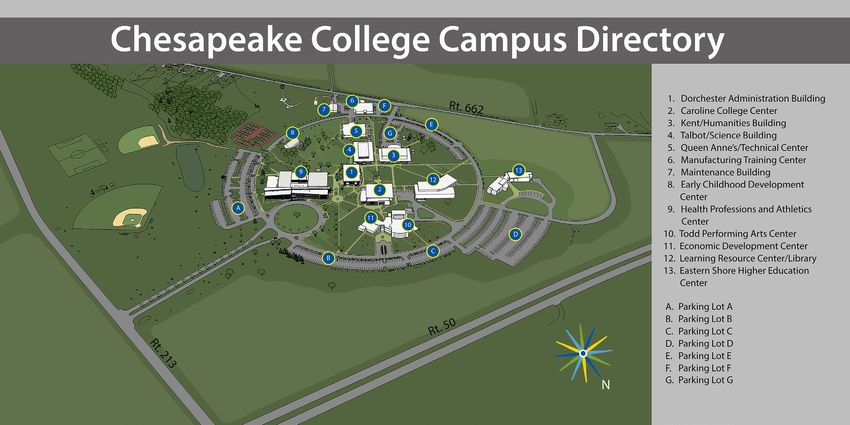
The Wye Mills campus is located at the intersection of US Route 50 and
Route 213 Phone: 410-822-5400, 410-758-1537
The Cambridge Center is located on 416-418 Race Street, Cambridge,
MD 21613 Phone: 410-228-4360
SEMESTER SCHEDULES
Fall semester (Aug 22 - Dec. 5) Winterim I (Dec. 14 - Jan.17)
Fall Interim I (Aug. 22 - Oct. 12) Winterim II (Jan. 2 - Jan. 17)
Fall Interim II (Oct. 13 - Dec. 2) Spring Interim I (Jan. 23 - Mar. 20)
Spring Interim II (Mar. 22 - May 5)
Classes are offered on the Wye Mills and Cambrige campuses in the
face-to-face traditional classroom offerings, online, and hybrid (online
and in-class combination).
Chesapeake offers three types of online courses, each with different
requirements for on-campus attendance. They have different “course
mode” labels in the schedule.
N1: Totally online. Requires no campus visits.
N2: About 90% online. Students may be required to come to campus for
proctored exams, a course orientation, or other activities.
HY: Hybrid courses combine internet-based instruction (about 50%) with
face-to-face classroom instruction (50%) during scheduled classroom
sessions. For more information go to: http://www.chesapeake.edu/
onlinelearning/
ARE ONLINE COURSES RIGHT FOR YOU?
Find out FREE! Take the SmarterMeasure self-test. In 30 minutes, it will
rate your likelihood of doing well in an online class at that time. It tests
certain skills that are important to online students: reading comprehen-
sion, typing speed, technical competency, and certain personal
attributes. You will receive confidential feedback via email.
Log in at chesapeake.readi.info
username: chesapeake
password: student
Online classes are NOT easier than traditional ones. They often require
more reading and writing. Keeping up with deadlines can be harder
when there are no class meetings, so self-discipline is key. Before you
sign up for an online class, take the Smarter Measure and be sure.
PROGRAMS OF STUDY AND DEGREES
Chesapeake College offers Letters of Recognition, Certificates, and
Associate Degrees in Career Programs for preparation for career entry
and Transfer programs designed to transfer to four-year universities.
10GENERAL INFORMATION
Go to our college catalog for more information about our programs of
study at http://ecatalog.chesapeake.edu/.
ASSESSMENT AND PLACEMENT FOR COLLEGE COURSES
Chesapeake College is committed to your success. To help you begin
reaching your goals, the College offers a computerized Academic Skills
Assessment (ASA). This instrument is used to measure your entry-level
skills in mathematics, language, and reading; the results of which allow
academic advisors to assist you with your selection of courses. Students
with placement scores below college ready must begin their
developmental coursework in their first semester.
No student will be denied admission as a result of the assessment
scores. However, in most cases, you are required to complete the ASA
as a condition of enrollment. If your test scores indicate a need for skill
development, you will be required to complete the appropriate develop-
mental courses. For additional information, contact Student Success and
Enrollment Services, extension 2240 or 2250.
ACCESSING YOUR INFORMATION
The Chesapeake portal: https://mycampus.chesapeake.edu is a web
site that allows students and faculty to log in one time for immediate
access to many important campus resources including courses on
Canvas, CRAB, Skipjack mail and its associated tools, library databases,
WC Online, and more. Users will be able to customize the portal page
to fit their needs. To log in, users simply go to the portal page from the
campus website and follow the instructions there.
11ACCESSING YOUR INFORMATION
CRAB (CHESAPEAKE REGISTRATION AND BEYOND)
WHAT IS CRAB AND WHY DO I NEED IT?
CRAB (Chesapeake Registration and Beyond) holds your student records.
To Access CRAB, log in to the My Campus portal and and click on the link
to Web Advisor/CRAB.
When you are in CRAB, you can search forcourse sections, use express
registration, drop sections, view your class schedule and your academic
and financial profile, pay your bill, and request needed forms. New
students may access their information usually within 24 hours of registration.
CANVAS: THE PLACE FOR YOUR CLASSES
Every section of every course at Chesapeake has an online site in our learn-
ing management system, CANVAS. Most instructors – even in face-to-face
classes – use a Canvas site to provide course content, connect you to course
activities and assignments, and display grades. Plan to log in to Canvas a
week before the semester starts to read the course syllabus and a message
from your instructor, explaining how to prepare for the first day of class.
NEED HELP WITH CANVAS?
Log in problems: Contact the Help Desk at 410 - 822 - 5400 x2224
Course issues: Click Help from the Canvas Dashboard and select the
pertinent option or go to http://www.chesapeake.edu/students/
mycampus-chesapeakes-portal
SKIPJACK MAIL
Skipjack Mail is the official method of communication from Chesapeake
College. This free email account is actually a variation of Google mail, so
it also provides access to other Google apps, including Google Drive’s free
tools for word processing, spreadsheets, presentation, storage, and sharing.
You can connect your Skipjack mail Google account to Canvas, to simplify
turning in assignments you created and stored in Google Drive.
You may bring your mobile device (laptop, tablet, or smartphone) for use on
campus and connect to the WiFi system. Some instructors embrace the use
of mobile technology in the classroom while others feel it is disruptive to the
class. Your instructor(s) will inform you of his/her preference.
COLLEGE BOOKSTORE
The College Bookstore is owned and operated by Barnes and Noble. The
Bookstore sells new and used textbooks, school supplies; Chesapeake
College imprinted clothing, snacks, and gift items. Payment may be made
in cash, by check, student financial aid, major credit card, or by Barnes and
Noble gift card. Purchases must total at least $10 to pay by check and you
12GENERAL INFORMATION
must present a valid driver’s license. A fee will be charged for any personal
checks returned from the bank for insufficient funds.
Please remember, for the protection of the students on campus, the
Bookstore always requires those selling books to show a CURRENT student
ID card, driver’s license (out of state is fine, too), or military ID.
For more information about the bookstore and learn how to order books,
go to http://chesapeake.bncollege.com/webapp/wcs/stores/servlet/
BNCBHomePage?storeId=44064&catalogId=10001&langId=-1
FOOD SERVICES
Sodexo U.S.A. provides the food services for Chesapeake College.
The Skipjack Café, located on the first floor of the Caroline College
Center, offers a variety of hot and cold selections, including daily and
weekly themed specials.
Sodexo now offers a new benefit to our guests with the SoGo Cash
Card. The Cash Card is a debit card that can be used for purchases in the
College’s Skipjack Café. Guests never have to worry about having cash for
on-site purchases and experience faster than cash check-out transactions.
Guests may register their card on our secure Website and protect the value
on their cards exclusive offers and rewards for new users and ongoing
loyalty rewards for cardholders.
CAFE’ HOURS
Monday - Thursday
Breakfast: 8:00 to 10:30 a.m. Lunch: 11:00 a.m. to 2:30 p.m.
2:30- 3:00 p.m. (closed) Dinner: 3:00 to 6:30 p.m.
The Cafe’ closes at 2:00 p.m. on Fridays.
(Operating hours are subject to change.)
Note: Summer hours: Monday - Thursday, no Friday hours.
ATM
There is an automated teller machine located in the Caroline College
Center dining area. The ATM is owned by a private company and there is a
$2 terminal fee per transaction.
CHILD CARE
An Early Childhood Development Center is located on the Wye Mills
Campus for children ages three to seven. The daily schedule includes a
wide variety of activities and equipment to promote the development of
basic intellectual, physical, social, creative and emotional skills in young
children. Please call Melissa Saperstein, Director at 410-827-5801,
msaperstein@chesapeake.edu for more information.
13GENERAL INFORMATION
BUS SERVICE
Bus service is available to the Wye Mills campus and the Cambridge Center.
Buses will travel morning and afternoon routes in Caroline, Dorchester, Kent,
Queen Anne’s and Talbot counties. Tickets can be purchased at the College
Business Office. You can get the schedules and maps at
http://www.mustbus.org or call 866-330-MUST (6878) for more information.
LOST AND FOUND
The College is not responsible for lost or found items. However, you can
contact the College Information Desk by dialing extension 2240, or go in
person to the first floor of the Dorchester Administration Building to claim
lost items or to submit found articles. To report the loss of items of significant
value, contact Public Safety at 410-758-7275.
STUDENT HEALTH INSURANCE
Chesapeake is concerned about your well-being. While the College does not
carry a student health plan, medical insurance coverage is available to
Chesapeake College students through National Student Services, Inc.
For more information, pick up their brochure at the Information Desk in the
Dorchester Administration Building lobby.
COUNSELING INFORMATION
Students seeking personal and/or academic counseling can go to the Office
of Student Success located on the first floor of the Dorchester Administration
Building or contact 410-822-5400, extension 2250 for more information.
Counselors will provide referrals to other agencies and/or professionals as
needed. Our counselors follow the confidentiality guidelines suggested by the
American Association for Counseling and Development. For more information,
please go to https://www.chesapeake.edu/students/mental-health
HEALTH EMERGENCY
In the event of an emergency, students should contact 911 as well as Public
Safety at 410-758-7275. If it is not an emergency, and only a slight injury, look
for the first aid kit that is located in each building.
CAMPUS SECURITY
http://www.chesapeake.edu/security
Security Guard-Wye Mills 410 - 758 - 7275
Security Guard-Cambridge 410 - 463 - 4185
COLLEGE HOURS OF OPERATION
All buildings are generally open from 7:00 a.m. to 9:30 p.m., Monday through
Thursday and 7:00 a.m. to 4:30 p.m. on Fridays.
14GENERAL INFORMATION
Chesapeake College works to enhance the level of security on campus to
provide a safe and secure environment for students, faculty, staff and
visitors. The Department of Public Safety has primary responsibility for
campus security and safety.
For more information regarding campus security, including crime statistics,
staffing and emergency management, please go to the Campus Security
link.
INCLEMENT WEATHER PROCEDURES
When inclement weather or other events necessitate emergency
cancellation of all classes and closing of the campus, special radio and
television announcements and College telephone recordings will notify the
community of such closings. The College Switchboard will carry a recorded
message by 6:15 a.m. for day events or by 3:30 p.m. for evening events.
Information will also be available on the College website at
www.chesapeake.edu by 6:15 a.m./3:30 p.m. and via the College mobile
app.
Radio and television stations will be notified by 6:15 a.m. on stations WAAI,
WBAL, WCEI, WCTR, WKDI, WPOC, WSCL, WTDK, WMAR-TV, WBAL-TV, WJZ-TV,
WJLA-TV, Fox 45, and WBOC-TV. When evening classes must be cancelled
because of inclement weather, these stations will be notified by 3:30 p.m.
The College cannot be responsible for the timelines in which radio and
television information is aired.
SERVICES & PROGRAMS FOR STUDENTS
FIRST YEAR EXPERIENCE
Chesapeake provides a wide array of free services designed to assist you
throughout your entire learning experience with us. However, even with all
the services we offer, we know that your first semester can sometimes be
your hardest because of the many adjustments you are making in your life.
To help ensure that your freshman year is a successful one, make sure you
have signed up for FSC 101 for your first semester. First-time students taking
at least seven load hours are also strongly encouraged to apply to the SAIL
program.
FRESHMAN SEMINAR COURSE (FSC 101) is an institutional requirement
which must be taken within the first 12 load hours of study. FSC 101
engages students in key skill areas designed to increase their success in
college. This course asks students to: practice effective written and oral
communication, both individually and in a collaborative presentation;
examine and discuss strategies related to academic success; explore
15SERVICES & PROGRAMS FOR STUDENTS
opportunities and services available at Chesapeake College; complete
academic and career assessments; develop a basic understanding of
policies affecting students and to demonstrate and utilize basic technolog-
ical competencies, including navigation of MyCampus, the College’s online
portal system.
SUCCESS AND INTERACTIVE LEARNING (SAIL) is a program designed to get
students actively involved in the college experience from day one. First-time
students who are taking at least six load hours (two classes) can apply to the
SAIL program. The program includes workshops, trips to four-year colleges
and universities and as well as other student activities. Students who success-
fully complete the SAIL program and finish the semester with a GPA of 2.0 or
higher will receive tuition scholarship discounts off their following semester
tuition at Chesapeake. For more information, contact Dana Bowser, Director
of First-Year Experience at 410-822-5400, ext. 5857 or
http://www.chesapeake.edu/students/first-year-programs
PART TIME FULL TIME
(at least 2 classes) (at least 4 classes)
GPA 2.0 - 2.9 GPA 3.0 - 3.9 GPA 2.0 - 2.9 GPA 3.0 - 3.9
$200 $250 $300 $350
FOCUS (FIRST GENERATION OPPORTUNITIES FOR CAREER
& ULTIMATE SUCCESS) is a program designed for freshmen first-generation
male students. The program provides these students with exposure to
academic support and career exploration during the first year in college.
The program includes weekly meetings, career preparation activities
(including resume writing and interviewing skills), workshops with business
and community leaders, and academic planning. For more information
about FOCUS, contact Director of First-Year Experience Dana Bowser, at
410-822-5400, ext. 5840 or dbowser@chesapeake.edu.
HINTS (HELPFUL INFORMATION FOR NON-TRADITIONAL STUDENTS) is
an online community created for non-traditional students. Students can
access links to important campus resources and information. The HINTS
program also offers additional academic support in the areas of time
management, study skills and technology. For more information contact
Director of First-Year Experience Dana Bowser, at 410-822-5400, ext. 5840 or
dbowser@chesapeake.edu.
16SERVICES & PROGRAMS FOR STUDENTS
ACADEMIC ADVISING AND STUDENT PLANNING
http://www.chesapeake.edu/students/academic-advising-planning
Near the end of each semester, you will meet with an advisor to schedule
classes for the upcoming semester. However, academic planning should
be an ongoing process. Don’t wait until it’s time to work on the next
semester’s schedule. The most successful students develop a long-term
academic plan, which includes long-range course planning, along with
career and transfer advising. While every student originally meets with
an advisor in the Student Affairs division, once you’ve selected a major,
you will be assigned a faculty advisor in your program of study. At any
time, students are encouraged to utilize services and participate in
workshops offered by Student Success staff.
Students already enrolled in classes are given first choice in selecting
courses during a scheduled priority registration period each semester.
During priority registration, students may reserve a place in class with-
out making immediate payment, and before classes are opened to the
public at large.
Be your own best advisor. Give some thought to the courses you’d like
to take. Try to balance subjects of greater interest and ease with subjects
you find more difficult—don’t save all of your most difficult courses for
your final semester. Be certain to check your program of study for cours-
es that may not be offered every semester (not all courses are offered
each semester and some are only offered during specific semesters).
Be prepared when meeting with your advisor.
Should you desire specific transfer or career information, an appoint-
ment should be scheduled in our Student Affairs division. Advisors are
here to assist you and to try and answer your questions, but they need
your input—they cannot make decisions for you, only offer suggestions.
TRANSFER ADVISING
If you are enrolled in a transfer program at Chesapeake, it is your
responsibility to meet the requirements of the institution to which you
intend to transfer. Because colleges can have very different program
requirements in the first and second years of study, you will need to
research the course requirements of the institution to which transfer is
planned. But don’t worry; Chesapeake has excellent resources to assist
you in your research. Begin by scheduling an appointment with
Chesapeake’s Transfer Advisor by calling 410-822-5400, ext. 2250, 2239.
We will help you plan a strategy to meet requirements so that credits are
not lost in transfer. Please see a transfer advisor in your first semester.
It is important that you start the transfer process as early as possible so
that you take the courses necessary for admission to your chosen four-year
17SERVICES & PROGRAMS FOR STUDENTS
college. Also, you will need to find out about any specific transfer requirements
particular to your chosen institution. If you are planning to transfer within
Maryland, you should consult the Transfer Advisor about using ARTSYS, avail-
able via the internet at www.artsys.usmd.edu/ Any college you plan to attend
will require an official transcript from Chesapeake.
Transferring to other Maryland Public Institutions of Higher Education
The Maryland Higher Education Commission has adopted a special transfer
policy for community college students transferring to other public
Maryland institutions. This policy allows students to transfer from one
institution to another with the maximum number of college-level credits
assured. Transfer students are held to the same academic rules and
regulations as the students originally enrolled at the four-year college.
For more information on transferring please go to:
https://www.chesapeake.edu/students/advising-for-transfer
THE EASTERN SHORE HIGHER EDUCATION CENTER
The mission of the ESHEC is to play a key role in the educational and
economic development of the upper Eastern Shore, by providing access
to area residents to baccalaureate and graduate degrees from partnering
four year institutions. By supporting and providing on-going high quality
opportunities for learning, the Eastern Shore Higher Education Center
enhances both the employment options and overall quality of life for the
citizens and workers on Maryland’s Upper Eastern Shore.
The ESHEC is proud to have the following educational partners:
Chesapeake College, Salisbury University, the University of Maryland
Eastern Shore (UMES), the University of Maryland University College
(UMUC), Stevenson University, Notre Dame of Maryland University, and
LaSalle University.
For more detailed information, go to http://info.chesapeake.edu/eshec/.
CAREER SERVICES
http://www.chesapeake.edu/students/career-services
Are you undecided about your major course of study because you still
haven’t really decided what you want to be “when you grow up?” The
primary goal of Chesapeake College’s Career and Job Development
Services is to assist students, alumni, residents of the Mid-Shore
community, and area businesses in meeting their career and employment
needs. A variety of free services are offered to assist individuals in exploring
and assessing career options. Assistance is given in the form of career
counseling, self-awareness and assessment, career exploration, labor
market information, career research, resume and cover letter critiques, and
job readiness workshops.
18SERVICES & PROGRAMS FOR STUDENTS
Plan to attend one of the workshops offered by Chesapeake’s
Academic and Career Services advisors for help in career planning. For
more information, call the Director of Job Development at extension
5804, or advising at extension 2239. The following are some things to
ask yourself when choosing a career.
DEVELOP A STRATEGY FOR CAREER PLANNING
• Describe in detail what you want from your career and set your career goals.
• Talk to as many people as you can in the career field you are considering.
• Obtain a related job or volunteer experience to see if the match fits.
FINANCIAL AID
What is financial aid? Financial aid is any form of assistance, whether it
is a grant, loan, or work program, that helps students meet their edu-
cational expenses. Chesapeake College offers awards in the following
federal programs: Federal Pell Grant, Federal Supplemental Grant,
Federal Work-Study and Federal Perkins Loan. We do not participate in
the Stafford or Direct Loan programs. There are a variety of Maryland
State Scholarships. For more information regarding state aid, go to
www.mhec.state.md.us
HOW DO I APPLY FOR FINANCIAL AID?
The Free Application for Federal Student Aid is available in the Financial
Aid Office or online at www.fafsa.ed.gov. The College code number is
004650 and Chesapeake will receive the record electronically. The results
are forwarded to the student in a form called a Student Aid Report. The
process takes approximately two weeks, so students should apply early.
Awards will not be done until a student’s file is complete and they have
registered for the upcoming term.
WHEN SHOULD I APPLY FOR FINANCIAL AID?
Generally a student should apply for financial aid in January for the
upcoming fall semester, but we accept applications any time during the
academic year.
IS THERE OTHER AID AVAILABLE?
Other sources for financial aid include:
• Workforce Investment Board (WIB) funds may be available to help you
with tuition and books if you plan to train and work in the five-county
area. WIB funds are federal dollars allocated specifically to those who
need training in order to qualify for a new job, to upgrade their current
job, or to retrain after being laid off from a job. Visit the Career Center,
located on the Wye Mills campus in the Economic Development Center
building, or connect with your local One-Stop Career Center in Denton,
19SERVICES & PROGRAMS FOR STUDENTS
Chestertown, Cambridge, or Easton. For more information, call
410-822-1716, or visit online at www.uswib.org.
• Institutional scholarships are available. The deadline for applying is at
the end of April each year. Please check MyCampus announcements and
Facebook for important announcements regarding scholarships and other
important financial aid information.
• Private scholarships can be research online at www.fastweb.com.
• The College offers a payment plan. Contact the Business Office at exten-
sion 5863 or http://www.chesapeake.edu/financial-aid/payment-plan
for more information.
Any questions students may have about financial aid can be answered by
the Financial Aid staff at Chesapeake College or by accessing our web
pages at https://www.chesapeake.edu/financial-aid. The
Financial Aid Office is located in the Dorchester Administration Building,
room D-144. The office is open Monday through Friday, from 8:30 a.m. to
4:30 p.m. It’s important to apply early for financial aid, since most aid is
awarded on a first-come, first-served basis; however, applications are still
accepted and encouraged after the May 1 priority deadline.
SERVICES FOR STUDENTS WITH DISABILITIES
In compliance with the Americans with Disabilities Act of 1990 and section
504 of the Rehabilitation Act of 1973, Chesapeake College is fully commit-
ted to providing equal access to all programs and services for qualified
students with disabilities. Students with disabilities may receive accom-
modations through the Office of Disability Services. Accommodations may
include:
Alternative testing arrangements
Extended time for tests
Priority seating
Sign language interpreters
Scribes, Readers, Interpreters, Note-takers
Assistive Technology
To qualify for accommodations, students must initiate contact with
Judy Gordon, Accessibilty and Student Compliance Coordintor, at
410-827-5805, or email jgordon@chesapeake.edu. Additional information
can be found at https://www.chesapeake.edu/students/disability
MULTICULTURAL AFFAIRS
http://www.chesapeake.edu/students/diversity
The Director of Multicultural Affairs provides academic and transfer
20SERVICES & PROGRAMS FOR STUDENTS
advising, serves as a liaison between faculty and culturally diverse students. The
Director links culturally diverse students with resources on and off campus that
promote student success. The Director conducts presentations to community
and service organizations. The Director recruits culturally diverse students from
the area high schools and in the community. The Director also serves as the
advisor of the student organization UHURU, the college’s multicultural student
union. For more information, call 410-827-5857.
TRIO STUDENT SUPPORT SERVICES
TRiO Student Support Services (SSS) at Chesapeake College is funded by the
U. S. Department of Education and serves students who are the first in their
family to attend college, meet federal income requirements and/or who may
have a disability. Together with other student service programs across the cam-
pus, such as the Academic Advising Center, First-Year Programs, Financial Aid,
Student Life and Academic Support Center, TRiO SSS provides:
1) Tutoring in reading, writing, mathematics, science, and other subjects;
2) Advice and assistance in selecting a major and career planning;
3) Postsecondary course selection;
4) Assistance in completing financial aid and scholarship applications;
5) Assistance in applying for transfer admission to a four year university
6) Workshops and counseling services designed to improve financial
literacy, time management, study skills etc.
TRiO SSS students also participate in cultural events, field trips, leadership
activities, professional development, and have an active TRiO Student Council.
Students interested in joining TRiO Student Support Services should contact
any TRiO staff member or go to info.chesapeake.edu/lrc/tutoring/trio-stu-
dent-support-services to complete an application. TRiO Student Support
Service offices are located on the second floor of the Caroline College Center
and the Multi-Service Center in Cambridge. TRiO flyers and applications are also
available all across campus or students may contact a TRiO SSS admin at
410-827-3416 or 410-827-3419 for more information.
PROGRAMS OF STUDY
The college offers a large selection of credit and continuing education
offerings designed to help students prepare for transfer to upper level
institutions, for immediate entry into a career, or for enhancing work-relat-
ed skills. Beyond the curricula, the college offers many opportunities for
further academic, social, personal, cultural, and athletic development
through a rich variety of extracurricular and co-curricular activities.
21ACADEMIC PROGRAMS & SUPPORT
CAREER AND PROFESSIONAL STUDIES programs are designed to meet the
increasing demand for technicians, semi-professional workers, and skilled
craftsmen for employment in industry, business, the professions, and
government. These curricula are planned primarily to provide workers of
the region served by the College.
TRANSFER PROGRAMS include freshman and sophomore courses in arts
and sciences and pre-professional education. These programs are designed
for transfer into baccalaureate degree programs at four-year colleges and
universities. For more details go to http://ecatalog.chesapeake.edu/
HONORS PROGRAM AT CHESAPEAKE COLLEGE
The Honors program mission is to develop exceptional teaching and
learning experiences at Chesapeake College. Through experiential course
projects, off-campus travel, and leadership opportunities, our program
provides engaging, personalized, and relevant learning experiences that
equip students to succeed at Chesapeake and beyond. A primary focus is
enabling students to research and successfully apply to four-year schools
while earning scholarship dollars to help fund their education.
Students completing fifteen honors credits representing at least three
different disciplines are eligible to graduate as Honors Scholars and will
receive special recognition at Commencement. To learn more about the
program, contact Amber McGinnis at amcginnis2@chesapeake.edu or
call 410-822-5400, ext. 2326.
THE LEARNING RESOURCE CENTER
The Learning Resource Center at Wye Mills houses the following services
for students, staff, and faculty and community members:
Contact the Library at 410.827.5860
The Chesapeake College Library in the Learning Resource Center meets the
information needs of students, faculty, and the community with a diverse
collection of books, films, recordings and images, along with an extensive
electronic collection of online periodicals, e-books, and subject-specific
databases. Open-access computers, study spaces for groups and
individuals, lots of natural light, and a spacious floor plan make the library
a comfortable place for learning. Information literacy skills are taught
throughout the curriculum and supported through class instruction,
subject-specific research guides, and one-on-one assistance in person,
by phone, and by email.
Throughout the Learning Resource Center are computers offering a
wide-ranging variety of software packages and applications, which support
the academic needs of the students. Technology specialists are available to
22ACADEMIC PROGRAMS & SUPPORT
assist with specific software and projects. In addition, scanners and digital
cameras are available for student use. Printers and copy machines are
available for 10 cents per page for single-sided, black and white pages.
All students (credit and non-credit) have library privileges. All registered
students are automatically entered into the library’s circulation database
and can immediately check out library items. Also, any community member
who lives within our five-county area may apply to use the library by
completing a registration form. Most circulating items can be checked out
for two weeks and can be renewed. Renewals can be handled over the
phone, via e-mail, or in person. Reserve or reference materials and current
periodicals cannot be checked out and must be used in the LRC.
Students will not be charged for overdue items; however, grade reports and
transcripts will not be issued until the LRC materials are returned. Reminder
notices on overdue items are sent via e-mail to student email accounts on
Skipjack Mail. All library materials and services may be accessed through
http://info.chesapeake.edu/lrc/library.
ACADEMIC SUPPORT CENTER
The ASC can be reached at 410-827-5854
The Academic Support Center (ASC)’s main office is located on the first floor
of the Learning Resource Center in room L-105. Faculty, professional staff,
and peer tutors provide free assistance to students individually and in small
groups in most subject areas, especially writing, math, science, and technol-
ogy. Tutors focus on helping students master concepts, learn study skills, and
become independent learners. Tutors provide help on any stage of a project
or course, so students are encouraged to visit early and often. Students may
schedule appointments, and walk-ins are welcome on a first-come, first-
served basis. Limited assistance is also available online or by phone.
Each semester, specific hours are dedicated to tutor-led study sessions for
some high-demand courses; the dedicated tutoring schedule changes each
semester. Students can find schedules and make appointments online at
the ASC’s website http://info.chesapeake.edu/lrc/tutoring
ACADEMIC SUPPORT AT THE MULTI-SERVICE CENTER IN THE
CAMBRIDGE FACILITY
Contact the Multi-Service Center at 410-822-5400, ext. 2602
The Multi-Service Center provides the same services as the Academic
Support Center at the Wye Mills campus. Students, faculty, and staff are
provided with a wide range of services including computer use, tutoring,
library services and testing.
23ACADEMIC PROGRAMS & SUPPORT
TUTORING
Faculty, professional staff, and peer tutors provide assistance to students
individually and in small groups in most subject areas, especially writing,
math, science, and technology. Tutors focus on helping students master
concepts, learn study skills, and become independent learners. Tutors
provide help on any stage of a project or course, so students are encour-
aged to visit early and often. Students may schedule long-term or one-time
appointments, and walk-ins are welcome on a first-come, first-served basis.
Assistance is also available online or by phone. Each semester, specific
hours are dedicated to tutor-led study sessions for some high-demand
courses; the dedicated tutoring schedule changes each semester. Students
can find schedules and make appointments online at the ASC’s website
http://info.chesapeake.edu/lrc/tutoring
TESTING CENTER
The Testing Center can be found in two locations:
Learning Resource Center, Room L-107, Wye Mills Campus,410-822-5400
ext. 2234 or the Cambridge Multi-Service Center, Cambridge Center,
410-228-4860, ext. 2601.
The Testing Center on the Wye Mills campus administers the Accuplacer
test for those entering the College, classroom make-up tests, online course
exams, the College Level Examination Program (CLEP) tests, and proctored
exams from other academic institutions nationwide. The Center, located
in the Learning Resource Center, has day, evening, and weekend hours. All
test takers must present valid photo identification before taking any test.
In order to complete the test, students must arrive at least one hour prior
to closing. Those students wishing to complete the Accuplacer test must
arrive at least two hours prior to closing.
The staff of the Testing Center also administers the Accuplacer, an instru-
ment used to measure your entry-level skills in mathematics, language, and
reading. All students are required to complete the Accuplacer, the results of
which allow academic advisors to assist you with your selection of courses.
For additional information on the Accuplacer, please refer to the Testing
Center web page.
Accessing the Testing Center:
• Students must show photo identification (driver’s license, Chesapeake
College ID, etc.) before receiving a test.
• Special testing accommodations can be arranged for students with docu-
mented disabilities.
• For Accuplacer testing, students must arrive at least two hours prior to
closing in order to complete the test.
24ACADEMIC PROGRAMS & SUPPORT
• Students who take Accuplacer are required to obtain and complete a
form from the Student Affairs office, prior to going to the Testing Center.
• If the Accuplacer test is not completed, students have up to seven days to
complete the test.
• Currently enrolled students are responsible for taking a test during the
time period established by their professors. Students must come to the
Testing Center during its open hours.
• Testing Center staff can forward assignments to a student’s instructor.
It is the student’s responsibility to follow through on any communication
with an instructor. The Testing Center staff does not advise students on
course-related matters.
• Students needing to have tests proctored for another institution (either
for a distance education course, a licensure exam, etc.) may make arrange-
ments for such tests through the Testing Center. These tests may only be
proctored during regular Testing Center hours. There is a charge for this
service.
25STUDENT SURVIVAL TIPS
STUDENT SURVIVAL TIP #1
Attitude is Everything!
It’s very important to make a good impression in the classroom. Your
instructor is human and will naturally prefer to work with students who
are respectful, dedicated, and pleasant. The class as a whole will benefit by
each individual’s professional behavior.
Classroom Behaviors that Guarantee Success!
• Let your instructor know that school is a top priority.
• Approach problem solving with creativity.
• Maintain a positive attitude.
• Be an active participant in class.
• Respect others and work well with them.
• Practice effective communication.
• Be dependable.
• Be responsible for your learning; you will earn the grade you receive.
• Demonstrate a willingness to learn and work hard.
• Be open to suggestions and feedback.
• Submit professional work.
STUDENT SURVIVAL TIP #2
You Can Do It! Developing a Personal Management System
Are there things in your life you know you need to change, but you are
unsure of how or where to begin? Whether you need to increase your
exercise, improve your study habits, curb your spending, lose weight,
reduce negative stress, better manage your time, or just feel better about
yourself, there are steps you can take to becoming a happier, healthier
person. Review the steps below and start today!
• Be aware of the things you are doing now—use logs, journals, and charts
to track them.
• Learn about good habits, techniques, etc.
• Make a list of “keeper” behaviors as well as a list of things you think you
need to change.
• Think big, but start small—have a long-term goal in mind, but start by
making small changes in behavior that will “stick.”
• Write your goals down. Be positive.
• Don’t make excuses, but don’t beat yourself up if you experience a setback.
26STUDENT SURVIVAL TIPS
• Reward yourself for positive changes in behavior.
• When you have mastered one change, evaluate and plan again.
Remember that Chesapeake has many resources available to you. If you’re
not sure where to begin, call the Office of Student Success and Enrollment
Services, ext. 2250.
STUDENT SURVIVAL TIP #3
Develop an Academic Plan
It’s important to know how long it will take you to complete your program
of study, graduate with a certificate or associate’s degree or transfer to a
four-year university. Follow these tips to save you time and money:
1. Access your Student Plan (log on to MyCampus, CRAB/WEBAdvisor
and click the Student Plan link on your Student Menu)
2. Make an appointment with your advisor to develop a timeline for completion.
3. “Plan” your semesters by entering required courses for each subsequent
semester until completion.
4. Review your student plan frequently to insure that you are on track
STUDENT SURVIVAL TIP #4
Tips for Staying Motivated
The motivation to do something starts with the desire to do it! Next, you must
believe that it is possible and set goals to accomplish what it is that you want.
Finally, maintaining a positive attitude along with hard work will keep you
moving in the right direction. Sometimes it’s hard to maintain the energy and
enthusiasm that you start off with at the beginning of a semester. If you feel like
you are losing some of the “drive to succeed,” consider some of the following
suggestions:
• Know yourself; what it is that you want, why you want it, and then work
to achieve your goals.
• View risk as a challenge, or as an opportunity to succeed.
• React to any stressors in a positive manner.
• Write down your goals and keep track of your progress.
• Be realistic when you set goals; make sure they are attainable and measurable.
• Remember that short-term goals are the building blocks for long-term success.
• Create incentives for yourself (things, activities) as rewards for doing well.
• Focus on incentives when you experience a minor setback.
• Find satisfaction in the “doing” as much as in any outside rewards.
27STUDENT SURVIVAL TIPS
STUDENT SURVIVAL TIP #5
Stay Connected
Keep up with college information! Many students are not informed
because they don’t check their email on a regular basis. You can access
your email through:
• MyCampus – Chesapeake College’s portal. MyCampus provides easy
access to your campus resources such as:
• WebAdvisor/CRAB – our student Information System
• Canvas (the place for courses)
• Skipjack email (your official campus email)
• Need help? Call the Help Desk at 410-822-5400 ext. 2224 or email
cchelpdesk@chesapeake.edu.
STUDENT SURVIVAL TIP #6
Meeting with Your Instructor
You should meet with your instructor as soon as you are having difficulties
in your class. Don’t wait until the end of the semester to ask for help. Before
meeting with your instructor, ask please follow this tips:
1. Review any concerns honestly with yourself. Are you accepting respon-
sibility for your learning? Write down any specific problem(s) you may be
having and see if there is anything you can do to improve the situation; for
example, tutoring, better study habits, time management, etc.
2. Make an appointment with your instructor outside of class. Review the
course syllabus for your instructor’s hours, email, office number, and phone
extension. If you are unable to meet with your instructor during scheduled
office hours, try to find an alternate time agreeable to you.
3. Be on time for your appointment and be pleasant, introducing yourself
to the instructor and identifying the class you are coming to discuss.
4. Be ready to discuss your concerns openly with your instructor; have your
concerns written down so you don’t forget anything you came to discuss.
5. During the discussion, if you are still having difficulty understanding
your instructor, ask for clarification. Talk through the problem as much as
possible.
6. Before leaving, summarize the solutions you’ve worked out. Thank your
instructor and ask to come back if necessary.
28STUDENT SURVIVAL TIPS
STUDENT SURVIVAL TIP #7
NOTE TAKING TIPS http://www.studygs.net/lcturnote.htm
1. Leave large empty spaces in your notes if you miss material during a
lecture; fill in the missing information after class.
2. Exchange photocopies of notes with classmates; someone else may
have picked up something you missed.
3. Listen actively; participate in class discussions.
4. Copy material from the board.
5. Label, number, and date all your notes, and be as organized and as neat
as possible.
6. Use pictures and diagrams to make relationships visual; label all
diagrams and graphs.
7. Use index cards instead of paper to create flash cards.
8. Use complete sentences when material is important.
9. Use symbols to signal important information or questions in your notes
(*, ?, !, etc.).
10. Listen carefully for key words and phrases during a lecture.
11. Edit and review your notes within 24 hours of taking them.
12. Eliminate nonessential material from key points when taking notes;
make connections to prior learning.
STUDENT SURVIVAL TIP #8
TOP TEN STUDY TIPS http://www.studygs.net/shared/studying.htm
1. Develop and stick to a study routine; plan on spending two hours of
study time for every hour you spend in class.
2. Organize and plan your study times, especially for tests. Avoid cramming!
3. Study difficult subjects first.
4. Be aware of the time of day when you have the most energy and tackle
your most demanding tasks at those times!
5. Avoid distractions as much as possible (TV, phone, visitors, etc.).
6. Use pictures, charts, and diagrams as methods to help you remember material.
7. Form a study group with others in your class.
8. Avoid scheduling marathon study sessions; try to take a break every hour.
9. Use a regular study area; it’s human nature to form habits.
10. Practice daily and weekly reviews of material learned in class.
29STUDENT SURVIVAL TIPS
STUDENT SURVIVAL TIP #9
Test Taking Tips http://www.studygs.net/tsttak1.htm
1. Consider what your instructor is emphasizing and what you are
expected to know before beginning to study.
2. Make up test questions you think will be on the test and learn the
answers. Practice, practice, practice.
3. Read the test questions and directions very carefully. Be sure to read
them as they are, not as you would like them to be.
4. Budget your use of time on an essay exam. Look over the entire test FIRST.
5. Answer the easy questions first. Mark those you are uncertain about
and return to them later.
6. On essay exams, know what you can answer in a given amount of time.
Outline important information before responding to the question.
7. Try to eliminate as many choices as possible. Objective and
multiple-choice test questions may have multiple correct answers, but
choose the best. Be cautious about changing your original answer.
8. Pay attention to the wording of questions. All segments of a true-false
statement must be true for the entire statement to be true.
9. Answer every question. A partial answer is better than no answer at all.
10. Develop a plan of attack for taking the exam. Remember the above tips
throughout the entire exam. Be sure to save a few minutes at the end
of the test to proofread your work.
STUDENT SURVIVAL TIP #10
Time Management http://www.studygs.net/shared/mgmnt.htm
As you try to fit all of life’s many demands into your schedule as a student,
you’ll often find yourself wondering where all the time goes. How can you
possibly find the time to do everything that’s expected of you? Use these
time planning suggestions to help you better manage your time.
1. Use a semester plan, a weekly plan, and daily “to-do” lists to help
schedule your time.
2. Be realistic about the time you need to accomplish an activity. Don’t set your
self up for failure by underestimating the time it takes to accomplish a task.
3. Allow flexibility in your schedule. Plan for the unexpected by giving
yourself time between tasks.
4. For your mental and physical wellness, plan time for fun. Recreation
deserves a place in your priorities!
30STUDENT SURVIVAL TIPS
5. Remember that neatness and organization can help save you time!
Doing things well the first time around means that you won’t have to
waste time later.
6. Use “wait” time; for example, carry review flash cards with you to study
your notes while waiting in line for an appointment, between classes,
etc. Remember, wasted minutes add up quickly to wasted hours.
7. Learn to say “no.” Hang a “do not disturb” sign on your door.
STUDENT SURVIVAL TIP #11
Ten Stress Reducing Tips http://www.studygs.net/stress.htm
Worried about grades, finances, family, personal problems, work, and life in
general? Feeling totally “stressed out?” Although it all may seem over-
whelming, you can learn to control stress and sometimes even let it work
to your advantage by following these tips:
1. Have a positive attitude. Focus your energy and look for a fresh outlook.
Often we worry about things that never happen!
2. Remember to breathe! Sounds too easy, but it helps; you may be hold-
ing your breath during times of stress. Take several deep breaths, and then
consciously regulate your breathing until you feel relaxed again.
3. Stand up, stretch, and shake loose. Yawn a huge yawn and vocalize your
exhalation.
4. Exercise. Divert the stress to something active and positive.
5. Avoid alcohol and drugs. They may seem to alleviate stress, but it’s only
temporary; they actually induce additional stress.
6. If too many things need immediate attention, don’t panic. Finish something
easily done to give yourself a sense of accomplishment, and then move on.
7. Visualize a scene that soothes you - you’re on a beach, you can hear the
waves crashing, the sea air is salty, the sun feels warm on your skin.
8. Ask for support from others. Talk it out. Get a hug!
9. Change your location. Take a walk. Look out the window.
10. Laugh! At yourself or with someone - look for the silver lining!
31You can also read


