2017-202 2 Strategic Plan - Northern Border Regional ...
←
→
Page content transcription
If your browser does not render page correctly, please read the page content below
2017-2022 Strategic Plan
Regional Vision: The Northern Border region is known for its vital
          regional economies and thriving communities that provide for the
          well-being of the region’s residents and support the stewardship of
          the region’s natural and cultural assets.

          Mission: The mission of the Northern Border Regional Commission
          is to catalyze regional, collaborative, and transformative community
          economic development approaches that alleviate economic distress
          and position the region for economic growth

                              Representing the Federal Government
                                 Mark Scarano, Federal Co-Chair

                                Representing the State of Maine
                              The Honorable Paul LePage, Governor
              Governor’s Alternate: John Butera, Economic Advisor, Office of the Governor
      State Program Manager: Andrea Smith, Department of Economic & Community Development

                            Representing the State of New Hampshire
                             The Honorable Chris Sununu, Governor
    Governor’s Alternate: Commissioner Jeffrey Rose, Dept. of Resources & Community Development
       State Program Manager: Christopher Way, Dept. of Resources & Community Development

                                Representing the State of Vermont
                                The Honorable Phil Scott, Governor
Governor’s Alternate: Deputy Secretary Ted Brady, Agency of Commerce & Community Development State
            Program Manager: Jared Duval, Agency of Commerce & Community Development

                              Representing the State of New York
                            The Honorable Andrew Cuomo, Governor
       Governor’s Alternate: Deputy Secretary of State Mark Pattison, Local Government Services
        State Program Manager: Kyle Wilber, Local Government Services, NY Secretary of State

                              Northern Border Regional Commission
                           James Cleveland Federal Building, Suite 3602
                                        53 Pleasant Street
                                Concord, New Hampshire 03301
                                     Phone: (603) 369-3001
                                         www.nbrc.gov

                                                  2
Table of Contents
Executive Summary....................................................................................................................................... 4
Introduction .................................................................................................................................................. 7
   The Northern Border Regional Commission ............................................................................................. 7
   The Northern Border Region .................................................................................................................... 9
       A Shared History ................................................................................................................................... 9
       Current Socioeconomic Trends ........................................................................................................... 10
       Regional Opportunity .......................................................................................................................... 12
Regional Strategy 2017-2022 ...................................................................................................................... 14
   Regional Vision:....................................................................................................................................... 14
   Mission: ................................................................................................................................................... 14
   Investment Principles.............................................................................................................................. 14
   NBRC Roles .............................................................................................................................................. 15
   Strategic Goals & Objectives: 2017—2022 ............................................................................................. 15
    Appendix 1. Plans & Strategies Consulted ............................................................................................. 26

                                                                               3
Executive Summary
                      The Northern Border Regional Commission (NBRC) is a partnership
                      between the federal government and the states Maine, New
                      Hampshire, New York and Vermont. Created by the 2008 Farm Bill,
                      the NBRC targets resources to promote economic growth strategies
                      and projects in the northern areas of its member states.

                      The Commission is composed of a Federal Co-Chair appointed by
                      the President and confirmed by the United States Senate, and the
                      governors of each state in the region or their appointed alternates.

                      This strategic plan for 2017-2022 will guide the Commission’s
                      programs and investments as it seeks to help the Northern Border
                      region emerge from a period of significant economic transition and
The Northern          challenge. The Commission’s strategies are designed to capitalize
                      on regional assets to grow and retain wealth in the region, and are
Border region         informed by local priorities identified by public, private, and not-
is poised for         for-profit stakeholders.
economic              By investing in projects that address shared regional challenges and
revitalization if     catalyze common opportunities, the NBRC plays a critical role in
                      helping Northern Border communities retool their economies for
it can modernize      the future. The Northern Border region is poised for economic
its infrastructure,   revitalization if it can modernize its infrastructure, invest in
                      business and workforce development, and build its capacity for
invest in business    community economic development. The NBRC is uniquely
and workforce         positioned to make these pivotal improvements possible.

development,          Strategic Plan Highlights
and build its
                      Regional Vision: The Northern Border Regional Commission works
capacity for          to help achieve a future in which:
community
                         The Northern Border region is known for its vital regional
economic                 economies and thriving communities that provide for the
development.             well-being of the region’s residents and support the
                         stewardship of the region’s natural and cultural assets.

                      Mission: The mission of the Northern Border Regional Commission
                      is to catalyze regional, collaborative, and transformative
                      community economic development approaches that alleviate
                      economic distress and position the region for economic growth.

                                     4
Investment Principles
In determining its investment priorities, the Commission is guided
by the following principles:
Invest for long-term community and economic impact;
Support local initiatives that contribute to regional solutions;
Encourage integrative approaches to building economic,
community, and environmental well-being;
Capitalize on local and regional assets to grow and retain
wealth in the region;
Use NBRC resources to fill gaps in the region’s funding
environment for community economic development; and
Stimulate and integrate the capacity and resources of other
partners and funders.
Strategic Goals & Objectives: 2017—2022
Goal #1. Infrastructure in Northern Border communities is
modernized to better support business retention and expansion,
and better position the region to compete in the global economy.
Objective 1.1: Community infrastructure for business
development. Revitalize and modernize essential
infrastructure in Northern Border region communities.
Objective 1.2: Telecommunications. Increase access,
affordability, and use of high speed telecommunications by
Northern Border residents and businesses.
Objective 1.3: Energy. Stabilize and reduce electric and
thermal energy costs.
Goal #2. Businesses in the Northern Border region are creating
and sustaining jobs and wealth from the region’s assets and are
able to find employees with necessary skills.
Objective 2.1: Asset-based business enterprise. Retain,
expand and diversify business enterprise that capitalizes on
the region’s natural, cultural, and economic assets.
Objective 2.2: Entrepreneurship and Innovation. Position
the Northern Border region as an attractive and supportive
place for creative and entrepreneurial people.
Objective 2.3: Workforce development. Support and expand
a highly productive workforce with skills suited to existing
and future business needs.
5
Goal #3: Northern Border communities and businesses are well
positioned to anticipate and capitalize on changing trends, and
Objective 3.1: Leadership & community capacity. Foster
entrepreneurial leadership and capacity for community economic
development.
Objective 3.2: Regional knowledge. Inform and align local,
state, and regional economic development decision making
with regional data and perspectives.
Five Year Performance Goals
Assuming consistent annual funding, the Commission will gauge its
success and impact against its strategic goals and objectives
between 2017 and 2022 with these performance measures:
5,000 jobs created or retained
10,000 households and businesses with access to improved
infrastructure
1,000 businesses representing 5,000 employees benefit
from NBRC investments
7,500 workers provided with skills training
250 communities and 1,000 leaders engaged in regional
leadership, learning and/or innovation networks supported
by the NBRC
3:1 NBRC investment leverage
6
The Northern Border Regional
Commission
The 2008 Farm Bill created the Northern Border Regional
Commission (NBRC) to help address the community and economic
development needs of the most severely distressed portions of the
Northeastern United States. The NBRC is a federal‐state regional
commission that targets resources to stimulate economic growth
strategies and projects in the northern areas of Maine, New
Hampshire, New York and Vermont.

The NBRC’s service region is rural and heavily forested, and its
economy has historically depended on natural-resource based
industries such as pulp and paper production. In the past 30 years,
however, these industries have changed dramatically as efficiency
grew, demand for traditional products declined, and production
shifted to lower-cost regions of the world. The NBRC was
established in part to address the challenges created by these
economic shifts, and to serve as a catalyst to help alleviate
economic distress and position the region for new economic
opportunities, stabilization and growth.

The Commission is a partnership between the federal government
and the Northern Border states, designed to deliver targeted and
strategic federal investment into the region to help address
priorities identified at the state and local levels. The Commission is
composed of a Federal Co-Chair appointed by the President and
confirmed by the United States Senate, and the governors of each
state in the region or their appointed alternates. Policy and funding
decisions of the commission require the affirmative vote of the
Federal Co-Chair and a majority of the four Governors.

The NBRC’s multi-state vantage point and capacity for catalytic
investment position it to help the region’s communities learn from
each other and replicate success as they face common challenges
and act on common opportunities. The Commission’s investment
strategies are informed by local priorities identified by public,
private, and not-for-profit stakeholders and designed to capitalize
on regional assets to grow and retain wealth in the region.

                                                     7
The Commission’s Economic & Infrastructure Development
Investment program has made grants to economic development
projects across the region since 2010.The NBRC has played an
especially valuable role as a “first in” source of grant capital that
can attract and match other federal and state sources. In small,
rural communities, this flexible approach is critical.
In its early years, the investments of NBRC were guided by the 2008
recommendations of the Northern Forest Sustainable Economy
Initiative, a federally-funded regional economic assessment and
strategy process led by the Northern Forest Center with support
from the region’s governors. In 2014, the Commission contracted
with the Northern Forest Center to update that strategy as the
basis for this strategic plan. The Northern Forest Center is a
regional non-profit with a service area nearly identical to that of
the NBRC.
This plan is informed by extensive engagement with NBRC
stakeholders across the region and grounded in local, state, and
regional economic development strategies already in place. This
work included the following in 2015-2016:
stakeholders across all four states;
plans and strategies across the region, including
Comprehensive Economic Development Strategies (CEDS)
and other regional development strategies, the Northern
Forest Sustainable Economy Initiative, and other relevant
plans;
Participation in economic development forums around the
region;
Assessment of strategic plans developed by other federal-
state regional development commissions;
A regional socioeconomic assessment commissioned from
the New Hampshire Center for Public Policy Studies;
A November 2015 conference of regional stakeholders; and
Input from the NBRC federal co-chair and state members.
This plan marries the results of the stakeholder engagement and
information collection with the NBRC statute (40 U.S.C, Subtitle V)
to create a program and investment strategy that reflects the
unique challenges and opportunities of the Northern Border Region
and the economic priorities of its member states and communities.
8
The Northern Border Region
A Shared History
The Northern Border region encompasses 1,100 towns and small
cities and 36 counties across the northern reaches of Maine, New
Hampshire, Vermont, and New York. Home to over 2 million people
and the largest intact forest east of the Mississippi, the Northern
Border region has been shaped over the centuries by the
interactions between people and land and, more recently, a focus
on conserving the landscape and developing the economy in
tandem.

In the 1800s the region’s farms and forests provided the raw
materials that built some of Northeast’s largest cities. In the 20th
century new industries emerged and the region was known globally
as the birthplace of modern pulp and paper making, with whole
communities built around massive mills that employed tens of
thousands across the region. During the same era, the region
established itself as a premier recreation destination, drawing
millions of visitors to enjoy its mountains, lakes, and fresh air.

In more recent decades, global economic pressures have caused
forest-based industries to shed tens of thousands of jobs, altered
markets for the region’s products and services, and spurred land
speculation and continuous land sales. Like many rural parts of
America, the Northern Border region is grappling with a changing
economy and a transition from manufacturing dependence to a
more diversified, service-driven economy.

In this context, the Northern Border Regional Commission plays a
critical role in helping Northern Border communities retool their
economies for the future.

                                                    9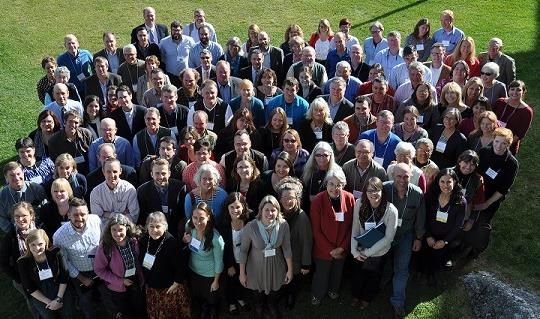
Current Socioeconomic Trends
The social and economic circumstances of the Northern Border region are diverse, and yet
a number of common trends are shared across much of the region.

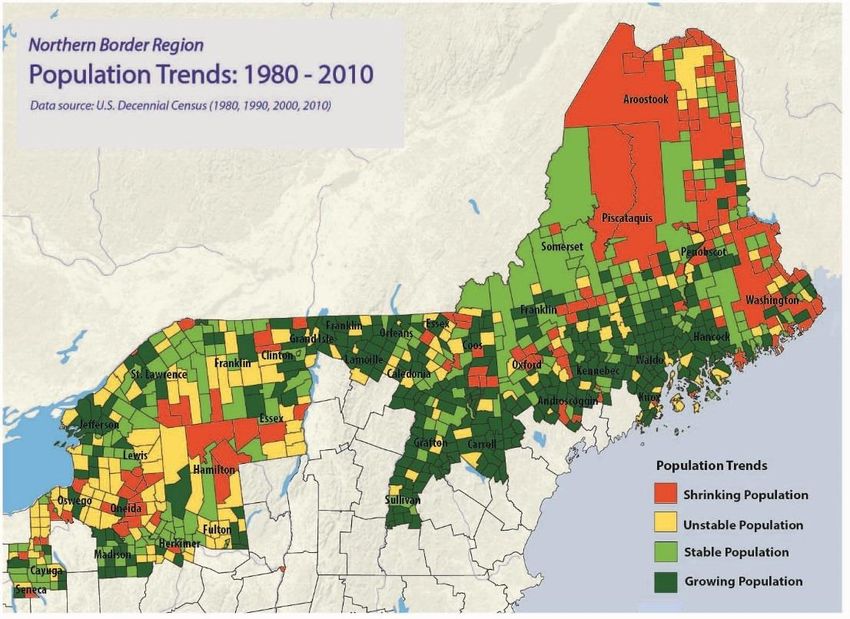
Population shifts: After several decades of change, overall population has stabilized in
much of the Northern Forest, but the major extraction-based manufacturing communities
and remote areas continue to lose population. Population is growing most quickly in
percentage terms in recreation-based communities, but in terms of sheer numbers of
people, most population growth is in communities whose economies are based on
state/federal employment or services.

Aging population: The Northern Border region as a whole is slightly older than the
southern tiers of its member states, and its population is aging more quickly. Between
2003 and 2013, the share of the population over the age of 65 increased by almost 22%.
These changes are occurring primarily because of low birth rates and because people are
‘aging in place,’ but also because these communities are having difficulty retaining younger
people. This has important implications for the economy, as human capital is one of the
principal forces behind economic development.
                                            10
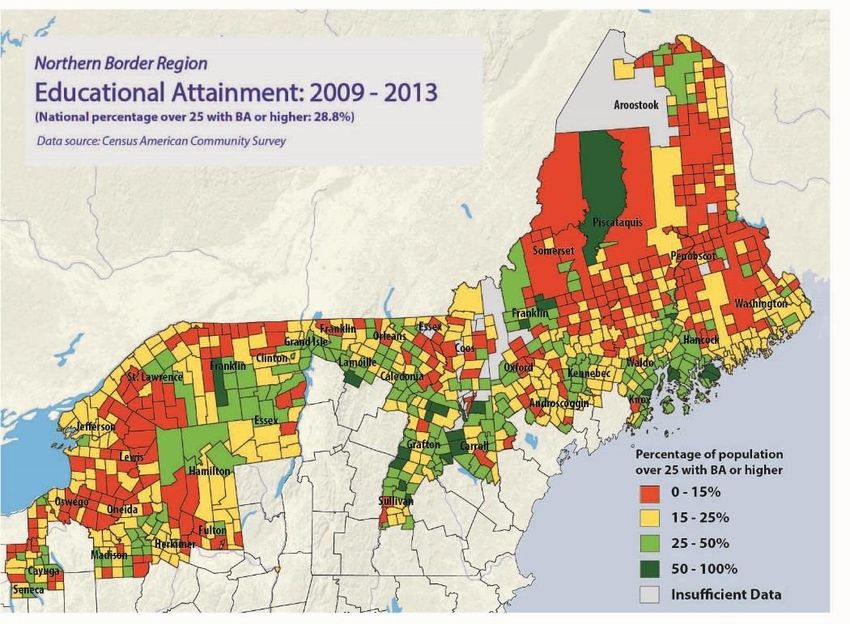
Changing workforce needs: Today’s economy demands a very different type of skill set
than in the past. Many of the region’s historic manufacturing communities have levels of
college education well below the national average, reflecting a time when getting a well-
paying job in a mill required a high school diploma and a willingness to work. As high-skill
work becomes more important in all sectors of the economy, a significant segment of the
region’s workforce is at a disadvantage, mismatched with the needs of many existing and
potential new businesses.
Diversifying economy: Across the United States, health care, social assistance and
government account for an ever increasing share of the national economy, with
manufacturing on the decline. The Northern Border region is no different. Manufacturing’s
contribution to the regional
economy (as measured by Change in Employment in the Northern Border
worker compensation), Region - Key Industries
while still significant, 250,000 223,465 213,704
210,169 Government
declined by 16% between 200,000 154,761 152,867
141,277
2003 and 2013, as 150,000 Health care and
103,606 111,469 social assistance
contributions from the 100,000
106,052
Leisure &
government, health care 100,769 97,874 85,609 hospitality
50,000
and social assistance, and
- Manufacturing
leisure and hospitality 2003 2008 2013
sectors grew.
11Distressed communities: A challenging combination of job and population loss, decaying
infrastructure, and low economic diversification has left many of the region’s historic
population centers grappling with low income and high rates of poverty. Distress is most
apparent in parts of the region that were historically dependent on manufacturing, and/or
that are most remote.
Regional Opportunity
While at the macro level the socioeconomic context of the Northern Border region is
challenging, there are many bright spots of opportunity across the landscape:
The region’s natural asset base remains intact, providing raw materials for industry as
well as natural amenities that are drawing residents and businesses to the region.
Northern Border communities offer many appealing characteristics—small size, safety,
a strong sense of community, and a beautiful landscape—to build on.
The region’s proximity to markets and major population hubs—Boston, New York,
Montreal and others—ideally positions it to provide products and recreational
experiences that can compete in the global economy.
The Northern Border Regional Commission is uniquely positioned to help the region
capitalize on its promising qualities. Strategic investments to modernize infrastructure,
strengthen business and workforce development, and build capacity for community
economic development, planning, and implementation will revitalize the Northern Border
region’s economy.
12Profiles of Economic Transition
Most of the Northern Border region is also known as the Northern Forest, and the historic
economy was built on forest-based industry. In the 1800s and for much of the 20th century, the
region was home to hundreds of wood products mills, producing pulp and paper, lumber and
other wood products. These industries supported tens of thousands of jobs, and led to the
creation of many of the region’s communities.
The stories of these communities put faces and places to the socioeconomic trends and
challenges that inform the work of the NBRC. Once thriving communities centered around
manufacturing facilities, these places now grapple with a shrinking and aging population, low
family incomes, higher than average poverty, and low numbers of college graduates.
Lyons Falls, NY: A paper mill anchored the economy of Lyons Falls for over a century. When it
closed in 2001—at a cost of 192 jobs—it was the second largest employer in Lewis County.
Today the community is slowly demolishing the blighted buildings, and planning to repurpose
the site for new uses.
Northeast Kingdom, VT: Caledonia, Essex, and Orleans
counties form Vermont’s Northeast Kingdom (NEK). Once a
hub of furniture making and other industry, the region lost
over 1,000 jobs in forest and wood products between 2001
and 2009 as manufacturers like Ethan Allan consolidated their
operations. Alongside traditional forest products, today’s NEK
economy is evolving to include a focus on recreation and
agriculture.
Berlin, NH: “The City that Trees Built” was New
Hampshire’s 4th largest city in 1930, home to several pulp
and paper mills that employed thousands and led the
industry in innovation. By 2008, the mills were gone, and
the city population had declined by over 50%. Today Berlin
is reinventing itself, in part around renewable energy and
motorized recreation.
Millinocket, Maine: The Great Northern Paper company literally built the city of Millinocket in
1899 to house the workforce for its mills. At their peak, the mills employed 4,000 people in the
best-paying manufacturing jobs in Maine. The last of these facilities closed its doors for good in
2014. Millinocket and neighboring towns now face a challenge like many Northern Border
communities before them—to reinvent their forest-based economy and diversify for the future.
13Regional Strategy 2017-2022
Regional Vision:
The Northern Border Regional Commission (NBRC) aims to help
achieve a future in which:
The Northern Border region is known for its vital regional
economies and thriving communities that provide for the
well-being of the region’s residents and support the
stewardship of the region’s natural and cultural assets.
This is a vision not just of the NBRC, but one articulated in
community economic development strategies across the region.
Mission: The mission of the Northern Border Regional
Commission is to catalyze regional, collaborative, and
transformative community economic development approaches that
alleviate economic distress and position the region for economic
growth.
Investment Principles
In determining its investment priorities, the Commission is guided
by the following principles:
Invest for long-term community and economic impact;
Support local initiatives that contribute to regional solutions;
Encourage integrative approaches to building economic,
community, and environmental well-being;
Capitalize on local and regional assets to grow and retain
wealth in the region;
Use NBRC resources to fill gaps in the region’s funding
environment for community economic development; and
Stimulate and integrate the capacity and resources of other
partners and funders.
14NBRC Roles
The NBRC works to achieve its mission and act on its investment
principles through four primary roles, which it delivers directly and
also through its grants and partnerships:
Investor. The NBRC uses its grant resources to catalyze
transformative community and business development projects,
and brokers public-private investment strategies to leverage its
impact.
Partner. The NBRC works with—and in support of—local, state
and regional partners to identify and advance regional
development priorities.
Advocate. The NBRC is an advocate for the needs and
opportunities of the Northern Border region within federal and
state agencies to bring enhanced attention and resources to the
region.
Connector. The NBRC connects community and business
development leaders and their ideas across the region to
extend the reach of good ideas and accelerate economic
opportunities.
15Strategic Goals & Objectives:
2017—2022
NBRC program and investment decisions between 2017 and 2022
will be prioritized to address the following strategic goals and
objectives, which are informed by common priorities identified at
the local and state level. This framework is designed to ensure the
strategic impact of the Commission’s work while respecting the
diverse and ever-evolving community economic development
needs of the region.
Goal #1. Infrastructure in Northern Border communities is
modernized to better support business retention and expansion,
and better position the region to compete in the global economy.
Modern infrastructure is a keystone for successful economic
development. Most of the Northern Border region’s 1,100
communities were built over a century ago and are challenged to
function with community infrastructure that is many decades old.
In addition to these local needs, the region must also invest in
infrastructure that helps it overcome two fundamental challenges
to economic growth: high energy costs and poor access to high
speed telecommunications.
Objective 1.1: Community infrastructure
for business development
Revitalize and modernize essential infrastructure in Northern Border
region communities.
Community infrastructure (water and sewer and other utilities,
transportation, housing, and community facilities such as schools
and hospitals) in many Northern Border communities is antiquated,
in some cases over a century old. Furthermore, infrastructure in
many community centers was built for a population far larger than
what exists today. Coupled with declining tax base and public
budgets, the result in many communities is infrastructure that is
poorly suited to retaining and attracting businesses, residents and
visitors.
16Selected Strategies:
Make strategic, highly leveraged investments in basic
infrastructure projects—water and sewer, other utilities,
and transportation—that support specific community
economic development goals.
Support downtown revitalization efforts tied to business
retention and attraction objectives.
Create or enhance business development sites, community
facilities, and housing to support the retention and attraction of
new businesses and residents.
Objective 1.2: Telecommunications
Increase access, affordability, and use of high speed
telecommunications by Northern Border residents and businesses.
Affordable, reliable, and high-speed broadband and cellular access
is a prerequisite for virtually any business. It is also fundamental for
current and potential new residents in Northern Border
communities. The Federal Communications Commission defines
broadband as a minimum download speed of 25 Mbps and
minimum upload speed of 3 Mbps. While internet access has
improved in the region in the last decade, in many places it still falls
far short of the modern broadband standard. Large swaths of the
Northern Border region lack access to wired broadband service
(DSL, cable, or other wired lines). A smaller but still significant
portion of the region lacks access to mobile data service. Customers
in many areas have access to only 1 provider (little redundancy) or
slow (Objective 1.3: Energy
Stabilize and reduce electric and thermal energy costs and increase.
Energy costs in the Northern Border region are some of the most
expensive in the U.S. In the lower 48 states, New York has the most
expensive commercial electric costs. Vermont ranks 5th, New
Hampshire 6th and Maine 9th highest. For thermal energy, the
Northern Border region is largely un-served by natural gas and
relies on fuel oil and bottled/liquid gas for the bulk of its heating. As
a result, the region is subject to radical swings in heating costs as
markets respond to fossil fuel availability, world events and winter
weather. Overall, unpredictable and often expensive energy costs
are a significant barrier to economic development in the region.
Selected Strategies:
Improve the energy efficiency of public facilities to decrease
and stabilize overall energy costs.
Support high-efficiency, distributed generation projects that
increase use of clean indigenous fuels (wood and other
biomass, water, wind, solar, geothermal, hydroelectric).
Encourage cooperative energy efficiency and/or generation
projects that reduce business energy costs.
18Goal #2. Businesses in the Northern Border region are creating
and sustaining jobs and wealth from the region’s assets and are
able to find employees with necessary skills.
The region’s natural, social, cultural and other assets can serve as a
strong foundation for business creation. Yet as the region
diversifies the economy built around these assets, it must
strategically invest in creating a fertile environment for
entrepreneurship and develop the workforce that will enable these
new ventures to thrive.
Objective 2.1: Asset-based business enterprise
Retain, expand and diversify business enterprise that capitalizes on
the region’s natural, cultural, and economic assets.
The Northern Border economy was historically heavily dependent
on manufacturing, particularly pulp and paper, but these jobs have
declined by over 50% since the 1970s. While employment numbers
have grown in leisure and hospitality, healthcare and social
services, and government, these jobs have not replaced the wages
and wealth creation that manufacturing once derived from the
region’s significant indigenous assets. These assets remain in place,
however, providing a basis to build a significant scale of economic
impact where the region finds particular advantage.
Selected Strategies:
Provide technical and financial assistance to help existing
and new businesses enhance their competitiveness and
capitalize on the region’s cultural, economic and natural
assets.
Build demand and/or markets for Northern Border region
products and services.
Support regional planning and economic development
efforts that promote good stewardship of the region’s
natural resource base.
19Objective 2.2: Entrepreneurship and Innovation
Position the Northern Border region as an attractive and supportive
place for creative and entrepreneurial people.
The Northern Border economy is transitioning from a reliance on a
small number of large employers to reliance on greater numbers of
small- and medium-sized businesses. The region’s population is also
aging, creating a pressing need to refresh and strengthen the
pipeline of business leaders. The region has many assets that can
be leveraged to attract entrepreneurial people, including strong
institutions of higher learning, quality of life, proximity to markets,
and competitive advantages in a number of specific sectors. The
challenge is to knit these assets together, fill gaps, and create
entrepreneurial networks and support systems that create the
conditions for entrepreneurs to thrive.
Selected Strategies:
Support entrepreneurship and business creation and
retention through business-succession support, enhanced
entrepreneurial networks, incubators/entrepreneurial work
spaces, innovative capital, and other strategies.
Support the ability of entrepreneurs to access and
commercialize technologies and business concepts
generated by the region’s public and private R&D
institutions.
20Objective 2.3: Workforce development
Support and expand a highly productive workforce with skills suited
to existing and future business needs.
Unemployment and underemployment is high in many parts of the
region, and yet many businesses report challenges in finding
workers with the skills they need. With an aging workforce
developed around a manufacturing economy that is now
significantly diminished, and few new people coming in to the
region, the region is challenged to improve the skills and
productivity of existing workers, rather than just increase the
number of jobs. To keep pace with a rapidly evolving regional and
global economy, training opportunities must be continuous and
meet workers where they are, whether preparing to enter the
workforce for the first time, in a job already, or displaced.
Selected Strategies:
Strengthen connections between research labs, educational
institutions, and other R&D facilities and the business
community to increase commercialization and intellectual
transfer.
Provide skills training in targeted industry sectors (as
identified by local/regional plans).
Accelerate adoption of new technologies and business
practices to enhance productivity.
Support workforce training programs with local businesses.
21Goal #3: Northern Border communities and businesses are well
positioned to anticipate and capitalize on changing trends, and
are resilient in the face of change.
In the small, rural communities that characterize much of the
Northern Border region, community economic development efforts
are usually led by volunteer elected officials, small business leaders,
local non-profits, or even individual citizens. Their ability to
capitalize on new opportunities is often limited by leadership
development, access to professional expertise, and lack of
information. Addressing these capacity gaps is a crucial and yet
often overlooked ingredient in successful community development.
Objective 3.1: Leadership & community capacity
Foster entrepreneurial leadership and capacity for community
economic development.
Unlike an earlier era, when large corporations provided financial
capital to build business, wealth, and employment in the Northern
Border region, the next generation of economic development is
being led by smaller, locally grown businesses and civic
organizations. In a fast-moving global marketplace, however, rural
business and community leaders are often challenged to find the
information, connections, and support needed to adequately tackle
the challenges before them, and to develop the continuum of
leadership that will sustain success.
Selected Strategies:
Provide professional training and capacity building for
organizations and institutions that support development
and implementation of community economic development
plans and strategies.
Support opportunities to inform, and connect
entrepreneurial community leaders across the region.
Support regional collaborations, networks and other
strategies that accelerate the adoption of successful
economic development strategies across the region.
22Objective 3.2: Regional knowledge
Inform and align local, state, and regional economic development
decision making with regional data and perspectives.
Creating vital economies and communities for the Northern Border
region requires quick and continuous adaptation to numerous
trends and realities, many of them external to the region. Further,
in a global economy, regions have become a locus of effective
economic development due to their ability to offer a diversity of
people, knowledge institutions, land base, and services businesses.
Responding to macro trends and operating with a regional
frameset, however, requires capacity beyond the reach of
individual communities and even states.
Selected Strategies:
Support regional data synthesis and communication of
regional trends to inform regional state, and local economic
development efforts.
Document and communicate of community economic
development best practices with broad applicability in the
Northern Border region.
Support regional and state-level economic development
planning.
23Turning Assets into Community Revitalization Success
Across the Northern Border region, a number of communities and businesses are using
local assets to revitalize local communities in innovative ways. The NBRC helped to sponsor
a regional conference in 2015 that highlighted a number of these successes:
After a devastating fire, community leaders in
Hardwick, Vermont worked with local lenders and
residents to reopen businesses quickly, and focus on
EcoPhotography.com
© Jerry Monkman/
increasing “local food” markets. Today, 75 businesses
are flourishing, employment is up by nearly 6 percent,
and the average annual wage is 4 percent higher than
the regional average.
The Model Neighborhood Wood Heat Initiative, which operates in Maine, New
Hampshire, Vermont, and northern New York, has combined local wood with modern
technology to create $3.6 million in economic impact.
Coös County, New Hampshire, is now home to 1,000 miles of interconnected ATV
trails—the largest systems in the Northeast, attracting thousands of visitors from 32
states.
A community-owned forest in Errol, New Hampshire, has
generated $3.7 million in timber sales through
sustainable forest management and will net $100,000
annually to the town budget over time.
Essex County, New York, has become an incubation hub
for agriculture businesses, attracting young entrepreneurs and reversing a decline in
the local ag economy.
A Vermont initiative focused on the working-lands economy has created 106 jobs and
increased aggregated gross income 10x for participating businesses.
Small towns have created and branded local promotional events
like a hiking challenge (Saranac Lake, New York) or a jack-o’-
lantern festival (Littleton, New Hampshire) to draw thousands of
new visitors to their downtowns and the surrounding region.
In and around Millinocket, Maine the group Our Katahdin has crowdsourced $50,000
in investment for “small win” community development projects.
Vermont’s Kingdom Trails Bike Association drew nearly 70,000 mountain bike user
visits in 2014, with each visit leaving $100 in the regional economy.
24Impact & Evaluation
Five Year Performance Goals
The NBRC is committed to accountability and to documenting the impact of its work both
quantitatively and qualitatively. Assuming consistent annual funding levels, the Commission
will gauge its success and impact against its strategic goals and objectives between 2017
and 2022 with these performance measures:
Goal #1: Goal #2: Goal #3: Across all its
Infrastructure Business & Regional goals and
Workforce Leadership objectives
Development
10,000 households 1,000 businesses 250 communities 5,000 jobs
and businesses with representing and 1,000 leaders created or
access to improved 5,000 employees engaged in regional retained
infrastructure benefit from leadership, learning
NBRC investments and/or innovation
networks supported
by the NBRC
7,500 workers 3:1 NBRC
provided with investment
skills training leverage
The Commission will also annually publish success stories stemming from its programs to
highlight the impact and stories that go beyond the numbers.
Indicators of Regional Progress
he Commission’s five year performance goals are designed to measure the direct impacts of
NBRC programs and investments. Of equal priority, however, is understanding the overall
“state of the region” and whether as a whole the Northern Border region and the
communities within it are improving their socioeconomic condition over time.
To this end, the NBRC updates annually its measures of economic distress, which include:
poverty, unemployment, population change, educational attainment, median household
income, and seasonal home percentage. Annual distress listings and data can be found on
the NBRC website at www.nbrc.gov.
In the future, the Commission hopes to partner with other regional organizations to develop
a more comprehensive regional indicators framework that can inform the Commission and
other economic development investors in the region about the overall health of the region.
25Appendix 1. Plans & Strategies
Consulted
Multi-State
Northern Forest Sustainable Economy Initiative Strategy &
Recommendations, October 2008
Northeast CanAm Connections: Integrating the Economy
and Transportation. August, 2009
Maine Regional
Androscoggin Valley CEDS, June 2014 (AVCOG)
Aroostook-Washington CEDS, April 2015 (NMDC)
Eastern Maine CEDS (EMDC)
Kennebec Valley CEDS, June 2013 (KVCOG)
Midcoast CEDS, 2014 (MCEDD)
Maine Statewide
Economic Strategy for Maine, January 2013. Maine State
Chamber of Commerce.
Making Maine Work: Critical Investments for the Maine
Economy. 2010 (Maine State Chamber of Commerce and
the Maine Development Foundation)
Making Maine Work: Critical investments for the Maine
economy: Growing Maine's workforce. October, 2013.
(Maine State Chamber of Commerce and the Maine
Development Foundation)
Measures of Growth, 2015. (Maine Development
Foundation, Maine Economic Growth Council)
Regional Quality of Place Investment Strategies: A Guide for
Economic Development Districts. 2011. (Maine Quality of
Place Council)
New Hampshire Regional
A Plan for New Hampshire's North Country, Regional Plan
for the North Country Council Planning Region. (North
Country Council)
Broadband in Coos County, New Hampshire Preliminary
Report, March 2016. University of New Hampshire.
Coos Economic Action Plan
Neil & Louse Tillotson Fund Strategic Plan 2016-2021
North Country CEDS (North Country Council)
26 Upper Valley Lake Sunapee Regional Planning Commission
Draft Regional Plan
New Hampshire Statewide
New Hampshire Economic Review 2015. (New Hampshire
Division of Economic Development)
New York Regional
Adirondack Regional Assessment Project (May 2009, update
2011)
Advantage Adirondacks: Advancing Economic Opportunities
Across the Adirondack Park (November 2014)
Central New York Economic Development Council Strategic
Plan
Central New York Initiative: A Comprehensive Economic
Development Strategy for Central New York (June 2013)
Genesee-Finger Lakes Economic Development District
Comprehensive Economic Development Strategy Update
(2014-2015)
Lake Champlain-Lake George Regional Planning Board 2011-
2012 Comprehensive Economic Development Strategy
Update (2011-2012)
Mohawk Valley Economic Development Council Strategic
Plan
North Country Economic Development Council Strategic
Plan
New York Statewide
2015 Regional Council Guidebook
2015 Upstate Revitalization Initiative Handbook
Vermont Regional
Economic Development District of Northern Vermont CEDS
2015 - 2020
Northeast Kingdom Regional Plan
Northwest Regional Planning Commission Regional Plan
Strategic Industries in the Northeast Kingdom (NVDA)
Vermont Statewide
Vermont 2020 CEDS
2728
You can also read


