Blackpool Aspire Academy Curriculum Pathway 2017-2020 Information & Subject Preference Guide - February 2017
←
→
Page content transcription
If your browser does not render page correctly, please read the page content below

Blackpool Aspire Academy
   Curriculum Pathway
        2017-2020

     Information &
Subject Preference Guide

                  February 2017
Contents
 1.   Introduction
 2.   GCSE Reform
 3.   Curriculum Structure
 4.   Top Tips
 5.   Subject Preference Timeline
 6.   Core Subjects
 7.   Preference Subjects
 8.   Subject Preference Form
Introduction
Dear Parents/Carers

This Key Stage Four Curriculum Pack contains information about the core subjects and preference subjects
which are available for study from Year 9.

All students will follow GCSE (or equivalent) courses in English, Mathematics, Science, and at least one from
French, History, Geography & Computer Science.

Enhancement subjects fall into different categories: the traditional GCSEs and vocational qualifications such
as BTEC’s or Level 2 Certificates. Learners are able to choose four options to meet the full curriculum
entitlement.

Please read the relevant sections in this pack to understand fully the differences between the courses on
offer. Students in school have had the opportunity to listen to and talk with subject teachers or curriculum
leaders about the preference subjects and have recently engaged in taster lessons to give them a better idea
of what they may be studying in future. You are invited to an Curriculum Information and Parents’ Evening
on Thursday 2nd March 2017 when the KS4 curriculum will be explained and you will have the opportunity to
get further information from Subject Leaders and your son/daughters current teachers. This will also allow
for consultation with subject teachers or members of the Senior Leadership Team.

The subject preference form is included at the back of this booklet and a further copy will be given out on
the evening. After careful consideration of applications, students will be required to meet with a member of
the Leadership Team over the following weeks to ensure that they are happy with their choices before any
final decisions are made. Decisions will also be made on the basis of viability of the course depending on low
numbers as well as full courses due to high numbers, a full timeline is included in this information booklet.

If at any time you have any questions regarding this important process, please feel free to contact me at any
time (r.hughes@aspire.fcat.org.uk).

Yours sincerely

Mr R Hughes
Assistant Principal
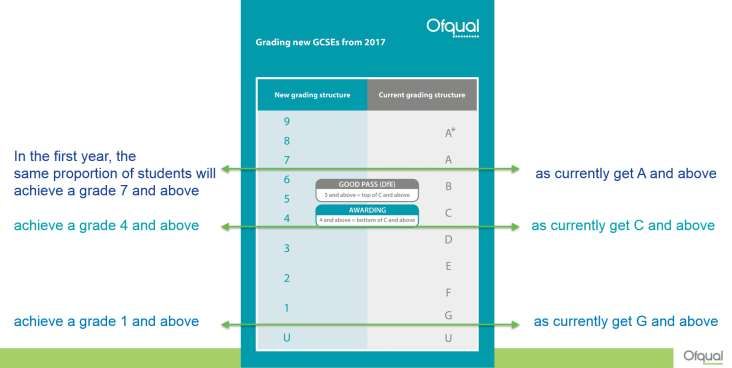
GCSE Reform – What is 9-1?
1. Introduction
As you are probably aware the government has introduced radical new changes to the structure and
assessment of GCSEs. We are moving away from the familiar system of A*-G grades to a system of grading
with numbers 9-1. In addition to the changes to the structure of GCSEs, the government is also raising a
‘good pass’ from a C to a new grade 5, where a 5 represents the top third of a C and the bottom third of a B.
This is to align the UK with the best education systems in the world.
From September 2015 new reformed GCSEs will be taught in English language, English literature and maths,
with the first results issued in August 2017. Further subjects will see new GCSEs introduced over the following
two years.
2. What new GCSEs will look like?
The main features of the new GCSEs are:
A new grading scale of 9 to 1 will be used, with 9 being the top grade. This will allow greater
differentiation between students and will help distinguish the new GCSEs from previous versions.
Assessment will be mainly by exam, with other types of assessment used only where they are needed
to test essential skills
There will be new, more demanding content, which has been developed by government and the exam
boards
Courses will be designed for three years of study - they will no longer be divided into different
modules and students will take all their exams in one period at the end of their course
Exams can only be split into ‘foundation tier’ and ‘higher tier’ if one exam paper does not give all
students the opportunity to show their knowledge and abilities
Resit opportunities will only be available each November in English language and Maths
3. New GCSE Grading Scheme
Curriculum Structure
At this point in your son/daughters time at Blackpool Aspire Academy we ask them to help determine what
subjects and qualifications it is that they would like to study in Key Stage 4.
Certain subjects are considered essential and form the core part of the curriculum that all students will follow,
this includes
GCSE English Language
GCSE English Literature
GCSE Mathematics
GCSE Combined Science (Unless in Set 1 where students will study Separate Sciences)
Physical Education
PSHE & RE
Beyond this we give students the opportunity to express a preference for four other subjects that they wish
to study, we offer a range of academic (GCSE) and vocational (BTEC and equivalent) courses that enable all
students to study a broad and balanced curriculum (Ofsted 2016).
It is expected that all students will study at least one of the following subjects as part of recent government
reforms to education.
GCSE Geography or
GCSE History or
GCSE French or
GCSE Computer Science
These subjects are considered “gateway” subjects that employers and further education providers
look very favourably on when students apply for jobs or university places.
The English Baccalaureate (EBACC)
The English Baccalaureate is recognition awarded to students that have successfully attained a Grade 5 or
higher in the following subjects:
GCSE English
GCSE Maths
GCSE Science or GCSE Computer Science
Either GCSE History or Geography
GCSE French
This very academic route will not be suitable for all students.
Subject specific information is provided later in this booklet, including the next steps that each qualification
could lead to including possible careers that each qualification opens up.
Please look carefully at the information provided, and please discuss your son/daughters preferences with
them – this is critical point in their educational journey, and it will not be possible to make changes in Year 9
if they change their minds.
Top Tips for Future Success You need to think long and hard about the subjects that you would like to study in Year 9; you need to think about why it is you want to do that subject! Good reasons for expressing a subject preference You are good at the subject You think you will enjoy the course It fits your career ideas and plans It goes well with your other choices It helps to give you plenty of choice post 16 You think you might want to continue studying it post 16 Your research shows that it will interest you and motivate you to learn. Bad reasons for expressing a subject preference Your friends have chosen it You think it will be easy You think it’s a good option for a boy/girl Someone else thinks it is a good idea You like the teacher you have now You did not have time to research your options properly
Timeline
Week Commencing           What’s Happening?
30th January 2017         Year 8 Careers Fair at
                          Blackpool Pleasure Beach
13th February 2017        Taster lessons take place
                          Subject Information pack released
20th February 2017        Half Term – Parents & Students to read information pack and
                          discuss subjects available
27th February 2017        Y8 Curriculum Information Assembly
                          Y8 Parents & Information Evening
6th March 2017            Monday – Deadline for Subject Preference forms
                          Student interviews with members of the Leadership Team begin
13th March 2017           Student interviews continue
20th March 2017           Student interviews continue
27th March 2017           Details from interviews collated, and subject preferences
                          finalised
3rd April 2017            Students & Parents informed of which subjects have been
                          allocated

Future Key Dates

September 2017       Key Stage 4 Begins
June 2020            Final External Exams Take Place
August 2020          Final Results Available
September 2020       Post-16 Courses Begin
Core Subjects These subjects serve as the compulsory part of our curriculum offer, the study of English, Mathematics & Science ensures that our students are articulate, literate numerate and scientifically curious when they move on to the next stages of their lives. All students will study for GCSE’s in: English Language English Literature Mathematics Combined Science All students will continue to study but not receive an external qualification in: PSHE (Personal, Social & Health Education) & RE (Religious Education) Physical Education
GCSE English
Why Study English Language & Literature?

English Language provides you with the key reading, writing and spoken language skills to assist
you when you enter the wider world of further education and employment. It involves studying both
fictional and non-fiction texts from the 19th, 20th & 21st centuries and writing in a variety of genres
and styles.

English Literature provides you with the analytical skill to approach and understand a variety of
literary texts including poetry, prose and plays. The subject inspires and improves your own writing
style as you study esteemed and valued authors from Shakespearean times through to the modern
day. The discussion of topics and ideas that influence these texts allows students to examine their
own cultural heritage and the variety of perspectives that exist.

What Will I Study?

              Year 9                          Year 10                           Year 11
 Non – Fiction                     ‘An Inspector Calls’–JB           English Language Paper 1
 Point- of – View writing          Priestley                         Reading Exam Practice
                                   Focus on themes
 War Poetry                                                          Spoken Language
 Reading Assessment                ‘A Christmas Carol’ – C           Assessments
                                   Dickens                              - Speech writing
 Media James Bond & Spy
 Fiction                           Descriptive Writing               Narrative Writing
 Descriptive Writing
                                   Reading and examining           ‘Power’ poetry cluster
 Shakespeare’s ‘Macbeth’ –         writers’ perspectives in non-
 understanding of plot.            fiction texts Paper 2 Language. Unseen Poetry Analysis

 Non-Fiction Reading               Point of View Writing –Articles   Letter & Leaflet writing
 Autobiographical Extracts         & Essays
                                                                     Revisit ‘A Christmas Carol’ &
 Dystopian Fiction Reading         ‘Conflict’ Poetry cluster         ‘Macbeth’ – focus on themes.
 Assessment
                                   Reading and analysis of           Revisit ‘An Inspector Calls’-
                                   creative fictional texts.         characters

                                   Revisit Shakespeare’s          Revision of bespoke language
                                   ‘Macbeth’-Focus on characters. topics required for the
                                                                  examinations

Students are encouraged to participate in theatre visits to see live productions of the literary texts
studied.
Qualification Details CAREER
GCSE English Language
OPPORTUNITIES
GCSE English Literature
AQA Exam board
100% examination Journalism,
o Spoken Language element assessed separately – non-
exam.
Publishing,
GCSE English Language:
o Paper 1 – Explorations in Creative Reading & Writing
o Paper 2 – Writer’s Viewpoints & Perspectives Education,
GCSE English Literature:
o Paper 1 – Shakespeare & the 19th century novel.
o Paper 2 – Modern texts & poetry Creative Media,
What Support is on Offer? Performance,
Lesson 6 is offered by subject teachers for extra assistance. Student
study guides are provided.
Law,
PiXL Lit App is available for revision of literature texts.
http://www.bbc.co.uk/schools/gcsebitesize recommended website. Social Work
What Next? Librarian
It is a core subject and without a qualification of 5 or above in this
subject you will have to re sit the exams to the required standard in order Advertising
to continue further studies at college or sixth form.
Possible learning pathways include ‘AS‘ & ‘A’ Levels in English Language, Marketing
English Literature, English Language & Literature, Creative Writing,
Media Studies, Drama & Theatre Studies.
Editor
Who should I contact for more information?
Mrs S Johnson, Lead Teacher of English.
What the Students Say:
‘English lessons always make me think more deeply about things.’
Fahmidah Year 11
‘English lessons are enjoyable and topics are broken down so we
understand them’.
Lauren Year 11GCSE Mathematics
Why Study Mathematics?
Mathematics is a core subject and a compulsory part of your KS4 curriculum, this is because the
over-whelming use of Mathematics in every career path and in your everyday lives. Whichever path
you will want to take after you leave Blackpool Aspire Academy you will need to have received a
good pass (Grade 5) in Mathematics. Without a good pass in Mathematics you will have to retake
Mathematics at your set college, 6th form or apprenticeships. Mathematics promotes not only the
ability to manipulate numbers but also logical thinking and problem solving which are transferable
skills to future careers.
What Will I Study?
Year 9 Year 10 Year 11
Higher: Higher: Higher:
Indices/roots/factors/multi Solving equations Congruency
ples Inequalities Constructions
Standard form/ surds Constructions Reciprocals
Algebraic equations Transformations Proportionality
Sequences Accuracy bounds Vector geometry
Statistics (representing 2D shapes Changing the subject
data) 3D shapes Trigonometry
Fractions Probability Further Trigonometry
Ratio Similarity Iterations
Pythagoras/Trigonometry Graphs Accuracy bounds
Graphs Further Trigonometry Graphical work
Foundation: Circle theory Foundation:
Integers/factors/multiples Foundation: Rearranging equations
Algebraic expressions Area/perimeter Quadratic algebra
Statistics (representing Transformations Right angles triangles
data) Ratio/proportion Pythagoras/trigonometry
Fractions/ percentages 2D shapes Ratio/proportion
Algebraic equations 3D shapes Averages
Angles Real life graphs Circles/cylinders/cones
Averages Right angled trigonometry Vectors
Constructions Probability
Pythagoras
Quadratic algebraQualification Details CAREER
GCSE Mathematics
OPPORTUNITIES
Edexcel – Specification 1MA1
The exam will be 3 papers each 1 hour 30 minutes long. The first
will be non-calculator and the other two calculator papers. Actuarial analyst
What Support is on Offer? Forensic
accountant
The most important support is making sure you get the most out of
every lesson as well as making sure you ask the maths teachers about Teacher
any topics you are unsure on.
Online learning platform/revision tools/resources logins. Stockbroker
(MathsWatch, PIXL maths, JustMaths)
Weekly lesson 6 (year 11) Meteorologist
Weekly exam practice/papers (year 11)
Maths revision packs Software tester
What Next? Quantity
surveyor
Whatever you choose for your next step you have to achieve a grade 5
otherwise wherever you go you will have to re-sit Mathematics.
Corporate
A Level Mathematics Investment
A Level Further Mathematics banker
Level 3 Core Mathematics
Who should I contact for more information?
Mr A. Thompson, Lead Teacher of Mathematics
a.thompson@aspire.fcat.org.uk.
What the Students Say:
“Maths in KS4 is more independent, teachers are there to help but the
learning and progress is drive by us more.”
Natalie Year 10
“Don’t waste any years, every year counts! Always focus in Maths”
Connor Year 11
“My teacher is very supportive and always provides work for our ability
and to help to push ourselves further to challenges us and make
greater progress.”
Shannon Year 11GCSE Combined Science
Why Study Combined Science?
Science is essential to understanding the world in which we live. Many of the most important aspects
of our lives are driven by scientific discovery including the phones we use and the medical treatment
we receive. Science is the most exciting subject to study due to the wide range of practical and
theoretical work carried out.
Studying Combined Science will help you to develop skills that are essential to any future career
such as planning investigations, carrying out research, teamwork and evaluation.
GCSE Combined Science is taught by a passionate and enthusiastic team of scientists specialising in
all three science subjects; Biology, Chemistry and Physics.
“Science and everyday life cannot and should not be separated”
Rosalind Franklin- first person to see an image of DNA
“The scientist is not a person who gives right answers; he is one who asks the right questions”
Claude Levi-Strauss- French Anthropologist
What Will I Study?
Year 9 Year 10 Year 11
Biology- Biology Biology
Cells Homeostasis Cells, Organisation,
Organisation of Plants and Inheritance Bioenergetics, Infection,
Animals Ecology Homeostasis, Inheritance,
Bioenergetics Ecology
Infection
Chemistry Chemistry Chemistry
Atomic Structure Rate of Reaction Atomic Structure, Chemical
Chemical Changes Organic Chemistry Changes, Energy Changes,
Energy Changes in Chemical Chemical Analysis Structure and Bonding,
Reactions Chemistry of the Atmosphere Quantitative Chemistry, Rate,
Structure and Bonding Using Resources Organic Chemistry, Chemical
Quantitative Chemistry Analysis, Atmosphere and
Resources
Physics Physics Physics
Particle Model Forces Particles, Energy, Waves,
Energy Radiation Electricity, Forces, Radiation,
Waves Electromagnetism Electromagnetism
Electricity
There will be 21 required practical investigations carried out over the Combined Science course.
These will be assessed as part of the summative exam at the end of year 11.Qualification Details CAREER
GCSE Combined Science Trilogy (worth 2 GCSEs)
OPPORTUNITIES
AQA
100% Examination
Each examination lasts 1 hour and 15 minutes. Two exams will be People with GCSE
taken in each of Biology, Chemistry and Physics. Combined Science are
some of the most
What Support is on Offer? employable people in
a wide variety of
After school lessons are made available to all GCSE Combined Science careers.
students. These are planned specifically to the requirements of the
individual student. Science opens up
We use the Collins Combined Science Trilogy Revision guides. They will
opportunities in a wide
be handed out free of charge to all students in year 11. Supplementary range of careers:
material will also be distributed in years 9 and 10. Medicine
Dentistry
What Next? Animal Health
Music
Blackpool Sixth Form offer: Technology
A Level courses in Biology, Chemistry, Physics and Psychology. Sport Science
BTEC level 3 courses in Applied Science, Health and Social Care,
Engineering
Engineering and Sport Science
Psychology
Blackpool and the Fylde College offer:
Engineering Diploma
Level 3 Applied Science Diploma including Medical, Forensic and And some careers you
Environmental Science may not have thought
of…
Who should I contact for more information? Finance
Marketing
Mr W Buchanan- Lead Teacher of Science Photography
Art Restoration
What the Students Say: Media and Film
“We learn a lots of new things in Science and gain knowledge on a wide Technology
variety of topics. It helps us to understand the world and how to help Food Technology
people in the future. Our teacher is always helpful and wants us to do
our best”
Macauley - Year 10
“Science is great because it gives us the opportunity to gain a greater
insight into how the world works. The teachers are supportive and make
sure you have a really good understanding of the subject”
Sophie - Year 10Physical Education
Why Study PE?
A broad and balanced curriculum, which fulfils National Curriculum guidelines but which
also enables Aspire Academy to prioritise its curriculum to its pupils needs.
A curriculum that develops attitudes, behaviours and establishes norms of conduct.
A curriculum that includes leadership as a skill to develop with our pupils.
A curriculum that allows continuity from Year 7 to Year 9.
A curriculum which will be developed to allow continuity between different key stages.
A curriculum which allows pupils to spend meaningful time on each unit of work.
A curriculum which makes best use of resources and staff.
A curriculum which is consistent for each pupil.
A curriculum that allows pupils to progress according ability and which influences KS4.
What Will I Study?
Year 9 Year 10 Year 11
Invasion Boys = Rugby, Options from invasion Options from invasion
Basketball, Hockey, games of Basketball, games of Basketball,
Football, 20- 30 hrs Football, Rugby, and Football, Rugby, and
Net/wall Boys =Tennis, handball. handball.
Badminton, Table tennis Options from Netball, Options from Netball,
20-30 hrs Hockey, Football, Hockey, Football,
Striking and fielding Basketball. Basketball.
Boys = Cricket, Baseball, Options from striking & Options from striking &
Rounders 30 hrs fielding games eg fielding games eg
Invasion Girls = Netball, Rounders, Cricket and Rounders, Cricket and
Hockey, Football, Athletics. Athletics.
Basketball, 20-30 hrs Health & Fitness. Health & Fitness.
Net/wall Girls = Tennis, Trampolining, Table tennis Trampolining, Table tennis
Badminton, Table tennis and perhaps Gymnastics. and perhaps Gymnastics.
12-20 hrs
Striking and fielding
Girls = Rounders, Cricket
30 hrsQualification Details: CAREER
There may be a chance to undertake a leadership course in ‘Coach
OPPORTUNITIES
Education’ or a proficiency award in a certain sport of your liking.
The core PE you undertake will support your future study at KS4 & 5.
PE Teacher
What Support is on Offer? Sports
Development
There may be opportunities to develop your leadership, officiating Sports Coaching
and organising skills through supporting extra-curricular work Sports
before school or after school in the ‘out of hours’ programme. Management
You may also be able to join a school team to really improve your Physiotherapy &
skills. Sports Injury
PE staff can also guide you to a team or club in the Blackpool &
Fylde area to enhance your skills and your competitive nature, your Nutritionist
teamwork and co-operation skills and your ability to socialise. Public/Armed
services
What Next? All active careers
from landscaping
You will then be in a good position to develop your skills and to the Fire brigade.
techniques further at KS4 and KS5 leading to possible career choices
in a range
Who should I contact for more information?
Mr Lavelle, Director of Expressive & Performing Arts, Subject Lead of
PE
Student Quotes
“I like doing PE because it inspires me to keep exercising and helps me
to learn new skills outside of the classroom”
Jade, Year 11.
“PE is a lesson I look forward to because I like being active and trying
new sports and improving. I play football and now I know how to play
rugby and badminton better”
Adam, Year 9Preference Subjects All students must study at least one of the following: GCSE Geography GCSE History GCSE French GCSE Computer Science Students can then express a preference to study from the following subjects: GCSE Separate Sciences GCSE Religious Studies GCSE Art GCSE Art:Textiles Hospitality & Catering Materials Technology VCERT Business & Enterprise BTEC ICT BTEC Sport BTEC Travel & Tourism GCSE Dance
GCSE Geography
Why Study Geography?
Geography helps us to make sense of the world around us. The course will give you the chance to
get to grips with some of the big global questions and understand the social, economic and physical
forces and processes which shape and change our world. So many of the world's current problems
boil down to Geography, and we need the geographers of the future to help us understand them.
Geography at GCSE level is both challenging and rewarding.

Geography at Aspire Academy is taught by well-qualified and highly experienced teachers, in a
successful department. In September 2016 the department gained the Geographical Association’s
‘Centre of Excellence’ for the quality of geography teaching and learning.

In December 2016 Ofsted stated that:
‘In geography, the teacher’s prior knowledge of what the pupils could do underpinned an effective
challenge to the class to write a diary entry of a Nepalese Sherpa, which encouraged them to display
empathy and an awareness of cultural differences.’
‘Teaching is particularly effective in geography.’

What Will I Study?

            Year 9                           Year 10                        Year 11
 The challenge of natural         The living world                 The changing economic
 hazards                                                           world
                                  Urban issues and challenges
 Physical landscapes in the                                        The challenge of resource
 UK                               Fieldwork and geographical       management
                                  skills
Qualification Details CAREER
OPPORTUNITIES
GCSE Geography
AQA Syllabus A
100% examination
Physical Geography paper (35% of final grade) According to the Royal
Human Geography paper (35% of final grade) Geographical Society,
Geographical skills and fieldwork (30% of final grade) Geography graduates
have some of the
What Support is on Offer? highest rates of
graduate employment.
Lesson 6 revision lessons are made available to all geographers to help
support revision and exam technique.
Geography is great for
The Geography department produces its own revision guides which are
given out (free of charge) to all GCSE Geography students. any kind of career that
involves the
What Next? environment, planning,
or collecting and
Blackpool Sixth Form offer AS/A level Geography, AS/A level Sociology. interpreting data.
Popular careers for
Blackpool and the Fylde offer course in Marine Biology and Coastal
people with geography
Management (Foundation Course), Travel and Tourism (Level 2 and 3
BTEC) and Travel Services (Level 2 and 3 BTEC). qualifications include:
town or transport
Who should I contact for more information? planning, surveying,
conservation,
Miss L. Stevenson, Head of Geography and Director of Humanities.
sustainability, waste
What the Students Say and water
management,
‘For me, Geography has opened my eyes to the world. I have a greater environmental
knowledge and understanding of the physical and human world in
planning, tourism, and
which I live. I thoroughly enjoy Geography lessons and would
recommend the subject to any Year 8 student who is considering it as weather forecasting.
an option.’
Tia, Year 11 The army, police,
government, research
‘I love Geography! Each of the units we study are very different, but all
of them are linked in some way, meaning that topics are easier to organisations, law and
understand than other subjects.’ business world also
Jodie, Year 11
love the practical
‘Geography has made me understand the physical aspects of the world research skills that
in a lot more detail. It has informed me about how our world works and geographers develop.
has raised questions about the world that I had never considered
before. I enjoy the lessons and the work is really interesting.’
Tayla, Year 11GCSE History
Why Study History?
It would be great to know what could happen before we make an important decision wouldn’t it?
Well, studying History can help us do this on a big scale.
By analysing past events we learn about the consequences of people’s actions, from kings & queens
to the London baker who forgot to put his fire out on September 2nd 1666…
If we apply this knowledge to the present, governments, businesses and individuals can learn lessons
from past mistakes or successes and make informed choices about their futures.
What Will I Study?
Year 9 Year 10 Year 11
Germany 1890-1945. A study Elizabethan England c1568- Historic Environment Study.
of how Germany became a 1603. A study of how a young An in depth study of the
great world power, suffered woman from a difficult family, defeat of the Spanish Armada
defeat and humiliation in dealt with complex problems in the English Channel in the
World War One, struggled to including religious bigotry and summer of 1588.
regain their status and finally sexism to become arguably
succumbed to the rule of England’s greatest monarch. Germany1890-1945
Adolf Hitler and the Nazis. Overview Re-cap.
The Health and the People
Conflict and Tension 1918- c1000- Present Day. A study Conflict and Tension 1918-
1939. A study of how world of how and why the health 1939 Overview Re-cap.
leaders tried and ultimately and life expectancy of British
failed to build a lasting peace people has changed so Elizabethan England c1568-
in Europe and around the dramatically over the last 1000 1603. Overview Re-Cap
world. years.
The Health and the People
c1000- Present Day.
Overview Re-CapQualification Details CAREER
GCSE History. AQA.
OPPORTUNITIES
100% examination based at the end of Year 11.
o 50% Paper 1- Germany 1890-1945 and Conflict and Tension
1918-1939. Any qualification in
o 50% Paper 2- Elizabethan England c1568-1603 and The History is highly valued
Health and the People c1000- Present Day. by further and higher
education institutions
What Support is on Offer? due to the analytical
and critical reasoning
During Year 11 students will be invited to attend Lesson 6 to skills that they
consolidate extend previous learning. develop. Common
career paths taken by
CGP Revision guides will be provided to all History students.
History graduates
Individual revision guides will be published to Show my Homework. include:
What Next? Law
Teaching
History is highly valued by all post-16 institutions and is included in Police Force
the English Baccalaureate. This means that a GCSE in History can help Armed Forces
you to study any post-16 course.
Journalism
More specific History related courses are as follows: Business
Management
A-Level Ancient History- Classical Civilisation Media
Politics
A-Level History- Medieval and Modern
Who should I contact for more information?
Mr D Carter, Subject Leader of History d.carter@aspire.fcat.org.uk
Miss L. Stevenson, Director of Humanities
What the Students Say
“History is amazing! It opens your mind to things you’ve never even
considered before, which could potentially involve you and your
family.”
Sinead, Year 11
“I chose History because I love to learn about what has happened in
our country’s past. I like History because it gives you an insight in to
how the past has influenced the future.”
Arran, Year 11
“History is great because you to learn about the past and how the
world has evolved.”
Fahmidah, Year 11GCSE French
Why Study French?
Learning languages gives pupils opportunities to develop their listening, speaking, reading and
writing skills. To be able to express yourself with increasing confidence, independence and creativity.
To explore the similarities and differences between French and English and learn how language can
be manipulated and applied in different ways. To develop communication skills, together with
understanding the structure of language to lay the foundations for future study. To support the
development of literacy skills in your own language. The ability to understand and communicate in
another language is a lifelong skill. Future employability is enhanced by knowledge of a foreign
language and opens doors to a wide range of opportunities.
What Will I Study?
Year 9 Year 10 Year 11
Themes include: Themes include: Themes include:
School Me, my family and friends. Holiday and Travel
Future Aspirations Food and drinks and Shopping
Study and Work Lifestyle Environment
Daily Life Family celebrations International and global
Cultural Life Customs and festivals dimensions
Leisure and Hobbies Town and Region World problems
Media and communication
Qualification Details
Qualification Title: GCSE French (Grade 9-1)
Examination Board: AQA
GCSE French has a Foundation Tier (grades 1-5) and a Higher Tier (grades 4-9)
The following units are assessed:
Unit 1 Listening (25%)
o Understanding and responding to different types of spoken language
Unit 2 Speaking (25%)
o Communicating and interacting effectively in speech for a variety of purposes
Unit 3 Reading (25%)
o Understanding and responding to different types of written language
Unit 4 Writing (25%)
o Communicating effectively in writing for a variety of purposesWhat Support is on Offer? CAREER
Departmental support opportunities include focused lesson 6 support OPPORTUNITIES
sessions eg for help with speaking, revision guides with CD for listening
practice, online revision and consolidation materials with personal logins
and passwords. Knowing a foreign
language can help you in
Recommended websites: many aspects of your life,
www.linguascope.com including travel and work.
www.languagesonline.org.uk But did you know that you
www.funwithlanguages.vacau.com can find some of the
www.languageskills.co.uk coolest jobs just by
knowing another
language?
What Next?
Media (journalism) and
Languages are an invaluable skill to have. Having a language can film
increase your salary from 8 to 20% and gives you a head start on other Tourism and travel
potential employees as by speaking another language you’re vital to any services, including
company who does international business (and there’s a lot of them). airlines and hotels
Plus, a language is also a pre-requisite for lots of university courses so Banks and insurance
it’s something to consider if you’re thinking about university in the Government
future. Languages are key to the exciting multinational world we live in! International
Languages at A-level (such as A Level French at Blackpool Sixth) offer companies
you a fantastic opportunity to work towards becoming a linguist. Publishing companies
Health services
Who should I contact for more information? Social services
Immigration services
Mrs J. Barnett, Director of Modern Languages Primary and Secondary
school Teaching.
Law
What the Students Say: Gaming
Flight Attendant
“Taking French was a really good decision. It is not as hard as I thought Photography
it would be and it will open up a lot of opportunities for me in life” Fashion
Demi, Year 10
“I really enjoy how we practise our French skills in different ways. I think
that taking French could lead to travelling around the world.”
Joshua, Year 10GCSE Computer Science
Why Study Computer Science?
Computer Science is a rapidly growing subject and is seen as an underpinning subject across science
and engineering and indeed many other subjects. It involves the study of computers, including how
they work and looking at the growth in the mobile device market. Furthermore, the logical thinking
skills that you will learn in Computer Science are invaluable and will help with your learning in other
subjects especially maths.
What Will I Study?
We break down the Computer Science curriculum into the following areas.
Year 9 Year 10 Year 11
Computer Systems System Security Non-Examined Assessment
Computational Thinking & System Software Revision
Algorithms More Python
Learning Python & how to Translators and Facilities of
create a robust program Languages
What is SQL? Ethical, Legal, Cultural and
Memory & Storage Environmental Concerns
Networks: Wired and Computational Logic
Wireless Data Representation
In Year 11 students have to complete a 20 hour board-set assignment which is worth 20% of their
grade in the programming language Python.Qualification Details CAREER
GCSE Computer Science
OPPORTUNITIES
OCR Exam Board
80% Exam; 20% NEA
At the end of Year 11, students will sit two 90 minute exams; Some careers where
o Paper 1 is focused on Computer Systems; this is useful
o Paper 2 is focused on Computational Thinking, Algorithms
and Programming.
include:
Data Analyst
What Support is on Offer?
Games Developer
To support student learning, we currently offer the following:
Lesson 6 to support revision
Information
Independent learning through Google Classroom so that
students can learn to program at their own pace Systems Manager
Customised revision materials and practice papers
A programming drop-in session to support the learning of IT Consultant
Python
A wide range of revision websites and online quizzes to help
with the learning and revision of difficult topics Multimedia
Programmer
What Next?
Systems Analyst
Following this qualification, many students go on to study some of the
following:
A level in Computing or Level 3 equivalent Web Designer
A Level in ICT or Level 3 equivalent
A Level in Electronics
Web Designer
Apprenticeship in the IT industry
Who should I contact for more information? Digital Copyrighter
Ms S. Matthews, Director of Technology & Computing Network Engineer
What the Students Say: Social Media
Manager
“Computer Science is amazing!!!”
Patrick – Year 9
Technical Author
“It can be difficult but it gets easier as you learn more”
Luke – Year 11 Artificial Intelligence
Intelligence Service
Mobile Application
DeveloperGCSE Separate Sciences
Why Study Separate Sciences?
For students passionate and curious about Science, this is the option that you need to select. Science
will be the most important subject of the 21st Century and with so many advances in the fields of
technology, medicine and space exploration, why wouldn’t you want to be a part of it?
This option is not only for students interested in pursuing a career in Science. It will allow you to
develop many skills required for a wide variety of careers including planning, research, teamwork
and investigation.
All teachers in the department are just as passionate about Science, with dedicated specialists in
Biology, Chemistry and Physics. Be part of the future! Choose Separate Science!
“It is not the strongest species that survives or the most intelligent. It is the one most adaptable to
change”- Charles Darwin author of “On the Origin of Species”
“I feel sorry for people who don’t understand anything about Chemistry. They are missing an
important source of happiness!”- Linus Pauling 1954 Winner of Nobel Prize for Chemistry
“If anyone says he can think about quantum physics without getting giddy, that only shows he has
not understood the first thing about them”
- Niels Bohr discovered that electrons orbit the atom in energy shells
What Will I Study?
Year 9 Year 10 Year 11
Biology- Biology Biology
Cells Homeostasis Cells, Organisation,
Organisation Inheritance Bioenergetics, Infection,
Bioenergetics Ecology Homeostasis, Inheritance,
Infection Ecology
Chemistry Chemistry Chemistry
Atomic Structure Rate of Reaction Atomic Structure, Chemical
Chemical Changes Organic Chemistry Changes, Energy Changes,
Energy Changes Structure and Chemical Analysis Structure and Bonding,
Bonding Chemistry of the Atmosphere Quantitative Chemistry, Rate,
Quantitative Chemistry Using Resources Organic Chemistry, Chemical
Analysis, Atmosphere and
Physics Physics Resources
Particle Model Forces
Energy Radiation Physics
Waves Electromagnetism Particles, Energy, Waves,
Electricity Space Electricity, Forces, Radiation,
Electromagnetism, Space
There are 28 required practical investigations assessed in the final examinations.Qualification Details CAREER
GCSE Biology
OPPORTUNITIES
GCSE Chemistry
GCSE Physics
AQA There are many
100% Examination options open to you if
Each examination lasts 1 hour and 45 minutes. There are two in you choose Separate
each of Biology, Chemistry and Physics Science. These include:
Medicine
What Support is on Offer? Dentistry
Zoology
After school lessons are made available to all GCSE Combined Science Pharmacy
students. These are planned specifically to the requirements of the
individual student.
Chemical
Engineering
We use the Collins Biology, Chemistry and Physics Revision guides. Forensic Science
These will be handed out free of charge to all students in year 11. Astrophysics
Supplementary material will also be distributed in years 9 and 10. Civil Engineer
Nuclear Physics
What Next?
It can also lead to
Blackpool Sixth Form College offer A Level courses in Biology, other careers
Chemistry, Physics and Psychology.
including:
Who should I contact for more information? Law
Photography
Mr W Buchanan- Lead Teacher of Science
Psychology
Finance
What the Students Say: Media and Film
Teaching
“Separate Science gives us an understanding of the world and provides
us with life skills for the future. We learn in lots of different ways and
do lots of practical experiments and group work.”
Julia – Year 10
“Separate Science gives us a wide range of opportunities for our future.
It provides us with important information about our world and our
society. Teachers are friendly and helpful and always plan exciting
lessons.”
Joshua - Year 10GCSE Religious Studies
Why Study Religious Studies?
GCSE RS will turn your world upside down, turn childish thoughts into mature ideas, and turn
darkness into light. The topics studied in Religious Studies inevitably lead to fascinating and
mystifying, sometimes outrageous aspects of the human experience. The topics studied will be
based on concepts surrounding popular culture, violence, the environment, social change and
emotional life. In addition to the content of the units studied, the focus on critical thinking about
religion, Empathy and tolerance towards other cultures and customs, Religious knowledge, the
knowledge about religions and religious cultures, is a powerful resource to use throughout the rest
of your life. Let’s face it: religion is one of the most powerful social and cultural forces in human
history.
What Will I Study?
Please provide a brief outline of the different topics / areas of study that will be covered in each year
group
Year 9 Year 10 Year 11
Students will investigate topics Students will investigate Students will investigate
through two religions topics through two religions topics through two religions
Christianity and Islam. Christianity and Islam. Christianity and Islam.
The nature of God. God as Peace and Conflict: Beliefs Religion and life:
omnipotent, loving and about war, Terrorism and Origins of the universe, The
just, and the problem of Violence, Just War and environment, Origins of
evil and suffering. Pacifism. Human life,
Resurrection and life after Crime and Punishment: Abortion, Euthanasia and
death Reasons for Crime, Death and afterlife.
Crucifixion of Jesus Christ Christian and Muslim Relationships and family:
Worship attitudes towards criminals, Human sexuality, Family
Persecution Christian and Muslim planning, Sexual
Key beliefs of Sunni and attitude the death penalty relationships, Marriage,
Shia Islam family life and Gender
Predestination equality.
Muhammed (PBUH)
The Five pillars of IslamQualification Details CAREER
GCSE
OPPORTUNITIES
AQA
All assessment is linear, with exams taking place at the end
Of Year 11. Jobs directly related to
Paper 1: students are required to study two religions in depth. Religious Studies
Paper 2: students must study philosophical and ethical themes. include:
The assessment objectives (AOs): AO1 (knowledge and National and local
understanding) and AO2 (analysis and evaluation). Both are worth government,
50% at GCSE.
including the Civil
Service and
What Support is on Offer?
government
Opportunities are available for students who need to catch up on work
agencies, as well as
and obtain a deeper understanding of the topics studied, in lesson 6, non-governmental
which is run after school. organisations
(NGOs);
Revision guides and extra learning material can be obtained from Mr Schools, colleges
Butt, B4. and universities (for
teaching and
What Next? research positions);
Blackpool Sixth Form College you can go onto study AS/A Level Charities, voluntary
Courses - A Level Religion, Ethics and Philosophy. You will need a 5 in and not-for-profit
GCSE English and a grade 5 or above in Religious Studies is preferred. organisations;
Social services and
Who should I contact for more information? other caring
professions;
Mr A. Butt, Subject Leader of Religious Education The church and
Miss L. Stevenson, Director of Humanities other religious
organisations;
What the Students Say Financial and legal
firms;
‘We get to learn through various activities such as class debates, day
trips and personalised activities to help you learn. I really enjoy giving The National Health
my opinion and debating controversial issues.’ Service;
Joshua, Year 10 PR, advertising,
sales and marketing
‘Religious Studies is an interesting and diverse subject to take. It allows companies;
expansion of knowledge and respect for all people.’
Hannah, Year 10 Media companies;
Libraries, charities,
‘Religious Studies is an ecstatic subject because it emphasises the museums, television
importance of tolerance and diversity.’ companies and
Leon, Year 10 publishing houses
also a range of
roles.GCSE Art
Why Study Art GCSE
1. The Internet has created an explosion of opportunity for digital designers and multimedia
artists
The world is filled with computers, smartphones, tablets and other portable electronic devices.
Almost all businesses have an online presence, with online advertising increasing by the day. The
demand for web designers, app designers, software designers, graphic designers, digital illustrators,
multimedia artists, video producers, online publishers, animation artists, game designers and many
other digital careers is undergoing unprecedented growth.
2. Those with a wide skill set have an advantage, in any career
Some people excel at mathematics. Others have strengths in written language. Others excel in
creative areas such as Art and Design. If you are lucky enough to excel in two or three of these areas,
you are part of a much smaller subset of the population. Those who are multi-skilled are
astronomically more useful, well rounded, hirable and capable of excelling in a much wider range
of professions.
3. Art makes you happy
Art courses often begin with observation of the real world: recording, analysis and creation of a
visual response to the surroundings. Art makes students look at things anew – even mundane
ordinary aspects of the world. The fluffy, ‘feel good’ reasons that are usually given for selecting Art
as a subject are given because they are right. Art does fill the soul. There is something magical about
smearing pencil and paint across a piece of paper and sculpting form with your hands.
Communicating with colour and shape and form awakens the imagination; it opens a door to ‘now’.
If you love making art, you’ll miss it when it’s gone.
What Will I Study?
Year 9 Year 10 Year 11
Ancient art – cave art Industrial art – romantics Portrait project.
(animals) (fantasy) the immpressionists Landscape project.
Aborigional (illustrating (landscapes), cubism (portraits Still life project.
stories), ancient greece and still life), futurists Personal study project.
(lifestyles). (movement), surrealism
Medieval art – illustrated (dreams), Pupils select one project from
lettering (decoration), stained Contempory art – the above list and follow a
glass (still life), aztecs Pop art (icons), land art creative journey which must
(warfare), mexican sugar skulls (journeys and nature), show evidence of:
(pattern), heraldry (early cartoons and animation
graphics) and symbols) and (manga, stan lee, marvel), Research and investigation,
mosiacs (portraits). installations (conceptual Experimentation and
ideas), photography development of ideas,
(composition), video recording information and
(storyboards), digital (image producing a personal,
manipulation), public meaningful outcome.
sculpture (a sence of place).CAREER
Qualification Details
OPPORTUNITIES
GCSE Art And Design
AQA
Unit 1: 60% Internally Set Controlled Assessment Animator
o 30% Antique dealer
Skills-observation drawing, collage, printing, painting, Architect
3d work, digital art, photoshop. Archaeologist
o 30%
Art gallery curator
Skills-observation drawing, painting, mixed media,
collage, printing, sculpture, and digital media Art sales
Unit 2: 40% Externally Set Exam Piece Body piercer
o The skills assessed will depend on the choice of project in Year Costume designer
11 Fashion designer
Fine artist, Florist
What Support is on Offer? Furniture designer
Film and television
Art Extra sessions are open to any art GCSE pupil. These sessions offer
set creator
the opportunity for pupils who may wish to extend projects to gain
higher grades or the sessions can be used offer support and extra 1:1 Graphic designer
help from our specialist art team. Monday to Friday 1.20pm – 2.00pm Hair dresser
every day during term time and Monday to Thursday 3.00pm – 4.00pm Illustrator
during every week during term time. Interior designer
Jewellery design
What Next? Museum curator
Music Promotional
‘A’ level courses in any arts based subjects.
National Diploma in any arts based subjects. design
An Apprenticeship in any creative based employment. Photographer
Portrait painter
Who should I contact for more information? Product designer
Printer
Mr S. Iddon, Subject Lead of Art Set designer
Mrs S. Matthews, Director of Technology & Computing Sewing machinist
Sign Writing
What the Students Say TV and media
design
‘Art makes me feel more confident, I like the challenge and really enjoy Theatre set design
developing my ideas and watching my art improve’.
Georgia, Year 11 Tattooist
Textile designer
‘I chose Art GCSE because it’s calming and I am good at it but I wanted Web designer
to get better and challenge myself’. Window dresser
Cody, Year 11
‘I want to be an Architect or Interior designer; Art will help me achieve
this’.
Ryan, Year 11GCSE Art: Textiles
Why Study Art Textiles?
Do you like being creative? Enjoy working independently on your own ideas? Are open minded?
Enjoy working with a wide range of materials and fabrics? Drawing? Making 3D objects? Being
experimental and creating something unusual that has the WOW factor?
Then Art Textiles is the course for you!
If you choose Art Textiles you are required to work in one or more of the following areas of textile
design: Fashion design and illustration, costume design, constructed textiles, printed and
dyed textiles, surface pattern, stitched and/or embellished textiles, soft furnishings and/or
textiles for interiors.
Studying Art improves performance in other subjects
James Catterall, leading professor and Chair of the Faculty at the UCLA Graduate School of
Education and Information Studies, has studied 12,000 students over twelve years. His research
demonstrates that involvement in the arts (both Visual Art and Performing Art) is associated with
higher levels of attainment in both high school and university. Art enhances fine motor skills,
hand-eye coordination, problem solving skills, lateral thinking, complex analysis and critical
thinking skills. No matter what career you choose, those who can arrange, present and display
material in a way that is aesthetically pleasing have an advantage.
What Will I Study?
Year 9 Year 10 Year 11
Textile techniques Students will be given specific During year 11 students select
You will experiment with a projects to complete during one theme from a set list, they
range of techniques such as each term of year 10. Each will then follow a creative
felt making, printing, trapping, project will be assessed journey which must show
construction techniques, against the GCSE criteria and evidence of:
manipulating fabrics. one will be submitted as unit 1 Research and investigation,
of their final assessment. Experimentation and
Artist focus development of ideas,
Students will research a range Each project should include: recording information and
of Textile artists. Then Research and investigation, producing a personal,
complete an in depth project Experimentation and meaningful outcome.
which will have a self-directed development of ideas,
textile outcome. recording information and SKILLS- these will vary
producing a personal, depending on the choice of
meaningful outcome. topic and personal responses
of individual pupilsCAREER
Qualification Details
OPPORTUNITIES
GCSE ART AND DESIGN
AQA
UNIT 1: 60% UNIT 2: 40% Art gallery curator
3 YEAR COURSE WHICH IS ALL PRACTICAL WORK Art therapist
Costume designer
What Support is on Offer
Community arts
Art Extra sessions are open to any art GCSE pupil. These sessions offer worker
the opportunity for pupils who may wish to extend projects to gain
higher grades or the sessions can be used offer support and extra 1:1
Dressmaker
help from our specialist art team. Tuesday and Thursday 1.20pm – Exhibition designer
2.00pm and Tuesday and Thursday 3.00pm – 4.00pm every week.
Fashion designer
What Next? Florist
Footwear designer
‘A’ level courses in any arts based subjects.
National Diploma in any arts based subjects. Glass maker
An Apprenticeship in any creative based employment. Graphic designer
Hat designer
Who should I contact for more information?
Illustrator
Subject Teacher: Miss Isherwood Interior designer
Subject Lead: Mr Iddon
Jewellery designer-
Student Quotes maker
Make-up artist
‘Art Textiles is good because it’s not as stressful as other subjects, you
have a lot of freedom with the work you can do, I can be myself’ Museum curator
Gabi Year 9 Pattern cutter
The greatest thing about Textiles Art is the range of skills you explore; Photographer
you can express your feelings within art in all sorts of styles’ Photographic stylist
Wen Year 9.
Product designer
‘Art Textiles helps you express yourself and challenges you to use your
imagination’
Prop maker
Chelsea Year 9 Set designer
Art makes me feel calm, it’s not easy or difficult it’s just right for me’
Sewing machinist
Brandon Year 9 Sign writer
Tailor
Tattooist
Textile designer
Visual merchandiser
Web designerHospitality and Catering
Why Study Hospitality and Catering?
Do you like food? Do you like cooking? Are you creative? Want to use ingredients to produce new
and exciting dishes? Do you want to learn in a practical way and be assessed both internally and
externally? Want to learn about balanced diets? Can you work safely in a team and independently?
Then Hospitality and Catering is for you! If you choose Hospitality and Catering here are some of
the facts. Hospitality and Catering is a Technical award assessed through 2 units, 1 internal and 1
external exam. During this course you will develop your knowledge and understanding of different
areas such as, nutrients, intolerances, healthy living, Hospitality & Catering job roles and structure.
You will develop your practical skills using different Catering equipment to produce a range of
dishes. You will be internally assessed through your ability to plan, prepare, cook and present and
range of nutritional dishes whilst creating a portfolio of evidence. Throughout this course you will
explore dishes from around the world to widen your understanding of the Hospitality and Catering
industry. As well as completing practical activities you will also gain knowledge and understanding
of the Hospitality & Catering industry which will support the externally assessed exam.
What Will I Study?
Year 9 Year 10 Year 11
During year 9 you will develop Internal assessment portfolio, Continuation of Internal
vital culinary skills that will nutritional needs of target assessment scenario 1 &
help you with planning and group. Environmental issues gathering portfolio
preparing nutritional dishes. and food safety. evidence.
You will also investigate areas
such as Internal assessment scenario Exam content focusing on:
Food poisoning, 1 & gathering portfolio
intolerances and nutrients. evidence. Understand the
Understand the importance of nutrition
importance of nutrition Understand the when planning meals.
when planning meals. importance of nutrition Understand Menu planning
Understand Menu planning when planning meals. Understand the
Understand the Understand Menu planning environment in which
environment in which Be able to cook dishes. hospitality and catering
hospitality and catering Understand how providers operate.
providers operate. Hospitality and catering Understand how
Understand how provision meets health and hospitality and catering
hospitality and catering safety requirements. providers operate.
providers operate. Understand how
Be able to cook dishes. Hospitality and catering
Developing and improving provision meets health and
skills learnt at KS3. safety requirements.
Understand how
Hospitality and catering
provision meets health and
safety requirements.Qualification Details CAREER
WJEC Level 2 Award in Hospitality and Catering
OPPORTUNITIES
Course Content breakdown
Chefs:
Externally assessed unit
Unit 1 - The Hospitality and Catering Industry Head Chef
Internally assessed unit Sous Chef
Unit 2 - Hospitality and Catering in Action
Pastry Chef
What Support is on Offer? Larder Chef
Sauce Chef
Lesson 6 will be available to develop practical skills and complete your
portfolio of evidence. Nutritionist
Kitchen Porter
There are also a range of websites to support with subject content:
Restaurant
www.foodsafety.gov manager
http://homefoodsafety.org/app
www.nutrition.org.uk Waiter / Waitress
www.food4life.org.uk/key-stage-four/health-and-nutrition/nutritional-
requirements/
Receptionist
www.gdalabel.org.uk/gda/gda_values.aspx Housekeeper
Conference
What Next? manager
Hotelier
WJEC Level 3 Food, Science and Nutrition (certificate and diploma)
Level 3 NVQ Diploma in Advanced Professional Cookery Hotel manager
Level 3 Advanced Diploma in Food Preparation and Cookery Bar keeper
Supervision
Food critic
Who should I contact for more information?
Mr J Barnhurst, Subject Leader of Technology
Ms S Matthews, Director of Technology & Computing
What the Students Have to Say:
“I like Hospitality and Catering because I can cook and try food I
haven’t tried before and share it with my family.”
Charlie – Year 9
“I like Catering because it helps me with learning about what food I
should eat and what a healthy balanced diet looks like.”
Charlie – Year 9You can also read


