2018-2019 ACADEMIC CALENDAR - Clemson University
←
→
Page content transcription
If your browser does not render page correctly, please read the page content below
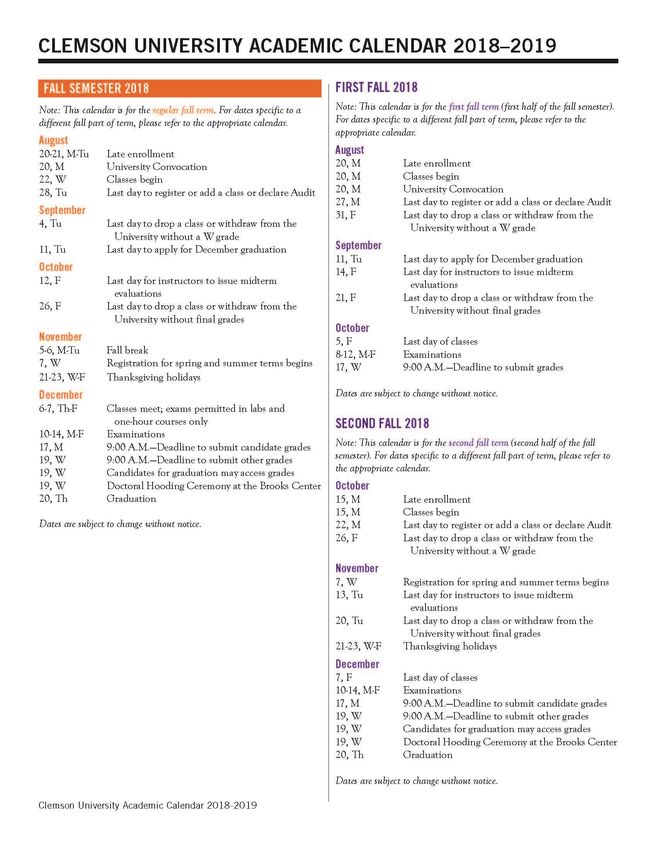
2018-2019 ACADEMIC CALENDAR

            II- 1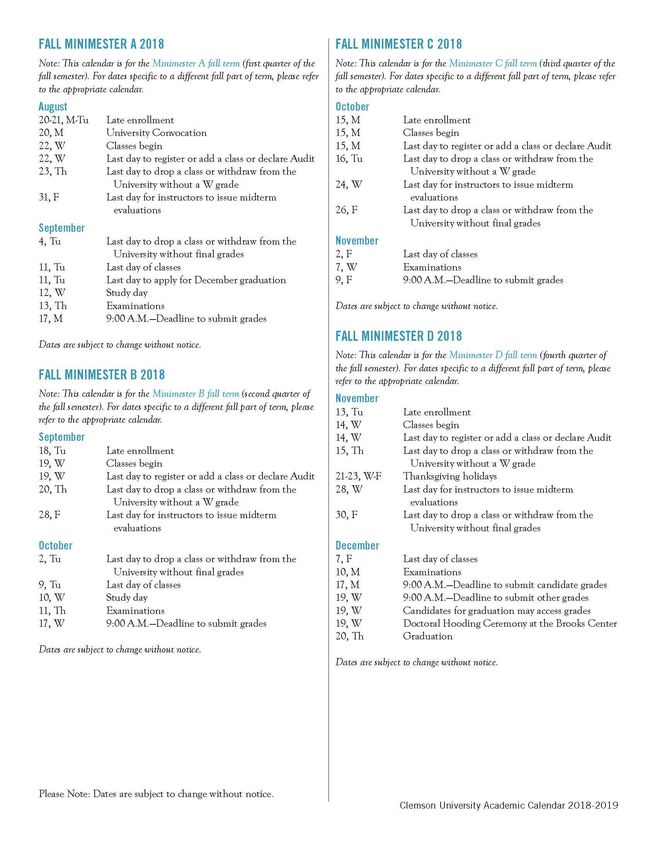
II- 2
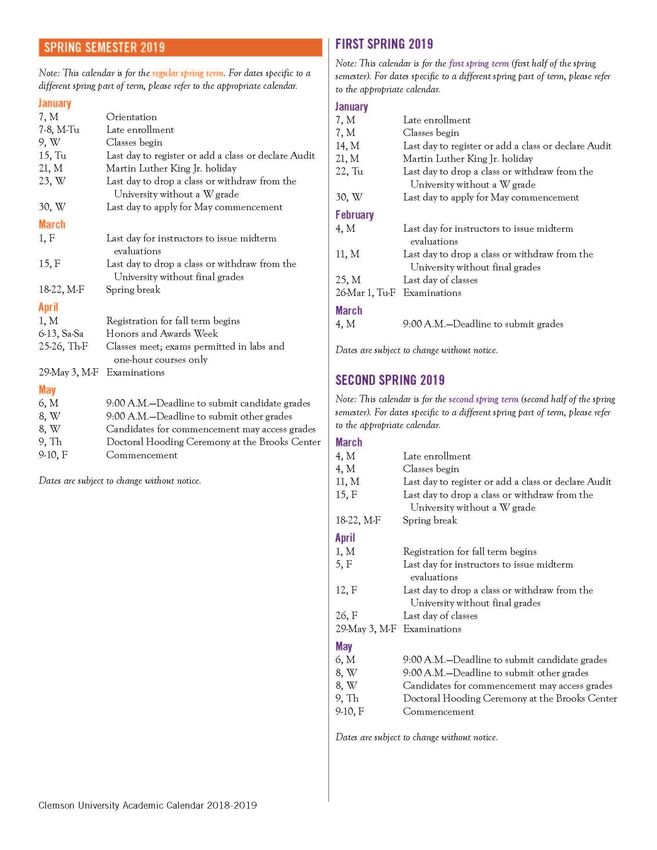
II- 3
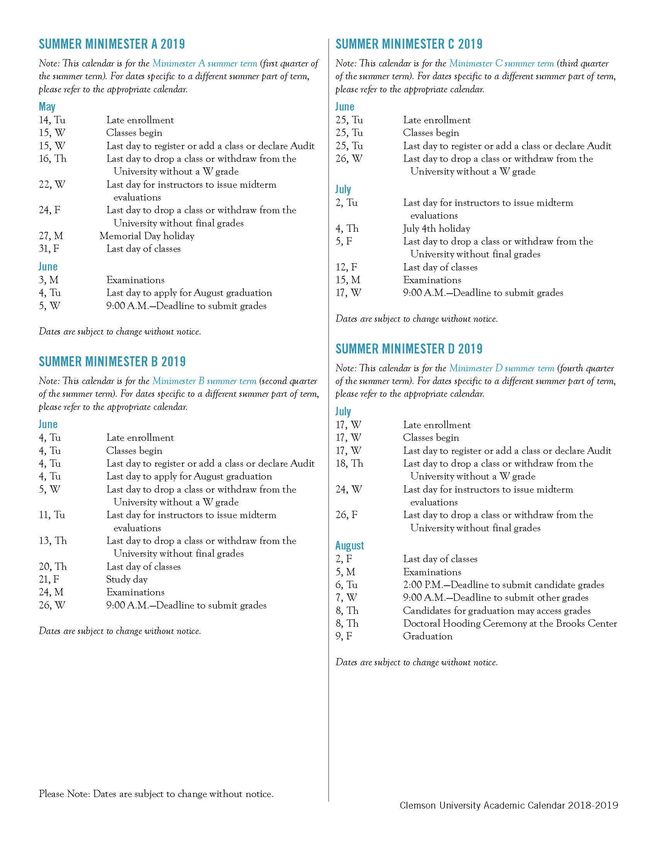
II- 4
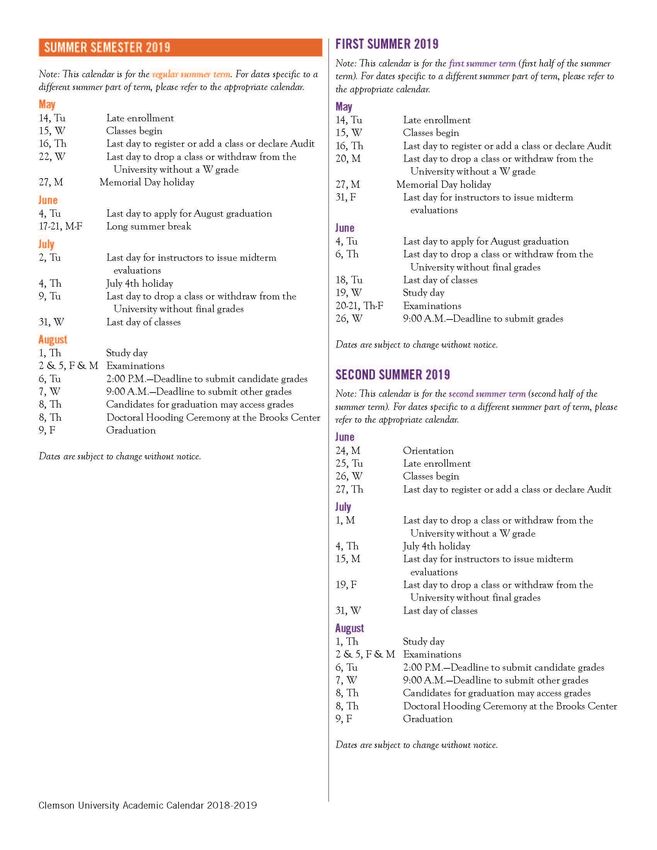
II- 5
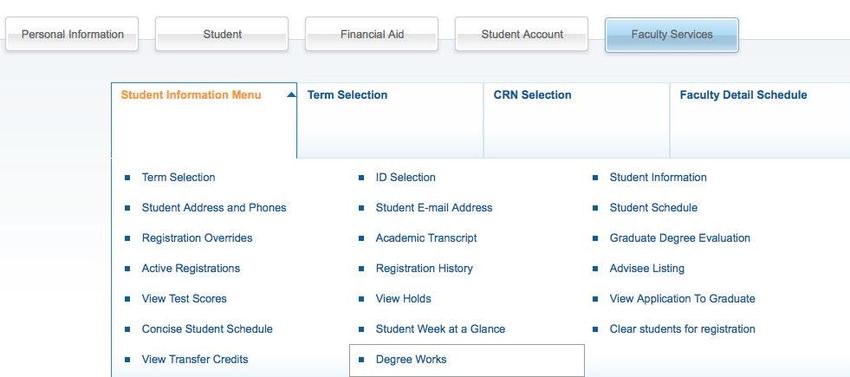
II- 6
ACADEMIC FORGIVENESS POLICY
Contact: Cal Becker, Associate Registrar, BCALVIN, 656-2174
The Academic Forgiveness Policy (AFP) allows a student enrolled beginning Fall 2013 to eliminate from
the GPA calculation up to three courses in which a D or F was earned. Students enrolled prior to Fall
2013 who were under the former Academic Redemption Policy will be allowed academic forgiveness on
a modified scale.
The following conditions apply:
Courses taken prior to fall semester 2003 may not be considered for academic forgiveness.
While D or F grades in required courses may be eliminated before the course is repeated, the
required course must be repeated satisfactorily at Clemson University before graduation. Both
grades will remain on the transcript, degree progress report, and other official documents. For
financial aid purposes, courses repeated under this policy resulting in duplicate credit do not
count for satisfactory academic progress.
The AFP shall apply only to courses taken at Clemson University. Course substitutions are not
permitted.
Candidates for graduation must request AFP by the deadline to submit candidate grades. See the
academic calendars at http://www.registrar.clemson.edu/html/Acad_Cal.htm
Students may not invoke the AFP after they have graduated. After graduation, students may
repeat coursework, but both grades will be calculated in the grade-point average.
The AFP may not be applied to a course taken on a Pass-No Pass basis or to any course in which
the student was previously found in violation of the academic integrity policy.
A completed Academic Forgiveness Request Form must be submitted to Enrolled Student Services in 104
Sikes Hall. (http://www.registrar.clemson.edu/html/acadForgiveness.htm) For a comparison of the former
Redemption Policy and current Forgiveness Policy, see below.
Redemption (old policy) Forgiveness (new policy)
Student decides when to use the Forgiveness Policy and must initiate the process
Redemption was an automatic process
with advisor
Forgiveness is not tied to withdrawal hours. Effective Fall 2013, students will not
Redemption was tied to withdrawal hours
have a limit on withdrawal hours
Courses required for degree must be retaken at Clemson. If the course is not
Course must be retaken at Clemson
required for the degree, it can be forgiven and does not have to be retaken.
Can apply to classes retroactive (i.e., current senior could forgive class from
freshman year) only for courses taken Fall 2003 or later
Limited to 10 hours of redemption Limited to three classes
For students who enrolled under the Academic Redemption Policy, remaining redemption hours have been converted to
Forgiveness courses (on a proportionate basis) as of Fall 2013. The scale used for the conversion is published online at
http://www.registrar.clemson.edu/html/acadForgiveness.htm
II- 7
ACADEMIC ELIGIBILITY POLICY
Contact: Julia Lusk, Student Services Manager, MCBRIDE, 656-3941

All students are expected to study and perform to the best of their abilities. The academic eligibility
standards listed below represent minimum levels required to remain enrolled at the University. A student
who fails to meet these standards is not making satisfactory academic progress and should seek additional
assistance from an academic advisor, the Academic Recovery Program, the Academic Success Center or
other appropriate University resources.

The evaluation for academic eligibility is separate from the evaluation for satisfactory academic progress
conducted by the Financial Aid office. Further information on satisfactory academic progress for financial
aid purposes can be found on page II-28 and at www.clemson.edu/financial-aid/applying/academic -
progress.html .

ACADEMIC ELIGIBILITY DEFINITIONS
The following terms identify levels of academic difficulty pertinent to a student’s academic eligibility.
    Academic Alert: A student who earns a semester grade-point average below 1.5, regardless of
    cumulative grade-point average, is placed on academic alert. No notation concerning academic alert
    will appear on the student’s permanent record.
    Academic Probation: A student who fails to maintain a cumulative grade-point average of 2.0 or
    higher is placed on academic probation. No notation concerning probation will appear on the student's
    permanent record. A student on academic probation may enroll in a maximum of 16 credit hours,
    unless permission for a higher course load is granted by the academic advisor. Students on academic
    probation are expected to participate in the Academic Recovery Program.
    Academic Suspension: A suspended student is ineligible to enroll in classes for the fall or spring
    semester immediately following the suspension notification. Suspension is for one semester only and
    the student is eligible to reenroll the following semester.
    Academic Dismissal: A student who enrolls after a suspension is subject to dismissal at the end of
    the next semester in which he/she does not meet the academic eligibility criteria listed below. The
    period of dismissal is for one calendar year and readmission is by appeal only. A dismissed student
    who is readmitted and again fails to meet academic eligibility standards will be permanently
    dismissed. Permanent dismissal may not be appealed, and a student permanently dismissed may not
    apply for Academic Renewal.
A student on academic probation enrolled for two consecutive semesters is evaluated to determine
academic eligibility. Eligibility for continued enrollment is evaluated at the end of each semester unless
otherwise indicated in this policy. Students who have completed only one semester will not be evaluated.

ACADEMIC ELIGIBILITY STANDARDS
A student on academic probation (below a 2.0 cumulative GPA) will remain academically eligible if one
of the following conditions is met.

        1. The student passes at least 12 credit hours and earns a 2.4 or higher semester GPA. Duplicate
           credits do not count as credits passed unless otherwise required to meet an alternative
           departmental standard.

                                                   II- 8
2. The student achieves the minimum cumulative grade-point average (MCGPA) listed below.
           Total Attempted Hours*                           MCGPA
                     16-29                                     1.75
                     30-59                                     1.85
                     60-89                                     1.95
                     90+                                       2.00
           *Total Attempted Hours includes all credit hours attempted at Clemson, plus
           any advanced standing earned from transfer credits and credits awarded from
           approved examination programs. Only grade points earned at Clemson are
           used to calculate the MCGPA.
        3. The student achieves a 2.0 or higher cumulative GPA.

ACADEMIC ELIGIBILITY EVALUATION
As described below, academic eligibility criteria are different for students who 1) have completed fewer
than three semesters, 2) have completed at least three semesters, 3) have been suspended, and 4) are
returning on appeal. Conditions of academic eligibility are described in the Academic Eligibility
Standards section.

    1. A student who has completed fewer than three fall and spring semesters will be evaluated at the
       end of his/her first spring semester unless he/she entered the University that semester. If the
       student is on academic probation for two consecutive semesters, he/she is eligible to enroll in the
       subsequent summer and fall semester but must meet academic eligibility standards in the fall
       semester to avoid suspension for the following spring semester. This term of suspension is not
       appealable. First time students have three full semesters of eligibility. If a student withdraws for
       one or more semesters, those semesters are not counted as eligible semesters.
    2. After a student has completed three or more fall and spring semesters, he/she will be evaluated at
       the end of each semester. If the student is on academic probation for two consecutive semesters,
       and fails to meet academic eligibility standards, he/she is will be suspended for the next regular
       (fall or spring) semester. A student subject to suspension at the end of spring semester is required
       to enroll in summer school at Clemson and meet academic eligibility standards to avoid
       suspension.
    3. A student who re-enrolls after being suspended is evaluated at the end of each semester until a
       cumulative grade-point average of 2.0 or higher is achieved. A previously suspended student who
       is on academic probation and fails to meet academic eligibility standards will be dismissed at the
       end of the following semester for one calendar year and permitted to re-enroll only as a result of a
       successful appeal.
    4. A student permitted to re-enroll due to a successful appeal of suspension or dismissal is evaluated
       at the end of each semester until a cumulative grade-point average of 2.0 or higher is achieved. A
       student who fails to meet academic eligibility standards will be suspended or dismissed,
       according to his/her academic situation.

                                                   II- 9
POTENTIAL ACADEMIC ELIGIBILITY OUTCOMES FOR
STUDENTS WHO HAVE COMPLETED FEWER THAN THREE SEMESTERS (FALL AND SPRING)
Scenario: Student’s first semester of enrollment is Fall 2018. Student’s CGPA falls below 2.0 at the conclusion of the Fall 2018 term.
Outcome: Student is on academic probation but can re-enroll in Spring 2019.
At conclusion of Spring 2019 term
Student achieves 2.0 CGPA: Student is in good standing and can re-enroll in Fall 2019.
Student remains below 2.0 CGPA but meets AE criteria: Student remains on academic probation but can re-enroll in Fall 2019.
Student does not meet *AE criteria: Student remains on academic probation but can re-enroll in Fall 2019.
At conclusion of Fall 2019 term
Student achieves 2.0 CGPA: Student is in good standing and can re-enroll in Spring 2020.
Student remains below 2.0 CGPA but meets AE criteria: Student remains on academic probation but can re-enroll in Spring 2020.
Student does not meet *AE criteria: Student is suspended for Spring 2020; there is no appeal process for this suspension.
Student can re-enroll beginning in Summer 2020.
AE Criteria (Must satisfy one of these criteria):
1. Pass at least 12 credit hours and earn 2.4 GPA at conclusion of current term of enrollment
2. Achieve minimum cumulative grade-point average (MCGPA)
Total Credit Hours MCGPA
16-29 1.75
30-59 1.85
60-89 1.95
90+ 2.00
at conclusion of current term of enrollment
3. Achieve a 2.0 or higher cumulative GPA at conclusion of current term of enrollment
II- 10POTENTIAL ACADEMIC ELIGIBILITY OUTCOMES FOR
STUDENTS WHO HAVE COMPLETED THREE OR MORE FALL AND SPRING SEMESTERS
Scenario: Student is a continuing student who enrolled for the first time prior to Fall 2018. Student’s CGPA is below 2.0 at the conclusion of the Fall 2018 term.
Outcome #1: Fall 2018 is NOT the student’s second consecutive term for failing to meet the AE criteria: Student remains on academic probation but can re-
enroll in Spring 2019
At conclusion of Spring 2019 term
Student achieves 2.0 CGPA: Student is in good standing and can re-enroll in Fall 2019.
Student meets AE criteria: Student remains on academic probation but can re-enroll in Fall 2019.
Student does not meet AE criteria: Student subject to suspension for Fall 2019
Student attends summer school and achieves 2.0 CGPA: Student is in good standing and can re-enroll in Fall 2019.
Student attends summer school and meets AE criteria: Student remains on academic probation but can re-enroll in Fall 2019.
Student attends summer school and does not meet AE criteria: Student is suspended for Fall 2019 but can reenroll beginning in Spring 2020.
Student can file an appeal and, if successful, can re-enroll in Fall 2019 but must meet AE criteria at the conclusion of Fall 2019 semester. If
AE criteria are not met at the conclusion of Fall 2019, student is suspended for Spring 2020; there is no appeal process for this suspension.
Student does not attend summer school: Student is suspended for Fall 2019 but can re-enroll beginning in Spring 2020. Student can file an
appeal and, if successful, can re-enroll in Fall 2019 but must meet AE criteria at the conclusion of Fall 2019 semester. If AE criteria are not
met at the conclusion of Fall 2019, student is suspended for Spring 2020; there is no appeal process for this suspension.
Student does not attend summer school and does not file an appeal: Student is suspended for Fall 2019 but can re-enroll in Spring 2020.
Outcome #2: Fall 2018 is the student’s second consecutive term for failing to meet the AE criteria: Student is subject to suspension for Spring 2019
Student files an appeal: If successful, the student can re-enroll in Spring 2019 but must meet AE criteria at the conclusion of Spring 2019
semester. If AE criteria are not met at the conclusion of Spring 2019, student is suspended for Fall 2019; there is no appeal process for this
suspension.
Student does not appeal: The student is suspended for Spring 2019 but can re-enroll in Fall 2019.
AE Criteria (Must satisfy one of these criteria):
1. Pass at least 12 credit hours and earn 2.4 GPA at conclusion of current term of enrollment
2. Achieve minimum cumulative grade-point average (MCGPA)
Total Attempted Hours MCGPA
16-29 1.75
30-59 1.85
60-89 1.95
90+ 2.00
at conclusion of current term of enrollment
3. Achieve a 2.0 or higher cumulative GPA at conclusion of current term of enrollment
II- 11STUDENTS SUBJECT TO DISMISSAL
Scenario: Student re-enrolls in Fall 2018 after suspension. Student’s CGPA is below 2.0 at the conclusion of the Fall 2018 term.
Outcome #1: The student meets one of the AE criteria at the conclusion of the Fall 2018 term. The student can re-enroll in Spring 2019.
At the conclusion of the Spring 2019 term
Student achieves 2.0 CGPA: Student is in good standing and is eligible to re-enroll in Fall 2019.
Student meets AE criteria: Student remains on academic probation but is eligible to re-enroll in Fall 2019.
Student does not meet AE criteria: Student is subject to dismissal for a calendar year
Student attends summer school and achieves 2.0 CGPA: Student is in good standing and is eligible to re-enroll in Fall 2019.
Student attends summer school and meets AE criteria: Student remains on academic probation but is eligible to re-enroll in Fall 2019.
Student attends summer school and does not meet AE criteria: Student is dismissed for a calendar year and must appeal for readmission.
Student can file an appeal and, if successful, can re-enroll in Fall 2019 but must meet AE criteria at the conclusion of the Fall 2019 semester.
If AE criteria are not met at the conclusion of Fall 2019, student is dismissed for a calendar year and there is no appeal process for this
dismissal. After a calendar year, the student must appeal for readmission.
Student does not attend summer school: Student is dismissed for a calendar year and must appeal for readmission. Student can file an
appeal and, if successful, can re-enroll in Fall 2019 but must meet AE criteria at the conclusion of the Fall 2019 semester. If AE criteria are
not met at the conclusion of Fall 2019, student is dismissed for a calendar year; there is no appeal process for this dismissal. After a calendar
year, the student must appeal for readmission.
Student does not attend summer school and does NOT file an appeal: Student is dismissed for a calendar year and must appeal for
readmission.
Outcome #2: The student does not meet one of the AE criteria at the conclusion of the Fall 2018 term: Student is subject to dismissal for a calendar year
Student can file an appeal: If successful, the student can re-enroll in Spring 2019 but must meet AE criteria at the conclusion of Spring 2019
semester. If AE criteria are not met at the conclusion of Spring 2019, student is dismissed for a calendar year; there is no appeal process for
this dismissal. After a calendar year, the student must appeal for readmission.
Student does not appeal: Student is dismissed for a calendar year and must appeal for readmission.
AE Criteria (Must satisfy one of these criteria)
1. Pass at least 12 credit hours and earn a 2.4 GPA at the conclusion of the current term of enrollment
2. Achieve minimum cumulative grade-point average (MCGPA) :
Total Credit Hours MCGPA
16-29 1.75
30-59 1.85
60-89 1.95
90+ 2.00
at the conclusion of the current term of enrollment
3. Achieve a 2.0 or higher cumulative GPA at the conclusion of the current term of enrollment.
II- 12WITHDRAWAL FROM COURSES POLICY
Contact: Reagan Blondeau, Assistant Registrar, BREAGAN, 656-2431
W GRADE POLICY
A grade of W indicates that the student withdrew from the course or was withdrawn by the instructor after the first two
weeks and prior to the last five weeks of classes, not including the examination period. Proportionate time periods apply
during summer and other shortened sessions.
Students who withdraw from a course will have a W recorded on their transcripts for the course. W grades will not post on
official transcripts until after grades have been calculated for the term.
WITHDRAWAL-RELATED DATES
During the first two weeks of class, students may drop courses without having their enrollment in the course(s) reflected
on their official record. The deadline to drop a course without record is September 5 for the fall term and January 24 for
the spring term. Proportionate time periods apply during summer and other shortened sessions.
After October 26 for the fall term and after March 15 for the spring term, students cannot withdraw from their courses and
will have final grades recorded.
PROCEDURE FOR WITHDRAWAL FROM LAST COURSE
Students are not allowed to drop their last remaining class. Prior to the first day of class, students wishing to withdraw
from the University must submit a Withdrawal Prior to First Day of Classes form
(www.registrar.clemson.edu/html/forms.htm) in order to drop their last class. Beginning with the first day of class,
students must submit a Withdrawal Request form (www.registrar.clemson.edu/html/forms.htm ) to withdraw from the
University since dropping the last class ends their enrollment for the term. For more information about withdrawing from
the University, review page II-14.
Visit www.registrar.clemson.edu/html/forms.htm for the appropriate form:
Withdrawal Prior to First Day of Class (prior to the start of classes)
Withdrawal Request (once classes have started)
STUDENT ATHLETES
Student athletes cannot drop a course that would cause their enrollment to fall below 12 credit hours.
REGISTRATION CORRECTION FORM
The Registration Correction form (www.registrar.clemson.edu/secure/f2/regForm.htm) may be used by instructors who
wish to drop students after the deadlines above.
II-13WITHDRAWAL FROM THE UNIVERSITY
Contact: Jeff Appling, Associate Dean, JAPPLIN, 656-3022
A student may withdraw from the University subject to the restrictions in the section on W-Withdrew. Prior to the
last day to withdraw from classes, students may withdraw via the iROAR registration portal. All military service or
medical withdrawals must be processed by the Associate Dean of Undergraduate Studies. Students should report to
E-103 Martin Hall.
Students receiving financial aid who withdraw from the University may have to repay significant portions of their
financial aid. Students should report to G-01 Sikes Hall to determine the repayment amount. For financial aid
purposes, enrollment is defined and satisfactory academic progress levels are established as of midnight on the last
day to drop without a W grade. Withdrawing from the University can negatively impact financial aid eligibility if a
student has not completed a sufficient number of hours. Details are available at
http://www.clemson.edu/financial-aid/ .
II-14CHANGE OF ACADEMIC PROGRAM
AND CHANGE OF CURRICULUM YEAR
GENERAL GUIDELINES FOR CHANGING ACADEMIC PROGRAMS
To start the process to change an academic program, students must submit a Change of Academic Program form via
iROAR. To complete the form, a student would go to the Student Records tab and select Change of Program (GS 14
and Undergrad).
1. When new freshmen and transfer students enroll at Clemson, most are accepted into a particular academic
program. Two notable exceptions are 1) engineering students who must enroll in General Engineering their
first year and 2) business students who must enroll in Pre-Business their first year. See paragraph 4 below for
related comments on these two groups. Additionally, approximately 200 students are accepted each year as
undeclared students.
2. At orientation and prior to the start of classes, the Admissions Office approves and processes changes of
academic program requests for new freshmen and transfer students.
3. Once classes begin, students must use the Change of Academic Program form via iROAR. Students wishing
to change academic programs should talk with an advisor in both departments. Students should gain the
acceptance in the new academic program prior to disengaging from the current one. Many academic
departments have established one or more conditions, such as a minimum GPA, an application process, etc.,
that must be satisfied before approving a student’s request to change academic program. Students are
usually assigned to the curriculum year in effect at the time of the academic program change. Once the
Change of Academic Program workflow has been approved, Enrolled Student Services will process the
request.
4. All engineering students must complete the first-year General Engineering curriculum before being admitted
into a specific engineering program (Civil, Electrical, Mechanical, etc.). All new business students must
complete the first-year Pre-Business curriculum before being admitted into a specific business degree
program (Accounting, Economics, Management, etc.). Both curricula have minimum GPA requirements that
must be satisfied before students can advance to a specific degree-granting academic program. Advisors in
both programs assist students in selecting a specific academic program and curriculum year.
5. If a student withdraws from the University or does not remain continuously enrolled (summer terms
excluded), he/she is readmitted into the academic program in which he/she was last enrolled.
Please refer to the Departmental Change-of-Academic Program Requirements section on page II-17 in this manual
for departmental- and/or program-specific restrictions.
RESOURCES FOR STUDENTS CONSIDERING A CHANGE OF ACADEMIC PROGRAM
If a student is considering changing academic programs and is unsure of which new academic program to choose,
the Michelin Center for Career and Professional Development (MCCPD) can help. The Center offers career
assessments that can help students understand their interests, skills and abilities and relate to Clemson’s academic
programs and the world of work. Students may stop by the MCCPD, located in 316 Hendrix Student Center, to take
an assessment from 9:00am - 12:00pm or 1:30pm – 4:00pm. Students may also call 864-656-6000 to schedule an
appointment.
II-15CHANGING CURRICULUM YEAR
1. When students initially enroll at Clemson, the curriculum requirements for the degree in their academic
program are those outlined in the Undergraduate Announcements in effect at the time of their enrollment.
The Undergraduate Announcements (undergraduate catalog) is published annually around May 15 and is in
effect for 12 months until the following May 15.
2. If a student who has not remained continuously enrolled (summers excluded) at the university chooses to
re-enroll, the student´s curriculum year is changed to the one in effect at the time of re-enrollment for
students with fewer than 90 credits. For seniors (90 credits and more), the curriculum year remains the same
as when they were last enrolled. The student´s academic program department can approve an exception. A
Change of Academic Program form must be submitted via iROAR to change a student’s Curriculum Year.
3. When transfer students first enroll at Clemson, they are assigned the curriculum in effect for their academic
program based on the Undergraduate Announcements in effect at the time they enroll at Clemson. As an
alternative, transfer students may select the curriculum in effect in the Undergraduate Announcements at the
time they entered the previous college(s), provided they have been in continuous enrollment since initially
entering college. Further, transfer students may select any curriculum at Clemson subsequent to their initial
college enrollment. New transfer students should meet with an advisor in their academic program department
to determine which curriculum year is best for them. New transfer students wanting a curriculum year
different from the one in effect when they transfer to Clemson should talk with their advisor and submit a
Change of Academic Program form via iROAR.
4. Enrolled students who wish to change curriculum year within their current academic program (or who have
been pursuing an academic program curriculum in order to complete requirements to change their academic
program) should first meet with their academic advisor to discuss 1) the advantages, disadvantages,
availability of required courses that must be taken and 2) earned courses that can be used in the new
curriculum. Students must receive approval to change their curriculum year requirements. A Change of
Academic Program form must be submitted via iROAR.
II-16DEPARTMENTAL CHANGE OF
ACADEMIC PROGRAM REQUIREMENTS
CHANGE OF ACADEMIC PROGRAM POLICY
Any undergraduate student who meets Academic Eligibility requirements may transfer from one major to another major,
subject to departmental enrollment restrictions and entrance requirements as stated elsewhere in the Undergraduate
Announcements. Any college or department that seeks an exception to this policy must have the approval of Academic
Council.
Candidates for graduation must be officially accepted in the major for which they are applying for a degree no later than
the date applications for diplomas are due.
DEPARTMENTAL CHANGE OF ACADEMIC PROGRAM INFORMATION AND CONTACTS
Please contact the appropriate departmental representative for the most current information on change-of-academic
program requirements for a particular department.
COLLEGE OF AGRICULTURE, FORESTRY AND LIFE SCIENCES
AFLS Undeclared Any student desiring a CAFLS academic program but unsure of which academic program
will be suitable or unable to meet academic requirements for the desired academic
program may initially switch to AFLS Undeclared.
Contact: Katie Black, (hulse@clemson.edu), 864-650-0621, F153 P&A
Agricultural Education Contact: Christi Leard (ccampb3@clemson.edu); 656-4082, 244 McAdams
Phil M. Fravel (fravel@clemson.edu); 656-6947; 238 McAdams
Agribusiness Contact: Christi Leard (ccampb3@clemson.edu); 656-4082, 244 McAdams
Agricultural Mechanization
& Business Contact: Christi Leard (ccampb3@clemson.edu); 656-4082, 244 McAdams
Hunter Massey (massey4@clemson.edu); 656-4056; 249 McAdams
Animal & Veterinary Students wishing to change their academic program to Animal Veterinary Sciences must
Sciences have earned a minimum 2.5 GPA.
Contact: Glenn Birrenkott (gbrrnkt@clemson.edu); 656-4019; 140 P&A
Jason Allen (ja6@clemson.edu); 656-3162; 131 P&A
Environmental & Contact: Amy Sanders, (amybs@clemson.edu); 656-4840; 265 Lehotsky
Natural Resources
Environmental & Natural Any student interested in ENR and unsure of which concentration to go
Resources Undeclared into should contact Amy Sanders, (amybs@clemson.edu); 656-4840; 265 Lehotsky
Food Science and Human Food Science & Technology Concentration:
Nutrition Contact: Sara Cothran (sstanci@clemson.edu); 864-508-0875; 210 P&A
Nutrition Concentration:
Students wishing to change into the Dietetics emphasis within the Nutrition concentration
must meet the following requirements:
II-17For Dietetics emphasis,
1. Complete at least 60 credit hours by the end of the semester the student is applying.
2. Have a minimum GPA of 3.20.
3. Complete BIOL 1030 and BIOL 1050 (or BIOL 1100), BIOL 1040 and BIOL 1060 (or
BIOL 1110), CH 1010, CH 1020, CH 2230, CH 2270, and BIOL 2220 with a C or better.
4. Complete FDSC 1010, PSYC 2010, ECON 2000 or 2120, NUTR 2030 and NUTR 2160
with a B or better.
5. Complete a Dietetics emphasis application form by the beginning of either spring semester
or fall semester.
Students with a GPA of less than 3.2 GPA but greater than 3.0 are conditionally accepted
with final acceptance based on posted semester grades. Students are allowed to apply up to
two times. Once in the Dietetics emphasis, a student may complete the curriculum, but
must maintain a minimum GPA of 2.0. To receive a signed Declaration of Intent and/or
Verification Statement, students must comply with the GPA, grade and other requirements
indicated in the “Declaration of Intent and Verification Statement Policy.” A signed
Verification Statement is required for admission to an ACEND-accredited dietetic
internship program, but receipt of a Verification Statement does not guarantee acceptance
into an ACEND-accredited dietetic internship program. (See the FNPS Handbook for more
details.)
To receive a signed Declaration of Intent and/or Verification Statement, a student must
meet the following academic and professional requirements:
1. Earn a minimum of a baccalaureate degree from a U.S. regionally accredited
college/university.
2. Complete all the academic requirements of a dietetics education program accredited by
ACEND.
3. Demonstrate an overall minimum GPA of 3.0 based on all completed college
coursework.
4. Complete all DPD-required NUTR and FDSC courses with a B or better.
5. Complete all other DPD-required coursework with a C or better.
6. Adhere to Clemson University’s Academic Integrity Policy and the Student Code of
Conduct.
Contact: Lacey Durrance (edurran@clemson.edu); 656-7716; 215 P&A
Forest Resource Contact: Amy Sanders, (amybs@clemson.edu); 656-4840; 265 Lehotsky
Management
Horticulture Contact: Lisa Flick (lcflick@clemson.edu); 656-3683; 170 P&A
Packaging Science Students wishing to change their academic program to Packaging Science must have
earned a minimum 2.0 cumulative GPA, complete four (4) of the following courses with
an average GPA of 2.7—BIOL 1030, BIOL 1040, CH 1010, CH 1020, PHYS 2070,
PHYS 1220, PHYS 2080, PHYS 2210, MTHS 1060 (or 1040 +1070), and complete
PKSC 1020 with a grade of B or better.
Contact: Tyler Stuettgen (tstuett@clemson.edu) 864-552-0658; 234 P&A
Glenda Brown (gbrwn@clemson.edu); 656-5698; 224 P&A
Plant & Environmental Contact: Lisa Flick (lcflick@clemson.edu); 656-3683; 170 P&A
Sciences
Turfgrass Contact: Lisa Flick, (lcflick@clemson.edu); 656-3683; 170 P&A
Wildlife & Fisheries Biology Contact: Amy Sanders, (amybs@clemson.edu); 656-4840; 265 Lehotsky
II-18COLLEGE OF ARCHITECTURE, ARTS, AND HUMANITIES
SCHOOL OF DESIGN AND BUILDING
Architecture Students' applications for acceptance into the program are reviewed at the end of fall
semester each year. Candidates must first complete ARCH 1010 and earn a 2.7
cumulative GPA at the end of the fall semester. Students will be accepted into the
academic program based on GPA, space availability and their performance
in ARCH 1010. Students who have been accepted into the program will be notified
before the start of the spring semester.
Contact: Timothy Brown (tb2@clemson.edu) 656-3914, Lee Hall 3-132
Construction Science Change of academic program requests are considered only once a year,
& Management normally in May or June. To receive consideration for a change of academic program,
students must complete an application form and have their names placed on the waiting
list. Students must have 1) completed ENGL 1030, PHYS 2070 and 2090, and MTHSC
1020 or 1060; 2) earned at least 30 semester credit hours with at least 24 of the 30 credit
hours completed at Clemson; and 3) earned a minimum 2.7 cumulative GPA by the end
of the spring semester of the year the change of academic program request is made.
Students who do not meet the minimum requirements at the end of the spring semester
will not be considered.
Contact: Deborah Anthony, (adebora@clemson.edu); 656-0181; 2-122 Lee Hall
Landscape Architecture Contact: Matthew Powers (powers8@clemson.edu); 656-4408; 3-116 Lee Hall
Michelle Marchese (marches@clemson.edu); 656-3926; 3-112 Lee Hall
SCHOOL OF THE ARTS
Performing Arts To be considered for a change of academic program to Performing Arts, students must
pass an interview and/or audition with departmental faculty and have earned at least a 2.8
GPA.
Contact: David Hartmann (hartmad@clemson.edu); 656-3043; 221 Brooks Center
(Retiring in July)
After July: contact Beth Anne Johnson (elamar@clemson.edu); 221 D Brooks Center
Art (B.F.A.) Contact: Valerie Zimany (vzimany@clemson.edu); 656-3880; 2-121 Lee
SCHOOL OF HUMANITIES
English Contact: Keri Crist-Wagner (kcristw@clemson.edu); 656-3153; 816 Strode
History Students requesting to change their academic program to History must have completed at
least 12 credit hours at Clemson and have either earned a minimum 2.0 cumulative GPA
or have completed HIST 1720 or 1730 at Clemson with a grade of A or B.
Contact: James Burns (burnsj@clemson.edu); 656-5373; 126 Hardin
II-19Language & Students who have completed fewer than 50 credit hours with a
International Health minimum cumulative GPA of 2.5 may change their academic program to Language and
International Health. Students with 50 or more credit hours with a minimum cumulative
GPA of 2.75 may apply for a change of academic program into Language and
International Health; academic program change approvals will be based on space
availability.
Contact: Lindsey Kovach (lgillen@clemson.edu); 656-3393; 701 Strode
Language & Contact: Lee Ferrell (ferrell@clemson.edu); 656-3393; 501 Strode
International Trade
Modern Languages Contact:
(American Sign Language, American Sign Language: Stephen Fitzmaurice (sfitzma@clemson.edu)
Chinese, French, German, 864-431-7778, 705 Strode Tower, CU 105, University Center of Greenville
Italian, Japanese, Spanish) Chinese: Yanming An (yanming@clemson.edu); 656-3544; 614 Strode
French: Joe Mai (jmai@clemson.edu); 656-3393; 509 Strode
German: Johannes Schmidt (schmidj@clemson.edu), 656-3393; 704 Strode
Italian: Luca Barattoni (lbaratt@clemson.edu); 656-3393; 303 Strode
Japanese: Jae Takeushi, (jtakeuc@clemson.edu); 656-3393; 313 Strode
Spanish: Allison Hinds (aaw3@clemson.edu); 656-3933; 710 Strode
Pan African Studies Contact: Abel Bartley (abartly@clemson.edu); 656-5372; 108 Hardin
Philosophy Contact: Steve Satris (stephen@clemson.edu); 210 Hardin
Religious Studies Contact: Steven Grosby (sgrosby@clemson.edu); 656-7907 ext. 13; 218 Hardin
Benjamin White (bwhite5@clemson.edu); 656-7907 ext. 19; 222 Hardin
Mashal Saif (msaif@clemson.edu); 214 Hardin Hall
Elizabeth Jemison (ejemiso@clemson.edu) 864-656-2001, 220 Hardin
Women’s Leadership Contact: Diane Perpich (dperpic@clemson.edu); 656-1532, 224 Hardin
Undeclared/Exploratory Only those students who have earned 45 or fewer credit hours may change into
Humanities Undeclared.
Contact: Jessica Owens, (dean4@clemson.edu); 656-2365; 201 ASC
II-20COLLEGE OF BEHAVIORAL, SOCIAL AND HEALTH SCIENCES
Anthropology Students wishing to change their academic program to Anthropology must have earned at
least 12 credit hours at Clemson and must have a minimum 2.0 cumulative GPA.
Contact: Stacey Marcus, (staceym@clemson.edu); 864-656-0371; 309 Edwards
Communication Students may change their academic program to Communication based on approval from
a Department of Communication faculty committee. The deadline for applying for a
change of academic program during the fall semester is September 15 with decisions
made by October 1. For spring semester changes of academic program, the deadline is
February 15 with decisions made by March 1. A maximum of 30 changes of academic
program are accepted per year. To qualify for a change of academic program, applicants
should have completed 15 credit hours at Clemson University, including ENGL 1030
(transfer credit accepted) and COMM 2010. A C or better must be earned in ENGL 1030
and COMM 2010. All students must have earned a 2.5 GPA or higher. An application
and a writing sample are also required. The typical profile of a successful applicant
granted a change of academic program includes a GPA of well above 3.0, a superior
writing sample, and an overall application which demonstrates an understanding of and
commitment to a career in communication. For the most up to date requirements and
information visit
https://www.clemson.edu/cbshs/departments/communication/academics/undergraduate/c
ommunication/apply-undergraduate.html
Contact: Emma Stephens (easteoh@clemson.edu): 656-5506, 309 Edwards
Criminal Justice Students wishing to change their academic program to Criminal Justice must have earned
at least 12 credit hours at Clemson and must have a minimum 2.0 cumulative GPA.
Contact: Stacey Marcus, (staceym@clemson.edu); 864-656-0371; 309 Edwards
Health Science An application is required to change into Health Science. The process is very
competitive, and applications are accepted in the Fall semester starting on the first day of
class with a deadline of the last day of class. Students are allowed to apply once per year
and are limited to a total of two submissions while at Clemson. Decisions are based on
available space, GPA, and earned academic credit. Applications are reviewed by the
Department of Public Health Science Advisory Committee. Changing into Heath Science
is not guaranteed. Students are encouraged to apply during the first semester of their
freshman year due to space limitations. Students applying in their sophomore year must
have completed all freshman science and math requirement plus the Statistics
requirement for their specified concentration. Students should contact Kristin Goodenow
as soon as possible to learn more specifics.
Contact: Kristin Goodenow (kristig@clemson.edu); 656-5123; 309 Edwards
Nursing Students may change academic programs into Nursing based on the approval of an
admissions committee in the School of Nursing. Applications are accepted each year
during January with a submission deadline of January 31. Decisions will be made in
February and students will be notified by March 1. There will be two applications. One
will be an application for freshmen students who have completed only one semester of
college course work who, if accepted, will remain on track to graduation. Students should
not count advanced credit standing from AP and IB examinations and high school dual
enrollment credit if applying in this category. Seats in this group will be very limited and
therefore acceptance is extremely competitive. The second application will be for all
II-21other students, including those who have transferred from another institution to Clemson,
and have been enrolled at Clemson for at least one semester (full-time), with sophomore
and higher standing including transfer credit. Students approved to change into nursing as
a sophomore [spelling correction] will have a start date of the following January for
enrolling in upper-division (junior-level clinical) nursing courses and should expect to
complete the full program in 4.5 years total. All applicants should meet the following
minimum requirements prior to the semester of application: a GPA of 2.75, and
completion of a minimum of two required sciences in the Nursing curriculum with a C or
better. Selection priority is based on GPA, number of completed nursing prerequisites,
and grades in the science courses required for Nursing. Students are also expected to
enroll in 14-16 credit hours of course work for a back-up academic program in the
fall/spring semesters, not in random elective courses. Students are allowed to apply only
twice for a change into nursing. Detailed information is available from the CBSHS
Academic Advising Center in 309 Edwards Hall or at www.clemson.edu/nursing
Contact: Adam McFarlane, Ph.D. (armcfar@clemson.edu), 864-656-1503; 309 Edwards
Parks, Recreation &
Tourism Management
(except PGM) Students wishing to change their academic program to one of the PRTM concentrations
may do so when space is available if they have a 2.0 cumulative GPA and approval of the
department chair or the chair’s designee. Students are encouraged to speak with the
PRTM advisor about changing their academic program prior to the start of their
sophomore year to avoid a delay in graduation due to course sequencing and course
prerequisite requirements. Bridge to Clemson students are also advised to change into
PRTM prior to enrolling at Clemson. Students changing into PRTM prior to their
sophomore year will be enrolled in 15 credits of PRTM in the fall of their sophomore
year.
Contact: Stacey Marcus, (staceym@clemson.edu); 864-656-0371; 309 Edwards
PGA Professional Contact: Rick Lucas (rlucas@clemson.edu); 656-0112; 128 Lehotsky
Golf Management
Political Science Students wishing to change their academic program to Political Science must have earned
at least 12 credit hours at Clemson and must have a minimum 2.0 cumulative GPA.
Contact: Freshman/Sophomore- Kristin Goodenow (kristig@clemson.edu); 656-5123;
309 Edwards
Junior/Senior- Adam Warber, (awarber@clemson.edu); 656-1828; 232 Brackett
Psychology Students wishing to change their academic program to Psychology must attend a
mandatory change of academic program meeting. At the time of the meeting, a student
must have a 2.4 cumulative GPA based on 12 or more credits completed at Clemson or in
the Bridge Program. Preregistration for the meeting is required. Complete instructions are
available at
http://www.clemson.edu/cbbs/departments/psychology/undergraduate/changemajor.html.
Students who do not yet meet the requirements to change into Psychology will also find
useful information at the above URL.
Contact: Jeff Moore (jtmoore@clemson.edu); 656-2570; 327 Brackett
Sociology Students wishing to change their academic program to Sociology must have a minimum
2.0 cumulative GPA.
II-22Contact: Contact: Stacey Marcus, (staceym@clemson.edu); 864-656-0371; 309 Edwards
Sports Communication Students wishing to change their academic program to Sports Communication must have
approval of a Department of Communication faculty committee. The deadline for
applying for a change of academic program during the fall semester is September 15 with
decisions made by October 1. For spring semester changes of academic program, the
deadline is February 15 with decisions made by March 1. To qualify for a change of
academic program, applicants should have completed 15 credit hours at Clemson
University, including ENGL 1030 (transfer credit accepted) and COMM 2010. A ‘C’ or
better must be earned in ENGL 1030 and COMM 2010. All students must have earned a
2.5 GPA or higher. An application and a writing sample are also required. The typical
profile of a successful applicant granted a change of academic program includes a GPA
of well above 3.0, a superior writing sample, and an overall application which
demonstrates an understanding of and commitment to a career in communication. For the
most up to date requirements and information, visit
https://www.clemson.edu/cbshs/departments/communication/academics/undergraduate/sp
orts-communication/apply.html
Contact: Emma Stephens (easteph@clemson.edu); 656-5506, 309 Edwards
II-23COLLEGE OF BUSINESS
With the exception of the Economics BA and Graphic Communications programs, all Business School change of
academic program requests (students changing into or out of pre-business, into any business program, and between any
business programs) are processed by the Business School Academic Advising Center located in G-02 Sirrine Hall. The
Economics department processes academic program requests into and out of the Economics BA program and the Graphic
Communications department processes change of academic program requests into and out of Graphic Communications.
Pre-Business Students wishing to change their academic program to Pre-Business must have 1)
completed at least 12 credit hours at Clemson and 2) a minimum 2.0 Clemson cumulative
GPA.
Contact: Business School Advising Center, G-02 Sirrine
A-E Kristy Lockhart kristyl@clemson.edu 656-2526
F-H Melonee Yearwood meloney@clemson.edu 656-3943
I-P Emily Danuser edanuse@clemson.edu 656-2826
Q-Z Suerea Wooten swooten@clemson.edu 656-6956
Business Degree Programs To be eligible for admission into the B.S. degree programs in Accounting, Economics,
Financial Management, or Management, students must have completed the courses
outlined in the Pre-Business first-year core curriculum and have a Clemson/Bridge
cumulative GPA of 2.0 or higher. Students wishing to enter the marketing program must
have completed the pre-business first-year core curriculum and have a Clemson/Bridge
cumulative GPA of 3.0 or higher. Students should initiate a change-of-academic
program request with the Business School Academic Advising Center after completing
the first-year core curriculum. Students who fail to meet the requirements for admission
to a degree-granting business program may remain in Pre-Business until those
requirements are met, but only until completion of 64 credit hours. Students who exceed
64 credit hours and still do not meet the requirements for admission into a degree
program must declare another academic program.
Contact: Business School Advising Center, G-02 Sirrine
A-E Kristy Lockhart kristyl@clemson.edu 656-2526
F-H Melonee Yearwood meloney@clemson.edu 656-3943
I-P Emily Danuser edanuse@clemson.edu 656-2826
Q-Z Suerea Wooten swooten@clemson.edu 656-6956
Economics B.A. Students wishing to change their academic program to B.A. in Economics must have
completed at least 12 credit hours at Clemson and must have a 2.0 minimum
Clemson/Bridge cumulative GPA.
Contact: Robert Fleck (rfleck@clemson.edu); 656-3964; 228B Sirrine
Graphic Communications Students wishing to change their academic program to Graphic Communications must
have earned 1) a minimum 2.0 cumulative GPA, 2) 12 or more credit hours at Clemson,
and 3) a B or better in GC 1020.
Contact: Amanda Menefee (menefee@clemson.edu); 656-3447; 207 Godfrey Hall
II-24COLLEGE OF EDUCATION
Education Changing into academic programs in Education is highly competitive and limited in Early
Childhood Education, Elementary Education, and Special Education. The process
involves a formal application and an essay. Requests for a change of academic program
application can be made by appointment with an advisor. Students wishing to change
into any education academic program must have a minimum GPA of 2.75; however,
applicants’ GPA are often higher. Applications are accepted only in the fall with a
submission deadline of the first Wednesday in December. For more information, visit
http://www.clemson.edu/academics/dcas/advising/education/change-of-major/
Early Childhood Education Contact: Staci Koonce (skoonce@clemson.edu); 656-0491; 309 105-A Tillman Hall
Elementary Education
Secondary Education: (Math Contact: Jamie Garland (jgarlan@clemson.edu); 656-3180; 105-B Tillman Hall
English, Social Studies),
Math Teaching, Science Teaching,
Special Education
II-25COLLEGE OF ENGINEERING, COMPUTING AND APPLIED SCIENCES
General Engineering Students currently enrolled in a non-engineering academic program wishing to change
their academic program to any engineering academic program must first change into the
General Engineering (GE) program. Students cannot change directly into a specific
engineering academic program. To obtain approval to change into GE, a student must
first 1) meet with a GE advisor; 2) complete the following courses with a grade of C or
better: MATH 1060 (or MATH 1040 + 1070); CH 1010, and ENGR 1020 (or ENGR
1050 + 1060); and 3) have a cumulative GPA of 2.0 or higher.
Changing from GE into an engineering degree program is contingent on 1) completing
the GE courses required by the individual engineering department with a grade of C or
better and 2) earning the minimum cumulative GPA set forth by the individual
engineering department. Refer to the current University Announcements for specific
engineering curricula and departmental requirements.
Contact: General Engineering Advising Center; 656-2541; 1st Floor Lever
Computer Information Students wishing to change their academic program to Computer Information Systems
Systems must have a minimum 2.0 cumulative GPA. For more information, visit
https://www.clemson.edu/cecas/departments/computing/academics/undergrad_students/a
dvising/index.html
Contact: Chris Plaue (cplaue@clemson.edu); 656-6933; 106 McAdams Hall
Computer Science Students wishing to change their academic program to Computer Science must have a
minimum 2.0 cumulative GPA. For more information, visit
https://www.clemson.edu/cecas/departments/computing/academics/undergrad_students/a
dvising/index.html
Contact: Chris Plaue (cplaue@clemson.edu); 656-6933; 106 McAdams Hall
Geology Contact: Alan Coulson (acoulso@clemson.edu); 656-1897; 339 Brackett
II-26COLLEGE OF SCIENCE
Biochemistry Contact: Alison Starr-Moss (astarr@clemson.edu); 656-6877; 158 P&A
Biological Sciences Students wishing to change their academic program to Biological Sciences must have a
minimum 2.4 cumulative GPA. Upon meeting this requirement, students may change
their academic program to Biological Sciences during non-peak advising times.
Contact: Londan Means (londanm@clemson.edu); 656-3604, 124 Long
Noelle Waggett (nwagget@clemson.edu); 656-5074, 129 Long
Chemistry Contact: Dennis Taylor (dftay@clemson.edu); 656-2680; 265 Hunter
Kris Coleman (kcolem3@clemson.edu); 656 3089, 219 Hunter.
Genetics Contact: Alison Starr-Moss (astarr@clemson.edu); 656-6877; 158 P&A
Mathematical Sciences Contact: Leo Rebholz (ugcmath@clemson.edu); 656-6404; O-102 Martin
Microbiology Students wishing to change their academic program to Microbiology must have a
minimum 2.4 cumulative GPA. Upon meeting this requirement, students may change
their academic program to Microbiology during non-peak advising times.
Contact: Londan Means (londanm@clemson.edu); 656-3604, 124 Long
Noelle Waggett (nwagget@clemson.edu); 656-5074, 129 Long
Physics and Astronomy Contact: Chad Sosolik (sosolik@clemson.edu); 656-0310; 206 Kinard
NON-DEGREE PREPROFESSIONAL HEALTH STUDIES
Prepharmacy Contact: Adam Hunter (hunter3@clemson.edu); 656-3288, 105 Long
Preprofessional Health Contact: Adam Hunter (hunter3@clemson.edu); 656-3288, 105 Long
II-27FINANCIAL AID
CONTACT: Offices of Student Financial Aid and Scholarships, G-01 Sikes Hall, 656-2280, finaid@clemson.edu
APPLYING FOR FINANCIAL AID
Application for financial aid is complete when 1) a student has been accepted to the University as a degree-seeking
student and 2) the Office of Student Financial Aid has received all required documents, including a federally processed
FAFSA (Free Application for Federal Student Aid). Students may complete the FAFSA electronically at www.fafsa.gov.
The code used to list Clemson on the FAFSA is 003425. Students and parents of dependent students need a FSA ID to file
electronically without a signature, to make corrections online, and to renew their FAFSA the following year. To request or
change a FSA ID, students or parents may go to https://fsaid.ed.gov.
The FAFSA can be submitted beginning October 1 for 2018-19. To be considered for all federal and state financial aid
programs, the FAFSA priority deadline is January 1 for entering freshmen and April 1 for continuing students.
Applications for PLUS and private loans must be completed no later than June 15 to be available for fall payment.
All records used in completing the FAFSA and other applications should be saved in case they are needed for verification
purposes later. Students may view their student account information online in iROAR.
All accepted freshmen and continuing students are automatically considered for University-administered scholarships.
Students’ official Clemson records are reviewed to determine students’ academic program, class standing, GPA and other
selection criteria; students are considered for any scholarship for which they are eligible. It is not necessary to apply for a
particular scholarship or have prior knowledge of eligibility criteria (except for the scholarships listed as exceptions at
http://www.clemson.edu/financial-aid/types/scholarships/clemson-restricted.html).
Evaluation of a student’s FAFSA begins shortly after the deadline dates. Students must annually submit the FAFSA to
receive consideration for federal financial aid programs and need-based University scholarships.
STATE SCHOLARSHIPS (PALMETTO FELLOWS, LIFE, HOPE)
No application is required for new or continuing students who qualify for the SC Hope or LIFE scholarships. All students
who are South Carolina residents will automatically be reviewed to determine their eligibility for these scholarship
programs.
The Palmetto Fellows scholarship DOES require an application. The student can obtain the application from his/her high
school guidance counselor.
For more information about these programs, go to http://www.clemson.edu/financial-aid/types/scholarships/state-
scholarships.html or www.che.sc.gov. Also, please refer to the LIFE, HOPE and Palmetto Fellows at a Glance handout
on page II-31 that describes eligibility and important things to remember about the state scholarships. Please note that
the requirements for eligibility, renewal, and enhancement of the state scholarships are currently under review by
the state and are projected to change significantly for 2019-20.
For eligibility purposes, grades and credits earned at all colleges attended will be used to calculate a student’s LIFE
Scholarship GPA and credits. Students are required to report all courses regardless of grades earned.
CONTINUED ELIGIBILITY FOR RENEWABLE CLEMSON UNIVERSITY SCHOLARSHIPS
Renewable Clemson University scholarships are reviewed each year and, when funded, can be renewed for a maximum of
three additional years of continuous undergraduate study. Continued eligibility is dependent on criteria established for
each scholarship, including meeting the minimum GPA requirement and satisfactorily completing 12 credits per semester.
(More restrictive criteria apply for renewal of state scholarships.) Unless otherwise noted on the official award
notification, a minimum cumulative 3.0 GPA is required for renewal. Renewable scholarships are not renewed
II-28automatically; consideration for scholarship continuation is based on all eligibility requirements, other aid awarded, and
available funding.
SUMMER SCHOOL
Financial aid is primarily awarded in the nine-month academic year, but selected programs are available year round to
students who attend summer sessions. For students who have already used aid in the fall and spring, South Carolina state
scholarships may be available to eligible full-time students, and the Federal Pell Grant is available to eligible students
enrolled at least half-time. However, students who borrowed the Federal Direct Loan maximum during the academic year
are not eligible for additional Direct Loan assistance in the summer unless they have progressed to a higher grade level
with a higher loan limit. As an alternative, students may benefit from the Federal Direct PLUS (for parents or graduate
students) or a private loan. Students in special programs, such as Cooperative Education, may have unused stipends from
fall or spring that can be used in the summer. Please note that aid used in the summer counts against lifetime limits.
Application for summer session aid requires the Financial Aid Request Form for Summer Enrollment in addition to the
preceding year’s FAFSA. Students should NOT submit the Financial Aid Request Form for Summer Enrollment until
their summer session schedule is FINALIZED. Financial aid will be processed based on a student's registered credit hours
in iROAR. Students or parents applying for a Federal Direct PLUS Loan must complete a loan application/
promissory note online at https://studentloans.gov. If applying for a private loan, students and their co-signers must
complete a loan application/promissory note directly with their lender of choice. First-time Federal Direct Loan
borrowers must complete a promissory note and entrance loan counseling at https://studentloans.gov.
Cooperative Education students who wish to receive their unused fall or spring scholarship stipends in the summer
must enroll in at least 12 credit hours during summer school. Students receiving non-resident scholarships or out-of-
state tuition scholarships may be eligible to receive a prorated amount of their scholarship in summer.
STUDY ABROAD
Students who wish to study abroad should first contact the study abroad coordinator in the Office of Global Engagement.
Those who wish to receive financial aid for course work outside the United States must schedule an appointment with the
financial aid office at least three months prior to their departure.
Federal financial aid is available for sanctioned study abroad programs. Depending on the type of program, scholarships
and campus-based aid may be available. Students should inquire with the academic department coordinating their trip and
the Office of Global Engagement about the availability of travel grants-in-aid.
Financial aid is disbursed upon verification of the student’s enrollment in the foreign country. Therefore, financial aid is
not available in time to pay upfront costs such as advance deposits and plane fares.
Students using federal financial aid while studying abroad must be enrolled in classes that will transfer back to Clemson to
fulfill degree requirements. Enrollment standards vary by program.
SATISFACTORY ACADEMIC PROGRESS
The Clemson University Satisfactory Academic Progress Policy evaluates both the quality (GPA) and quantity (credit
hours earned) of a student’s academic work. The student must first earn the minimum GPA and credits required to meet
the academic eligibility and graduation standards as defined in the Clemson University Undergraduate Announcements.
Additionally, the student must maintain satisfactory academic progress to receive any type of financial aid assistance.
To view the Satisfactory Academic Progress Policy and frequently asked questions, please visit
https://www.clemson.edu/financial-aid/eligibility/academic-progress.html.
Notifications of warning status and unsatisfactory academic progress are sent after each term to all currently enrolled
students who applied for financial aid.
II-29You can also read


