2019 QUALITY, COST EFFICIENCY, AND CIGNA CARE DESIGNATION METHODOLOGY - For physicians and physician groups June 2018
←
→
Page content transcription
If your browser does not render page correctly, please read the page content below
2019 QUALITY, COST
EFFICIENCY, AND
CIGNA CARE
DESIGNATION
METHODOLOGY

 For physicians and physician groups
 June 2018
Table of contents

Introduction..................................................................................................................................................... 3
Cigna quality and cost-efficiency display principles......................................................................................... 3
Specialty types assessed for quality and cost-efficiency displays ................................................................... 4
Quality evaluation and displays ...................................................................................................................... 5
Evidence-based medicine (EBM) assessment process................................................................................... 6
Credit for utilizing Cigna Centers of Excellence .............................................................................................. 9
Cost-efficiency evaluation and displays .......................................................................................................... 9
2019 Outlier methodology............................................................................................................................. 12
Cigna Care Designation inclusion methodology ............................................................................................ 13
Buffer zone methodology .............................................................................................................................. 14
Cigna Collaborative Care pathway to achieve Cigna Care Designation ........................................................ 17
Additional information and data limitations .................................................................................................... 20
Process to display strategic alliances information ......................................................................................... 21
Specific market activities .............................................................................................................................. 21
Feedback process ........................................................................................................................................ 21
Physician process to correct errors or request reconsideration ..................................................................... 22
How to register complaints ........................................................................................................................... 22
2019 Physician evaluation methodology changes......................................................................................... 23
Appendices................................................................................................................................................... 24

   Appendix 1: 2019 Cigna Care Designation market information..........................................................24

   Appendix 2: 2019 Quality and cost-efficiency display markets...........................................................26

   Appendix 3: EBM rules used for the 2019 physician evaluation.........................................................27

   Appendix 4: Colorado provider appeal process .................................................................................39

THN-2018-338. © 2018 Cigna. Some content provided under license.                                                                               2|Page
Introduction
Many of our customers want to know more about physician quality and cost-efficiency. To help provide Cigna
customers with relevant information to make their own health care decisions, we evaluate quality and cost-
efficiency information by using a methodology consistent with national standards and incorporating physician
feedback on contracted providers in 21 specialty types. Physicians who meet Cigna’s specific quality and cost-
efficiency criteria can receive the Cigna Care Designation (CCD) for a given specialty. CCD information may
also be utilized as part of a tiered benefit plan option.
This whitepaper explains the methodology used to measure the quality and cost-efficiency results of individual
physicians and physician groups, and provides details regarding the information used on the provider directory
displays.
Cigna quality and cost-efficiency display principles
We follow three key principles when providing our quality and cost-efficiency information to customers,
employers, and physicians.
1. Standardized performance measures using the most comprehensive data set available. We use
   nationally recognized measures derived from those endorsed by the National Quality Forum (NQF),
   National Committee for Quality Assurance (NCQA), Healthcare Effectiveness Data Information Set
   (HEDIS®1), or developed by national physician organizations.

2. Responsible use of the information. The displays only reflect a partial assessment of quality and cost
   efficiency based on our claims data, and should not be the sole basis for decision-making as such
   measures have a risk of error. Our customers are encouraged to consider all relevant factors and to consult
   with their treating physician when selecting a provider for care. In general, Cigna-participating providers are
   independent practitioners; they are not employees or agents of Cigna. Treatment decisions are made
   exclusively by the treating physician and the patient. We provide our customers with helpful information to
   allow them to make informed decisions. The quality and cost-efficiency markers used in evaluating
   physicians for CCD are intended for that purpose only. We do not guarantee the quality or cost efficiency of
   the actual services provided by contracted physicians, even those that qualify for CCD.

3. Collaboration and improvement enablement. We are committed to providing information and solutions
   that can help support access to quality health care. A detailed description of our methodology, information
   about the summary metrics, and ongoing data to help improve performance is available to physicians and
   physician groups. We also continue to have ongoing discussions with key physician organizations, ranging
   from national associations to large physician groups, which provide input for future design changes.

Frequency of Reviews
The methodology for determining the quality and cost-efficiency displays is subject to change as tools and
industry standards evolve, and physician feedback is obtained and periodically updated. We used dates of
services from January 1, 2016 through December 31, 2017 for the review period to assess for 2019 quality and
cost-efficiency displays. This review includes claims data from Cigna Managed Care and PPO plans.

1   HEDIS® is a registered trademark of the National Committee for Quality Assurance (NCQA).

THN-2018-338. © 2018 Cigna. Some content provided under license.                                  3|Page
External certification
Cigna earned the Physician and Hospital Quality Certification for the fifth time in July 2017. The NCQA
Physician and Hospital Quality (PHQ) certification program evaluates how well health plans measure and
report the quality and cost of physicians and hospitals. NCQA Quality Certification Standards meet New York
state requirements implemented in November 2007 concerning physician performance measurement,
reporting, and tiering programs.

Specialty types assessed for quality and cost-efficiency displays
The 21 physician specialty types are identified in the table below. A physician can only be assigned one
specialty, tax identification number (TIN), and geographical market for quality and cost-efficiency displays. The
physician’s primary specialty, as determined by Cigna, is used to establish the specialty to evaluate physicians
with multiple specialties.
Assessed specialty types
Allergy and immunology                             Cardiology                    Cardio-thoracic surgery
Dermatology                                        Ear, nose, and throat (ENT)   Endocrinology
Family practice                                    Gastroenterology              General surgery
Hematology and oncology*                           Internal medicine             Nephrology
Neurology                                          Neurosurgery                  Obstetrics and gynecology
Ophthalmology                                      Orthopedic surgery            Pediatrics
Pulmonary                                          Rheumatology                  Urology
*Does not include radiation oncology

Note: Cigna evaluates providers at the group level. Geriatric physicians, nurse practitioners, and physician
assistants who deliver primary care services as part of the group will be evaluated as part of the group.
Market availability
Our Network Contracting and Market Medical Executive teams defined the 2019 geographical markets in which
CCD is recognized. The zip code of a physician’s primary office address is used to align a physician with a
given market. The physician’s primary specialty and geographic market is then used to determine the physician
peer group for comparison of quality and cost-efficiency outcomes.

Please see Appendix 1 for a list of markets, and the volume and percent of physicians reviewed in each
market, which are CCD providers effective January 1, 2019.

THN-2018-338. © 2018 Cigna. Some content provided under license.                                     4|Page
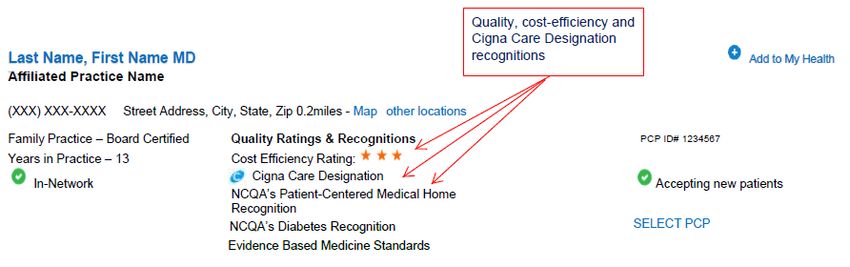
Sample: Online health care professional directory display (myCigna.com)

Quality evaluation and displays
Providers are evaluated on a number of criteria that we believe are markers of provider practice quality.
Information relative to specific quality criteria met by a physician is displayed in the online provider directory on
both the public website (Cigna.com) and secure customer website (myCigna.com). We use three quality
indicators to review participating physicians in the 21 specialty types. Each physician qualifying for a specific
quality indicator is identified in our online health care professional directory.
1. Group board certification
   Group board certification criteria are based on the American Board of Medical Specialties (ABMS) and the
   American Osteopathic Association (AOA) certification information, and are consistent with our Practitioner
   Credentialing and Recredentialing Policy. Board certifications criteria help determine whether board-
   certified physicians in the group predominantly provide patient care. This standard is met if:
    •    Either 80 percent of physicians within a group are board certified and provide 50 percent of the care, or
         at least 80 percent of the care is provided by board-certified physicians, or
    •    For groups (practices) with four or fewer physicians, either 65 percent of physicians within a group are
         board certified and provide 50 percent of the care, or at least 65 percent of the care is provided by
         board-certified physicians
2. Adherence to evidence-based medicine rules
   The quality of physician care is evaluated using a claims-based assessment for 91 evidence based
      medicine (EBM) rules derived from rules endorsed by the National Quality Forum (NQF), Healthcare
      Effectiveness Data Information Set (HEDIS), or developed by physician organizations. These rules
      span 43 diseases and preventive cares conditions (see Appendix 3), and are potentially applicable to
      the care provided by physicians in 15 specialty types. For a list of the specialty types that are covered
      by Evidence Based Medicine (EBM) rules, please see the chart on page six.

THN-2018-338. © 2018 Cigna. Some content provided under license.                                      5|Page
3. National Committee for Quality Assurance (NCQA) Physician Recognition
NCQA Physician Recognition Programs assess clinicians and practices to ensure they support the delivery
of high-quality care, and provide medical services that adhere to evidence-based, nationally recognized
clinical standards of care. We identify physicians in our online provider directory who have received
recognition in any of these four NCQA Physician Recognition Programs:
• NCQA Diabetes Recognition Program (DRP)
• NCQA Heart/Stroke Recognition Program (HSRP)
• NCQA Patient-Centered Medical Home Recognition (PCMH - 2 versions)
• NCQA Patient Centered Specialty Practice Recognition (PCSP)
Additional information about these programs is available on the NCQA website (https://ncqa.org > Programs >
Recognition).
Evidence-based medicine (EBM) assessment process
The EBM rules used in the 2019 evaluation apply to 15 primary care and non-primary care specialties.
Currently there are no EBM rules that apply to dermatology. In 2017, the EBM assessment process for
gastroenterology, general surgery, neurosurgery, ophthalmology, and orthopedic surgery was removed
because fewer than two percent of groups with these specialty types had sufficient volume to assess.
Overall, approximately 12.8 percent of physicians in all assessed specialty types are associated with groups
that do not have sufficient volume to assess adherence to the EBM rules. However, they have sufficient
volume to assess cost efficiency. Similarly, 5,955 or almost one percent of physicians are associated with
groups that do not have sufficient volume to assess cost efficiency and, as a result, are assessed based on
adherence with the EBM rules alone.
Specialty types covered by EBM rules
Allergy and immunology Cardiology Cardiothoracic surgery
Endocrinology Family practice Hematology and oncology
Internal medicine Nephrology Neurology
Obstetrics and gynecology Otolaryngology (ENT) Pediatrics
(OB/GYN)
Pulmonary Rheumatology Urology
THN-2018-338. © 2018 Cigna. Some content provided under license. 6|PageThe 2019 EBM assessment component review includes measuring compliance with 91 EBM rules (see
Appendix 3), where applicable, for the medical conditions displayed in the following table:
Disease and preventive care conditions covered by EBM rules
Adolescent well-care Chronic kidney disease Pharyngitis, appropriate testing for
children
Adult access to Congestive heart failure Pneumonia, community-acquired
preventive/ambulatory health bacterial (CAP)
services
Alcohol and other drug Chronic obstructive pulmonary Potentially harmful drug-disease
dependence disease (COPD) exacerbation, interactions in the elderly
pharmacotherapy management
Antidepressant medication Coronary artery disease (including Pregnancy management
management statin therapy)
Asthma (includes use of Diabetes (including statin therapy) Prenatal and postpartum care
appropriate medications)
Atrial fibrillation (includes use of Epilepsy Prostate cancer
Anticoagulation Medications)
Attention deficit hyperactivity Human papillomavirus vaccine for Rheumatoid arthritis
disorder (ADHD) adolescents
Breast cancer Hypertension Sickle Cell Anemia
Breast cancer screening Low back pain Sinusitis (acute)
Bronchitis (acute) Migraine headache Tonsillectomy
Cardiac surgery Multiple sclerosis Upper respiratory infection
Cerebral vascular accident and Osteoporosis Well-child visits in the first 15
transient cerebral ischemia months of life
Cervical cancer screening Otitis externa (acute) Well-child visits in the third, fourth,
fifth, and sixth years of life
Child and adolescent access to Otitis media (acute)
primary care
Chlamydia screening Persistence of beta-blocker
treatment after a heart attack
Definitions used in the following methodology description:
1. Physician specialty type: Any one of the 21 specialty types listed in the table of assessed specialty
types found on page four
2. Group specialty type: Any one of the 21 specialty types listed in the table of assessed specialty types
found on page four. The provider group that is evaluated may include physicians with the same
THN-2018-338. © 2018 Cigna. Some content provided under license. 7|Pagespecialty, or the provider group may be evaluated using one of the following mixed-specialty group
designations, as applicable: multispecialty medical group (mixture of multiple non-PCP specialists),
mixed specialty medical group (mixture of PCPs and non-PCP specialists), primary care medical group
(mixture of PCP specialists)
3. Specialty category: Primary care specialties (family practice, internal medicine, and pediatrics), or
non-primary care specialties (the 18 other specialties assessed for CCD)
We determine the extent to which an individual physician or provider group complies with EBM rules according
to the following conventions:
Peer or market EBM rule adherence for each geographic market
• In order for an EBM rule to be included for review at the geographic market level for a physician or
physician group, there must be at least 20 opportunities for the rule within the specialty category (primary
care or non-primary care specialties) and market for the most recent two-year data review period. For 2019
displays, that period is January 1, 2016 through December 31, 2017.
• The average adherence rate for each EBM rule is calculated for the specialty category (primary care or
non-primary care specialties) for each geographic market to derive the peer market-average result.
Individual physician or group practice EBM rule adherence
• Opportunities and successes for each eligible EBM rule are aligned to the appropriate individual physician
(using the visit requirements outlined below and relevant specialty type category).
Visit requirements: A physician is considered responsible for adherence to the EBM rule if the following
conditions are met:
o The EBM rule is relevant to the physician’s specialty (see Appendix 3). For example, the cervical cancer
screening EBM rule is relevant to OB/GYN, family practice, and internal medicine, but it is not relevant
to other specialties.
o There have been at least two office visit encounters for a patient with Cigna coverage during the claim
review period.
o At least one of the office visit encounters occurred in the last 12 months of the claim review period.
Note: 28 of our EBM measures require only one office visit encounter in the last 12 months of the claim review
period. These measures are identified by an asterisk [*] in Appendix 3.
• Individual physicians are aligned to medical groups, and EBM rule opportunities, successes, and expected
successes are then summed to obtain medical group totals.
• A Quality Index for the medical group is calculated by dividing the physician’s or physician group’s number
of actual EBM rule adherence successes by their number of expected EBM rule-adherence successes.
Expected EBM rule-adherence successes are derived by applying the geographic market-average EBM
rule adherence-success rates to that physician medical group’s particular rule mix opportunities.
• EBM (quality) measures are not risk adjusted because the EBM rules have explicit definitions for both the
THN-2018-338. © 2018 Cigna. Some content provided under license. 8|Pagenumerator and the denominator of each measure. The denominator explicitly defines the population that is
at risk; thus, risk adjustment is incorporated into the definition of the measure.
• A 90 percent confidence interval around the Quality Index is determined, allowing EBM quality performance
to be measured with a strong degree of certainty. The lower bound of the 90 percent confidence interval for
a particular physician or physician group is defined as the Adjusted Quality Index for that physician
medical group.
• Physician groups that meet the Cigna group board-certification criteria have 30 or more total EBM rule-
adherence opportunities. In addition, at least 50 percent of their treatment episodes (used in the
physician’s or medical group’s cost-efficiency (ETG) analysis) are attributed to the physician specialty types
that are assessed for EBM rule adherence, and are ranked using the Adjusted Quality Index score.
• Physicians or physician groups with an Adjusted Quality Index score in the top 34 percent of their medical
group specialty type and geographic market are placed in the highest performance category for EBM rule
adherence. They will have “Evidence Based Medicine Standards” displayed next to their names in the
provider directory. Physicians or physician groups that have results in approximately the bottom 2.5
percent for the medical group specialty types in the market where there are at least 20 medical groups of
that medical group specialty type in the market are placed in the bottom category. The remainder is in the
middle category.
• A threshold is set for each market and for each medical group specialty type within a market. These
thresholds are determined by specific market considerations such as geography, specialty volume, access
to specialty care, and contract requirements. Thresholds range from approximately 30 percent to 70
percent. The use of threshold adjustments allows individual market factors to be taken into account.
However, it is important to note that when such market-specific threshold adjustments are made, all other
physician medical groups in that market with the same medical group specialty type that meets the revised
market threshold value will then be deemed to have met the quality requirement for CCD.
Credit for utilizing Cigna Centers of Excellence
We evaluate hospital-stay outcomes and cost-efficiency information for Cigna customers through the Cigna
Centers of Excellence (COE) program for all practices. Utilization of COEs by a reviewable physician practice
provides credit towards the quality component of CCD. If a practice has at least one COE admission and a
minimum Quality Index of 0.70 during the data analysis period, then a five percentage-point increase in the
Quality Index will be granted. The increased Quality Index is then used to determine eligibility for CCD. COE
admissions must be consistent with the specialty of the physician providing the COE-related care in order to
qualify.
Cost-efficiency evaluation and displays
Participating providers are evaluated for their cost efficiency using an industry-standard methodology (i.e.,
episode treatment groups) that determines the average cost of treating an episode of care for a variety of
medical conditions and surgical procedures. The episode costs are compared to other physicians and
physician groups of the same specialty in the same geographical market. The results of this evaluation are
displayed by using stars ( ) in our online provider directory and myCigna.com, the secure website for Cigna
customers.
THN-2018-338. © 2018 Cigna. Some content provided under license. 9|PageCost-efficiency stars communicate cost-efficiency results. Three stars for cost efficiency represent the top 34
percent of physicians or physician groups when compared to other physicians and physician groups of the
same group specialty type within the geographic market. Two stars represent physicians or physician groups in
the middle 33 percent for cost efficiency. Physician groups that are in the bottom 33 percent for cost efficiency
receive one star. Providers who do not meet the volume criteria for the cost-efficiency assessment will have a
message next to their name in the provider directory indicating that there was not enough claim volume to
assess their cost efficiency.
Cost-efficiency symbols
Results in top 34 percent for cost efficiency
Results in middle 33 percent for cost efficiency
Results in the bottom 33 percent for cost efficiency
Please see Appendix 2 for the geographical markets and volume of physicians reviewed for quality and cost-
efficiency displays beginning January 1, 2019.
We use ETG methodology, an industry standard available through Optum, to evaluate the cost efficiency of
individual physicians and medical groups. The methodology incorporates case-mix and severity adjustment,
and claims are clustered into more than 500 different episodes of care. Additional information about the
OptumInsight Episode Treatment Groups, including a complete listing of the ETGs, is available at
etg.optum.com/etg-links/episode-treatment-groups/.
Using the ETG methodology, we can determine how a physician medical group’s cost-efficiency compares to
other physician medical groups of the same group specialty type (primary care physician group, single-
specialty group, mixed specialty group, or multi-specialty group) in the same geographic market. For example,
in the case of single-specialty primary care medical groups, the medical group’s cost-efficiency performance is
compared to the performance of other single-specialty primary care medical groups in the same market (i.e.,
family practice medical groups are compared to other family practice medical groups, internal medicine groups
to internal medicine groups, and pediatric medical groups to pediatric medical groups). A physician or
physician group’s performance is a result of its fee schedule, utilization patterns and referral patterns (e.g., use
of hospitals and other facilities).
ETG assessment requirements
• There must be at least 10 occurrences of a specific ETG (e.g., incorporating episode severity and
treatment level, co-morbidity, complications, or the presence of pharmacy benefits) within the geographic
market and specific physician specialty type in order to determine the market average cost for that ETG to
include it in the market’s analysis.
• The peer or market average for each specific ETG is established for each market and physician specialty
type.
• To reduce variation within cost-efficiency results, several ETGs are excluded from the assessment process,
including routine immunizations and other inoculations, transplants, and ETGs with low volume or wide cost
variation. Episodes with a severity level of four (the highest severity level assigned by the OptumInsight
ETG software) are also excluded from analysis, for most conditions.
THN-2018-338. © 2018 Cigna. Some content provided under license. 10 | P a g eExample: For the Nashville market during the data analysis period, 15 occurrences of ETG XX (with the
same severity, treatment level, co-morbidity, complications, and presence of pharmacy benefits) are
attributed to family physicians. The average cost of ETG XX for family physicians in the Nashville market is
established by computing the numerical average of the cost of all 15 occurrences of this ETG subject to the
application of outlier trimming methodology outlined in the following section. This process is replicated for
each ETG with at least 10 occurrences in the Nashville market for a given physician specialty type in order
to determine the market cost average for each ETG that is eligible for evaluation in the market.
ETG assessment process
• Individual physician medical groups must have at least 30 total episodes of care during the review period in
order to be assessed for cost efficiency. In order for an episode to be attributed to a physician (responsible
physician), two criteria must be met:
1. The physician must be responsible for more costs for medical or surgical management services
than any other physician providing care for the episode, and
2. the medical or surgical management costs for the physician must be at least 30 percent of the
total episode medical or surgical management costs.
If these two criteria are not met, the episode is excluded from analysis. While only the costs associated with
physicians’ provision of management services are used to attribute the episode to a particular physician,
total costs (physician management costs + all ancillary costs (e.g., lab, X-ray, hospital, ambulatory surgery,
and physical therapy) are used to characterize the total cost of the episode.
• The actual cost of an episode of care for each physician group and for the physicians within that group is
compared to the market average cost of an episode of care, which is derived using their unique mix of
ETGs and the peer averages.
• The sum of all actual ETG episode costs for a medical group divided by the sum of all corresponding ETG
episode market-average costs is the physician group’s Performance Index.
Example: The ABC Physician Group consisting of three family physicians in the Nashville market has five
episodes of care belonging to two unique ETGs (ETG1 and ETG2) that are attributable to the group. For
simplicity, disregard the requirement that the physician or physician group must have a minimum of 30
attributable episodes in order to be reviewed for cost efficiency. Average episode costs for ETG1 and
ETG2 have been established for all other primary care physicians or groups practicing in the Nashville
market. Three episodes of ETG1 are attributable to the ABC Physician Group and two episodes of ETG2
are attributable to the ABC Physician Group.
THN-2018-338. © 2018 Cigna. Some content provided under license. 11 | P a g eIn the table below, the physician group’s cost per episode is displayed for each of the three occurrences of
ETG1 and for each of the two occurrences of ETG2, along with the market average cost for an episode for
ETG1 and ETG2 for all family physicians in the Nashville market.
Actual episode cost Market average cost
ETG 1 2,000 3,500
ETG 1 1,000 3,500
ETG 1 4,000 3,500
ETG 2 15,000 19,000
ETG 2 18,000 19,000
Average 8,000 9,700
Performance Index = 8,000/9,700 = 0.825
Dividing the average cost of all episodes of care attributable to the physician group by the average of all
market-average episode costs for the ETGs on which the physician group’s cost-efficiency performance is
being evaluated yields a Performance Index (PI) of 0.825. The PI for the physician group can be
interpreted as Medical Group ABC is 17.5 percent more cost efficient than other family medicine physician
groups in the Nashville market.
• A 90 percent confidence interval around the PI is used to determine a range of performance within which
the medical group’s true performance would fall with a high level of confidence. The upper bound of the
confidence interval is defined as the Adjusted Performance Index and is used to compare cost-efficiency
performance among physician medical groups. The upper bound of the 90 percent confidence interval is
used to ensure that the physician group’s performance is at least as good as, or better than the upper
bound threshold.
• A threshold is set for each market and for each medical group specialty type within a market. These
thresholds are determined by specific market considerations such as geography, specialty volume, access
to specialty care, and contract requirements. Thresholds range from approximately 30 percent to 70
percent. The use of threshold adjustments allows individual market factors to be taken into account.
However, it is important to note that when such market-specific threshold adjustments are made, all other
physician medical groups in that market with the same medical group specialty type that meets the revised
market threshold value will then be deemed to have met the quality requirement for CCD.
2019 Outlier methodology
In order to portray physicians’ cost-efficiency performance in the most accurate manner, the cost-efficiency
evaluation includes a methodology to account for outlier episodes. Outlier episodes are substantially different
from the market expected amounts. High cost episodes (ETGs) that are greater than 1.5 times the market
specialty averages are reduced to 1.5 times the market specialty average. Low cost outlier episodes are
determined by the Optum software, or are episodes of less than $25 and are excluded from the evaluation.
THN-2018-338. © 2018 Cigna. Some content provided under license. 12 | P a g eLevel of evaluation (unit of analysis)
While we review participating physicians at the individual level, the majority of the assessments are performed
at the physician group or practice, or group TIN level. Individual physicians who are not part of a group are
assessed if volume criteria are met. This approach provides robust data for evaluation and is consistent with
the assumption that:
• Patients with Cigna coverage often chose a group rather than a specific physician within the group,
and;
• Patients with Cigna coverage who initially choose a specific physician frequently receive care by
another physician within the practice or group.
Cigna Care Designation inclusion methodology
In 2019, physicians who meet our specific quality and cost-efficiency criteria, can receive Cigna Care
Designation for a given specialty and will receive the symbol next to their name in our online provider
directory tools. CCD may also be utilized as part of a tiered benefit plan option (e.g., Cigna Care Network).
Additional information on Cigna products and benefit plans is available on the Cigna for Health Care
Professionals website (CignaforHCP.com > Resources > Medical Resources > Medical Plans and Products).
How providers are evaluated for CCD
Cigna evaluates whether the physician or group has achieved certain quality and cost-efficiency results, which
are detailed more fully below. If the physician or group achieves those results, then the physician or group may
be assigned CCD.
Participating physicians may receive the designation if the physician or physician group:
• Is located in one of the 74 markets that currently participate in this program
• Practices in one of the 21 assessed specialties
• Meets Cigna group board certification criteria
• Has a minimum volume of 30 complete episode treatment group occurrences
• Group performance in the top 40% for quality OR have 50% of physicians in the practice achieve
NCQA recognition AND meet the cost-efficiency criteria of being in the top 40% with the groups
Adjusted Performance Index (API) less than or equal to 1.03.
• Group performance in the top 34% for quality OR have 50% of physicians in the practice achieve
NCQA recognition AND have less than 30 ETG episodes (with no cost ranking).
• Group performs in the top 34% for cost with the groups Adjusted Performance Index (API) less than or
equal to 1.03 AND are either between 2.5% and 66% for quality or have less than 30 EBM
opportunities (with no quality ranking).
We inform our customers that a CCD for a physician or group should not be the sole basis for their decision-
making because our review for cost-efficiency and quality reflects only a partial assessment of quality and cost-
efficiency. There could be a risk of error in the data used to perform the review, and inclusion of a physician as
CCD does not mean that the physician offers equal or greater quality and cost efficiency than other
participating providers. We encourage our customers to consider all relevant factors when choosing a primary
care physician or specialist for their care, and to speak with their treating physician when selecting a specialist.
THN-2018-338. © 2018 Cigna. Some content provided under license. 13 | P a g eBuffer zone methodology
Variation in physician group or physician group performance (e.g., positive or negative, substantial, or
minimal), is inevitable and expected in an annual review process due to various factors (e.g., changes to
physician group makeup, external market factors, and practice pattern modifications). A “buffer zone”
methodology addresses small-scale variation for physicians or physician groups whose CCD status changes
from the previous review cycle. A practice may maintain its designation status if the group is within 3 percent of
the current year's quality and cost criteria, or is within 3 percent of the cost index when the group does not
meet cost and quality criteria.
The selected physician group must meet certain criteria to achieve the 2019 buffer zone designation. The
standard criterion applied includes:
• meeting the physician group board certification criteria,
• the board-certified physicians must be responsible for at least 50 percent of the group episodes,
• the group must have at least 30 episodes, and
• the group must not be in the bottom 2.5 market percentile for EBM quality performance, in a market
with greater than 20 groups within the specialty category in the market.
THN-2018-338. © 2018 Cigna. Some content provided under license. 14 | P a g e2019 Cigna Care Designation inclusion algorithm (Quality assessment) THN-2018-338. © 2018 Cigna. Some content provided under license. 15 | P a g e
2019 Cigna Care Designation inclusion algorithm (Cost assessment)

THN-2018-338. © 2018 Cigna. Some content provided under license.                       16 | P a g e
Cigna Collaborative Care pathway to achieve Cigna Care Designation
We collaborate with selected physician groups to help them achieve the triple aim of improving quality, cost
efficiency, and the patient care experience. The Cigna Collaborative Care® (CCC), a value-based care
approach, leverages the foundation of accountable care organizations (ACOs) and patient centered medical
home (PCMH) models by recognizing physicians affiliated with a CCC that demonstrate improvement in
medical delivery and clinical outcomes, and achieve improvement in reducing the cost of care.
Cigna's value-based care model is designed for collaboration with physician groups that may include PCPs
only, a mix of PCPs and specialists, or specialists only. The groups enter into a contract with Cigna in which
they agree to be evaluated based on quality and cost criteria that are unique to the CCC model.
Physicians and physician groups are first assessed by applying the standard CCD pathway to determine
inclusion. If the physicians and physician groups are unable to achieve designation through the standard CCD
pathway, but they are affiliated with a CCC group, then a CCC pathway inclusion criteria may be applied next
to determine if they can be designated.
CCC primary care groups achieving a Total Medical Cost Performance Index of less than or equal to 1.03 and
a CCC Quality Index of greater than or equal to 0.99, will be assigned CCD. Specialists that did not meet the
standard CCD criteria, but are affiliated with a CCC primary care group that meets the alternate CCD pathway
criteria for inclusion may be assigned CCD.
To be considered for CCD inclusion, CCC physicians must be MDs and/or DOs in one of three primary care
specialties or one of 18 non-primary care specialties (see the Assessed specialty types table on page four).
Note: We perform evaluations at the group level. Some groups include geriatric physicians, nurse practitioners,
and physician assistants who deliver primary care services as part of the group. In such cases, geriatric
physicians, nurse practitioners, and physician assistants will be considered for CCD as part of the group.
Primary care quality assessment
The CCC group must have at least 20 evidence-based medicine (EBM) opportunities during the data collection
period. A Quality Index is calculated for each CCC group based on adherence to EBM measures. If the CCC
group’s Quality Index is 0.99 or better, the quality requirement is met. The Quality Index is calculated based on
adherence to Evidence Based Medicine (EBM) standards. The EBM rules for CCC groups can vary from the
core set utilized by CCD based on each individual CCC group agreement.

Primary care cost-efficiency assessment
Total medical cost (TMC) is used to evaluate cost-efficiency for primary care CCC group arrangements. To
calculate the TMC index for CCC primary care groups, aligned patients and practitioners are identified. A per
patient per month (PPPM) score is calculated and risk adjusted. The final risk adjusted PPPM score is divided
by the market PPPM score to create the TMC cost index. The TMC cost index reflects all medical costs for
Cigna customers who are aligned to PCPs in the CCC agreement, excluding pharmacy and non-PCP
behavioral health costs. If the group's TMC Performance Index is 1.03 or less, the practice meets the pathway
cost requirement.

THN-2018-338. © 2018 Cigna. Some content provided under license.                                  17 | P a g e
Buffer zone methodology
Variation in CCC group performance (e.g., positive or negative, substantial, or minimal) is inevitable
and expected in an annual review process due to various factors (e.g., changes to physician group
makeup, external market factors, and practice pattern modifications). A “buffer zone” (grandfathering)
methodology addresses variation for physician groups or physician groups whose CCD status
changes from the previous review cycle. A CCC group may maintain its CCD status if the CCC group
was “in” during the prior cycle.

Note: Individual markets may adjust the grandfathering criteria for CCC groups at the market level, in order to
exclude from grandfathering those CCC groups with large-scale variation in results from the prior year.
Adjustments are made at the market level and are applied to all CCC groups in the market.

Cigna Collaborative Care review process
The evaluation methodology is applied annually (and quarterly as needed) to all existing and new CCC groups.
    •    CCC groups that do not meet criteria can be re-evaluated using quarterly data, through our
         reconsideration process. If the quality and performance indexes improve, and are meeting the market
         criteria for inclusion during two consecutive quarters, the CCC group will be given CCD status.
    •    Since CCC groups can earn CCD status on a quarterly basis, we reserve the right to remove the CCD
         status if the CCC group demonstrates significant decline in performance below the required criteria in
         four consecutive quarters, or if the CCC group discontinues its collaborative agreement with us and
         does not meet the standard CCD criteria.
    •    A re-evaluation occurs with each refresh where grandfathering may be applied. As noted previously,
         individual markets may adjust the grandfathering criteria at the market level. When adjustments are
         made at the market level, they are applied to all CCC groups in the market.

THN-2018-338. © 2018 Cigna. Some content provided under license.                                 18 | P a g e
2019 Cigna Collaborative Care to Cigna Care Designation Algorithm THN-2018-338. © 2018 Cigna. Some content provided under license. 19 | P a g e
Data sources
         The following table outlines the evaluation data sources, and how they are used:

         Data source                                               How information is used
         Cigna Physician Metrics                                   The data is used to produce ETG efficiency and EBM
         (January 2016 – December 2017)                            summary reports.

         Use combined Cigna managed care and PPO Note: Data for Medicare-eligible individuals is removed.
         product data with episodes of care or EBM
         rules attributed to the responsible physician.
         Cigna Central Physician File (CPF)                        File extracts to identify contracted physicians, TIN,
         (as of April 2018)                                        groups, specialty, board certification status, network,
                                                                   and products contracted.

         Physician Recognition Program File obtained               The status of physicians recognized for the diabetes,
         from the National Committee for Quality                   heart/stroke, physician practice connections, and
         Assurance (NCQA)                                          patient-centered medical home, or patient-centered
         (as of April 2018, and at least six times per             specialty practice recognition programs is updated
         year)                                                     based on information received from NCQA.

                                                                   Percent of physicians recognized in an NCQA program
                                                                   for a group is calculated based on the recognition and
                                                                   group alignment.
         Cigna utilization and COE data                            Specialty groups that admit to COE facilities (based on
                                                                   utilization data) will receive credit towards the quality
                                                                   component evaluation for CCD inclusion.

         Additional information and data limitations
         The quality and cost-efficiency displays are a partial assessment of quality and cost-efficiency, and are
         intended to provide information that can assist Cigna customers in health care decision-making. Cigna
         customers are encouraged to consider all relevant information and to consult with their treating
         physician in selecting a physician for care.
         While we use the best available information to create an objective assessment methodology, there are
         some limitations:
         •    The EBM and cost-efficiency information is based on our claim data only. Aggregated claim data
              from multiple payers (e.g., insurance companies, self-insured plans, and government plans) may
              provide a more complete picture of physician performance. We support data aggregation initiatives,
              and will consider using it in evaluations when credible data are available.
         •    We can only use received claim data in evaluations. There may be health care services performed
              for which no information is provided to us.
         •    Specific service line item detail may not always be available due to the way claims may be
              submitted by physicians or processed by us.
         •    Pharmacy data inclusion is limited to customers covered by a Cigna-administered pharmacy benefit
              plan.
         •    We use ETGs), an industry standard grouper, to risk-adjust for patient severity. Although ETG

THN-2018-338. © 2018 Cigna. Some content provided under license.                                             20 | P a g e
software is recognized as a leading risk adjustment model, perfect patient severity-risk adjustment
does not exist.
• Many physicians or physician groups are unable to be displayed for quality and cost-efficiency due
to small patient populations. We will not display results for those physicians or physician groups
whose episodes or opportunities sample do not meet certain volume thresholds.
Process to display strategic alliances information
Health Alliance Plan (HAP)
Physicians or physician groups in the Eastern Michigan area (Genesee, Oakland, Lapeer, St. Clair,
Livingston, Washtenaw, Macomb, Wayne, and Monroe counties) have been evaluated and designated
through information received from Health Alliance Plan. In 2016, Cigna took on the role of evaluating
these physicians using the same quality and cost methodology utilized in all other CCD markets, as
described in this whitepaper. The assessment review period for 2019 CCD inclusion is January 1, 2016
through December 31, 2017. Physicians who meet our specific quality and cost-efficiency criteria will
receive CCD status.
Specific market activities
California Integrated Healthcare Association assessment: Pay for performance
• Cigna HealthCare of California participates in a statewide initiative coordinated by the Integrated
Healthcare Association (IHA) to measure and improve clinical quality, patient experience, use of
information technology, and public reporting of physician performance results.
• We pay incentive payments to physician organizations based upon performance against standard
quality measures.
• The common set of key measures used for assessment relies on national standards or EBM
practices.
• The measure set, audit manual, and data-submission file layouts are released each year by IHA.
• More information about the program and the assessment results is available on the www.IHA.org
website.
Feedback process
We welcome and encourage participating physicians, customers, and employers to provide feedback
and suggestions for how we can improve the reports, as well as other suggested program
improvements. Employees and patients with Cigna-administered plans should call the telephone
number listed on the back of their Cigna ID card, or access the Feedback button available online at
myCigna.com. Participating physicians can also provide feedback online by accessing the Feedback
button on Cigna.com, or call Cigna Customer Service at 1.800.88Cigna (1.800.882.4462). Feedback
and suggestions are reviewed, and changes to the physician evaluation methodology, reporting
formats, and processes are implemented as appropriate. Methodology changes are generally reviewed
and implemented on an annual basis.
THN-2018-338. © 2018 Cigna. Some content provided under license. 21 | P a g ePhysician process to correct errors or request reconsideration
Participating physicians or physician groups have a right to seek correction of errors, and request data
review of their quality and cost-efficiency displays.
To do so, send an email to PhysicianEvaluationInformationRequest@Cigna.com, or fax to
1.866.448.5506 to request additional information, for detail reports, to request reconsideration of your
quality and cost-efficiency displays, to correct inaccuracies, or to submit additional information. The
request for reconsideration must include the reason and any documentation you wish to provide in
support of the request. If the group meets the criteria for CCD inclusion upon reconsideration, the
provider will be displayed with the symbol next to their name in our online provider display tools.
The National Selection Review Committee process is initiated within five business days of our receipt of
a reconsideration request. A Cigna Network Clinical Manager (NCM) or Network Clinical Specialist
(NCS) will contact the physician practice or physician group to clarify information received for
reconsideration and generate detail reports. The NCM or NCS may change the physician group
designation if the obtained information meets inclusion criteria. These may include, but are not limited
to a verification of board certification; a revision to the Evidence Based Medicine (EBM) adherence
score; or a verification of completion of one or more NCQA physician recognition programs. The
National Selection Review Committee will review the request if the obtained information does not meet
inclusion criteria.
The National Selection Review Committee participants include Cigna physicians and Cigna network
clinical performance staff. Voting committee participants include the National Medical Director and
physician representatives from the three Cigna regions, their alternates, and ad hoc physicians. Non-
voting participants include the Assistant Vice President of Provider Measurement and Performance,
National Network Business Project Senior Analyst, Health Data Senior Specialist, Marketing Product
Senior Specialist, Network Product Integration Leads, Network Clinical Managers and Network Clinical
Specialists.
The National Selection Review Committee determination may include changing the designation,
upholding the original designation, or pending the determination for additional information. Notification
of the decision is sent to the physician group after the committee determination is made. The National
Selection Review Committee process and final decision is complete within 45 days of receipt of a
reconsideration request.
Colorado providers should refer to Appendix 4 on pages 38-39 for Colorado specific reconsiderations.
How to register complaints
At any time, Cigna customers may register a complaint with us about the quality, cost efficiency, and
CCD displays by calling the telephone number located on the back of their Cigna ID card.
THN-2018-338. © 2018 Cigna. Some content provided under license. 22 | P a g eRegistering a complaint for Cigna customers in New York
The NCQA is an independent not-for-profit organization that uses standards, clinical-performance
measures, and member satisfaction to evaluate the quality of health plans. It serves as an independent
ratings examiner for Cigna Life and Health Insurance Company, Connecticut General Life Insurance
Company, and Cigna HealthCare of New York, Inc., reviewing how CCD, and quality and cost-
efficiency displays meet criteria required by the State of New York.
Complaints about the quality, cost efficiency, and CCD displays in New York may be registered with
NCQA, in addition to registering with Cigna, by submitting them in writing to customer support at
www.ncqa.org or to NCQA Customer Support, 1100 13th Street, NW, Suite 1000, Washington, DC
20005.
2019 Physician evaluation methodology changes
Changes to our 2019 physician evaluation methodology are outlined below:
Methodology item 2019 Details and rationale
change or enhancement
Change in the number of There are 91 rules covering 43 The EBM rule set was
diseases covered in the EBM disease and preventive care changed to align more closely
rules conditions. with national standards.
NCQA Recognition Programs The NCQA Physician Practice NCQA retired the Physician
Connections Recognition Practice Connections
Program (PPC) was removed. Recognition Program (PPC)
Cigna Care Designation Appling a 1.03 cut point for Normalizes inclusion criteria
(CCD) API as a last step for cost and helps to distribute the
inclusion percentage of providers
evenly in CCD markets
Cigna Care Designation Allow grandfathering at the
(CCD) default thresholds (40% and
34%) only
Reconsideration requests for Provider groups can request
quality and cost-efficiency reconsideration for quality and
displays or cost efficiency. If upon
reconsideration the group
meets the CCD criteria, they
will be included as CCD.
THN-2018-338. © 2018 Cigna. Some content provided under license. 23 | P a g eAppendices
Appendix 1: 2019 Cigna Care Designation market information
Market Name Volume Reviewed Percent Designated Percent Not Designated
AR Arkansas 5618 10.73 89.27
AZ Maricopa 9141 39.22 60.78
AZ All Other 1877 12.47 87.53
AZ Pima 2601 30.41 69.59
CA North 2167 16.34 83.66
CA South 32069 21.03 78.97
CA Bay Area 13036 50.58 49.42
CA Sacramento 3310 36.37 63.63
CA Central Valley 3393 34.98 65.02
CO Front Range 10596 26.58 73.42
CT Connecticut 10076 52.86 47.14
DE Delaware 2509 10.96 89.04
FL Jacksonville 3085 18.02 81.98
FL All Other 5109 18.65 81.35
FL South Florida 10984 29.41 70.59
FL Orlando 6283 32.77 67.23
FL Tampa 10929 34.38 65.62
GA Atlanta 9374 55.78 44.22
GA All Other 4814 38.95 61.05
IL Chicago Metro 18040 58.36 41.64
IL Rockford 3127 14.23 85.77
IN Indianapolis 4764 31.76 68.24
KS KS/MO Kansas City 4947 21.22 78.78
LA All Other 2780 15.68 84.32
LA Baton Rouge 2997 19.92 80.08
LA New Orleans 3085 19.71 80.29
MA Western 4896 30.78 69.22
MA Boston 20287 32.98 67.02
MD Maryland 12209 51.22 48.78
MD Northern VA 5836 29.59 70.41
DC Metro North 6707 50.81 49.19
ME Maine 4070 38.48 61.52
MI Michigan 18358 17.62 82.38
MS Mississippi 5410 20.54 79.46
NC Charlotte 4573 30.81 69.19
NC East 4285 15.92 84.08
NC Raleigh 5232 31.94 68.06
NC Triad 3774 39.35 60.65
NC West 2825 18.76 81.24
NH New Hampshire 4343 33.46 66.54
THN-2018-338. © 2018 Cigna. Some content provided under license. 24 | P a g eMarket Name Volume Reviewed Percent Designated Percent Not Designated
NJ North Jersey 11423 32.05 67.95
NJ South Jersey 4837 17.43 82.57
NV Nevada 4285 24.95 75.05
NY Metro 30913 28.80 71.20
OH Northern 11755 22.01 77.99
OH Central 8127 72.76 27.24
OH Southern 7911 34.98 65.02
OH NW Ohio 3028 35.14 64.86
OR Oregon 10978 18.69 81.31
PA Philadelphia 11979 33.96 66.04
PA All Other 13259 21.38 78.62
PA Pittsburgh/Western 7583 64.76 35.24
RI Rhode Island 3379 22.67 77.33
SC Low Country 3241 20.98 79.02
SC Midlands 2592 26.16 73.84
SC Upstate 3590 14.68 85.32
TN West 3828 34.09 65.91
TN Central 6759 31.20 68.80
TN East 7088 26.27 73.73
TX Austin 4479 31.48 68.52
TX Dallas/Ft. Worth 10899 39.60 60.40
TX Houston 12431 26.04 73.96
TX San Antonio 3595 16.11 83.89
TX East Central Texas 2833 18.96 81.04
UT Wasatch Front 4611 24.46 75.54
VA Hampton Roads 3552 31.39 68.61
VA Richmond 3205 32.57 67.43
VA Western 3922 36.16 63.84
VT Vermont 2053 24.26 75.74
WA Seattle 11816 39.67 60.33
WA All Other 5653 16.24 83.76
WI Milwaukee/Green Bay 8503 41.49 58.51
WI All Other 4587 53.24 46.76
WV West Virginia 4687 18.75 81.25
THN-2018-338. © 2018 Cigna. Some content provided under license. 25 | P a g eAppendix 2: 2019 Quality and cost-efficiency display markets
* Indicates markets where physicians are assessed for quality and cost-efficiency display only
Market name Specialists reviewed Market name Specialists reviewed
AL Alabama * 7224 NC Raleigh 5232
AR Arkansas 5618 NC Triad 3774
AZ Maricopa 9141 NC West 2825
AZ All Other 1877 NH New Hampshire 4343
AZ Pima 2601 NJ North Jersey 11423
CA North 2167 NJ South Jersey 4837
CA South 32069 NV Nevada 4285
CA Bay Area 13036 NY Metro 30913
CA Sacramento 3310 NY All Other * 18303
CA Central Valley 3393 OH Northern 11755
CO All Other * 2214 OH Central 8127
CO Front Range 10596 OH Southern 7911
CT Connecticut 10076 OH NW Ohio 3028
DE Delaware 2509 OK Oklahoma * 5713
FL Jacksonville 3085 OR Oregon 10978
FL All Other 5109 PA Philadelphia 11979
FL South Florida 10984 PA All Other 13259
FL Orlando 6283 PA Pittsburgh/Western 7583
FL Tampa 10929 RI Rhode Island 3379
GA Atlanta 9374 SC Low Country 3241
GA All Other 4814 SC Midlands 2592
IL Chicago Metro 18040 SC Upstate 3590
IL All Other * 6195 TN West 3828
IL Rockford 3127 TN Central 6759
IN Indianapolis 4764 TN East 7088
IN All Other * 6178 TX Austin 4479
KS KS/MO All Other * 5302 TX Dallas/Ft. Worth 10899
KS KS/MO Kansas City 4947 TX Houston 12431
KY Kentucky * 9548 TX San Antonio 3595
LA All Other 2780 TX East Central Texas 2833
LA Baton Rouge 2997 UT Wasatch Front 4611
LA New Orleans 3085 VA Hampton Roads 3552
MA Western 4896 VA Richmond 3205
MA Boston 20287 VA Western 3922
MD Maryland 12209 VT Vermont 2053
MD Northern VA 5836 WA Seattle 11816
DC Metro North 6707 WA All Other 5653
ME Maine 4070 WI Milwaukee/
Green Bay 8503
MI Michigan 18358
WI All Other 4587
MS Mississippi 5410
WV West Virginia 4687
NC Charlotte 4573
NC East 4285
THN-2018-338. © 2018 Cigna. Some content provided under license. 26 | P a g eYou can also read


