2018/19 STRATEGIC AND ANNUAL PERFORMANCE PLANS, AND BUDGET PRESENTATION TO THE SELECT COMMITTEE ON EDUCATION AND ARTS AND CULTURE
←
→
Page content transcription
If your browser does not render page correctly, please read the page content below
2018/19 STRATEGIC AND ANNUAL PERFORMANCE PLANS, AND
   BUDGET PRESENTATION TO THE SELECT COMMITTEE ON
          EDUCATION AND ARTS AND CULTURE

                    25 April 2018
PRESENTATION OUTLINE
▪Opening Remarks
▪Overview
▪SACE Vision and Mission
▪SACE Values
▪Strategic Outcomes Oriented Goals 2014/15 – 2019/20
▪Alignment of Mandates
▪2018/19 Programmes and Sub-Programme Plans
▪2018/19 Budget
                                                       2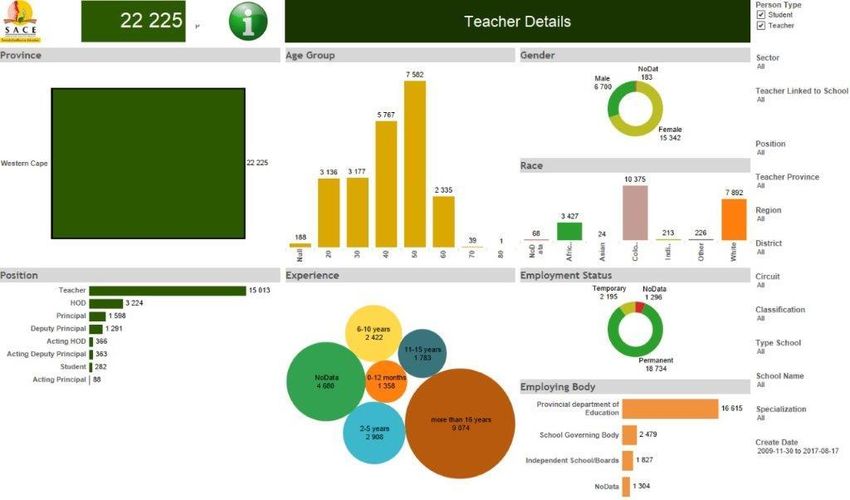
OVERVIEW
• The SACE-led process of professionalising the teaching profession is
  progressing well, through the multi-stakeholder driven approach.
• This has inevitably necessitated that the newly appointed Council take stock
  on its strategy, delivery of the core mandates, and the entire institutional
  capacity with an ultimate goal of repositioning SACE to play its rightful role in
  the teaching profession.
• In line with this, Council is prioritising the following, in order to deliver on its
  mandate efficiently and effectively during its four year term of office
  (2017/18 – 2020/21):
• Core / Deliverables
    • Professionalisation of the teaching profession (Refer to the Next Slide)
    • Evidence-Based and Data-driven Advisory
• Enablers and Conditions
    • Improved ICT
    • Strengthened Advocacy and Communication
    • Institutional Capacity – Job Evaluation Process
    • Provincial Offices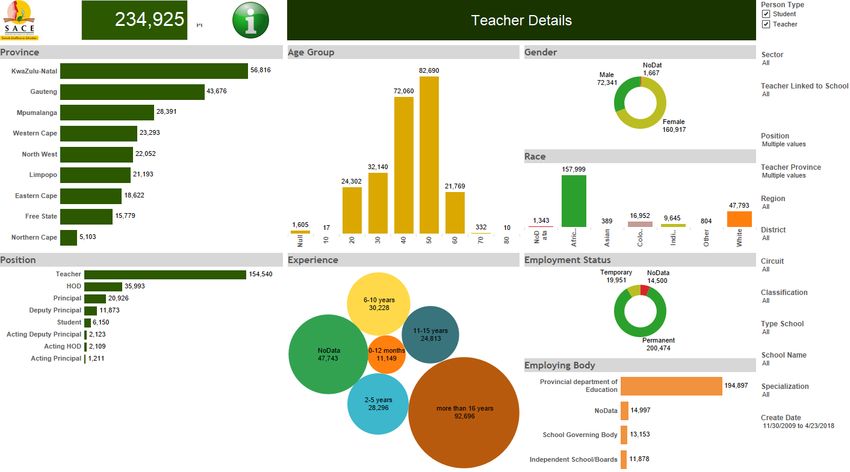
PROFESSIONALISE THE TEACHING PROFESSION
         LINKED TO THE 5 APP PROGRAMMES
                                                                      Provisional
   Professional          Criteria for Entry
                                               ITE Outcomes/      Registration from
     Teaching           into Initial Teacher
                                                 Attributes        1st Year Student
    Standards                Education
                                                                        Teachers

                                                                     Continuing
 Induction and e-            Teacher             Professional       Professional
PoE for the Novice         Professional        Registration and       Teacher
     Teachers              Designation           Certification      Development

 Code of Conduct            Periodic Re-        Maintenance /
                            Certification      Retention of the    SACE Recognition
 Code of Professional   linked to the CPTD       Professional       Status by SAQA
        Ethics             system cycle          Certification
STRATEGY
VISION
  To promote professionalism amongst all educators in South Africa by
ensuring that our services are easily accessible, continuously empowering
   through development, ensuring commitment to the profession and
 adherence to the ethos of education as enshrined in the South African
                               Constitution.

                            MISSION
SACE shall strive to ensure that the education system is enriched,
 by providing properly registered and professionally developed
         educators that would display professionalism.
                                                                       6
VALUES
SERVICE-ORIENTED            Ensure that the teaching profession in general and educators in
                            particular are serviced satisfactorily at all times. Servicing educators
                            is priority number one for all SACE employees.

                            Provide quality and excellent service to educators and the profession
QUALITY                     as a whole.

OPENNESS AND TRANSPARENCY   All SACE matters should be treated with honesty and sincerity. SACE
                            will strive to engage and consult with its stakeholders on various
                            matters regularly.

PROFESSIONALISM             Display high level of professionalism at all times.

                                                                                             7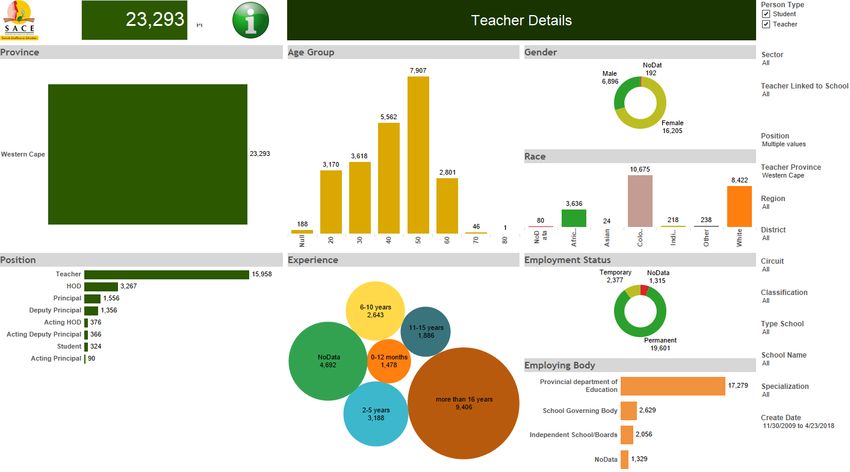
STRATEGIC OUTCOMES ORIENTED GOALS 2015/16 – 2019/20

Strategic outcome   Maintain an updated register of all qualified educators, sub registers
Oriented goal       of special categories, and issue relevant different certificates.

Strategic outcome   Set and maintain ethical standards and process complaints.
Oriented goal

Strategic outcome   Improved participation in Continuing Professional Development that
Oriented goal       contributes to quality teaching and learning.

Strategic outcome   Improved research production to advise and inform the teaching
Oriented goal       profession.

Strategic outcome   Enhance teacher professionalisation.
Oriented goal
                                                                                   8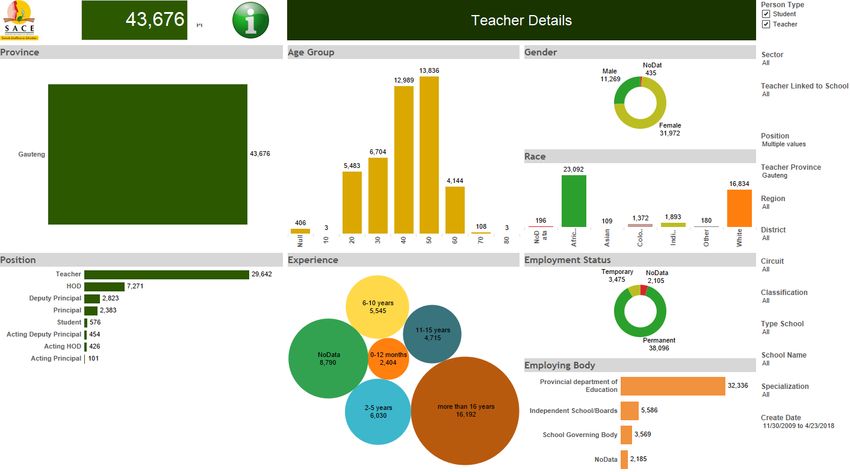
ALIGNMENT OF MANDATES
LEGISLATIVE AND OTHER MANDATES
                                                                               SACE Act no.31 of
                                                                               2000 as amended by
                                                                               the BELA Act no.65 of
                                                    Towards the Realisation
                                                    to Schooling 2030
                                                                               2011
                                                    DBE Action Plan to         Register Educators
                          Medium Term Strategic
                                                    2019                       Manage a system for
                          Framework 2014 – 2019                                continuing professional
                                                    GOAL NO: 16
                          OUTPUT NO:1                                          development for all
National                                            Improve the                teachers
Development Plan:         -Improved quality of
                                                    professionalism,           Professional Ethics
                          teaching and learning
Vision 2030                                         teaching skills, subject   Professional Practice
                          through Development,
- SACE’s role in                                    knowledge and              Standards
                          supply and effective
promoting                                           computer literacy of
                          utilisation of teachers
                                                    teachers throughout
Professional standards,                             their entire careers.
quality assurance of PD
Programmes and                                      DBE Programme 3
Providers, and Ensuring                             Teachers, Human
that teachers earn PD                               Resource and
Points from these                                   Institutional
programmes                                          Development                                10
The primary outcome of the Plan is to improve the quality of teacher
education and development in order to improve the quality of teachers and
teaching.
1. It addresses the career of a teacher through a number of phases from
recruitment through to retirement:
• Recruitment of potential teachers.
• Preparation of new teachers.
• Induction into the world of work.
• Career-long (continuing) professional learning and development.
2. SACE has an important quality management role to play in promoting and
supporting the system for identifying and addressing teacher development
3
needs.
SACE responsibilities in this regard include ensuring that:
• the providers of teacher development programmes are fully approved by
SACE;
• the professional development courses available for teachers are
endorsed by SACE; and
• can lead to the accrual of Professional Development (PD) points on
3. Development of the teacher knowledge and successful completion;
practice standards.
11NQF ACT AND NPFTED
NPFTED (2007)
• Section 53: “the South African Council for Educators (SACE), as the professional body for professional
educators, will have the overall responsibility for the implementation, management and quality
assurance of the CPTD system. SACE will be provided with the necessary resources and support to
undertake that role”.
NQF Act no.67 of 2008
• Professional Bodies Recognition by SAQA
• Section 29: “A statutory or non-statutory body of expert practitioners in an occupational field must apply in the
manner prescribed by the SAQA in terms of section 13(1)(i)(i) to be recognised as a professional body in terms
of this Act”
• Development and Registration of the Professional Designation on the NQF
• Section 30: “A professional body that is recognised in terms of section 29 must apply to the SAQA, in the
manner determined by the SAQA in terms of section 13(1)(i)(ii), to register a professional designation on the
NQF”.
• Cooperation with other QCs
• Section 28: Despite the provisions of any other Act, a professional body must co-operate with the relevant QCs
in respect of qualifications and quality assurance in its occupational field.
12PROGRAMME AND
SUB-PROGRAMME PLANS
13PROGRAMME 1: REGISTRATION PURPOSE: ▪ Register qualified educators and create sub registers for special categories; ▪ Maintain and update educator database; and ▪ Enhance the quality of the registration of teachers by introducing standards. KEY FUNCTIONS: ▪ Determine minimum criteria and procedures for registration; ▪ Consider and decide on any application for registration; ▪ Keep a register of the names of all persons who are registered; and ▪ Determine period of validity of the registration.
UNAUDITED 2017/18 REGISTRATION NUMBERS
       AS AT THE 31ST MARCH 2018
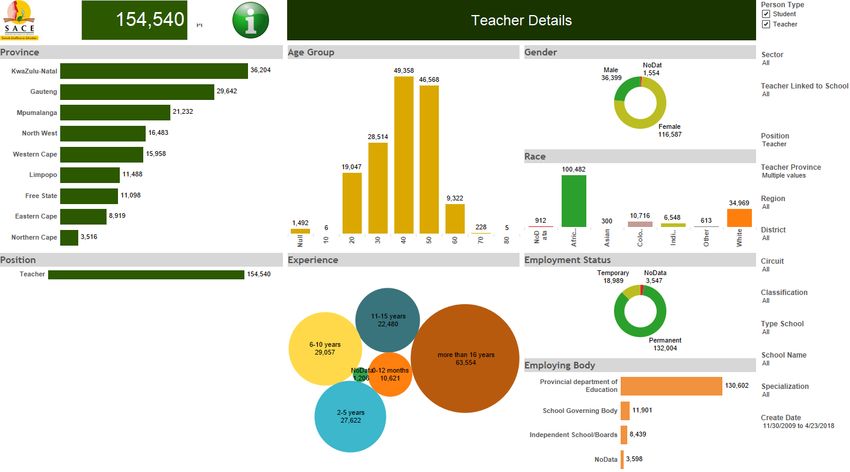
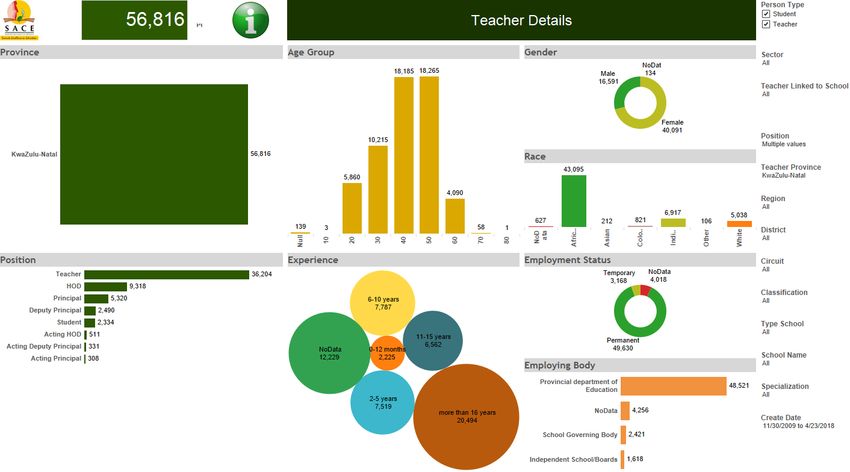
  • The current SACE register stands at 556 483

REGISTRATION TYPE : 1st April – 31st   NUMBERS
March 2018 (Unaudited)
NEW                                    34 087

UPDATE                                 45 454

TOTAL                                  79 541
REGISTRATION CONT….
Programme Performance Indicators and Annual Targets for 2018/19
STRATEGIC OBJECTIVE PROGRAMME MEDIUM-TERM TARGETS
PERFORMANCE INDICATOR
2018/19 2019/20 2020/21
To register all qualified Number of new educators 38 000 35 000 35 000
educators. registered.
Number of educators 47 000 47 000 47 000
updating and renewing
their registration status.
16QUARTERLY TARGETS FOR REGISTRATION 2018/19
PERFORMANCE INDICATOR REPORTING ANNUAL QUARTERLY TARGETS
PERIOD TARGET
2018/19
1st 2nd 3rd 4th
Number of new educators Quarterly 38 000 10 000 9 000 8 000 11 000
registered.
Number of Educators updating Quarterly 47 000 12 700 12 700 9 000 12 600
and renewing their
registration status.
17REVIEWING AND RE-CONCEPTUALISING REGISTRATION PROCESSES AND SYSTEMS
ISSUES STRATEGY
1. Doing away with On-the-Spot Registration • Address Fraud and criminal elements during the registration process
• Minimise current influx in the SACE national and KZN Offices in particular
2. Unregistered Practising Teachers - Engage teacher employers: the School Governing Body Associations,
Independent Schools and the nine Provincial Education Departments
3. Vetting and Verification: Professional • Concept document developed on Fitness-to-Practice
Fitness-to-Practice • Infusing Fitness-to-Practice into the Revised Registration Policy and Criteria
Ensure that fit-and-proper teachers are registered with SACE by:
• conducting criminal record check through the South African Police Service
(SAPS),
• determining suitability to work with children through clearance from the
Department of Social Development (DSD) Child Protection Register as
required by the Child Protection Register, and
• clearance from the Department of Justice and Constitutional Development’s
Sexual Offenders Register.
Phased-in implementation from 1st January 2019, preceded by engagements
with SAPS, DSD, DoJC and some advocacy and communication with teachers
– evident in the current media engagements
18REVIEWING AND RE-CONCEPTUALISING REGISTRATION PROCESSES AND SYSTEMS
ISSUES STRATEGY
4. Verification of the Commenced Pilot in the 5 Universities (University of Zululand,
Qualifications for the Newly University of KZN, Central University of Technology - Bloemfontein,
Qualified Educators and University of Free State, and University of Venda through:
welcoming them into the Registration of all final year student teachers in line with the
teaching profession during Fitness-to-practice criteria
the graduation ceremony Verification of their qualifications through the Schools /
Faculties of Education in December / January.
Issue professional registration certificates on graduation day –
admission into the profession – First ceremony took place on
the 27th March 2018 at the Central University of Technology
in Bloemfontein.
5. Student Teachers • Registration of student teachers, provisionally from first year,
Registration and provide them with full registration subsequent to their 1
year mandatory induction
6. Online Registration • The development of the online registration is underway.19PROGRAMME 2 : ETHICS PURPOSE: ▪ Promote ethical conduct among educators through the development and enforcement of the Code of Ethics. ▪ Facilitate interventions and support for schools, educators and school communities on ethical matters. KEY FUNCTIONS: ▪ To uphold the image of the teaching profession by reviewing the Code of Professional Ethics Annually ; ▪ To investigate complaints of improper conduct against educators; ▪ To institute disciplinary hearings at the behest of the Council where evidence of a breach of the Code of Professional Ethics for Educators has been found; and ▪ Advocate the Code of Professional Ethics. 20
PROGRAMME 2: ETHICS (2017/18 Unaudited)

Financial Years     Numbers   Concluded   Outstanding
                              Cases       Cases

2016/17 Backlog into 248      157         91
2017/18
2017/18 New Cases 510         327         183
Received
TOTAL
                                          274
                                                        21
ETHICS CONT….
Programme Performance Indicators and Annual Targets for 2018/19
STRATEGIC OBJECTIVE PROGRAMME MEDIUM-TERM TARGETS
PERFORMANCE INDICATOR
2018/19 2019/20 2020/21
Promote the maintenance of Number of educators to be 10 000 15 000 15 000
Ethical Standards in the trained on the Code of
profession. Professional Ethics.
Number of cases to be 550 550 550
concluded annually.
22QUARTERLY TARGETS FOR ETHICS 2018/19
PERFORMANCE INDICATOR REPORTING ANNUAL QUARTERLY TARGETS
PERIOD TARGET
2018/19
1st 2nd 3rd 4th
Number of educators to be trained Quarterly 10 000 2 500 3 500 2 500 1 500
on the Code of Professional Ethics.
Number of cases to be concluded Quarterly 550 120 150 120 160
Annually.
23KEY ISSUES FOR NOTING
• In the 2016/17 Annual report we declared the backlog of educator misconduct cases as
248.
• As part of remedial action, the new Council allocated additional financial resources, in
October/November 2017 to address this backlog, and 157 cases have been finalised by the
end of March 2018.
• Legal firms have been procured to deal with the 274 2017/18 backlog which should be
concluded by mid 2018/19 financial year.
• Council conducted the Case Management Business Review Process and is Developing a
strengthened Panellists hybrid model made up of the Peer review and legal professionals to
minimise the recurring case backlogs:
• Legislative and Political Support
• Legislative frameworks governing SACE’s Legal and Ethics Activities
• Interlinkages with stakeholder community
• Institutional function and capacity in handling ethics cases
• Jurisdictional challenges
• Guardianship of Minors
• Institutional capacity and culture support
• Sufficient funding
• Adequate and competent human capitalKEY ISSUES FOR NOTING • A new structure has been proposed for the Ethics Division to address the internal capacity challenge. • A policy on Panellists, Prosecutors and Presiding Chairpersons is being revised to strengthen the integrity of SACE’s case management processes and procedures. • Some guidance and support has been received from SACE’s engagement with the Commission on Gender Equality. • The Commission on Gender Equality allowed SACE to use its hotline number for reporting the sexual misconduct cases. • The current process of addressing the institutional capacity through, amongst others the job evaluation project, is looking at strengthening the Ethics Division quantitatively and qualitatively in order to address the exiting gaps.
Provinces       2011/12   2012/13   2014/15   2015/16   2016/17

                13        16        06        06        05

                                                                  REPORTED SEXUAL VIOLENCE
Eastern Cape

Free State      14        10        10        09        13

Gauteng         24        17        22        13        09

KwaZulu Natal   15        24        23        11        18
Limpopo         13        05        06        06        08
Mpumalanga      20        05        09        20        25

                                                                  CASES
North West      01        06        05        03        03
Northern Cape   01        0         02        02        01
Western Cape    11        19        11        23        17
                                                                  26

Grand Total
PROVINCE NUMBER
Eastern Cape 6
Free State 4 2017/18
Gauteng 14 Reported
Kwazulu-Natal 17
Sexual
Limpopo 4
Mpumalanga 8 Violence
Northern Cape
North West
2
1
Cases = 72
Western Cape 16SEXUAL VIOLENCE / HARRASSMENT RELATED CASES
• Rise v/s Reporting Awareness;
• Council took a resolution to prioritise the sexual harassment cases;
• Collaboration with DBE (HEDCOM Sub-com on Legal Matters, SACE-KZN PED
Collaboration Model through the Premier and MEC’s Offices;
• Replicate the Model in all the 9 provinces;
• SACE released a research report on, Factors and Environment that facilitate
sexual misdemeanours between teachers and learners
Poverty in Double Personality
Culture
Communities / Space Power Relations Character
Families Patriarchy
“Best Teachers”
Colluding Teachers
MST, Arts and / Colluding
Under-Reporting
Age Factors and
Culture, SMTs Teachers and
Parents
35 - 54 environment facilitatiPROGRAMME 3: CPTD SYSTEM PURPOSE: • Ensure that educators engage in life-long learning throughout their career. • Ensure that educators’ classroom practice and professional competence are improved through the provisioning of quality SACE approved providers and endorsed professional development programmes. KEY FUNCTIONS: • Monitor and support educators’ participation in the three year CPTD system cycle • Monitor and support educators’ professional development uptake • Endorsement of professional development activities • Approval of professional development providers • Development and maintenance of the CPTD Information system
CPTD SYSTEM CONT….
  Programme Performance Indicators and Annual Targets for 2018/19
STRATEGIC OBJECTIVE              PROGRAMME                                      MEDIUM-TERM TARGETS
                                 PERFORMANCE INDICATOR

                                                               2018/19             2019/20                 2020/21
To promote career-long quality   Number of practicing          50 000 PL1          28 321 Teachers         10 000 Teachers
continuing professional          educators signed up to the    Teachers
development for all school-      CPTD system per year.
based educators                  (Disaggregated by Cohort)
Number of signed up teachers                                   158 763 signed-up   174 639 of signed-up    192 102 of signed-up
who are engaged in three types                                 principals,         principals, deputies,   principals, deputies,
                                 Type 1: Self-Initiated PD                         HODS and all PL1        HODS and all PL1
of Professional Development      Activity                      deputies, HODS
                                                                                   Educators               Educators
(PD) Activities from:                                          and all PL1
                                                               Educators

                                                               127 010 principals, 133 361 of signed-up    140 029 of signed-up
                                                               deputies, HODS      principals, deputies,   principals, deputies,
                                 Type 2: School Initiated PD
                                                               and all PL1         HODS and all PL1        HODS and all PL1
                                 Activity                                          Educators               Educators
                                                               Educators
                                                                                                                      30
CPTD SYSTEM CONT….
Programme Performance Indicators and Annual Targets for 2018/19
STRATEGIC OBJECTIVE PROGRAMME MEDIUM-TERM TARGETS
PERFORMANCE INDICATOR
2018/19 2019/20 2020/21
To promote career-long quality Number of practicing 50 000 PL1 28 321 Teachers 10 000 Teachers
continuing professional educators signed up to the Teachers
development for all school- CPTD system per year.
based educators (Disaggregated by Cohort)
Number of signed up teachers Type 3:Externally Initiated 95 258 signed- 100 021 of signed- 105 022
who are engaged in three types up principals, up principals, signed-up
of Professional Development deputies, HODS deputies, HODS principals,
(PD) Activities from:
and all PL1 and all PL1 deputies, HODS
Educators Educators and all PL1
Educators
31CPTD SYSTEM CONT….
Programme Performance Indicators and Annual Targets for 2018/19
STRATEGIC OBJECTIVE PROGRAMME MEDIUM-TERM TARGETS
PERFORMANCE INDICATOR
2018/19 2019/20 2020/21
To promote career-long Number of signed up educators 26 320 all Signed up 63 708 all Signed up 63 708 all Signed up
quality continuing who meet the minimum HODs (Cohort 2: 2015- Group 1 (Secondary Group 2 (P (Cohort 3:
professional development requirement of 150 CPTD points 2017) meet minimum and Combined) 2016-2018) meet
for all school-based over the three year cycle. requirement of 150 Educators (Cohort 3: minimum
educators (Disaggregated by Cohort – CPTD points by Dec 2016-2018) meet requirement of 150
Principals and Deputy Principals, 2017. As at the 8th minimum CPTD points.
HODs, PL1 Educators). September 2017 requirement of 150
CPTD points.
Number of new Professional 130 new Professional 140 new Professional 150 new Professional
Development Providers Processed Development Providers Development Development
in the year of submission (in terms Processed in the year of Providers Processed in Providers Processed
of approved status, not approved submission the year of submission in the year of
status, rejected and in process) submission
32CPTD SYSTEM CONT….
Programme Performance Indicators and Annual Targets for 2018/19
STRATEGIC OBJECTIVE PROGRAMME MEDIUM-TERM TARGETS
PERFORMANCE INDICATOR
2018/19 2019/20 2020/21
To promote career-long Number of new Professional 750 new Professional 800 new 850 new
quality continuing Development Activities Development Professional Professional
professional development Processed in the year of Activities Processed Development Development
for all school-based
submission (in terms of in a year. Activities Processed Activities
educators
endorsed status, not-endorsed in a year. Processed in a
status, rejected and in process) year.
Number of Endorsed 160 190 220
Development Activities
subjected to quality assurance
by SACE in a financial year
33QUARTERLY TARGETS FOR CPTD-SYSTEM 2018/19
PERFORMANCE REPORTIN ANNUAL TARGET QUARTERLY TARGETS
INDICATOR G PERIOD 2018/19 1st 2nd 3rd 4th
Number of practicing educators signed Quarterly 50 000 PL1 Teachers 15 000 000 - 20 000
up for the CPTD system
Number of signed up teachers who are Bi-Annual Type 1: 122 700 signed- Type 1: Type 1 -
Type 1:
engaged in three types of Professional up principals, deputies, 32 720 49 080
40 900
Development (PD) Activities from: HODS and all PL1
Type 1: Self-Initiated PD Activity Educators
Type 2: School Initiated PD Activity
Type 3:Externally Initiated Type 2: 98 160 signed-up Type 2: Type 2:
- Type 2:
principals, deputies, 24540 24540
49 080
HODS and all PL1
Educators
Type 3:
73 620 signed-up
principals, deputies, Type 3: Type 3:
Type 3:
HODS and all PL1 16 360 24 540
32 720
Educators
34QUARTERLY TARGETS FOR CPTD-SYSTEM 2018/19
PERFORMANCE REPORTING ANNUAL TARGET QUARTERLY TARGETS
INDICATOR PERIOD 2018/19 1st 2nd 3rd 4th
Percentage of signed up Annual 24847 of all Signed up 24847 of all - 35 new 63 708 all
educators who meet the HODs (Cohort 2: 2015- Signed up Professional Signed up
minimum requirement of 150 2017) meet minimum HODs (Cohort Developmen Group 1
CPTD points over the three year requirement of 150 CPTD 2: 2015-2017) t Providers (Secondary
cycle. points by Dec 2017 meet Processed and
(Disaggregated by Cohort – minimum Combined)
Principals and Deputy Principals, requirement Educators
HODs, PL1 Educators). of 150 CPTD (Cohort 3:
points by Dec 2016-2018)
2017 meet
minimum
requirement
of 150 CPTD
points.
Number of new Professional Quarterly 130 new provider 30 new 35 new 200 30 new
Development Providers applications processed in Professional Professional Professional
Processed in the year of a year Development Developmen Developmen
submission (in terms of . Providers t Providers t Providers
approved status, not approved Processed Processed Processed
35
status, rejected and in process)QUARTERLY TARGETS FOR CPTD-SYSTEM 2018/19
PERFORMANCE REPORTING ANNUAL TARGET QUARTERLY TARGETS
INDICATOR PERIOD 2018/19 1st 2nd 3rd 4th
Number of new Professional Quarterly 750 new Professional 170 200 - 180
Development Activities Development
Processed in the year of Activities Processed
submission (in terms of
in a year
endorsed status, not-
endorsed status, rejected
and in process)
Number of Endorsed Bi-Annual 160 - 60 100
Professional Development
Activities subjected to quality
assurance by SACE in a
financial year
36THE PAST 10 YEARS
Multi-Stakeholder Two-
and-half days CPTD 2017
system Review 2013 - 2016 1st Cohort: Principals
Conference held in 1st Cohort: and Deputy Principals
Principals and Sign-Ups Certificates
September 2017 2011 - 2012
Deputy Principals Issued and New Cycle
SACE Act no.31 of Sign-Ups and Starts
2000 amended by participation in the
2008 - 2010 the BELA Act (2011), 1st year of the CPTD Conference –
Research study on ISPFTED (2011) three year cycle Take Stock, Review,
Continuing Some Options
Professional Teacher 2nd Cohort: HODs
Development CPTD Pilot Report
(May 2012) Sign-Up and DBE, DHET
Practices in schools participation in the 9 Provincial Education
2007 (WC, FS, KZN) 1st year of the Departments
CPTD three year cycle SACE Councillors
NPFTED (2007)
Implementation Auditor General
SACE/DBE Initial Task Teacher Development Plan Approved
Team Summit and 3rd Cohort: PL1 Teacher Unions
(November 2012) Principals
CPTD System Design Declaration Sign-Ups and
Document Version 13A participation in the School Governing Bodies
CPTD System Pilot in
Draft CPTD NDP (2012) 1st year of the Associations
9 Provinces, 13 three year cycle 37
HEIs and other Providers
Implementation Protocol
Districts38
Eastern Cape
  Province
 67 256
Free State
 Province
24 552
Gauteng
Province
77 265
KZN Province
 95 560
Limpopo
Province
57 256
Mpumalanga
 Province
  35 000
North West
 Province
 26 086
Northern Cape
  Province
  12 976
Western Cape
 Province
  35 931
SIGN-UP COMPARISONS
     248 Additional Sign-Ups in the last 8 months and half
16 August 2017                  21 April 2018

                                                             48
CAPE WINELANDS
SIGN-UPS
491st Cohort Principals and Deputies
2nd Cohort
School Head of
 Department
3rd Cohort
School Head
     of
Department
1st Cohort
3rd Cohort Principals
PL1 Teachers and
Deputies2nd Cohort
School Head
of
Department3rd Cohort
School Head
of
DepartmentISSUES FOR NOTING
• Remedial action has been taken in terms of the two indicators that led to the matter of
emphasis in the 2016/17 annual report by:
• Reviewing the affected indictors and adjusting them accordingly
• Keeping the CPTD system performance information and evidence of performance in line with the
Framework on Performance Information and Technical Indicator Descriptors in the 2017/18 and 2018/19
Annual Performance Plans.
• The sign-up process is progressing very well nationally;
• Revamped CPTD Self-Service Portal;
• Onsite Monitoring and Quality Assurance of the SACE Endorsed PD Activities;
• Additional CPTD System Coordinators in provinces to:
• Monitor the participation in the CPTD System
• Provide ongoing school-based support
• Collaborate Provincial Education Departments and Teacher Unions
• Sending of SMS, once a year, to provide update on progress made in terms of PD activities
uptake and Professional Development Points earned;
• Annual CPTD Reports were sent out, through SMS in January / February 2018 to all educators
who signed-up;
• CPTD certificates for Principals and Deputy Principals have been sent out those who earned 150
PD Points in February 2018;CPTD MANAGEMENT
SYSTEM AND PROFESSIONAL
RE-CERTIFICATIONCONCEPTUALISATION OF THE THREE-YEAR CPTD CYCLE AND
PROFESSIONAL RE- CERTIFICATION LINK
• PHASED-IN APPROACH ACCORDING TO THE FOLLOWING COHORTS
Financial Year Cohort
2017/18 – 2019/20 Pilot Study and Refinement with the Principals and
Deputy Principals
2019/2020 Principals and Deputy Principals
2020 / 2021 Heads of Departments
2022/2023 Secondary and Combined Schools
Principals and Deputy Principals
2023 / 2024 Primary and Special Education Needs Schools
Heads of Departments
CPTD CYCLES AND RE-CERTIFICATION CONTINUES EVERY THREE YEARSCONCEPTUALISATION OF THE THREE-YEAR CPTD CYCLE AND PROFESSIONAL RE-
CERTIFICATION LINK
2nd Year of the Three Year 3rd Year of the Three Year
Cycle Cycle
1st Year of the Three Year Cycle Monitoring and Support on Monitoring and Support on
the basis of Manual or Online the basis of Manual or
Monitoring and Support on the
PDP Online PDP
basis of Manual or Online PDP
Remedial Action by the Remedial Action by the
Remedial Plan and Action by the
Teacher (where necessary) Teacher during the
Teacher (where necessary)
Teacher Receives 2nd Annual remaining 10 Months (if
Teacher Receives 1st Annual CPTD necessary)
CPTD Activities and Points
Activities and PD Points Report
Report Teacher Receives Three-
Year Annual CPTD Activities
Sending of All Qualifications to SACE by end of and Points Report
the 2nd Year for Verification and Police Clearance
Security Features – for Vetting Fitness to Practice Prior to the
HPCSA, SAPC Issuing of the Certificate at the end of the three
year cycle
Certificate Issued as Follows:
Non – Compliance due to defiance and
/ or Failure to comply in line with One – Year Further Grace Period
Provided for those who failed to comply Bronze/Silver/ Gold Notarized
remedial action, support and one year
grace period provided will result in on the basis of various valid contextual Re-Certification - Certificate
factors. However, they still need to
application of section 7 of the SACE
continue with their three-year normal Issued with three years fixed
Code of Ethics and Suspension of the
Certification / Registration Status cycle date and CPTD Points Earned
and statement of PD ActivitiesCONCEPTUALISATION OF THE THREE-YEAR CPTD
CYCLE AND PROFESSIONAL RE- CERTIFICATION
LINK
CPTD System and Re-Certification Period
3-years OR 5 Years
CPTD System 3 Years / NDP – 5 YearsPROGRAMME 4: PROFESSIONAL STANDARDS PURPOSE: • To develop a set of professional standards for teachers’ practice that is theoretically informed, contextually appropriate and widely accepted by stakeholders. • Develop various strategies and processes of assisting and supporting educators with regard to professional matters and needs; • Improve and maintain the status and image of the teaching profession; • Facilitate processes of ensuring that more and better teachers join the teaching profession; and • Ensure the quality of initial teacher education and ongoing professional development through quality assurance mechanisms and standards. KEY FUNCTIONS: • Managing and implementing the teacher professionalisation programme in collaboration with the education stakeholders; • Develop, implement and maintain professional practice standards across the teacher education continuum; • Develop and register the teacher professional designation with The South African Qualifications Authority (SAQA).
PROFESSIONAL STANDARDS….
 Programme Performance Indicators and Annual Targets for 2018/19
STRATEGIC OBJECTIVE PROGRAMME                                               MEDIUM-TERM TARGETS
                    PERFORMANCE INDICATOR
To enhance teacher                                       2018/19                 2019/20               2020/21
preparation and
professional practice.
                         Set Professional practice       Professional practice   -                     -
                         standards for teaching.         standards approved
                                                         and gazetted.

                         Monitor the Implementation of   -                       National report on    National report on
                         the Professional Practice                               the implementation    the
                         Standards.                                              of the professional   implementation of
                                                                                 teaching standards    the professional
                                                                                 on practising         teaching standards
                                                                                 educators.            on practising
                                                                                                       educators and
                                                                                                       student teachers.
                                                                                                                 62
PROFESSIONAL STANDARDS….
Programme Performance Indicators and Annual Targets for 2018/19
STRATEGIC OBJECTIVE PROGRAMME MEDIUM-TERM TARGETS
PERFORMANCE INDICATOR
To enhance teacher 2018/19 2019/20 2020/21
preparation and
professional practice.
Professional Professional teacher designation Professional teacher Professional teacher Professional
designation for piloted, finalised and registered designation designation teacher
teachers developed on the SAQA Professional Bodies implemented implemented designation
and Professional Designations together with the 1t together with the piloted, finalised
and registered.
database. phase of full 2nd phase of full and registered on
professional professional the SAQA
registration. registration. Professional Bodies
and Professional
Designations
database.
63QUARTERLY TARGETS FOR PROFESSIONAL STANDARDS 2018/19
PERFORMANCE REPORTING ANNUAL TARGET QUARTERLY TARGETS
INDICATOR PERIOD 2018/19 1st 2nd 3rd 4th
Set Professional practice Annual Professional practice - - - Professional
standards for teaching. standards approved practice
and gazetted. standards
approved and
gazetted.
Professional designation for Annual Professional teacher - - - Professional
teachers developed and designation piloted, teacher
registered. finalised and registered designation
on the SAQA piloted,
Professional Bodies and finalised and
Professional registered on
Designations the NQF.
searchable database.
64ISSUES FOR NOTING
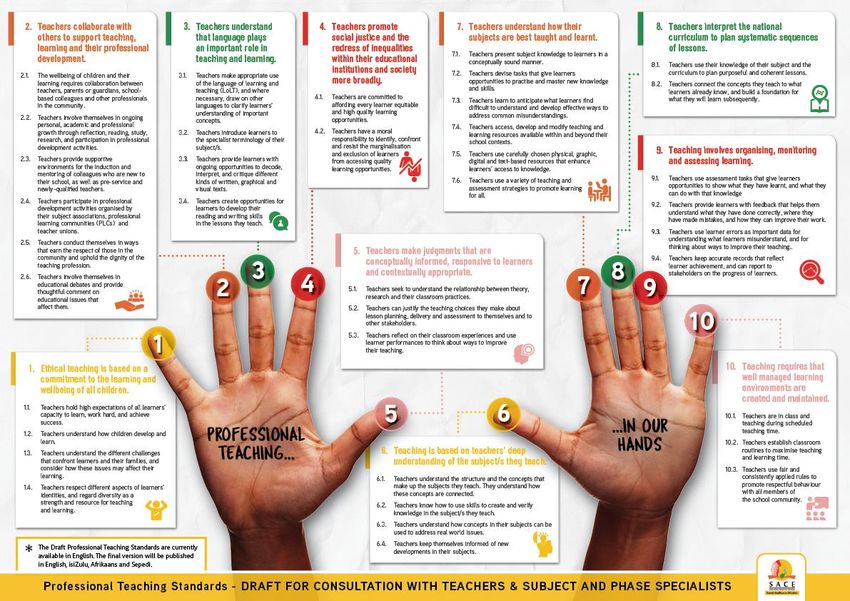
Draft Teaching Standards Released in October 2017 for Narrow
Consultation in the 9 Provinces
Teachers, Stakeholders Office-based Officials
Revised Version as Informed by the Consultation Process
Research Papers on the professional standards process
Final Draft Professional Teaching Standards followed and the product – in collaboration with the Wits
School of Education and the Zenex Foundation
Publish the Professional Teaching Standards, through formal Gazette, for the Wider
Consultation through the Public Comment Process
Gazetted Professional Teaching Standards Public Comments Process1 4 7
Beginner teacher
Recruitment (induction programmes in CPTD (3-year cycle)
probation period) Standards for CPTD
Criteria for recruitment
and selection into ITE Standards for full registration programmes
CPTD
2 5 8
ITE programmes Periodic renewal of
Submission of e-PoE registration
Standards for provisional
registration (student Review of e-PoE against
Full registration with
teachers) professional standards
SACE retained
3 6
Professional teacher:
Final student year and occupational
graduate designations awarded Field Testing the Professional
Provisional registration Full registration with
with SACE (NQT) SACE
Teaching Standards Against the
Teacher Professionalisation Path
POE – Portfolio of EvidencePROGRAMME 5:POLICY AND RESEARCH PURPOSE: • To enhance policy and research coordination within SACE. • To strengthen the SACE advisory role and service that is informed by policy, research, and consultative processes. • To promote research on professional matters and any other educational matter relevant to SACE. KEY FUNCTIONS: • Advising the Ministers of Basic and Higher Education, Council and the profession on professional matters; • Provide ongoing support to all the SACE Divisions and Committees in terms of policy and research matters; • Conceptualize and undertake research on professional matters for purposes of informing SACE programmes, Council decisions Educational policy, advising the Minister of Education, Council and the profession; • Produce policy and research publications/ reports and disseminate research findings through various communications channels; • Establish and manage the SACE resource center and virtual library.
POLICY AND RESEARCH….
 Programme Performance Indicators and Annual Targets for 2018/19
STRATEGIC OBJECTIVE PROGRAMME                                                  MEDIUM-TERM TARGETS
                    PERFORMANCE INDICATOR
 To influence national                                     2018/19                  2019/20     2020/21
policy and initiatives
through quality
evidence-based research
and advice.
                          The number of research report    3                        6           5
                          produced in line with the SACE    National Report on
                          Research Policy and Agenda.      the utilization of the
                                                           research projects
                                                           produced.
                          Number of Policy advice and      2                        3           2
                          briefs produced per annum

                          Number of Provincial             2                        2           3
                          Practitioner-Based Research
                          Conferences / Seminars Held                                                69
POLICY AND RESEARCH….
Programme Performance Indicators and Annual Targets for 2018/19
STRATEGIC OBJECTIVE PROGRAMME MEDIUM-TERM TARGETS
PERFORMANCE INDICATOR
To influence national 2018/19 2019/20 2020/21
policy and initiatives
through quality
evidence-based research
and advice.
Establish the SACE Resource Resource centre and Resource centre Virtual Library
center and virtual library virtual library established and established and
research and concept equipped launched
approved
70QUARTERLY TARGETS FOR POLICY AND RESEARCH 2018/19
PERFORMANCE REPORTING ANNUAL TARGET QUARTERLY TARGETS
INDICATOR PERIOD 2018/19 1st 2nd 3rd 4th
The number of research Annual 3 1 1 1 -
report produced in line
with the SACE Research
Policy and Agenda
Number of Policy advice Annual 2 1 - 1 -
and briefs produced per
annum
Number of Provincial Bi-Annual 2 1 - 1 -
Practitioner-Based
Research Conferences /
Seminars Held
Establish the SACE Annual Resource centre and - - - Resource
Resource center and virtual library centre and
virtual library concept approved virtual library
concept
71
approvedEVIDENCE-BASED AND DATA-DRIVEN ADVISORY
Strengthen Policy and Data and Knowledge
Research on Professional Management
Registration Database
Matters, SACE Mandate,
CPTD Information System
SACE Self-Renewal, and
Educator Misconduct Case Management
related Educational Matters System
Teacher Support and Advisory – Ministers,
Resource Hub Council, Profession2018/19 BUDGET
OVERVIEW OF 2018/19 BUDGET AND MTEF ESTIMATES
                                 2014/15       2015/16       2016/17           2017/18       2018/19     2019/20       2020/21
                                 Audited       Audited       Audited           Budget        medium - term

Financial performance in R,000        73,235        69,805         70,768           72,703       103,420     110,620       110,620

Registration fees                      6,314         4,800          8,398            6,200         6,000       6,000         5,000
Subcription fees                      49,735        52,080         50,358           52,080        78,120      78,120        78,120
Reprints of certificates               2,059           400          2,075            1,880         2,000       2,000         2,000

Interest receivable                    4,337           768             2,280         2,400         1,000       4,200         5,200
CPTD Subsidy                          10,531        11,557             7,239         9,743        16,000      20,000        20,000
Sundry income                            259           200               418           400           300         300           300

                                      61,434        68,384         60,037           72,703        98,148      96,582        98,300

Administration                        47,745        56,524         49,717           55,460        73,648      64,882        66,400
Research                                 670         1,132            495            1,000         1,500       3,200         3,400
Professional Development              10,531         8,437          7,239           10,743        18,000      22,000        22,000
Registration                             394           659            939            1,500         2,000       2,500         2,500
Code of Ethics                         2,094         1,632          1,647            4,000         3,000       4,000         4,000

Net surplus                           11,801         1,421         10,731                0         5,272      14,038        12,320
DETAILED OPERATIONAL EXPENDITURE
INCOME Note 103,420,000 Repairs &maintenance 13 1,000,000
Registration fees 1 6,000,000 M/vehicle running cost 45,000
Subcription fees 2 78,120,000 Salaries 14 49,377,000
Reprints of certificates 2,000,000 Security services 600,000
Interest receivable 3 1,000,000 Staff development 300,000
CPTD Subsidy 4 16,000,000 Sundry expenses 61,000
Sundry income 300,000
Telephone 800,000
TRAVEL & ACCOMMODATION 15 3,000,000
OPERATIONAL EXPENDITURE 98,148,000
Rates, Water and Electricity 3,000,000
Advertising 300,000
DATABASE DEV/ MAINTENANCE 2,000,000
Audit fees 5 900,000
CODE OF CONDUCT 16 3,000,000
Bank charges 350,000 REGISTRATION OF EDUC 17 2,000,000
Compensation commissioner 6 250,000 PROFESSIONAL DEVELOPMENT 18 0
CPTD 16,000,000
Cleaning of buildings 7 250,000
Consultation fees 8 600,000 Professionalisation 2,000,000
Depreciation 9 3,500,000 RESEARCH 19 1,500,000
Insurance 10 600,000 PUBLICITY AND COMMUNICATION 3,000,000
Lease charges 11 0
Leasohold Improvements 1,000,000
Legal cost 1,000,000 CAPITAL EXPENDITURE 5,272,000
Office rental 12 850,000 RESERVE FUND 20 5,272,000
Postage 15,000
Printing and Stationery 850,000 Budget surplus/ Deficit 02019 PROVINCIAL BUDGET
KZN Freestate Limpopo Cape town E. Cape TOTAL
Capital Expenditure 0 0 3,183,333 3,183,333 3,183,333 9,550,000
REVENUE 2,365,072 1,837,372 4,742,205 4,742,205 4,742,205 18,429,058
Transfer 2,115,609 1,718,809 1,718,809 1,718,809 1,718,809 18,429,058 OFFICE FURNITURE 0 0 0
sundry income
PARTITIONING &
OPERATIONAL NETWORK 0 0 350,000 350,000 350,000 1,050,000
EXPENDITURE 2,365,072 1,837,372 1,558,872 1,558,872 1,558,872 8,879,058
OFFICE
Cleaning of EQUIPMENTS 0 0 0
buildings 18,000 18,000 18,000 18,000 18,000 90,000
Office rental 450,000 313,500 0 0 0 763,500 CORPORATE
IDENTITY 0 0 0
Postage 13,000 7,000 7,000 7,000 7,000 41,000
ADVERTISING 0 0
Printing and Stationery 45,000 45,000 45,000 45,000 45,000 225,000
BUILDING AT
Repairs &maintenance 25,000 25,000 60,000 60,000 60,000 230,000 COST 0 0 2,833,333 2,833,333 2,833,333 8,500,000
Salaries 1,761,872 1,376,672 1,376,672 1,376,672 1,376,672 7,268,558
Telepho
7,200 7,200 7,200 7,200 36,000 Budget surplus/
ne 7,200
Deficit 0 0 0 0 0 0
Water and
Electricity 45,000 45,000 45,000 45,000 45,000 225,000
DATABASE DEV/NOTES
▪ Registration fees remain at R400 for Foreigners, R200 for South Africans and
R50 for renewals;
▪ The Council has increased the educator Annual Subscription from R120 to
R180 to counter the effect of inflation and to increase its delivery levels at
provincial levels. The increase is effective from 01.11.2017;
▪ This will mainly improve delivery capacity of mandatory functions;
▪ Approval has been obtained from treasury to subsidise implementation for
CPTD as follows: for 2019 – R 16 mil and for 2020 – R 20 mil.
▪ During the last quarter of 2018 the council allocated additional R2 million for
processing the high volume of cases
▪ Close monitoring of case management processes to ensure speedy
finalization
77NOTES/cont ….
▪ The current 2 provincial offices budget is included in the summation budget above;
▪ The Council is renting provincial office spaces ;
▪ All mandatory functions are delivered at Provincial points;
▪ The delay in the decision to increase subscription contributed to the postponement of the
establishment of offices in the Western Cape; Limpopo and Eastern Cape to take place
during this financial year;
▪ Poor response to the Bids for acquisition of offices were considered in February 2018 , the
council is considering alternatives to make progress in the matter;
▪ Council will lease the premises for provincial offices until it can afford out right purchases;
▪ The establishment of the planned provincial offices depends on the increased subscription;
▪ The surplus in 2019 and 2020 is to build reserve towards acquisition of provincial office
buildings.
▪ Mobile services will be an option for the remaining 3 provinces in the circumstances.
78THANK YOU
You can also read


