407 INTERNATIONAL INC - Annual Information Form For the Year Ended December 31, 2020 As at February 11, 2021
←
→
Page content transcription
If your browser does not render page correctly, please read the page content below
407 INTERNATIONAL INC.

      Annual Information Form

For the Year Ended December 31, 2020

       As at February 11, 2021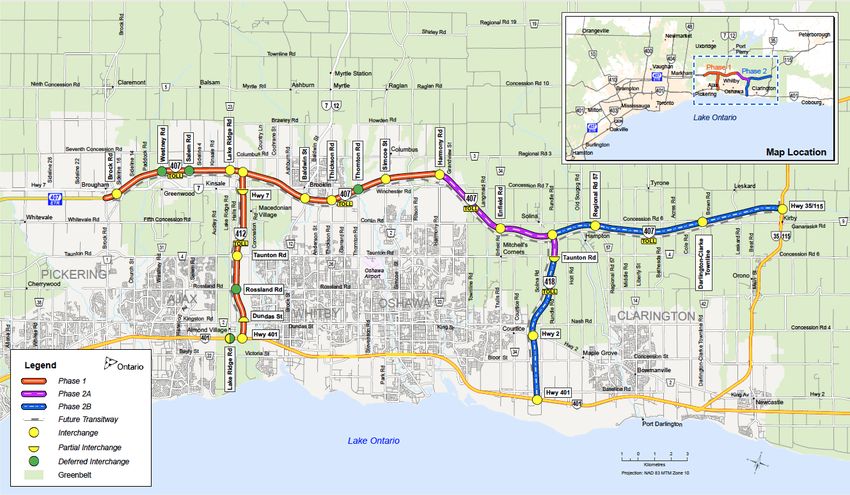
ANNUAL INFORMATION FORM
                                                       TABLE OF CONTENTS
FORWARD-LOOKING STATEMENTS ............................................................................................... 5
CORPORATE STRUCTURE ............................................................................................................... 5
1.     Name, Address, Incorporation and Ownership ................................................................. 5
2.     Intercorporate Relationships................................................................................................. 5
GENERAL DEVELOPMENT OF BUSINESS .................................................................................... 6
1.     Traffic ......................................................................................................................................... 6
2.     Construction ............................................................................................................................. 6
3.     Information Technology ......................................................................................................... 7
4.     Customer Service .................................................................................................................... 7
5.     Other Developments ............................................................................................................... 8
5.1. International Organization for Standardization (“ISO”) ........................................................... 8
5.2. 407 ETR Team Charter ............................................................................................................. 8
5.3. 407 ETR in the Community ....................................................................................................... 8
5.4    Data Theft Incident..................................................................................................................... 8
1.     General Summary .................................................................................................................... 9
2.     Production and Services ...................................................................................................... 10
3.     Specialized Skill and Knowledge........................................................................................ 11
4.     Competitive Conditions ........................................................................................................ 12
5.     Highway 407............................................................................................................................ 12
5.1. Construction Activities ............................................................................................................. 13
5.2. Tolling and Back Office Activities ........................................................................................... 13
6.     Process and Technology Enhancements ......................................................................... 14
7.     Intangible Properties ............................................................................................................. 14
8.     Seasonal Variations .............................................................................................................. 14
9.     Economic Dependence......................................................................................................... 15
9.1. Authorized Requester Electronic Data Services Agreement ............................................... 15
9.2. MTO Enforcement Services .................................................................................................... 15
9.3. Police Services Agreement ..................................................................................................... 16
9.4. Transponder Supply and Leasing/Toll System Technology and Licensing ....................... 16
10.    Employees............................................................................................................................... 16
11.    Strategic Plan ......................................................................................................................... 17
12.    Corporate Social Responsibility and Environmental Policies...................................... 17
12.1. Environmental Pollution Prevention & Climate Change Risk .............................................. 17
12.2. Management Commitment...................................................................................................... 17
12.3. Corporate Awareness .............................................................................................................. 18
12.4. Stakeholder Awareness and Participation............................................................................. 18
12.5. Performance Monitoring and Reporting ................................................................................. 18
13.    Risk Factors ............................................................................................................................ 18
13.1. Construction of Extensions and Deferred Interchanges ...................................................... 18
13.2. Toll Exempt Vehicles and Unbillable Transactions............................................................... 19
13.3. Traffic Volumes and Toll Revenue ......................................................................................... 19
13.4. Possible Transportation Improvements ................................................................................. 19
13.5. Operating and Maintenance Expenses.................................................................................. 20
13.6. Technology Infrastructure ....................................................................................................... 20
13.7. Cybersecurity ........................................................................................................................... 20
13.8. Ownership of Intellectual Property and Reliance on Certain Suppliers .............................. 20
13.9. Liquidity ..................................................................................................................................... 20
13.10. Inflation...................................................................................................................................... 21
13.11. Adequate Insurance/Risk Management................................................................................. 21
                                                                                                                                          Page 2 of 78
13.12. Changes in Laws ..................................................................................................................... 21
13.13. Market for Securities ................................................................................................................ 21
14. Insurance ................................................................................................................................. 21
DIVIDENDS ................................................................................................................................ 22
DESCRIPTION OF CAPITAL STRUCTURE ............................................................................. 22
1. General Description of Capital Structure.......................................................................... 22
2. Ratings ..................................................................................................................................... 22
3. Existing Indebtedness .......................................................................................................... 24
3.1. July 1999 Bonds....................................................................................................................... 25
3.2. August 1999 Bonds ................................................................................................................. 25
3.3. March 2000 Bonds................................................................................................................... 26
3.4. July 2000 Bonds....................................................................................................................... 26
3.5. December 2004 Notes............................................................................................................. 27
3.6. February 2006 Notes ............................................................................................................... 28
3.7. November 2011 Notes............................................................................................................. 28
3.8. April 2012 Notes....................................................................................................................... 29
3.9. September 2012 Notes ........................................................................................................... 29
3.10. October 2013 Notes................................................................................................................. 29
3.11. May 2014 Notes ....................................................................................................................... 30
3.12. March 2015 Notes.................................................................................................................... 30
3.13. May 2015 Notes ....................................................................................................................... 30
3.15. May 2016 Notes ....................................................................................................................... 30
3.15. November 2016 Notes............................................................................................................. 31
3.18 March 2017 Notes.................................................................................................................... 31
3.19 September 2017 Notes ........................................................................................................... 31
3.20 May 2018 Notes ....................................................................................................................... 32
3.21 March 2019 Notes.................................................................................................................... 32
3.22 March 2020 Notes.................................................................................................................... 32
3.23 May 2020 Notes ....................................................................................................................... 33
3.24 Senior Bank Credit Facilities................................................................................................... 33
4. Voting Securities and Principal Holders of Voting Securities ...................................... 33
MARKET FOR SECURITIES ..................................................................................................... 34
1. Name, Occupation and Security Holding.......................................................................... 35
2. Conflicts of Interest ............................................................................................................... 37
LEGAL PROCEEDINGS AND REGULATORY ACTIONS ............................................................ 37
INTEREST OF MANAGEMENT AND OTHERS IN MATERIAL TRANSACTIONS .................... 37
TRANSFER AGENTS AND REGISTRARS ..................................................................................... 37
MATERIAL CONTRACTS ................................................................................................................. 37
NAMES AND INTERESTS OF EXPERTS ....................................................................................... 38
ADDITIONAL INFORMATION........................................................................................................... 38
1. Executive Compensation ..................................................................................................... 38
2. Summary Compensation Table........................................................................................... 39
3. Employment Agreements..................................................................................................... 40
4. Compensation of Directors.................................................................................................. 40
5. Other Compensation for Services ...................................................................................... 41
6. Indebtedness of Directors and Executive Officers ......................................................... 41
7. Additional Information .......................................................................................................... 41
CORPORATE GOVERNANCE ......................................................................................................... 41
1. Background............................................................................................................................. 41
2. The Company’s Corporate Governance Practices ......................................................... 41
3. Mandate and Direction of the Board of Directors ........................................................... 41
Page 3 of 784. Orientation and Continuing Education.............................................................................. 44
5. Nomination of Directors ....................................................................................................... 45
6. Valuing Diversity .................................................................................................................... 45
7. Board Assessments and Evaluations ............................................................................... 45
8. Compensation ........................................................................................................................ 46
9. Ethical Business Conduct.................................................................................................... 46
AUDIT COMMITTEE........................................................................................................................... 47
1. Charter of the Audit Committee .......................................................................................... 47
2. Composition of the Audit Committee ................................................................................ 47
3. Audit Committee Oversight ................................................................................................. 49
4. Audit Fees ............................................................................................................................... 49
5. Exemption ............................................................................................................................... 49
SCHEDULE A ............................................................................................................................ 50
AUDIT COMMITTEE MANDATE ............................................................................................... 50
SCHEDULE B ............................................................................................................................ 57
SUMMARY OF MATERIAL PROVISIONS OF CONCESSION AGREEMENT.......................... 57
SCHEDULE C ............................................................................................................................ 60
SUMMARY OF MATERIAL PROVISIONS OF TOLLING AGREEMENT .................................. 60
SCHEDULE D ............................................................................................................................ 61
SUMMARY OF MATERIAL PROVISIONS OF MASTER TRUST INDENTURE........................ 61
Page 4 of 78FORWARD-LOOKING STATEMENTS
This Annual Information Form includes statements about expected future events and operating results that are
forward-looking. Forward-looking statements may include words such as “anticipate”, “believe”, “could”, “expect”,
“goal”, “intend”, “may”, “outlook”, “plan”, “strive”, “target” and “will”. These forward-looking statements reflect the
internal projections, expectations, future growth, performance and business prospects and opportunities of 407
International Inc. (the “Company”) and are based on information currently available to the Company. Actual results
and developments may differ materially from results and developments discussed in the forward-looking statements
as they are subject to a number of risks and uncertainties as discussed in this Annual Information Form. In developing
these forward-looking statements, certain material assumptions were made, including assumptions as to the timing
of highway development activities and the impact and duration of the novel coronavirus (“COVID-19”) pandemic.
Readers are cautioned not to place undue reliance on the Company’s forward-looking statements and assumptions
as management of the Company and its subsidiaries (“Management”) cannot provide assurance that actual results
or developments will be realized or, even if substantially realized, that they will have expected consequences to, or
effects on, the Company. These forward-looking statements are subject to change as a result of new information,
future events or other circumstances, as discussed above, in which case they will only be updated by the Company
where required by law.
CORPORATE STRUCTURE
1. Name, Address, Incorporation and Ownership
The Company has its head and registered office at 6300 Steeles Avenue West, Woodbridge, Ontario L4H 1J1. It
was incorporated under the Business Corporations Act (Ontario) (“OBCA”) on March 17, 1999 and was continued
under the Canada Business Corporations Act (“CBCA”) on October 10, 2003. The Company is a majority-owned
Canadian company, whose shares are beneficially owned, directed or controlled by the Canada Pension Plan
Investment Board (“CPPIB”) (50.01%)1, Cintra Global S.E. (“Cintra Global”) (43.23%)2, and SNC-Lavalin Inc. (“SNC-
Lavalin”) (6.76%) (See “Description of Capital Structure - Voting Securities and Principal Holders of Voting
Securities”).
2. Intercorporate Relationships
The wholly owned subsidiaries of the Company are as follows:
1. 407 ETR Concession Company Limited (“407 ETR”) was initially known as the Ontario Transportation Capital
Corporation (“OTCC”). It was established by the Province of Ontario (the “Province”) as a Crown agency in
1999 and was continued as a share capital corporation under the OBCA under the name 407 ETR
Concession Company Limited. Following the acquisition of all the issued and outstanding shares of 407 ETR
by the Company, 407 ETR was continued under the CBCA on October 10, 2003. 407 ETR is responsible for
the operation, maintenance, management and expansion of Highway 407 ETR3.
2. Canadian Tolling Company International Inc. (“Cantoll”) was initially incorporated under the OBCA on
December 6, 2001 under the numbered company 2007466 Ontario Inc., and was continued under the CBCA
on October 10, 2003. Cantoll owns the integrated computerized accounting, billing and customer
management system and transponders, and is responsible for the development of Highway 407 ETR’s
integrated automation systems. Cantoll also provides third-party tolling services to the Province for Highway
407 (See “Description of the Business – Highway 407”).
3. 11783378 Canada Inc. was incorporated under the CBCA on December 10, 2019 and is utilized for the
Company’s tax planning strategies.
1 CPPIB’s ownership is comprised of shares beneficially owned through Ramp Canada Roads LP, CPPIB Ramp Canada Roads Inc.,7577702 Canada Inc., and shares over which
control or direction is exercised through MICI Inc. (the parent company of which CPPIB holds a majority economic interest). For more details, please see “Description of Capital
Structure – Voting Securities and Principal Holders of Voting Securities”.
2 Cintra Global’s ownership is comprised of shares beneficially owned through Cintra 4352238 Investments Inc. For more details, please see “Description of Capital Structure –
Voting Securities and Principal Holders of Voting Securities”.
3 For a description of Highway 407 ETR, please see “Description of the Business – General Summary”.
Page 5 of 78GENERAL DEVELOPMENT OF BUSINESS
The following is a general description of the development of the Company’s business and conditions that have
influenced it over the last three completed financial years:
1. Traffic
In early 2020, COVID-19 was confirmed in multiple countries throughout the world and, on March 11, 2020, the World
Health Organization declared a pandemic. The Province of Ontario (the “Province”) declared a state of emergency
on March 17, 2020 and mandated the closure of schools, public facilities and non-essential businesses. In late April
2020, the Province released a staged framework for the safe reopening of local businesses, services and public
spaces. The first stage of reopening in the GTA was initiated in late May 2020 for select workplaces and businesses.
The second stage, initiated in mid-June 2020, saw the opening of more public facilities and non-essential businesses.
The third stage, implemented by region and completed by August 1, 2020, allowed all businesses, schools and public
spaces to gradually re-open while complying with public health and workplace safety restrictions. While Highway 407
ETR has experienced significant declines in traffic volumes since the onset of the COVID-19 pandemic, the Company
observed gradual improvements in traffic volumes with each stage of the re-opening. However, due to a steep
increase in the number of COVID-19 infections throughout autumn, additional region-based lockdowns were
implemented in late November and early December for the Toronto, Peel, York and Hamilton regions. A Province-
wide lockdown was announced on December 26, 2020 and a second state of emergency and stay-at-home order
was implemented from January 14, 2021 until February 10, 2021. Since the onset of the COVID-19 pandemic,
Highway 407 ETR has experienced significant declines in traffic volume as compared to the same period in 2019.
This traffic reduction will continue to have a significant negative impact on the Company’s revenues and results of
operations.
In 2020, year-over-year vehicle kilometres travelled (“VKT”) decreased by 45.3% (-0.2% in 2019 and +1.4% in 2018).
Total annual trips decreased by42.9% (+1.2% in 2019 and +0.7% in 2018). The decrease in traffic in 2020 was
primarily a result of measures adopted by the Province to combat the spread of COVID-19, which had a direct impact
on demand for highway travel in the GTA. Prior to the COVID-19 pandemic, traffic volumes were comparable to the
same period in 2019, with slightly higher VKT. Transponder usage represented 82.1% of trips in 2020 (81.8% in 2019
and 82.2% in 2018).
2. Construction
407 ETR continues to improve Highway 407 ETR through construction projects designed to increase capacity, and
improve traffic flow and customer convenience, including investments in widening bridge structures and adding new
lanes to the highway. 407 ETR also regularly undertakes various highway rehabilitation initiatives designed to
improve and replace existing elements of the infrastructure, such as resurfacing the asphalt pavement in certain
sections of the highway, replacing concrete pavement, upgrading to energy efficient light-emitting diode (LED)
highway lighting, replacing and relining culverts under and along the highway and rehabilitating various bridge
structures.
In 2018, 407 ETR commenced the construction of the widening of Highway 407 ETR between Markham Road and
the York Durham Line (“Segment E1”). In 2019, 407 ETR commissioned and opened these additional lanes in
Segment E1.
In 2019, 407 ETR commenced construction of the widening of Highway 407 ETR between Highway 410 and Highway
401, and between Highway 401 and Derry Road. In the second half of 2020, the construction work was completed
and the new lanes were commissioned and opened to traffic.
On November 17, 2020, following inspection and approval by the Ontario Ministry of Transportation (“MTO”), 407
ETR announced the official opening of 33 new lane kilometers amounting to an additional lane in each direction on
Highway 407 ETR between Highway 401 and Highway 410. All of the work completed was done under COVID-19
requirements for construction. Highway 407 ETR has now been built to approximately 90% of its maximum number
of lanes.
The Company completed the construction of Sideline 26 (Whites Road) interchange and the Region of Durham
completed the construction of Whites Road to the south of Highway 407 ETR. The interchange was commissioned
and opened to traffic on February 3, 2021.
Page 6 of 78Since privatization, 407 ETR has nearly doubled Highway 407 ETR’s capacity, adding over 600 lane kilometers since
2001 at no cost to taxpayers.
3. Information Technology
407 ETR continues to work with suppliers to develop new products to replace roadside tolling cameras, antennas
and transponder technology, thereby enhancing its trip capture and toll evasion enforcement capabilities.
In 2020, work continued on the upgrade of hardware and software components of the Company’s integrated
automation system. The upgrades included further enhancements to collections processing, business process
management, advanced traffic management solution, asset management, data management and analytics, customer
relationship management, trip transactions matching and the rating of trips, as well as self-service capabilities such
as the 407 ETR website and the development of a mobile application. The Company successfully released a beta
version of a mobile application and later launched a comprehensive multi-channel marketing campaign to promote
the availability of the mobile application on the App Store and Google Play. The company will continue to develop
new functionalities during 2021 that will enhance the customer experience.
Work also continued in 2020 on a significant project that will ultimately result in the implementation of a new Enterprise
Resource Planning (“ERP”) and Customer Relationship Management (“CRM”) solutions. This initiative will take
several years to complete and will ultimately involve the majority of 407 ETR back-office processes and systems.
During 2020, various development activities for the CRM and ERP implementation were completed. Implementation
efforts will continue throughout 2021. A phased approach has been undertaken to manage implementation risks and
407 ETR has developed a release strategy that will balance the demands of introducing functionality while assuring
quality and stability of business operations.
Cantoll also continued with enhancing capacity to provide tolling services for the Province’s Highway 407 (See
“Description of the Business – Highway 407”). In 2019, all remaining development activities were successfully
completed to support the implementation of Phase 2b, which opened to traffic in December 2019 and completed the
construction of Highway 407.
In 2020, Business Continuity Planning and Disaster Recovery Planning (“BCP/DRP”) activities continued in
accordance with 407 ETR standards. This included plan updates, table top exercises and a system failover exercise.
407 ETR complies with the Payment Card Industry Data Security Standards (“PCI-DSS”) for a level-two merchant.
Ongoing PCI-DSS compliance remains a focus for 407 ETR.
4. Customer Service
Results of annual customer service, research and attitudes surveys conducted throughout 2020 continue to show
strong levels of customer satisfaction with 407 ETR. In particular, customers who have continued to use Highway
407 ETR throughout the COVID-19 pandemic have positively identified with the time and money savings and more
predictable commute that come as a result of using the highway.
Customers continued to enjoy 407 ETR’s multi-tier loyalty program for frequent light vehicle transponder users (the
“ETR Rewards Program”). Since its introduction in 2007, the ETR Rewards Program has offered customers over
$202.8 million in fuel savings and free weekend kilometres on Highway 407 ETR.
In 2020, due to the COVID-19 pandemic, many customers used the highway less frequently and in some cases were
unable to meet the eligibility requirements of the ETR Rewards Program. 407 ETR relaxed the requirements of the
program and allowed customers to remain in the program at their previously attained reward levels.
407 ETR aims to provide an enhanced customer service experience. In recognition of its commitment to providing
customers with a world-class highway and outstanding customer service, in 2020, 62 of 407 ETR’s customer service
representatives (“CSRs”) became certified as “World Class CSRs” based on specific criteria established by Service
Quality Measurement Group Inc. (“SQM”). SQM is an independent organization that measures both call centre and
customer satisfaction rates by surveying hundreds of 407 ETR customers each month. SQM benchmarks call centre
customer service for over 500 call centres globally, and provides call centres with feedback on how best to improve
their services.
In 2020, SQM certified 407 ETR’s call centre as a "World Class Call Centre” for the seventh consecutive year, placing
the call centre in an elite group of fewer than 25 call centres (out of 500 leading call centres benchmarked globally
Page 7 of 78by SQM). SQM’s criteria for “World Class Call Centre Certification” includes the requirement that at least 80% of
customer calls be at the world class level for three months or more.
5. Other Developments
5.1. International Organization for Standardization (“ISO”)
407 ETR has maintained ISO 9001 certification for its quality management system implemented for activities related
to the operation, management, tolling, maintenance and rehabilitation of Highway 407 ETR. In January 2021, the
Company updated its certification from ISO 9001:2008 to the new ISO 9001:2015 standard, which will expire in
January 2024. .
5.2. 407 ETR Team Charter
407 ETR’s corporate values are highlighted in a Team Charter that is well established and communicated within the
organization. The Team Charter defines the core values and principles of the work conducted by 407 ETR
employees, calling on employees to work safely, engage each other, work together proactively, act decisively,
continually improve, and focus on the team’s best interests; both within and across departments. The Team Charter
applies to all 407 ETR employees, and is championed by Management and employees.
5.3. 407 ETR in the Community
Throughout the COVID-19 pandemic, the Company took several measures to assist customers and the communities
it serves through numerous donations and policy changes to help those experiencing financial difficulties.
In March 2020, the Company provided $12,500 in 407 ETR gift cards to 24 GTA hospitals for a total donation of
$300,000 in gift cards for distribution to frontline hospital workers.
On April 27, 2020, 407 ETR announced a multi-year $5.2 million total commitment to assist with COVID-19 relief in
the GTA. This was the largest donation in company history and was directed towards healthcare and community
support services.
As part of this investment, 407 ETR gave $50,000 to the same 24 hospitals that had received gift cards (as described
above) so that hospitals could allocate the funding to areas of greatest need. This represented a $1.2 million
investment from 407 ETR to support a range of healthcare initiatives from sourcing ventilators to assembling satellite
COVID-19 units to treat patients remotely.
The remaining $4 million was pledged to United Way of Greater Toronto to provide funding from 2020 to 2023 for its
network of agencies in Durham, Halton, Hamilton, Peel, Toronto and York. 407 ETR’s investment is targeting four
critical areas: (i) food security; (ii) employment and income security; (iii) isolated seniors; and (iv) mental health. The
Company donated $1.3 million in 2020, representing the first year of the Company’s commitment to support the
United Way.
Throughout 2020, 407 ETR took other actions to assist customers, including the temporary suspension of transponder
lease fees and interest accrual, creating a financial assistance program for customers impacted by the pandemic,
and suspending seasonal tolling which would have resulted in an additional toll rate increase during the COVID-19
pandemic.
Additionally, 407 ETR staff demonstrated their community support through the continuation of employee volunteering
and fundraising activities. Together with corporate matching dollars, 407 ETR and its staff raised more than $120,000
for its annual United Way campaign. On November 13, 2020, employees also participated in One Big Day, 407 ETR’s
corporate-wide day of volunteering which was modified to conform to include virtual events and activities that
conformed with COVID-19 restrictions.
5.4 Data Theft Incident
On May 10, 2018, 407 ETR publicly disclosed a suspected internal theft of information relating to approximately
60,000 customers. The stolen customer information consisted of customer name, address, and in some cases,
telephone numbers with the sensitivity of this information considered to be low. Nonetheless, 407 ETR immediately
notified the appropriate authorities and also individually contacted all affected customers. The Company conducted
a thorough internal investigation in relation to this incident and has assisted with an investigation by York Regional
Page 8 of 78Police. In July 2020, criminal charges were laid against a former 407 ETR employee who is alleged to have been
involved with the data theft. The protection of customer information remains of utmost importance to 407 ETR and
the Company remains committed to ongoing data security enhancements.
DESCRIPTION OF THE BUSINESS
1. General Summary
Highway 407 ETR is the first all-electronic open-access toll highway in the world, traversing the GTA, the largest
urban centre in Canada. Highway 407 ETR runs 108 kilometres from Burlington in the west to Pickering in the east
along the top of the GTA and connects to eight major highways – Queen Elizabeth Way (“QEW”), Highways 403,
401, 410, 427, 400 404 and Highway 407, which is owned by the Province. Highway 407 runs from Brock Road in
Pickering, the eastern terminus of Highway 407 ETR, to Highways 35/115 in Clarington. Highway 407 has two major
north-south connections to Highway 401, Highways 412 and 418, which are both toll roads owned by the Province.
The Province enacted the Ontario Highway 407 Act, 1998 (the “407 Act”) to authorize and facilitate the sale of OTCC
and privatize Highway 407 ETR. Under the provisions of the 407 Act, 407 ETR and the Province entered into the
Highway 407 Concession and Ground Lease Agreement dated April 6, 1999 (the “Concession Agreement”). The
Concession Agreement is a 99-year contract which, in combination with the 407 Act, authorizes 407 ETR to establish,
collect and enforce payment of tolls, and obliges 407 ETR to manage, maintain, repair and toll Highway 407 ETR. A
copy of the Concession Agreement is available at 407etr.com, and a summary of some of the principal provisions
contained in the Concession Agreement is set out in Schedule B hereto.
The Company was established for the purpose of submitting a bid to the Province to acquire all the issued and
outstanding shares of 407 ETR. Following the selection of the Company as the successful bidder, the Company, the
Province, SNC-Lavalin, Ferrovial, S.A., Concesiones de Infraestructuras de Transporte, S.A. (“Cintra”), and Capital
d’Amérique CDPQ Inc. entered into a share purchase agreement on April 12, 1999. On May 5, 1999, the Company
completed the acquisition of all the issued and outstanding shares of 407 ETR for a purchase price of $3.113 billion.
The mission of 407 ETR is to provide a fast, safe and reliable customer experience on and off the highway. 407 ETR
aims to maximize customer satisfaction and shareholder value through the delivery of a superior travel experience
providing a fast, safe and reliable alternative transportation route in the GTA. Since 1999, 407 ETR has almost
doubled the highway’s capacity, expanding from 643 lane kilometres (including ramps and interchanges) to 1,232
lane kilometres. Since extending Highway 407 ETR by 15 kilometres eastward to Brock Road and by an additional
25 kilometres westward to the QEW in 2001, 407 ETR has also widened Highway 407 ETR with over 250 additional
lane-kilometres.
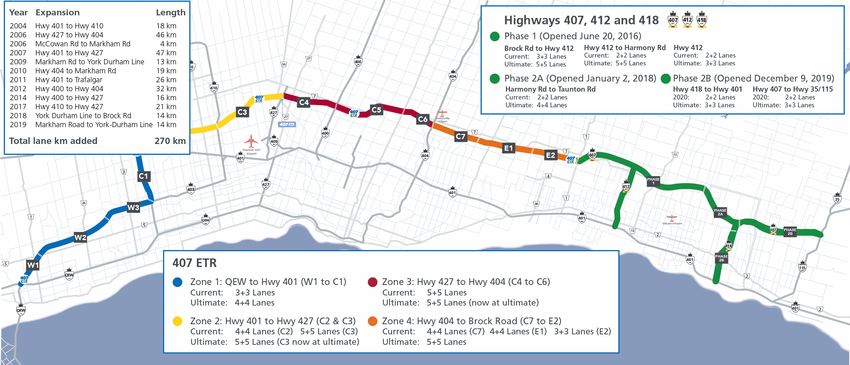
The map below details highway expansions since 2004, as well as current and ultimate expected lane capacity. Lane
capacity data is also provided for the tolled and provincially-owned Highway 407 and Highways 412 and 418
(subsequent “Highway 407” references include Highways 412 and 418 except where one or both are specifically
referenced).
Page 9 of 782. Production and Services
Highway 407 ETR is designed to provide open and unimpeded access to motorists.
The toll system is designed based on the following concepts:
1. All-Electronic Toll Collection: Toll transactions are registered electronically under an open road system. There
are no barriers, cash or token/ticket toll booths or coin machines. Motorists are not required to stop or slow
down to pay tolls when entering or exiting the highway, nor are they lane-restricted.
2. Open-Access Highway: All vehicles are able to travel on Highway 407 ETR. Users are either identified for
billing purposes through video-based licence plate identification or by a transponder.
3. Revenue Optimization: Fully flexible toll rates allow 407 ETR to manage congestion and optimize revenue
by charging based on usage by: day of week, distance, time of use, vehicle type, direction and highway
zone(s).
As a vehicle enters or exits Highway 407 ETR, vehicle information is gathered, either by reading a vehicle-mounted
transponder or by photographing the front1 and/or rear licence plate. This information is transmitted to the back-office
computer systems, where the vehicle’s entry and exit are matched to generate a complete trip. Tolls are calculated
and billed to the account of the person registered to the licence plate or transponder, as described below.
A transponder is a small electronic radio-frequency-identification device that works in tandem with the electronic
sensors on overhead gantries located at entry and exit points on Highway 407 ETR and which log a vehicle’s trip on
the highway. Mounted correctly, the transponder is attached to the interior of the windshield of the vehicle, behind
the rear-view mirror. Installation requires no tools and can be done in less than two minutes. By law, transponders
are mandatory for heavy vehicles using Highway 407 ETR and Highway 407, which have a Registered Gross Vehicle
Weight (“RGVW”) or gross weight of over 5,000 kilograms (five tonnes).
In the event a transponder is not detected upon entry or exit of the highway, trips are logged by using a highly accurate
licence plate recognition system. The camera system is located on each overhead gantry, capturing up to three
images when a vehicle enters and exits Highway 407 ETR, which are sent to a central processing computer.
In the case of a first-time non-transponder user, name and address information for Ontario residents are obtained
from the MTO licence plate database. For non-Ontario residents, 407 ETR has established agreements with service
providers in respect of certain other jurisdictions to obtain name and address information for first-time non-
transponder users with out-of-province vehicle registrations. Tolls are accumulated and invoices are prepared and
sent on a monthly basis.
The Tolling, Congestion Relief and Expansion Agreement (“Tolling Agreement”) between the Province and 407
ETR, the principal provisions of which are summarized in Schedule C, allows significant flexibility for 407 ETR in
setting tolls, rates and structure. The toll structure is variable based on distance travelled, class of vehicle, direction,
time of day and zone of Highway 407 ETR travelled. 407 ETR’s toll structure includes different pricing during the
peak hours for the busiest zones of Highway 407 ETR. Highway 407 ETR is segmented into four zones to reflect the
unique travel demand profiles of the highway corridor. In addition to per kilometre toll charges, a Trip Toll Charge
(defined below) is applied to each trip. For vehicles without a transponder, a camera charge (previously referred to
as a video toll charge) is also applied, as described below.
[remainder of page left blank intentionally]
1 Front-capture licence plate camera implementation continues with 102 of 198 tolling sites completed as of December 31, 2019.
Page 10 of 78On February 1, 2020, the Company introduced new toll rates for light vehicles, heavy single unit vehicles and heavy
multiple unit vehicles. Subsequent seasonal toll rate changes announced for 2020 were not implemented as a result
of the COVID-19 pandemic and toll rates remain at the rates announced on February 1, 2020 which are as follows:
Spring per km Rates | Effective: February 1, 2020 – April 30, 2020
Zone 1 Zone 2 Zone 3 Zone 4
Entire trip is based QEW to Highway 401 Highway 401 to Highway 427 Highway 427 to Highway 404 Highway 404 to Brock Road
on time of entry.
RATE PERIOD
START TIME WESTBOUND EASTBOUND WESTBOUND EASTBOUND WESTBOUND EASTBOUND WESTBOUND EASTBOUND
Weekdays 12 a.m. – 25.29 ¢ 25.29 ¢ 25.29 ¢ 25.29 ¢ 25.29 ¢ 25.29 ¢ 25.29 ¢ 25.29 ¢
6 a.m. – 42.85 ¢ 43.76 ¢ 42.83 ¢ 48.29 ¢ 46.31 ¢ 47.43 ¢ 44.86 ¢ 42.04 ¢
7 a.m. – 48.74 ¢ 55.13 ¢ 50.89 ¢ 56.44 ¢ 54.43 ¢ 56.43 ¢ 54.93 ¢ 47.83 ¢
9:30 a.m. – 42.53 ¢ 45.45 ¢ 44.02 ¢ 48.29 ¢ 46.58 ¢ 47.43 ¢ 46.58 ¢ 42.04 ¢
10:30 a.m. – 39.07 ¢ 39.07¢ 39.07 ¢ 40.17 ¢ 40.17 ¢ 40.90 ¢ 39.07 ¢ 38.47 ¢
2:30 p.m. – 51.93 ¢ 44.04 ¢ 50.55 ¢ 48.98 ¢ 51.01 ¢ 51.92 ¢ 43.62 ¢ 48.61 ¢
3:30 p.m. – 61.14 ¢ 50.10 ¢ 55.45 ¢ 59.00 ¢ 58.99 ¢ 62.24 ¢ 49.56 ¢ 58.48 ¢
6 p.m. – 51.93 ¢ 44.04 ¢ 50.55 ¢ 48.98 ¢ 51.01 ¢ 51.92 ¢ 43.62 ¢ 46.81 ¢
7 p.m. – 25.29 ¢ 25.29 ¢ 25.29 ¢ 25.29 ¢ 25.29 ¢ 25.29 ¢ 25.29 ¢ 25.29 ¢
Weekends 12 a.m. – 25.29 ¢ 25.29 ¢ 25.29 ¢ 25.29 ¢ 25.29 ¢ 25.29 ¢ 25.29 ¢ 25.29 ¢
& Holidays 11 a.m. – 34.63 ¢ 35.96 ¢ 35.96 ¢ 35.96 ¢ 35.96 ¢ 35.96 ¢ 34.63 ¢ 34.63 ¢
7 p.m. – 25.29 ¢ 25.29 ¢ 25.29 ¢ 25.29 ¢ 25.29 ¢ 25.29 ¢ 25.29 ¢ 25.29 ¢
A Trip Toll per
Summer Charge
km Ratesis applied
| Effective: Mayfor each
1, 2020 trip (Light
– October 31, 2020 Vehicles $1.00, Heavy Single-Unit Vehicles $2.00, and Heavy Multi-
Unit Vehicles $3.00). This is in addition to the per kilometre charge. The camera charge for non-transponder trips
by light vehicles is $4.20 per trip, and $50.00 per trip for heavy vehicles.
Zone 1 Zone 2 Zone 3 Zone 4
Entire trip is based QEW to Highway 401 Highway 401 to Highway 427 Highway 427 to Highway 404 Highway 404 to Brock Road
For a complete list of ofcurrent
on time entry. charges, visit www.407etr.com.
RATE PERIOD
START TIME WESTBOUND EASTBOUND WESTBOUND EASTBOUND WESTBOUND EASTBOUND WESTBOUND EASTBOUND
The 407 Act authorizes electronic tolling on Highway 407 ETR. Ontario’s Highway Traffic Act makes it an 25.29
12 a.m. – 25.29 ¢ 25.29 ¢ 25.29 ¢ offence to:
25.29 ¢
¢ 25.29 ¢ 25.29 ¢ 25.29 ¢
Weekdays 6 a.m. – 45.24 ¢ 43.76 ¢ 42.83 ¢ 50.97 ¢ 48.74 ¢ 50.07 ¢ 44.86 ¢ 44.38 ¢
7 a.m. – 51.45 ¢ 58.20 ¢ 53.72 ¢ 59.58 ¢ 57.46 ¢ 59.56 ¢ 57.98 ¢ 50.49 ¢
• evade a toll,9:30by any means;
a.m. – 45.24 ¢ 47.97 ¢ 46.95 ¢ 50.97 ¢ 49.17 ¢ 50.07 ¢ 49.17 ¢ 44.38 ¢
• obstruct or 10:30
altera.m. –
a licence
41.25 ¢
plate; 41.25 ¢ 41.25 ¢ 42.40 ¢ 42.40 ¢ 43.17 ¢ 41.25 ¢ 41.25 ¢
• sell a device2:30to
p.m.assist
– in ¢the evasion
54.81 46.49 ¢ of a toll;
53.36or
¢ 51.70 ¢ 53.84 ¢ 54.80 ¢ 46.04 ¢ 51.31 ¢
• operate a vehicle
3:30 p.m. – over 5,000
64.54 ¢ kilograms
52.88 ¢ RGVW58.53 ¢ on Highway
62.28 ¢ 407 ETR
62.27 ¢ without a¢properly52.31
65.70 affixed
¢ transponder.
61.73 ¢
6 p.m. – 54.81 ¢ 46.49 ¢ 53.36 ¢ 51.70 ¢ 53.84 ¢ 54.80 ¢ 46.04 ¢ 47.05 ¢
The 407 Act sets out7 p.m.a– toll collection 25.29 ¢
procedure
25.29 ¢
with
25.29 ¢
requirements
25.29 ¢
for 25.29
notice¢
and25.29
dispute
¢
settlement
25.29 ¢
procedures.
25.29 ¢
These procedures are in addition to other standard remedies at law. Under Ontario law, licence plate holders
12 a.m. – 25.29 ¢ 25.29 ¢ 25.29 ¢ 25.29 ¢ 25.29 ¢ 25.29 ¢ 25.29 ¢ 25.29 ¢
must
Weekends 11 a.m. – 37.96 ¢ 37.96 ¢ 37.96 ¢ 37.96 ¢ 37.96 ¢ 37.96 ¢ 34.63 ¢ 34.63 ¢
renew the
& Holidays
plates either every
7 p.m. –
year
25.29 ¢
or every
25.29 ¢
two years,
25.29 ¢
except trailer
25.29 ¢
plates.
25.29 ¢
The 407 Act
25.29 ¢
provides
25.29 ¢
that if tolls
25.29 ¢
remain
unpaid for longer than 90 days after notice of non-payment is given, 407 ETR may notify the Ontario Registrar of
Motor Vehicles (the “Registrar”) of non-payment and the Registrar will deny the renewal of Ontario licence plate
permit(s) and the issuance of a plate permit to the person in question (“Licence Plate Denial”). The Registrar will
Winter per km Rates | Effective: November 1, 2020 – January 31, 2021
also transfer unpaid 407 ETR charges that are in Licence Plate Denial from unattached or attached plates that have
expired for more than six months, Zoneto1 an attached valid plate
Zone 2 for that person. Zone Since
3 the onset ofZone the 4COVID-19
pandemic in March 2020,
Entire trip is based Licence Plate401Denial effectiveness
QEW to Highway has
Highway 401 to Highway 427been somewhat
Highway reduced
427 to Highway 404 due
Highway to404
the Province’s
to Brock Road
extended grace period for
on time of entry.
RATE PERIOD
expired plates, and a lack of police enforcement for vehicles driven with expired plate
WESTBOUND EASTBOUND
stickers, which is aSTART Highway
TIME Traffic Act offence. WESTBOUND EASTBOUND WESTBOUND EASTBOUND WESTBOUND EASTBOUND
12 a.m. – 25.29 ¢ 25.29 ¢ 25.29 ¢ 25.29 ¢ 25.29 ¢ 25.29 ¢ 25.29 ¢ 25.29 ¢
Weekdays 6 a.m. – 44.04 ¢ 43.76 ¢ 42.83 ¢ 49.63 ¢ 47.19 ¢ 48.75 ¢ 44.86 ¢ 43.21 ¢
3. Specialized Skill and Knowledge
7 a.m. – 50.09 ¢ 56.67 ¢ 52.30 ¢ 58.01 ¢ 55.94 ¢ 58.00 ¢ 56.45 ¢ 49.16 ¢
9:30 a.m. – 44.04 ¢ 46.71 ¢ 45.71 ¢ 49.63 ¢ 47.87 ¢ 48.75 ¢ 47.87 ¢ 43.21 ¢
The toll system for 10:30
Highway
a.m. – 407
40.16 ¢ETR was 40.16initially
¢ developed
40.16 ¢ by41.28
a group
¢ of 41.28
companies
¢ led¢ by Hughes
42.04 40.16 ¢ Aircraft Canada
40.16 ¢
Limited (“Hughes”),2:30including
p.m. – Bell
53.37 ¢ Canada,
45.27 ¢ Bell Sygma
51.96 ¢ Inc. and
50.34 ¢Mark IV52.43
Industries
¢ Corp.
53.36 ¢ (“Mark
44.83 ¢IV”) (collectively,
49.96 ¢
the “Developers”). 3:30
Hughes
p.m. –
was
62.84 ¢
subsequently
51.49 ¢
acquired
56.99 ¢
by Raytheon
60.64 ¢
Canada
60.63 ¢
Ltd. (“Raytheon”).
63.97 ¢
In October
50.94 ¢ 60.11 ¢
1999,
407 ETR and Raytheon 6 p.m. –
entered
53.37 ¢
into agreement
45.27 ¢
(the
51.96 ¢
“Extension
50.34 ¢
Toll Supply
52.43 ¢
Agreement”)
53.36 ¢
for the
44.83 ¢
supply of
46.81 ¢
the
7 p.m. – 25.29 ¢ 25.29 ¢ 25.29 ¢ 25.29 ¢ 25.29 ¢ 25.29 ¢ 25.29 ¢ 25.29 ¢
electronic tolling system
12 a.m. –
for Highway
25.29 ¢
407 ETR. The
25.29 ¢
business arrangement
25.29 ¢ 25.29 ¢
has since25.29
25.29 ¢
been¢
renewed
25.29 ¢
and enhanced,
25.29 ¢
which supports the capture
Weekends 11 a.m. – and
34.63 ¢communication
36.96 ¢ of trip
35.83 ¢data between
36.96 ¢ all gantries
36.96 ¢ on Highway
36.96 ¢ 40734.63
ETR,¢ Highway
34.63 ¢ 407
and &407 ETR’s back7 p.m.office,
Holidays – as¢ well as25.29
25.29 escrow
¢ agreements
25.29 ¢ covering
25.29 ¢ source
25.29 ¢ code 25.29
and¢ other 25.29
intellectual
¢ property
25.29 ¢
described in the Extension Toll Supply Agreement and the respective Developers’ licences. Cantoll, on behalf of 407
ETR, and Raytheon are currently governed by a Master Supply and Services Agreement (the “MSSA”) which extends
to December 31, 2023 and governs the supply of certain products and services for Highway 407 ETR, as well as
licensing for the continued use of toll system technology across the Province.
Page 11 of 78407 ETR personnel perform all maintenance activities on toll device technology supplied by Kapsch TrafficCom AG
(“Kapsch”) (see “Economic Dependence” – “Transponder Supply and Leasing/Toll System Licensing”).
Cantoll is the owner and developer of the back-office computer systems necessary for the operation of the tolling and
billing system that supports Highway 407 ETR and Highway 407. Pursuant to certain intercompany agreements,
Cantoll provides 407 ETR with the right to use and access the tolling and billing system, and leases transponders to
407 ETR, which sublease the devices to users of the toll highways as prescribed under Ontario’s Highway Traffic Act
(see “Description of Business – Transponders and Toll System Technology”).
Where the intellectual property or designs of toll system elements are owned by one or more Developers other than
Cantoll, Cantoll has been granted non-exclusive, non-transferable, fully paid-up licences to use the software for
Highway 407 ETR and Highway 407. The licences may terminate pursuant to the terms of the respective agreements,
including due to a breach by Cantoll.
4. Competitive Conditions
Ontario is the most industrialized province in Canada and is the country’s business and financial centre. The
population of Ontario currently exceeds 14.5 million, representing more than one-third of the total population of
Canada, and is concentrated in the area served by Highway 407 ETR. Based on Government of Ontario reports, the
population of the GTA exceeds seven million and is projected to exceed nine million by the year 2031. Future growth
in the GTA is expected to continue further north, north-west and north-east in areas proximate to the highway corridor.
Since the beginning of the concession in 1999, average workday trips have steadily increased from 237,326 to
408,232 trips per day in 2019. Increases in average workday trips are attributable to general economic and population
growth in the vicinity of Highway 407 ETR, increased capacity of the highway, increasing congestion on the alternative
highways, and a growing acceptance of the toll road concept within the GTA and surrounding regions. In 2020, due
to the adverse traffic impacts of the COVID-19 pandemic commencing in March 2020, average workday trips declined
significantly to 233,155 trips per day.
As of December 31, 2020, 1,590,665 transponders were in circulation and the transponder penetration rate remains
high, reflecting continuing growth in the number of transponder users and customer preference for this lower cost
option when using Highway 407 ETR. The steady improvement in transponder penetration is also due to the success
of ongoing promotions, which encourage customers to register for initial or additional transponders, resulting in less
video trips taken.
4.1. In many instances, 407 ETR has designed, constructed, completed, commissioned and opened additional
lanes to traffic on Highway 407 ETR before it was required to under the Concession Agreement, which has
avoided congestion or brought relief to some heavily travelled portions of the highway. Under Schedule 22
of the Concession Agreement, certain Highway 407 ETR traffic levels are measured against annual
minimum Traffic Thresholds, which escalate annually up to a prescribed lane capacity. If traffic level
measurements are below the corresponding Traffic Thresholds, amounts calculated under Schedule 22 are
payable to the Province (a “Schedule 22 Payment”) in the following year. For 2019, a Schedule 22 Payment
of approximately $1,775,000 was paid to the Province in April 2020.
Due to the COVID-19 pandemic and related Province-wide shutdowns and stay-at-home orders (described
above), traffic on Highway 407 ETR has been significantly lower and Traffic Thresholds for 2020 were not
achieved as prescribed under Schedule 22. It is the Company’s position that due to the adverse traffic
impacts of the COVID-19 pandemic and the force majeure provisions of the Concession Agreement, no
amount is payable to the Province for 2020 under Schedule 22. 407 ETR made all other annual payments
to the Province for 2020, including for police services (see Section 9.3 – Police Services Agreement), MTO
enforcement services (see Section 9.2 – MTO Enforcement Services), and data access fees (see Section
9.1 - Authorized Requester Electronic Data Services Agreement).
5. Highway 407
In 2009, the Province announced the construction of Highway 407, to be extended east from Brock Road/Highway
7, the eastern terminus of Highway 407 ETR, to Highways 35/115 (Clarington), and the construction of Highways 412
and 418 to provide north-south connections to Highway 401. The Province confirmed that it would maintain public
ownership of these highways, set tolls and receive toll revenues for their use. These highways were constructed in
two phases (“Phase 1” and “Phase 2”, respectively), described further below.
Page 12 of 78You can also read


