5.3 JAXA: GCOM-C/SGLI - new developments JAXA/EORC Hiroshi Murakami IOCCG-22 Committee Meeting
←
→
Page content transcription
If your browser does not render page correctly, please read the page content below
5.3 JAXA: GCOM-C/SGLI
     new developments

            Hiroshi Murakami
             JAXA/EORC
           IOCCG-22 Committee Meeting
  Cottesloe Beach Hotel, Perth, Australia, Feb. 2017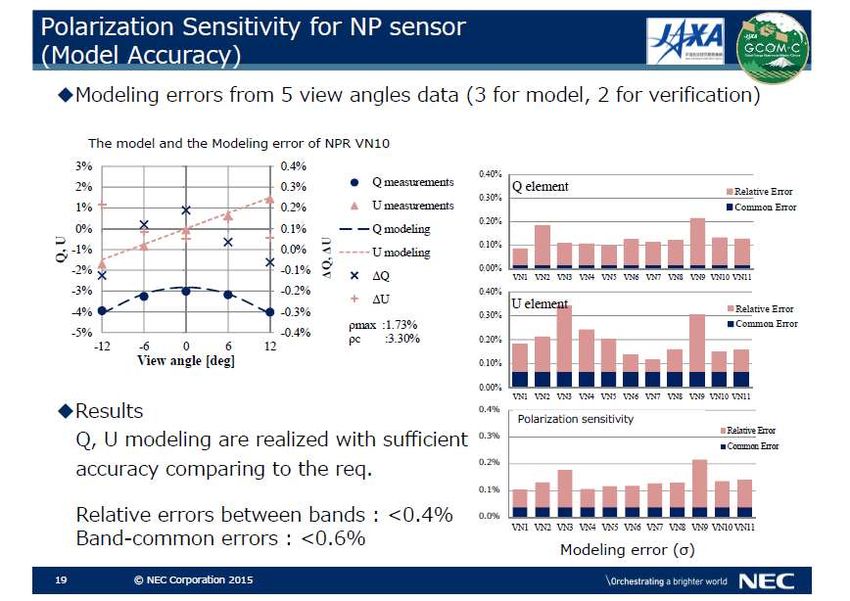
1. JAXA Earth observation satellite missions
Targets (JFY Apr-Mar)           2012 2013 2014 2015 2016 2017 2018 2019 2020 2021 2022
Disasters & Resources                                 [Land and disaster monitoring]
JERS1/OPS, SAR (1992-1998)                                 ALOS-2 / PALSAR-2                                    ALOS-Next
ADEOS-I/AVNIR
ALOS/AVNIR2, PALSAR                                ALOS-2CIRC
                                                                                                            Optical
(2006-2011)                                               ISS/CIRC
Climate System                    TRMM / PR 2013~       [Precipitation 3D structure]
                             with NASA
•Water Cycle                                       GPM / DPR
ADEOS-I/AMSR (1996-1997)                   with NASA                                                            Feasibility study
Aqua/AMSR-E (2002-2010)                  [Wind, SST , water vapor, precipitation]
                                             GCOM-W / AMSR2

                                                                        [Vegetation, aerosol, cloud, SST, ocean color]
                                                GCOM-C will be
•Climate change                                                                              GCOM-C / SGLI
ADEOS-I/OCTS (1996-1997)                        launched in 2017
ADEOS-II/GLI (2003)                                                                 [Cloud and aerosol 3D structure]
                                                                                           EarthCARE / CPR
                                                                          with ESA

                                       [CO2, Methane]                                     [CO2, Methane, CO]
•Greenhouse gases                                                                                    GOSAT-2
                             GOSAT / FTS, CAI 2009~                           with MOE

       (ref.) JMA               MTSAT-1R (Himawari-6)
                                    MTSAT-2 (Himawari-7)                       [Cloud, aerosol, SST]
       meteorological
                                    [Cloud, SST]
       satellites                                                                   Himawari-8/AHI
                                                                                         Himawari-9 (standby)

               Mission status            On orbit              Development                 Study                 Pre-phase-A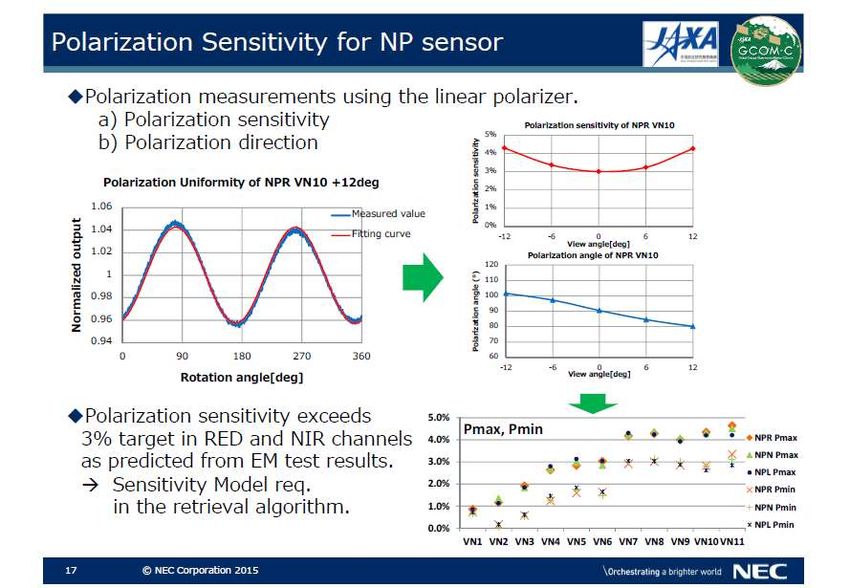
2. GCOM-C mission targets
        Long-term observations of radiation budget and carbon cycle

                                                                                                                CO2 increase and
                                                                                                                Global warming
GCOM-C
Global/horizontal                                                               Global environmental change
distribution of cloud and        radiative forcing change                           (irradiance, temperature,
aerosol                                                                                 CO2, precipitation)

                                                            • Global coverage
                                                            • Many parameters
                                                            • Long-term data

                             Cloud                                              Land                       Ocean
                                                                    • Photosynthesis production   • Photosynthesis production
EarthCARE/CPR                                                         - Vegetation index            - Sea surface temperature

                                                                                                                                   Feedback
3-D structure of                                                      - Leaf area index             - Phytoplankton chl-a
cloud and aerosol
                                                                      - Primary production          - Dissolved organic matter
              Aerosol                                                 - Above-ground biomass        - PAR
                                                                    • Land cover/use              • pCO2, pH
                                                                    • Soil respiration            • POC, Sedimentation

Knowledge improvement of cloud and aerosol                         Ecosystem
by GCOM-C & EarthCARE                                              CO2 sink and pool

Evaluation of model outputs and process parameterization                        Change of atmosphere CO2

                                                                                                                              3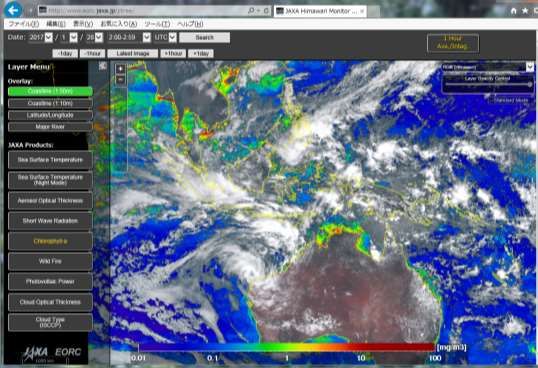
3. GCOM-C/SGLI: Satellite/Sensor system Total FOV: 70deg
Earth Solar diffuser = 24deg 3 telescopes
Visible and Near- VNR-NP (~1150km@nadir)
infrared Radiometer Non-polarization
three telescopes
(SGLI-VNR) Each has the same 11
channels
GCOM-C VNR-POL FOV: 55deg
Polarization two
satellite (670nm and 865nm)
(~1150km@45deg
telescopes along-track slant)
InfraRed Scanner Solar Each has three 45deg
Internal lamp (PD)
calibration polarization-angle filters
(SGLI-IRS) window
Earth 45deg along-
Earth view Earth track slant
SWIR detector observation
window
FOV: 80-deg mechanical
cooler
Scan
mortar
Deep space
window
Black body
Optical bench
GCOM-C SGLI characteristics
TIR detectors
Launch Date 2017
Weight 2,000kg
Sun-synchronous (descending local time: 10:30),
Orbit
Altitude: 798km, Inclination: 98.6deg
Mission Life 5 years (3 satellites; total 13 years)
Push-broom electric scan (VNR: VN & P)
Scan
Wisk-broom mechanical scan (IRS: SW & T)
1150km cross track (VNR: NP & POL)
Scan width
1400km cross track (IRS: SWIR & TIR)
Spatial resolution 250m, 500m, 1km
Polarization 3 polarization angles for POL SGLI/VNR daily coverage
Along track tilt Nadir for VN, SW and TIR, & +/-45 deg for POL 4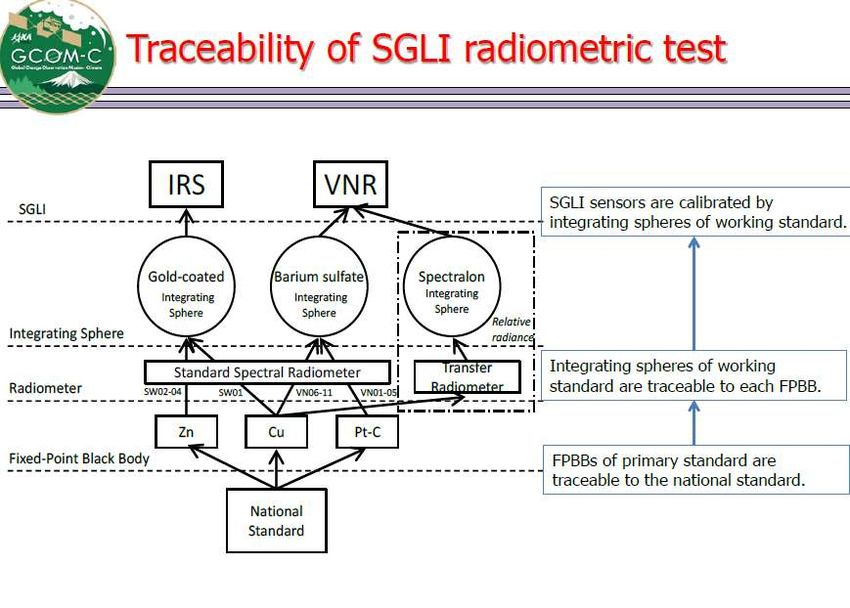
3. GCOM-C/SGLI The RSR data will be open to the public
Specification of SGLI spectral bands
Lstd Lmax SNR@Lstd IFOV
CH 2
W/m /sr/m -
nm m VNR-NP
K: Kelvin K: NET
low-gain bands
VN1 380 10 60 210 250 250 /1000
VN2 412 10 75 250 400 250 /1000
Multi-angle obs. for 674nm and 869nm
VN3 443 10 64 400 300 250 /1000
VN4 490 10 53 120 400 250 /1000
VN5 530 20 41 350 250 250 /1000
VNR-POL POL bands
VN6 565 20 33 90 400 250 /1000
VN7 673.5 20 23 62 400 250 /1000
VN8 673.5 20 25 210 250 250 /1000
VN9 763 12 40 350 1200* 250 /1000* SGLI-IRS
VN10 868.5 20 8 30 400 250 /1000
VN11 868.5 20 30 300 200 250 /1000
POL1 673.5 20 25 250 250 1000
POL2 868.5 20 30 300 250 1000
SW1 1050 20 57 248 500 1000
SW2 1380 20 8 103 150 1000
SW3 1630 200 3 50 57 250 /1000
SW4 2210 50 1.9 20 211 1000
TIR1 10800 700 300K 340K 0.2K 250/500/1000
TIR2 12000 700 300K 340K 0.2K 250/500/1000
Uchikawa, T., K. Tanaka, Y. Okamura, S. Tsuida, and T. Amano, "Proto Flight Model (PFM) performance and development status of Cisible and Near
Infrared Radiometer (VNR) on the Second-generation Global Imager (SGLI)", SPIE Asia-Pacific Remote sensing, Beijing, China, 9264-27, 2014.
Tanaka, K., Y. Okamura, T. Amano, T. Hosokawa, and T. Uchikita, "The development status of Second Generation Global Imager Infrared Scanning
Radiometer (SGLI-IRS)", SPIE Asia-Pacific Remote sensing, Beijing, China, 9264-15, October, 2014. 5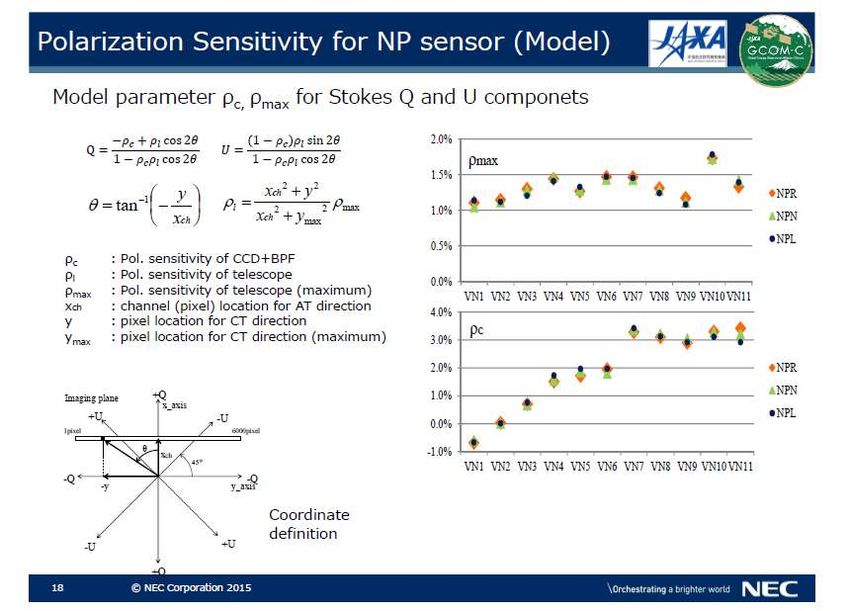
4. GCOM-C/SGLI development
• SGLI final radiometric tests has been finished in 2016
• Barium-sulfate and Spectralon integrating spheres were used for VNR
    • Absolute performance is characterized by the barium sulfate
       integrating sphere
    • Relative performance is characterized by the Spectralon
       integrating sphere
    • The consistency of two integrating spheres is confirmed through
       the linearity performance evaluation
• Gold-coated integrating sphere were used for SWIR
• The performances of each band and pixel were characterized and
  satisfied the requirement (SNR, gain, dynamic range, stability,
  uniformity, linearity..)
• The radiometric parameters are implemented in the ground system
• IRS final radiometric test is ongoing
Hashiguchi et al., Radiometric performance of Second Generation Global Imager (SGLI) using integrating sphere, SPIE
Remote Sensing 2016 at Edinburgh, United Kingdom Sep. 26, 2016
                                                                                                                      6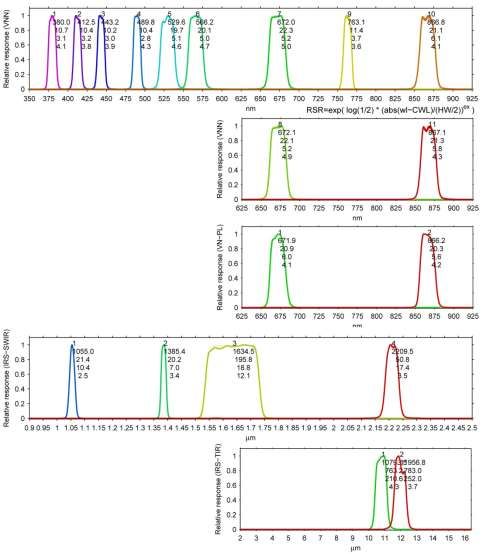
Hashiguchi et al., Radiometric performance of Second Generation Global Imager (SGLI) using integrating sphere, SPIE
Remote Sensing 2016 at Edinburgh, United Kingdom Sep. 26, 2016
                                                                                                                      7
Sakashita et al., Proto Flight Model (PFM) development status of Visible and Near-Infrared Radiometer (VNR) on the
Second-Generation Global Imager (SGLI), SPIE-APRS, 9881-26, New Delhi, India, April 2016
Sakashita et al., Proto Flight Model (PFM) development status of Visible and Near-Infrared Radiometer (VNR) on the
Second-Generation Global Imager (SGLI), SPIE-APRS, 9881-26, New Delhi, India, April 2016
Sakashita et al., Proto Flight Model (PFM) development status of Visible and Near-Infrared Radiometer (VNR) on the
Second-Generation Global Imager (SGLI), SPIE-APRS, 9881-26, New Delhi, India, April 2016
5. Product development and implementation
JFY
April-March
2009 2010 2011 2012 2013 2014 2015 2016 2017 2018 2019 2020 2021 2022 2023
Review
GCOM-C SGLI
SGLI engineering model Review GCOM-C Data GCOM-C1
launch release Project end
Milestone SGLI pre-flight model
Ground system Review
(Project start
2008~ ) System definition Design Development Test Review Review GCOM-C2 launch
Initial
Development Initial development Performance development Launch version development cal/val
Improvement and application
phase
C1 RA#1
GCOM-RA4 (C1 RA#2) C1 RA#3 C1 RA#4
PI
algorithm
research Research & trial by selection alg v1
other satellite data
interaction
algorithm
and simulation evaluation
meeting prepa-
EORC PI alg submission v0.1 alg v0.2 alg v0.3 ration
research & L1B draft data
PLI-1 PLI-2 Initial Validation & Improvement
development Review cal/val Research product development
Submission to Interaction interaction
the ground system (flow, volume)
Implement to the
Ver. 0.0 Ver. 0.0 Ver. 0.1 Ver. 1 Ver. 2 Ver. 3
operation system Review
define I/F integration test
of the ground system
GCOM-C GCOM-C2
Launch GCOM-C3
5 years
~13 years 11GCOM-C Operation Flow (Ocean)
Calibration by JAXA Applications and international collaboration
Level-1B 1km/250m 1km/500m/250m 1km B. Franz (NASA): multi sensor
L1B1 VNI L1B1 SWI L1B1 TI L1B1 POL M. Wang (NOAA): Atm.corr, VIIRS
McKinna(NASA):IOP model
Daytime Day&Night time Tachiiri(JAMSTEC): Earth system model
CEOS/OCR-VC, IOCCG,
Atmospheric corr. module SST module KJWOC/AWOC
Incl. cloud detection Incl. cloud detection
NASA, NOAA, CNES,
Atmos. aerosol Toratani (Tokai U.) GISTDA. Australia..
Frouin (SIO, US) Sea surface temp. Domestic: FRA, JCG, JMA..
JAXA JAXA
Normalized water
PAR
leaving radiance
Kobayashi (Yamanashi U.)
In-situ instrument
Research parameters
Redtide
Ocean color module Ishizaka (Nagoya U.)
Chlorophyll-a conc.
JAXA aph
IOP Net Primary Productivity
Total Suspended Matter IOP shape Ishizaka (Nagoya U.)
Toratani (Tokai U.) Hirata (Hokkaido U) PFT Hirawake (Hokkaido U)
Hirawake (Hokkaido U) Goes(Columbia Univ): Nitrate, NPP
CDOM absorption Hirata (Hokkaido U)
Hirata (Hokkaido U)
EZD
Suzuki (Hokkaido U.): HPLC Hirata (Hokkaido U) Matsuoka(U Laval): Arctic DOC&POC
Kuwahara (Soka U): Val at Sagami Bay Kahru (SIO): Regional alg &Val
Isada (Hokkaido U): Val at Akkeshi-Bay Antoine (Curtin U.): Cal/Val
Blue: standard products, red: research products and double-line boxes are subject for level-3 production 12JAXA Himawari-monitor
JAXA Himawari-8 products (planned)
Level Product name Grid size Format
L1 Reflectance (6 bands), Brightness temperature (10 bands)
0.02~0.05
Aerosol optical thickness, Angstrom exponent,
Atmosphere Equal lat-lon grid
cloud properties
(Full disk)
L2 Ocean Sea surface temperature, Ocean color (Rw, Chla..) NetCDF4
Land Fire detection, Vegetation index, Snow cover
0.01 (around
Flux Short-wave radiation, PAR, UV..
Japan)
L3 Hourly average
• Underlined products are produced
regularly, and other products are
under investigation
• Ocean color:
Murakami, H. (2016): Ocean color
estimation by Himawari-8/AHI,
Proc. SPIE 9878-10, May 7, 2016
• JAXA products are distributed by
FTP with simple user registration
http://www.eorc.jaxa.jp/ptree/
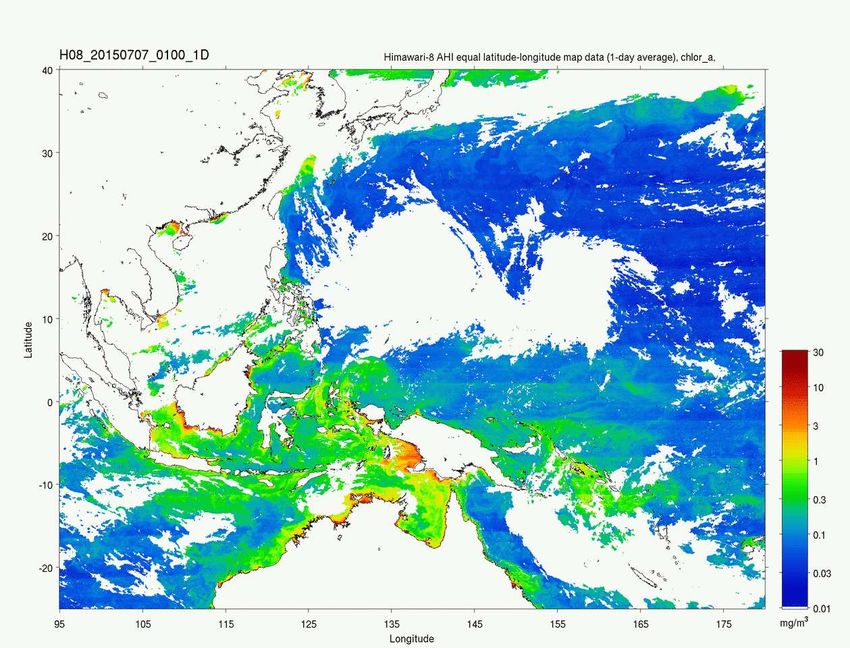
13Himawari-8 Chl-a 2015/7/7 - 2016/6/30
146. Summary
• The mission targets of GCOM-C are contribution to the climate
system researches, the carbon cycle and the radiative forcing, through
series of satellites, GCOM-C, C2 and C3.
– It has 250-m resolution and along-track slant-view polarization
observation to improve the land and coastal monitoring, and
aerosol estimation.
– Stable calibration: on-board diffuser with monthly moon
observation
• GCOM-C/SGLI will be launched in Calender Year 2017.
• The new research period has been started since April 2016
(JFY2016-2018)
• Follow-on missions
– GCOM-C2, 3..., don’t have been approved yet: need long-term series missions
– We have to demonstrate the success of GCOM-C1
– International collaboration, e.g., JPSS, Sentinel-3, GOCI-1/2, PACE..
15You can also read


