A CO-OPERATIVE SOLUTION TO CLIMATE CHANGE - Sustainability - Sustainability ...
←
→
Page content transcription
If your browser does not render page correctly, please read the page content below
A CO-OPERATIVE
SOLUTION TO CLIMATE CHANGE
            Sustainability
            Solutions
            Group
“
Co-operatives have long fostered inclusive and
sustainable approaches to economic and social
development at the local level. It is in keeping with
this focus that co-operatives are expanding their
development efforts creatively, into areas such as
environmental sustainability and carbon neutrality,
“
as communities around the world are struggling
to adapt to climate change and strengthen their
resilience against its impacts.
Secretary General Ban Ki Moon
Message on the International Day of Co-operatives
5 July 2008
November 30, 2014
Prepared by Sustainability Solutions Group
With support from International Co-operative Alliance
Sustainability
Solutions
GroupTable of Contents 1 Introduction 1 2 Why are co-operatives unique? 2 3 How are co-operatives addressing climate change? 7 4 Scaling up 13 5 What do co-operatives hope for from the international climate change negotiations? 17 6 A challenge for co-operatives 18 7 Conclusion 21
“...many cooperatives are
recognised as leaders in
tackling climate change.”
1 Introduction
The world’s nations will convene in December 2014 in Lima, Peru and then in December 2015 in Paris, France
to negotiate an agreement to collectively address climate change. In the course of these negotiations, we urge
countries to recognize and employ the value that co-operatives bring to this challenge.

Climate action leadership is a common trait of co-operatives across all sectors in which they work. This is not
to say that every co-operative is meaningfully addressing climate change and that there is no more work to be
done. It is clear, however, that co-operatives are one of the most exciting and powerful vehicles through which
societies can confront what Secretary General Ban Ki Moon describes as the defining issue of our age.1

This paper is a call to action to massively engage cooperatives. It highlights examples of co-operative
leadership, describes characteristics that uniquely position them to confront climate change challenge, and
details redcommended policy that would empower co-operatives to drive the world in its transition to a low
carbon economy.

Co-operatives offer a pathway forward, a solution that is tried and tested, that addresses climate change while
also confronting inequality, advancing democracy, building resilient economies, and confronting poverty.

This is the co-operative model.

     1 www.un.org/apps/news/infocus/sgspeeches/statments_full.asp?statID=2355#.VFfM3PnF93k

                                                                                                              1
2 Why are Co-operatives Unique?
Co-operatives represent something special for the climate change challenge. It is a combination of experience
and a proven track record, resilience, an unrelenting dedication to universal values, the ability to achieve
multiple outcomes at once, and flexibility and versatility.
THE CO-OPERATIVE MOVEMENT IS THE BIGGEST
ECONOMY YOU HAVE NEVER HEARD ABOUT
The co-operative movement is represented in every country and in every sector. The movement currently
represents:
1 billion members and clients
250 million jobs
~12% of total jobs in the G20
$ Turnover of $2.2 trillion by the
largest 300 cooperatives globally
2CO-OPERATIVES ARE BUSINESSES
DRIVEN BY VALUES, NOT PROFITS
VALUES
Co-operatives are businesses that survive or fail based on their ability to Co-operatives are based
provide goods and services to their members. They are entrepreneurial on the values of self-
and must compete with other forms of business. At the most basic help, self-responsibility,
level, co-operatives serve the needs of their members, whatever those democracy, equality,
needs might be, rather than delivering profit to investors. This means equity and solidarity. In the
that the co-operative model is highly flexible and appropriate for myriad tradition of their founders,
economic activities, from providing renewable energy to mitigating co-operative members
floods. Additionally, co-operatives adhere to the seven Co-operative believe in the ethical values
Principles, which are the model’s code of ethics: of honesty, openness, social
responsibility and caring for
1. Voluntary and open membership others.
2. Democratice member control
3. Member economic participation
4. Autonomy and independence
5. Education, training and information
6. Co-operation among co-operatives
DEFINITION
7. Concern for community A co-operative is an
autonomous association of
persons united voluntarily
CO-OPERATIVES ARE DEMOCRATIC to meet their common
economic, social, and cultural
Co-operatives are democratic organisations, in which a board is elected needs and aspirations
based on the principle of one member, one vote – analogous to a through a jointly-owned and
political democracy. This means that their activities are more likely democratically-controlled
to represent the will of the communities in which they operate. They enterprise.
are also non-discriminatory. Anyone who meets the requirements of
membership can become a member.
3CO-OPERATIVES HAVE AN INTRINSIC
COMMITMENT TO SUSTAINABILITY
Co-operatives implemented the principles of sustainability before the
Brundtland Commission famously defined the concept as meeting
the needs of the present without compromising the ability of future
generations to meet their needs. The seven co-operative principles
embed many of the concepts that are currently associated with
sustainability to such a degree that one can claim that co-operatives are
practical manifestations of sustainability principles.
CO-OPERATIVES ARE COLLECTIVE
ENDEAVOURS
Effective climate change mitigation can only be achieved by
complementary and collective action to avoid individual initiatives
that may offset efforts in other areas. Co-operatives are a collective
endeavour illustrative of the type of action required.
CO-OPERATIVES TAKE THE LONG-
TERM VIEW
As private businesses, co-operatives take the long-term view. They
have no requirement for delivering short-term profits; and although
co-operatives do need to make a profit in order to be commercially
successful, they do not put profits over societal concerns. This context
gives them the opportunity to make long-term investments and means
that they are more likely to consider intergenerational impacts - critical
for meaningful action on climate change.
CO-OPERATIVES ARE THE MOST
RESILIENT FORM OF ENTERPRISE
Co-operatives are resilient, finding ways to survive when other
businesses would simply close. As a result they are more stable
businesses in communities. This type of resiliency will be critical in
the face of a changing climate and increasing volatility due to extreme
weather and other environmental changes.
4CO-OPERATIVES ARE A SOURCE OF
STABILITY
Co-operatives tend to be rooted in a community or communities and
will tend to stay there through good times and bad. They are a source of
stability for communities.
CO-OPERATIVES COMBAT POVERTY
AND UNDERMINE INEQUALITY
Poverty undermines the means of people to reduce GHG emissions and
adapt to climate change. Co-operatives are a powerful tool for reducing
poverty and undermining inequality. Enhancing human capital based
on individual knowledge and skills, and social capital based on mutually
beneficial formal and informal relationships, is important for facilitating
a transition toward a low carbon economy. Co-operatives provide
capacity in a multitude of ways: through training, member engagement,
developing the economy, and addressing needs of the communities in
which they operate.
Co-operatives provide capacity through:
• training,
• member engagement,
• developing the economy, and
• addressing needs of the communities in
which they operate.
5They can do it! They are doing it!
Co-operatives are already on the
ground implementing a zero or low
carbon economy.
63 How are Co-operatives
Addressing Climate Change?
TRANSPORTATION
Vancouver, Canada – Modo is a car-sharing co-operative that enables members to access cars
when they need them, avoiding the costs and environmental impacts of owning a car. Modo
members drive 1,400 kilometres a year on average, in comparison to 6,000–24,000 kilometres
that other drivers in the region average.
Vancouver, Canada – Shift Urban Cargo Delivery is a worker co-operative that delivers
everything from groceries to restaurant meals by cargo bicycle.
Wisconsin, USA – Worker co-operative Union Cab uses primarily hybrid cars and sets annual
targets for energy efficiency improvements.
Oxford, UK – Broken Spoke is a multi-stakeholder co-operative that provides courses in bicycle
riding, repair, safety, as well as shared equipment and workshops.
AGRICULTURE
Sweden – Lantmännen Co-operative, a farmer co-operative, has established a specialist
company called Agrobränsle AB that supports willow (salix) as an energy crop. It has been
involved in research, development and marketing of willow in Sweden and the rest of Europe.
Nieuwoudtville, South Africa – Heiveld Co-operative, a producer of the finest organic rooibos
tea is leading a significant climate change adaptation program to identify strains of rooibos
that are more resilient to changing climate conditions.
Nepal – Garima Farmers Co-operative expanded the varieties of vegetables that grow well
in shortened growing seasons and developed a group savings scheme to reinvestment in
aquaculture and poultry farming to further diversify their incomes.
Costa Rica – Coopedota Co-operative produces 50,000 60 kg bags of high-grade coffee per
year. It substituted 95% of its drying process firewood with brushwood and husks leftover
from harvesting and processesing coffee cherries. An energy management program and
installation of a micro-mill for smaller batches reduced electricity use by more than 50%. In
2009, it became the first carbon neutral coffee in the world.
La Farge, Wisconsin, USA – Organic Valley, an organic farmer co-operative developed a
community-owned wind farm sufficient to power 1,800 homes while 32% of their diesel fleet
fuel is biodiesel. The members of Organic Valley have eliminated the use of synthetic fertilisers
from their operations.
7ENERGY
Zamość, Poland – Our Energy Co-operative plans to build 12 biogas plants, their capacity
between 0.5 and 1 MW, in clusters of four in three different communities.
Toronto, Ontario, Canada – Zooshare Co-operative will recycle 3,000 tonnes of animal manure
from the Toronto Zoo and 14,000 tonnes of inedible food waste from local grocery stores into
renewable power for the Ontario grid using a biogas generator.
Toronto, Ontario, Canada – SolarShare Co-operative develops solar power projects across
Ontario and offers securities in the form of bonds to its members to invest in the project
portfolio. SolarShare currently has almost 700 members and 25 projects representing over
2 MW of installed solar power generation capacity.
Copenhagen, Denmark – Middelgrunden Wind Turbine Co-operative developed one of the
first offshore wind farms in the world, with 20 2 MW turbines, powering approximately 40,000
homes.
End, Finland – Eno Energy Co-operative is a district energy co-operative in a small town with
a population of 6,500 located in Eastern Finland, which runs three heating plants using waste
biomass.
Mondragon, Basque Region, Spain – Mondragon Assembly designs and manufactures
systems and equipment for automation and robotic-guided assembly of photovoltaic solar
panels.
8$ FINANCE
Victoria, Australia – bankmecu, a co-operative bank, has created a landbank to offset
biodiversity loss associated with the construction of new homes and the greenhouse gas
emissions from cars the bank finances. The Landbank also contributes to bankmecu’s carbon
neutral status.
Germany – GLS Bank, a credit union with 30,000 members issues funds for renewable energy
including a power supply system in Schönau, as well as investment funds in wind energy
dating back to 1995.
Padua, Italy – Banca Etica has founded a limited company to undertake energy efficiency
investments using the Energy Services Contract model. The headquarters is a model of energy
efficiency and low emissions.
Bern, Switzerland – Swiss Mobiliar, an insurance co-operative, has funded a lab focused
on climate risk and natural hazards at Oeschger Centre for Climate Research, including the
Mobiliar Chair for Climate Impact Research.
Vancouver, Canada – Vancity Credit Union has been carbon neutral since 2008 and offers a
program for reducing GHG emissions in small businesses called ClimateSmart, preferential
loan rates for fuel-efficient vehicles, and energy efficiency loans for homes.
Guelph, Ontario, Canada – Cooperators Insurance has been investigating and advocating for
the overland flood insurance in Canada in response to increasing and uninsured damage as a
result of floods.
9RETAIL
Retail co-operatives such as Cooperativa Obrera (Argentina), Coop Brazil, Coop Denmark,
S Group (Finland), Coop Italy, JCCU (Japan), iCoop Korea, Coop Norway, Consum (Spain), Eroski
(Spain), Coop Sweden, UKOOPSPILKA (Ukraine), and Co-operative Group (UK) have articulated
a comprehensive strategy to address climate change2. The strategy includes boosting eco-
friendly products, preserving the marine environment, sourcing organically farmed products,
supporting sustainable forestry management, preventing and managing waste, transporting
goods and people sustainably, improving energy efficiency in buildings, developing renewable
energy, boosting education, training and information for employees and consumer-members,
and raising political awareness.
Vancouver, Canada – Mountain Equipment Co-operative has set an internal shadow price on
carbon and integrated that price into scenario planning, as well as decreasing its overall GHG
emissions by 31% between 2007 and 2012.
Seattle, Washington, USA – REI, an outdoor equipment retail co-operative is committed to
becoming carbon neutral in its operations by 2020 and has outfitted 26 stores with solar PV
installations and has led an effort to create a standard for its industry to track environmental
impacts of shipping products.
Seoul, Korea – iCOOP Korea has invested in solar energy generation and geothermal energy
for its product and logistics centres. The co-operative is also focused on displacing imports of
fertilizer and animal feed to reduce GHG emissions.
Japan – Seikatsu Club Consumers Co-operative Union (SCCU), a consumer co-operative with
341 000 households as members, has a strategy that includes a focus on food self-sufficiency
and zero emission of toxic substances from the supply chain. SCCU has made significant
investments in wind and solar power and has established an energy co-operative: Seikatsu
Club Energy Cop., Ltd.
2 See the report from EuroCoop (2013) Climate Change and Consumer Co-operatives: Taking the Challenge
Forward. Retrieved from: http://eurocoop.coop/dmdocuments/publication_report/4th_Edition_Euro_
Coop_Climate_Change_Report.pdf
10HOUSING
Europe – In 2009, the European Committee for social and co-operatives housing proposed
a Euros 16 billion retrofit program for the 25 million homes in Europe that the members own
and operate that would generate 200,000 jobs using a combination of carbon trading and
investments.
Sweden – HSB, a housing co-operative with 550,000 members, designed and developed a
climate change train that travelled the county to educate people on climate change strategies
to save energy and GHG emissions.
London, UK – Sandford Walk Housing Co-operative reduced its GHG emissions by 60% by
installing wood pellet boilers, solar hot water systems, and retrofitting for energy efficiency.
11OTHER
São Paulo, Brazil – Rede CataSampa is a network of fifteen worker
co-operatives that collect recyclables including plastic, paper, glass,
Styrofoam, and waste vegetable oil to make biodiesel and other
products.
Cleveland, Ohio, USA – Evergreen Co-operatives are worker co-
operatives that aim to create economic regeneration in Cleveland
in the green economy. Co-operatives include Green City Growers,
a major hydroponic greenhouse operation, a solar energy co-
operative, and a laundry co-operative.
UK – Urbed is a worker co-operative of planners and designers
that specialise in urban regeneration including the development
of new neighbourhoods that reduce energy use and achieve
carbon neutrality.
Boston, Massachusetts, USA – Co-operative Recycling and
Organics employs novel waste separation systems to increase
reclamation and sale of clean paper, plastics, metals, waste
vegetable oil, and organic food waste reducing customer trash
sent to landfill and incinerators by 50% or more.
Brazil – Unimed, a medical co-operative, with more than 20
million clients, has developed a carbon foot printing tool for
its 352 cooperatives present in 4,632 counties, focused on
low-carbon economy.
124 Scaling Up
Governments can employ the co-operative model to advance their efforts on climate change. The diversity of
different sectors in which co-operatives engage means that they are able to work together to address climate
change while also advancing sustainable development goals (and the United Nations Post-2015 Development
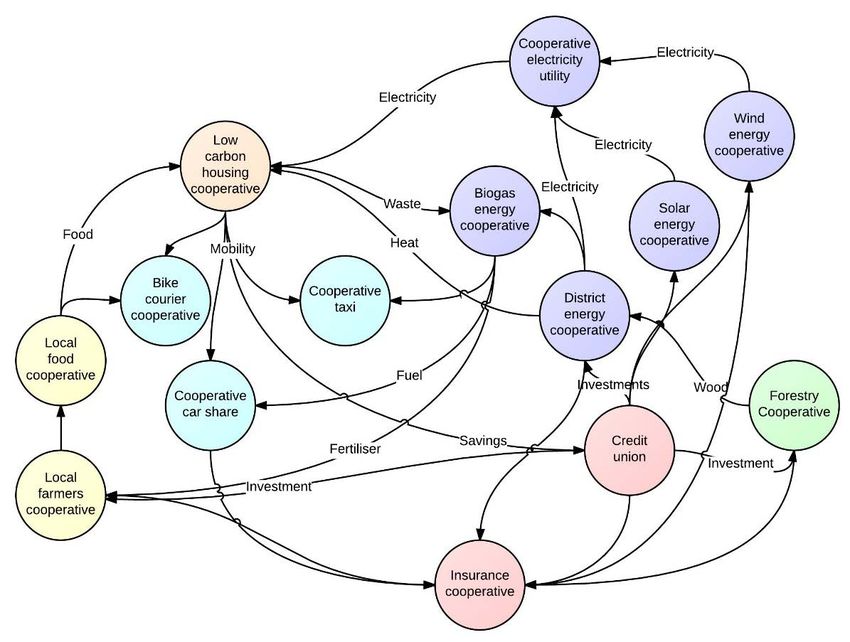
Agenda). The following figure shows what a zero carbon co-operative economy would look like if these co-
operatives were all located in the same community.
Figure #8. Flow of resources amongst co-operatives located in a single community. A zero carbon economy is
supported by closed resources loops, and by keeping resources within the community.
13Examples of policy areas that governments could target in advancing a low carbon economy include:
Providing clean energy: Energy co-operatives around the world are providing renewable
energy to their members in the form of solar, wind, biogas, and district energy.
Protecting food, forests, and people: Forestry and agricultural co-operatives use
sustainable management practices to keep carbon in the ground.
Sustainable housing: Housing co-operatives are providing zero carbon or passive house
housing to their members.
Financing the green economy: Credit unions are providing investments in renewable
energy and local food. Insurance co-operatives are providing resiliency to their members in the face of
extreme weather events and a changing climate.
Providing sustainable transportation: Car co-operatives provide high efficiency
vehicles to their members and reduce the rate of driving and car ownership. Taxi co-operatives provide
better working conditions for their drivers and fuel-efficient vehicles. Bike courier co-operatives provide
low carbon transport for goods in cities.
Providing sustainable goods and services: Retail co-operatives provide local
goods at affordable prices, minimising the need for commercial transportation. They work to reduce
the environmental impacts of the production of the goods at source, reduce waste, generate renewable
energy, transport goods and people sustainably, reduce the impact of their operations, and educate
consumer-members and staff.1
International cooperation: Co-operatives are working together across national and
sectorial borders to develop new co-operatives and build resiliency to climate change.
3 See the report from EuroCoop (2013) Climate Change and Consumer Co-operatives: Taking the Challenge Forward. Retrieved from:
http://eurocoop.coop/dmdocuments/publication_report/4th_Edition_Euro_Coop_Climate_Change_Report.pdf
14Co-operatives represent a systemic solution to global challenges in energy, transportation, housing, retail,
employment, and the economy.
Governments can advance the co-operative solution to climate change by creating appropriate enabling
conditions (legal frameworks) that reduce barriers to co-operative development.
Table 1: Enabling strategies for governments to support co-operative development.
Theme Recommendation Example of specific strategies
Capital Governments provide specialised • Seed granting program
access to capital to enable • Revolving loan funds
co‑operatives to expand in areas
that mitigate or adapt to climate • High risk loan funds
change • Dedicated feed-in tariffs for co-operatives
• Favourable tax treatment for local
investments
• Financial guarantees
Legislation Governments create a • Adaptation of legal and regulatory
non‑discriminatory regulatory requirements to the specific nature and
environment that facilitates the characteristics of co-operatives, according
creation and development of co- to the different legal cultures and
operatives traditions
Recognition Governments promote • Inclusion of the co-operative model in
the co‑operative model in high school and post-secondary curricula
educational programs, business
development programs, and as • Specialised business development streams
part of a national economy for co-operatives
• Co-operative development resource
centres to support the creation of new
co‑operatives
15“...the global threat
of climate change is
also a global threat to
co‑operatives.”
165 What do Co-operatives hope
for from the international
climate change negotiations?
Co-operatives are businesses that function in every sector of the economy in every region of the world. The
global threat of climate change is also a global threat to co-operatives. Co-operatives vary in their ability to
adapt and respond to climate change according to the context in which they operate, the resources they
have at their disposal, and their level of preparedness.
The International Co-operative Alliance approaches climate change through the lens of the co-operative
values of self-help, self-responsibility, democracy, equality, equity, and solidarity and the ethical values of
honesty, openness, social responsibility, and caring for others. Following these values, it proposes that:
1. Climate negotiations must ensure that GHG emissions must not exceed dangerous levels.
2. Countries and extra-national sectors such as shipping carriers and airlines must assume responsibility for
their share of global GHG emissions and their share of GHG emissions reductions.
3. Countries must live up to previous commitments on which the rest of the world is depending.
4. All countries need to invest in efforts to reduce GHG emissions and adapt to climate change.
5. Countries with more resources need to help those with fewer resources to reduce GHG emissions and
adapt to climate change.
6. Countries should adopt concrete policies towards sustainable consumption and production patterns and
behaviours.
7. All countries need to report transparently on their GHG emissions and their efforts to reduce emissions.
8. Countries need to support the transfer of technology and intellectual property that aids reduction of GHG
emissions or adaptation to climate change while considering unsuspected detrimental impacts.
9. Recognising the unique contribution co-operatives can play in creating resilience, reducing GHG
emissions, and advancing sustainable development, it is critical that countries create the legal and
financial conditions under which co-operatives can significantly scale up their efforts and contributions to
address climate change.
176 A challenge for Co-operatives
Co-operatives can advance their efforts to address climate change by building on the co-operative principles.
Table 2: Actions for co-operatives to advance their efforts to address climate change.
Principle Related Actions
1. Voluntary & Open • Demonstrate that people want to join co-operatives on the basis of their
Membership efforts to address climate change
2. Democratic Member • Encourage members to set policies for the co-operative on climate change,
Control both to reduce GHG emissions and reduce the risks to the business
3. Member Economic • Identify and report on the risk that climate change impacts pose to the co-
Participation operative’s business
4. Autonomy & • Use the co-operative as a mechanism to enable members to meaningfully
Independence address climate change (self-help)
• Establish capital mechanisms that support strategies to address climate
change without compromising co-operative values
5. Education, Training, & • Provide training and education on climate change impacts, risks, and
Information strategies to reduce emissions
• Identify ways in which the co-operative can support members to reduce
their impact on the climate
• Work with other organisations and businesses to reduce GHG emissions
• Provide decision-makers with information on the impacts of climate change
on co-operative business and the steps co-operatives are taking to address
climate change
18Principle Related Actions
6. Cooperation • Work with other co-operatives locally and internationally to reduce or
Amongst eliminate GHG emissions
Co‑operatives
• Work with other co-operatives on the principle of solidarity to support in
preparing for or responding to the impacts of climate change
• Transfer technologies and skills that contribute to addressing climate change
to other co-operatives
• Support co-operatives when they are impacted by climate change
7. Concern for • Eliminate (or at least reduce considerably) the climate impact of the
Community co‑operative
• Identify opportunities to build or enhance the resilience of the community
to climate change impacts
• Identify and support populations that are particularly vulnerable to the
impacts of climate change
1920
Conclusions
The latest report from the Intergovernmental Panel on Climate Change indicates that climate change is set to
inflict severe, widespread, and irreversible impacts on people and the natural world unless carbon emissions
are cut sharply and rapidly.3 With 1 billion members, co-operatives are an important global network that
can play a key role in cutting carbon emissions. At the same time, co-operatives advance values such as the
importance of dialogue and solidarity while leading societies towards a democratic, people-centred economy.4

This paper provides a snapshot of the way in which a small sample of co-operatives is working to reduce
greenhouse gas emissions. With appropriate policies and incentives, this effort can be significantly broadened
in all sectors of the economy and in all countries of the world. In the upcoming negotiations in Lima and Paris,
we urge that countries consider the role that co-operatives can play in tackling climate change and to introduce
concrete proposals that recognize cooperatives as a well-suited model of enterprise to deliver those goals.

    4   http://www.ipcc.ch/pdf/assessment-report/ar5/syr/SYR_AR5_SPM.pdf, pg. 13
    5    Paraphrased from a speech by former ILO Secretary General: http://www.ilo.org/public/english/bureau/dgo/speeches/
        somavia/2008/cooperatives.pdf
                                                                                                                             21
Photo Credits All photos obtained under a creative commons license from www.flickr.com. Page/Photo Flickr User 0 Cathedral of LIma David Stanley 2/3 Buildings davebloggs007 4/5 Tongbong Co-operative Farm Clay Gilliland 6 Vancity bicycles sillygwailo 8-9 Farm Luc Legay 8-9 Solar Panels Bart Speelman 10 Row housing la citta vita 11 Produce JWolff-STL 12 Factory workers scobleizer 14 Co-op meeting Saw-mon 16 House pieces woodley-wonder-works 18-19 Community cycling event solylunafamilia 20 Bicycle co-op SLO County Bicycle Coalition 22
Sustainability
Solutions
Group
You can also read


