A continental view of connected environmental research
←
→
Page content transcription
If your browser does not render page correctly, please read the page content below

Impact Objectives
  • Wide scale and systematic coverage of major European terrestrial, freshwater and transitional
    water environments – 200 research sites selected from a wider pool of ≈400 sites

  • Integrated observations across the critical zone, supporting whole ecosystem science

  • Macrosystem ecology approach, studying interactions of abiotic and biotic ecosystem
    components at multiple scales, including human-environment interactions

  • Enables research into ecosystem processes influenced by multiple drivers, as well as socio-
    ecological research relating to ecosystem services

A continental view of connected
environmental research
     Chairman of the global Long-Term Ecosystem Research network ILTER Michael Mirtl talks about his
     work coordinating a bold European vision to link hundreds of environmental observation and research sites

                     Can you explain                How does eLTER RI differ from other             this critical gap by linking multiple user
                     the European LTER             environmental research that is underway          groups to integrated research sites, local
                     (Long-Term Ecosystem          across Europe?                                   expert teams and their long-term data
                     Research) and its main                                                         legacies. We are working towards this goal
                     components?                   eLTER RI is building on the LTER-Europe          in collaboration with existing regional and
                                                   network and related projects, to pursue          subject-specific environmental RIs. In
LTER-Europe is a regional group within             a fundamentally systemic approach to             future years, eLTER RI will enable integrated
the International Long-Term Ecosystem              observing and analysing the environment.         cross-scale and cross-disciplinary analysis
Research network (ILTER), which was                While several existing thematic                  of comparable data across time and
established in 1993. LTER-Europe consists          environmental research infrastructure            geographical zones.
of 26 national LTER networks. Formally             projects focus on one or more elements
founded in 2007, LTER-Europe currently             of environmental change, eLTER RI will           Can you explain the global role and impact
comprises around 450 ecosystem research            be the only research infrastructure which        of the European LTER?
sites and 35 Long-Term Socio-Ecological            takes a holistic view of the integrated
Research (LTSER) platforms, which have             impacts of stressors on a wide variety of        Besides representing the European
been collecting data for decades.                  European benchmark ecosystems. eLTER             contribution (Regional group) to the actual
                                                   RI sites are collecting a broad range of         global LTER network, the European LTER
Drawing from the large collection of sites         terrestrial, freshwater and transitional water   has lately been setting the pace in several
and institutions of LTER-Europe, there             parameters across all major geographical         respects. Since 2016 Europe has provided
are projects and processes developing              systems and climatic zones in Europe. Data       the chairman. Major achievements include
LTER further in Europe both technically            gathered will include biological, physical       the global adoption of the European
(services and tools) and strategically.            and chemical variables, as well as properly      site classification, standard observation
The technical flagship project is currently        scaled socioeconomic metrics. Ecosystem          variables and the site registry and
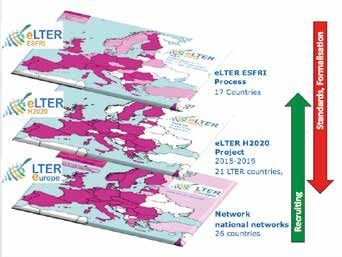
the eLTER H2020 project (2015-2019),               change caused by long-term pressures and         accreditation webservice (DEIMS). This
focusing on standards, tools and services.         short-term pulses can thus be investigated       service and ILTER´s experiences in a global
In parallel, the eLTER ESFRI process aims          at all geographical and temporal scales –        roll-out caught the attention of GEO. As
at developing an over-arching formalised           and across climatic gradients.                   a result, in 2016, ILTER was invited to
European Research Infrastructure (eLTER                                                             become a GEO Participating Organization.
RI), which will facilitate scientific access and   What do you hope the ultimate impact will        It has since engaged in the GEO In-situ
answer complex environmental questions.            be from this work?                               Foundational task, working towards a
eLTER RI was recently included on the 2018                                                          follow-up to the Global Terrestrial Observing
Roadmap of the European Strategy Forum             Progress in understanding, managing and          System (GTOS) and further developing
on Research Infrastructures (ESFRI) and            securing our vital ecosystems is hampered        DEIMS as a pilot for a global GEO site
plans to operate about 200 well-equipped           by dispersed observation sites and single        registry. l
European LTER sites and LTSER platforms.           discipline research. Our goal is to close

30 www.impact.pub
Network addressing global
environmental challenges
     A collaboration of experts and research and observation sites across Europe is taking a whole system
     approach to filling a critical gap in top-class science at a continental scale, ultimately building knowledge
     and resilience against global environmental challenges

The Earth’s critical zone, which extends      The eLTER RI is focused on measuring                 these extended periods. LTER-Europe´s
from the tops of our largest trees down       change in ecosystems over time, and                  LTSER platforms were a new dimension in
to the bedrock beneath our soil and           understanding the influential factors causing        seeking to incorporate research on human-
groundwater, supports the vast majority       change, such as human land use and                   environment interactions. Such research
of life on earth, including humans and a      industrial development. The development              requires cross-disciplinary approaches on
diverse array of fauna and flora. This zone   of eLTER RI builds on the LTER-Europe                environmental and socioeconomic topics.
is coming under increasing pressure from      network and on the eLTER H2020 and other             A number of projects have built on LTER-
major factors such as global climate change   related projects. The research infrastructure        Europe, with the aim of encouraging
and human exploitation. The European          will comprise around 200 observation and             standardisation, data-sharing via
Long-Term Ecosystem, critical zone and        research sites in a distributed network, to          databases and portals, and access to
socio-ecological Research Infrastructure      be centrally managed and supported by a              data for researchers, policy makers and
(eLTER RI) coordinator Michael Mirtl of       cross-disciplinary head office. This central         other decision-makers. The EU-funded,
the Helmholtz Centre for Environmental        node will act as an interface between users          four-year eLTER H2020 project has made
Research and Environment Agency Austria       and data repositories, as well as providing          significant steps towards the process of
states that ‘if humans are to find ways to    strategic support in areas such as data              data integration. ‘The project has provided
protect and sustain the ecosystems that       quality assurance, international networking          the independent national LTER networks
in turn nurture our existence, we need to     and technical innovation and development.            and sites with standards, tools and services
understand all the interacting factors that                                                        that otherwise would have been set up in
cause environmental change.’ The RI will      COORDINATED EFFORT                                   parallel… or never,’ says Mirtl.
help researchers address the challenges       In the context of the global ILTER network
of biodiversity loss, climate change,         and the LTER-Europe network of 26 national           eLTER H2020 is a key transition project
eutrophication and pollution, in order        LTER networks, many of the LTER sites                between a voluntary network of sites and
to support sustainable environmental          have operated for decades and hold legacy            the development of a full eLTER Research
management.                                   data covering environmental changes over             Infrastructure. Concluding in 2019, the work

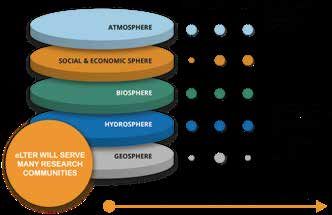
Elements of the European LTER process                                 Whole-system approach supporting interdisciplinary collaboration at top sites

                                                                                                                                     www.impact.pub 31
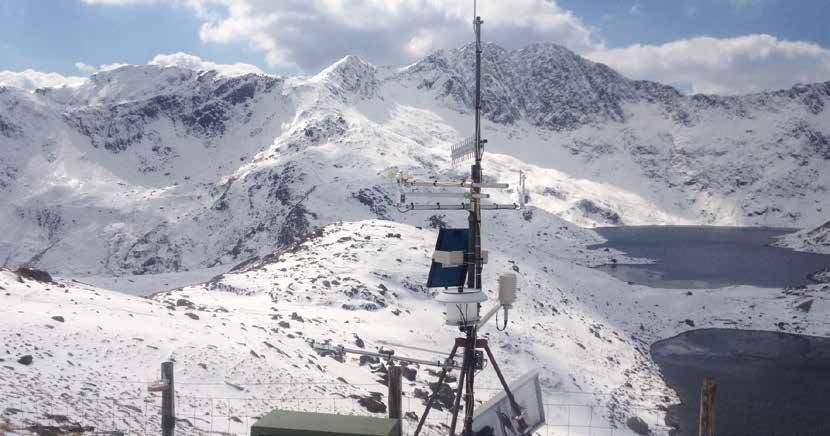
© Natural Resources Wales
has already begun to identify the major           research sites. Mirtl explains that these sites   and adopted by environmental agencies,
environmental issues and key scientific           were incorporated to ‘achieve wide-scale          consultancies and regional authorities.
questions to be supported by the eLTER RI.        systematic coverage of the major European         Mirtl hopes that the RI will facilitate
Also, being developed is a Data Integration       terrestrial and aquatic environments and          spatial and temporal ecosystem, critical
Portal with flexible tools through which data     socio-ecological zones’.                          zone and socio-ecological research by
can be accessed and a Dynamic Ecological                                                            providing a comprehensive platform for
Information Management System (DEIMS)             eLTSER PLATFORMS AND MASTER SITES                 holistic interpretation of highly complex
to document research sites, which has been        The eLTSER Platforms and Master Sites are         environmental systems, in a cost-effective
adopted by ILTER. The project has also            to be the key nodes in the RI. The eLTSER         manner, but there is still plenty of work to be
piloted transnational access to a selection       Platforms are designed to be regional hubs        done. ‘eLTER is currently doing much that can
of sites by scientists. 171 research sites have   for environmental and socio-ecological            support research, but when eLTER RI is fully
been analysed in detail concerning their          research and information exchange. As well        operational, the scientific community and
scientific programs and equipment. They           as building knowledge of socio-ecological         other end users will benefit even more.’ l
encompass all the main biogeographic              interactions, a major objective is for
regions in Europe such as Boreal Alpine,          these sites to feed into local and regional
Mediterranean and Continental. ‘eLTER has         decision- making regarding long-term
co-evolved with a range of sister research
infrastructures and monitoring networks in
                                                  environmental sustainability. Examples
                                                  could include advising regional planning
                                                                                                       Project Insights
Europe such as ICOS, the Integrated Carbon        authorities on the design and location of
Observation System, and LifeWatch, which is       new housing and industrial developments,             NATIONAL COORDINATING
an e-infrastructure supporting access to and      or helping environmental agencies prioritise         INSTITUTIONS (SORTED BY
analyses of biodiversity data. Major efforts      their efforts in a range of areas, such as           COUNTRIES):
                                                                                                       • EAA/AT • INBO/BE • IBER-BAS/BG •
have been made to clarify connections,            habitat conservation. The eLTER Master
                                                                                                       WSL/CH • CAS CR/CZ • SGN – FZJ –
interfaces and divisions of tasks, to avoid       Sites are strategically located, will be highly      UFZ/ DE • IGN/DK • UGR/ES • SYKE/FI
duplication and ease communications.              instrumented and provide facilities for the co-      • CNRS/ FR • TUC/GR • MTA OK/HU •
These systems have been formalised through        location of multidisciplinary research teams         BGU/IL • CNR/IT • LU/LV • SOVON/NL •
cooperation agreements,’ points out Mirtl.        and management functions with sister RIs.            NINA/ NO • MI-PAN- ERCE/PL • SPECO/
                                                                                                       PT • UNIBUC/RO • UNS/RS • SLU/SE •
STANDARDISATION AND INTEGRATION                   Currently 160 research institutions have             ZRC- SAZU/SI • ILE-SAS/SK • ITU/TR •
                                                                                                       CEH/UK
The eLTER RI will deploy mandatory standard       joined the eLTER RI ESFRIprocess and 17
observation variables and harmonise many          countries have so far pledged support. The
of the measurements made at the involved          Head Office, most probably to be based in            FUNDING
sites. Mirtl says it is important that sites      Germany, will comprise the main point of             The eLTER H2020 INFRAIA and other LTER
taking part in the RI ‘are able to comply         contact for the RI. One of its important roles       projects are funded by the EU. Component
with strict criteria governing, for example,      will be to coordinate national site networks         networks and sites of LTER-Europe are
                                                                                                       primarily supported by national sources.
the minimum set of measurements to be             (National Research Infrastructures, NRIs)
made, measurement methods to be used              and the proposed Topic Centres, which                CONTACT
and the process of exposing data via the          will help deliver the strategic objectives of        Michael Mirtl
central Data Integration Portal’. As per LTER-    the RI. Four centres will cover the areas            eLTER Coordinator
Europe, the RI will comprise both large-scale     of: data quality assurance, validation
multidisciplinary eLTSER platforms and            and standards; analysis toolkits and a               W: www.lter-europe.net
smaller ecosystem research sites.                 community modelling platform; research
The two main goals of the RI are to achieve       outreach and interfaces including fostering
broad geographical coverage and to support        cross-disciplinary research; and developing
excellent science by providing access to          partnerships for innovation and technological
comprehensive environmental information.          development. Many SMEs are involved
To this end, a hierarchical structure of          peripherally, through their work with member
sites has been developed, capped by the           institutes and research sites. It is envisaged
eLTSER platforms, which also host eLTER           that RI data could support new decision-
sites and cascading down through a range          making tools and models, which could
of highly instrumented to more simple             be commercialised by smaller companies

32 www.impact.pub
You can also read


