The National LGBTQ Task Force's Guide to the 2020 Census
←
→
Page content transcription
If your browser does not render page correctly, please read the page content below
The National LGBTQ
     Task Force’s Guide to
     the 2020 Census:
     AN INTRODUCTION

What is the Census?                                                Census survey collection will mostly take place from March
                                                                   through April 2020 – online, by mail, and by phone. If you
Every 10 years, the federal government attempts to count           don’t fill out the Census during that time, the U.S. Census
every person living in the U.S. for the Census, also known as      Bureau (Bureau) will send people, known as enumerators,
the “Decennial Census” or the “short form Census.” The next        to visit and collect responses from households in person in
Census will aim to take a snapshot of all people living in the     late-April through early-July 2020. To avoid being visited by
U.S. on April 1, 2020. Results from the Census directly affect     enumerators, make sure to fill out the Census online, by mail,
issues of democracy – Census data are used to redraw district      or by phone before April 2020!
lines and distribute representative seats – and determine
funding of social service programs for each state, including       Moreover, if an enumerator still can’t connect with you, the
Medicaid, Section 8 housing vouchers, and the Supplemental         Bureau will fill out the Census survey on your behalf, input-
Nutrition Assistance Program (SNAP). Census data are also          ting answers based on what they believe is the make-up of
used by advocates to ensure they are meeting the needs of          your household based on statistics. Don’t let this happen to
people in our communities, and by litigators to enforce civil      you! It is another way our identities are erased and we are
rights protections.                                                misrepresented.

Why should LGBTQ people                                                                What happens if I leave
care about the Census?                         To ensure fair access                   some responses on the Cen-
Although the goal of the Census is to            to democracy and                      sus blank?
count everyone living in the U.S., certain         social services                     A fully completed Census survey would
populations are inevitably undercount-
ed. Transgender and queer people, LGB
                                                    funding, it is                     provide our communities with the most

people, people of color, immigrants,              important for our                    accurate data to advocate for access to
                                                                                       necessary resources, and the Bureau en-
people who are experiencing homeless-             community to be                      courages everyone to fill it out. However,
ness, renters, people living in rural areas,
people with low incomes, single-parent
                                               accurately counted in                   it is unlikely that the Bureau will send an

households, people with limited English          the 2020 Census.                      enumerator to a household for leaving a
                                                                                       single question unanswered. Nonethe-
proficiency, and young children are over-                                              less, it is a possibility that the Bureau will
whelmingly undercounted in the Cen-                                                    have someone call you or visit you at your
sus. To ensure fair access to democracy and social services        house to finish incomplete Census surveys. Last year, the
funding, it is important for our community to be accurately        acting director of the Bureau stated that they process many
counted in the 2020 Census.                                        incomplete surveys, so incomplete surveys are not uncom-
                                                                   mon.
What happens if I don’t fill out the Cen-
sus?                                                               There are privacy protections in place that prevent the
                                                                   Bureau from sharing personal information with anyone else,
Laws regarding the Census state that that any adult who            including other government agencies or individuals, for 72
“refuses or willfully neglects…to answer, to the best of his       years. This means that no one outside of the Bureau can ac-
knowledge, any of the questions on any schedule submit-            cess your personal responses to the Census survey.
ted to him in connection with any census…shall be fined not
more than $100.” Basically, the law requires that everyone         Earlier this year, the U.S. Supreme Court held that a question
living in the U.S. fill out the Census or be fined. The law also   regarding citizenship CANNOT be included on the 2020
specifies that it is illegal to tell someone NOT to fill out the   Census. So, the citizenship question will NOT be on the 2020
Census.                                                            Census.

                          1   THE NATIONAL LGBTQ TASK FORCE’S GUIDE TO THE 2020 CENSUS: AN INTRODUCTION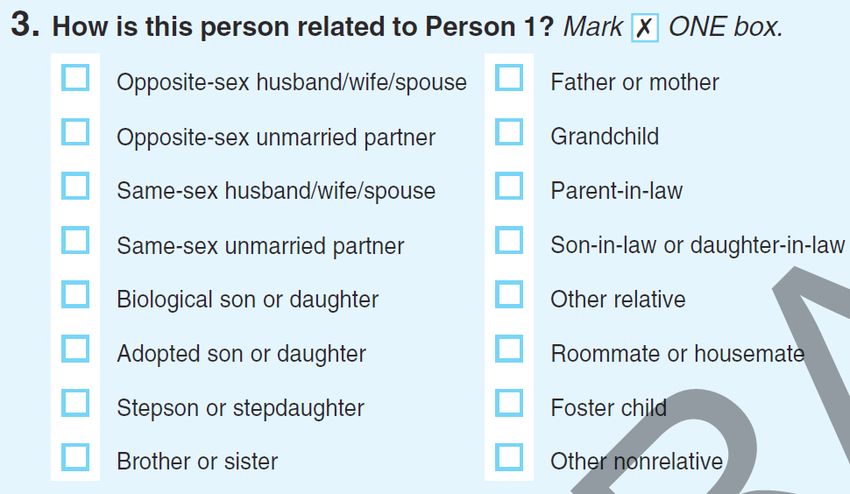
What questions are on the Census?                               Although the questions ask about April 1, 2020, or
There are only nine questions on the Census and                 “Census Day,” the survey tries to count people where
seven additional questions for each person liv-                 they usually live and sleep. Below, you’ll find the
ing in that household.                                          questions as they will appear on the 2020 Census.

                     Census 2020 Questions
    1. How many people were living or staying in this house, apartment, or mobile home on April 1, 2020?*

    2. Were there any additional people staying here on April, 2020 that you did not include in Question 1?

    3. Is this house, apartment, or mobile home owned with mortgage or loan, owned without mortgage or loan,
       rented, or occupied without payment of rent?
    4. What is your telephone number?
       Please provide information for each person living here. If there is someone living here who pays the
      rent or owns this residence, start by listing him or her as Person 1. If the owner or the person who pays
                    the rent does not live here, start by listing any adult living here as Person 1.

                                                      Person 1
    5. What is Person 1’s name?*
    6. What is Person 1’s sex?*
    7. What is Person 1’s age and date of birth?
    8. Is Person 1 of Hispanic, Latino, or Spanish origin?*
    9. What is Person 1’s race?*

                                                      Person 2
    1. Print name of Person 2
    2. Does this person usually live or stay somewhere else?
    3. How is this person related to Person 1?*
    4. What is this person’s sex?
    5. What is this person’s age and date of birth?
    6. Is this person of Hispanic, Latino, or Spanish origin?
    7. What is this person’s race?

 *Discussed in more detail below

                       2   THE NATIONAL LGBTQ TASK FORCE’S GUIDE TO THE 2020 CENSUS: AN INTRODUCTION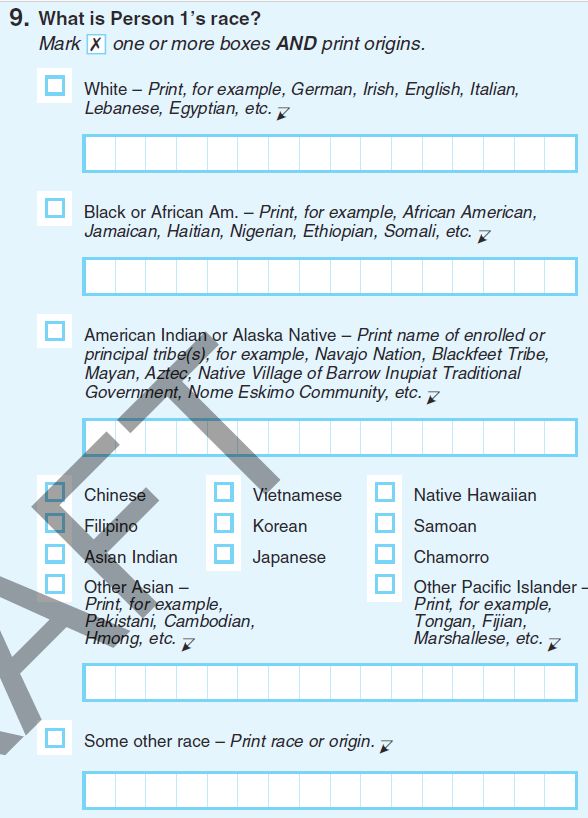
How do I navigate filling out the Census                           Questions
as an LGBTQ person?                                                1. How many people were living or staying
When looking at some of the questions and response                 in this house, apartment, or mobile home
choices on the Census, queer and transgender people may            on April 1, 2020?
find that their lives aren’t exactly represented in the provided
responses. We’re working to change that. The Task Force has
been working to add questions about sexual orientation and
gender identity (SOGI) so that our communities have access
to better data on our lives and can see ourselves reflected
on the form. Additionally, we are working alongside other
groups to ensure that data on our racial and ethnic identi-        Considerations:
ties are being accurately captured. For now, it is extremely
important to be counted on the Census so that our com-             People who don’t have a house, apartment, or mobile
munities have fair and accurate political representation and       home: Forty percent of the 1.7 million young people
enough money for the social service programs - like Medic-         who are experiencing homelessness in the U.S. iden-
aid and SNAP - that so many LGBTQ people rely on. Below            tify as LGBTQ. Rates of adult LGBTQ homelessness
we have provided additional information on specific ques-          are not available, but may also be disproportionately
tions to help you navigate filling out the Census.                 high. The Census Bureau is required to count all peo-
                                                                   ple living in the U.S., regardless of whether they have
Things to keep in mind:                                            a fixed address. If you don’t have a regular address,
    • Confidential – The Census Bureau, which is                   you can still fill out the Census using the address you
      tasked with conducting the Census, is prohibited             stay at most often – even if that address isn’t a resi-
      from sharing data identifying individuals from the           dence. You can use the address of a shelter that you
      Census surveys with ANYONE for 72 years. This                frequent, or a geographic address where you sleep
      includes other government agencies and anyone                most nights.
      outside of the Bureau. After 72 years, data on indi-         People staying in your home temporarily, or that are
      vidual people can be released publicly.                      new to your home: In addition to high rates of home-
    • Self-identification – The Bureau respects how                lessness, LGBTQ people experience high rates of
      people self-identify on the Census. Since respons-           housing instability. As a result, they may stay with
      es are restricted to few options for many of the             friends or family temporarily, or engage in “couch-
      questions, answer as best as you can with how you            surfing”. The Census intends to count everyone at
      self-identify. Since the Bureau doesn’t cross-check          the place where they stay most often; if it’s difficult to
      the information you provide on the survey with               identify a place where you stay most often, you can
      any other source, it is okay if you respond differ-          be counted at a place you stay frequently. If some-
      ently on the Census than how you would normally              one is staying with you irregularly, you could consider
      answer an official government survey. Additionally,          asking that person if they think they’ll be counted
      it doesn’t cross-check the information you provide           at another house – if not, offer to include them on
      on the Census with any other personal identifiable           your Census form. Additionally, very young children
      information you may have provided on other docu-             (especially those under the age of five) are one of the
      ments, including your birth certificate or driver’s          most undercounted groups on the Census. Make sure
      license.                                                     to count each person in your household, including
                                                                   young children and newborn babies. Any child born
    • “False” answers – Census law also indicates that             before April 1, 2020 should be included – even if they
      anyone who “willfully gives any answer that is false”        haven’t made it home from the hospital yet!
      on the survey may be fined up to $500. Essen-
      tially, the point of this law is to make sure that each      People who aren’t on your lease: The goal of the Cen-
      household only submits one survey, which ensures             sus is to accurately count all people living in the U.S.
      that everyone is fairly and accurately counted. It           where they generally live and sleep; it is not tasked
      is not intended to punish people who answer the              with enforcing housing laws. The Bureau does not
      questions in a way that better reflects who they are         cross-check survey responses with any other docu-
      with regard to their name and sex.                           ments. It is important to count all people living in a
                                                                   household, even if there are more people residing in
    • Enumerators – If you have not filled out the Cen-            the house, apartment, or mobile home than are on
      sus online, by mail, or by phone by late-April 2020,         the lease. Accurately responding to the Census won’t
      the Bureau will send an enumerator to your house-            impact a housing voucher or your ability to stay in
      hold to collect a response from you. To avoid this,          your house but will ensure fair and accurate represen-
      fill out your Census survey early and encourage              tation and sufficient funding for social services.
      others to do the same.

                        3   THE NATIONAL LGBTQ TASK FORCE’S GUIDE TO THE 2020 CENSUS: AN INTRODUCTION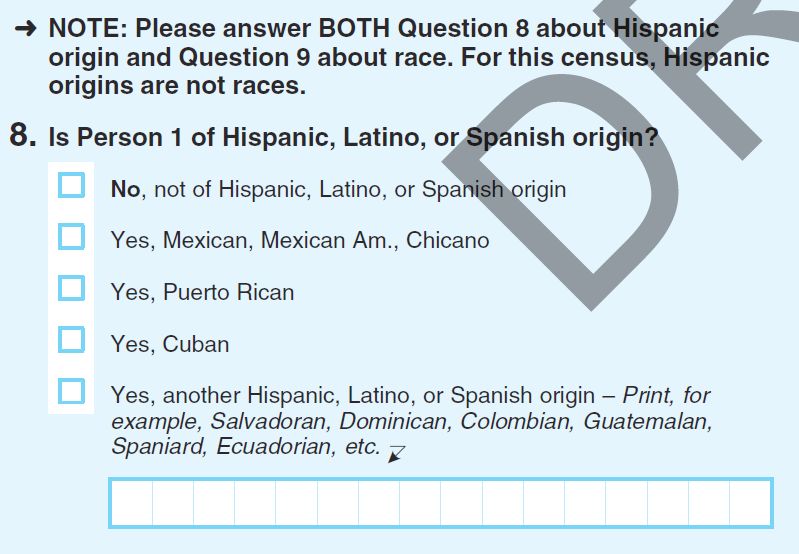
5. What is Person 1’s Name?

The Bureau asks for names on this survey just to en-
sure they are not receiving multiple responses. There
is no requirement that you use a name that is on your
official documents. Therefore, you can use the name
you feel most comfortable with using, even if it does
not match other documents, including your birth cer-           However, in the past 40 years, people have advo-
tificate or driver’s license.                                  cated to change how these questions are asked to
                                                               better collect accurate data and to broaden answer-
                                                               able categories. For example, many organizations
6. What is Person 1’s Sex?                                     and individuals have pushed for several decades to
                                                               get a Middle Eastern/North African (MENA) cate-
                                                               gory added as a response category. If this category
                                                               was added, then the data from the Census would be
                                                               much more accurate.

Like many surveys we fill out, the Census restricts
the responses to this question to “male” and “fe-
male” only. Unfortunately, this question fails to
acknowledge the myriad of sexes and genders that
exist. The Task Force is working to change that for
future Census surveys.
Transgender, non-binary, and gender nonconforming
folks navigate this question - and the gender binary itself
- every day of their lives. This survey is no different; you
can self-identify here in the way that feels most comfort-
able for you. As mentioned previously, the Bureau does
not cross-reference individuals’ answers on the Census
with any other documentation. Your answer to this ques-
tion does not need to match what you have on official
documents. For the 2020 Census survey, answer this
question in whichever way feels best to you.

8. Is Person 1 of Hispanic, Latino, or Span-
ish Origin? AND 9. What is Person 1’s race?
The Census questions on ethnicity and race are im-
portant for the evaluation of federal programs and
for the enforcement of civil rights. With data from
the Census, we can give more evidence as to racial
disparities that exist across the country and use it to
better advocate for our communities.

                       4   THE NATIONAL LGBTQ TASK FORCE’S GUIDE TO THE 2020 CENSUS: AN INTRODUCTION
More recently, the Bureau found, through years of ture data on all people in our community, including
testing, that the separate ethnicity and race ques- bisexual people, transgender people, gender non-
tions do not collect information in the best way as conforming and non-binary people, LGBTQ people
currently worded – it found that we get much better who are not living with their spouse or unmarried
data on Latinx folks if we combine the ethnicity and partner, LGBTQ people who are not in relation-
race questions. Thus, the Bureau put out a recom- ships, asexual people, or intersex people. In fact,
mendation, with supportive research, to combine the responses to this question remain unnecessarily
the questions. gendered, which the Task Force is also working to
change.
But in the same way this administration halted the
addition of sexual orientation and gender identity Furthermore, it is not uncommon for LGBTQ people
questions to the 2020 Census, the administration to live in “complex households,” or households
has also stopped progress on the addition of a with multiple family members, families, friends, and
MENA category and the combination of the ethnic- other LGBTQ people. Again, the response options
ity and race questions. Unfortunately, without ap- for this question do not accurately capture complex
proval from the administration, the Bureau couldn’t living situations. For example, for chosen family, it’s
move forward with these changes. For now, we are likely that “other nonrelative” is the category that
stuck with two separate ethnicity and race ques- best fits. However, it may not feel good to reduce
tions. such a relationship to that category. While we work
with the Bureau to improve this question for future
However, there is space to write in detailed infor- surveys, the most important thing to remember
mation about your ethnicity or country of origin, for now is that you should count everyone in your
which allows us to better understand differences household, even if you do not have a close relation-
within racial and ethnic groups. We will continue to ship to them.
work with our colleagues in racial justice and social
justice organizations to press the Administration to We cannot continue to be undercounted in the
improve the race and ethnicity questions that are Census. The data from the Census will have an
asked on future surveys. impact for at least ten years – until the 2030 Census
is fielded. Our communities and our lives depend
(For a detailed history on the race and ethnicity on the programs like Medicaid, food stamps, and
questions on the Census, please visit: https://census- housing vouchers that are funded results. Our ac-
counts.org/wp-content/uploads/2019/03/Census- cess to democracy depends on our full representa-
Report-2014-WEB.pdf) tion in Census data. And our civil rights depend
on enforcement of the law using Census data. We
can’t wait another ten years to get it right!
Person 2, Question 3. How is this person
related to Person 1?
In the 2010 Census, this question on relationship to
Person 1 had a response option of “same-sex mar-
ried couple.” That was the first time the Census ex-
plicitly captured data on same-sex married couples.
For the 2020 Census, responses to this question will
also capture data on same-sex unmarried couples
who reside together. Despite these changes, the
responses still do not accurately represent or cap-
5 THE NATIONAL LGBTQ TASK FORCE’S GUIDE TO THE 2020 CENSUS: AN INTRODUCTIONYou can also read


