A NEW SOUTH AMERICAN SUBSECTION OF SIDA SECT - The University of Texas at ...
←
→
Page content transcription
If your browser does not render page correctly, please read the page content below
NUMBER 12                                                               FRYXELL: A NEW SUBSECTION OF SIDA      15

       A   NEW SOUTH AMERICAN SUBSECTION OF SIDA SECT.
           NELAVAGA (MALVACEAE) WITH TWO NEW SPECIES
                                             Paul A. Fryxell
  Plant Resources Center, 1 University Station FO404, The University of Texas at Austin, Austin, Texas 78712

        Abstract: Sida [sect. Nelavaga] subsect. Conglomerata is described as a new subsection
        of the genus, including eight species from South America. Two of the eight are newly
        described: Sida calva and S. florulenta. The group is characterized by having flowers
        and fruits borne in axillary glomerules.
        Resumen: Se describe como nueva Sida [secc. Nelavaga] subsecc. Conglomerata,
        incluyendo ocho especies sudamericanas. Dos de las ocho son descrito de nuevo: Sida
        calva y S. florulenta. El grupo se caracteriza por tener flores y frutos portado en
        glomérulos axilares.

        Keywords: Malvaceae, Sida sect. Nelavaga, South America.

     A key to the South American species of              Malesia, by Fryxell (1985) for North and
the genus Sida L. was published by Kearney               Central America, and by Krapovickas (2006)
(1958), and the genus has been treated for               for Argentina ‘‘and nearby countries.’’ The
different parts of South America by Schu-                group is characterized by a distinctive calyx
mann (1891), Rodrigo (1944), Monteiro                    morphology, often with dark-green mar-
(1936, 1949, 1969), Macbride (1956), Fryx-               gined, more or less trullate calyx lobes, 5-
ell (1992, 2001), Burandt (1992), Fuertes                carpeled fruits that have a characteristic
(1995), and Krapovickas (2003, 2006, 2007).              mericarp morphology (Krapovickas, 2006,
The global treatment by Baker (1892)                     fig. 2), and a base chromosome number
treated only three of the species considered             (where known) of x 5 8, in contrast to x 5 7
here (S. tomentella Miq., S. urens L., and S.            in section Sida and most other sections of
pseudo-urens Baker f.) and did not place                 the genus (Fryxell, 1997). Within section
them together as a coherent group, other                 Nelavaga a subgroup of species is character-
than noting that S. urens and S. pseudo-                 ized by having flowers and fruits that are
urens are allied. Sida was subdivided into               subsessile and congested in axillary glomer-
sections by Schumann (1891), Monteiro                    ules. The best-known representative of this
(1936, 1949), Clement (1957), Kearney                    group is the widespread species, Sida urens,
(1958), and Fryxell (1985). The last-named               which occurs in the New World from
treatment, although based on Central and                 Mexico and the West Indies to northern
North American species, has been found to                Argentina, and also in Africa and Madagas-
be applicable globally, with certain modifi-             car and as a recent introduction in Hawaii
cations (e.g., Sivadasan & Anil Kumar,                   (Starr et al., 2002). It and its near relative
1996; Krapovickas, 2003). The history of                 Sida rufescens A. St.-Hil. are weak-stemmed
this infrageneric subdivision was reviewed               herbaceous plants that tend to be scandent
and summarized by Fryxell (1997, pp. 206,                on other vegetation. Bovini (2001) noted an
255).                                                    affinity of Sida rufescens with his newly
     Borssum Waalkes (1966) established                  described S. laciniata Bovini, although the
Sida sect. Nelavaga Borss. Waalk. for a                  latter is characterized by having an erect
portion of the genus that occurs in the                  habit.
tropics of both the Old World and the New                     In contrast, another subgroup of South
World. Section Nelavaga was treated sepa-                American species in sect. Nelavaga shares
rately by Borssum Waalkes (1966) for                     the glomerulate inflorescences found in

LUNDELLIA 12:15–27. 2009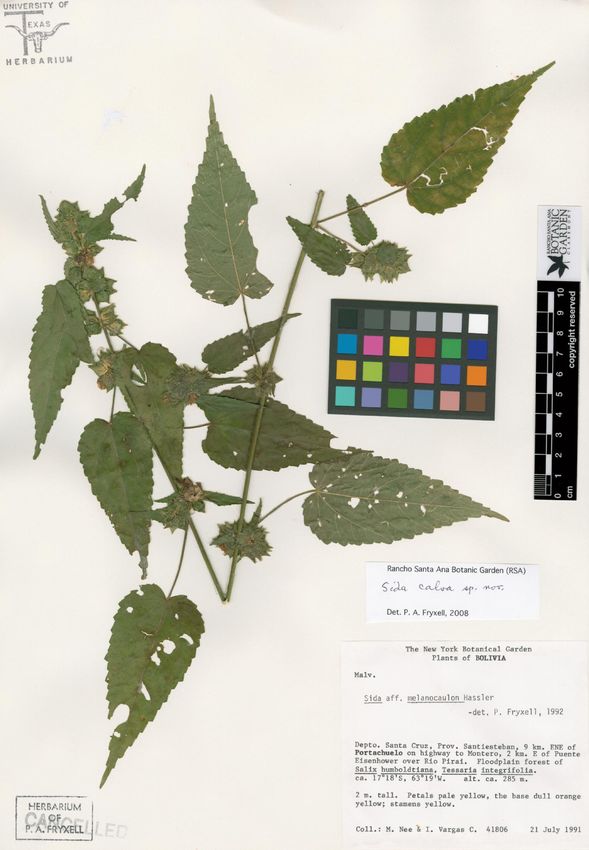
16   LUNDELLIA                                                                           DECEMBER, 2009

     Sida urens and Sida rufescens, but differs in     tion in part on the basis of a drawing that was
     presenting robust, shrubby plants with            attached to the holotype of S. ulei and which
     woody stems that are usually erect and            is preserved in the Field Museum photograph
     reach heights of 1–2 meters as well as            F-9399, the specimen being no longer extant.
     having larger calyces. Sida urens has been        The drawing clearly shows ten styles and
     reported to have a chromosome comple-             stigmas in the dissected flower. The type
     ment of 2n 5 32, and Sida melanocaulon            specimen lacked fruits. With this disposition
     Hassl., representing the shrubby group, has       of S. ulei, it becomes clear that the statement
     2n 5 16 (Krapovickas, 1957). These species        that S. ulei is a synonym of S. nemorensis
     with glomerulate, axillary inflorescences are     (Fryxell, 1976) is incorrect. A better under-
     here separated as a distinct subsection of        standing of the latter species, based in part on
     sect. Nelavaga (subsect. Conglomerata),           the examination of additional specimens,
     with the remaining species retained in            makes its distinction evident.
     subsect. Nelavaga. Subsection Conglomerata             Species of subsect. Conglomerata were
     was recognized earlier as a group (‘‘Grupo        treated by Schumann (1891), Monteiro
     Urentae’’) by Monteiro (1936), but he             (1936, 1949), Kearney (1958), and Krapo-
     included three species (S. savannarum K.          vickas (2006). Several names have been
     Schum., S. guianensis K. Schum., and S. ulei      published for these plants, but specimens
     Ulbr.) that do not belong in sect. Nelavaga       have recently been examined that do not
     as now conceived, in addition to the              conform to known taxa, a finding that gave
     following three species that are included         rise to the present investigation. There are
     here: S. melanocaulon, S. urens, and S.           six shrubby species in subsect. Conglomerata,
     tomentella. Later, without explanation,           each with more or less distinct geographical
     Monteiro (1949) narrowed the group to             distributions. A key to the species of subsect.
     three species (S. savannarum, S. tomentella,      Conglomerata and their distributions and
     and S. ulei) and used another name                synonymy are presented below, including
     (‘‘Grupo Tomentellae’’) for it, transferring      the description of two new species.
     S. urens out of the group. Neither ‘‘group’’
     name was validly published (McNeill et al.,       Sida L. [sect. Nelavaga Borss. Waalk.] sub-
     2006, Art. 36). The name S. ulei is now           sect. Conglomerata Fryxell, subsect. nov.
     placed in Sida sect. Muticae C. Presl             Type species: Sida urens L.
     (Krapovickas, 2003); S. savannarum is a
     synonym of Sida aggregata C. Presl (Kra-               Subsect. Conglomerata a subsect. Nelavaga
     povickas, 2003), also in sect. Muticae; and S.    per florus et fructuum in glomerulis plurifloribus
     guianensis is a synonym of Sidastrum              subsessilibus in axillis foliorum dignoscenda.
     quinquenervium (Duchass. ex Triana &                   Subsect. Conglomerata is distinguished
     Planch.) Baker f. (Fryxell, 1978).                from subsect. Nelavaga by flowers and fruits
          Monteiro (1936, 1949), Kearney (1958),       crowded in subsessile axillary glomerules.
     and Fryxell (1976) have associated the name            Characters that these species have in
     Sida ulei with the group of species treated       common include inflorescences of axillary
     here, specifically with S. nemorensis Mart. ex    glomerules often aggregated into terminal
     Colla. In part this view followed the statement   interrupted spikes, narrowly ovate to lance-
     by Ulbrich in the protologue of S. ulei that it   olate leaves, 5-carpeled fruits with slender
     is allied to S. tomentella. However, Krapo-       mericarps, and relatively large calyces that
     vickas (2003) has found that S. ulei is better    enclose and conceal the fruits. The axillary
     placed in Sida sect. Muticae C. Presl, rather     glomerules are sometimes subumbellate on a
     than in Sida sect. Nelavaga, based on the         short (1–3 mm) peduncle, although this
     number and conformation of the mericarps          structure is usually obscured by the crowding
     in the fruit. Krapovickas made this disposi-      of the flowers or fruits.
NUMBER 12 FRYXELL: A NEW SUBSECTION OF SIDA 17
KEY TO THE SPECIES OF SIDA SECT. NELEVAGA SUBSECT. CONGLOMERATA
1. Plants herbaceous, the stems weak, decumbent or often scandent, reclining on and supported by other vegetation
2. Calyx 5–7(–8) mm long
3. Herbage sparsely pubescent, green . . . . . . . . . . . . . . . . . . . . . . . . . . . . . . . . . . . . . 8. Sida urens L.
3. Herbage densely pubescent, rufous or yellowish . . . . . . . . . . . . . . . . . . . 6. Sida rufescens A. St.-Hil.
2. Calyx 8–12 mm long
4. Calyx lobes acuminate . . . . . . . . . . . . . . . . . . . . . . . . . . . . . . . . . . . . . . . . . . 4. S. laciniata Bovini
4. Calyx lobes usually acute . . . . . . . . . . . . . . . . . . . . . . . . . . . . . . . . . . 7. S. schumanniana Krapov.
1. Plants shrubby, the stems woody, erect or recurving
5. Stems and leaf blades (but not petioles) virtually lacking pubescence; calyx yellowish at base, the lobes 6–
7 mm wide between the sinuses (Bolivia: Santa Cruz) . . . . . . . . . . . . . . . . . . . . . 1. Sida calva, sp. nov.
5. Stems and leaf blades manifestly pubescent; calyx green throughout, the lobes 4–5 mm wide between the
sinuses
6. Upper leaf surface with antrorsely oriented, recurved or appressed simple hairs 0.5–1.5 mm long; calyx
ecostate
7. Upper leaf surface with recurved or appressed hairs 1(–1.5) mm long; calyx 8–9 mm long, the lobes
acute (Peru, Bolivia, Brazil) . . . . . . . . . . . . . . . . . . . . . . . . . . . . . . . 3. Sida florulenta, sp. nov.
7. Upper leaf surface with appressed hairs ca. 0.5 mm long; calyx 8–12 mm long, the lobes acute or
sometimes acuminate . . . . . . . . . . . . . . . . . . . . . . . . . . . . . . . . 7. Sida schumanniana Krapov.
6. Upper leaf surface variously pubescent with hairs less than 0.5 mm long, including stellate hairs; calyx
5- or 10-ribbed at base
8. Stem hairs uniformly 0.2–0.3 mm long; axillary glomerules with fewer than five flowers
(Brazil) . . . . . . . . . . . . . . . . . . . . . . . . . . . . . . 5. Sida nemorensis Mart. ex Colla
8. Stem hairs coarser, variable, 0.5–2 mm long; axillary glomerules 6–8-flowered or more (Brazil,
Argentina, Bolivia) . . . . . . . . . . . . . . . . . . . . . . . . . . . . . . . 2. Sida caudata A. St.-Hil. & Naud.
1. Sida calva Fryxell, sp. nov. (Fig. 1). the leaves, the clusters tending to be aggre-
TYPE: BOLIVIA. SANTA CRUZ: Prov. gated toward the apices of the branches.
Santiesteban, 9 km ENE of Portachuelo on CALYX 8–10 mm long, yellowish basally,
hwy. to Montero, 2 km E of Puente otherwise green, more than half-divided, the
Eisenhower over Rı́o Pirai, ca. 17u189S, lobes triangular or trullate, up to 6–7 mm
63u199E, alt. ca. 285 m, 2 m tall, 21 Jul wide between the sinuses, acute or subacu-
1991, Nee & Vargas C. 41806 (HOLOTYPE: minate, with stellate-pubescent margins and
NY!; ISOTYPE: TEX!). tips (hairs 0.5–1 mm long), the calyx 5-
angled at the sinuses, sometimes with simple
Frutices ad 2 m staturae, caulibus lignosis pub- hairs to 2 mm in basal portion, the venation
escentis carentibus; foliis glabris praeter faciem adax-
ialem petiolorum barbatam; calycibus 8–10 mm longis not prominent. PETALS pale yellow, the base
ad basem lutescentibus ecostatis marginibus pubescentis. dull orange-yellow; stamens yellow [fide
collectors]. FRUITS not seen.
SHRUBS to 2 m tall, the stems essentially
ADDITIONAL SPECIMENS EXAMINED: BOLIVIA.
devoid of hairs of any size. LEAF BLADES ovate,
SANTA CRUZ: Prov. Ichilo. Parque Nacional Amboro,
5–10 cm long, 2–5.5 cm wide, basally cor- along Rı́o Seguayo, 17u409S, 63u439W, 450 m, Nee
date, apex acuminate, margin coarsely cre- 38864 (RSA, NY). Huachi, head of Beni River, 3000 ft,
nate, palmately to pedately 7–9-nerved, Sep 1921, Rusby 469 (NY).
glabrous above and beneath; petioles 1.5–
4 cm long, with a narrow, dense line of hairs A field note in the pocket of Rusby’s
0.3–0.4 mm long on adaxial side plus a few 1921 specimen (# 469) states, ‘‘Wissadula
long hairs (1.5–2 mm) at distal end near (?). Fls. Light yellow. Large shrub with very
juncture with lamina, otherwise glabrous; long slender reclining branches.’’
stipules linear, 4 mm long, 0.5 mm wide, 1-
nerved, glabrous. FLOWERS borne in subses- 2. Sida caudata A. St.-Hil. & Naudin, Ann.
sile clusters of 4–8 (or more) in the axils of Sci. Nat. Bot. ser. 2, 18: 52. 1842. TYPE:18 LUNDELLIA DECEMBER, 2009
FIG. 1. Sida calva sp. nov. Isotype (TEX).NUMBER 12 FRYXELL: A NEW SUBSECTION OF SIDA 19
BRAZIL. MINAS GERAIS: Claussen 29 (P as ADDITIONAL SPECIMENS EXAMINED: BRAZIL. BA-
HIA: 6 km E de Poçoes, 14u369400S, 40u209300W, 10
photo F-35534!).
Aug 2004, Amorim et al. 4307 (CEPEC, NY). MINAS
GERAIS: Serra do Ouro Branco, 20u289S, 43u419W,
Sida tomentella Miq., Linnaea 22: 553. 1849. 1000 m, 12 May 1990, Arbo et al. 3985 (CTES, K);
TYPE: BRAZIL. MINAS GERAES: Caldas, 1845, Widgren 478 (BR, S-2); Caldas, 10 May 1874,
[no date,] Regnell I-16 (HOLOTYPE: U- Mosén 1788 (S-2). MATTO GROSSO: Santa Anna da
248898! [labeled as ‘‘isotype’’]; ISO- Chapada, 20 May 1903, Malme 3401 (S-2). PARANÁ:
Mun. Palmeira, Rod. BR-277 descido rio Capivara, 8
TYPES?: BR, LE!, P as photo F-35547!).
Mar 1984, Hatschbach 47582 (CTES, NY); Ponta
[type locality at: 21u559S, 46u109W] See Grossa, 24 Apr 1910, Dusén 9905 (MO, S); Mun.
discussion of questionable isotypes be- Ponta Grossa, Parque Villa Velha, 24 Feb 1967,
low. Hatschbach 16052 (C, CTES); Villa Velha, 13 Mar
Sida tomentella Miq. var. brevicalyx K. 1904, Dusén 4050 (S); Mun. Ivai, 15 May 1972,
Hatschbach 29309 (C, CTES, NY); Capão Grande, pr.
Schum. in Fl. Bras. 12(3): 309. 1891. Ponta Grosso, Dusén 3936 (S); Capão Bonito, 16 May
TYPE: BRAZIL. MINAS GERAIS: Caldas, 1914, Dusén 15046 (S); Jaguariahyva, 23 Apr 1911,
18 Apr 1874, Regnell I-16 (ex p.) Dusén s.n. (S), 15 May 1914, Jönsson 354a (S). SANTA
(HOLOTYPE: P as photo F-35546!). CATARINA: Laguna, Morro N.S. da Gloria, 24 Jan 1984,
Krapovickas & Cristóbal 39388 (C, CTES). ARGEN-
Sida melanocaulon Hassl., Feddes Repert. 8:
TINA. MISIONES: Dep. Iguazú, Isla San Martı́n, Vanni
24. 1910. TYPE: PARAGUAY. Sierra de et al. 2793 (CTES, NY); Dep. Candelaria, Loreto,
Amambay, ad ripas rio Estrella, Rojas 220 m, 21 Apr 1958, Montes 27391 (NY); Dep.
[for Hassler] 10294 (HOLOTYPE: G as Candelaria, La Pastora, 220 m, 11 Jul 1946, Montes
photo F-23778!; ISOTYPES: B as photo F- 2413 (NY). CORRIENTES: Dept. San Martı́n, Yapeyú,
costa del Rı́o Uruguay, 12 Feb 1979, Schinini et al.
9386!, BAF, P).
17006 (CTES, NY). BOLIVIA. SANTA CRUZ: Prov.
Sida margaritensis Hassl., Feddes Repert. 12: Ichilo, 2 km N of Buena Vista, 17u259S, 63u409W,
266. 1913. TYPE: PARAGUAY. Prope 320 m, Krapovickas & Fortunato 43923 (C, CTES, NY).
Cerro Margarita, Hassler 11065 (HOLO-
TYPE: G; ISOTYPE: BM). Kearney (1958, Note 40) suggested that
Sida tomentella is ‘‘perhaps a synonym of S.
SHRUBS 0.6–2.5 m tall, the stems some- caudata A. St.-Hil. & Naudin, an older
times purplish pigmented, prominently hir- name.’’ Monteiro (1977) concluded that S.
sute with setae 1–2 mm long, with or without caudata and S. tomentella are indistinguish-
an understory of smaller (sometimes glandu- able on the basis of an examination of a wide
lar) hairs, the setae simple or sometimes range of material including the type of S.
stellate with few arms. LEAF BLADES ovate, 3– caudata. Krapovickas (2006) also followed
8.5 3 1.5–3.5 cm, coarsely serrate-crenate, this view, and it is adopted here.
cordate, acute to slightly acuminate, sparsely The typification of Sida tomentella is
stellate-pubescent on both surfaces, the hairs problematical. It is based on ‘‘Regnell I-16’’
3–5-armed beneath, ca. 1 mm diam., with according to the protologue. The holotype
fewer arms and slightly smaller above; lacks a collection date but clearly it was
petioles 1–2.5 cm with pubescence like stems; collected prior to 1849, the date of
stipules linear, 3–8 mm long, pubescent. publication of the name. Specimens with
FLOWERS in axillary glomerules of 6 or more this designation (‘‘I-16’’) may be found in
flowers. CALYX 6–9 mm long, 10-ribbed at many herbaria, but with widely varying
base, hirsute with simple hairs 1–2 mm long collection dates. As stated on the U.S.
and often with smaller hairs in addition, half National Herbarium type register web site,
or more divided, 5-angled at sinuses, the the ‘‘dates are recondite.’’ For example, the
lobes acuminate, 3 mm wide at sinuses. Stockholm herbarium has one specimen
MERICARPS 3.5 3 1–1.5 mm, apically 2- dated 20 Apr 1860, two dated 21 May
spined (spines 1 mm). 1862, one dated 22 Apr 1873, and one
ICONOGRAPHY: None known. lacking a date. The Copenhagen herbarium20 LUNDELLIA DECEMBER, 2009
has two specimens, both of which are ules of six or more flowers, evidently
dated 13 Jan 1866, as is the specimen at subsessile or on short pedicels 1–3 mm long,
Kew, and the one at the Smithsonian is the glomerules forming interrupted spici-
dated 23 Mar 1866. Since the species was form inflorescences, often on axillary lateral
described in 1849, none of these specimens branches. CALYX 8–9 mm long, slightly 5-
with later dates can be considered as angulate at sinuses, not ribbed, half or more
original material, and thus cannot be divided, the lobes narrowly triangular-acute
considered as isotypes. Those that are cited (4–5 mm wide between the sinuses), sparse-
as isotypes above have not been checked ly ciliate (especially basally), the hairs
for their dates of collection, and are thus sometimes simple and 1–2 mm long, some-
cited with a ‘‘?’’. This problem with Regnell times stellate and ca. 1 mm in diameter.
collections has been noted before for PETALS 6 mm long (exceeding calyx), pale
Pavonia guerkeana R.E. Fr., based on yellow with reddish base; androecium in-
Regnell I-15 (Fryxell, 1999, p. 116), which cluded. MERICARPS presumably 5 (but intact
is the same collection number that is cited fruits not observed), glabrous except mi-
as the type of Abutilon septemlobum Miq. I nutely pilose apically, 3 mm long, 1.5 mm
have been unable to discover an explana- wide, minutely bi-apiculate, the apicula
tion of the numbering system used by 0.3 mm long, the dorsal wall smooth.
Regnell, or of the varying dates that are
recorded on these herbarium sheets. ADDITIONAL SPECIMENS EXAMINED. PERU.
CUSCO: La Convención, Dist. Vilcabamba, Chiwan-
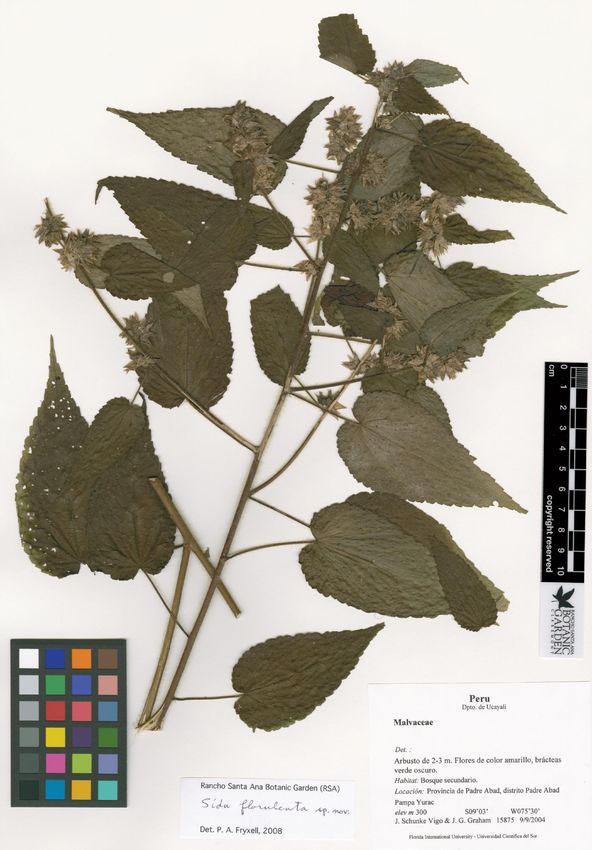
3. Sida florulenta Fryxell, sp. nov. (Fig. 2). quiri, 12u459160S, 73u8960W, 881 m, 18 Jul 2004,
Galiano et al. 6645 (MO, TEX). BOLIVIA. GUANI-
TYPE: PERU. UCAYALı́: Provincia de TIPUANI: 1892, Bang 1446 (NY-2). BRAZIL. MINAS
Padre Abad, Distr. Padre Abad Pampa GERAIS: Viçosa, Upper Chacha Valley, [20u559S,
Yurac. Arbusto de 2–3 m. Flores de color 43uW,] 670 m, 30 Jul 1930, Mexia 4922 (NY, RSA).
amarillo, brácteas verde oscuro. Bosque
secondario, 300 m, 9u39S, 75u309W, 9 Sep The collection of Mexia from Minas
2004, Schunke Vigo & Graham 15875 (HO- Geraes cited above is widely separated from
LOTYPE: F!; ISOTYPE: RSA!). the other specimens from Peru and Bolivia,
yet agrees well with these specimens in
Frutices 2–3 m staturae, caulibus lignosis mani- morphology. It is of interest that a second
feste et dense pilosis; laminis foliorum in faciebus
collection by Mexia (# 4773) of Sida urens
adaxialibus trichomatibus simplicibus antrorsis (1–
1.5 mm longis) recurvatis vel adpressis; calycibus 8– (q.v.) from essentially the same locality, and
9 mm longis ecostatis ad basem ciliatis, pilis 1–2 mm. when compared side-by-side with # 4922,
shows all of the contrasting characters that
SHRUBS 2–3 m tall, the stems promi- distinguish S. florulenta and S. urens. Evi-
nently pilose, the hairs simple, 2 mm long. dently the two species are sympatric, perhaps
LEAF BLADES ovate, 5–11 cm long, 2–5.5 cm separated by ploidy level.
wide, basally cordate, acuminate, coarsely
crenate-serrate, palmately 7-nerved, the up- 4. Sida laciniata Bovini, Eugeniana 25: 23,
per surface with recurved or appressed fig. 1. 2001. TYPE: BRAZIL. MINAS GERAIS:
simple hairs 1(–1.5) mm long, antrorsely Januária, Vale do Rio Peruaçu, a caminho
oriented, the lower surface with fewer and do cerrado do Judas, 21 Jul 1997, Salino
smaller hairs (especially on nerves) including 3297 & Stehmann (HOLOTYPE: BHCB-n.v.).
some stellate hairs; petioles 1.5–4.5 cm long, [type locality at: 15u209S. 42u209W]
pilose like stems, sometimes with an adaxial Erect SUBSHRUBS, the stems cylindrical,
line of dense shorter hairs 0.1–0.6 mm long; velutinous (hairs simple), the younger stems
stipules subulate, nearly glabrous, 4 mm reddish. LEAF BLADES 1.5–7.5 3 1.2–4.5 cm,
long. FLOWERS crowded in axillary glomer- chartaceous, concolorous, cordiform, theNUMBER 12 FRYXELL: A NEW SUBSECTION OF SIDA 21
FIG. 2. Sida florulenta sp. nov. Isotype (RSA).22 LUNDELLIA DECEMBER, 2009
base cordate, the apex acute, the margins of 2–4 flowers (sometimes solitary), the
irregularly serrate, velutinous above and pedicels 1–2 mm long. CALYX 7–8 mm long,
beneath, the hairs simple or rarely stellate, ca. half-divided, 5-angulate, stellate-pubes-
the younger ones reddish; petioles cylindric, cent, basally 10-ribbed, the lobes 4–5 mm
ca. 5 cm long, velutinous, reddish; stipules long, 4–5 mm wide at sinus, acuminate.
filiform, ca. 3 mm long, velutinous, reddish. PETALS yellow, 7–8 mm long, slightly ex-
INFLORESCENCES axillary, aggregate; flowers ceeding the calyx. [GENITALIA not seen;
with a pedicel 3–4 cm long, velutinous, FRUITS not seen.]
reddish; calyx pyramidal, membranous, yel- ICONOGRAPHY: Rodrigo (1944, plate 14
lowish-pallid, reddish on the margins of the [holotype of Sida riedelii]).
lobes, very acuminate, velutinous; corolla
yellow, ca. 1.2 cm in diameter; staminal tube ADDITIONAL SPECIMENS EXAMINED. BRAZIL.
ca. 2 mm tall, glabrous; ovary 5-locular, GOIÁS: Mun. Cristalina, Lajeado (Rod. BR-040), 12
Apr 1981, Hatschbach 43835 (C, CTES) [16u409S,
glabrescent; stigmas capitate, 5. MERICARPS 47u409W]. PARANÁ: Mun. Londrina, Lereville, Campo
5, submuticous, ca. 2 3 2 mm, laterally das Pedras, 29 Sep 1970, Hatschbach 24861 (C, CTES).
reticulate. [Description translated from pro- [23uS, 51uW].
tologue.]
ICONOGRAPHY: Bovini (2001, page 25, When Schumann originally described
Fig. 1). Sida riedelii, he suggested it was allied to
Sida spinosa L. This suggestion was followed
5. Sida nemorensis Mart. ex Colla, Herb. by Monteiro (1936), who reduced it to
Pedem. 1: 416. 1833. TYPE: BRAZIL. MINAS varietal rank within S. spinosa, which
GERAIS: Rio Belmonte [Jequitinhonha, reduction in rank was followed by Rodrigo
16u26920S, 41u09100W]. Martius s.n. (holo- (1944) and Kearney (1958). Kearney, how-
type: TO!). Cf. Fryxell (1976). ever, suggested (Kearney, 1958, Note 48)
that this taxon ‘‘may be specifically distinct
Sida riedelii K. Schum. in Fl. Bras. 12 (3): from S. spinosa.’’ None of these authors
296. 189. 1891. Sida spinosa L. var. noted the similarity of S. riedelii to those
riedelii (K. Schum.) Monteiro, Monogr. species (S. caudata, S. tomentella, etc.) that
Malv. Brasil. 41. 1936. TYPE: BRAZIL. form the basis for the group under study here,
SÃO PAULO: Prope Sorocaba, Riedel where it seems clearly to belong, although
2021 (HOLOTYPE: B as photo F-9391! Rodrigo (1944, p. 129) noted that this plant
[reproduced by Rodrigo, 1944: pl. 14]; has ‘‘flores numerosas aglomeradas en el ápice
ISOTYPES: NY!, US!). [type locality at: de las ramas formando conjuntos subglobosos
23u459S, 47u309W] densos,’’ unlike S. spinosa.
SHRUBS 0.5–2 m tall, slender; stems 6. Sida rufescens A. St.-Hil., Fl. Bras. Merid.
woody, densely short-pubescent, the hairs 1: 185. 1827. Sida urens var. rufescens (A. St.-
uniformly 0.2–0.3 mm long, stellate. LEAF Hil.) Baker f., J. Bot. 30: 294. 1892. TYPE:
BLADEs narrowly ovate, 3–6 cm long, 1.5– BRAZIL. MINAS GERAIS: Prope Formigas
2 cm wide (smaller upward), basally cordate [Montes Claros], St.-Hilaire s.n. (HOLOTYPE:
(sinus shallow: 1–3 mm), the margin serrate, P as photo!).
apically acuminate, both surfaces densely
stellate-pubescent, the hairs ca. 0.5 mm Sida pseudo-urens Baker f., J. Bot. 30: 294.
long; petioles 8–12 mm long (shorter up- 1892. TYPE: PERU. Tarapoto, Mathews
ward), with pubescence like stem, denser 1552 (HOLOTYPE: BM).
distally; stipules linear, 3–7 mm long, Sida urens var. aurea Hassl., Repert. Spec.
0.5 mm wide, sparsely pubescent, the hairs Nov. Regni Veg. 12: 267. 1913. TYPE:
to 0.5 mm. FLOWERS in axillary glomerules PARAGUAY. In regione calcarea cursusNUMBER 12 FRYXELL: A NEW SUBSECTION OF SIDA 23
superioris fluminis Apa, prope Cerro NY). PARÁ: Rio Tocantins, lungo l’Itgarapé Murú
Margarita, Mar 1913, Hassler 11037 presso Aleobaça, 15 Aug 1899, Buscalioni 1606 (NY).
GOIÁS: 3 km S of São João da Aliança, 850 m, 15 Mar
(HOLOTYPE: G; ISOTYPES: NY!, P as 1971, Irwin et al. 31797 (COL, CTES, NY, UB). MINAS
photo!, UC!), non Sida aurea G. Don GERAIS: 5 km NE of Rio Manso and Coutode
1831 nec Sida aurea Lodd. 1842. Magalhães, 960–1000 m, Anderson et al. 8773 (COL,
Sida urens f. warmingiana Monteiro, Monogr. NY); 10 km N of Paracatú, road to Unaı́, 720 m, 7 Apr
1973, Anderson et al. 8331 (NY). BOLIVIA. Without
Malv. Brasil. 38. 1936. TYPE: BRAZIL.
locality, Bang 2807 (NY); Guanai, 2000 ft., May 1886
MINAS GERAIS: Morro das pedras, Belo Rusby 1454a (NY). SANTA CRUZ: Prov. Florida, 3 km
Horizonte, 30 May 1933, s. coll., s.n. (by air) NE of Mairana, 18u69S, 63u569W, 1800 m, 9
(HOLOTYPE: Jard. Bot. de B. Hor. #7948- May 1998, Nee 49300 (NY, TEX); Prov. Sandoval, San
n.v.). Matias, 170 m, 16u219S, 58u269W, Krapovickas &
Schinini 36163 (CTES, NY); Prov. Ñuflo de Chávez,
480 m, Steinbach 862 (NY); Prov. Ibáñez, near
Weak-stemmed, trailing SUBSHRUBS, de- Bermejo, 18u79S, 63u369W, 1400 m, 23 Mar 2002,
cumbent or often supported on other Nee 51946 (NY); Prov. Ibáñez, between Santa Cruz and
vegetation; stems freely branching, semi- Abapó, 17u559S, 63u159W, 470 m, 28 Mar 1998, Nee et
woody, densely rufous-pubescent, the hairs al. 48794 (NY, TEX); Prov. Velasco, 5 km de San José
de Campamento, 15u99200S, 60u599290W, .230 m,
mostly stellate, 1–1.5(–2) mm long, yellow- Guillen & Lazo 4310 (MO, NY) PARAGUAY. CON-
ish or ferruginous. LEAF BLADES ovate, 3– CEPCIÓN: San Salvador, Mar 1917, Rojas 2591 (NY).
6 cm long, 2–3.5 cm wide, basally shallowly ARGENTINA. MISIONES: Dep. Candelaria, 5 Feb 1947,
to deeply cordate, sharply serrate, promi- Schwindt 92 (CTES, NY).
nently ciliate on marginal teeth, acute,
palmately 7–9-nerved, stellate-pubescent be- Bovini (2001) summarizes the various
neath, with mixture of stellate, bifurcate, and dispositions of Sida rufescens and concludes
simple hairs above; stipules linear, 6–7 mm that it should be recognized in specific rank,
long, setose; petioles 1–3.5 cm long, with as do Kearney (1958), Fryxell (1985), and
pubescence like stem. FLOWERS in axillary Krapovickas (2006).
glomerules of 6–8 flowers (or more), the
glomerules subsessile or sometimes on 7. Sida schumanniana Krapov., Bonplandia
lateral branches (peduncles) 1–3 cm long (Corrientes) 15: 32. 2006. TYPE: ARGEN-
or more; pedicels 1–2 mm. CALYX 5–7 mm TINA. SALTA: Dep. Orán, Orán, 15 Jul 1962,
long, densely stellate-pubescent, the hairs Krapovickas & Legname 4509 (HOLOTYPE:
setose, 1–2 mm long, yellowish or ferrugi- CTES; ISOTYPE: LIL). [Type locality at:
nous, ca. 1/3-divided, the 5 lobes each 22u509S, 64u309W]
2.5 mm long, triangular and acute or
acuminate, the calyx 5-angled and 4–5 mm Sida urens L. var. grandiflora K. Schum., in:
wide at the sinuses. PETALS 4–5 mm long Fl. Bras. 12(3): 307. 1891. TYPE: PERU.
(subequal to calyx), yellow, apparently Pavón s.n. (MA? specimen not located),
glabrous except pilose on margins of claw, non Sida grandiflora Poir. 1810 nec Sida
the androecium ca. half length of petals. grandiflora (Paxton) Walp. 1848.
MERICARPS 2 mm long, muticous, glabrous.
ICONOGRAPHY: None known. SHRUBS to 2 m tall, erect or sometimes
sprawling, the stems woody, purplish, with
ADDITIONAL SPECIMENS EXAMINED. GUYANA. sparse to dense long, simple hairs 1–1.5 mm.
Rewa River, at Grant Falls, 3u109N, 58u409W, 20 Sep LEAF BLADES ovate-cordate, up to 12 3 7 cm
1997, Clarke et al. 6549 (NY). SURINAM. fluv. (but progressively smaller upward), basally
Corantyn, Apoera, 22 Oct 1916, Stahel & Gonggrijp
subcordate to cordate, coarsely crenate-
2973 (NY). VENEZUELA. CARABOBO: Guaremales,
road from Puerto Cabello to San Felipe, 10–100 m, dentate, palmately 5–7-nerved, the upper
1921, Pittier 9146 (NY). BRAZIL. BAHIA: Barreiras, surface with appressed simple (occasionally
460 m, 12u99S, 45uW, Krapovickas et al. 38699 (CTES, bifurcate, rarely stellate) antrorsely-oriented24 LUNDELLIA DECEMBER, 2009
hairs 0.5–1 mm long, the lower surface with species Sida schumanniana is heterotypic
many fewer hairs widely scattered and with respect to Sida urens var. grandiflora.
randomly oriented, these sometimes stellate; Therefore it must stand on the basis of
petioles 1–6 cm long (smaller upward), Krapovickas’ description and typification
densely pilose (especially distally) with and not that of Schumann. Unfortunately,
simple hairs 1–2 mm long or more and the illustration that was a part of the
with short recurved hairs (0.1–1 mm) in a protologue was the result of a printing error,
narrow row on the adaxial side; stipules 3– in which the caption for Figure 6, corre-
7 mm long, subulate, hirsute to nearly sponding to S. schumanniana, was combined
glabrous. FLOWERS crowded in axillary with the drawing from Figure 8, depicting
glomerules or these sometimes on short Sida waltoniana Krapov., a rather different
lateral branches up to 1.5 cm long, the species. Thus, the figure and the description
pedicels 1–3 mm long, the branch forming in the protologue are discordant, and the
an interrupted raceme. CALYX 8–12 mm illustration must be ignored when interpret-
long, ca. half or more divided, 5-angled at ing the species. However, the specimen upon
the sinuses, the lobes trullate or somewhat which the unpublished illustration was
acuminate, 4 mm wide between the sinuses, based (Solomon & Nee 14297, cited above)
ciliate, the hairs simple, 1(–3) mm long and was examined in preparing the above
with some smaller stellate hairs. PETALS description.
yellow, sometimes exceeding the calyx. According to the original description,
FRUITS not seen. Sida schumanniana belongs in subsect.
ICONOGRAPHY: Krapovickas (2006, page Conglomerata and recombines the weak-
33, fig. 6 [in error]). stemmed, scandent habit of S. urens and S.
rufescens with the large calyces of the
ADDITIONAL SPECIMENS EXAMINED. COLOMBIA. remaining species in the subsection. It is
SANTA MARTA: 2500 ft, 20 Dec 1898, H.H. Smith 718 (A, also notable for its wide distribution accord-
BM, BR, COL, F, G, GH, NY, PH, S, UC, US); Santa ing to Krapovickas (2006), from Venezuela
Marta, 1000 ft, 5 Jan 1899, H.H. Smith 719 (NY).
BOLIVIA. LA PAZ: Prov. S. Yungas, San Bartolomé (near
to Argentina. However, thirteen paratypes
Calisaya), 750–900 m, Jul 1939, Krukoff 10020 (NY), (cited above as ‘‘specimens examined’’) were
Krukoff 10047 (NY); 3.8 km W of Huancaré, 2000 m, seen in the present study and found to be
16u239S, 67u339W, 29 Sep 1985, Solomon & Nee 14297 quite variable, so that further study and
(NY). SANTA CRUZ: Prov. Velasco, Estancia Flor del Oro, evaluation of this variability is warranted.
13u339S, 61u09300W, 190 m, 27 Jun 1991, Nee 41483
(NY); Prov. Ichilo, Parque Nacional Amboro, 17u409S,
63u439300W, 450 m, 22 Sep 1990, Nee 38869 (NY). 8. Sida urens L., Syst. Nat., ed. 10. 1145. 1759.
PARAGUAY. AMAMBAY: Cerro Corá, 17 Aug 1980, TYPE: [JAMAICA.] Browne s.n. (LECTOTYPE,
Schinini & Bordas 20231 (NY); Sierra de Amambay, Rojas designated by Rodrigo, 1944: LINN-866.20
[for Hassler] 10540 (NY). ARGENTINA. SALTA: Sierra [reproduced by Rodrigo, 1944, pl. 17]).
de Ramos, 20 Aug 1944, Schulz & Varela 5472 (NY);
Dept. Orán, Santa Marı́a, 17 Jul 1944, Willink 194 (NY);
Entre Agua Blanca y Angosto del Pescado, 19 Sep 1991, Sida verticillata Cav., Diss.1: 13. t. 1. f. 12.
Guaglionone et al. 2725 (NY); Dept. San Martı́n, La 1785. TYPE: BRAZIL. RIO DE JANEIRO:
Porcelana, 3 Sep 1944, Schulz 5514 (NY). Commerson s.n. (HOLOTYPE: P-JU
#12275!; ISOTYPES: P, MA-29796! (fide
Krapovickas named this species in Garilleti, 1993).
honor of K. Schumann and cited Schu-
mann’s varietal name as a synonym. He did Usually scandent HERBS OR SUBSHRUBS 1
not elevate var. grandiflora to specific rank, (–2) m tall, the stems pilose with simple
as this would have resulted in a later hairs 1.5–2 mm long and a few scattered
homonym, although he could have done so stellate hairs, the epidermis not concealed.
and provided a nomen novum. Rather, the LEAF BLADES ovate, basally cordate, coarselyNUMBER 12 FRYXELL: A NEW SUBSECTION OF SIDA 25
serrate, acuminate, 6–7 cm long, 2.5–4.5 cm Manaus, 2u199S, 60u59W, 13 Feb 1992, Nee 42561
wide, progressively smaller upward, the (NY). GOIAS: Piranhas, 23 May 1966, Irwin et al. 17683
(CTES, NY); Luziana, 15 km ao sul da cidade, 10 May
upper surface with simple (0.5–1 mm), 1982, Heringer 18346 (NY); Serra Dourado, 6 km NE
bifurcate, and stellate hairs, the lower surface of Mossamedes, 700–780 m, 12 May 1973, Anderson et
similar but more often stellate-pubescent; al. 10199 (NY). MINAS GERAIS: Viçosa. Agricultural
petioles 1–3 cm long (smaller upward) with College lands. Disused hill road Chacha Valley, alt.
pubescence like stem; stipules 2–5 mm long, 680 m, 2 Jun 1930, Mexia 4773 (NY, RSA); Rio
Pandeiros, 520 m, 18 Apr 1973, Anderson et al. 9095
subulate. FLOWERS in subsessile, axillary (COL, NY). PARÁ: Fordlandia, Sep 1931, Krukoff 1234
glomerules of 3–8 (or more) flowers or (NY). PARANÁ: Mun. 2 Vezinhos, Foz do Chopim, 12
these on short lateral branchlets up to 3 cm Dec 1968, Hatschbach & Guinarães 20561 (NY); Mun.
long. CALYX 5–7(–8) mm long, half or more Laranjeiras, Salto Osorio, Rio Iguazú, 18 Apr 1970,
divided, the lobes trullate, acute or acumi- Hatschbach 24156 (CTES, NY). PERNAMBUCO: Tapera,
26 Jul 1931, Pickel s.n. (RSA). RIO GRANDE DO SUL: S.
nate, 3–4 mm wide at sinus, the margins Leopoldo, 17 Mar 1950, Rambo 46361 (NY). BOLIVIA.
prominently ciliate, the cilia 1–1.5 mm long. Reis, 1500 ft., Jun 1886, Rusby 1454 (NY). BENI: Prov.
PETALS 6–7 mm long, yellowish or ‘‘salmon’’ Vaca Diez, Riberalta, 11u09S, 66u49N, 170 m, Solomon
with orange or purplish base, exceeding the 16724 (MO, NY). LA PAZ: Nor Yungas, Yoloso,
calyx; staminal column 2 mm, the filaments 1280 m, 6 May 1980, Luteyn & Dorr 13512 (CTES,
NY); Yungas, Bang 652 (NY); Coripata, 1700 m, 27 Jun
3 mm. MERICARPS 5, slender, 3 3 1.5 mm, 1930, Buchtien 8129 (NY); Sud Yungas, Coroico, 9 May
smooth-walled, glabrous or nearly so, api- 1991, Beck 19860 (CTES, NY); Polo-Polo bei Coroico,
cally muticous. 1000 m, 1912, Buchtien 4098 (NY). SANTA CRUZ: NE of
ICONOGRAPHY: Schumann (1891, plate Bermejo, 18u79S, 63u369W, 1425 m, Nee 52393 (NY).
60), Rodrigo (1944, plate 17 [image of TARIJA: Prov. O’Connor, Entre Rı́os, 1450 m, 20 May
1971, Krapovickas et al. 19025 (CTES, LPB, MO, TEX).
lectotype]), Fuertes (1995, page 32, fig. 3), PARAGUAY. In regione lacus Ypacaray, Cordillero de
Areces & Fryxell, (2007, page 168, plate II-6 Altos, Mar 1913, Hassler 12529 (NY); Pilcomayo River,
[mericarp]). Morong 960 (NY). ARGENTINA. CORRIENTES: Dep.
Concepción, 19 Feb. 1969, Pedersen 9029 (C, CTES,
REPRESENTATIVE SPECIMENS EXAMINED. BRITISH NY); Carambola, 17 Feb 1983, Pedersen 13502 (C,
GUIANA. Pomeroon River, Jan 1923, De La Cruz 2896 CTES, NY); Dep. Itazuingó, San Carlos, 11 Apr 1974,
(NY); Kamahusa, Upper Mazaruni River (lat. ca. Krapovickas et al. 24938 (CTES, NY); Dep. Itazuingó,
59u509W), Jul 1923, De La Cruz 4190 (NY). COLOM- 27u369S, 56u309W, Tressens et al. 6590 (COL, CTES);
BIA. SANTA MARTA: H.H. Smith 717 (A, BM, BR, COL, Dep. San Martı́n, 12 km E de Colonia Pellegrini,
F, G, GH, K, NY, P, PH, S, UC, US). TOLIMA: ‘‘La 18u319S, 57u39W, 1 Mar 1989, Tressens et al. 3747
Trinidad,’’ Libano, 1000–1200 m, Dec 1917, Pennell (CTES, NY); Tres Cerros, 5 Feb 1982, Schinini et al.
3364 (NY). ANTIOQUı́A: Medellin, Sep 1934, Daniels 21863 (CTES, NY); Dep. Mburucuyá, Estancia Santa
1178 (NY). EL VALLE: La Cumbre, 1500–1600 m, May Teresa, 3 May 1964, Krapovickas & Cristóbal 11416
1922, Pennell & Killip 5966 (NY). VENEZUELA. (CTES, NY); Dep. Santo Tomé, Colonia Garabı́, 19 Jul
PORTUGUESA: Guanare, 26 Jan 1984, 400 m, Fryxell et 1982, Tressens et al. 2081 (CTES, NY). FORMOSA: Dep.
al. 4352 (NY); 5 km NW of Guanare, 9u49N, 69u499W, Pilagá, Espinillo, 7 Mar 1949, Morel 7322 (CTES, LIL,
200 m, 5 Nov 1990, Dorr et al. 7647 (NY). MÉRIDA: RSA). JUJUY: Los Lapachos, 3 Apr 1996, Krapovickas &
Near Las Gonzales, 8u259N, 71u209W, 800–1600 m, 9 Cristóbal 46667 (CTES, F, GH, MEXU, NY). MISIONES:
Nov 1990, Dorr & Barnett 7663 (NY); Caracas, 3000 ft., Dep. Candelaria, Santa Ana, 20 Mar 1930, Rodriguez
1854, Fendler 72 (NY); Caracas, & vic., 3000–3500 ft., 56787 (NY); Dep. Leandro Alem, Paso Carreta, 9 Mar
15 Dec 1920, Bailey & Bailey 45 (NY). TRINIDAD. 1969, Krapovickas et al. 15011 (CTES, NY). SALTA: Rio
1877–1880, Fendler 231 (NY); Pointe Gourde, 31 Mar Pescado, 10 Jul 1956, Borsini 570 (CTES, NY). Dep. San
1921, Britton & Broadway 2655 (NY). ECUADOR. Ignacio, Teyucuaré, 12 May 1955, Montes 14793 (CTES,
LOJA: 12 km S of Vilcabamba, 4u159S, 79u159W, NY), Colonia San Ignacio, 220 m, 21 Mar 1956, Montes
1755 m, 8 Jul 1989, Dorr & Valdespino 6530 (NY). 14924 (CTES, NY). PANAMÁ. CANAL ZONE: Farfan
PERU. HUÁNUCO: Near Rı́o Huallaga, 750 m, 6 Jun beach, Bay of Panama, just N of canal, 27 Feb 1976,
1981, Young & Sullivan 808 (NY). UCAYALı́: Prov. Fosberg 56080 (POM). PUERTO RICO. Vieques Island,
Coronel Portillo, 8u409S, 75u09W, 8 Aug 1980, Gentry vicinity of Isabela Segunda, Shafer 2510 (NY). CUBA.
29446 (NY). BRAZIL. AMAZONAS: Canumã, 4u29S, SANTA CLARA: Prov. Soledad, Cienfuegos, Belmonte
59u49W, 28 Jun 1983, Hill 12895 (NY); Maués, 3u239S, Brook, 6 Nov 1928, Jack 6612 (POM); Santiago de las
57u449W, 29 Jul 1983, Hill 13203 (NY); Manaus, 25 Jun Vegas, 5 Jan 1906, Van Hermann 3499 (POM). PINAR
1974, Lasseign P21184 (CTES, INPA, NY); Mun. DEL Rı́O: Punta Brava, 15 Nov 1904, Baker & O’Donovan26 LUNDELLIA DECEMBER, 2009
4078 (POM). MEXICO. CHIAPAS: 18–20 km N of Fuertes Aguilar, J. 1995. Sida L. (Malvaceae). Flora de
Ocozocoautla along road to Mal Paso, Municipio of Colombia 17: 1–142.
Ocozocoautla de Espinosa, 800 m, 26 Jan 1972, Breedlove Garilleti, R. 1993. Herbarium cavanillesianum. Font-
23843 (CAS, RSA). NAYARIT: Tepic, 12 Feb 1927, Jones queria 38: 1–248.
22851 (POM). Holmgren, P. K., N. H. Holmgren, and L. C. Barnett.
1990. Index herbariorum. Part 1. The Herbaria of
Numerous additional specimens of Sida the World. ed. 8. New York.
Kearney, T. H. 1958. A tentative key to the South
urens are cited by Krapovickas (2006) from American species of Sida L. Leafl. W. Bot. 8:
Argentina, Bolivia, Brazil, and Paraguay. 249–272.
Starr et al. (2002) cite its recent introduction Krapovickas, A. 1957. Números cromosómicos de
in Hawaii. Malváceas americanas de la tribu Malveae. Revista
Agron. Noroeste Argent. 2: 243–260.
———. 2003. Revisión de Sida sección Muticae C.
ACKNOWLEDGMENTS Presl (Malvaceae-Malveae) Bonplandia (Cor-
rientes) 12: 123–132.
I am grateful to the curators of the ———. 2006. Las especies argentinas y de paı́ses
following herbaria for making specimens vecinos de Sida secc. Nelavaga (Malvaceae: Mal-
available to me for this study: C, F, K, LL, veae). Bonplandia (Corrientes) 15: 5–45.
MO, NY, POM, RSA, S, TEX, and U ———. 2007. Novedades en el género Sida (Mal-
vaceae, tribu Malveae). Bonplandia (Corrientes) 16:
(acronyms according to Holmgren et al., 193–208.
1990). I am especially grateful to J.G. Macbride, J. F. 1956. Malvaceae, Flora of Peru. Publ.
Graham for bringing to my attention the Field Mus. Nat. Hist., Bot. Ser. 13, Part IIIA, n. 2:
type of Sida florulenta, which was the initial 442–593.
stimulus for this study. McNeill, J., F. R. Barrie, H. M. Burdet, V. Demoulin,
D. L. Hawksworth, K. Marhold, D. H. Nicolson, J.
Prado, P. C. Silva, J. E. Skog, J. H. Wiersema, and
LITERATURE CITED N. J. Turland. 2006. International Code of
Botanical Nomenclature. Regnum Veg. vol. 146.
Areces, B. F. and P. A. Fryxell. 2007. Malvaceae, in: International Association for Plant Taxonomy.
Flora de la República de Cuba, fasc. 13: 1–228. Lichtenstein: Gantner Verlag.
Baker, E. G. 1892. Sida, in: Synopsis of genera and Monteiro Filho, H. da C. 1936. Monographia das
species of Malveae. J. Bot. (London) 30: 71–78, Malvaceas Brasileiras. Fasc. I. O genero Sida;
138–142, 235–240, 290–295, 324–332. Revisão das especies brasileiras. 1a Parte. Chave
Bovini, M. G. 2001. Novedades em Malvaceae das especies sul americanas e novedades brasi-
brasileiras. Eugeniana 25: 22–25. leiras. Rio de Janeiro: Ministerio da Agricultura.
Borssum Waalkes, J. van. 1966. Malesian Malvaceae pp. 1–56.
revised. Blumea 14: 1–213. ———. 1949. As especies argentinas, brasileiras e
Burandt, C. L., Jr. 1992. A monograph of Sida sect. uruguayas da secção Malvinda do genero Sida.
Oligandrae (Malvaceae). Syst. Bot. 17: 164–179. Lilloa 17: 501–522.
Clement, I. D. 1957. Studies in Sida. Contr. Gray ———. 1969. Malvaceae brasiliensis novae vel criticae.
Herb. 180: 1–91. II. Revista Fac. Ci. Univ. Lisboa, sér. 2, C, Ci. Nat.
Fryxell, P. A. 1976. On some Brazilian Malvaceae of 16: 15–36.
Martius, published by Colla in 1833. Taxon 25: ———. 1977. Malvaceae brasilienses novae vel criticae.
589–593. V. Trabalhos 26 Congr. Nac. Bot. [Brazil] pp.
———. 1978. Neotropical segregates from Sida L. 401–412.
(Malvaceae). Brittonia 30: 447–462. Rodrigo, A. del P. 1944. Las especies argentinas y
———. 1985. Sidus sidarum—V. The North and uruguayas del género Sida (Malvaceae). Revista
Central American species of Sida. Sida 11: 62–91. Mus. La Plata ser. ii. 6: 81–212.
———. 1992. Malvaceae, in: G. Harling & L. Schumann, K. 1891. Sida, in: Martius Fl. Bras. 12(3):
Andersson. Flora of Ecuador 118: 1–141. 279–347 + plate 60.
———. 1997. The American genera of Malvaceae—II. Sivadasan, M. and N. Anil Kumar. 1996. Sida ravii, a
Brittonia 49: 204–269. new species of Malvaceae from India. Willdenowia
———. 1999. Pavonia Cavanilles (Malvaceae). Fl. 25: 651–654.
Neotrop. 76: 1–284. Starr, F., K. Martz, and L. L. Loopei. 2002. New plant
———. 2001. Malvaceae, in: J. A. Steyermark, et al. records from the Hawaiian Archipelago. Bishop
(eds.). Flora of the Venezuelan Guyana 6: 186–219. Mus. Occas. Pap. 69: 16–27.NUMBER 12 FRYXELL: A NEW SUBSECTION OF SIDA 27
LIST OF COLLECTORS Krapovickas, A. et al. 15011 (8), 19025 (8),
24938 (8), 38699 (6)
Amorim, A. M. et al. 4307 (2) Krukoff, B. A. 1234 (8), 10020 (7), 10047 (7)
Anderson, W. R. et al. 8331 (6), 8773 (6), Lasseign, A. P21184 (8)
9095 (8), 10199 (8) Luteyn, J. L. & L. J. Dorr 13512 (8)
Araujo-M., A. et al. 1972 (3) Malme, G. O. A. 3401 (2)
Arbo, M. M. et al. 3985 (2) Mathews, A. 1552 (6)
Bailey, L.H. & Z. Bailey 45 (8) Mexia, Y. 4773 (8), 4922 (3)
Baker, C. F. & O’Donovan 4078 (8) Montes, J. E. 2413 (2), 14793 (8), 14924 (8),
Bang, A. M. 652 (8), 1446 (3), 2807 (6) 27391 (2)
Beck, S. G. 19860 (8) Morel, I. 7322 (8)
Borsini, O. 570 (8) Morong, T. 960 (8)
Breedlove, D. E. 23843 (8) Mosén, C. W. H. 1788 (2)
Britton, N. L. & W. E. Broadway 2655 (8) Nee, M. 38864 (1), 38869 (7), 41483 (7),
Buchtien, O. 4098 (8), 8129 (8) 42561 (8), 49300 (6), 51946 (6),
Buscalioni, L. 1606 (6) 52393 (8)
Clarke, D. et al. 6549 (6) Nee, M. & I. Vargas C. 41806 (1)
Claussen, P. 29 (2) Nee, M. et al. 38869 (7), 41483 (7),
Daniels, H. 1178 (8) 48794 (6)
De La Cruz, J. S. 2896 (8), 4190 (8) Pedersen, T. M. 9029 (8), 13502 (8)
Pennell, F. W. 3364 (8)
Dorr L. J. & L. C. Barnett 7663 (8)
Pennell, F. W. & E. P. Killip 5966 (8)
Dorr, L. J. & I. Valdespino 6530 (8)
Pittier, H. F, 9146 (6)
Dorr, L. J. et al. 7647 (8)
Rambo, B. 46361 (8)
Dusén, P. 3936 (2), 4050 (2), 9905 (2),
Regnell, A. F. I-16 (2)
15046 (2)
Riedel, J. G. F. 2021 (5)
Fendler, A. 72 (8), 231 (8)
Rodriguez, F. M. 56787 (8)
Fosberg, F. R. 56080 (8) Rojas, T. [for Hassler] 2591 (6), 10294 (2),
Fryxell, P. A. et al. 4352 (8) 10540 (7)
Galiano et al. 6645 (3) Rusby, H. H. 469 (1), 1454 (8), 1454a (6)
Gentry, A. 29446 (8) Salino, A. & J. R. Stehmann 3297 (4)
Guaglionone, E. R. et al. 2725 (7) Schinini, A. & E. Bordas 20231 (7)
Guillen, R. & R. Lazo 4310 (6) Schinini, A. et al. 17006 (2), 21863 (8)
Hassler, E. [see also: Rojas] 11037 (6), 11065 Schulz A. G. 5514 (7)
(2). 12529 (8) Schulz, A, G. & Varela 5472 (7)
Hatschbach, G. 16052 (2), 24156 (8), 24861 Schunke Vigo, J. & J. G. Graham 15875 (3)
(5), 29309 (2), 43835 (5), 47582 (2) Schwindt, E. 92 (6)
Hatschbach, G. & O. Guimarães 20561 (8) Shafer, J. A. 2510 (8)
Heringer, E. P. 18346 (8) Smith, H. H. 717 (8), 718 (7), 719 (7)
Hill, S. R. 12895 (8), 13203 (8) Solomon, J. C. 16724 (8)
Irwin, H. S. et al. 17683 (8), 31797 (6) Solomon, J. C. & M. Nee 14297 (7)
Jack, J. G. 6612 (8) Stahel, G. & J. W. Gonggrijp 2973 (6)
Jones, M. E. 22851 (8) Steinbach, R. 862 (6)
Jönsson, G. 354a (2) Tressens, S. et al. 2081 (8), 3747 (8), 6590(8)
Krapovickas, A. & C. L. Cristóbal 11416 (8), Van Hermann, H. A. 3499 (8)
39388 (2), 46667 (8) Vanni, R. O. et al. 2793 (2)
Krapovickas, A. & R. Fortunato 43923 (2) Widgren, J. F. 478 (2)
Krapovickas, A. & P. R. Legname 4509 (7) Willink, A. 194 (7)
Krapovickas, A. & A. Schinini 36163 (6) Young, K. & G. Sullivan 808 (8)You can also read


