A Novel Approach to Treating Acute Hamstring Functional Neuromuscular Disorder-Effects of Primal Reflex Release Technique
←
→
Page content transcription
If your browser does not render page correctly, please read the page content below
CLINICAL OUTCOMES RESEARCH

A Novel Approach to Treating Acute Hamstring Functional
Neuromuscular Disorder-Effects of Primal Reflex Release Technique
Lucas Bianco, DAT, LAT, ATC1; James May, DAT, LAT, ATC2; Alan Nasypany, EdD, LAT, ATC2
1BIOKINETIX,   Chicago, IL; 2University of Idaho, Moscow, ID

ABSTRACT                                                                     INTRODUCTION

                                                                             H
Hamstring injuries have an occurrence rate of 3.05 per 1000
athlete exposures in intercollegiate athletics. Current clinical
practice recommendations for rehabilitation of hamstring                         amstring injuries are a common pathology
injuries are based on pathoanatomical muscle tissue healing
timeframes. The purpose of this study was to examine the                     within physically active patient populations.1-6
effects of modulating the nervous system with Primal Reflex
Release Technique (PRRT) in patients clinically diagnosed with               Injury to the hamstring muscle complex can
functional neuromuscular hamstring muscle-related disorder                   present as tissue damage leading to pain and
(FNHD). In this a priori case series, PRRT was utilized in four              functional limitations.1-4,5-8 Structural damage,
patients participating in intercollegiate, National Collegiate
Athletic Association Division II, athletics to evaluate Numeric              ranging from micro-trauma to macro-trauma, can
Pain Rating Scale (NRS) for current pain, Disablement of the                 occur when the force placed on the hamstring
Physically Active (DPA) scale, modified Patient Specific
Functional Scale (PSFS), and Active Knee Extension Test                      muscle is greater than the mechanical limits of the
(AKET). The initial pre-treatment to post-treatment average                  tissue.9,10 Functional limitations, not structural
difference for NRS (3.25±2.5 points) and AKET (11±2.16°)                     damage, are frequently used to classify a
improved by an amount that satisfied MCID and MCD
respectively. The pre-treatment to one-week follow-up                        patient with a hamstring injury, and determine
average difference for NRS (5.5±2.3 points), PSFS                            treatment parameters based on
(4.75±2.5 points), and AKET (20.5±14°) improved by an
amount that satisfied MCID or MCD. The average timeline for                  recommendations of tissue healing timeframes.6-
discharge to full unrestricted activity was 2.75 days. In the                8,11 It is possible that a portion of these injuries
four patients classified with a functional neuromuscular muscle              have minimal or no structural damage and are
disorder (FNMD), PRRT was utilized as the only manual
therapy intervention. Through modulation of the nervous                      FNMDs, thus they do not need to adhere to the
system, the outcomes reported by the patients were both                      recommended tissue healing timeframes.
meaningful and clinically significant. Based on the results and
the current standard of care for similar patients, the need for
further research into this paradigm is warranted. Hamstring                  Hamstring injuries are prevalent in the
injuries continue to be a significant clinical injury in the athletic        intercollegiate athletic population, with a rate of
patient population. A thorough evaluation and appropriate
classification of muscle injury can help clinicians decided an
                                                                             3.05 per 1000 athlete exposure.12 The goals of
effective treatment for the patient. Clinicians seeking to                   hamstring rehabilitation include decreasing pain,
improve patient outcomes may benefit from considering a                      restoring function, and returning to the prior level
paradigm that modifies the neural allostatic loads.
                                                                             of sports performance with minimal risk of
Key Phrases                                                                  reinjury.1,2,7,11 Previous research on hamstring
Autonomic nervous system, patient-reported outcomes,
clinician-rated outcomes
                                                                             treatment and return to play programs has been
                                                                             completed for patients classified with hamstring
Correspondence                                                               injury. However, the re-injury rates for this clinical
Dr. Lucas Bianco, 3205 Street Lynchburg, VA 24501.
E-mail: lucasbianco4915@gmail.com                                            significant injury have been consistent over the
                                                                             past 20 years.1,2,4,8,11-13 With an increased risk
Full Citation
Bianco L. A Novel Approach to Treating Acute Hamstring                       of re-injury rate in intercollegiate athletics,
Functional Neuromuscular Disorder-Effects of Primal Reflex                   further research is required to determine more
Release Technique. Clin Pract Athl Train. 2019;2(1):19-31.                   effective interventions and treatment theories to
https://doi.org/10.31622/2019/0001.5.
                                                                             decrease pain, restore range of motion (ROM),
Submitted: December 9, 2018 Accepted: February 26, 2018                      and improve function following classification of a
                                                                             hamstring injury.

                                                                        19
Copyright © by Indiana State University                                                            Clinical Practice in Athletic Training
All rights reserved. ISSN Online 2577-8188                                                        Volume 2 – Issue 1 – February 2019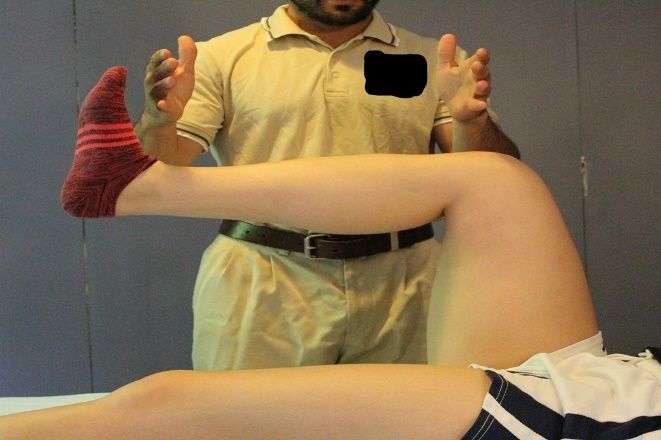
A Novel Approach to Treating Acute Hamstring Functional Neuromuscular
                                    Disorder-Effects of Primal Reflex Release Technique

The pathoanatomical evaluation is recommended                      these patients. Based on this new classification
as the means for assessing a patient with a                        system, patients treated in this case series would
possible hamstring injury.1,2,7,8,10,14 The widely                 be classified as having a FNMD. The neural
used, O’Donoghue Muscle Injury Classification                      component of a musculoskeletal injury can easily
system correlates tissue damage to loss of                         be overlooked as it is not commonly associated
function.15 Based on this classification system,                   or treated under the tissue model.17 As
patients who present with pain and decreased                       rehabilitation theories evolve to meet the
function would be classified with a grade I or II                  progressive neurophysiologic research, clinicians
hamstring strain. A recent consensus statement on                  may desire interventions purposed to create
muscle injuries in sport provides a new                            ideal function of the neurological system, rather
comprehensive classification system.16 The Munich                  than protocols encompassing the myopic muscle
Muscle Injury Classification system (Figure 1) was                 tissue healing model.
used by the treating clinician (TC) to sub-classify

                                                                     Type 1:               Type 1A: Fatigue-induced Muscle
                                                                 Overexertion-                        Disorder
                                                                 related Muscle
                                                                    Disorder
                                       Functional                                           Type 1B: Delayed-onset Muscle
                                                                                                      Soreness
                                         Muscle
                                        Disorder
                                                                                               Type 2A: Spine-related
                                                                 Type 2:
   A. Indirect                                                Neuromuscular
                                                                                            Neuromuscular Muscle Disorder

  Muscle Injury/                                              Muscle Disorder                 Type 2B: Muscle-related
    Disorder                                                                                Neuromuscular Muscle Disorder
                                        Strucual                                             Type 3A: Minor Partial Muscle
                                         Muscle                     Type 3:                             Tear
                                         Injury                  Partial Muscle
                                                                      Tear                    Type 3B: Moderate Partial
                                                                                                    Muscle Tear

                                       Contusion                                                   Subtotal Complete
   B. Direct                                                       Type 4:                            Muscle Tear
                                                                  (Sub)total
  Muscle Injury                                                      Tear                               Tendinous
                                      Laceration                                                         Avulsion

Figure 1. Munich Muscle Classification16
Patients with hamstring injuries in this study were classified with a Type 2A Muscle-related Neuromuscular
Muscle Disorder and treated with PRRT, an innovative neurophysiological approach to treatment Patients
with hamstring injuries in this study were classified with a Type 2B Muscle-related Neuromuscular Muscle
Disorder and treated with PRRT, an innovative neurophysiological approach to treatment.

                                                            20
Copyright © by Indiana State University                                                  Clinical Practice in Athletic Training
All rights reserved. ISSN Online 2577-8188                                              Volume 2 – Issue 1 – February 2019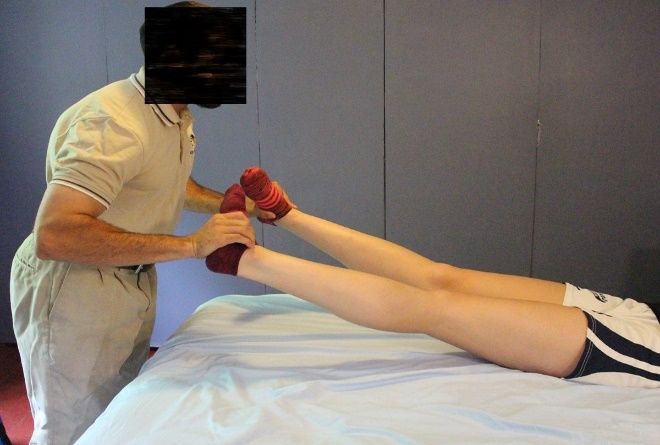
A Novel Approach to Treating Acute Hamstring Functional Neuromuscular
                                     Disorder-Effects of Primal Reflex Release Technique

The central nervous system (CNS) and peripheral                    practice has been demonstrated in the
nervous system (PNS) are directly related, and                     literature.24-26 The purpose of this study was to
function in unison to provide appropriate sensory                  examine the effects of modulating the nervous
information to the brain to maintain a state of                    system with PRRT in patients classified with
allostasis throughout the body.18-20 Allostatic                    functional neuromuscular hamstring muscle-
modulations in loading of the muscle tissue are                    related disorder (FNHD).
often due to facilitated neurons and/or inhibited
neurons creating abnormal function.20                              PATIENTS
Neurophysiologist, Sir Charles Sherrington,
                                                                   Four patients (3 males and 1 female) averaging
introduced the law of reciprocal innervation
                                                                   (19.75±1.5 years of age) actively participating
which is used in therapeutic techniques, such as
                                                                   in intercollegiate athletics (Table 1) reported to
proprioceptive neuromuscular facilitation, to
                                                                   the athletic training clinic with posterior thigh
relax the agonist muscle via reflexive stimulation
                                                                   pain. All four patients were evaluated by a
of the antagonist muscle.21 The use of reciprocal
                                                                   certified athletic trainer and met criteria to be
innervation may be an effective treatment when
                                                                   included in this study. Each patient was classified
the nervous system is in need of a modulating
                                                                   with FNMD and treated by the same athletic
external stimulus.22 Expanding on this theory,
                                                                   trainer with four years of clinical practice
withdrawal and startle reflexes that lead to
                                                                   experience who had completed, The Primal
muscle spasm and possibly pain can be due to
                                                                   Reflex Release Technique™ Home Study Course,
mal-adaptation or abnormal stimulation of the
                                                                   and The Primal Reflex Release Technique™ Live-
nervous system.19 As a result of trauma (e.g., high
                                                                   Training Seminar. Based on the a priori design,
speed running or agility movements), the nervous
                                                                   the patients were not treated with any other
system may remain “up-regulated” and unable
                                                                   therapeutic interventions. Patient-oriented
to restore a state of more ideal allostasis. In this
                                                                   evidence (POE) and clinician-oriented evidence
up-regulated state, the use of an external
                                                                   (COE) outcome measures were collected for each
stimulus to reset the CNS can resolve pain and
                                                                   patient over the course of treatment. The
restore function instantly.19,23 The creator of
                                                                   Numeric Pain Rating Scale (NRS) for current pain,
PRRT, John Iams, recognized that reflex
                                                                   Disablement of the Physically Active (DPA) scale,
responses to startling and/or painful events may
                                                                   and modified Patient Specific Functional Scale
persist in the form of facilitated or inhibited
                                                                   (PSFS) were all included as POE. The COE
muscles, which leads to compensatory patterns,
                                                                   classified measure was the, Active Knee
pain, dysfunction.23 Through modulating the CNS
                                                                   Extension Test (AKET), and hamstring manual
through the PNS, PRRT, an innovative treatment
                                                                   muscle test (MMT). The Institutional Review Board
paradigm, can help reset the nervous system to a
                                                                   (IRB) of the two universities involved in this study
more ideal allostatic load following a traumatic
                                                                   approved the collection and dissemination of
incident such as a mechanism of injury leading to
                                                                   outcomes. All participants provided written
a hamstring injury. The use of PRRT in clinical
 Table 1. Demographics and Evaluation Information
                                                                             Location of Pain in
 Patient              Age           Gender                 Sport                                           Involved Side
                                                                               Posterior Thigh
 1                    18            Female            Cross Country          Lateral Distal Third                Right
 2                    19             Male                Soccer                 Middle Third                      Left
                                                                               Lateral Middle
 3                    21              Male              Basketball                                               Left
                                                                                    Third
                                                                              Medial Proximal
 4                    21              Male              Basketball                                               Left
                                                                                    Third
                                                             21
Copyright © by Indiana State University                                                   Clinical Practice in Athletic Training
All rights reserved. ISSN Online 2577-8188                                               Volume 2 – Issue 1 – February 2019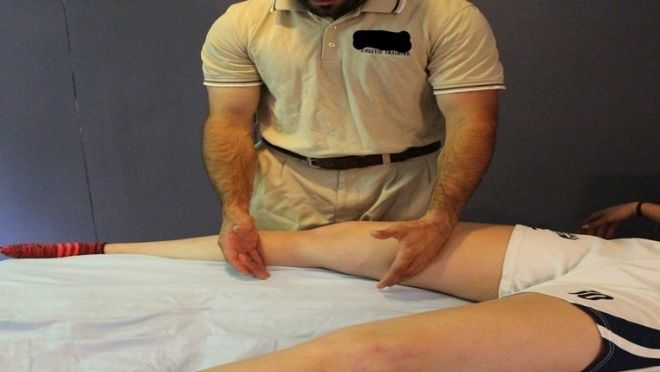
A Novel Approach to Treating Acute Hamstring Functional Neuromuscular
                                    Disorder-Effects of Primal Reflex Release Technique

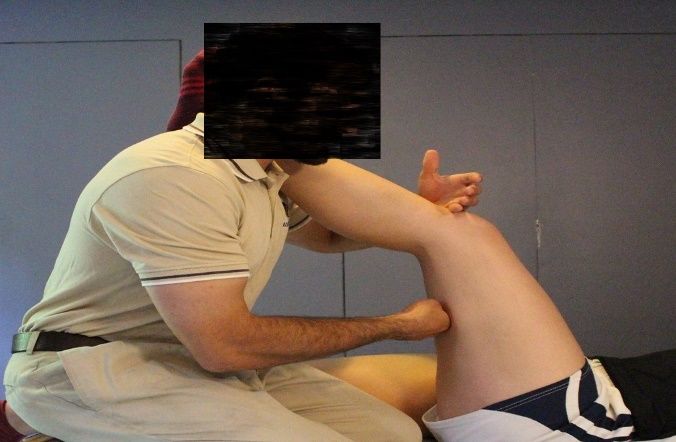
consent to have their non-identifiable information                SI Bilateral Release (Figure 5), and was
included in this study.                                           completed bilaterally, for a total of 2-3 minutes
                                                                  per session. After completion of the treatment,
At the time of initial evaluation, each patient                   the patient stood up and then walked the length
reported pain with a decrease in active ROM                       of the clinic two times, a total of approximately
and function in the affected extremity compared                   60 feet. Then AKET and PSFS were reassessed,
bilaterally. Due to the short time period from                    along with the NRS, at the conclusion of the initial
onset of injury to evaluation of the patient (within              treatment session.
1-2 days), lack of structural damage diagnosis,
and Munich muscle injury classification each                      OUTCOME MEASURES
patient was determined to have sustained a
neuromuscular muscle disorder. One patient self-                  The NRS, PSFS, MMT, and AKET were assessed
reported a previous “hamstring strain” on his                     at the following time-points: pre- and post-initial
contralateral side, while the other patients                      treatment session, discharge, one-week, and six-
reported no previous hamstring pathology.                         week follow-up assessment. The DPAS was
Following the evaluation, POE and COE                             collected at the pre-initial treatment session, one-
measures were completed. Patients were                            week, and six-week follow-up assessment.
included if they had the following outcome                        Following the evaluation and collection of initial
scores; NRS of ≥2/10, AKET measurement of                         outcome measures, each patient received the
≤70˚ on involved side, and a PSFS score of                        PRRT sequence described below. Total number of
≤8/10 (Table 2).                                                  treatments and days to discharge were tracked
                                                                  for each patient.
INTERVENTION
                                                                  Numeric Rating Scale & Disablement of the
The initial PRRT treatment session was completed                  Physically Active
immediately following the initial evaluation and
collection of baseline patient outcome measures.                  The NRS and DPAS patient-reported outcomes
The patient was positioned supine on a treatment                  assessments measured each patient’s perception
table for all treatments. Then the TC provided a                  of pain and disablement. The NRS is an 11-point
tactile stimulus the patient’s muscle bellies and                 pain scale where 0 is “no pain” and 10 is “the
tendons, or a quick movement the patient’s limb                   worst pain imaginable.” Scores reported for the
to create a reflexive response. The stimulus                      NRS represent patient reported current pain in a
activates proprioceptors in the local tissue                      weight bearing position (i.e. standing) at the time
through reciprocal innervation that can lead to a                 of assessment. A change of 2 points or greater is
more ideal allostatic load in the nervous                         considered a Minimal Clinically Important
system.21-23 Starting with the involved side, each                Difference (MCID) for the NRS.27 The DPAS was
technique was completed for approximately 12                      designed and validated for assessing
seconds, followed by the intervention on the                      disablement in physically active individuals. A
contralateral limb. Four PRRT treatment                           64-point scale with 16 possible identifiers of
techniques in the same sequence were utilized on                  disablement individually scored on a 5-point
each patient.                                                     Likert scale where zero is “no issues” and 4 is a
                                                                  “severe” issue. For acute conditions, a MCID is
The intervention consisted of the following                       reached with a 9-point difference in scores.28
sequence: Hamstring Down-Regulate (dR) (Figure
2), Gastrocnemius Reset (Figure 3), Medial
Knee/ Sacroiliac (SI) Joint Reset (Figure 4), and
                                                            22
Copyright © by Indiana State University                                                  Clinical Practice in Athletic Training
All rights reserved. ISSN Online 2577-8188                                              Volume 2 – Issue 1 – February 2019
A Novel Approach to Treating Acute Hamstring Functional Neuromuscular
Disorder-Effects of Primal Reflex Release Technique
Table 2. Inclusion and Exclusion Criteria
Inclusion Exclusion
Acute, sudden posterior thigh pain NRS of ≥2/10 Gross deformity
MOI: acceleration or deceleration during running Visible ecchymosis
Tender area to palpate on hamstring Previous hamstring strain
Weakness compared bilaterally with knee flexion 5˚ No specific MOI
Involved side AKET measurement ofA Novel Approach to Treating Acute Hamstring Functional Neuromuscular
Disorder-Effects of Primal Reflex Release Technique
Range of Motion (ROM) patients and the a priori design. The PSFS
classified each activity on an 11-point scale with
To objectively assess ROM, the AKET was 10 defined as, able to perform the same as
completed. The AKET is completed with the before injury. An MCID is established for the
patient lying supine. First, the Clinometer phone PSFS when a score for a single activity changes
application (plaincodeTM, Stephanskirchen, by 3 points.32 For the single activity, the patient
Germany) was utilized to position the angle of was asked to stand with his/her feet about an
hip flexion at 90° by placing the device on the inch apart and then cued to “bend forward and
posterior aspect of the thigh. Once in 90° of hip touch your toes”. Following completion of the task
flexion the patient was advised to straighten at the patient was asked to score the task on the
his/her same knee while the patient maintained a 11-point scale.
fixed 90° hip flexion position.29,30 The Clinometer
was then moved to the anterior tibial shaft to RESULTS
assess the amount of knee extension which was
recorded as the AKET measurement, a straight Four patients were evaluated and treated by the
knee was considered 90° of movement. The TC and were discharged to full unrestricted
standard error of measurement (SEM) has been activity in an average of 2.75 days from the
reported at 3.8°.29,30 The Minimal Detectable start of treatment (Table 3). During the treatment
Change (MDC) has been recorded between 9.7° sessions, POE and COE outcomes were collected
and 10.5°.29,30 to assess the patient’s pain and function.
Immediately following the initial treatment all the
Strength Testing patients reported a decrease in pain that met
MCID standards and three out of the four
Manual Muscle Tests were included to grade patients had an increase AKET measurement that
muscular strength during evaluations.31 Each was greater than the MDC (Table 4). Prior to
patient was positioned prone and queued to flex returning to full unrestricted activity (i.e.
his/her knee through the full ROM. If the patient competitive event) the patients had decrease in
could not move through the full ROM against NRS, as well as increases in PSFS, MMT and
gravity a grade of 2 was documented. No AKET (Table 5 & Table 6). At the one-week
patients had a trace amount of movement, grade assessment all the patients reported a MCID for
1. When full ROM accomplished against gravity NRS and DPAS while all but one had a MCID
with no pain and the same ROM compared recorded for PSFS (Table 6). The AKET measures
bilaterally a grade of 3 was documented. Next, for each patient were all greater than the MDC
the TC placed force on the posterior aspect of at the six-week follow-up assessment (Table 5).
the calcaneus while the patient’s knee was flexed At the six-week follow-up after discharge each
to 90° and then asked the patient to resist. If the patient reported no re-injury and maintained
patient was able to resist the same force outcome scores.
bilaterally a grade of 5 was recorded, grade of
4 was provided when full ROM was obtained DISCUSSION
but one side was unable to resist the same force
as the contralateral side.31 The initial treatment of PRRT resulted in
immediate improvements on the NRS and AKET
Patient Specific Functional Scale for all four patients classified with a FNHD
(Table 4). Applying the PRRT hamstring treatment
For assessment of perceived function, a modified
sequence to these patients paired with
PSFS was implemented for uniformity between
appropriate activity progression (restricted to
24
Copyright © by Indiana State University Clinical Practice in Athletic Training
All rights reserved. ISSN Online 2577-8188 Volume 2 – Issue 1 – February 2019A Novel Approach to Treating Acute Hamstring Functional Neuromuscular
Disorder-Effects of Primal Reflex Release Technique
Table 3. Course of Treatment Timeframe
Time from Injury Number of Limited Participation Discharged Unrestricted
Patient #
to Tx (Days) Tx Sessions in Sport (Days) from Tx (Days) Activity (Days)
1 1 3 2 4 3
2A Novel Approach to Treating Acute Hamstring Functional Neuromuscular
Disorder-Effects of Primal Reflex Release Technique
unrestricted activity) assisted the patients in signs and symptoms assumed to be associated
returning to pre-injury participation levels. The with tissue healing.7,14,36,37 New classification
focus of the four PRRT treatment techniques was systems are warranted as Ekstrand et al., found
on modifying the nervous system rather than a that patients classified with structural injuries
muscle tissue healing model which is commonly through clinician evaluation only had evidence of
followed after the classification of an acute MRI diagnosed muscle tear in 29% of patients.39
hamstring injury. Treating hamstring injuries with No diagnostic imaging was completed during this
neurophysiological based interventions can have case series. Through an innovative treatment used
positive effects on pain, ROM, and function of with these patients to modify neural allostatic
the patient. The results of this case series support loads, immediate changes in pain and function
the use of intervention theories to modulate the occurred leading to discharge criteria being
CNS to assist patients classified with FNHD return achieved faster than the traditional timeframes
to normalized allostatic loads demonstrated by associated the muscle tissue healing. Each patient
outcomes improving before expected muscle in this study reported immediate decreases in
tissue healing timeframes. pain at an amount that satisfied a MCID and
increased ROM greater than a MDC at the one-
The classification of FNHD was based on the week follow-up for each patient (Table 5 &
Munich muscle injury classification system. This Table 6). Immediate changes in pain and ROM
system takes into account past classification are useful to clinicians and further research
systems based on structural damage and systems should be completed on treatments that have
that explored functional deficits. By adding similar effects.
increased specifications for muscle injury, the
Munich muscle injury classification system supports Hamstring injury and re-injury rates have been
the use of a more patient-centered intervention consistent for the past 20 years and have been
approach. In patients that do not have structural associated with prolonged symptoms in
muscle damage a FNMD guides clinicians to physically active populations.3-5, 12 Most
consider the neurological mechanisms of injury, traditional treatments for acute hamstring injuries
which are often overlooked. have been studied in physically active
populations and include stretching techniques
The goals for a patient following a hamstring paired with strengthening (e.g., eccentric)
injury is to decrease pain followed by restoring exercises, and trunk stabilization and agility drill
normal ROM, strength, and function, while progressions.13,34, 38 Most of these stretching
minimizing injury recurrence rates.1,2,7,11 Pain techniques are time consuming and rely on tissue
management is the initial goal of any change that may not restore neuromuscular
rehabilitation program. Pain could be the connections that are also responsible for
prolonged symptom that needs to be addressed functional deficits. Range of motion increases
before function can be fully restored.6,11,33,34 have been linked to sensory perception instead
Decreasing pain is commonly achieved through of the commonly cited mechanical theories to
heat, ice, ultrasound, electrical stimulation, increase muscle extensibility.17,40 Currently, the
mechanical therapies, and rest.1,2,13,33-35 best recommendations do not recommend
Following a decrease in pain, ROM must be clinicians to consider modifying the neural
restored before strength and functional activities allostatic loads following an acute hamstring
can improve.35-38 Clinicians assess musculoskeletal injury.1,2,13,35-38 To improve on the hamstring
injuries in this manner based on a hypothesized injury and re-injury rates new innovative
correlation with severity of signs and symptoms. treatments should be explored. Treatments that
Rehabilitation is progressed based on decreased
26
Copyright © by Indiana State University Clinical Practice in Athletic Training
All rights reserved. ISSN Online 2577-8188 Volume 2 – Issue 1 – February 2019A Novel Approach to Treating Acute Hamstring Functional Neuromuscular
Disorder-Effects of Primal Reflex Release Technique
attempt to adjust dysregulated neural allostatic Sherry et al., provided an outline of differential
loads created during a mechanism of diagnosis, prognosis, and return to play protocol
injury/trauma need to be considered in future for acute hamstring injury.11 This protocol
research, as well as implemented into clinical recommends 3 phases over eight weeks to
practice. Sherry et al., reported that re-injury progress a patient to return-to-activity. The
occurs in one-third of patients within two weeks return-to-activity was based on pain-free
of returning to unrestricted activity from a palpation over the injury site, full muscle strength,
stretching and strengthening hamstring injury full muscle endurance, and no kinesiophobia.
treatment program.13 None of the patients in the Patients classified with acute hamstring strain
current case series suffered re-injury upon return-to-play in a range of 6-22 days.4,7,13
returning to full team activities at six-week Gibbs et al., assessed 31 patients classified with
follow-up which supports the effectiveness of grade I hamstring strain. Fourteen of the patients
PRRT in a short-term period. had normal MRI and returned to full team
activities at an average of 6 days while 17
The nervous system is sophisticated from the patients averaged 20 days to return to full team
reflex circuits that occur at the spinal level to the activities.7 Comparatively, the patients in this
descending motor pathways that control current study were discharged to return to full
voluntary movement. Following injury or even unrestricted activity and able to complete full
perceived tissue damage the nervous system team activities at 2.5 days.
reacts with reflexes (e.g., flexor reflex,
autogenic inhibition reflex, myotatic reflex).19,20 With no peer-reviewed articles specific to the
Each of these movements are facilitated by an treatment of patients classified with acute
external stimulus and provide sensory hamstring injury, PRRT has been found to have a
information to the neurons within the spinal cord positive effect on pain and function when
which result in motor neurons being activated to implemented in other areas of the body.
diffuse the external stimulus. When the reflex Hansberger et al. reported a decrease pain in
circuit is functioning appropriately the nervous patients with chronic and acute plantar fasciitis in
system is effective at recognizing and an intercollegiate athletic training clinic.24 The
responding to potentially dangerous external current study employed treatment procedures
stimuli. However, in some cases external stimuli that were similar in design and time for
cannot be managed solely by the reflex intervention to the case series by Hansberger.
circuit.40,41 The sensory information travels Hansen-Honeycutt et al., reported an immediate
through the spinal cord to the brainstem and decrease in musculoskeletal pain in three patients
forebrain, which then sends a signal through the using PRRT and breathing reflex triggering
descending motor pathway to respond to the exercises in a intercollegiate athletic training
stimulus.19,20,40 If addition sensory information clinic.25 After utilizing these techniques, each
continues to ascend to the CNS, the allostatic patient reported a decrease in tenderness to
load will remain increased thus leading to palpation over his/her tender areas or with
hypersensitivity of the nervous system. Through primary musculoskeletal complaint.25 The samples
modulation of the CNS, reflexes can be for both studies were patients in intercollegiate
stimulated to modify the allostatic load which athletic training clinics.24,25 A third study was a
would potentially result in immediate changes at case report on a patient with shoulder
the local site of musculoskeletal injury.22 impingement syndrome treated with PRRT which
resulted with immediate reduction of POE for
There are several programs that are available pain, disablement, and perceived function.26
to guide the treatment of acute hamstring injury.
27
Copyright © by Indiana State University Clinical Practice in Athletic Training
All rights reserved. ISSN Online 2577-8188 Volume 2 – Issue 1 – February 2019A Novel Approach to Treating Acute Hamstring Functional Neuromuscular
Disorder-Effects of Primal Reflex Release Technique
These examples of PRRT decreasing or resolving had an immediate change in pain and ROM
pain in 1 to 3 treatments warrants further following treatment sessions. Treating patients
investigation of this technique in other classified with FNMD with PRRT led to immediate
musculoskeletal disorders such as acute hamstring and short-term changes in the POE and COE
injury. outcomes along with successful return-to-activity.
The use of PRRT possibly modified the neural
Based on outcomes recorded in the current study, allostatic load of the patient, which could explain
treatments focused on modulating the CNS the improved patient outcomes in the current
warrant further investigation in both clinical and study. The standard of care for hamstring muscle
laboratory settings that utilize randomized injuries is guided by the goal of creating a tissue
controlled methods. As expressed by the results, change to decrease pain, restore function,
the intervention, PRRT, used in the current case improve strength, and limit reinjury.1,2,7,11 In the
series may have been effective at creating ideal current study, COE and POE outcomes were
function of the nervous system instead of a positively affected in a shorter amount of time
healing the tissue based on a myopic muscle compared to pathoanatomic healing timeframe
tissue healing model. Future studies should for similar patients classified with grade 1
incorporate a larger sample size of patients with hamstring strain. The available research on PRRT
acute hamstring injury treated and assess the supports, through clinic practice outcomes, a
effectiveness of PRRT in patients with and without neurophysiological approach to treatment of
MRI evaluated hamstring injuries. To expand on acute hamstring injury. Based on the outcomes of
the effectiveness of PRRT, cohort studies the study, clinicians looking to improve patient
comparing PRRT versus other treatment outcomes may benefit from considering a
interventions for acute hamstring injury would paradigm that modifies the neural allostatic
help support if the effects of this study were due loads during treatment prior to or in conjunction
to the use of PRRT. with other techniques rather than relying solely
on the pathoanatomical theory of tissue healing.
The case series presented was the first to report
the outcomes of PRRT for treating acute REFERENCES
hamstring injury. Some of the limitations include a
small sample size, and no clinician reliability. The 1. Clanton TO, Coupe KJ. Hamstring strains in
TC was a novice practitioner with one year of athletes: diagnosis and treatment. J Am Acad
clinical application of PRRT and therefore had Orthop Surg. 1998;6: 237-248.
not become an expert at the technique through 2. Opar DA, Williams MD, Shield AJ. Hamstring
years of practice. The TC providing the treatment strain injuries. Sports Med. 2012; 42: 209-
also obtained measurements (e.g. MMT, ROM) 26. https://doi.org/10.2165/11594800-
and was not blind to results. The patients were 000000000-00000.
young, physically active intercollegiate athletes 3. Malliaropoulos N, Papacostas E, Kiritsi O,
therefore the effects may be expected in the Rad PM, Papalada A, Gougoulias N,
same population. Maffulli N. Posterior thigh muscle injuries in
elite track and field athletes. Am J Sports
CLINICAL APPLICATION Med. 2010;38: 1813-9.
https://doi.org/10.1177/0363546510366
Through the case series performed by a certified
423.
athletic trainer in an athletic training clinic, the
4. Elliott MC, Zarins B, Powell JW, Kenyon CD.
results of PRRT to treat patients with FNMD were
Hamstring muscle strains in professional
reported. In this isolated case series patients,
28
Copyright © by Indiana State University Clinical Practice in Athletic Training
All rights reserved. ISSN Online 2577-8188 Volume 2 – Issue 1 – February 2019A Novel Approach to Treating Acute Hamstring Functional Neuromuscular
Disorder-Effects of Primal Reflex Release Technique
football players a 10-year review. Am J injuries. Clin Sports Med. 2015;34(2):263-
Sports Med. 2011;39: 843-50. 84.
https://doi.org/10.1177/0363546510394 https://doi.org/10.1016/j.csm.2014.12.009
647. .
5. Ekstrand J, Gillquist J, Möller M, Oberg B, 12. Dalton SL, Kerr ZY, Dompier TP.
Liljedahl SO. Incidence of soccer injuries and Epidemiology of hamstring strains in 25
their relation to training and team success. NCAA sports in the 2009-2010 to 2013-
Am J Sports Med. 1983;11: 63-7. 2014 academic years. Am J Sports Med.
https://doi.org/10.1177/0363546583011 2015;43: 2671-9.
00203. https://doi.org/10.1177/0363546515599
6. Askling C, Saartok T, Thorstensson A. Type of 631.
acute hamstring strain affects flexibility, 13. Sherry MA, Best TM. A comparison of 2
strength, and time to return to pre-injury rehabilitation programs in the treatment of
level. Br J Sports Med. 2006;40: 40-4. acute hamstring strains. J Orhto Sports Phys
https://doi.org/10.1136/bjsm.2005.01887 Ther. 2004;34(3):116-25.
9. https://doi.org/10.2519/jospt.2004.34.3.1
7. Gibbs NJ, Cross TM, Cameron M, Houang 16.
MT. The accuracy of MRI in predicting 14. Schneider-Kolsky ME, Hoving JL, Warren P,
recovery and recurrence of acute grade one Connell DA. A comparison between clinical
hamstring muscle strains within the same assessment and magnetic resonance imaging
season in Australian Rules football players. J of acute hamstring injuries. Am J Sports Med.
Sci Med Sport.2004;7(2):248-58. 2006; 34:1008-1015.
https://doi.org/10.1016/S1440- https://doi.org/10.1177/0363546505283
2440(04)80016-1. 835.
8. Chan O, Del Buono A, Best TM, Maffulli N. 15. O'donoghue DH. Treatment of injuries to
Acute muscle strain injuries: a proposed new athletes. Philadelphia, PA: WB Saunders
classification system. Knee Surg Sports Company; 1984.
Traumatol Arthrosc. 2012;20(11):2356-62. 16. Mueller-Wohlfahrt HW, Haensel L, Mithoefer
https://doi.org/10.1007/s00167-012- K, Ekstrand J, English B, McNally S, Orchard
2118-z. J, van Dijk CN, Kerkhoffs GM, Schamasch P,
9. Morgan DL. New insights into the behavior of Blottner D. Terminology and classification of
muscle during active lengthening. Biophys J. muscle injuries in sport: a consensus
1990;57: 209-21. statement. Br J Sports Med. 2012;47(6):
https://doi.org/10.1016/S0006- 342-50. https://doi.org/10.1136/bjsports-
3495(90)82524-8. 2012-091448.
10. Schuermans J, Van Tiggelen D, Danneels L, 17. Weppler CH, Magnusson SP. Increasing
Witvrouw E. Biceps femoris and muscle extensibility: a matter of increasing
semitendinosus—teammates or competitors? length or modifying sensation? Phys Ther.
New insights into hamstring injury mechanisms 2010;90: 438.
in male football players: a muscle functional https://doi.org/10.2522/ptj.20090012.
MRI study. Br J Sports Med. 2014;48: 1599- 18. Panjabi MM. The stabilizing system of the
606. https://doi.org/10.1136/bjsports- spine. Part I. Function, dysfunction,
2014-094017. adaptation, and enhancement. Clin Spine
11. Sherry MA, Johnston TS, Heiderscheit BC. Surg. 1992;5: 383-9.
Rehabilitation of acute hamstring strain
29
Copyright © by Indiana State University Clinical Practice in Athletic Training
All rights reserved. ISSN Online 2577-8188 Volume 2 – Issue 1 – February 2019A Novel Approach to Treating Acute Hamstring Functional Neuromuscular
Disorder-Effects of Primal Reflex Release Technique
19. Yeomans JS, Li L, Scott BW, Frankland PW. 28. Vela LI, Denegar C. The disablement in the
Tactile, acoustic and vestibular systems sum physically active scale, part II: The
to elicit the startle reflex. Neurosci & psychometric properties of an outcomes scale
Biobehav Rev. 2002;26: 1-1. for musculoskeletal injuries. J Athl Train.
https://doi.org/10.1016/S0149- 2010;45: 630‐641.
7634(01)00057-4. https://dx.doi.org/10.4085%2F1062-
20. Noakes TD, Peltonen JE, Rusko HK. Evidence 6050-45.6.630.
that a central governor regulates exercise 29. Hamid MS, Ali MR, Yusof A. Interrater and
performance during acute hypoxia and intrarater reliability of the active knee
hyperoxia. J Exp Biol. 2001;204: 3225-34. extension (AKE) test among healthy adults. J
21. Sherrington CS. On reciprocal innervation of Phys Ther Sci. 2013;25: 957-61.
antagonistic muscles. Third note. J R Soc Med. https://dx.doi.org/10.1589%2Fjpts.25.957.
1896;60: 414-7. 30. Reurink G, Goudswaard GJ, Oomen HG,
https://doi.org/10.1098/rspb.1907.0026. Moen MH, Tol JL, Verhaar JA, Weir A.
22. Sharman MJ, Cresswell AG, Riek S. Reliability of the active and passive knee
Proprioceptive neuromuscular facilitation extension test in acute hamstring injuries. Am
stretching. Sports Med. 2006;36: 929-39. J Sports Med. 2013;41: 1757-61.
https://doi.org/10.2165/00007256- https://doi.org/10.1177/0363546513490
200636110-00002. 650.
23. Iams J. What is the primal reflex release 31. Kendall FP, McCreary EK, Kendall HO.
technique for pain relief? 2012. Available at Muscles, Testing and Function: Testing and
http://www.theprrt.com/what-is-the-primal- Function. Philadelphia, PA: Lippincott
reflex-release-technique-for-pain-relief.php. Williams and Wilkins; 1983.32.
Accessed December 6 2016. 32. Horn KK Jennings S Richardson G Vliet DV
24. Hansberger BL, Baker RT, May J, Nasypany Hefford C Abbott JH. The patient‐specific
A. A novel approach to treating plantar functional scale: Psychometrics, clinimetrics,
fasciitis–effects of primal reflex release and application as a clinical outcome
technique: a case series. Int J Sports Phys measure. J Orhto Sports Phys Ther. 2012;42:
Ther. 2015;10(5): 690-9. 30‐42.
25. Hansen-Honeycutt J, Chapman EB, Nasypany https://doi.org/10.2519/jospt.2012.3727.
A, Baker RT, May J. A clinical guide to the 33. Mason DL, Dickens V, Vail A. Rehabilitation
assessment and treatment of breathing for hamstring injuries. Cochrane Database
pattern disorders in the physically active: Syst Rev. 2012;12:CD004575.
Part 2, a case series. Int J Sports Phys Ther. https://doi.org/10.1002/14651858.CD004
2016;11(6): 971-79. 575.pub3.
26. Carnahan K. Inclusion of primal reflex 34. Mendiguchia J, Brughelli M. A return-to-sport
release technique (PRRT) plan of care for algorithm for acute hamstring injuries. Phys
shoulder pain: A case study. ND. Retrieved Ther Sport. 2011;12: 2-14.
from http://theprrt.com/files/prrtpatient- https://doi.org/10.1016/j.ptsp.2010.07.00
case-study.pdf. 3.
27. Farrar JT, Young JP, LaMoreaux L, Werth JL, 35. Copland ST, Tipton JS, Fields KB. Evidence-
Poole M. Clinical importance of changes in based treatment of hamstring tears. Curr
chronic pain intensity measured on an 11‐ Sports Med Reports. 2009;8: 308-14.
point numerical pain rating scale. Pain. https://doi.org/10.1249/JSR.0b013e3181c
2001;94: 149‐158. 1d6e1.
30
Copyright © by Indiana State University Clinical Practice in Athletic Training
All rights reserved. ISSN Online 2577-8188 Volume 2 – Issue 1 – February 2019A Novel Approach to Treating Acute Hamstring Functional Neuromuscular
Disorder-Effects of Primal Reflex Release Technique
36. Järvinen TA, Järvinen TL, Kääriäinen M, Orhto Sports Phys Ther. 1998;27: 16-2.
Äärimaa V, Vaittinen S, Kalimo H, Järvinen https://doi.org/10.2519/jospt.1998.27.1.1
M. Muscle injuries: optimising recovery. Best 6.
Pract Res Clin Rheumatol. 2007;21: 317-31.
https://doi.org/10.1016/j.berh.2006.12.00
4.
37. De Vos RJ, Reurink G, Goudswaard GJ,
Moen MH, Weir A, Tol JL. Clinical findings
just after return to play predict hamstring re-
injury, but baseline MRI findings do not. Br J
Sports Med. 2014;48: 1377-84.
https://doi.org/10.1136/bjsports-2014-
093737.
38. Wangensteen A, Tol JL, Witvrouw E, Van
Linschoten R, Almusa E, Hamilton B, Bahr R.
Hamstring reinjuries occur at the same
location and early after return to sport: a
descriptive study of MRI-confirmed reinjuries.
Am J Sports Med. 2016;44: 2112-21.
https://doi.org/10.1177/0363546516646
086.
39. Kilcoyne KG, Dickens JF, Keblish D, Rue JP,
Chronister R. Outcome of Grade I and II
Hamstring Injuries in Intercollegiate Athletes
A Novel Rehabilitation Protocol. Sports
Health. 2011;3: 528-33.
https://doi.org/10.1177/1941738111422
044.
40. Ekstrand J, Askling C, Magnusson H,
Mithoefer K. Return to play after thigh
muscle injury in elite football players:
implementation and validation of the Munich
muscle injury classification. Br J Sports Med.
2013. https://doi.org/10.1136/bjsports-
2012-092092.
41. Kingsley RE. Concise Text of Neuroscience.
2nd ed. Baltimore, MD: Lippincott Williams &
Watkins; 2000. Motor systems III: The basal
ganglia; 285–310.
42. Siegelbaum SA, Hudspeth AJ. Principles of
neural science. Kandel ER, Schwartz JH,
Jessell TM, editors. New York City, NY:
McGraw-hill; 2000.
43. Turl SE, George KP. Adverse neural tension:
a factor in repetitive hamstring strain? J
31
Copyright © by Indiana State University Clinical Practice in Athletic Training
All rights reserved. ISSN Online 2577-8188 Volume 2 – Issue 1 – February 2019You can also read


