A Rapid Health Impact Assessment of the Conwy Health Precinct at Colwyn Leisure Centre - January 2008 - WHIASU
←
→
Page content transcription
If your browser does not render page correctly, please read the page content below
A Rapid Health Impact Assessment of the Conwy
   Health Precinct at Colwyn Leisure Centre

                 January 2008
Acknowledgements
Conwy County Borough Council is grateful for support and assistance from Conwy
Voluntary Services Council, Denbighshire Voluntary Services Council, Age Concern
and the Welsh Health Impact Assessment Support Unit.
We are also very grateful to the stakeholders who gave their time to attend and contribute
to the participatory stakeholder workshop
Contents
Page
Introduction 3
What is Health Impact Assessment? 3
Health Precinct – Colwyn Leisure Centre 3
Partners Involved 5
Building Strong Bridges 5
Conwy County Council 5
Welsh Health Impact Assessment Support Unit 6
The Conwy Health and Well-being Partnership Team 6
The Stakeholder Workshop 7
Identifying potentially affected vulnerable and/or disadvantaged groups 7
Evidence 9
Participatory Stakeholder Workshop 10
Attendees 10
Programme 11
Health and Wellbeing Determinants Checklist 12
Summary of Impacts 13
Summary of Recommendations 17
Producing the report 19
Conclusion 19
References 20
Appendices 21Introduction
In September 2007, the Welsh Health Impact Assessment Support Unit (WHIASU) (1) was
approached to help support a health impact assessment (HIA) on the proposed Health
Precinct in Eirlas Park Leisure Centre, Colwyn Bay.
It was felt that the project would benefit enormously from a HIA – by both Conwy County
Borough Council, who were leading on the project, and Conwy Voluntary Services Council.
It would do this by identifying the Health Precincts potential impacts on health and
wellbeing and any gaps in its provision that may have an impact on delivery to the local
population. Importantly, it could throw up and address any health inequalities within it. It
would also ‘add value’ to the proposal by actively engaging with local stakeholders –
community and voluntary groups, local authority representatives, local public health
practitioners and elected members – in a participartory workshop. This took place on
January 15th 2008 and this report is one of the outputs from that day.
What is Health Impact Assessment?
Health Impact Assessment is a process which supports organisations to assess the
potential consequences of their decisions on people’s health and well-being. The Welsh
Assembly Government is committed to developing its use as a key part of its strategy to
improve health and reduce inequalities.
Health impact assessment provides a systematic yet flexible and practical framework that
can be used to consider the wider effects of local and national policies or initiatives and
how they, in turn, may affect people’s health. Health impact assessment works best when
it involves people and organisations who can contribute different kinds of relevant
knowledge and insight. The information is then used to build in measures to maximise
opportunities for health and to minimise any risks. It also provides a way of addressing the
inequalities in health that continue to persist in Wales. The systematic approach uses the
wider or social determinants of health as a framework for appraisal and leads to realistic
recommendations. The Welsh Health Impact Assessment Support Unit was established to
support the process in Wales and provide advice and guidance for those who wish to
undertake HIA’s.
Health Precinct – Colwyn Leisure Centre
The “Health Precinct” is a joint partnership between Age Concern, Conwy and
Denbighshire NHS Trust and Conwy County Borough Council.
The project is a part of an exciting refurbishment programme at Colwyn Leisure Centre and
will complement and extend the wide range of community activities and programmes taking
place at the Eirias Park complex.
The term Health Precinct project refers to the development of a place where exercise and
health professionals can work together to develop innovative and evidence-based solutions
to improving the health of the people of Conwy through physical activity , whether for ill
health prevention, exercise by prescription, chronic disease management or rehabilitation
from acute or chronic ill health. The Health Precinct also offers the opportunity to deliver
other health services such as a Sexual Health Clinic.
3This collaboration will support a wide range of local residents to move seamlessly from
medically supported therapy to community based physical activity. There will also be an
opportunity for the very important social element to be integrated into the delivery of
programmes.
The Health Precinct is a natural evolution of programmes which have been operating at
Colwyn Leisure for a number of years. Groups and individuals who have benefited and will
experience greater benefits as a result of the Health Precinct project include: clients living
with long term conditions and cardiac rehabilitation clients. The Health Precinct project will
also provide the opportunity for the expansion and development of current programmes
such as PALS, the GP referral schemes, cardiac rehabilitation and the Evergreens.
PALS (Positive Active Living Saturdays)
This programme was created at the request of a group of over 50’s who felt there wasa
gap in the activities provided. They did not want to compete with younger people or feel
self conscious among extremely fit and active gym users. After consultation it was decided
to extend the opening hours in order to accommodate the PALS group. The activities
offered are varied and include tai-chi, aqua aerobics, line and ballroom dancing, badminton
and the use of health and fitness suites. It also importantly provides an opportunity for
social interaction. The service complements other activities and initiatives within the centre
such as the gp referral scheme and the evergreens programme.
GP Referral Scheme
This scheme was introduced in order to provide supervised safe physical activities within a
community-based environment to a client base that otherwise may not have had an
opportunity to access the facilities. Participating GPs or a member of the primary health
care team will identify a patient who meets the referral criteria. The client will then have a
number of group based activity options made available during the 16 week programme.
This is monitored through progress reviews which are used to motivate and encourage
continued participation of a more physically active lifestyle.
The Evergreen Programme
The Evergreen programme consists of fitness classes and swimming sessions. These
week day sessions complement the PALS scheme which operates on Saturday evenings.
Both the Evergreens and PALS schemes provide an opportunity for social activity within a
safe and friendly environment.
In short, the Health Precinct project will assist any person suffering from a chronic health
condition or recovering from illness, to enjoy all of the proven benefits of appropriate
physical activity in a structured, professionally supervised but very sociable environment. It
will support mental health and well-being as much as physical health. It is also additional
and complementary to all existing activities at Colwyn Leisure Centre and will have no
advers affect on current programme
4Partners Involved
Building Strong Bridges
Building Strong Bridges is an initiative to strengthen partnership working between the
voluntary sector and the NHS in Wales. Partnership working is the core principle for the
delivery of the Welsh Assembly Government’s policies and plans. Health and Social Care
Facilitators have been established in every county in Wales to build strong bridges
between the voluntary and statutory sector.
For more information please contact:
Colette Neal,
Health & Social Care Facilitator/ Hwylusydd Iechyd a Gofal Cymdeithasol
CVSC/ CGGC
Tel/ Ffon: 01492 523850
Email / E-bost: coletteneal@cvsc.org.uk
Conwy County Borough Council
Conwy County Borough Counci/Conwy Local Health Board's Health and Well Being
Strategy 2008 - 20011 has identified 3 Priority Areas:
1. Bringing the Right Services Closer to the Community
2. Helping People remain independent for longer
3. The prevention and management of chronic conditions
The Health Precinct team, comprising health professionals, exercise physiologists and
appropriately qualified exercise professionals, will be dedicated to exploring how physical
activity can be applied to each of those priorities.
The team will make use of a range of community resources, including walking trails,
community halls, parks, outdoor facilities, swimming pools and leisure centres to develop
sustainable and motivational programmes.
For more information please contact:
John Hardy
Principal Leisure Manager / Prif Swyddog Hamdden,
Conwy County Borough Council / Cyngor Bwrdeistref Sirol Conwy
Tel / Ffon: 01492 533223
Email / E-bost: john.hardy@conwy.gov.uk
5Welsh Health Impact Assessment Support Unit
www.whiasu.wales.nhs.uk
Welsh Health Impact Assessment Support Unit
WHIASU is based in the Cardiff Institute of Society, Health and Ethics which is part of Cardiff
University’s School of Social Sciences. It is funded by the Welsh Assembly Government,
through the Wales Centre for Health and is resourced to cover both North and South Wales.
The key roles of WHIASU are:
To support the development and effective use of the health impact assessment
approach in Wales through building partnerships and collaborations with key statutory,
voluntary, community and private organisations in Wales.
To provide direct information and advice to those who are in the process of
conducting health impact assessments.
To contribute to the provision of new research, and provide access to existing
evidence, that will inform and improve judgements about the potential impacts of
policies, programmes and projects.
For more information:
North and Mid Wales: Liz Green, Welsh Health Impact Assessment Support Unit, Croesnewydd Hall, Wrexham
Technology Park, WREXHAM LL13 7YP Tel: 01978 313664 or Email: liz.green@wch.wales.nhs.uk
South Wales: Dr Eva Elliott, Welsh Health Impact Assessment Support Unit, Cardiff Institute of Society, Health
and Ethics, School of Social Sciences, 53, Park Place, CARDIFF CF10 3AT Tel: 029 2087 9609 or Email:
elliotte@cardiff.ac.uk
The Conwy Health and Well-being Partnership Team
Our vision is for a modern, successful Conwy with major improvements in the Health and
Well-being of those who live in and work in the county. This will in time, reduce inequalities
and promote social cohesion.
The role of the team is to develop, drive forward and support the implementation of and
performance manage the Healthy Conwy Strategy.
The
The Stakeholder
strategy Workshop
is a plan to help people feel good, healthy and lead a full life and our work is
undertaken in partnership with many agencies – statutory, voluntary and independent and
also with the people who live and work in Conwy. For more information please contact:
Libby Evans
Acting Health & Well-being Partnership Manager
Rheolwraig Partneriaeth Iechyd a Lles Dros Dro,
Health & Well-being Team / Yr Adran Iechyd a Lles,
Central Office,
Builder Street,
Llandudno, LL30 1DA Tel / Ffon: 01492 574070
Email / E-bost: libby.evans@conwy.gov.uk
hscwb@conwy.gov.uk
6The Stakeholder Workshop
The LA wished to include the widest possible range of partners so it was proposed initially
to discuss the proposals with members of the local community and relevant stakeholders.
HIAs can be categorised in two ways. Firstly, “in-depth” HIAs, which are conducted over a
matter of weeks or months, and secondly “rapid” HIAs, which are completed in hours or
days. This approach was considered very suitable for the Conwy Health Precinct as the
process had already gone through a very comprehensive process of option evaluation and
a “preferred option” had been identified.
Identifying potentially affected vulnerable and/or disadvantaged groups
Six weeks before the workshop a steering group was put together, membership of which
was as follows:
Jill Owen Health and Social Care Coordinator, CVSC
John Hardy Principal Leisure Manager, CCBC
Paul Frost Head of Leisure & Community Services, CCBC
Lindsay Haveland Health and Social Care Facilitator, DVSC
Lee Parry-Williams Health and Wellbeing Facilitator, CCBC
Liz Green Welsh Health Impact Support Unit
Rhodri Morgan Community Chest Officer, CCBC
Sian Ap Dewi NPHS
Glynis Tabberer Conwy & Denbighshire NHS Trust
A key element of rapid HIA is usually a participatory stakeholder workshop where those
affected are brought together to examine the proposal. This was planned to take place on
Tuesday 15th January 2008 at Colwyn Leisure Centre, Eirais Park, Colwyn Bay. The
steering group met to identify vulnerable and/or disadvantaged groups who may be
affected by the proposed changes. The following list of possible stakeholders taken from
“Improving Health and Reducing Inequalities. A Practical Guide to health impact
assessment” (2) was considered.
7Vulnerable and/or disadvantaged population groups
The target groups you identify as vulnerable or disadvantaged will depend on the
characteristics of the local population and the nature of the proposal itself. The most
disadvantaged and/or vulnerable groups are those which will exhibit a number of
characteristics, for example children in living poverty. This list is therefore just a
guide and you may like to focus on groups that have multiple disadvantages.
1. Age related groups*
• Children and young people
• Older people
2. Income related groups
• People on low income
• Economically inactive
• Unemployed
• People who are unable to work due to ill health
3. Groups who suffer discrimination or other social
disadvantage
• People with disabilities
• Refugee groups
• People seeking asylum
• Travellers
• Single parent families
• Lesbian and gay people
• Ethnic minority groups**
• Religious groups**
4. Geographical issues
• People living in areas known to exhibit poor economic and/or health indicators
• People living in isolated areas
• People unable to access services and facilities
You will also want to assess the impact on the general adult population and/or
assess the impact separately on men and women.
Please note that this list is a guide and is not exhaustive.
* Could specify age range or target different age groups for special consideration.
** May need to specify.
Invitations were sent out by post to groups and individuals from the following population
groups:
1. Age related groups
Children and young people
Older people
2. Income related groups
• People on low income
• Economically inactive
• Unemployed
8• People who are unable to work due to ill health
3. Groups who suffer discrimination or other social disadvantage
People with disabilities (including physical, sensory and learning)
Families
Ethnic minority groups
People with mental health challenges
People suffering the effects of drug or alcohol misuse
Disease specific groups
Carers
4. Geographical issues
People living in areas known to exhibit poor economic and/or health indicators
People living in rural Conwy
People who work in the existing GP surgeries
Patient groups from affected surgeries.
A week before the event, those who had booked were sent the background information to
the project and some information on what a Health Impact Assessment is. They were
asked to read the information before coming to the workshop. Although they would be
given the information again by John Hardy, Principal Leisure Manager of Conwy County
Council, it was felt that it would be difficult to take in on the day and the participants needed
time to absorb the information beforehand in order to participate in a more meaningful way.
They were also asked to bring with them any evidence to support the workshop and their
comments. This could be either quantative or qualitative lay knowledge.
Evidence
In putting together the proposal for the Health Precinct, the local authority had consulted
with local public health and wellbeing partners, Trust and healthcare professionals and
used the available evidence base to inform the direction of the service provision. The
principle of the Health Precinct ties in with national and local strategies (3,4,5).
This evidence included community health information from the Welsh Health Survey (6),
census data from the Office of National Statistics (7), data from the Conwy Health Needs
Assessments and supporting research that indicates that increased physical activity has a
beneficial impact on people’s health and wellbeing (8,9,10,11). The Health Precinct
wanted to build on services and provision that were already available locally and integrate
them in a cohesive and beneficial way. The Precinct is situated in areas of Colwyn Bay as
recognised by the Lower Super Output Area as deprived and are included in the Multiple
Index of Deprivation for Wales (12,13). The HIA Development Officer searched for
previous similar projects that had been subject to an HIA via the HIA networks (1, 14,15)
but none had been undertaken.
As statistical evidence on the health impacts had been considered already, the aim of this
workshop was primarily to gather lay and community knowledge and evidence around the
impacts of the Health Precinct. All comments were documented in a participatory
workshop and the comments within this report are those from the day.
9Participatory stakeholder workshop
There were twenty participants, with representatives from a variety of voluntary
organisations, patient groups, the Local Health Board, the Local Authority and service
users.
ATTENDEES
Chris Sweetnam Service user
Judith Jones Service user
Roy Dracott Carer
Eryl Davies Particpation & Engagement Project Officer, Age
Concern North Wales Central
Councillor Glyn Jones Eirias ward, Conwy County Council
Councillor Abdul Khan Glyn ward, Conwy County Council
Iain Mitchell Director of Therapies, C & D NHS Trust
Jo Clay Senior Regional Officer, Sports Council for Wales
Sian Hooson Older Peoples Strategy Development officer, CCBC
Helen Thomas Operational Manager Older People, CCBC
Marie Waugh Chronic Conditions Coordinator, Conwy LHB
Ceri Smith PSE & Healthy School Coordinator, Eirias High
School
Louise Walton CICS Team Manager
Helen Williams Senior Practitioner, Conwy Social Services
Ann Allen Hafal representative
Lynne Galbraith Public Health Practitioner, NPHS Wales
Mrs L. Danson Colwyn Bay Town Mayor and SSAFA Forces Help
David Lloyd Williams Vice President of Colwyn Bay Lions
Mary Trinder Staff Supervisor, Carer’s Outreach
Mair Roberts Health Link Worker,Carer’s Outreach
Jill Owen Health & Social Care Coordinator,CVSC
Colette Neal Health & Social Care Facilitator,CVSC
Lindsay Haveland Health & Social Care Facilitator, DVSC
Paul Frost Head of Leisure & Community Services, CCBC
John Hardy Principal Leisure Manager, CCBC
10The programme for the participatory workshop was as follows:
9:15 Registration ( Tea/ Coffee available )
9:30 Welcome and introduction to workshop
Paul Frost, Head of Leisure and Community Services, Conwy County
Borough Council
9:40 An outline of the Health Precinct
John Hardy, Principle Leisure Manager, Conwy County Borough
Council
9:50 Outline of Health Impact Assessment
Liz Green, Welsh Impact Assessment Support Unit
10:00 Introduction to Appraisal Tool
Liz Green, Welsh Impact Assessment Support Unit
10:05 Screening session – using appraisal tool to identify key health impacts
of the proposal
Liz Green, Welsh Impact Assessment Support Unit
11:00 Tea/ Coffee break
11:15 Focus group(s) to:
1) Explore identified impacts in more depth
2) Identify changes required
12:15 Feedback or recommendations
12:30 Finish
Workshops were run in two groups. With Liz Green (WHIASU) and Lindsay Haveland
(DVSC) facilitating one and Colette Neal (CVSC) and Lee Parry-Williams (Conwy Health
and Wellbeing Team) facilitating the other. After their presentations, Paul Frost and John
Hardy stayed throughout the morning so that they could answer questions and clarify
issues about the proposals as they arose.
Participants used a Health and Well-Being Determinants Checklist (taken from ‘Improving
Health and Reducing Inequalities; A Practical Guide to health impact Assessment’) in order
to assist them in focusing their thoughts, and help them to make a judgement as to the
likely impacts of the proposed strategy upon the different health determinants.
11HEALTH AND WELLBEING DETERMINANTS CHECKLIST
( please note that this list is a guide and is not exhaustive)
1. Lifestyles Diet
Physical exercise
Use of alcohol, cigarettes, non-prescribed drugs
Sexual activity
Other risk-taking activity
2. Social and Family organisation and roles
community Citizen power and influence
influences on health Social support and social networks
Neighbourliness
Sense of belonging
Local pride
Divisions in community
Social isolation
Peer pressure
Community identity
Cultural and spiritual ethos
Racism
Other social exclusion
3. Living/ environmental Built environment
conditions affecting Neighbourhood design
health Housing
Indoor environment
Noise
Air and water quality
Attractiveness of area
Community safety
Smell/odour
Waste disposal
Road hazards
Injury hazards
Quality and safety of play areas
4. Economic conditions Unemployment
affecting health Income
Economic inactivity
Type of employment
Workplace conditions
5. Access and quality Medical services
of services Other caring services
Careers advice
Shops and commercial services
Public amenities
Transport
Education and training
Information technology
126. Macro-economic, Government policies
environmental and Gross Domestic Product
sustainability factors Economic development
Biological diversity
Climate
Source:
Improving Health and Reducing Inequalities: A practical guide to health impact
assessment. Welsh Assembly Government. September 2004 (1)
Summary of impacts
The following table describes the potential impacts of elements of the proposed Conwy
Health Precinct, the adverse effects, the positive impacts, any gaps identified and the
recommendations which emerged from the discussions of the issues.
1.Lifestyles
Positive/Opportunities (+ve) Negative/Issues (-ve)
Service. Flexible for carers Segregation of groups
Encourages individual carers to
look after their own health Safeguarding Vulnerable Groups
Improves social inclusion Act- There are implications
Improved access to physical Needs to ensure cross-generation
activity improves lifestyle for all involvement ( Food )
groups Needs to look at food provision
Improved independence=Improved within the centre
health
Improves health = Improved How will the outreach programme
lifestyle work? Who will it visit? Leisure
If you are making an effort to centres/ community centres?
come, you will take control There needs to be a plan
Prevention is better than cure
Diet information
P.E. Information
Smoking and Substance
information
13Lifestyle-Gaps:
Need to ensure an holistic approach is maintained
Referral method?
Better marketing Schemes
Dietary advice
Lifestyle- Recommendations:
Collaboration with school i.e. Healthy eating and dietician/ nutrition
2 Community and Social Influences
Positive/Opportunities (+ve) Negative (-ve)
Builds social networks Access and transportation
PALS Car parking
Signposting How to convince individuals to give
Partnerships with specialist confidence to come/ build trust
organisations How competent will the sports
Better perception therefore instructors be across the whole spectrum
wellbeing included of medical conditions?
Coming to leisure centre can Some people may not want to join in a
remove” ill health” label. public activity – How flexible will the
“Normalises” life again. facility be to accommodate this?
Great partnership working There needs to be flexibility when
opportunities dealing with chronic conditions
Keeps people within social Creche facilities and respite facilities
environment for cared for
Provides sense of belonging
Brings about cultural change
Consider wider population
Breaking down perceptions of “this Specialist equipment
is not for me” Capacity
Bringing things out of hospital Cost
Builds self-esteem/confidence Perception it is only for Colwyn Bay
Collaboration with education How many people can this project support
Educational delivery Management of expectations
Timetable for rollout/timeframes into
community
Gaps:
None Identified
Recommendations:
Glynis Tabberer to work with Ceri Smith re: collaboration with school
143 Environmental and Living Conditions
Positive/Opportunities (+ve) Negative (-ve)
Being looked at Parking
Area attractive Mobility
Civic pride Road hazards
Public transport could be arranged No public transport drop off sites on-site
on site as school buses do (affects those with breathing problems-
Flying start coming on site chronic conditions)
Creche facilities Need to prioritise those most at risk
Physical access to facilities should Lighting outside
be good Signage
Physical environment of centre Colour schemes for visually impaired
improved= improves the aspect of Needs assessment for every condition?
the area = improves mental health Will everyone be able to use the building?
& wellbeing Is the level of access required
Attractive environment raises sustainable for all conditions?
emotional & mental wellbeing
Gaps:
None Identified
Recommendations:
Parking- Need to prioritise those most at risk. Suggestion- Referral pass space in addition
to disabled parking. ( Needs managing ).
Work with school to ensure parents don’t park.
4 Economic
Positive/Opportunities (+ve) Negative (-ve)
Maintaining people with chronic Difficult to accommodate all needs of
conditions in work every condition
Stakeholders can play a role in Assessment of need
spreading the word Conwy as a county has a low income
Free for over 60’s Need to highlight cost guide
£1.50 per session Access-Cost of this
Good employment ladder Possible capacity & training implications
So new and unique for employees of leisure centre services
Great window for Conwy
Economic -Gaps:
If referred- Any possibility of travel pass for access?
Economic- Recommendations:
None given
155 Access to Services
Positive/Opportunities (+ve) Negative (-ve)
Having a pool of experts to call on Community transport schemes are limited
Experts from different fields all in Training issue takes time and people away
one place ie. CICS from their “day job”= cost implications
Continuation of support easier Public transport doesn’t stop here
Community transport schemes Demand may outstrip supply?
exist Individuals not affiliated to organisations
Opportunity to share good or GP’s- how will they be encouraged to
practice- Centre of Excellence? take part?
Those referred have access to GP’s- If they aren’t “signed up”, how will
intermediate care/ social services it work?
Possibility of one-stop shop Access for rural areas limited
provision for information, sign- Limited parking facilities
posting to other relevant services Capacity of Community transport
Internet access SS lack of capacity in CICS- Provide
phoneline for SS customer care in health
precinct
Managing expectations
Capacity-Who leads?
Transport for people with Long Term
Conditions-Community Transport capacity
Access to Services -Gaps:
Could link with DWP ( pension service)/ welfare rights an other organisations- Have “ hot
desks”
Access to Services- Recommendations:
Directory of services provided within HP
166 Macro
Positive/Opportunities (+ve) Negative (-ve)
Retaining qualified and high quality Increase in car usage & parking in
staff the area
Increase of volunteering Congestion
possibilities Need educational support
Return to work opportunities Invest
Increased mental wellbeing for WNERS?
people with chronic conditions
Better management of
condition=people maintained in
employment
Increasing skill base of work force
Reduce health expenditure
Health facilities have moved
further into the community
Meets Government policies such
as:- Health Social Care & Wellbeing
Strategy, Designed for North
Wales, Fulfilled Lives, Primary Care
Estates Strategy, Community
Service Framework, Climbing
Higher, National Services
Frameworks , Management of
Chronic Conditions in Wales
Involvement of GP’s
Macro-Gaps:
None Identified
Macro- Recommendations:
None Given
Summary of Recommendations
Having identified the potential impacts upon the health and well-being of the affected
groups, the following section focuses on opportunities to maximise the potential
improvements to peoples’ health and well-being, and to minimise the potential harmful
effects upon peoples’ health and well-being, arising from the proposed Conwy Health
Precinct.
From the appraisal session, it became clear that there were several cross-cutting themes
emerging and issues to consider. These included:
17 Access for all groups
Transport
Parking
Management of Expectations and Capacity
Transfer of resources from hospital to community services
Marketing
Management-monitoring, referrals, capacity, evaluation
Signage
Recommendations, incorporating comments, additions and alterations received after the
draft report was sent out to participants, are summarised below:
Final Recommendations:
Directory of Services offered and who to ( what is not offered )
Cycle rack
Referrals pass space in addition to disability parking with clamps- generating
income!
Public transport drop off point close to main entrance and shuttle from main gate
Intermediate care ( and others ) to collaborate with school
Clear referral processes
Outreach roll-out programme for rest of Conwy ( like “Doris” )
Informal timetable
Newsletter/articles /public open forum-preferred choice to raise awareness
One stop shop
Regular interface between different groups to aid social inclusion. Provide the
appropriate service and make it available to whoever needs it regardless of
condition/age/group
Make sure there is a ready supply of professional able to deliver
Training of professionals needs to be holistic
Organisations in community to take responsibility for raising awareness within own
groups
Develop an outreach service to develop confidence of individuals who don’t want
to join in public activities i.e. home visits to give info/raise awareness
Peer support scheme to help develop confidence in individuals
Incentive scheme i.e. bring a friend and get free coffee etc.
Full risk assessment of the individual and of the service to be carried out for the
more complex medical conditions. This needs to be ongoing
Develop schemes locally so that people with low incomes are able to enjoy long
term physical activity, i.e. make sure cost doesn’t prevent people from maintaining
their wellness
Ensure adequate signposting to welfare benefits advice to fit in with above
Ensure good signposting to voluntary support groups. Particularly the disease
specific and carers organisations
Public transport needs to be included as a partner in the project
Encourage transport to put a bus stop here-include centre in the schedules
Develop/extend/improve community transport schemes locally
18 Develop long term parking solutions – need more disabled bays
Develop timetable of services that doesn’t clash with peak flows of traffic in
surrounding environment i.e. schools- This could have an impact on individuals
being able to use their free public transport passes or the availability of community
transport vehicles
Develop a more integrated transport system
Revamp highway infrastructure of centre. One entrance is not enough, especially if
sharing it with the school
Producing the report
Jill Owen (CVSC) and Liz Green (WHIASU) used the material gathered at the workshop to
compile this report of the potential health impacts of the Conwy Health Precinct and
recommendations as to how adverse effects could be minimised and beneficial effects
maximised.
The report was shared with the individuals present at the stakeholder workshop for
comment before being finalised and submitted to Conwy County Borough Council to take
forward the recommendations.
Conclusion
The aim of this rapid Health Impact Assessment was to identify the potential health and
wellbeing impacts of the proposed Conwy Health Precinct and make recommendations as
to how project delivery could be modified and enhanced in order to remove or minimise
negative or harmful health and wellbeing impacts, and maximise positive or beneficial
effects upon health and wellbeing. The feedback from the session was very positive and
many found the HIA process a useful and informative way of discussing the nature of the
development and meeting with other partners and stakeholders to hear their perspectives.
The evaluation comments are included in Appendix 2.
Once the report is submitted to Conwy County Borough Council it would be particularly
helpful to have feedback on which of the recommendations they have implemented and
which they haven’t. The HIA has been included as one of 5 case studies in a research
project by WHIASU’ on ‘Public Involvement in Health Impact Assessment in Wales’ and the
findings will be published and disseminated in Autumn 2008 (16).
19References
1. Welsh Health Impact Assessment Support Unit website. www.whiasu.wales.nhs.uk
2. Improving Health and Reducing Inequalities: A practical guide to health impact
assessment. Welsh Assembly Government. September 2004
3. Securing our Future Health; Taking a Long Term View” was a review commissioned
by the Department for Health in March 2001 and undertaken by Derek Wanless,
4. The Review of Health and Social Care in Wales Report of Project Team advised by Derek
Wanless June 2003
5. Climbing Higher. Welsh Assembly Government’s Strategy for Sport and Physical
Activity, January 2005
6. Welsh Health Survey 2003-4. Welsh Assembly Government.
7. Office of National Statistics, www.statistics.gov.uk.
8. At least five a week: evidence on the impact of physical activity and its relationship
to health. A report from the Chief Medical Officer, England
9. Physical Activity and Public Health: Updated Recommendation for Adults from the
10. American College of Sports Medicine and the American Heart Association
(www.acsm.org_AM_Template.cfm_Section=Home)
11. BHFNC – Physical Activity and Health Fact Sheet 2007 - www.bhfactive.org.uk
12. Neighbourhood Profile for Conwy LSOA 007C, Office of National Statistics,
www.statistics.gov.uk.
13. http://www.lgdu-wales.gov.uk/pi/WimdProject.asp?id=1758
14. HIA Gateway website http://www.apho.org.uk/default.aspx?QN=P_HIA
15. Impact website www.iaia.org.uk
16. http://www.wales.nhs.uk/sites3/page.cfm?orgid=522&pid=10101
20Appendix One
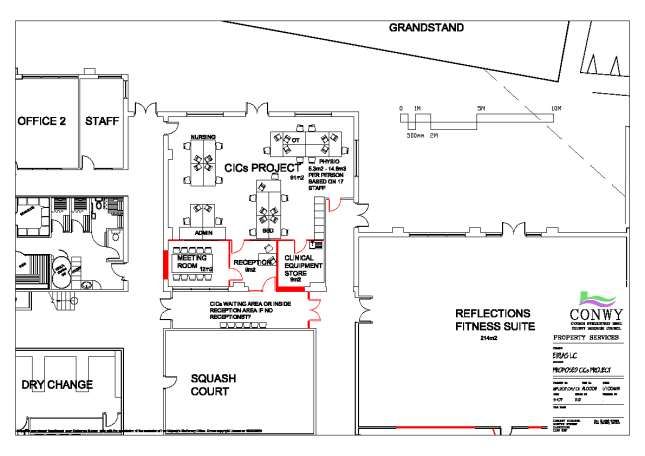
Proposed Floor Plan of Health Precinct Layout
21Appendix 2
Evaluation of Health Precinct HIA, Eirias Park, Colwyn Bay, Conwy
Date: 15th January 2008
Venue: Colwyn Bay Leisure Centre, Eirias Park, Colwyn Bay
Attendees
Jill Owen CVSC
Collette Neal CVSC
Lindsay Haveland DVSC
Paul Frost Head of Leisure Services and Community Services, Conwy County
Council (CCC)
John Hardy Principal Manager, Colwyn Bay Leisure Centre, CCC
Lee Parry-Williams Health and Social Care Facilitator, CCC
Rhodri Morgan Community Chest Officer , CCC
Glynis Tabberer Intermediate Care Service Manager, Conwy and Denbighshire NHS
Trust
Eryl Davies Participation & Engagement Project Officer, Age Concern,
Cllr Glyn Jones Eirias Ward, Colwyn Bay Town Council
Iain Mitchell Director of Therapies, Conwy and Denbighshire NHS Trust
Sian Hoosen Older Peoples Strategy Development Officer, CCC
Chris Sweetnam Service User
Helen Thomas Operational Manager Older People, CCC
Marie Waugh Chronic Conditions Coordinator, Conwy LHB
Mair Roberts Health Link Worker,Carers Outreach
Jo Clay Senior Regional Officer, Sports Council for Wales
Ceri Smith PSE & Healthy School Coordinator, Eirias High School
Louise Watson CICS Team Manager, Conwy and Denbighshire NHS Trust
Helen Williams Senior Practitioner, Conwy Social Services
Cllr Abdul Khan Glynn Ward, Colwyn bay Town Council
Cllr Mrs Danson Mayor, Colwyn Bay Town Council
Roy Draycott Carer
Judith Jones Service User
Louise Walton CICS Team Manager
Ann Allen Hafal Representative
David Lloyd Williams Vice President of Colwyn Bay Lions
Mary Trinder Staff Supervisor, Carers Outreach
Lynne Galbraith Public Health Practitioner, NPHS Wales
22Comments/Ratings (1 =did not meet expectations/poor and 10 = very much met
expectations/excellent)
To HIA Conwy Health Precinct in a structured, facilitated environment. Excellent
HIA, very well facilitated allowing all opinions to be raised. (10)
That common ground would be identified amongst all stakeholders involved in key
issues, concerns and recommendations would be identified (9)
Excellent morning – helped to understand and inform the concept of health precinct
(9)
Content – Very good, good input from all members of the group and presentation
good (9). Venue – found it difficult to hear because of noise from pool and other
group working in the same room (3).
Very informative and constructive. Unfortunately the room was not entirely suitable
due to the acoustics (8)
The presence of a wide cross-section of stakeholders presented expectations of a
‘high-quality’ discussion and a full list of recommendations (8)
Very interesting most people had the same ideas. Pity the groups could not have
met in different rooms. Content of workshop very good (8)
It was an interesting and informative workshop. However, unfortunately the
environment for the delivery of the workshop was acoustically difficult. It provided a
forum to put view points across following a structured process (8)
For the ‘Health Precinct’ to be explained and accepted as a centre of excellence for
the Health/Social/Leisure services partnership (8)
All explained well, very informative and thought all points were discussed thoroughly
(8)
To find out more about the ‘Health Precinct’. To understand the involvement of key
partner. To understand the role of Physical Activity in the Health Precinct. To
understand how similar models may be rolled out to other areas in Wales. (8)
Room inappropriate for meeting which detracted from presentations. Workshops
useful – good facilitators and contributions (8)
An interesting morning learning more about the project and the Health Impact
Assessment – a very sound way of discussing issues. I understand a little more
about how this can fit into the community and my field and am looking forward to
seeing it develop (7)
To participate in the decision making of the Health Centre and to obtain details of
when it is expected to come to fruition (7)
Opportunity to listen, consider and engage in meaningful debate 2 Collectively
agree and document the key issues, conflicts and resolutions 3 This is a beginning
and not an end (7)
Understanding of the role of the Health Precinct. Some important issues raised (6)
To understand what implications the health precinct has on the county of Conwy, the
local area and my team (CICS). How my team will fit into the programme (5)
I attended so that Mental Health might have a voice! I was right to attend as I feel
that it was a very focussed on physical disabilities (5)
23You can also read


