Agora's Software Defined Real-Time Network Delivers Real-Time Internet Advantages Over Content Delivery Network - WHITE PAPER
←
→
Page content transcription
If your browser does not render page correctly, please read the page content below
WHITE PAPER

Agora’s Software Defined
Real-Time Network™
Delivers Real-Time
Internet Advantages Over
Content Delivery Network

                           www.agora.io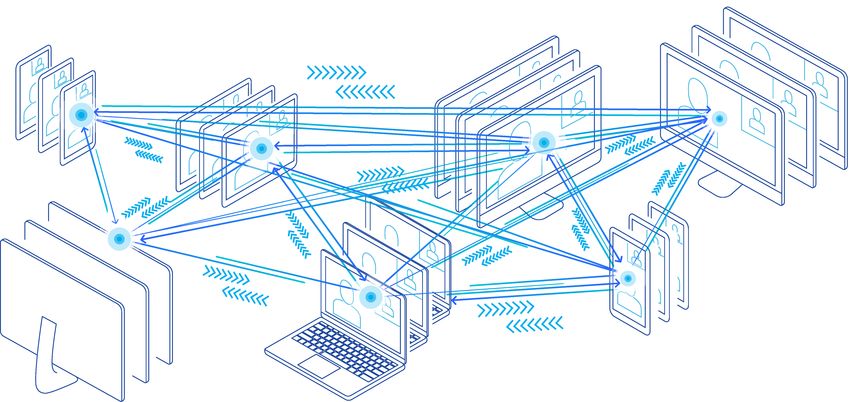
Preface
The public internet as we know it has been evolving and growing exponentially in the past
three decades. From the days of dial-up modem connection and small internet cafes in the
early ‘90s to the social media-driven mobile networks of the late 2000s, public internet has
become a critical part of our daily lives. Like air and water, our basic life sustenance, many of
us can’t imagine living a day without internet connectivity. Despite its significant growth and
many innovations, the public internet still has many limitations today that prevent it from
fulfilling the high demands of live audio/video streaming.

In order to understand the challenges of live audio/video streaming over the internet, we
must first understand the fundamental architecture of the internet.

Internet Is Best Effort-Based
The internet has been designed as a best effort system. In short, this means that while the
public internet prioritizes connectivity and scalability, there is no guarantee on delivery or
quality of service. Public internet is designed as best effort for good reason. As of January
2019, there were an estimated 1.94 billion websites on the internet, which is eight times more
than the number of websites measured in 2008 (Netcraft). Therefore, the top priority of the
public internet has been to sustain the hypergrowth rate and to ensure that each and every
website on the internet is both searchable and accessible. As a result, user experience,
reliability, and latency—all of which are key quality elements for live audio/video
streaming—are not priorities of the public internet.
When you send any data across the internet, the data packets actually pass through different
physical networks managed by various network operators. Since the public internet is like a
huge complex spider web, there are many paths your data traffic could take going through the
internet. ISPs use BGP (Border Gateway Protocol) to create a map of forwarding routes for the
destinations on the internet. This map may contain a number of options. However, each ISP
will write its own routing policies to determine which of these routes to use. These routing
policies take many factors into consideration, including the cost of forwarding.

ISPs generally forward traffic in this descending order of preference:
     1. Utilize ISP’s own network
     2. Forward to peer ISP for free
     3. Pay for transport over higher tier ISP
In many instances, an ISP will choose lower-quality delivery over incurring the cost of
purchasing transit for your media packets.

               AGORA’S SD-RTN™ PHILOSOPHY
Agora is a Live Engagement Platform as a Service Company. As part of our core
engagement services, Agora offers live interactive audio/video streaming powered by our
Software-Defined Real-time Network (SD-RTN™) that is accessible and available anytime,
anywhere in the world.
We built our SD-RTN™ with the philosophy that someday advancement in technology would
allow us to deliver as good or better experience quality as traditional carrier networks. The
advantage of SD-RTN™ versus a traditional carrier network is that SD-RTN™ isn’t confined
by device, phone numbers, or a telecommunication provider’s coverage area. Agora can
deliver live user engagement experiences in form of real-time communication (RTC) with
below advantages: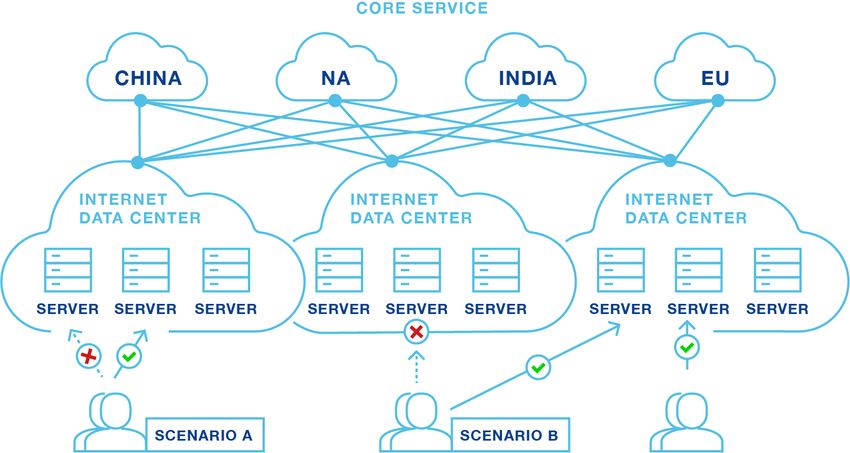
1. Cost Effective
•    Agora’s SD-RTN is a software overlay that is much less costly than tradition telco.
•    Communication realized through software modules on PC or mobile devices is
     inexpensive especially when compared with international phone calls, which still
     require dedicated hardware.
•    Global connected network with no roaming cost regardless where a user is located
     or traveling from one area to another.

2. Adaptability
•    Able to deliver 1 to 1, 1 to many and many to many engagement experiences.
•    Adaptable to use cases that phone devices cannot accommodate. Experience can
     further extend into 360-degree video, AR/VR environment, and other interactive
     engagement experiences not possible with a phone network.
•    Compatible with a wide variety of experience delivery devices (e.g., smart watch,
     smart glasses, future smart wear…etc).
•    Engagement experience is not tied to phone device, phone numbers, and country
     code limitations.
•    Service is available anywhere, works indoor (internet/wi-fi) and outdoor (wireless).

3. Quality of Service
•    SLA performance measured in real-time that covers the entire global network that
     many other service providers cannot guarantee.
•    True scalability, able to accommodate hundred thousands of users while
     maintaining service consistency and stability.

SD-RTN™ Quality of Experience
Agora’s SD-RTN™ is built with the following characteristics in mind to deliver quality of
experience (QoE) advantages over our competitors’ solutions:
•    Call connection establishment anywhere in the world within 100 – 200ms versus the
     ten-plus seconds of some major competitors
*    Stable video and audio with no scrambling, blurriness, slow motion, freezing or other
     similar undesired experiences
*    Smooth, natural, lifelike (voice, color…etc) experience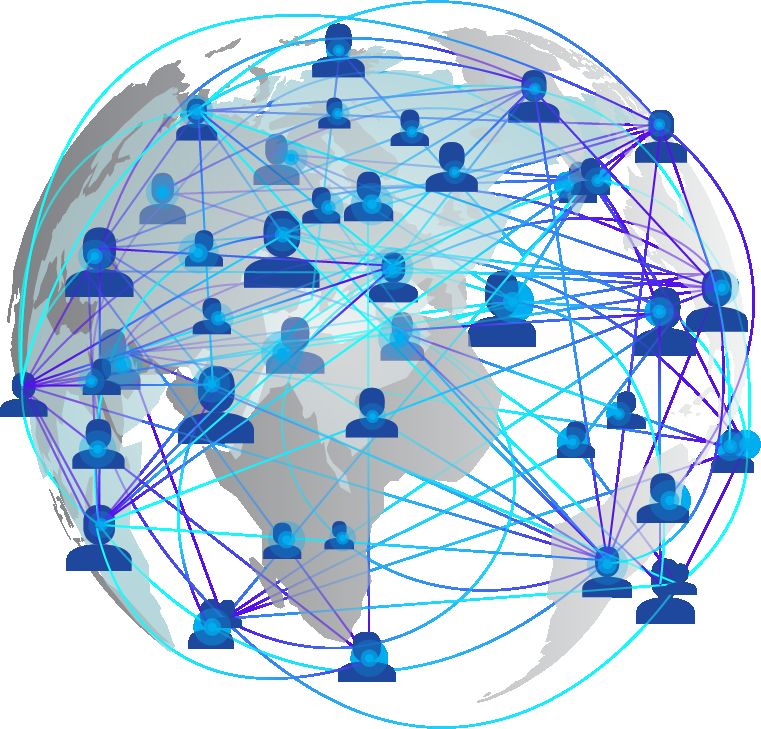
SD-RTN™ Quality of Service
Agora’s SD-RTN™ is built with the following characteristics in mind to deliver quality of
experience (QoE) advantages over our competitors’ solutions

Scalable and Efficient                            Performance
•   Scale from several users to millions          •   Carrier-grade SLA and service
    in a short amount of time without                 quality
    downtime                                      •   Business and Service Data Reporting
•   Large Scale                                       •    Online data report

    •   Millions of Concurrent                        •    Offline data report
        Users During Peak Time (PCU)                  •    Incident notification in real-time
    •   Millions of Concurrent Channels           •   Standardized Connection Points
        During Peak Time (PCC)                        •    Support RTMP / HLS / OBS
    •   Synchronized experience                       •    Support RTP and WebRTC
        regardless of Connection Speed
                                                  •   Advanced Network Monitoring
• High Bandwidth                                      •    Monitor every user, every
    •   Terabytes of total network                         stream, every connection point
        bandwidth                                     •    Automatic re-route (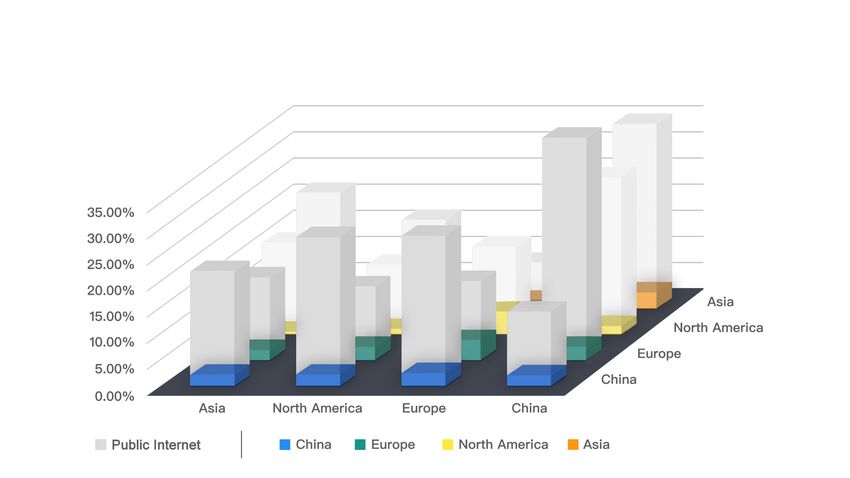
Reliability Improvement
Over Public Internet
Delivering real-time experience over the internet is not a just a milli-second number
game, it’s a challenge involving a combination of packet loss (random, serial, other),
bandwidth, jitter and network delay which are all contributing factors to latency.
Agora’s UDP-based network is designed with highest standard of reliability to
combat all of the above in order to create the best ultra low-latency experience over
our SD-RTN™.

Packet Loss
Packet Loss characterizes the packet drops that occur between a defined network
ingress point and a defined network egress point. We consider a packet lost if it
does not arrive at the specified egress point within a defined time period. Network
packet loss has three primarily causes,

•      Network Congestion: When congestion occurs, queues build up and packet
       drops occur as buffer becomes full.
•      Lower-layer Errors: Bit errors, which might occur due to noise or attenuation
       in the transmission medium. Actual bit errors rate may vary depending on the
       underlaying technology used. For example, fiber optic links could have bit
       error rate around 1x(10^-13) while older ADSL service could have higher bit
       error rate around 0.001 (1x10^-3).
•      Network Failures: While most networks are built to be highly resilient,
       however from time to time network elements could still fail resulting in
       temporary lost in connectivity thus causing packet loss.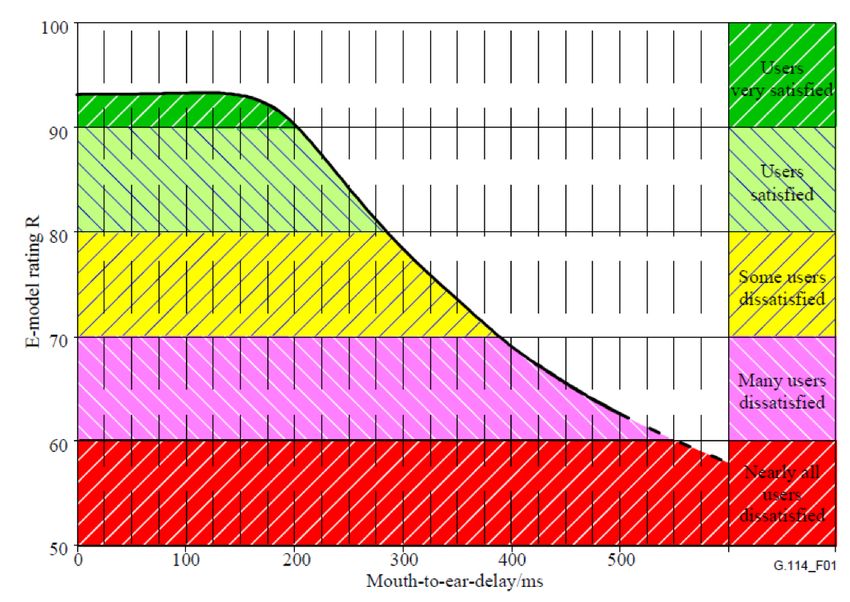
low                 low                   low          low
                             low                 low                   low        very low

                             low                 low                 very low     very low

                             low               very low                low          low

                           medium                high                 high         medium

                           very high            medium               medium        medium

                           very high            medium               medium        medium

                           very high            medium                high          high

Figure 1: Table comparison of packet loss rate of public internet vs SD-RTN™

Intra-Region

Figure 2: Table showing minutes of high data loss of public internet vs SD-RTN™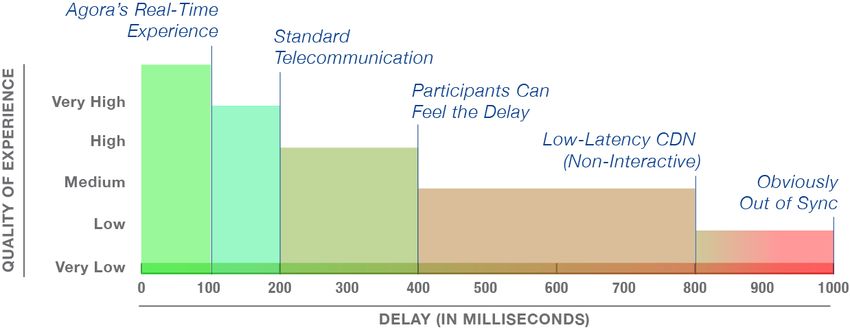
After years of development and fine tuning, Agora today measures our SD-RTN™’s
reliability using our very own very strict SLA standard of ‘less than or equal 0.5% data
packet loss per minute’. Based on test measurement data table above, we can see that
SD-RTN™ is easily ten to several hundred times more reliable in packet delivery than
the best effort public internet.

Network Jitter
Network Jitter is the variation in network delay caused by factors such as fluctuations
in queuing and scheduling. In general, jitter can be considered as one-way send delay
of two or more consecutive packets. Network jitter typically result in momentary
audio/video skip or out of sync.

Network Delay
Network Delay is the time different between an IP packet at a defined ingress point to
a defined egress point. Network delays have five contributing factors,
1) propagation delay along the network path (roughly 5ms per 1,000km for fiber optic)

2) switching delay (typically a few microseconds)

3) queueing delay

4) ‘data’ serialization and finally

5) software application end delay.

In summary, the best live interactive audio/video streaming network is one that can
deliver close to 100% of all data packets within the shortest time frame.
Edge-to-Edge
     Ultra Low-Latency Global Performance

Agora’s Software
Defined Real-Time                                                    **

Network™
Agora provides the world’s most
advanced private RTC network in
the world dedicated to voice, video
and live streaming.
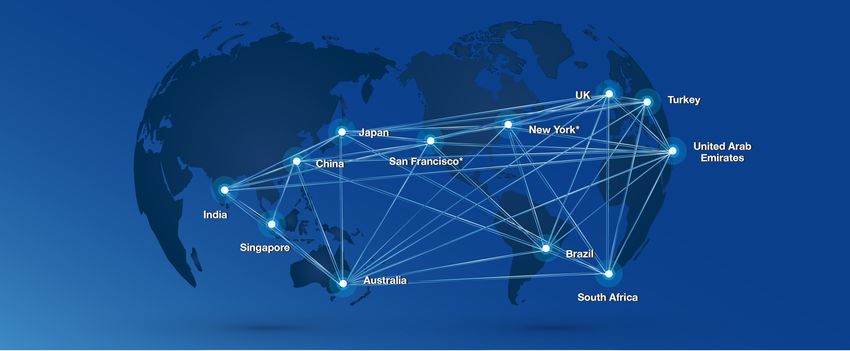
Agora’s global SD-RTN™ is made up
of over 200 datacenters dedicated to
sub-second latency and
high-availability of real-time video
and audio anywhere on the globe.
•          Scalable and Efficient
•          Reliable and Available
•          99.999% Uptime & 99.9%
           Network connection success

*US West Coast to US East Coast
**All tests on the right are performed on iphone X   Figure 3: Agora’s SD-RTN™’s Global Coverage Performance
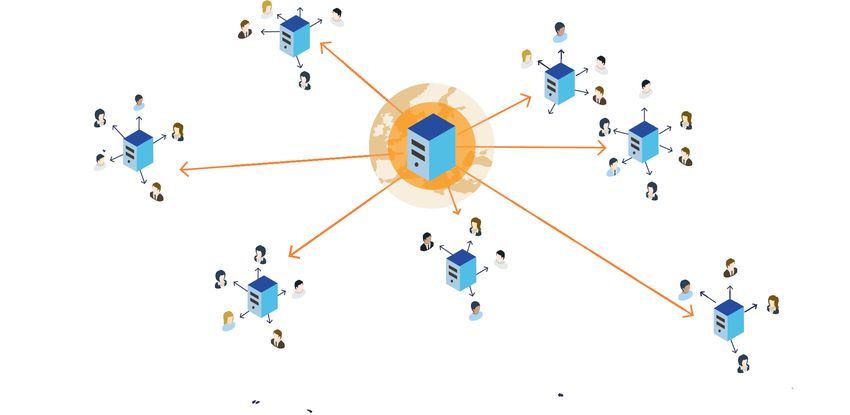
How Agora handles large audience Broadcast Differently than CDN First, let’s establish how a basic Content Delivery Network works. A CDN replicates content from a central origination source to local distribution centers. Then content is delivered from local distribution centers to each user in the local area based on their location proximities. Agora’s SD-RTN™ architecture uses a similar design as CDN to support one million-plus users in large broadcast sessions (demonstrated in Figure 4 above). Starting from the broadcast source, the broadcast video stream is replicated to various continental network nodes (e.g., North America, Asia, Europe, etc.). From the continental level, the broadcast video stream is sent further to various local IDCs (internet data centers) and then finally to each individual connected audience. However, this is where the similarities between Agora’s SD-RTN™ and CDN end. SD-RTN™’s “Real-Time Internet” Advantage Over Traditional CDN and Network Services LOW LATENCY The key to the ‘real-time’ element of live interaction streaming is very low latency. Agora’s SD-RTN™ incorporates many network logic and algorithm enhancements in order to deliver the real-time experience needed in a live interactive video streaming session. Loosely referencing the International Telecommunication Union (ITU) standard (aka: MOS - Mean Opinion Score), latency of less than 200ms is considered ideal (more than 400ms would create obvious negative real-time experience impact to users). Below figure extracted from ITU G.114 standard depicts telecommunication industry’s study on voice latency vs user satisfaction quality.
In summary, the lower the latency or delay, the more ‘real time or live’ a user’s experience feels.

In the case of a traditional CDN, ultra low-latency is not required because a CDN only needs
to worry about sending content to an end user in highest quality possible. Usually this
means CDN within its workflow builds in seconds of buffer and delays to achieve smooth
high resolution video streaming.

However, during a live interactive video streaming session, when the platform needs to
create a natural interactive dialogue between participants, achieving ultra low-latency
becomes a huge challenge.
Below chart shows the impact to ‘real-time’ experience as latency grows.
Latency Impact to ‘Real-Time’ Experience
                                                                       * Lower number = Better Experience

                                                                   *

                                                             *
    Agora’s SD-RTN™ achieves < 300ms global latency Edge to Edge across continent or < 100ms
    Edge to Edge within same continent. Above latency is sustainable from a small 2-4 person
    chat session all the way to one million users in a live interactive video streaming session.
    Traditional CDN cannot achieve Agora’s level of ultra low-latency. This is the first ‘Real-Time
    Internet’ advantage SD-RTN™ delivers over competitors.

2   BEYOND UNIDIRECTIONAL STREAMING
    In the case of content delivery, the CDN only needs to worry about delivering video content
    to each end user in the shortest amount of time possible. CDN achieves this with local
    cache content node. What traditional CDN architecture doesn’t need to take into
    consideration is the ‘relationship’ and bi-directional streaming between participants. For
    example, if we’re broadcasting a music concert globally, CDN only needs to cache a local
    copy of the music concert throughout all of its local content nodes. CDN does not need to
    worry about the millions of end users communicating back and forth with each other in real
    time or make each of its end users discoverable (aka: presence) by others in real time.
Traditional CDN : Agora’s SD-RTN™ :
Single Connected Relationship Multiple Connected Relationships
This is the second ‘Real-Time Internet’ advantage SD-RTN™ delivers over competitors.
3 LARGE CHANNEL
To further achieve the lowest possible latency during a large audience broadcast session,
Agora incorporates a ‘large channel’ concept into SD-RTN™’s smart routing logic. To
understand the concept behind large channel, first we’ll review a point we discussed in a
previous whitepaper. In order to minimize data packet loss, Agora’s SD-RTN™ by default sends
redundant data through the three most optimized network paths possible. Large channel
builds upon the above concept that in a multi-participant live interactive video streaming
session, Agora’s SD-RTN™ will try to establish optimized routing paths that are shared by as
many common participants as possible. Agora’s large channel approach achieves a fine
balance between ultra low-latency and audio/video experience synchronization between all
participants during a live interactive video streaming session. This is the third ‘Real-Time
Internet’ advantage SD-RTN™ delivers over competitors.4 HIGH AVAILABILITY AND ACCESSIBILITY
The best network design is useless if the service is not available or accessible. Anyone who has
tried making a Skype or similar product call from a country outside of the service provider’s
primary network coverage knows the pain of waiting to connect just to get a ‘Failure to
Connect’ error at the end of a 15 – 20 second connection attempt. To provide best in class
network availability and accessibility, Agora’s SD-RTN™ goes beyond standard disaster recovery
and hardware redundancy practices.
To better appreciate Agora’s high availability and high accessibility architecture, let’s revisit how
a CDN works. A traditional CDN typically offers a web entry point for client connection
requests. Then the CDN service compares the client’s IP address location, determines the
closest CDN distribution node from the client, and then sends back the best matched IP
address (of the closest distribution node) listed in the DNS server’s list. The first weakness in
this traditional CDN design is that the CDN cannot reroute connection in case of a local service
outage. When an outage occurs, the active client connection would drop and then the client
would immediately attempt to reconnect by making a new web request. Depending on how
quickly the CDN service provider recognizes there’s an outage and how frequently the DNS lists
get updated (usually every 10-15 minutes), there’s no guarantee that the client won’t get routed
again to the same local distribution service that’s experiencing an outage. This weakness also
impacts new clients trying to connect during an initial outage prior to the DNS list getting
updated. Regardless, a traditional CDN with a DNS-based design cannot achieve seamless
cutover during a service outage/interruption.
The second weakness in traditional CDN design is that the DNS list is fixed and biased towards
load balancing. This can result in a client on the West Coast of the U.S. getting routed over to a
content distribution node on the East coast, especially during peak West Coast evening hours.
Since the East Coast is three hours ahead, it would have much lighter network traffic.Conceptual Representation of CDN Architecture
In comparison to CDN’s DNS-based design above, Agora’s SD-RTN™ takes a completely
different approach. Agora’s SD-RTN™ uses an ‘access point’ (similar in concept to a universal
load balancer) design. Rather than depending on a fixed DNS list, Agora’s SD-RTN™ backend
customizes a list of best access points for each connecting client upon each access request.
In other words, Agora’s network logic is dynamic and always looking for the best connection
route based on actual network conditions in real-time. As a result, Agora’s SD-RTN™
achieves the following benefits over our competitors’ designs:
• Guaranteed first-time connection success from anywhere in the world
• An established connection within 1-2 seconds. No more endless dial tone music.
• Seamless recovery. If a server goes down, our network backend is able to
automatically reroute and re-establish everyone in an active session to a different
server within 200ms with no perceptible interruption.
This is the fourth ‘Real-Time Internet’ advantage SD-RTN™ delivers over competitors.
SCALABILITY
Last but not least, Agora’s SD-RTN™ design is highly scalable. Our network architecture
design allows us to quickly add server capacity at the local data center or connect more data
centers at the continent level. Besides being able to accommodate business demand growth
rapidly and flexibly across all of the global regions from a traditional hardware capacity
ramping perspective, Agora’s SD-RTN™ also delivers the same level of low latency liveinteractive video streaming experience whether there are a few or a million participants in the
session. In other words, not only is our network capacity highly scalable, our quality of
experience (QoE) is also highly scalable. This is no small feat considering most of our users
are on mobile devices and wireless phone networks spread across long distances rather than
dedicated high-speed broadband localized in a few physical locations.
Figure 4: Agora’s SD-RTN™ Availability and Scalability High Level Architecture
IN SUMMARY
Today, our SD-RTN™ achieves the following:
• 20+ Billion minutes per month, size equivalent of a small telco
• 99.98% data packet delivery
• Low latency, less than 300ms cross continent or less than 100ms within the same continent
• Over 1,000,000 concurrent participants in a single large-channel broadcast session
• Scalability from a few users to hundreds of thousands without downtime
• Smart monitoring and route optimization. In the catastrophic event of a particular regional
data center outage, the network will automatically reroute through our network in other regions
TO LEARN MORE:
sales@agora.io | www.agora.io | 408-879-5885
@AgoraIO @agora.io AgoraIO @AgoraIO-CommunityYou can also read


