Airbus' perspective on Quantum Computing & Experience with D-Wave system - Dr. Thierry Botter 12 April 2018 - D-Wave ...
←
→
Page content transcription
If your browser does not render page correctly, please read the page content below

Airbus’ perspective on
Quantum Computing &
Experience with D-Wave system

Dr. Thierry Botter
12 April 2018
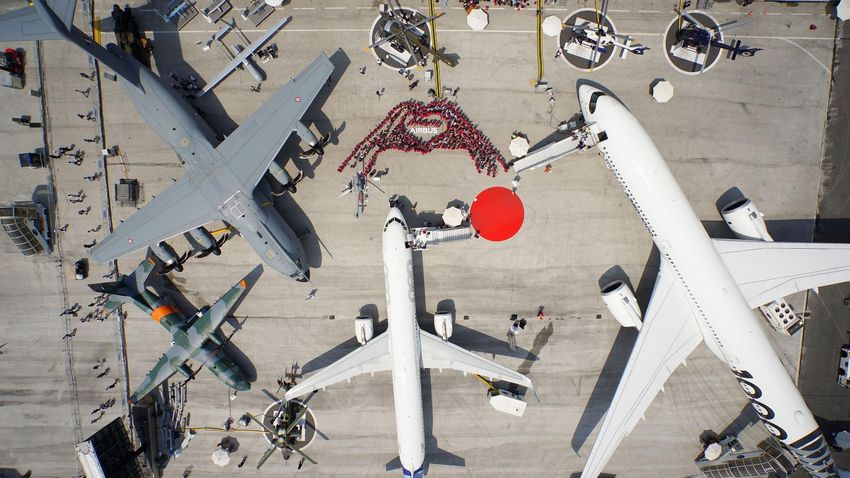
We are a worldwide leader in aeronautics,
space and related services: We make it fly!

Airbus by numbers (end of 2017)
                                                                               Airbus (Group) Revenue
Airbus Defence and Space

                                                                                 66,800 M€
  Airbus Helicopters
                           75%

                                      Airbus

    Product & Next-                       Aircrafts Delivered     Order Book
                             EBIT                                                  Employees
   gen R&D expenses                            in 2017:
                                                                950,354 M€
    2,011 M€               3,428 M€             718                               133,782
                                                                 7,265 A/C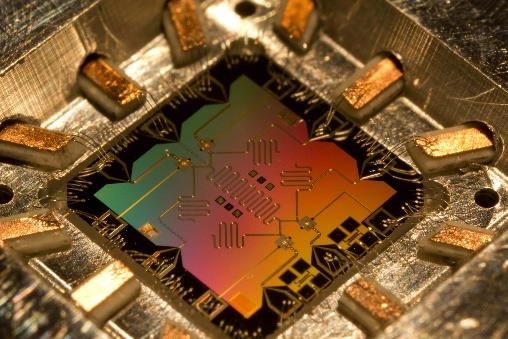
Airbus & High Performance Computing

                                                    TOP500

                                                 PFlops
Long history of deploying large HPC clusters :                                #1

TOP500 29th position, 1st among industries
in 2011 [1]                                      TFlops

                                                                                          AIRBUS

                                                 GFlops                           #500

Most use-cases focus on computationally              1993    1996   1999   2002    2005     2008   2011   2014

heavy simulations for engineering & design
(i.e. CFD, FEM, aeroacoustics, aeroelasticity,
flight & system simulations, …)

[1] https://www.top500.org/site/47306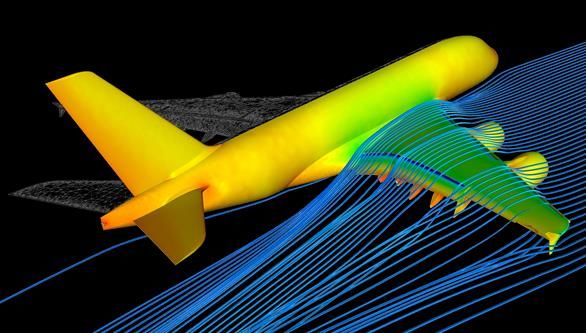
Airbus & High Performance Computing

Airbus’ investment level into HPC activities:
• Near-term IT solutions: ~3% of IT budget, with main focus on
  scaling up methods & tools for industrial production;                       Airbus IT
• Long-term research activities: ~1% of R&D budget.
                                                                                       HPC

R&D focused on extending the HPC toolset: cloud, distributed, multi-
platform (x86/ARM/GPU) … and quantum computing!

HPC activities run as collaborative projects between internal engineers &
external partners to bridge aerospace problems and HPC platforms                  Airbus
                                                                                   R&D
Only one relevant metric:                                                   HPC

Does a technology provide Airbus with a demonstrated performance
improvement in addressing a specific challenge?                                            *not to scale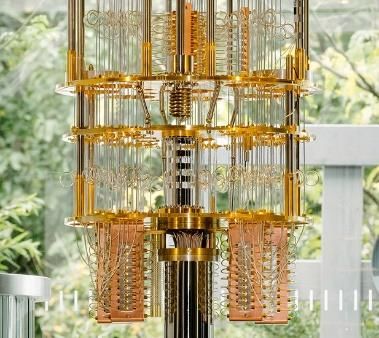
Airbus & Quantum Computing
Quantum Computing (QC) is being investigated as a possible extension to the
HPC toolset.

Open questions for Airbus:

• Can QC contribute to known HPC challenges? How?

• What HPC performance can be achieved with today’s QC at reduced problem
  sizes? How do performances scale with problem size?

• How can we prepare ourselves for a QC future? What’s the operational &
  business impact? When is the right time to invest in preparations?
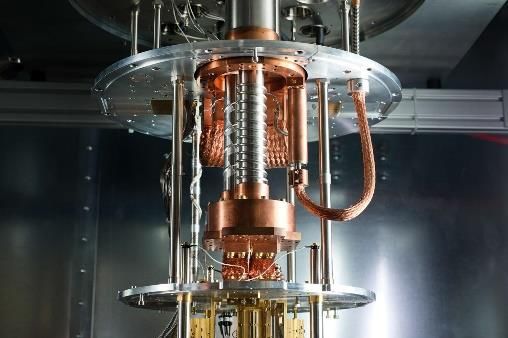
Quantum Computing @ Airbus
Why? When? How? What?
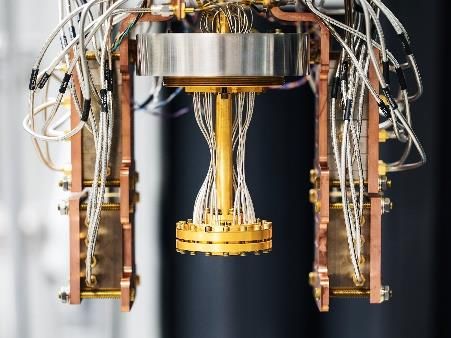
Gateway to Quantum Computing

       Apply HPC philosophy to QC: leverage external ecosystem in tandem with
       internal experts to investigate potential applications to Airbus needs.

       Strategic investment: Airbus became a seed investor in QC Ware in 2016.
       The marriage allowed Airbus to enter the space of Quantum Computing
       and have an expert partner to help explore the various corners of the space,
       across different QC hardware technologies and different aerospace
       applications.
Hardware Agnostic

            Airbus is indifferent to the type of quantum hardware implementation /
            vendor, and whether any system is truly quantum or not. The only
            determining factor is the demonstrated performances of these systems on
            relevant Airbus applications / business propositions.

  First QC project conducted with
  D-Wave 2000Q machine.
First QC investigation: Fault Tree Analyses
What?
Top Event
Fault Trees or Dependence Diagrams represent the connection
Intermediate points between sub-systems and nodes in large, complex
event engineering structures. Fault Tree Analyses (FTAs) investigate the
combination of local failures that result in global system failures,
often with mission safety implications.
Applications
Fault trees are relevant across many aerospace systems, including
Basic
aircraft, spacecraft and vehicle fleets. They are an integral part of
event
qualification and certification processes. First QC investigation
focused on FTAs for aircraft.
Why?
NP-hard problem to compute all possible failure modes, and
identify combination of failures that can lead to the safety critical
top-event (i.e. loss of system function). QC is known to have
potential benefits for this type of problem.
12/04/2018 *MMEL: Minimum Mandatory Equipment List 10First QC investigation: Fault Tree Analyses
Airbus typical problem
• QC hardware: 2000-qubit D-Wave machine.
The quantum annealer could handle FTAs with
up to ~300 events+gates.
QA
• Benchmark against commercial SAT solver
Run Time (sec)
shows competitive performance as timing
does not seem to be related to problem size
• Potential hybrid approach: find the shortest
minimal cut-sets using QA, followed by a
current software classical computation for the full fault-tree
solution calculation. Predicted 4x reduction of runtime.
not to scale
Events+Gates in Tree
12/04/2018 11First QC investigation: Fault Tree Analyses
Increased QC familiarity
• Project enabled Airbus experts to get first experience in applied QC.
• QC Ware led technical work: translate FTAs into QUBO (language amenable to quantum
annealers), program and run FTAs on D-Wave 2000Q machine, benchmarking against SAT
solver.
Impactful results
• Results demonstrated promise in an important area of Airbus’ business.
• Airbus additionally motivated to continue research on QC because of FTA results.
Lessons learnt
• Work through nomenclature and mathematical framework, incl. terms for consistency checks,
early in project – develop a common language between aerospace and QC worlds.Airbus & QC in the future
Airbus remains interested in the promise of QC. More projects to come!
The QC strategy in short:
• Hands-on experience through partnerships with external startups &
key players to evaluate selected HPC use-cases.
• Continuous evaluation of available technology & trends, to adapt
investment strategy accordingly .
• Raise awareness within the Airbus HPC community and continue to
research candidate use-cases.You can also read


