Design Brief - CD35 Compact Disc Player - Primare
←
→
Page content transcription
If your browser does not render page correctly, please read the page content below
Design Brief - CD35 Compact Disc Player

CD35 CD player combines a state-of-the-art TEAC dedicated CD drive, all-new
reference balanced DAC stage feeding a finely tuned balanced analog output stage
(with selectable fixed or variable output. Each component part of the CD35 Prisma – the
drive, the DAC, and the output stage – contributes to what is simply the best CD player
Primare has ever offered.

Contents
   • Design Philosophy
   • Drive Technology
   • Digital to Analog Conversion Technology
   • System Building
   • Specifications

Design philosophy
All of Primare designs are a result of our Practical Design Approach, resulting in a focus
on two fundamental design elements:
    1. Thoroughly implemented power supply designs – so that all elements of any
        design to operate effortlessly at their fullest effectiveness. Every product and sub-
        circuit demands unique power supply solutions - a more conventional linear supply
        or advanced switch mode main supply may work best dependent upon the
        application, and carefully crafted individual discrete power supplies are
        strategically inserted into the circuit to deliver power exactly where and how
        much is needed.
    2. Artfully crafted ultra-short signal paths - so that each individual component and
        sub circuit operates sympathetically to achieve a cohesive whole. Elegant and
        simple electrical designs are used in even the most complex product, utilizing
        ultra-short signal paths with all gain in one device whenever possible. Ultimately,
        this results in fewer, higher quality parts for a reduction in associated distortions
        and an increase in overall electrical efficiency.
        To that end, basic technologies have been selected to realize those benefits:
        • 2 and 4-layer double-sided circuit board construction allows for the most
             direct and efficient layout of circuit components not only for the shortest signal

Limstensgatan 7 | SE-21616 Limhamn | Sweden | +46 40 6548800 | primare.net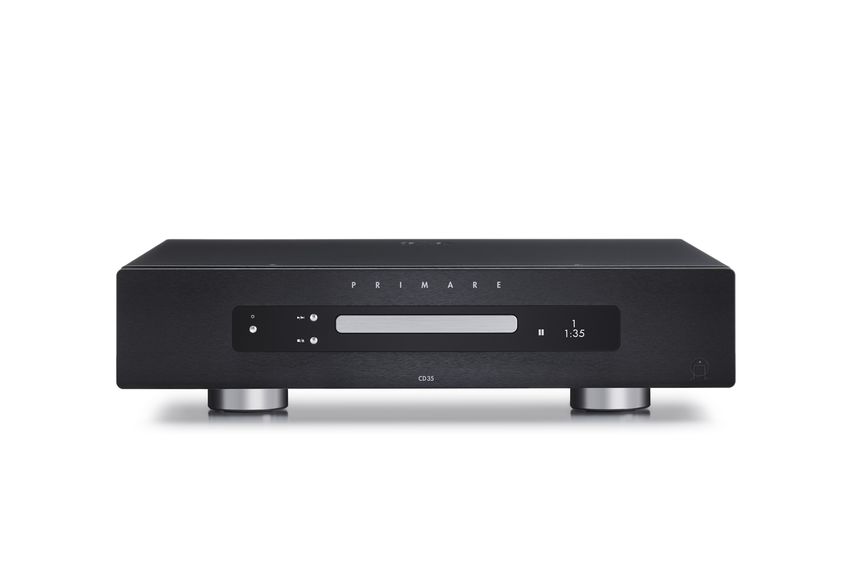
path, but also to more easily achieve a sympathetic layout of circuit and sub-
           circuit components for best performance.
       •   Surface mount components are used whenever possible as this allows for
           direct connection of the circuit device or component to the circuit board trace
           with the solder being used solely to mechanically hold the part in place. The
           elimination of the small metal lead or wire at each connection point in a more
           conventional large scale circuit device or component cumulatively shortens the
           signal path. Additionally, conventional large scale components demand
           through hole or “eyelet” construction, limiting direct contact of the component’s
           lead to the circuit board trace and resulting in the solder providing electrical
           connection as well as mechanical connection for the device. Neither solder nor
           the metal used in the leads of most large scale devices provide the best signal
           transmission, therefore limiting potential performance of even the best
           designed circuits.

Drive Technology
The TEAC CD 5020A-AT is an isolated transport that is adjustable for precise, smooth
tray loading, and low clamp noise. An internal interphase I2S and SPDIF digital audio
interface combined with buffered memory is utilized for improved performance.

Digital to Analog Conversion (DAC) Technology
In order to allow for playback of virtually any digital source with absolute accuracy and
musicality we have selected the state-of-the-art ES9028PRO SABRE digital-to-analog
converter (DAC), a 32-bit, 8-channel PRO series DAC based on ESS patented
HyperStreamDAC technology for outstanding performance with 129dB dynamic range
(DNR), and -120dB total harmonic distortion plus noise (TH+N). The ESS chip is used in a
balanced D/A conversion scheme that feeds a discrete analog output stage with a hand
selected FET input section.

Power Supply Technology
A customer linear power supply is combined with a switch mode standby supply (turned
off when in playback mode to minimize noise) to deliver on demand the precise power
needed.

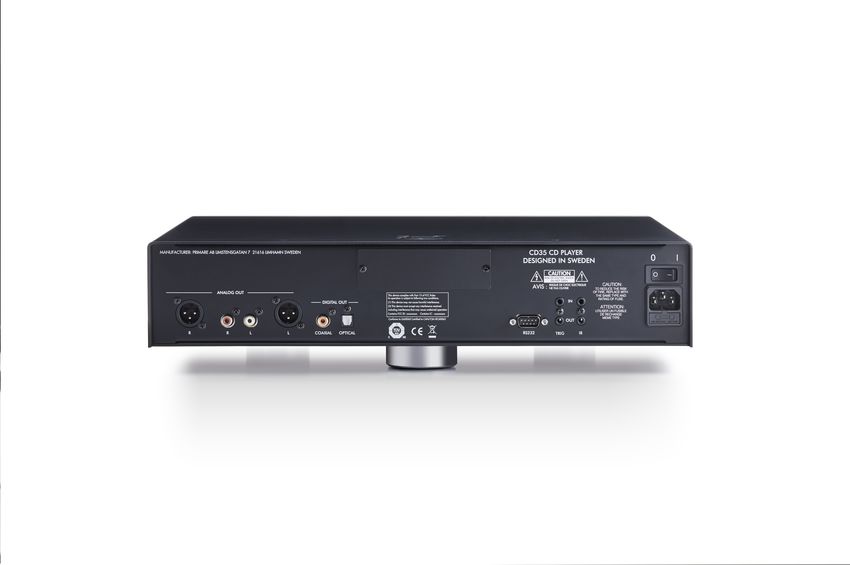
CD35 Rear Panel

Limstensgatan 7 | SE-21616 Limhamn | Sweden | +46 40 6548800 | primare.net
System Building
The optional configuration of the CD35 is but one example of Primare’s practical design
approach extending not only to the individual components we make, but also to the
system building options designed into each model. For example, if putting together a full-
featured digital and analog system based on the I35 integrated amplifier and CD35
platforms, a number of pairing options. Two possible combinations are detailed below:
I35 + CD35
Pairing the of I35 and CD35 offers certain advantages for improved
performance, In part due to the industry standard ESS Sabre chipset employed in
the DAC stage of the CD35 being able to provide subtly superior performance
over the AKM chipset based DAC stage in the I35 DAC. Additionally, the
separation of the all-analog amplification circuitry in the I35 from the digital
circuitry in the CD35 isolates those sections for lower noise floor and improved
power supply delivery.
I35 DAC + DD35
For those who wish to have a single control and connectivity center, the I35 DAC
can be paired with the soon to be released DD35 CD disc drive. The DD35 is a
transport only device, with digital outputs only and no DAC stage, and is perfect
to provide the best digital signal for conversion by the I35 DAC.
CD35 + powered loudspeakers
By connecting a pair of powered loudspeakers to the CD35 Prisma and selecting
the variable output option allows for the creation of a compact high-performance
CD disc based music system.
Limstensgatan 7 | SE-21616 Limhamn | Sweden | +46 40 6548800 | primare.netCD35 Compact Disc Player Specifications
Compact Disc Player
Mechanism: TEAC CD 5020A-AT
D/A converter: ESS Sabre ES9028PRO
Analog outputs – selectable fixed and variable:
• 1 pair RCA, 2.2 Vrms
• 1 pair XLR, 4.4 Vrms
Output impedance:
• RCA 370 Ω
• XLR 100 Ω
Digital outputs:
• 1x RCA
• 1x TOSLINK
Frequency response: 20Hz – 20 kHz -0.3dB
Signal to Noise: -110dB/AES17
THD + N: 20Hz – 20kHzYou can also read


