Tom Ford, CEO Lookout Mountain Community Services
      Jennifer Hibbard, COO View Point Health
←
→
Page content transcription
If your browser does not render page correctly, please read the page content below

Tom Ford, CEO Lookout Mountain Community Services
Jennifer Hibbard, COO View Point Health
Statewide Care Management Entities
• Lookout Mountain Community Services and View Point
  Health operate the two CME’s throughout the state of
  Georgia

• The CME’s serve as the “locus of accountability” for
  defined populations of youth with complex challenges
  and their families who are involved in multiple systems

• The CME’s are accountable for improving the quality,
  outcomes and cost of care for populations historically
  experiencing high-costs and/or poor outcomes

Georgia Statistics
        on the Populations We Serve
• Over 2.3 Million face the challenge of living with
  mental illness.
• Suicide is the 11th leading cause of death.
• One out of every 10 families is affected by
  intellectual disabilities.
• 41% of Georgians with addictive diseases report
  needing treatment but are not receiving it.
• SED youth
Georgia is ranked 47th in
       Spending Per Capita
               $46.54

1st District of Columbia    $360.57
26th Delaware               $106.04
51st Idaho                  $ 36.64
State Safety Net for Individuals with
 Mental Illness, Addictive Diseases and/or
       Developmental Disabilities
• Community Service Boards created by HB 100 in 1994
• Further defined in 2002
• Created to provide mental health, developmental
  disabilities, and addictive diseases services
• Authorized to provide health, recovery, housing, or
  other supportive services;
• Public agencies;
• Instrumentalities of the State
• Created for nonprofit and public purposes to exercise
  essential governmental functions.
• OCGA § 37-2-6
History of C&A Fee for Service

• SFY2006 process began to move C&A funding
  of services from primarily block grant to a fee-
  for-service (FFS) payment system
• Only pay for defined services; provider not
  paid for non-billable services
• Many new small providers; little accountability
• Increased fragmentation of system
Fragmented System of Care
• Services are driven by payer source rather
  than individual need
• A change in payer source results in a
  disruptive change in provider and possible
  change in level of service regardless of
  individual need
• Inconsistent quality among providers
• Limited focus on prevention and early
  intervention services
Care Management Entity
Care is values based:

• Youth-guided and family-driven
• Individualized
• Strengths-based, resiliency focused
• Culturally and linguistically competent
• Community-based, integrated with natural
  supports
• Coordinated across providers and systems
• Solution focused
• Data-driven, evidence-informed

Prevalence Utilization for target populations
                     within Georgia’s SOC.

                                                    Intensive Services
                             2-5%                       60% of $$$

CMEs serve the top
of the triangle,
targeting the highest                                Early Intervention
risk youth who are in                               Home & Community-
restrictive, costly
placements                   15%                    based; school-based
                                                        35% of $$$

                                         Prevention &
                             80%        Universal health
                                          promotion
                                           5% of $$$
Wraparound Visual
                                      Inpatient Hospital &
                           Psychiatric Residential Treatment Facility

                                           Child Welfare

                     Mental Health
                                                                                      Ongoing
                      Providers                              School Teachers
  Sources of                                                                         Community
   Income:                                                                            Services:
*Money
Follows the                                                                        *CSU
Person                                 Youth & Parent
*Balance         Faith                                                             * Respite
Incentive      Community                    CME                   Other Involved
Program                                                              Family        * Co occurring
* State                                                                              behavioral
Dollars                                                                              health

                                Juvenile
                                                      Friends &
                                 Justice
                                                      Neighbors

                               High Fidelity Wraparound
                                   Planning Process
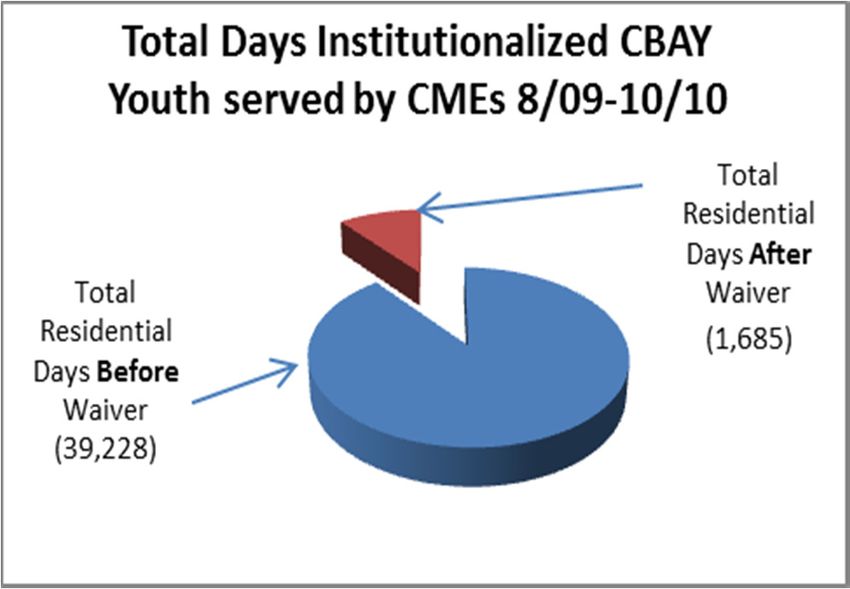
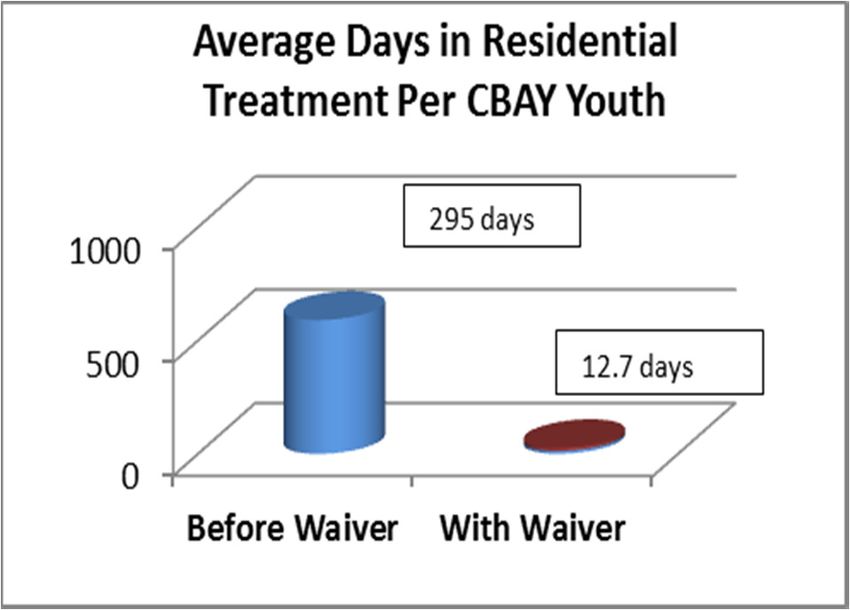
CME OUTCOMES… (DATA PROVIDED BY APS HEALTHCARE)
REDUCING COST OF INCREASING QUALITY OF CARE IN THE
$14,318,220 RESTRICTIVE CARE COMMUNITY
♦ At a cost of $365/day for a ♦ Locally driven and managed care
residential bed, the total bed days ♦ Increasing natural supports and
before CME cost the state family capacity to respond to crisis
$14,318,220. ♦ Decreasing dependences on formal
service systems
♦ After CME involvement through the
♦ Improved youth functioning in
$615,025 waiver, costs were reduced to
school, home and community
$615,025.
for One YearComprehensive Service Array
Inpatient Hospital
Adult Crisis Stabilization Program
Adolescent Crisis Stabilization Program
Acuity
High
Short-term Substance Abuse
Residential
Housing Residential Services
Psychosocial Rehabilitation
Peer Support Day Program Services
Therapy
(Individual, Group, Family)
Group Training
Outpatient Services
Medication Management
Acuity
Low
Psychiatric Evaluation
Assessment
Lower Cost Higher CostWhy and How? • Create complementary, not duplicate, treatment systems • Utilize Community Service Boards to leverage federal and state dollars that other providers cannot bring to bear. • Create a coordinating body to provide a holistic focus on the needs of children and families
Recommendations for C&A Services

• Establish a single benefit package for
  children receiving publically funded MH
  services
• Establish one set of standards to allow for a
  single provider network
• Require evidence-based practices with
  measurable outcomes
• Allow flexible funding focused on outcomes
  rather than frequency of contact
Recommendations for C&A Services

• Utilize system of care principles which
  include all necessary services and agencies
  needed to meet the needs of the child and
  family
• Utilize certified parent partners to facilitate
  navigation in the system
Robyn Garrett-Gunnoe
              Association Director
Georgia Association of Community Service Boards
                  912-312-3205
             rgunnoe@shpllc.com
You can also read


