Also Inside: Meet the Newly Elected Members of the Board of Governors 2021-2023 The 2021 IEEE Photonics Society Young Investigator Award
←
→
Page content transcription
If your browser does not render page correctly, please read the page content below
February 2021
Vol. 35, No. 1
www.PhotonicsSociety.org

             A Review of the IEEE Photonics Society in 2020

  Also Inside:
  • Meet the Newly Elected Members of the Board of Governors 2021–2023
  • The 2021 IEEE Photonics Society Young Investigator Award
Introducing IEEE Collabratec™
The premier networking and collaboration site for technology
professionals around the world.

IEEE Collabratec is a new, integrated online community where IEEE members,
                                                                                       Network.
researchers, authors, and technology professionals with similar fields of interest
can network and collaborate, as well as create and manage content.                   Collaborate.
Featuring a suite of powerful online networking and collaboration tools,                  Create.
IEEE Collabratec allows you to connect according to geographic location,
technical interests, or career pursuits.

You can also create and share a professional identity that showcases key
accomplishments and participate in groups focused around mutual interests,
actively learning from and contributing to knowledgeable communities.
All in one place!

Learn about IEEE Collabratec at
ieee-collabratec.ieee.org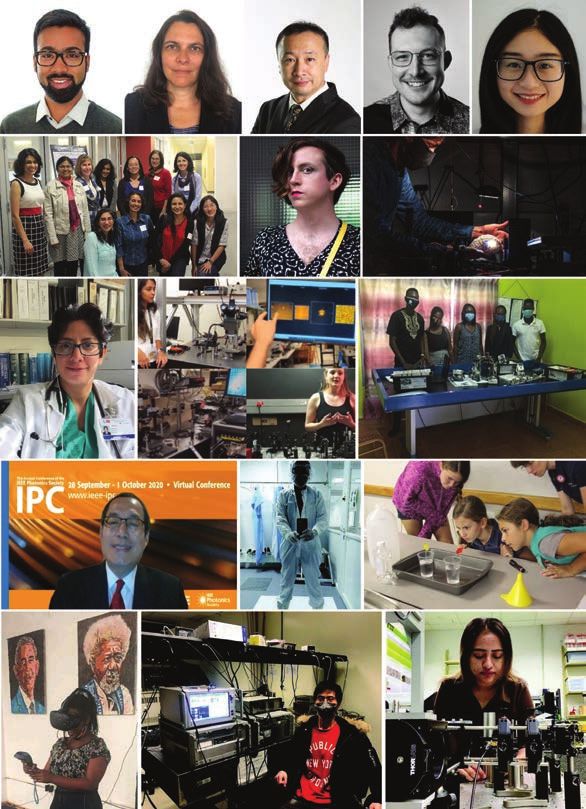
February 2021
Vol. 35, No. 1
www.PhotonicsSociety.org

             A Review of the IEEE Photonics Society in 2020

  Also Inside:
  • Meet the Newly Elected Members of the Board of Governors 2021–2023
  • The 2021 IEEE Photonics Society Young Investigator Award

                                                                                                                                                         February 2021 Volume 35, Number 1

10                                                                                                 A Conversation Between Newsletter EiCs, Nicolas Fontaine
                                                                                                   and Dominic Siriani . . . . . . . . . . . . . . . . . . . . . . . . . . . . . . . . . . . . . . . . . . .4
                                                                                                   Industry Engagement . . . . . . . . . . . . . . . . . . . . . . . . . . . . . . . . . . . . . . . . .6
                                                                                                   •   Life at a Photonics Startup: Lessons Learned

                                                                                                   Get to Know Your IEEE Photonics Society Leadership . . . . . . . . . . . . 10

                                                                                                   A Space for Young Professionals . . . . . . . . . . . . . . . . . . . . . . . . . . . . . . .12
                                                                                                   •   What’s Important—Let’s Talk

                                                                                                   Photonics Worldwide—This is my Lab . . . . . . . . . . . . . . . . . . . . . . . . . . .14

                                                                                                   News . . . . . . . . . . . . . . . . . . . . . . . . . . . . . . . . . . . . . . . . . . . . . . . . . . . . . .16
                                                                                                   •   Photonics Society Year End Accomplishments
                                                                                                   •   Meet the Newly Elected Members of the Board of Governors 2021–2023
                                                                                                   •   First Conference for LGBTIQA+ People in Science, Technology
23                                                                                                     and Innovation in Spain
                                                                                                   •   Tyndall Supporting Entrepreneurial ‘Explorers’
                                                                                                       for Deep Tech Start Up Program
                                                                                                   •   Horizons of Optical, Photonics and Emerging Sciences
                                                                                                       (HOPES)—A Fresh Look at Webinars!

                                                                                                   Careers and Awards . . . . . . . . . . . . . . . . . . . . . . . . . . . . . . . . . . . . . . . . 22
                                                                                                   •   Call for Nominations-IEEE Photonics Society
                                                                                                       2021 Distinguished Service Award
                                                                                                   •   IEEE Photonics Society Fellows—Class of 2021
                                                                                                   •   The 2021 IEEE Photonics Society Young Investigator Award
                                                                                                       Recipient Xi (Vivian) Chen
                                                                                                   •   Petition for Candidates—Photonics Society Board of Governors
                                                                                                   •   Call for Nominations-IEEE Photonics Society Awards

                                                                                                   Membership . . . . . . . . . . . . . . . . . . . . . . . . . . . . . . . . . . . . . . . . . . . . . . . 25
                                                                                                   •   IEEE Kyambogo University Photonics Week Annual Event
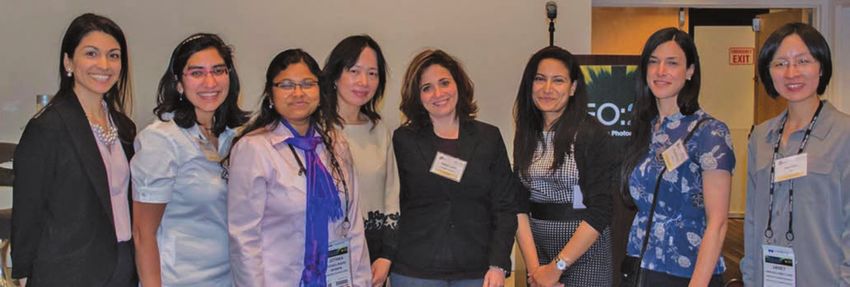
33                                                                                                 •   Women in Photonics—The Golden Circle
                                                                                                   •   Human Relationships Matter in Photonics

                                                                                                   Conference. . . . . . . . . . . . . . . . . . . . . . . . . . . . . . . . . . . . . . . . . . . . . . . . 30
                                                                                                   •   2020 IEEE Photonics Conference Post Highlights
                                                                                                   •   Virtual Lab Tours

                                                                                                   Publications . . . . . . . . . . . . . . . . . . . . . . . . . . . . . . . . . . . . . . . . . . . . . . . 33
                                                                                                   •   Meet the New Editor-in-Chief of the Journal of Lightwave Technology
                                                                                                   •   JSTQE CFP: Semiconductor Lasers
                                                                                                   •   JSTQE CFP: Optical Detectors
                                                                                                   •   JSTQE CFP: Hybrid Integration for Silicon Photonics
                                                                                                   •   JSTQE CFP: Machine Learning in Photonic Communications
                                                                                                       and Measurement Systems

                                      COLUMNS

                                                                         Editor’s Column . . . . . . . . . . 2                    President’s Column . . . . . . . . . . . 3

February 2021                                                                                                                                      IEEE PHOTONICS SOCIETY NEWSLETTER                              1
Editor’s IEEE Photonics Society
Column
DOMINIC SIRIANI
President Associate Editor of Central, Latin and
Carmen Menoni South American
Juan A. Hernandez Cordero
Welcome to the first issue for 2021 of IEEE Photonics Colorado State University USA
Institute of Materials Research
Phone: 970-491-8659/555
Society News! I’m excited and privileged to be the new Email: c.menoni@ieee.org
Department of Rheology and
Mechanics of Materials
Editor-in-Chief, and, thanks to the diligent and enthusi- Past President National Autonomous University of
Mexico
astic contributions from our staff and volunteers, I think Chennupati Jagadish
Circuito Exterior s / n, Ciudad
Australian National University
things are off to a great start! As I look back at what Universitaria,
Canberra, Australia AP 70-360; Coyoacán,
the Newsletter has been and forward to what it could Ph: +61-2-61250363 Mexico City 04510, Mexico
Email: ChennupatiJagadish@anu Email: jhcordero@iim.unam.mx
be, the foremost thought on my mind is what you, the .edu.au
Associate Editor of Asia & Pacific
Photonics Society members, want to share and gain from President-Elect Nicholas H. L. Wong
GLOBALFOUNDRIES Singapore Pte. Ltd.
this publication. So, as I begin my new tenure, I want to René-Jean Essiambre
60 Woodlands Industrial Park D Street 2
Bell Labs, Nokia, USA
encourage you to reach out to us with your contributions, Phone: 732 888-7014 Singapore 738406
Email: n.hl.wong@ieee.org
comments, and requests (ipsnewsletter@ieee.org). We’re email: rene.essiambre@nokia-bell-
labs.com @ Associate Editor of Northern Europe
here to listen and report! Martin Lavery
Secretary-Treasurer
After an unprecedented year, it’s worthwhile to re- School of Engineering
Dan M. Marom
Rankine Building
flect on the innovativeness, resilience, and passion of The Hebrew University of Jerusalem
University of Glasgow
School of Engineering
Oakfield Avenue
our members during 2020. In this issue, Photonics So- Edmund Safra Campus
G12 8LT
Jerusalem, Israel 91904
ciety President Carmen Menoni and Executive Direc- Tel: + 972 2 658 4851
Martin.Lavery@glasgow.ac.uk
tor Doug Razzano take a look at the Society’s various Email: danmarom@mail.huji.ac.il Associate Editor of Southern Europe
Ivana Gasulla
events and accomplishments of the past year. Zetian Mi Board of Governors ITEAM Research Institute
G. Bosco M. Mashanovitch Universitat Politècnica de València
and his conference co-chairs present their highlights Y. Chembo L. Oxenlowe Camino de Vera, 46022 Valencia
from the first ever fully virtual IEEE Photonics Con- L. Galdino S. Ralph Spain
R. Horng M. Sander Email: ivgames@iteam.upv.es
ference. Nicolas Fontaine and Fatima Garcia-Gunning M. Hutchinson M. Suzuki
A. Kasukawa J. Yao Student Editor
guide us through some virtual lab tours, just one of the Naznin Akter
Vice Presidents INSYST Integrated Nanosystems
successful events at IPC and ECOC 2020. Finally, there Conferences—Perry Shum Research Laboratory
are several highlights of past and ongoing events and Membership & Regional Electrical and Computer Engineering,
EC-3975
Activities—Fatima Garcia-Gunning
initiatives—the PRISMA Conference for LGBTIQA+ Publications—Seb Savory
Florida International University
10555 W Flagler Street.
people in science, technology, and innovation; the new Professional & Technical Miami, FL 33174
Development—Anna Peacock Email: nakte001@fiu.edu
Tyndall “Explorer” program; the Kyambogo University
Newsletter Staff Student Editor
Chapter’s Photonics Week; the UK and Ireland Chap- Senta L. Jantzen
Editor-in-Chief
ter’s HOPES webinar series; and offerings and insights Dominic Siriani
Optoelectronics Research Centre
University of Southampton
of the Silicon Valley Women in Photonics Chapter. Cisco Systems, Inc. Southampton
7540 Windsor Drive, Suite 412, SO17 1BJ, UK
Our always reliable, insightful, and thoroughly en- Allentown, PA 18195 Email: s.jantzen@soton.ac.uk
joyable mainstays of the Newsletter are also returning in 610-366-5875
Staff Editor
Email: dsiriani@ieee.org
2021. A necessary evil for some and a refreshing diver- Lisa Sandt
IEEE Photonics Society
sion for others, office meetings are the topic of Daniel Associate Editor of Australia
445 Hoes Lane
Joel Carpenter Piscataway, NJ 08854
Renner’s piece in his ongoing Industry Engagement se- The University of Queensland Australia Tel: 1 732 465 6662
ries. Vice President of Conferences Perry Shum answers Brisbane St Lucia, QLD 4072 Fax: 1 732 981 1138
Email: j.carpenter@uq.edu.au Email: ipsnewsletter@ieee.org
a slew of insightful questions posed by Naznin Akter.
Senta Jantzen takes us into the lives and labs of three IEEE prohibits discrimination, harassment, and
more young researchers—Abhinav Sharma from the Max bullying. For more information, visit http://www.
ieee.org/web/aboutus/whatis/policies/p9-26.html.
Planck Institute for the Science of Light (MPL), Germa-
ny; Naznin Akter from Florida International University;
IEEE Photonics Society News (USPS 014-023) is published bimonthly
and Guowu Zhang from McGill University. And Chris by the Photonics Society of the Institute of Electrical and Electronics
Doerr provides us with some lighthearted lab fun with Engineers, Inc., Corporate Office: 3 Park Avenue, 17th Floor, New
York, NY 10017-2394. Printed in the USA. One dollar per member per
his crowd-pleasing cartoon. Additionally, Akhil Kalle- year is included in the Society fee for each member of the Photonics
palli, who is the new Associate Vice President of Young Society. Periodicals postage paid at New York, NY and at additional
mailing offices. Postmaster: Send address changes to Photonics
Professionals (YPs), kicks off his new series for and by Society Newsletter, IEEE, 445 Hoes Lane, Piscataway, NJ 08854.
Photonics Society YPs. Copyright © 2021 by IEEE: Permission to copy without fee all or part
Finally, as I mentioned in the opening of this col- of any material without a copyright notice is granted provided that
the copies are not made or distributed for direct commercial
umn, what is foremost on our minds at the Newsletter advantage, and the title of the publication and its date appear on
is what is on your minds. Not only do we want to hear each copy. To copy material with a copyright notice requires spe-
cific permission. Please direct all inquiries or requests to IEEE
Copyrights Office.
(continued on page 5)
2 IEEE PHOTONICS SOCIETY NEWSLETTER February 2021
President’s
                   Column
                   CARMEN S. MENONI

As we start 2021 let’s celebrate one of the biggest scientific            Quantum information science is also driving large scale in-
accomplishments of this century, the development of a vaccine         terdisciplinary efforts, and in this area, Photonics is playing
to treat and control COVID-19, a virus that almost a year ago         a paramount role through the demonstration of single photon
changed our lives in many ways, and in particular the dynam-          emitters, optical processors, and single photon detectors. Integra-
ics of our professional life. Achieving this remarkable success       tion of these components into silicon or hybrid platforms will
in such a short time is not fortuitous. It relied on previous         be instrumental towards the demonstration of scalable, practical
scientific findings, and it involved the extreme dedication and       integrated quantum photonic architectures.
collaborations of key players worldwide working towards a                 The photonics landscape is much broader than the few exam-
common goal.                                                          ples I cite above. Nevertheless, all efforts of the photonics com-
    In Photonics there are examples of large-scale, complex proj-     munity share similarities in that they are driven by the interest
ects that have also required the most important players to come       to discover, engineer and produce the next novel device or system
together for a common goal. Close to my area of expertise is “Ex-     architecture and to transition technologies for massive production.
treme Ultraviolet Lithography” (EUV), which major develop-            We have learned from the discovery and production of multiple
ments occurred through Sematech, an international consortium          vaccines against COVID-19 that innovation, collaboration, the
formed by the main industrial players in the field. Today, EUV        exchange of research findings, agility and translational research are
steppers are on the fabrication floor producing the most advanced     essential to further expand the boundaries and reach of Photonics.
semiconductor chips.                                                      In all of these pursuits, the IEEE Photonics Society is provid-
    Another example is the complexity associated with fabricat-       ing its members and the community at large with opportunities
ing state-of-the-art photonics devices and photonic integrated        to collaborate, share ideas, and support their professional develop-
circuits that has been driven by the creation of consortia, such as   ment. You can get a glimpse of the Society’s accomplishments in
the United States’ AIM Photonics offering complete integrated         2020 also published in this issue.
photonic manufacturing and metrology capabilities. National
consortia are spearheading the development of photonic devices                                                   With warm regards,
and integrated circuits on a silicon platform that are key in nu-                                                 Carmen S. Menoni
merous technologies, which include sensing, imaging, and infor-                                    2020–2021 IEEE Photonics President
mation processing.                                                                                                 c.menoni@ieee.org

February 2021                                                                       IEEE PHOTONICS SOCIETY NEWSLETTER                   3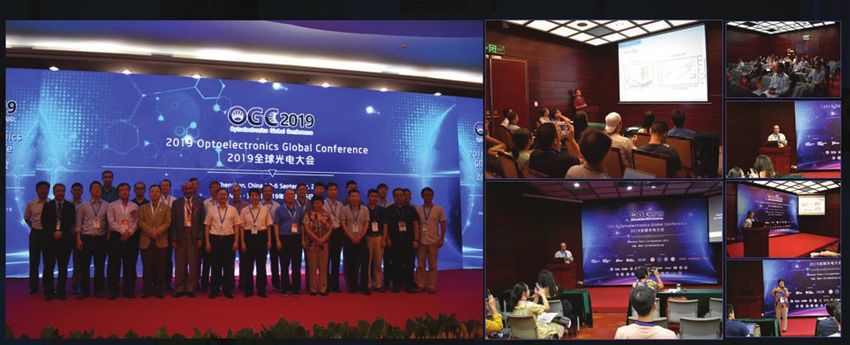
A Conversation Between Newsletter EiCs,
Nicolas Fontaine and Dominic Siriani
As Nicolas Fontaine wraps up his tenure as Editor-in-Chief        NF: I had a huge list of things I wanted to improve with the
of the Newsletter and Dominic Siriani prepares to begin his,      Newsletter, but only accomplished a few of them. One of my
the two have had several conversations about the recent past      favorite accomplishments was re-introducing student editors.
and the near future of the publication. The discussions have      The two success stories are Senta Jantzen’s column “Photon-
revolved around ambitions, achievements, and areas for im-        ics Worldwide,” where she finds different students around the
provement; evolving content and reliable mainstays; balancing     world to share a picture and a few paragraphs about their labo-
leading and listening; and, most importantly, serving, repre-     ratory and what they do. That’s a good way that people can
senting, and involving the entirety of the Photonics Society      share what they’re up to in photonics globally. And the other
membership. What follows is a back-and-forth between the          one is “Get to Know Your Photonic Society Leadership,” which
two that represents the most top-of-mind matters when it          Naznin Akter is leading. In my final issue we introduced a new
comes to the Newsletter. And we hope you’re able to use this      leadership updates column—the idea was to have the leader-
as an opportunity to join the conversation, and we welcome        ship actually say what they’re doing and how they need help.
your questions and feedback.                                      I am hoping that could become a regular column because I
                                                                  feel it’s important for the leadership to be able to show to the
NF: I had a great time doing the Newsletter for the past three    Society what they are working on and how they need help! The
years. It took me a while to get into it, and I finally got the   Society is really big and full of so many people with great ideas
hang of being EiC as I was leaving. The hardest thing was to      but only a small subset of people elected in the leadership.
try to encourage people to submit non-technical articles from         DS: What has been the greatest challenge as EiC?
around the world. Especially, trying to reach outside of my own
professional networks to reach everyone.                          NF: The research highlights have always been a very strange
   DS: That’s something I immediately noticed is that             type of article—it’s not really a journal paper but the con-
you’ve got some really ambitious and enthusiastic volunteers      tributors always want to write it like a journal article. And
at this point now, and we’re trying to bring on more people       also it only used to feature one research group per issue. I
like them.                                                        prefer learning about people, institutions, and culture behind
                                                                  the research. I’ve been trying to evolve the research high-
NF: My favorite experiences with the Newsletter were involv-      lights into collections of much shorter articles from around
ing younger people because they’re going to be the people of      the world. Rather than a shorter version of a journal paper,
the future and are eager to look for ways to volunteer. Nor-      they would be more like, “These are the people working, this
mally, it takes some time for the young/new volunteers to be      is our area, this is what we like to do, come visit us, these
excellent contributors. At first, they want to get told every-    are cool toys in our lab.” And of course you can have a little
thing to do. Eventually they realize they can develop and run     bit of tutorial stuff in there like “What is quantum optics?”
with their own ideas that they are passionate about. And then     In the previous issue we had a “Lab Tricks” column on beam
that’s best because they are inspired to work hard on it, and     measurements for lidar. The idea was to share some expert
they’ll do a great job.                                           laboratory techniques/skills to the public that you would not
   DS: So while you were the EiC, what were your primary          necessarily disclose in a journal paper. Previously, we had one
goals for the Newsletter?                                         on “Python for Automation.”

4       IEEE PHOTONICS SOCIETY NEWSLETTER                                                                         February 2021
DS: Daniel Renner also came up with a suggestion for             stick with something paper, who wants a hybrid. It’s going to
expanding the research highlights to encompass things like          be critical to get that feedback from the membership to figure
commercialization highlights—so technology that no lon-             out what’s going to best serve the entire community.
ger is really in the research phase but has actually been fully
commercialized. I think that’s an interesting idea. It makes        NF: So in your opinion, what is the value proposition of the
the section a little bit more all-encompassing, interesting         Newsletter?
to people in all stages of their career and across all seg-             DS: The whole purpose of the newsletter is just to keep the
ments of photonics—so from academia to government labs              community connected: for one, to important technology and
to industry.                                                        science—but you know of course there are all kinds of jour-
                                                                    nals for that—so really it’s about connecting members to one
NF: I think though for all these articles what’s most important     another—keeping people updated on what’s going on within
is to be written by someone in the photonics community and          the Society, at the members level, and at the leadership level.
not some random tech writer. So I guess it could be a problem       That’s the most important thing is to have this engagement
if you try to get too many “professionally written” articles in     of members within the Society, and we want to see that grow
there, and you lose touch with the photonics community.             more and more. We want to make the Newsletter a little bit
    DS: Yes, that’s at the heart of the Newsletter—to make sure     more of a conversation with members, get a little bit more
it comprises content directly from our members, which is one        feedback from them, get more contributions. And also by go-
of the strengths. But it’s also one of the challenges because, of   ing to something like an online format, we can have more di-
course as you mentioned, we have to make it appealing and           rect interaction through social media, comment sections, web
easy enough for people to submit research highlights. It is         board postings, and the like. So that’s the value of the News-
sometimes a struggle to find people who want to write or even       letter, to get back to your question: it’s all about connecting
necessarily know where to go.                                       members to each other and to the goings-on in the Society.

NF: One challenge was that the articles in the newsletter were      NF: Yeah, that’s pretty much what the Society is for: connect-
not archived. You couldn’t cite them.                               ing people.
   DS: Yeah, but you know at least if we start—and you know             DS: Exactly. I want to have people really engage in the
this is one of the main goals during my time with the newslet-      Newsletter and for people to be coming to us excited with
ter—to move things online, it would make it more broadly ac-        ideas to write articles and share what’s going on. It’s really
cessible and more easily referenced, even if it’s an informal way   something we’re passionate about, and we really want people
through a web link. And it makes it more shareable.                 to be involved. The other half of that is that not only do I
                                                                    want people to get involved, but I also want to know that what
NF: Personally my favorite version of Newsletter would be           we’re doing and what we’re providing is what’s best for our
just a four-page pamphlet mailed to everyone that has very          members. So we have the survey right now to find out about
very very short important things that you want to tell the          what direction we should go in the future. And going forward
community, like the conferences coming up, what the board           I want to be receiving feedback from people like, “This sec-
of governors/leadership is doing, the committees and how to         tion or this article really spoke to me, and I really want to see
reach out if you want, people who received some award or a          more like that,” or “This whole section could be done better.”
grant… mostly about what the society is doing and where we          Or new ideas for things that are missing from the Newsletter
need help and volunteers. And for everything else go onto our       that people like to see in other community news sources. It’s
website where you can see tons of articles. That would be my        important to get that feedback to make sure that we’re doing
ideal Newsletter.                                                   the best thing for our members, so that’s what I’m hoping that
    DS: I think that’s true for a lot of people, and there are a    this conversation will convey to people and create a little spark
lot of advantages to that sort of of system, both financially and   to ignite some ideas.
ecologically—it’s a lot less paper—and just for ease of access
and timeliness. A lot of people also like having a paper version    Please reach out to the Newsletter staff with your feedback!
to read. So that’s why we’re doing the survey right now, to get a   And remember to participate in the Newsletter survey to help
sense of who wants to see things go more online, who wants to       guide the direction of the Newsletter!

Editor’s Column
(continued from page 2)

about your news, events, and ideas, but we also want to             goings-on at the Newsletter, and we hope it inspires you to
know how best to serve you. My predecessor, Nick Fontaine,          reach out to us. So please contact us, and please participate
and I have had several conversations over the past several          in the ongoing Newsletter survey and our other solicita-
months about this, and we’ve included one here for your             tions in the future. I’m looking forward to a great 2021
benefit. We hope this provides some transparency into the           with you all!

February 2021                                                                     IEEE PHOTONICS SOCIETY NEWSLETTER               5
Industry Engagement
Life at a Photonics Startup: Lessons Learned
Meetings—the Good, the Bad and the Brand-Spanking New

By Daniel Renner
The quality of meetings is a constant topic of conversation in
most organizations, and very much so in startups. We have all
heard comments such as; meetings are a waste of time; meet-
ings are too long and involve too many people; meetings are
key to retaining our team culture; virtual meetings are great
but make it easy to get distracted; and many more. All these
comments have validity, of course.
   A great many meetings do waste a great deal of everyone’s
time and seem to be held for historical rather than practical
reasons [1]–[3]. On the other hand, it is clear that organiza-
tions cannot function without meetings, as a means to com-
municate, discuss problems and opportunities and arrive at
decisions. In addition, meetings fulfill a deep human need.
Humans are a social species. In every organization and every
culture, people come together in small groups at regular and
frequent intervals, and in larger “tribal” gatherings from time     meetings mostly positive in a small business environment,
to time. Face-to-face meetings in particular play an important      where the consequences of poorly executed meetings can be
role in developing people’s attachment to their company and         very expensive, catastrophically expensive in some instances.
to each other, a team spirit. If there are no face-to-face meet-    It is straightforward to calculate the direct cost of holding
ings in the places where they work, people’s attachment to the      a meeting and it is an illuminating exercise to determine
organizations they work for will be weak [3]. Thus, meetings        whether there is enough value in the output of the meeting
perform many functions:                                             to justify the expense. A small meeting, involving only four
• A meeting defines the team, the group, or the unit. Those         or five people for an hour, can cost a thousand or more dollars
   present belong to it; those absent do not. Everyone can look     in direct cost (salaries plus overhead). A meeting of ten or
   around and perceive the whole group and sense the collec-        twelve people for an hour can cost several thousand dollars.
   tive identity of which he or she forms a part [3].               This might be an excellent investment of company funds, but
• A meeting is the place where the group revises, updates,          it is not always the case. Unfortunately, very often it is not the
   and adds to what it knows as a group. Every group creates        case. In addition to the direct cost of the meeting we should
   its own pool of shared knowledge, experience, judgment,          also consider the missed opportunity cost of holding an inef-
   and tradition [3].                                               fective meeting. This cost can be orders of magnitude larger
• A meeting is the place where problems and opportuni-              than the direct cost. It is imperative for all organizations and
   ties are discussed, and decisions are made regarding future      for small businesses in particular to ensure that their team
   action. Meetings can efficiently bring together ideas and        members are trained on effective meeting techniques and that
   opinions and allow people to do their jobs in a more coordi-     they are conscious of the balance between the meeting output
   nated and cooperative manner. By discussing and deciding         value and the meeting cost.
   as a group, this creates in all present a commitment to the          Meetings come in all sizes, some include just a handful of
   decisions. Once something has been decided, even if you          people and others many thousands. The focus of this article is
   originally argued against it, your membership in the group       on meetings that happen in small startup companies, relatively
   entails an obligation to accept the decision. Real opposition    small meetings from two people to a few tens, at most. For
   to decisions within organizations usually consists of one part   these meetings at small businesses, you should consider the
   disagreement with the decision to nine parts resentment at       following eight principles for effective meetings:
   not being consulted before the decision. For most people on
   most issues, it is sufficient to know that their views were      Define the Purpose of the Meeting
   heard and seriously considered. They may regret that they        The first question to ask yourself is: What is the purpose, the
   were not followed, but they accept the outcome [3].              objective of the meeting?
   As mentioned, meetings can have both positive and nega-             What are the topics to be discussed? What is the desired
tive aspects. New meeting formats have both pros and cons.          output of the meeting? How do we know that the meeting
The question to be addressed in this article is how to make         objective has been achieved?

6        IEEE PHOTONICS SOCIETY NEWSLETTER                                                                          February 2021
The second question to ask yourself is: Does a meeting pro-      simply cancel. Periodic meetings have an ability to self-per-
vide the best mechanism to achieve these objectives?                 petuate, so constantly question whether the meeting should
    Are there other paths to achieve the objectives that would be    take place at that given time and whether that series of meet-
more appropriate, more efficient? Can an email discussion work       ings is still relevant. If it is not relevant any longer, redefine
better? Email is a powerful tool for a group to discuss issues and   it or cancel the whole series of meetings. The proliferation
arrive at decisions in a time effective manner. It is not always     of company meetings should be critically fought back. Have
appropriate though. It is time-efficient for each participant,       fewer but better meetings.
but the time that it takes to reach a decision can be long. In
addition, discussions via email require special attention given      Make the Meeting as Small as Possible
that all the non-verbal communication is lost, which leads to        It is not possible to define an ideal number of attendees, of
misunderstandings regarding intent and tone of the conversa-         course. This will depend on the nature of the meeting. But
tion. Face-to-face meetings give you the whole range of human        there is evidence to suggest that keeping the meeting small
communication paths and for some issues they really are the          is beneficial [1]. You are better able to notice body language
only possible way. Another option to consider is Management          when there are fewer people. Smaller meetings make it easier
By Walking Around (MBWA). Rather than calling a meeting              for everyone to participate. This is key: make sure that every-
where the discussion will mostly consist of several one-on-one       one participates, the chair should drive the discussion and in-
conversations, meet with each individual (or smaller groups of       volve in the discussion those that are remaining silent. Limit-
individuals) separately. This is more time consuming on the          ing attendees to a number somewhere between five and eight is
meeting organizer but less so for the meeting attendees and,         recommended. Some meetings need fewer than five people, of
on the balance, can be more time effective for the whole group.      course, and a few other meetings might need more than eight
    Think whether a virtual meeting would be more effec-             people, which should be the exception. Exceeding twelve peo-
tive than a face-to-face discussion for the objective you want       ple is highly discouraged. If you do need to go above twelve
to achieve and the circumstances. For discussions involving          attendees, such as in an all-hands meeting, for example, the
people at different locations or in the middle of a pandemic,        degree of planning and facilitation must go up to still achieve
as we are now, there might not be another choice. Pay special        meeting effectiveness.
attention that all participants are engaged, since the threshold         That said, you don’t want to pare the invite list down so
to join in the discussion is higher in virtual meetings for many     much that necessary people aren’t present, or others end up
people. Virtual meetings also limit non-verbal communication         feeling slighted [2]. The leader may have to leave out people
and introduce several other challenges that we will discuss as       who expect to come or who have always come. This needs tact
we progress through this article.                                    to be communicated; but since people generally believe that
    Once you have decided that a meeting is needed to achieve        they are overworked already and dislike going to meetings, it
your objective(s), communicate these objective(s) to the at-         is not usually hard to get their consent to stay away.
tendees through an Agenda. This is your plan for the meet-               The right balance of who attends and who doesn’t will de-
ing! You should ask others to suggest agenda items, which            pend on the nature of the meeting and the attendees. It is a
increases meeting relevance, ownership and engagement.               subjective measure, but you need to be comfortable that you
For clarity, you can also add a statement explaining what the        have reached the right balance. You might also consider a
objective(s) are. Send the Agenda out before the meeting, but        timed agenda, in which attendees join only the portions of the
not too far ahead-people should have this information fresh in       meeting pertinent to them, which is a powerful tool to im-
their minds. A few days ahead is ideal, but this depends on the      prove meeting effectiveness.
nature of the meeting of course. It is good practice to identify
Agenda items as being “For information” or “For decision,”           Prepare
so that those preparing for the meeting can better understand        All items should be thought of and thought about in advance
the nature of the objective(s).                                      if they are to be usefully discussed. If documents or presenta-
    In the case of regular, periodic meetings, you should ask        tions are produced at the meeting for discussion, they should
yourself these questions for every meeting. If the answer is         be to the point, brief and simple. It is a supreme folly to bring
that the meeting is not necessary at that particular time,           a group of people together to read six pages of closely printed
                                                                     sheets to themselves [3].
                                                                         Discussions that require significant preparation should be
                                                                     planned well ahead. Make clear, with the Agenda, what prepa-
                                                                     ration is necessary for the attendees. Lack of preparation by
                                                                     the meeting chair and attendees is one of the main causes for
                                                                     ineffective meetings.

                                                                     Be Present at the Meeting
                                                                     You have been invited to the meeting because your contribu-
                                                                     tions are believed to be necessary. Make sure that reality sup-
                                                                     ports this belief and that you contribute with your full capa-
                                                                     bility. Some people think that they can multitask, that they

February 2021                                                                      IEEE PHOTONICS SOCIETY NEWSLETTER                7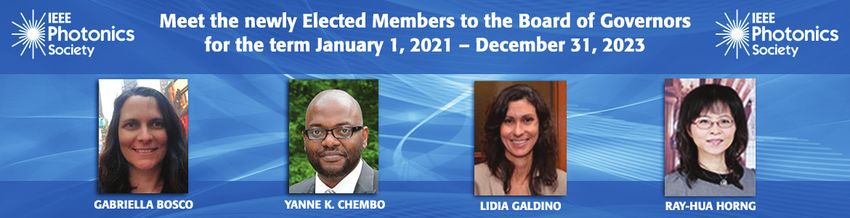
can finish an e-mail or read through their Twitter feed while        ing and finishing meetings on time (or earlier) should be part
listening to someone in a meeting. But research shows that           of the company culture of reaching deadlines on time. The op-
they really cannot. Recent neuroscience research makes the           posite, starting and/or finishing late, particularly in meetings
point quite clear on this issue [1]. Multitasking is simply a        chaired by top management, sends the message that timeliness
mythical activity. We can do simple tasks like walking and           might not be that important in the company. Meeting attend-
talking at the same time, but the brain cannot handle multi-         ees might also have other commitments following the sched-
tasking. In fact, studies show that a person who is attempt-         uled end time and the delay will then have a domino effect for
ing to multitask takes 50% longer to accomplish a task and           activities later in the day.
makes 50% more mistakes. So, smartphones and other elec-                 You might consider stand-up meetings to improve time
tronic devices should be discouraged at the meeting.                 efficiency. There is empirical data that proves they work. Al-
    The second reason to limit the use of smartphones at the         len Bluedorn from the University of Missouri and his col-
meeting is that they distract and annoy others. Surveys indi-        leagues concluded that stand-up meetings were about 34%
cate that meeting participants using electronic devices dur-         shorter than sit-down meetings, yet they produced the same
ing discussion can annoy other participants and this can have        solutions [1]. Going for a walk, rather than standing up in
very negative consequences if the person annoyed is a poten-         a room, is a good solution in many instances. But do not let
tial customer with whom you are having a group meeting.              the format distract you from what really matters, running an
People can feel insulted when someone reaches for the phone          effective meeting.
in a meeting, particularly if the meeting involves people from           An important role of the meeting chair is to ensure that the
other companies.                                                     participants are aware of time and control those that take an un-
    Still, there are some good reasons to have electronic devices    necessarily long time in their participation. It is hard to provide
at a meeting. Perhaps you are waiting for an urgent and impor-       guidelines on how long a meeting should be, this depends on
tant message, business related or personal. If this is the case,     its nature of course, but you should think carefully to justify
the device can certainly be used, but make sure to indicate at       to yourself meetings longer than an hour. Very few business
the beginning of the meeting that this is the situation. If these    meetings achieve anything of value after an hour and a half or
circumstances do not apply, have everyone silence their devices      two hours and an hour is enough time to allocate for most pur-
and pay attention to the discussion.                                 poses. Attendees’ attention and decision-making power starts
    Virtual meetings offer the opportunity of using smart-           waning if the meeting extends for much longer than an hour. In
phones or working on other tasks discreetly, without distract-       fact, think whether a meeting lasting 45 minutes or 30 minutes
ing others or upsetting customers. This should only be done if       would suffice. If it is necessary to meet for periods longer than
it will not affect the quality of your contribution to the quality   an hour, make sure to provide adequate breaks so that the at-
of the meeting outcome, of course.                                   tendees can recharge.

Maintain the Meeting Focus                                           Capture Decisions and Action Items
Through the duration of the meeting there will be constant           The output of the meeting should be captured in the form of a
pressure to move into other topics, whether related to the           list of decisions and action items. A good practice is to have a
Agenda or not. This needs acute vigilance by the part of the         person at the meeting, other than the chair, assigned to capture
chairperson. If the discussion starts to move into a tangent, it     these. You should reserve a short time at the end to review
should be brought back to the main path to achieve the meet-         them and make sure that all participants agree. An action item
ing objective within the allocated time. If the tangential topic     is properly described by a brief sentence that includes a verb, a
deserves further discussion, action should be defined to address     person responsible to complete it and a completion date. That
it separately. In some instances, a critical unforeseen item re-     is, it should describe:
lated to the meeting objective is uncovered in the discussion            What are we going to do?
and in this particular case it should be allowed to take as much         Who is responsible?
time as necessary, of course.                                            When should it be completed?
    Encourage the clash of ideas, provide an environment                 It is not strictly necessary to describe How will we do it?
where creativity can be unleashed and at the same time               This question might need one or more separate meetings to
have clear boundaries in your head as to when the conver-            define, but if there already are some ideas relating to this,
sation has diverged too far and should be brought back               they can be added as a comment. The review at the end of the
to the center, so that the group does not lose sight of the          meeting is a good time to ensure that all action items include
meeting objective.                                                   all their elements. The person responsible for the action item
                                                                     should be someone present at the meeting. If the assigned re-
Start on Time and Finish on Time (or Earlier)                        sponsible person is not present at the meeting, someone pres-
There is only one way to ensure that a meeting starts on time,       ent should be tasked with communicating this with the absent
and that is to start it on time. Latecomers who find that the        responsible person.
meeting has begun without them soon learn the lesson. The
alternative is that the prompt and punctual members will soon        Get Feedback
realize that a meeting never starts until ten minutes after the      Start from the premise that it is not easy to be a meeting
advertised time, and they will also learn the lesson [3]. Start-     chair or a meeting attendee. Develop your meeting skills

8        IEEE PHOTONICS SOCIETY NEWSLETTER                                                                            February 2021
collectively, relying on the insight and wisdom of all. A Bit About Me
Whether you are the meeting chair or a meeting attendee, I (Daniel Renner) grew up in the wil-
spend some time getting feedback on your meeting effec- derness of Chilean Patagonia, which
tiveness and what can be done to improve it. In general, not is one of the sources of my quest for
enough time is spent improving meeting skills, to the detri- adventure and for exploring new ar-
ment of the whole organization. Face-to-face meetings lend eas. In my early twenties I went to the
themselves better than virtual meetings to provide feedback University of Cambridge in England
and discuss meeting improvements. A special effort should to do a Ph.D. in Opto-Electronics, a
be applied to generate feedback when virtual meetings are new area at the time. Now, decades
the dominant format. later, I have lived through the whole
As you finish reading these eight principles for effective range of experiences that relate to the development, manu-
meetings you might say that this is all obvious, that it is “com- facturing and commercialization of complex photonic devices
mon sense”. The question though is, if it is “common sense,” and systems used in communication, sensor and industrial
why are these principles not commonly followed? They are applications. My experience spans both technical and busi-
“common sense” but they are not “common behavior.” They ness aspects of photonic products. This experience has in-
are not part of our built-in DNA, they are an acquired skill, cluded both large and small companies, which gives me a
thus education and training are needed. I encourage you to reasonable vantage point to comment on the ups and downs
make these principles part of your set of skills. You will not of life in a photonics startup.
be disappointed. I am currently Chief Business Development Officer at
Freedom Photonics in Santa Barbara, CA, and I look for-
References ward to the regular conversation to be carried out through
[1] “HBR Guide to Making Every Meeting Matter,” Harvard this column!
Business Review Press, 2016.
[2] Steven G. Rogelberg, “Why Your Meetings Stink – and
What to Do About It,” Harvard Business Review, January– Postdoc Opening in Experimental and
February 2019. Theoretical Optical Systems at the
[3] Anthony Jay, “Hoe To Run a Meeting,” Harvard Business University of Illinois at Urbana-Champaign
Review, March 1976.
Super-resolution Microscopy Photonic Nanojets
PNJ generator
About the Column
This is a regular column that explores business aspects of tech-
nology-oriented companies and in particular, the demanding Subsurface Volumetric Optical Interposer
business aspects of photonics startups. The column touches
on topics such as financing, business plan, product develop-
ment methodology, program management, hiring and reten-
tion, sales methodology and risk management. That is to say,
we include all the pains and successes of living the photonics
startup life.
This column is written sometimes by me (Daniel Qualified candidates are sought to conduct
Renner) and sometimes by invited participants, so that postdoctoral research with Prof. Lynford Goddard with
we can share multiple points of view coming from the full the goal of co-developing optical instrumentation and
spectrum of individuals that have something to say on this techniques for device characterization, computational
analysis, and/or machine learning. For more
topic. At the same time, this is a conversation with you,
information, see http://psl.mntl.illinois.edu/pdra.pdf.
the reader. We welcome questions, other opinions and sug-
The University of Illinois is an EEO
gestions for specific topics to be addressed in the future. If Employer/Vet/Disabled http://go.illinois.edu/EEO that
you have any questions or comments please contact participates in the federal e-Verify program and
me at, ipsnewsletter@ieee.org. participates in a background check program focused on
The expectation is that this column will turn into a useful prior criminal or sexual misconduct history.
source of business-related information for those who intend to The University of Illinois must also comply with
start, join, improve the operation, fund, acquire or sell a pho- applicable federal export control laws and regulations
tonic startup. A fascinating area that I have been one of those and, as such, reserves the right to employ restricted
lucky to enjoy as a way of living for a long time. party screening procedures for applicants.
February 2021 IEEE PHOTONICS SOCIETY NEWSLETTER 9Get to Know Your IEEE Photonics Society Leadership
Prof. Dr. Perry Shum,
Chair Professor Optoelectronics Intellisense Lab, Photonics Society Vice President of Conferences
Southern University of Science and Technology (SUSTech), Shenzhen, China
What is Your Current Profession? (IPC) is our major society conference each year.
I am currently a Chair Professor of Southern IPC 2021 will be in Canada, and IPC 2022
University of Science and Technology (SUS- will be in Singapore. Together with Conference
Tech) at the Department of Electrical and Elec- Council members, we are in the process of plan-
tronic Engineering (EEE), Shenzhen, China. ning the future of IPC with the consideration
My research interests focus on silicon photon- of time, venue, and technical areas.
ics, optical sensing, and laser technologies. I
have published more than 900 peer-reviewed What Do You Want to
papers, and my h-index is 45. I have received Accomplish as a Board Member
aggregated research funding of more than USD this Year/Next Year?
7 million as PI or co-IP. I wish to help to make IPC the major confer-
ence in Photonics.
What Role Does Your BoG Position Play for
the IEEE Photonics Society? What Challenges Why Photonics? What was Your “Photonics
Do You Face in Your Part? Moment?” (More Personal Background
I am currently Vice President of Conferences for the IEEE Pho- Story, etc.)
tonics Society. One of my key roles is to chair the Conference I began to know about Photonics as early as my undergrad-
Council. My responsibility as a Chair of the Conference Council uate final year project. That was also the reason I decided to
is to regularly review the society’s meetings portfolio to identify do a Ph.D. in the field of photonics. My photonics moment
and resolve current issues and challenges and make suggestions probably was the moment I received the IEEE EDS/MTTS
for new meetings. The Conference Council is also responsible India Chapter best paper award in Photonics-98.
for reviewing and approving technical co-sponsorship requests,
Chairs and Representatives for selected conferences, and loca- What About our Society’s Mission and Work
tion and venue selections for the IEEE Photonics Conference. that Motivates You?
Due to COVID-19, the challenge I am facing this year is to I joined the IEEE Photonics Society as a member when I was
work with various committee members via teleconference and a student. Before I became the chairman of the Conference
attend virtual conferences instead of physical onsite meetings. Council, I worked quite closely with the membership council.
What are You Currently Working On? What Specific Assets Do You Bring to the
I must host a virtual Conference Council meeting monthly. Due Table as a Board Member?
to Conference Council members’ different geographical loca- I think I can help promote the IEEE Photonics Society in Asia,
tions, the primary challenge is to find a standard time suitable and I started the Optoelectronics Global Conference (OGC)
for most people to meet online. The IEEE Photonics Conference with the Photonics Society as the main organizer.
Mention One Thing you have Changed and
One Thing you Want to Switch to Improve the
IEEE Photonic Society?
The IEEE Photonics Society is a very well-established society. I
would like to make incremental contributions to the photonics
community, its conferences, and future developments.
Can You Name a Person Who has had a
Tremendous Impact on You as a Leader?
PHOTO CREDIT: DR. PERRY
Maybe Someone Who has Been a Mentor to
You? Why and How did this Person Impact
Your Life?
I want to give my special thanks to Jagadish, a friend and a
mentor to me. He is always willing to offer help to me as well
At OGC 2019 conference. as Photonics Society members.
10 IEEE PHOTONICS SOCIETY NEWSLETTER February 2021PHOTO CREDIT: DR. PERRY
OGC 2019 conference highlights.
What are the Most Important Decisions What is One Characteristic that you Believe
You Make as a Leader of the IEEE Photonic Every Leader Should Possess?
Society? Willingness to listen and draw a conclusion and make the best
The most important decision I made was to accept the VP po- decision for the benefit of society.
sition and serve in the IEEE Photonics Society. No regrets.
What is the Biggest Challenge Facing
How Would You Advise Members Leaders Today?
Who Want to Become More Involved Time. We all have 24 hours a day. Capable leaders may reach
in Society? the limit if overcommitted.
I strongly encourage regional members to consider starting a
student chapter branch as well as a regional chapter. What is One Mistake You Witness Leaders
Making More Frequently Than Others?
Why Do You Think Members Should be Not being able to make decisions. Especially tough decisions.
Involved as Society Volunteers?
What are the Benefits? What Kind of Help and Support Do You Need
There are many benefits. Financially, members can enjoy a From the IEEE Photonics Society?
conference discount. Technically, there are so many online re- The IEEE Photonics Society organizes or sponsors many confer-
sources available to members. ences in the world. I would like to hear from conference orga-
nizers or delegates on whether we can enhance Photonics Soci-
What Advice Would You Give Someone ety conferences’ technical qualities. I want to work with domain
Going into a Leadership Position experts to explore the development of new technical tracks or
for the First Time? special sessions. We can also help promote IEEE Photonics So-
Be humble and learn from senior mentors. ciety membership and facilitate global collaborations under our
conference platform.
How Do You Ensure the IEEE Photonic
Society and its Activities are Aligned How Can Members Get Involved and Find
With Your Core Values? More Information About Your Progress/Role?
We have to work closely with volunteers from different sectors Members can contact me (shum@ieee.org) or any Conference
and make sure everyone is fully aligned. Council member directly if anyone is interested in helping or
providing feedback.
When Faced With Two Equally Qualified
Candidates, How Do You Determine Whom Tell us Something Fun About Yourself!
to Choose? I spent most of the time on undergraduate student projects
I will prefer to choose the one who is willing to learn and is rather than graduate projects. I prefer to give senior students
responsible for his/her work. more freedom to choose research topics and find their path.
February 2021 IEEE PHOTONICS SOCIETY NEWSLETTER 11A Space for Young Professionals What’s important—Let’s talk By Akhil Kallepalli, AVP of Young Professionals & Young Professionals Advisory Committee Chair What a year 2020 has been for all of us. This has, by far, been bership of another region; the committee intends to include the single most universally challenging year in our lifetimes this philosophy from the very beginning. and I hope it is the last of those! As this is our first conversation, let me share a couple of 2021 begins with an optimistic outlook and expectation serendipitous stories with you. In August 1996, an aspiring, with news regarding vaccinations and a better understanding young Larry showed up to an orientation session at Stanford. of COVID-19 available for science, industry and the general He was considering doing his graduate studies there. A stu- public. I am hoping that we, in the Photonics Society, can dent was assigned to him to show him around-meet Sergey! ride this optimistic wave of the pandemic’s eventual resolu- Even though they disagreed on a lot, they found a lot they tion with initiatives to promote and enable better opportu- agreed on too. Little did either know that in a few years, they nities globally for Young Professionals (YP) in the Society. would co-found Google. Consider the possibilities here, and In this issue’s column, I would like to share: the serendipitous nature of that meeting. • Initiatives of the future This one is a personal story. I have been volunteering for • Plans for the Young Professionals Advisory Committee, the IEEE UK and Ireland Photonics Chapter since 2017. In formed in the New Year, with a motivation to prioritize December 2019, just before the pandemic became an all-en- all aspects of early-career professionals, including personal compassing reality, I helped organise the British and Irish well-being, professional opportunities and equality, diver- Conference on Optics and Photonics (2019 IEEE BICOP). I sity and inclusion (EDI). was in the audience when an ever-enthusiastic and one of the • Some personal thoughts and experiences best presenters I have ever met—Prof Miles Padgett—took The YP community, members and volunteers up to 15 years the stage for a plenary talk. As soon as he finished his talk, post their first degree, members and volunteers up to 15 years with me only weeks away from handing in my thesis, I ap- post their first degree, within the Photonics Society is one of proached him to consider future collaboration opportunities the largest sub-groups of our membership. Any member who (as I had done with many other researchers as well). After an has completed their first graduation or qualification is eligible. interview that occurred in the airport while I was on my way This includes many professionals in various sectors and well for my first US conference with funding from the IEEE Pho- into their careers. With the Young Professional Advisory Com- tonics Society, I submit my thesis and signed a contract for mittee, I would like to focus on facilitating the improvement a postdoctoral position at the University of Glasgow. In the of professional experience with development opportunities. same conference visit, I came to meet Lauren (Mecum-Smith) Simultaneously, this also goes to include those professionals from the Photonics Society; a meeting that would eventually who are considering transitions between domains (industry, bring me this very role. academia, public sectors) and/or career levels. I am not saying my story is similar (if only!) or different from Young professionals hold great potential in shaping the that of Google, but I’m hoping to highlight that the opportunities that future scenario of any workplace, environment and culture. present themselves have no way to let us know what the future has to Giving this community the tools and ability to achieve this offer and how much good can come of one opportunity! positive change is one of the primary motivations of the com- In a recent webinar series I organised, I requested the mittee. The Advisory Committee intends to focus on, but not speakers to share their advice to early career professionals limit itself to: and students. When posed to Prof Padgett (University of • Leadership, training and professional development Glasgow), his response was “Work with the smartest people you • Increasing and enhancing volunteering opportunities can find that want to work with you. You can learn something from • Providing a smooth transition between career levels and each other. Work somewhere you will be happy … I think the people sectors you work with are more important than what you are working on.” • Assisting in better education and mentoring programs As I begin my term as the AVP of Young Professionals • Positively educating, promoting, and facilitating equality, and Chair of the Young Professionals Advisory Committee, diversity and inclusion I invite you to be a part of this conversation, encourage par- • Highlighting and promoting positive mental health ticipation and involvement of the membership in the hope • Recognizing individuals and organisations facilitating posi- and belief that together we can make the future better than tive change the past, no matter the task. This does not limit our collective interest, as the global community has a diverse set of requirements and challenges; About the Column a set that also allows us to learn from one another. A specific This regular column is written on behalf of and for Young Profes- problem in one region may have been overcome by the mem- sionals in the IEEE Photonics Society. The eligible membership 12 IEEE PHOTONICS SOCIETY NEWSLETTER February 2021
By comparing the beam width at different propagation dis- References
tances
for YP are(z), members
we can seeup tohow15 much the their
years post beamfirst
diverges.
degreeFig.
grad-4 A
[1]BitK.About
Bourzac,Me
“Startup Baraja promises cheap, reliable Li-
shows the
uation. Thisexperimental and model
makes the IEEE Young results of our beam
Professionals at 4 dis-
community dar for self-driving Icars,” IEEE
(Akhil Spectrum
Kallepalli) (online),
grew up in https://
the vi-
tances
one (0.2,
of the 2.7, 5.3,
largest 7.9within
groups m). Thethemeasured beamThrough
membership. width across
this spectrum.ieee.org/cars-that-think/transportation/self
brant coastal town of Visakhapatnam
8 m of propagation
column, with inputsisfromwithin
me0.3andmm,otherhence suggesting
invited authors, that
the -driving/startup-baraja-promises-cheap-reliable-lidar-for
in India. My background is diverse and
our beamisisto
objective very welland
reach collimated.
cater to the needs of this diverse com- -selfdriving-cars, Julof 2018.
a “jack of all trades” nature; I have
munity. The expectation of this column is to ensure that it pro- [2] P.B. Chapple, “Beam waiston
worked andremote
M2 measurement using a
sensing, hyperspec-
4. Conclusions
vides a forum for me to share the Advisory Committee’s progress finite slit,” Opt. Engineering. Vol 33,
tral imaging, no. 7, 1994.
biomedical optics and
Byachieving
in measuringitsthe beam waist
objectives (moreof to
a transceiver at different
come on this) dis-
and encour- [3] J.M. Khosrofian and biophotonics,
B.A. Garetz, “Measurement of a Gaussian
and novel modalities for
tance
age youwithto the knife
write backedge method,
to me we found
with your the measurement
insights and promote laser beam diameter sub-diffraction
through the directlevel
inversion of knife-edge
imaging. After
aresults areever-progressing
positive, well matched with the fitting
outlook. curveout
Please reach andtodeter-
me if data,” Applied optics,completing
Vol 22, no 21,
my1983.
Ph.D. in biomedical
mined
you wouldthatlike
thetobeam from the
comment, transceiver
support is well
and write collimated.
for this column [4] M.A.
optics and de Araújo, R. Silva,
biophotonics E. de Lima,
at Cranfield D.P. Pereira,
University P.C. de
(Shrivenham,
This measurement technique
(akhilkallepalli@ieee.org). I amis happy
provedtotoconnect
be a good on method
Twitter UK),Oliveira,
I am now“Measurement of Gaussian
based at the School laser
of Physics andbeam radius us-
Astronomy at
for profiling a beamasand
(@OptoPhysAkhil) qualifying the collimation of Baraja
well. ing the knife-edge
the University of Glasgowtechnique: improvement
as a postdoctoral on data
research analy-
associate.
LiDAR transceiver. sis,” Applied optics, vol. 48, no. 2, 2009.
IPS2020_NL_Survey_hpagead.pdf 1 12/10/20 2:20 PM
– ATTENTION IEEE PHOTONICS SOCIETY MEMBERS –
C
M
Y
CM
MY
CY
IEEE Photonics Society Newsletter Survey
CMY
K
This survey will help us to redesign how the newsletter is brought to you, (by way of print or online).
Please answer to the best of your ability and leave any comments you think may be
helpful to us in delivering the content you want to see. It is important to us that you
are receiving materials that best suit you, our members.
Let your voice be heard - Fill out the survey!
Visit: bit.ly/34YDXCw
14 IEEE PHOTONICS SOCIETY NEWSLETTER December 2020
February 2021 IEEE PHOTONICS SOCIETY NEWSLETTER 13You can also read


