Anganwadi Shiksha'' e-Learning training to empower front-line nutrition workers in Madhya Pradesh, India - UNSCN
←
→
Page content transcription
If your browser does not render page correctly, please read the page content below

1. Click on this   2. Reset the slide.   3. Where necessary,
                                        icon to insert a                         change the section using
                                        new photo.                               the ‘Crop’ function.

"Anganwadi Shiksha‘’
e-Learning training to empower front-line
nutrition workers in Madhya Pradesh, India
Dr Archana Sarkar I Food and Nutrition Security, Enhanced Resilience Project, India
Nutrition in a Digital World
UNSCN Webinar I 19th Nov 2020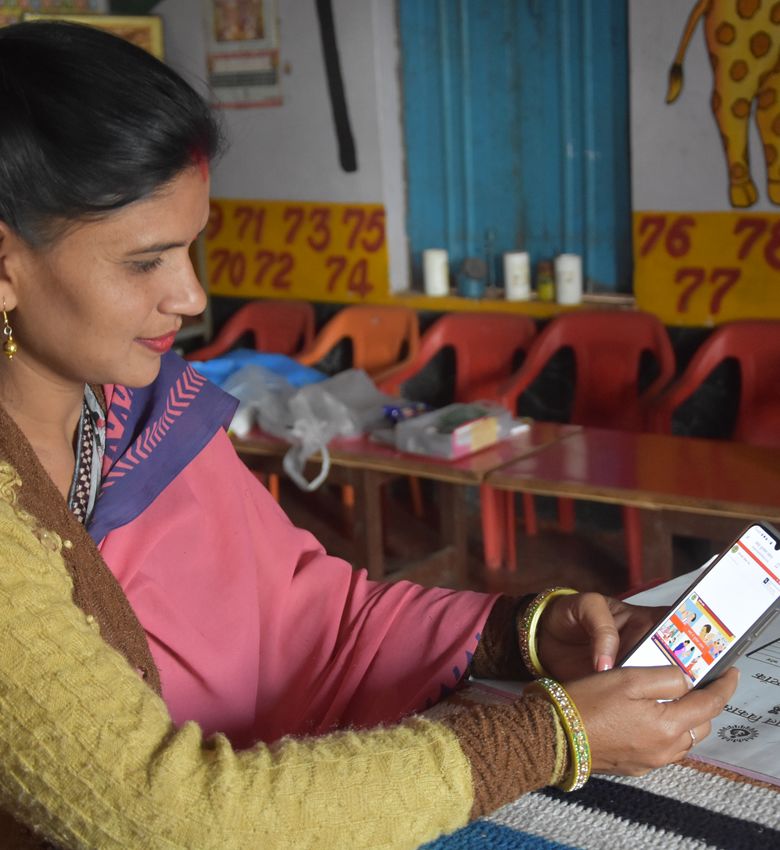
Stunting in Children (0-59 months)
                                                                                  by State/UT (in %, NFHS-4)
Malnutrition in Madhya Pradesh
Population: ca. 80 million
Children (under 5 years): ca. 11 million
Proportion of rural population: ca. 72 %

Prevalences in rural areas
• Women and men (BMI < 18.5 kg/m2): 31.8 % (NFHS-4)
• Anaemia in women (15-49 years): 53.7 % (NFHS-4)
• Wasting (under 5 years): 20.8 % (CNNS)
• Stunting (under 5 years): 40.6 % (CNNS)

MoHFW/UNICEF 2019; IIPS 2017, GoI 2015; GoI 2011

2        11/20/20     E learning Platform to empower frontline functionaries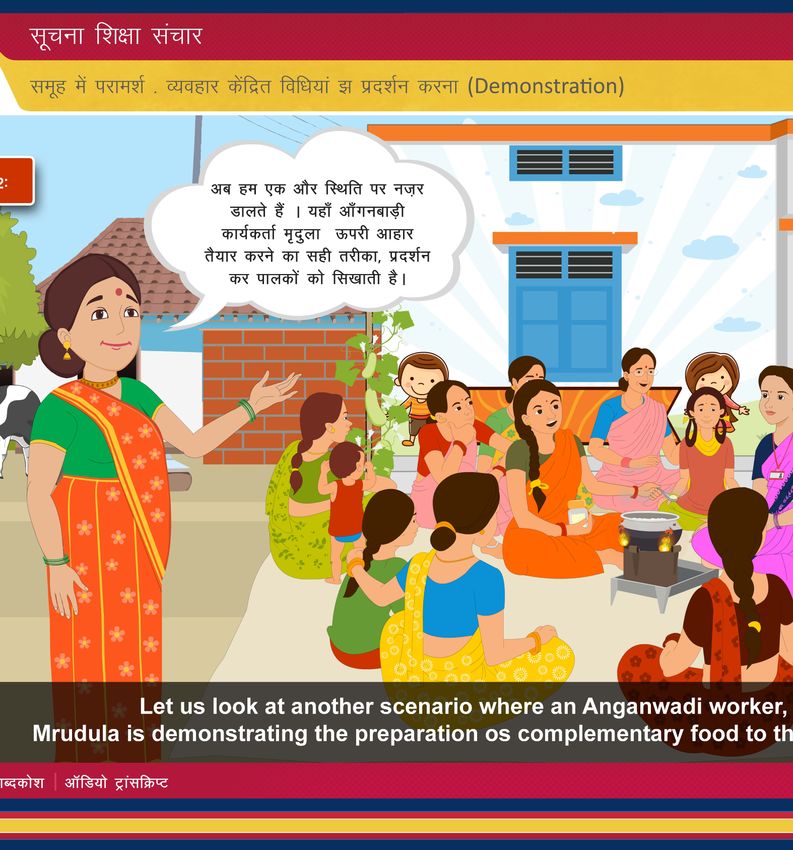
Challenges of Anganwadi Workers                                                       ???

Anganwadis (AWW) are social workers, employed by Department of Women
and Child Development (government staff)
• Knowledge gaps on adequate nutrition
• Variation in education level but high native intelligence
• Lack of access to further training (in remote locations)
• 7 modules, each 160 pages of content = cognitive overload

Why e-Learning tool?

•        AWWs are responsible for the health/nutrition of women and children at
         local health centers. However, lack access to structured and standardized
         training possibilities.

•        To fill in this gap, the GIZ FaNS project, together with the department in
         Madhya Pradesh, developed an interactive eLearning training platform,
         called Anganwadi Shiksha, to help systematically build AWW capacity.

Page 3       11/20/20   E learning Platform to empower frontline functionaries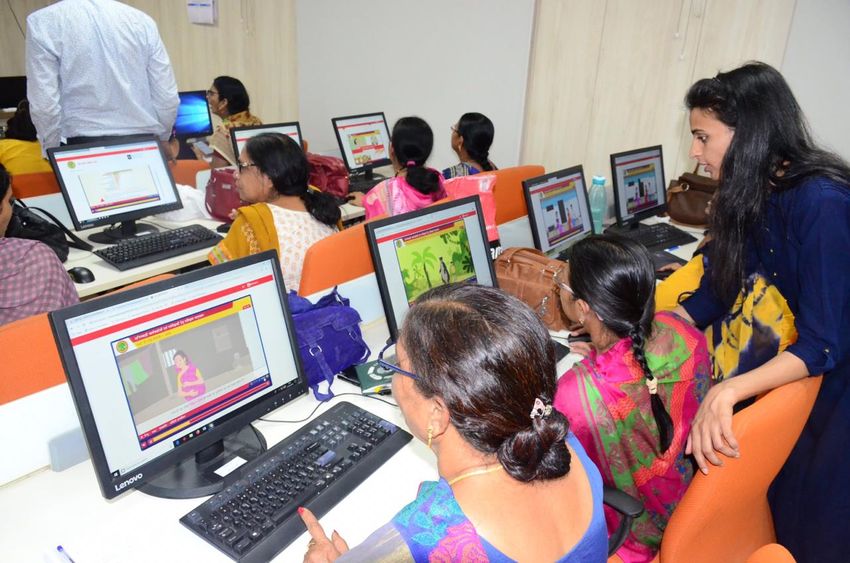
Features of the e-Learning training platform

           Open source

           40 hours of e-Learning

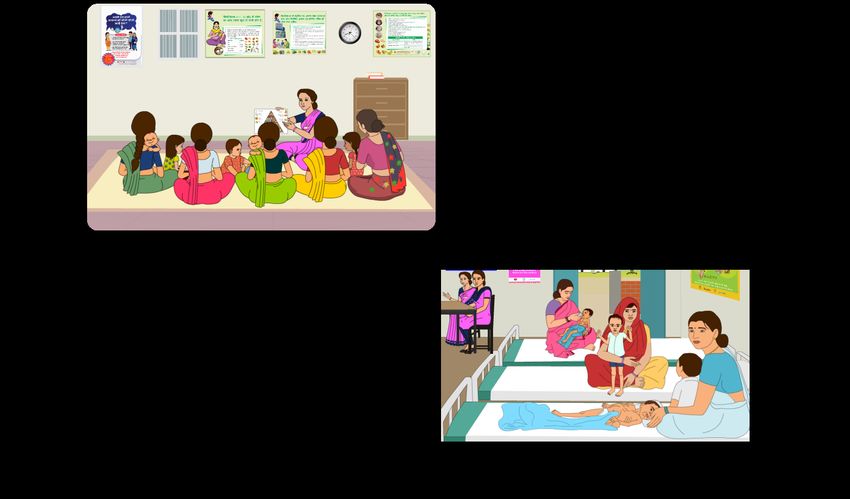
           Real life local scenarios

           Gamification of e-learning -Videos, games and quizzes
           (4,259 sketches and 807 animation sequences)

           200 randomised assessment questions

           Certificates are provided on successful completion

Page 4   11/20/20   E learning Platform to empower frontline functionaries
Dashboard in e-learning platform

Page 5   11/20/20   E learning Platform to empower frontline functionaries
Aim of the Effectiveness Study:

 •       To assess the effects of the e-learning digital tool
         on the capacity-building of front-line workers

 •       To assess if there is any need for modification of
         content, design and user-friendliness of the e-
         learning platform

 •       To understand the implementation challenges and
         ways to overcome in the next phase of
         sustainability and roll-out

Page 6      11/20/20   E learning Platform to empower frontline functionaries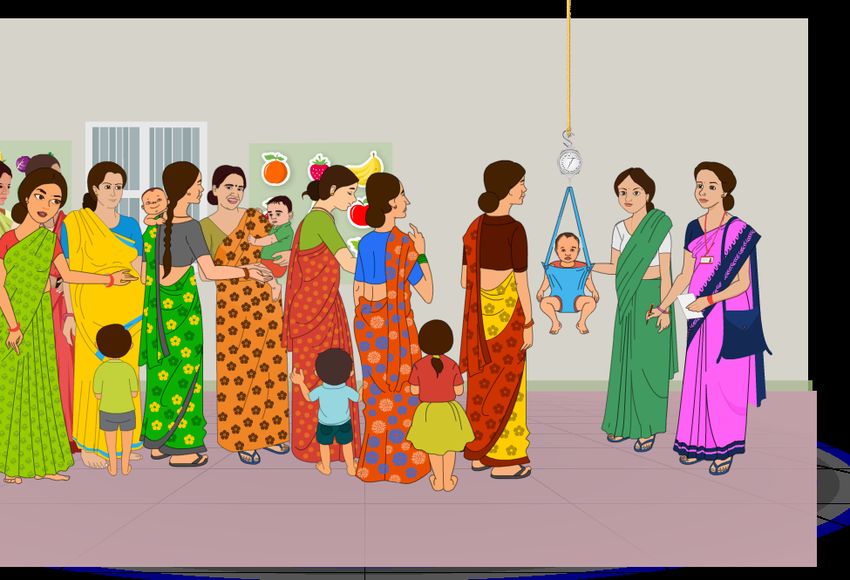
Methodology of the Study
Mixed method study used to collect data.

• Quantitative Questionnaires:
  n=105 intervention, n=100 control, with
  themes to capture information.

• In-depth Interviews:
  with 9 supervisors and 2 district-level
  officials (n=11) to understand
  perceptions and challenges.

• Focus Group Discussions:
  n=6, comprising 6-8 AWWs each, to
  gain in-depth insights into their
  perceptions, problems.

Page 7   11/20/20   E learning Platform to empower frontline functionaries
Key Findings: 1. Knowledge Enhancement
  • Completion of the course led to better awareness of roles
    and responsibilities as compared to control group

Page 8   11/20/20   E learning Platform to empower frontline functionaries
2. Content, language and Visuals

§ e-learning modules are comprehensive, systematic, local
  scenario based and in accordance with roles and
  responsibilities of Anganwadi workers.

§ Assessment at the end of each module acted as
  reinforcement to appraise performance and learning.

§ 92% said the content was easily understood and 99 %
  the language was comprehensible.

§ 61% said they acquired more knowledge and skills than
  in other training programs.

§ 64% said the information provided on the platform went
  into greater detail than classroom training.

Page 9   11/20/20   E learning Platform to empower frontline functionaries

3. User friendliness

     • Overall can be easily maneuvered
       through contents.

     • E-learning is limited in its use by
       illiterate workers- unable to maneuver
       smart phones.

     • Familiarity with feedback mechanism
       and live dashboard is limited with
       AWWs and Supervisors.

     • 65% said it took them less effort to
       learn using the eLearning platform.

Page 10   11/20/20   E learning Platform to empower frontline functionaries
4. Issues with Implementation
• Communication gap – Ambiguous information was provided to workers that
platform will be inaccessible after certain time period
• Internet connectivity- poor network connectivity did hamper spirit of AWWs,
limited information that offline version is available
• Limited technical assistance during the one-day orientation and the instructional
insufficiencies experienced by supervisors
• Handholding support/ strategic orientation/provision of user-friendly manual
on MIS login, feedback mechanism, technology-based support to systematically
address the implementation challenges
• Need to create a system of knowledge sharing and to improve grievance redressal
mechanism of AWWs and supervisors
• Not everyone had access to smartphones
5. Further study on operational feasibility could be planned after full roll-out
Page 11 11/20/20 E learning Platform to empower frontline functionariesConclusions and Way Forward • eLearning course could fill a capacity-building gap and enhance the knowledge and counselling skills of front-line workers. • The content of the e-Learning training was appreciated by the learners, as it was visual and local-scenario based. • Still a need to systematically address implementation gaps, especially communication at the last mile. • Recommendations to include content on ‘counselling of men and other members of the family’ and admission to nutrition rehabilitation centers (NRC) • platform provides an opportunity to train front- line workers with a minimum of resource mobilization and to ensure quality training through a medium that front-line workers find interest. Page 12 11/20/20 E learning Platform to empower frontline functionaries
Upscaling and replication

e-Learning platform
• Can be adjusted to other states in India
   and countries retaining basic content
• Can be used on any other Learning
   Management System
•     Adapts to complementary learning with
      other available approaches in India like
      Incremental Learning Approach (ILA)

    Reach in Madhya Pradesh:
    97,000 Anganwadi Workers and
    3,200 Supervisors

    Upscaling in India:
    1.4 million Anganwadi Workers

Page 13   11/20/20   E learning Platform to empower frontline functionaries
Thanks for
your attention!
Dr Archana Sarkar
(archana.Sarkar@giz.de)
@SecureNutrition
All photos © GIZ FaNS project India
Page 14 20/11/20 From Knowledge to Action through PLA nutrition trainingsDeutsche Gesellschaft für Internationale Zusammenarbeit (GIZ) GmbH Registered offices Bonn and Eschborn Friedrich-Ebert-Allee 36 + 40 Dag-Hammarskjöld-Weg 1 - 5 53113 Bonn, Germany 65760 Eschborn, Germany T +49 228 44 60 - 0 T +49 61 96 79 - 0 F +49 228 44 60 - 17 66 F +49 61 96 79 - 11 15 E info@giz.de I www.giz.de
You can also read


