ASIC's financial literacy program 2013-14
←
→
Page content transcription
If your browser does not render page correctly, please read the page content below
ASIC’s financial literacy
     program 2013–14

        ASIC’s

                 Financial guidance you can trust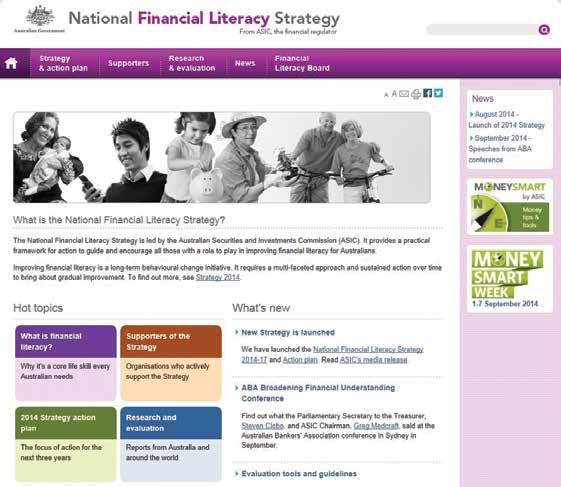
Contents
Introduction from the Chairman           1

Key results at a glance                  2

What is financial literacy?              3

National Financial Literacy Strategy     4

Partnerships and stakeholder relations   6

International activities                 7

ASIC’s MoneySmart website                9

ASIC’s MoneySmart Teaching program       21
Introduction from the Chairman
ASIC is the Australian Government agency responsible for financial literacy.
This report covers ASIC’s financial literacy activities
over the past year.

Among our most substantial pieces of work
this year were the review of the first National
Financial Literacy Strategy published in 2011 and
development of an updated Strategy for 2014–17.

The Strategy is a national framework for action,
led and coordinated by ASIC, to guide and
encourage all those with a role to play in improving
Australians’ financial literacy.

The release of the 2014–17 Strategy on 1 August
2014 marks the culmination of over 12 months
of research and consultation by ASIC with the
government, business, community and
education sectors.

I am pleased to say the Strategy has broad and            This year ASIC delivered professional learning to
dedicated support from all stakeholders. There is         over 2,500 teachers across Australia. There were
also strong support for ASIC’s leadership.                over 45,000 views of ASIC’s MoneySmart Teaching
                                                          resources and more than 1,400 schools engaged in
ASIC’s MoneySmart website is well established as a
                                                          some aspect of the program.
trusted, central reference point on money matters
for Australians from all walks of life. Around            We are also expanding our work into the VET
580,000 people visit the website each month.              sector, collaborating with government and industry
                                                          to develop new modules for Certificate III and IV
Our 26 financial calculators remain popular and
                                                          courses to help apprentices and trainees make
there have been over 500,000 downloads of our
                                                          sound money choices.
mobile apps. We also distributed more than
550,000 print publications this year.                     I commend the efforts of everyone who is active
                                                          in the field of financial literacy. Your contributions
With increasing numbers of people using
                                                          are valued and will be of vital importance as
smartphones and tablets, this year we optimised
                                                          we continue our journey towards improving the
ASIC’s MoneySmart website for mobile devices
                                                          financial literacy of all Australians.
to give people the best possible experience. We
also brought together ASIC’s MoneySmart and               Greg Medcraft
MoneySmart Teaching websites into a single site,          Chairman, ASIC
improving accessibility and the visibility of our
resources for both teachers and parents.

ASIC’s MoneySmart Teaching program, recently
recognised by the OECD for best practice in
financial literacy education, continues to promote
and support financial literacy in schools through
teacher professional development and quality
teaching resources aligned to the Australian
Curriculum.

                                                                             ASIC’s financial literacy program 2013–14   1
Key results at a glance
    A summary of key ASIC activities in 2013–14.

        National Financial Literacy Strategy
        ¡¡   Led a review of the 2011 Strategy, with more than 200
             stakeholders contributing

        ¡¡   Conducted a national stocktake survey of financial literacy
             initiatives

        ¡¡   Developed a new National Financial Literacy Strategy,
             released in August 2014

                            ASIC’s MoneySmart Teaching program
                            ¡¡   Delivered professional learning to over 2,500 teachers
                                 across Australia

                            ¡¡   There were over 45,000 views of our teaching resources

                            ¡¡   More than 1,400 schools engaged in some aspect of
                                 the program

        Partnerships and stakeholder relations
        ¡¡   Continued to host monthly gatherings of our national
             Financial Literacy Community of Practice, growing the
             community to over 500 participants

        ¡¡   Formed the Government Connect Working Group,
             developing and distributing resources for people in
             financial hardship

        ¡¡   Played a key role in establishing a new Committee on
             Retail Investors at IOSCO

        ¡¡   Facilitated Australia’s participation in the first international
             study of students’ financial literacy, released by the OECD
             in July 2014

2   ASIC’s financial literacy program 2013–14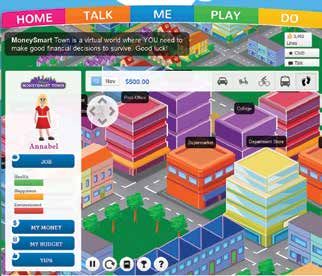
ASIC’s MoneySmart website
                  ¡¡   Brought together ASIC’s MoneySmart and MoneySmart Teaching websites
                       into a single site

                  ¡¡   Optimised the website for mobile devices to give people the best
                       possible experience

                  ¡¡   Around 580,000 people now visit the website each month (over 4.7 million
                       unique visitors last year)

                  ¡¡   86% of site users reported that they took action on their finances after
                       visiting the website

                  ¡¡   The budget planner, our most popular calculator, receives more than
                       70,000 views per month

                  ¡¡   Our mobile apps have now had more than 500,000 downloads

                  ¡¡   There were over 70,000 views of our videos

                  ¡¡   Distributed more than 550,000 print publications

                  ¡¡   Received over 2,500 feedback queries and responded to 90% of these
                       within 24 hours

What is financial literacy?
Financial literacy is a combination of financial knowledge, skills, attitudes and
behaviours necessary to make sound financial decisions, based on personal
circumstances, to improve financial wellbeing.
Source: ASIC, National Financial Literacy Strategy 2014–17 (REP 403), 2014.

Why is it important?
In today’s fast-paced consumer society, financial literacy is an essential everyday life skill. It means being
able to understand and negotiate the financial landscape, manage money and financial risks effectively and
avoid financial pitfalls.

Improving financial literacy can benefit anyone, regardless of age, income or background. It helps people
make informed financial choices, day-to-day and throughout their lives.

Financial literacy work is a key component of ASIC’s strategic priority to promote investor and financial
consumer trust and confidence.

                                                                              ASIC’s financial literacy program 2013–14   3
National Financial Literacy Strategy
    financialliteracy.gov.au
    Led by ASIC, Australia’s National Financial Literacy Strategy is a practical
    framework for action to guide and encourage all those with a role to play in
    improving Australians’ financial literacy.

    Review of the 2011 Strategy
    In 2013 ASIC led a review of the 2011 Strategy and sought input on issues and
    priorities for an updated Strategy for 2014–17.
    We consulted widely with financial literacy                We also conducted a national stocktake survey
    stakeholders from the business, community,                 to give a snapshot of financial literacy initiatives
    education and government sectors, with more than           around Australia, and released a report in October
    200 stakeholders contributing to the process.              2013 (ASIC Report 375) summarising 112 initiatives
    In October 2013 we released a report of our                submitted by 64 organisations in response to the
    consultation findings (ASIC Report 374), outlining         survey.
    key points from the 58 written submissions
    received together with additional feedback
    gathered through face-to-face and phone
    consultations.

                The consultation report and stocktake survey
                can be viewed on financialliteracy.gov.au/
                strategy-and-action-plan/consultation-2013.

4   ASIC’s financial literacy program 2013–14
Development of the 2014–17 Strategy
The new National Financial Literacy Strategy was released in August 2014.
Input from the review and consultation process, along with relevant research and international good
practice guidelines, informed the development of the new Strategy around five strategic priorities.

Strategic priorities 2014–17
 Individuals, families and communities
 1. Educate the next generation, particularly through the formal education system.
 2. Increase the use of free, impartial information, tools and resources.
 3. Provide quality targeted guidance and support.

 Policy and program development
 4. Strengthen co-ordination and effective partnerships.
 5. Improve research, measurement and evaluation.

The new Strategy has broad and dedicated support from all stakeholders. It was endorsed by the Australian
Government Financial Literacy Board in February 2014 and approved by ASIC’s Commission in April 2014.
The Strategy is available on financialliteracy.gov.au/strategy-and-action-plan/strategy-2014.

        National Financial Literacy Strategy website.

                                                                            ASIC’s financial literacy program 2013–14   5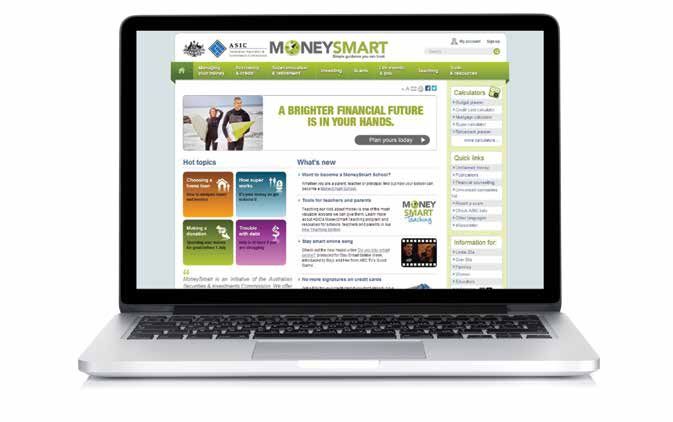
Partnerships and stakeholder relations
    ASIC works with financial literacy stakeholders and brings them together to
    exchange information, share research and promote their work.

    Community of Practice
    ASIC’s Financial Literacy Community of
    Practice promotes dialogue, partnerships and
    information exchange among members of the
    financial literacy community.

    Each month ASIC hosts presentations via video
    link that connect financial literacy professionals
    across Australia. The Community has over
    500 participants from the education, financial
    services, government and not-for-profit sectors.

    This year topics included Indigenous financial
    wellbeing programs, factors influencing              Community of Practice members, left to right: Kristen Hartnett,
    women’s financial decision-making, workplace         The Salvation Army; Samantha Reader, ASIC; Judy Gordon,
                                                         ASIC (with the giant compass used in our June 2014 advertising
    financial literacy programs in the banking sector,   campaign, see page 19); Paul Jajou, Good Shepherd Microfinance;
    the development of the superannuation industry,      Tony Devlin, The Salvation Army.
    school financial literacy programs and measuring
    financial exclusion.

    Government Connect Working Group
    This year ASIC formed the Government Connect Working Group with other
    Commonwealth Government organisations including:

    ¡¡   Department of Prime Minister and Cabinet – Office for Women
    ¡¡   Department of Social Services
    ¡¡   Department of Human Services
    ¡¡   Department of Employment.

    The group works in partnership to enhance the financial wellbeing of
    Australians, aiming to reach people at the point of making a money decision.

    The group’s first priority was to develop and distribute resources for people
    in financial hardship, as well as using existing networks including websites,
    newsletters and conferences to promote key money messages.

    Our 2014–15 projects will build women’s financial literacy and economic
    security, and enhance frontline staff members’ knowledge about ASIC’s
                                                                                            New brochure to help people
    MoneySmart resources so they can use them to help their clients.                        in financial hardship developed
                                                                                            by the Government Connect
                                                                                            Working Group.

6   ASIC’s financial literacy program 2013–14
MoneySmart Week 2013

moneysmartweek.org.au
MoneySmart Week promotes the importance of
financial literacy.

Coordinated by Financial Literacy Australia Limited (FLA), a non-profit organisation established by the
Australian Government Financial Literacy Board, the week involved teams of volunteers from community,
government and industry organisations holding over 250 events around Australia from 1–7 September 2013.

MoneySmart Week also incorporates a national award program recognising outstanding achievement in
financial literacy research, schools, workplaces and the community.

International activities
ASIC participates in a number of international forums that promote and
enhance the financial literacy of people across the world.

OECD International Network for Financial Education (INFE)
ASIC represents Australia on the Organization for Economic Co-operation and Development (OECD)
International Network for Financial Education (INFE). The INFE brings together policy makers and other
stakeholders to discuss financial education issues worldwide and develop international best practice
guidelines, some of which have been endorsed by the G20 and Asia-Pacific Economic Co-operation (APEC).

For more information about the INFE and best practice principles and guidelines, see the OECD’s
International Gateway for Financial Education at financial-education.org/standards.html.

                      OECD’s International Gateway for Financial Education website.

                                                                                  ASIC’s financial literacy program 2013–14   7
Global Partnership for Financial                        International Organization of
    Inclusion (GPFI)                                        Securities Commissions (IOSCO)
    ASIC participates in the Global Partnership for         This year ASIC played a key role in establishing a
    Financial Inclusion (GPFI) and has an advisory role     new Committee on Retail Investors at IOSCO.
    on the Financial Literacy and Consumer Protection
                                                            The Committee first met in July 2013 and is
    subgroup.
                                                            intended to be a forum to share experiences
    In May 2014 ASIC attended the GPFI workshop in          and develop approaches on investor education,
    Hobart, which reviewed work to date and updated         financial literacy and investor protection. ASIC
    the G20 Financial Inclusion Action Plan. The plan is    is leading a new work stream in this Committee
    available online at gpfi.org/our-work.                  focusing on effective ways to educate investors
                                                            about risk.

    OECD Programme for
    International Student Assessment
    (PISA)
    On 9 July 2014 the OECD released the first
    international study of students’ financial literacy,
    as part of its Programme for International Student
    Assessment (PISA) 2012.

    The study assessed the extent to which 15-year-olds
    have the financial knowledge and skills to
    successfully transition from school into higher
    education, employment or entrepreneurship.

    A total of 29,000 students from 18 countries and        and New Zealand, and behind Shanghai-China and
    economies participated, including around 3,300          the Flemish Community of Belgium.
    Australian students from 768 schools.
                                                            While this is a welcome result, there is more to be
    Australian students scored significantly higher than    done to prepare young Australians for the
    the OECD average, ranking equal third (fourth           challenges of financial decision-making beyond
    highest), with similar results to students in Estonia   school.

8   ASIC’s financial literacy program 2013–14
ASIC’s MoneySmart website
moneysmart.gov.au
ASIC’s MoneySmart website gives people clear information, useful tools and
independent guidance so they can make the most of their money.
ASIC’s MoneySmart website.
Who is ASIC’s MoneySmart for?
ASIC’s MoneySmart website is for all Australians. It has tools and tips to help people of any age, personal
circumstances or stage of life.
It is suitable for people with different levels of financial knowledge – from those tackling money issues for
the first time through to more experienced financial consumers.
There is a section with resources for teachers and tailored information for particular groups including
women, parents, under 25s, over 55s and Indigenous people.
ASIC’s financial literacy program 2013–14 9Financial turning points
ASIC’s MoneySmart helps people who are at financial turning points in their lives.
Starting work – establishing good money habits and sorting out their superannuation
Buying a home – working out how much they can afford and finding a suitable loan
Having a baby – coping with extra costs and protecting their family’s income
Losing your job – getting their finances sorted so they can get back on their feet
Preparing for retirement – making a financial plan and growing their retirement income
Visitors to the site
ASIC’s MoneySmart website receives around half a million visits each month
(over 4.7 million unique visitors per year).
Our audience has continued to grow during 2013–14, with site visits increasing by 131,000 per month (up
from 419,000 visits in June 2013). We now receive around 580,000 visits per month (a monthly average of
396,000 unique visitors).
Increase in site visitors since launch
10 ASIC’s financial literacy program 2013–14Mobile-friendly
ASIC’s MoneySmart website is now mobile-friendly to give our audience the
best possible experience across all devices.
When ASIC’s MoneySmart website launched in March 2011, most people viewed the site via desktop or
laptop computers. Since then viewing via computer has declined (down from 94% in March 2011 to 62%
in June 2014) and there has been a huge increase in the number of people accessing our site on mobile
devices (up from 6% to 38%).
In response to our audience needs, we upgraded ASIC’s MoneySmart content and tools in early 2014.
Mobile views of ASIC’s MoneySmart website.
Accessibility
We are making ASIC’s MoneySmart content and tools accessible for people
with a range of different needs.
We make sure our online information can be easily accessed by people with visual, physical, hearing and
cognitive impairments. We consider the needs of the elderly and people using assistive technologies.
The website is accessible on a range of devices and web browsers. We also consider situational accessibility
where someone might need to access video captions because their workplace has blocked audio.
Around 90% of our content now meets Level AA of Web Content Accessibility Guidelines (WCAG) 2.0,
and we aim for 100% compliance by December 2014.
ASIC’s financial literacy program 2013–14 11Improved search engine optimisation (SEO)
We have improved SEO to give people the greatest chance of finding ASIC’s
MoneySmart content and tools.
During 2013–14, visitors coming to ASIC’s MoneySmart from search engines such as Google (organic search)
increased substantially as we optimised our content. Our advertising campaigns have also contributed
to the sustained growth of our audience. In 2014–15 we aim to increase the number of websites linking to
ASIC’s MoneySmart to improve our referral traffic.
Increase in organic search since launch
16,000
14,000
12,000
10,000
8,000
6,000
4,000
2,000
0
Mar-11 Jun-11 Dec-11 Jun-12 Dec-12 Jun-13 Dec-13 Jun-14
Brand tracking survey
86% of users reported that they took action on
More and more Australians are aware of ASIC’s their finances after visiting ASIC’s MoneySmart.
MoneySmart resources and are using the website.
The most common actions were:
Our brand tracking survey in January 2014 found
that 26% of Australians were aware of ASIC’s ¡¡ Keeping a closer eye on spending
MoneySmart and 8.3% had visited the website. ¡¡ Preparing or updating a budget
We continue to receive positive feedback ¡¡ Shopping around for a better deal
about our calculators, with 93% of users finding
¡¡ Reviewing their financial situation
them useful and 58% saying they find them
extremely useful. ¡¡ Increasing the amount they save.
12 ASIC’s financial literacy program 2013–14Merger of ASIC’s MoneySmart and MoneySmart Teaching websites
Two separate sites have become one.
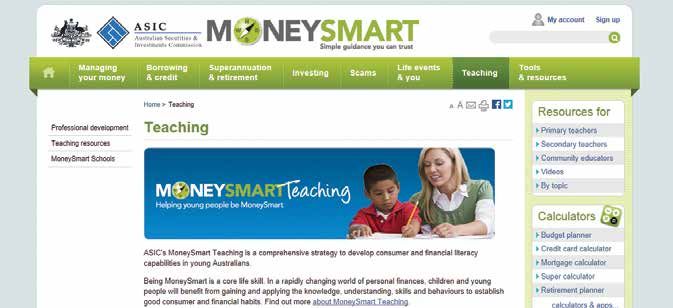
In May 2014 we brought together ASIC’s MoneySmart and MoneySmart Teaching websites into a single site.
This improved the accessibility and visibility of our resources for both teachers and parents.
The new Teaching section of ASIC’s MoneySmart.
Calculators and tools
ASIC’s MoneySmart has a comprehensive suite of calculators so people can
find fast answers to their money questions.
Our website features 26 financial calculators and three mobile apps. In 2013–14 most of our interactive
tools were made mobile-responsive, including our budget planner, credit card calculator and interest-free
deal calculator. This has made them even more popular, giving people a better user experience on mobile
phones and tablets.
Mortgage calculator rebuild
In April 2013 we converted our Mortgage calculator from Flash to HTML format, making it accessible across
all devices. The new format also improved the calculator’s search engine optimisation and our calculator
reached and held the number one position during 2013–14 in Google search for ‘mortgage calculator’.
ASIC’s financial literacy program 2013–14 13Top calculators
Budget planner 70,000 Mortgage calculator 64,000
views views
per month per month
Compound interest calculator 24,500
views
per month
Income tax calculator 36,500
views
per month
Retirement planner 19,000
views
per month
14 ASIC’s financial literacy program 2013–14Videos
The videos on ASIC’s MoneySmart website
communicate important money messages in an
engaging visual format.
There have been over 184,000 views of our
265 videos since the launch of the website, with
70,000 views this year. Our most popular video is
on budgeting with more than 9,500 views this
year.
Heidi and Andrew from ASIC’s MoneySmart team give
budgeting tips in our most popular video.
Social media
We encourage people to join in conversations
about money using ASIC’s MoneySmart social
media platforms.
By the end of 2013–14, we had 26,700 Facebook
page likes, 4,900 Twitter followers and had
reached around 1.2 million people via Twitter.
Facebook community
Our Facebook community is 77% female and
predominantly aged between 25 and 44. Many
are household money managers who regularly
discuss money management issues in their online
networks.
Our savings goals post reached close to 860,000 people.
Twitter community MoneySmartTeam @MoneySmartTeam - May 21
Using direct debits to pay your bills can be convenient but
Our Twitter followers are 71% male and are made up of a mix of financial
can have someservices professionals
pitfalls. Read and
our tips here: bit.ly/1nayazi
individuals from all walks of life. Here are some of our most popular tweets, showing reach (number of times
MoneySmartTeam @MoneySmartTeam - May 21
a tweet is seen on Twitter) and engagement (number of replies, retweets
Using direct and
debits mentions).
to pay your bills can be convenient but
MoneySmartTeam
can @MoneySmartTeam
have some pitfalls. - Apr 24
Read our tips here: bit.ly/1nayazi
MoneySmartTeam @MoneySmartTeam - May 21 Why don’t Australians make more voluntary contributions to
Using direct debits to pay your bills can be convenient but their super? This study gives an insight: goo.gl/CFGrgm
can have some pitfalls. Read our tips here: bit.ly/1nayazi
MoneySmartTeam @MoneySmartTeam - May 21 MoneySmartTeam @MoneySmartTeam - Apr 24
Using direct debits to pay your bills can be convenient but Why don’t Australians make more voluntary contributions to
can have some pitfalls. Read our tips here: bit.ly/1nayazi MoneySmartTeam
their @MoneySmartTeam
super? This study - Apr
gives an insight: 21
goo.gl/CFGrgm
MoneySmartTeam @MoneySmartTeam - Apr 24 Don’t be #fooled today! Check out MoneySmart’s tips to
Why don’t Australians make more voluntary contributions to protect yourself from scams here:
Reachedtheir
1,548 people,
super? 31 engagements.
This study gives an insight: goo.gl/CFGrgm Reachedmoneysmart.gov.au/scams/avoiding...
1,672 people, 37 engagements.
MoneySmartTeam @MoneySmartTeam - Apr 24 MoneySmartTeam @MoneySmartTeam - Apr 21
Why don’t Australians make more voluntary contributions to Don’t be #fooled today! Check out MoneySmart’s tips to
their super? This study gives an insight: goo.gl/CFGrgm protect yourself from scams here:
MoneySmartTeam @MoneySmartTeam - Apr 21 MoneySmartTeam @MoneySmartTeam - Mar 12
moneysmart.gov.au/scams/avoiding...
Don’t be #fooled today! Check out MoneySmart’s tips to It takes 33 years and costs 412K in interest to pay off a $5K
protect yourself from scams here: credit card debt if you just pay the minimum per
moneysmart.gov.au/scams/avoiding...
MoneySmartTeam @MoneySmartTeam - Apr 21 month: moneysmart.gov.au/tools-and-reso...
Don’t be #fooled today! Check out MoneySmart’s tips to MoneySmartTeam @MoneySmartTeam - Mar 12
Reachedprotect
6,440yourself
people, 37scams
from engagements.
here: ReachedIt3,750 people,
takes 33 38costs
years and engagements.
412K in interest to pay off a $5K
moneysmart.gov.au/scams/avoiding... credit card debt if you just pay the minimum per
MoneySmartTeam @MoneySmartTeam - Mar 12 month: moneysmart.gov.au/tools-and-reso...
It takes 33 years and costs 412K in interest to pay off a $5K
credit card debt if you just pay the minimum per ASIC’s financial literacy program 2013–14 15
month: moneysmart.gov.au/tools-and-reso...
MoneySmartTeam @MoneySmartTeam - Mar 12
It takes 33 years and costs 412K in interest to pay off a $5KFeedback
We received over 2,500 feedback queries this year and responded to 90% of
these within 24 hours.
Feedback provides many useful insights from ASIC’s MoneySmart audience, including suggestions for new
website content and technical questions about our apps and calculators. We use feedback as a way to
continually improve our content and resources.
‘I love this website it’s fantastic.
I struggled for years trying to get
control of my budget, tracking ‘I just wanted to let you know how
my spending and our super and helpful I find your website. It’s
this site is by far the best.’ easy to use, the info is unbiased
and straightforward. It’s an
excellent tool for people at any
Sandra
financial stage of life.’
Janet
‘I like the TrackMySpend app.
Makes me think about my
spending habits and promotes
discussion within my family.’ ‘Found I had better control and
money left over at my next pay
date.’
Michele
Kiki
‘Thank you very much for
providing very useful, simple ‘Always helpful, informative and
to understand, trustworthy, interesting.’
unbiased and constructive money
management information to
Phyll
the public from a trusted and
respected source – ASIC!’
Victor
16 ASIC’s financial literacy program 2013–14Publications
ASIC’s MoneySmart publications have increased in popularity over the last year.
In 2013–14 we distributed more than 550,000 publications, an increase of 230,000 from the previous year.
Our publications can be ordered for free from our website.
Top publications
1. Managing your money
A guide to help you take control and make the most of your 81,000
money, with a foldout budget planner. copies
2. Do you need urgent help with money?
A brochure on where to go for help when you’re having money 59,000
problems. copies
3. Credit, loans and debt
Booklet about how to stay out of trouble when you borrow 45,000
copies
money.
4. Dealing with debt
Your rights and responsibilities when dealing with debt. 25,000
copies
5. Super decisions
Choosing a fund, investment strategies and building your super. 24,000
copies
6. Investing between the flags
A practical guide to investing. 21,000
copies
7. To the max
Comic for young people on credit, mobile phones, loans and 21,000
copies
owning a car.
8. Financial decisions at retirement
How to make the most of your money in retirement and avoid 20,000
copies
costly mistakes.
9. You can complain
A guide to dealing with disputes over financial products. 17,000
copies
10. Financial advice and you
A guide to choosing and working with an adviser. 16,000
copies
ASIC’s financial literacy program 2013–14 17Promotions and campaigns
Our promotions and campaigns raise awareness of ASIC’s MoneySmart and
how we can help people with their personal finances.
Here are some highlights of the campaigns ASIC ran in 2013–14 to focus people’s attention on money
matters.
Net worth campaign
Our net worth campaign ran in January 2014, a time of year when people make New Year resolutions and
think about their financial goals. We encouraged people to use our net worth calculator to assess how well
they’re doing financially and make plans for the future.
Credit card campaign
In March 2014 we ran a campaign to help
people get smarter with their credit cards. Roy
Morgan research showed that middle income
earners, managers and degree-qualified
people were most likely to carry $5,000 or
more in credit card debt, compared to the
general population.
We encouraged people to use our credit card
calculator to work out how long it would take
to pay off their balance if they only made the
minimum monthly repayments. People shared
their stories about overcoming credit
problems to help and inspire others.
ASIC’s MoneySmart home page during the campaign.
18 ASIC’s financial literacy program 2013–14Wedding costs campaign
February is typically a big month for engagements
and so was the perfect time for us to run a wedding
costs campaign, a major cost for many.
The campaign helped people think about how
important it is to plan ahead when building a life
together.
We encouraged people to spend wisely on the big
day so they had money left over for a home deposit
or other things on their wish list.
Our infographic showed what people spend on
weddings and how they pay for them, which started
interesting conversations on social media. There
were almost 7,000 visits to the infographic from
February until June 2014.
Infographic from our wedding campaign.
Advertising
Our advertising campaigns to promote ASIC’s MoneySmart have increased
awareness and use of our tools and resources.
Brighter financial future campaign
ASIC’s June 2014 advertising
campaign ‘A brighter financial
future is in your hands’ targeted
younger families thinking about
their financial future and
people aged 45–60 planning
for retirement. Campaign
creative materials used ASIC’s
MoneySmart compass needle.
The campaign featured
‘Shopalite’ panels in large retail
shopping centres as well as
advertising in weekend
newspapers.
Shopping centre panels.
ASIC’s financial literacy program 2013–14 19MoneySmart
DIT CARD CALCULATOR BANNER ADS: 3. MORTGAGE CALCULATOR
MREC
We also encouraged people to use ASIC’s MoneySmart calculators and apps using digital advertising.
The ads achieved a high ‘click-through rate’ (CTR) of between 0.07% and 0.26%, higher than the 0.05%
CTR benchmark. A higher CTR indicates a stronger impact.
CREDITTRACK CHECK YOU’VE
CREDIT CHECK YOU’VE
CARDWHERE
DEBT YOUR GOT YOUR
CARD DEBT GOT YOUR
SPINNINGMONEY’S
OUT MORTGAGE
SPINNING OUT MORTGAGE
OF CONTROL?
GOING ON TRACK
OF CONTROL? ON TRACK
Download our free TrackMySpend App Our Credit Card Calculator can help Use our Mortgage Calculator
Authorised by the Australian Government, Capital Hill, Canberra. Authorised by the Australian Government, Capital Hill, Canberra. Authorised by the Australian Government, Capital Hill, Canberra.
Pointer rotates. Pointer stops to point at click through button as it appears. Pointer rotates.Pointer stops to point at click through button as it appears. Pointer stops to point at click through button as it appears.
Digital advertising.
We promoted a range of Facebook posts to specific types of users defined by age, gender and family
status. The promoted posts achieved a very high CTR of 1.058%. We also gained 4,026 Facebook likes
during the campaign period.
Promoted Facebook posts.
20 ASIC’s financial literacy program 2013–14ASIC’s MoneySmart Teaching program
moneysmart.gov.au/teaching
ASIC’s MoneySmart Teaching program teaches young people good money
habits and gives them essential skills for life.
About the program
ASIC’s MoneySmart Teaching is a financial literacy
education program for primary and secondary
students and their teachers, supported by state
and territory education authorities and the
Australian Council of State School Organisations.
The program builds on the successful ‘Helping Our
Kids Understand Finances’ trial which provided
financial literacy training to over 8,000 teachers.
It recognises and supports Australian schools
that help their students develop good money
habits, and promotes the importance of consumer
and financial literacy to families and their local
communities.
The program helps young people to: Illustration used in ASIC’s MoneySmart Teaching brochure to
show the path young people take to smarter money choices.
¡¡ understand the language of money and navigate
the consumer and financial landscape ¡¡ understand risk and reward while exercising
consumer rights and responsibilities
¡¡ plan the management of their finances in order
to spend, save, donate and invest wisely ¡¡ develop enterprising behaviours.
Education partnerships Professional learning for teachers
ASIC’s MoneySmart Teaching is delivered through ASIC delivered professional learning to over 2,500
a National Partnership Project Agreement teachers across Australia this year. We are on track
(2013–17) in six states and territories: New South to meeting our target of training 20,000 teachers
Wales, Victoria, Western Australia, South Australia, over 4 years.
Queensland and the Northern Territory. With
ASIC‘s MoneySmart Teaching professional
education department endorsement, ASIC
development aligns with the Australian
engaged directly with schools in Tasmania and the
Professional Standards for Teachers. Workshops,
Australian Capital Territory to ensure a national
refined in response to teacher feedback from the
approach.
program’s trial phase, are now used in schools to
Models of implementation vary in each state and support professional learning for teachers.
territory, with a number of states employing a
project officer to deliver the program across each
education sector.
ASIC’s financial literacy program 2013–14 21ASIC’s MoneySmart Schools
program
ASIC’s MoneySmart Schools program recognises
and supports Australian schools that help their
students develop good money habits.
The program also promotes the importance of
consumer and financial literacy to families and their
local community.
Becoming an ASIC MoneySmart School has many
advantages:
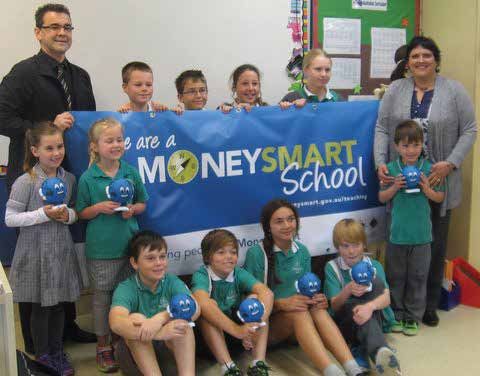
¡¡ Professional development – Schools receive ASIC MoneySmart School Singleton Primary (WA) students,
ongoing staff development and leadership Project co-ordinator Sheila Griffin and visiting NZ teacher
Gavin Parratt.
opportunities
¡¡ Showcase school initiatives – Schools get
¡¡ Implementation guidance and support –
the opportunity to showcase their consumer
Schools are given guidance with training,
and financial literacy initiatives on ASIC’s
curriculum implementation and community
MoneySmart website.
engagement approaches
¡¡ Promotional support – Schools receive public Schools can register online to join the program
relations and marketing support to promote through ASIC’s MoneySmart website.
commitment to consumer and financial literacy
education in the school and local community
ASIC MoneySmart
School: Wingham High
Wingham High School is an ASIC
MoneySmart School in country
NSW that took a whole of school
approach to consumer and
financial literacy in all learning
areas including their annual school
production.
The Year 9 Music, Art and Drama
students were employed to
produce the annual play. They
kept timesheets and were paid
accordingly. Students designed Wingham High School staff and students consider the costs of staging the
school production.
posters, tickets, costumes and
props, and were responsible
for choreography, hair and make up. They also and made financial recommendations for next
gained an awareness of copyright and other legal year’s production.
requirements.
In addition, consumer and financial literacy is
At the end of the production, students analysed included in the Year 10 Authentic Assessment and
expenditure and income to determine profit, features in their final report learning outcomes.
22 ASIC’s financial literacy program 2013–14ASIC’s MoneySmart Teaching resources
ASIC has developed teaching resources for students of all ages from primary
school to apprentices.
Units of work for primary and
secondary schools
Nineteen units of work for primary and secondary
students were made available in English,
Mathematics and Science. In 2013–14 almost 18,000
were downloaded and over 4,500 classroom
resources were distributed to teachers attending
ASIC’s professional development workshops.
Mathematics units of work for
Years 1–3
Maths units for Year 1, 2 and 3 students were also
released this year. These units use a storytelling
approach to introduce such concepts as:
Images from the Year 1 Mathematics unit ‘Bertie’s socks’.
¡¡ money as a finite resource
¡¡ responsible shopping
¡¡ fundraising and saving money
¡¡ recognising and handling currency while adding, subtracting and multiplying.
ASIC’s MoneySmart Teaching videos
Our videos can be used as classroom resources and to help teachers with their professional development.
This year there were 28,837 views of ASIC’s MoneySmart Teaching videos.
Digital activities
Our digital activities were viewed or downloaded in classrooms around Australia 12,823 times this year.
‘I trialled the unit of work this ‘I loved seeing the students
term with my Year 2 Number heavily involved in their learning
Group, with amazing results. We in a hands on way. It was also
concluded our term/unit with a great to see families joining in
fundraiser consisting of a money and encouraging the students in
museum and cake stall raising their learning.’
over $450! Little people can
achieve amazing things!’ Teacher, Amaroo Primary School
About the Foundation to Year 2
resource, ‘Pancakes make a difference’
Teacher, Waniora Public School
About Year 2 resource, ‘Keiren’s coin’
ASIC’s financial literacy program 2013–14 23ASIC’s MoneySmart Town game
Role play real-life money decisions in
a virtual world.
ASIC’s MoneySmart Town is a money management
role-playing game for primary students. Students
who play the game choose a family, home and job
and learn how to manage money using a series of
challenges. They earn an income, go shopping,
bank money and make consumer and financial
choices. Teachers can access the game through
Skooville, a secure web environment where children
are protected while learning and communicating
with their peers. ASIC’s MoneySmart Town game
was played by 4,612 students in 120 schools this
year. ASIC’s MoneySmart Town.
Personal financial learning for teachers
ASIC’s Financial Health for Teachers program is designed to enhance the confidence of teachers in the
classroom and at home. The program includes a range of practical videos featuring teachers, covering
topics such as saving for a home, living on one salary and preparing for retirement. The videos can be
accessed on the ASIC’s MoneySmart website.
Teaching resources for apprentices and trainees
Helping apprentices be smarter about money.
ASIC is developing five online modules to support ASIC has collaborated with the Australian Taxation
the delivery of the Certificate III ‘Be MoneySmart’ Office and industry representatives on the online
unit of competency from the Financial Services modules which will be published in early 2015,
Training Package. They aim to help apprentices together with a trainer guide and student
and trainees make sound money choices and workbooks.
support the completion of their training.
The modules include:
¡¡ Saving, budgeting and spending
¡¡ Personal tax
¡¡ Superannuation
¡¡ Debt management
¡¡ Insurance.
Image from the Be MoneySmart online modules for apprentices
and trainees.
24 ASIC’s financial literacy program 2013–14asic.gov.au | moneysmart.gov.au | ASIC Infoline: 1300 300 630
© Australian Securities and Investments Commission 2014 | ISBN 978-0-9805533-4-5
ASIC’s
Financial guidance you can trustYou can also read


