Assessment of herpetofauna diversity and human-herpetofauna-interaction in district Sudhnoti, Azad Jammu and Kashmir, Pakistan
←
→
Page content transcription
If your browser does not render page correctly, please read the page content below
E
                                     Journal of Wildlife and Ecology (2020). 4(4):156-163
                                                                                                        W
Research Paper                                                                                  Open Access

      Assessment of herpetofauna diversity and human-herpetofauna-
        interaction in district Sudhnoti, Azad Jammu and Kashmir,
                                   Pakistan
                                         Umara Noor1 and Rahima Haider1*
       1.   Department of Zoology, Women University of Azad Jammu and Kashmir, Bagh, Pakistan

       *Corresponding author e-mail: rahimahaiderkhan1@gmail.com
                                               ABSTRACT
     The Pakistan consists of three large mountains ranges i.e. Hindukush, Himalayas, and
     Karakorum. This mountainous landscape has greatly affected the climate, geology and
     hydrology; and played a vital role in current era for distribution and composition of fauna and
     flora of an Indo-Pakistan. The main objectives of the study are to know the diversity and
     ethnopharmacological applications of amphibians and reptiles of Sudhnoti, Azad Jammu and
     Kashmir, Pakistan. The linear count method is applied and amphibian and reptilian diversity
     is assessed through direct and indirect counts. The direct count is documentation of physical
     presence and voices while indirect count is citation of carcasses and group questionnaire
     survey. Binocular (32x50) is used to observe the animals. Book “Amphibian and reptiles of
     Pakistan” is consulted to correctly identify the species. For the statistical analysis PAST
     version 2.17C is used to find out the Simpson diversity (S), Shannon diversity (H´), Evenness
     (E), Margalef (R) and Dominance (D). During the research 22 species are noted from
     Sudhnoti and Laudakia agrorensis is the most common (R.A=0.156) species of the area. The
     dominance of the study area is recorded as: Dominance (0.06474), Simpson (0.9353),
     Shannon (2.937), Evenness (0.82), and Richness (5.714). During the study noted that
     different herpetofauna is used in different medicinal uses as; fat of common krait, Himalayan,
     leopard gecko, Bengal monitor, rope snake, yellow belly common house gecko is used to
     treat skin infection, backbone, epilepsy, impotency and snake bite.

     Keywords: Diversity, Folklore, Amphibians, Reptiles

     Citation: Noor, U., R. Haider. 2020. Assessment of herpetofauna diversity and human-herpetofauna-interaction
     in district Sudhnoti, Azad Jammu and Kashmir, Pakistan. Journal of Wildlife and Ecology. 4: 156-163.
     Received: 11, 09, 2020, Accepted: 22, 10, 2020, Published: 30, 12, 2020

                                                     INTRODUCTION
                      The Pakistan consists large mountains ranges i.e. the Hindukush, the Himalayas,
                      and the Karakorum (Roberts, 1997). This mountainous landscape has greatly
                      affected the climate, geology and hydrology; and played a vital role in current era
                      for distribution and composition of fauna and flora of an Indo-Pakistan (Khan,
                      2004, 2006). Herpetofauna feed on the insects (Hardy and Crnkovic, 2006).
                      Coastal beaches are used by many species of sea turtle, i.e. dermochelys coriacea,

   156                                             Noor and Haider, 2020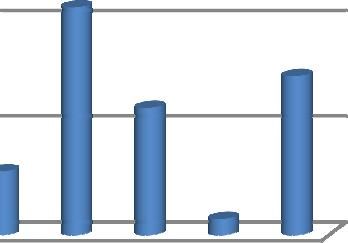
Journal of Wildlife and Ecology (2020). 4(4):156-163

      Chelonia mydas and Lepidocheyls olivacea in Pakistan. They are hunted for eggs
      by human, most of the sea turtle are reduced whole world, and many species are
      on threshold of extinction (Das, 1991). The inland turtle are having similar human
      pressure due to deforestation and frequent anthropogenic impact in their
      environment. The shallow rivers in Punjab almost continuously flow during the
      rainy season, disturbing river nature and turtle metapopulation. Fresh water
      turtle’s eggs are hunted, turtle meat and soup is a popular dish and recommended
      by native physicians a use for several diseases (Khan, 1979; Altaf et al., 2020).
               Some people are energetically participating in damage of reptilian species.
      They contract in the deal of wild animals, reptiles and other. Generally recognized
      as “sanyasies”, “gagras”, and “Tapri- was,” they have menaced the natural
      reptilian population all over Pakistan (Khan, 1993). The harshly and continually
      hound numerous reptilian species like varanus bengalensis, varanus griseus,
      uromastyx hardwickii, uromastyx asmusii,Trapelus agilis, Python molurus, Ptyas
      muscocus, spalerosophis diadema,etc. Additionally, the remains of these reptiles
      are in large requirement in common markets, as national physicians utilize them
      in research of recipes for treatment of numerous general ailments (Khan, 1993,
      2000; Altaf et al., 2020). Scincid population belonging to genera Ophiomorus,
      Novoeumeces Mabuya and Eurylepis, are in mostly demand in limited markets
      since they are required following by a high cost by “hakims.”To set up a hold for
      market, the animals are eviscerated living ,dehydrated in the sun ,and sold at high
      cost as “reg mahi,” an essential component of recipes which are called strong sex
      promoters (Khan, 1997). The body fat of different reptiles is thought to have
      healing characteristic for numerous diseases and is extensively used in research
      (Vohora and Khan, 1979, Khan, 1991; Khan, 2000; Altaf et al., 2018).
      Hoplobatrachus tigerinus and Uromastyx hardwickii are mostly used in the
      research laboratories and educational departments in Pakistan. Mostly reptiles are
      used to express anatomy, and physiological experiments; Uromastyx hardwickii
      collected from burrow, while Hoplobatrachus tigerinus is collected from puddles
      and ponds. Euphyctics cyanophlyctis microspinulata is depleted in Baluchistan
      and from different areas in various part of Punjab and also eliminated from these
      areas (Khan, 1990, 1991).
               Venomous snakes i.e. Naja naja, Bungarus caeruleus, Naja oxiana,
      Daboia russelii and Echis carinatus are provided in different health departments
      for venom and making of antivenin. The snakes are kept in overcrowded pens
      under bad conditions. Those that yield to bad situation are burned. Generally
      public herpetofauna especially snake on first sight, since all herpetofauna species
      are considered as poisonous and philosophy of all victims of is as “Kill it before it
      harms you”. Many of reptiles and amphibians are injured or killed on roads.
      (Khan, 1990) recorded data pertaining to road killed Bufo stomaticus. While many
      species, i.e. Fujervarya limnochairs, Euphlyctis cyanophlyctis, Calotes versicolor,
      Varanus griseus, Varanus bengalensi and turtles are injured or killed by bad
      drivers for fun and for the enjoyment of passengers. The vehicle is maneuvered to
      damage or kill the herpetofauna; it probability to cross road at same time (Khan,
      1993). The main objectives of the study are to know the diversity and

157                          Noor and Haider, 2020
Journal of Wildlife and Ecology (2020). 4(4):156-163
ethnopharmacological applications of amphibians and reptiles of Sudhnoti, Azad
Jammu and Kashmir, Pakistan.
MATERIALS AND METHODS
Data are collected from January 2017 to December 2019 from Sudhnoti, Azad
Jammu and Kashmir, Pakistan.
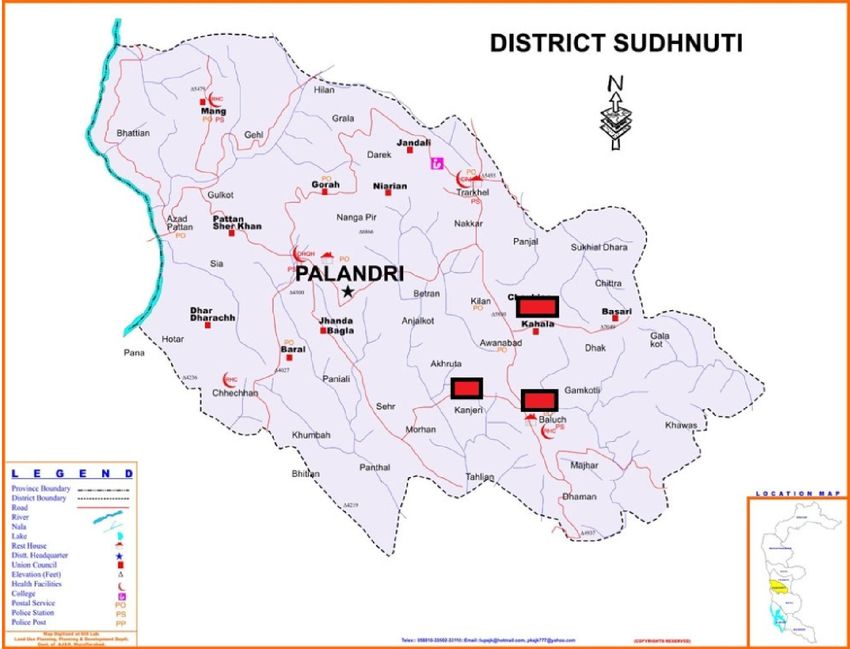
Figure 1: Map of the study area.
STUDY AREA
The district is divided into four tehsils i.e. Balouch, Trarkhal, Mang and Palandri
(Figure 1). Sudhnoti has a population of 242,000. Awan, Khwaja, Sudhan,
Qureshi, Mughal, Dar are main tribes of this area (Figure 1). Sudhnoti is one of
the eight districts of Azad Kashmir in Pakistan. Sudhnoti is located at Latitude 33o
42’ 54” and Longitude 73o 41, 9”. It is located 90 kilometer away from
Islamabad, the Capital of Pakistan. It is connected with Rawalpindi and Islamabad
through Azad Pattan road. Weather of this district is pleasant throughout the year.
Temperature in summer is almost 20 to 35o centigrade and in winter 2o centigrade.
In winter, one may see snow on Mountains. Snow fall occur in; Balouch,
Trarkhal, Qilan, Thill, Bethak, Baryote, Javali.
158 Noor and Haider, 2020Journal of Wildlife and Ecology (2020). 4(4):156-163
ASSESSMENT OF AMPHIBIAN AND REPTILIAN DIVERSITY
The linear count method is applied and amphibian and reptilian diversity is
assessed through direct and indirect counts. The direct count is doc
documentation of
physical presence and voices while indirect count is citation of carcasses and
group questionnaire survey (Altaf, 2016). Binocular (32x50) is used to observe
the animals Khan (2006) is consulted to correctly identify the species.
STATISTICAL ANALYSIS
For the statistical analysis PAST version 2.17C is used to find out the Simpson
diversity (S), Shannon diversity (H’), Evenness (E), Margalef (R) and Dominance
(D) (Hammert,
Hammert, 2001).
2001
RESULTS AND DISCUSSION
Data collected from the male (48) and female (52) respondents; all are Muslims,
mostly persons of the area having education as; Primary, Middle, Metric, FA, BA
and few have no education. During the survey noted that selected person having
different occupations
occupat i.e. housewives (51), army officers (12), laborers (32),
student (2), teacher (2) and Farmers 1. During the surveys noted that selected
person having the following age; 15 to 24 (n=43), 25 to 40 (24), 41 to 60 (3), and
51 to above 50 (30) (Figure 2).
80
60
40
20
0
Middle
Laborers
Students
FA
Matric
Sudhyalhill
Khala
Primary
Teachers
Male
Female
Illiterate
Farmers
51 to above
BA
Khangeri
15 to 24
25 to 40
41 to 50
Army officers
Housewives
Gender Education Occupation Study area Age
Figure 2:: Information of respondents of study area.
During the research noted that having 22 species recorded from Sudhnoti
as shown in Table 1. It is noted that is Laudakia agrorensis the most common
(R.A=0.156) species of these area.
159 Noor and Haider, 2020Journal of Wildlife and Ecology (2020). 4(4):156-163
Table 1: Diversity of the herpetofauna of Sudhnoti.
Scientific name Common name Urdu name Local Order Pi
Species Authority name Family
Amphiesma stolatum Striped keelback Lakeer dar Sup Squamata 0.067
Linnaeus, 1758 khar push Colubridae
Bufo himalayanus Himalayan toad Hamalayai Dad Anura 0.044
Gunther, 1864 gauk Bufonidae
Bufo Latastii Ladakh Toad Ladakhi gauk Dad Anura 0.044
Boulenger, 1882 Bufonidae
Bufo melanostictus Black-spectacled Hazara gauk Dad Anura 0.067
Schneider, 1799 Toad Bufonidae
Bufo Stomaticus Indus Valley toad Maidani gauk Dad Anura 0.022
Lutkin, 1862 Bufonidae
Bungarus caeruleus caeruleus Common krait Sangchoor Kala sup Squamata 0.022
Schneider, 1801 samp Elapidae
Daboia russelii russelii Russell's chain viper Koriala afi Sup Squamata 0.022
Shaw and Nodder, 1797 Viperidae
Eryx johni Common Sand boa Du-mohi Do-moi sup Squamata 0.022
Russell, 1801 Boidae
Fejervarya limnocharis Asian Grass Frog Pahari tidda Dad Anura 0.067
Gravenhorst, 1829 maindak Dicroglossidae
Hemidactylus flaviviridis Yellow belly Ghar chapkali Gharailo Squamata 0.022
Ruppell, 1835 common house gecko sandaila Gekkonidae
Laudakia agrorensis Agror agama / Agror wadi Kais kro Squamata 0.156
Stoliczka, 1872 Monitor lizard kirla Agamidae
Laudakia himayalayana Himalayan agma Himalayaie Rat Squamata 0.044
Steindachner, 1869 Kirla mandaila Agamidae
Laudakia pakistanica North-Pakistan Agma Pakistan Kirla Karbara Squamata 0.022
pakistanica Agamidae
Baig, 1989
Laudakia tuberculata Blue rock Agma Neela kirla Kirk ila Squamata 0.089
Hardwicke and Gray, 1827 Agamidae
Gloydius himalayanus Himalayan pit viper Himalayan Sup Squamata 0.022
Giinther, 1864 samp Colubridae
Hemidactylus brookii Brooke's house gecko Barani Sandaila Squamata 0.022
Gray, 1845 sandaila Gekkonidae
Naja oxiana Brown cobra Bhora nag Chhajla sup Squamata 0.022
Eichwald, 1837 Elapidae
Oligodon arnensis arnensis Banded kukri snake Patta kukri Sup Squamata 0.044
Shaw, 1802 saamp Colubridae
Ptyas mucosus mucosus Rope-snake Dhaman Sup Squamata 0.089
Linnaeus, 1758 Colubridae
Eublepharis macularius Leopard gecko Panj gira Sandaila Squamata 0.044
Börner, 1981 Sandaila Eublepharidae
Calotes versicolor Oriental Garden Girgit Sandaila Squamata 0.022
Daudin, 1802 Lizard Agamidae
Lycodon mackinnoni Himalayan Wolf Mackinnoni Mackinoni Squamata 0.022
Wall, 1906 Snake saamp Sup Colubridae
Varanus bengalensis Bengal monitor Bengali goh Peeli kro Squamata 0.044
Daudin, 1802 Varanidae
Himalayan toad (Bufo himalayanus) is recorded from the study area (with
relative abundance as 0.044) from the Baloch, district Sudhnoti. Ladakh Toad
(Bufo Latastii) is recorded from the study area (R.A 0.044) from the Baloch,
160 Noor and Haider, 2020Journal of Wildlife and Ecology (2020). 4(4):156-163
district Sudhnoti. Black Spectacled Toad (Bufo Melanostictus) is recorded from
the study area (R.A. 0.067) from the Baloch, district Sudhnoti. Indus Vally Toad
(Buffo Stomaticus) is recorded from the study area (R.A. 0.022) from the Baloch,
district Sudhnoti. Asian Grass Frog (Fejervarya Limnocharis) is recorded from
the study area (R.A. 0.067) Baloch, district Sudhnoti. Himalayan agma (Laudakia
himayalayana) is recorded from the study area (R.A. 0.044) from the Baloch,
district Sudhnoti. North-Pakistan Agma (Laudakia pakistanica pakistanica) is
recorded from the study area (R.A. 0.022) from the Baloch, district Sudhnoti.
Bengal monitor (Varanus bengalensis) is recorded from the study area
(R.A. 0.044) from the Baloch, district Sudhnoti. Common Sand boa (Eryx johni)
is recorded from the study area (R.A. 0.022) from the Baloch, district Sudhnoti.
Striped Keelback (Amphiesma stolatum) is recorded from the study area (R.A.
0.067) from the Baloch, district Sudhnoti. Rope-snake (Ptyas mucosus mucosus)
is recorded from the study area (R.A. 0.089) from the Baloch, district Sudhnoti.
Common krait (Bungarus caeruleus caeruleus) is recorded from the study area
(R.A. 0.022) from the Baloch, and district Sudhnoti. Agror agama (Laudakia
agrorensis) is recorded from the study area (R.A. 0.156) from the Baloch, district
Sudhnoti. Blue rock Agma (Laudakia tuberculata) is recorded from the study area
(R.A. 0.089) from the Baloch, district Sudhnoti. Yellow belly/ common house
gecko (Hemidactylus flaviviridis) is recorded from these study area (R.A. 0.022)
from the Baloch, district Sudhnoti. Russell's chain viper (Daboia russelii russelii)
is recorded from the study area (R.A. 0.022) from the Baloch, district Sudhnoti.
Brown cobra (Naja Oxiana) is recorded from the study area (R.A. 0.022) from the
Baloch, district Sudhnoti.
Table 2: Diversity indices of collected data.
Diversity Indices Values
Species 23
Individuals 47
Dominance (D) 0.06474
Simpson (S) 0.9353
Shannon (H') 2.937
Evenness (E) 0.82
Margalef/ Richness (R) 5.714
The dominance of the study area is recorded as: Dominance (0.06474),
Simpson (0.9353), Shannon (2.937), Evenness (0.82), Margalef /Richness (5.714)
(Table 2).
During the study noted that different herpetofauna used in different
medicinal uses as; fat of common krait, Himalayan, leopard gecko, Bengal
monitor, rope snake, yellow belly common house gecko is used to treat skin
infection, backbone, epilepsy, impotency and snake bite (Table 3).
161 Noor and Haider, 2020Journal of Wildlife and Ecology (2020). 4(4):156-163
Table 3: Medicinal use of Herpetofauna.
Species Part use/mode of application Medicinal use
Common krait Fat/Topical Backbone
Himalayan agama Fat/Topical Impotency
Leopard gecko Fat/Topical Snakebite
Bengal monitor Fat/Topical Joint pain
Rope Snake Fat/Topical Epilepsy
Yellow belly common house gecko Fat/Topical Skin infection
REFERENCES
Altaf, M., A.M. Abbasi, M. Umair, M.S. Amjad, K. Irshad, A.M. Khan. 2020.
The use of fish and herptiles in traditional folk therapies in three districts
of Chenab riverine area in Punjab, Pakistan. J Ethnobiol Ethnomed. 16: 1-
21.
Altaf, M., M. Umair, A.R. Abbasi, N. Muhammad, A.M. Abbasi. 2018.
Ethnomedicinal applications of animal species by the local communities
of Punjab, Pakistan. Journal of ethnobiology and ethnomedicine. 14: 55.
Altaf, M. 2016. Assessment of Avian and Mammalian Diversity at Selected Sites
along river Chenab. PhD thesis submitted, University of Veterinary and
Animal Sciences, Lahore-Pakistan.
Das, 1991. Colour Guide to the Turtles and Tortoise of the Indian Subcontinent. R
and A Publishing Limited, Prosthead, England.
Hammert, Q., D.A.T. Harper, P.D. Ryan. 2001. Past paleontological statistical
software package for education and data analysis. Palaeontol. stat.: 4.
Khan, M.S. 1979. On a collections of amphibians from northern Punjab and Azad
Kashmir,with ecological notes.Biologia.25(1-2):37-50.
Khan, M.S. 1980.Affinities and Zoogeography of herpetiles of Pakistan.Biologia.
26(1):113-171.
Khan, M.S. 1990.The impact of human activities on the status and distribution of
amphibians in Pakistan.Hamadryad.15(1):21-24.
Khan, M.S. 1991.Endangered species of reptiles of Pakistan and suggested to
conservation measures,in: Handbook published to mark second seminar on
Nature Conservation and Environment Protection, 12March. 1991,
Islamabad.Pakistan Wildlife Conservation Foundation.
Khan, M.S. 1993. Sar Zameen-a-Pakistan kay saanp (Snakes of Pakistan) Urdu
Science Board,299 Upper Mall,Lahore.
Khan, M.S. 1997.Biodiversity of geckonid faunaof Pakistan.pp.383-389. In
Biodiversity of Pakistan. (S.A.Muff.C.A.Woods,S.A.Hasan,Eds.Pakistan
Mus Nationlist .Islamabad and Gainesville,Florida.
Khan, M.S. 2000.Sar Zameen-a-Pakistan kay maindak aur khazinday (Frogs and
Lizards of Pakistan). Urdu Science Board.299Upper
,Mall,Lahore.Pakistan.
Khan, M.S. 2004. Annotated checklist and key to the amphibian of Pakistan.
Biologia. 22(2), 201-210.
Khan, M.S. 2006. Amphibians and reptiles of Pakistan. Krieger Publishing
Company.
162 Noor and Haider, 2020Journal of Wildlife and Ecology (2020). 4(4):156-163
Roberts, T.J. 1997. The Mammals of Pakistan. Oxford University Press. New
Yark. Hardy, L.M., A.C. Crnkovic. 2006. Diet of amphibians and reptiles
from the Engare Ondare River Region of central Kenya, during the dry
season. African Journal of Herpetology. 55: 143-159.
Competing interests: The authors have declared that no
competing interests exist.
Funding: Authors have no source of funding for this work.
Availability of data: Authors have included all data in the
manuscript that were collected during the field survey.
Authors’ contributions: Noor and Haider have designed
project, collected data and written this article.
163 Noor and Haider, 2020You can also read


