Australia's intergovernmental agreement on bushfires, floods and extreme events
←
→
Page content transcription
If your browser does not render page correctly, please read the page content below
REPORT

Australia’s intergovernmental
agreement on bushfires, floods and
extreme events

Dr Ray Canterford             Introduction                                           improvements to bushfire, flood and extreme
Former Division Head,                                                                event services; addition of further embedded
Hazard Services               Extreme meteorological and ocean-related events,       meteorologists in incident control centres
Bureau of Meteorology
                              including the tragic Victorian Black Saturday          and a high-level policy accomplishment: an
Mark Crosweller               bushfires in 2009, heat waves that preceded            intergovernmental agreement under the Council
Former Director-General       the catastrophic bushfires, and severe tropical
Emergency Management                                                                 of Australian Governments (COAG) in 2018,
Australia                     cyclones, resulted in the Australian Government        which was endorsed by state and territory
Department of Home Affairs    implementing recommendations from a                    governments and the Australian Government.
Chris Beattie                 comprehensive independent review (Bureau of            The intergovernmental agreement enshrines the
Chief Officer, South          Meteorology 2013). The review received significant     Hazards Services Forum and provides additional
Australian State Emergency    and positive response from government and the          clarity of roles and responsibilities for emergency
Service
                              Bureau of Meteorology (Bureau) over the following      management agencies at all levels of government.
                              years. One of the major recommendations and            The substantial outcomes resulting from the
Permissions information for   subsequent government response was the                 collaborative process are discussed in this paper
use of this content can be    standardisation and harmonisation of Bureau
found at https://knowledge.                                                          with a focus on shaping government and agency
aidr.org.au/ajem
                              services to jurisdictions in order to maximise         policies and operations to enhance community
                              the efficiency and value of its partnership with       safety.
                              emergency service organisations.
                                                                                     The work described here to achieve national
                              For hazard warning systems to be effective, they       consistency and standards across major hazards,
                              must be multi-faceted and be developed and             especially forecast and warning types, structure
                              operated collaboratively and across different levels   and technical content, will be an important input
                              of government and jurisdictional boundaries.           to the Australian Warning System, which was
                              Emergency services organisations use the Bureau’s      recently launched (see AFAC Warnings Group,
                              information, forecasts, warnings and advice to plan    Australian Institute for Disaster Resilience 2021).
                              for and manage the effects of natural hazards.         While the AWS is now in place for bushfires,
                              The Bureau worked closely with Emergency               the intergovernmental agreement and Hazards
                              Management Australia and all jurisdictions, as well    Services Forum should also assist that framework
                              as the Australasian Fire and Emergency Services        development as other hazards are introduced. The
                              Authorities Council (AFAC) and the Australian          outcomes described in this paper are essential
                              Local Government Association (ALGA) over a             to the national consistency of the forecasts and
                              period of 3 years. This was a unique opportunity       warnings for particular hazards, while the AWS
                              for a strengthened ‘natural hazards partnership’       will provide the essential national consistency of
                              similar to that in the United Kingdom. The teams       messaging and icons and calls to action. Both are
                              from all emergency services agencies and the           necessary for an effective Total Warning System.
                              Bureau established a landmark intergovernmental
                              agreement (Council of Australian Governments           Forecasting and warnings
                              2018) as well as an ongoing peak consultation
                              body: the Hazards Services Forum.
                                                                                     services
                                                                                     Economic activity and public safety are heavily
                              The work was undertaken within the Australian-
                                                                                     affected by severe weather, climate and floods.
                              New Zealand Emergency Management Committee
                                                                                     The forecasting and warning services of the
                              (ANZEMC 2020) through a joint Standardisation
                                                                                     Bureau (several million each year) are relied on
                              of Bureau of Meteorology Services Taskforce.
                                                                                     whenever there are heatwaves, fires, tropical
                              Outcomes from this work included significant
                                                                                     cyclones, gales, floods, thunderstorms, fog, frost

44      © 2021 Australian Institute for Disaster Resilience
R E P O RT

and other weather and ocean-related events such as storm surge        organisations were often handled by a small number of highly
and marine services. Further, the Bureau provides an extensive        respected and sought-after senior Bureau forecasters. These
range of other forecast and warning services, including smoke         pressures were particularly acute during protracted severe
and radiation atmospheric modelling, volcanic ash warnings            weather events. The pressure on the Bureau to satisfy a wide-
for aviation, space weather services and tsunami warnings and         ranging client base was particularly evident during the severe
advisories for Australia and the Indian Ocean region. In addition,    weather season of 2010–11 that included severe floods in many
the Bureau provides extensive climate services such as seasonal       parts of Australia, tropical cyclones (including Cyclone Yasi) and
outlooks. The effects of extreme weather in Australia, combined       bushfires in Western Australia. These incidents, including an
with its growing population, infrastructure and assets, has           international response to the Fukushima tsunami and associated
increased demand on the services offered by the Bureau.               nuclear radiation fallout modelling, demonstrated the increasing
                                                                      demand for Bureau services and the sustained pressure this can
The Bureau’s mission is to 'provide trusted, reliable and
                                                                      produce.
responsive weather, water, climate and ocean services for
Australia - all day, every day'. In undertaking this mission, the     The Australian Government appointed Ms Chloe Munro to
Bureau has partnerships with state and territory emergency            undertake the review with a support team from other agencies.
services organisations to ensure the safety and resilience of         The review noted the imbalance between demand and the
Australian communities.                                               Bureau’s capacity to deliver critical services to states and
                                                                      territories and Australian Government agencies. Among other
The 2011 review (Bureau of Meteorology 2013) examined the
                                                                      findings, the review recommended boosting the numbers of
Bureau’s capacity to respond to future extreme weather and
                                                                      frontline hydrologists and meteorologists. Additionally, the
disaster events and to provide seasonal forecasting services.
                                                                      review noted that:
The review identified 13 priority actions to mitigate risks and 16
options that could provide savings and enhance efficiency. The        ·   further storm surge experts were necessary for high-risk
first 2 priority actions - bolstering meteorologist and hydrologist       regions, especially along the Queensland coastline
numbers and upgrading flood warning systems, were addressed           ·   a review of Space Weather services was necessary
by the Bureau with Australian Government support.                     ·   an extreme weather centre should be considered
In response to the review, the Australian Government, in              ·   standardisation of Bureau services across all jurisdictions
partnership with the states and territories, progressed the other         was a priority (taking into account differing climate and
issues raised under:                                                      hazard regimes to optimise current and future services in a
·   Priority Action 3: formalise and standardise service levels           sustainable approach).
    provided to emergency services                                    Consistent with review recommendations to formalise service
·   Priority Action 4: agree clear allocation of responsibilities     levels with emergency services agencies, the Australian
    to state and local government for flood management, with          Government agreed to standardise many bespoke services.
    defined boundaries on the Bureau's role
                                                                      One of the issues highlighted in the review related to the issuing,
·   Option 21: apply a consistent cost-recovery model to all          interpretation and dissemination of flood warnings. The review
    supplementary services delivered to state/territory fire          identified a lack of clarity regarding roles and responsibilities,
    agencies.                                                         inconsistent arrangements across jurisdictions and the absence
This was achieved through the ANZEMC establishing the                 of binding agreements on service levels in relation to flood
Standardisation of Bureau of Meteorology Services Taskforce           management. This situation had the potential to cause confusion
on 4 October 2013, which then reported to the Law, Crime and          and elevate the risk that not all communities would have access
Community Safety Council (LCCSC) of COAG in 2015.                     to the highest standard level of information.

The Munro Review and the                                              Standardisation of forecast and
government response                                                   warning services
In the years leading up to the 2009 Black Saturday bushfires, the     The Bureau’s weather, flood and ocean forecasting and warning
Bureau had been developing high-resolution weather modelling          services, as well as critical climate services, are essential to
as well as expanding its interactions and collaboration with fire     decision-making, especially for emergency management.
and emergency services organisations. This included specialist        Australia’s states and territories have, historically, had different
severe weather meteorologists being embedded in some                  needs and governance structures for emergency management.
incident control centres. Additionally, the Bureau was an active      The evolution of locally focused arrangements and models of
partner in the Bushfire CRC (and the following Bushfire and           operation had resulted in variations in the services provided by
Natural Hazards CRC), which enabled fire weather research to be       the Bureau. These variations led to increasing complexity in the
advanced and adopted into services.                                   delivery of services and were inhibiting its ability to effectively
                                                                      meet expectations and respond nationally to concurrent hazard
It was recognised that during extreme weather events, briefing        events.
requests from representatives from government and media

                                               Australian Journal of Emergency Management      Volume 36     No. 1    January 2021       45
REPORT

The taskforce recommended that the Bureau standardise its                 ·   producing an intergovernmental agreement under COAG on
hazards services and allocated responsibilities across the Bureau,            the ‘Provision of Bureau of Meteorology Hazard Services to
states, territories and local governments for flood management.               the States and Territories’
The taskforce provided an implementation plan that was                    ·   establishing the Hazards Services Forum
endorsed by the ANZEMC and the LCCSC. Additionally, the                   ·   creating a services-focused National Flash Flood Information
taskforce recommended a time-limited working group to focus                   Repository
on flood warning infrastructure and risk-based network planning.
                                                                          ·   establishing the National Flood Warning Infrastructure
The taskforce members from state and territory emergency                      Working Group.
services agencies were at the senior operational and policy
levels (Deputy Commissioner, Chief Officer, CEO) as well as the           ANZEMC, and subsequently the LCCSC, agreed to all
CEO of AFAC and the Senior Policy Advisor of the Australian               recommendations, including the intergovernmental agreement
Local Government Association. The Australian Government was               to provide the Bureau’s hazard services to states and
represented at Division Head level by the Bureau and Emergency            territories. Figure 1 shows the 9-year timeline (2009–18) of
Management Australia (part of the Attorney-General’s                      the major event triggers and the critical steps to establishing
Department at the time and now within the Department of                   the intergovernmental agreement. These steps included the
Home Affairs). The taskforce members’ roles and contributions to          2011 review, the Australian Government response and the
this work were critical and enabled an effective decision-making          ANZEMC Standardisation Taskforce Report in 2015 and the
body for the standardisation to be overwhelmingly successful.             intergovernmental agreement in 2018.
The taskforce was very effectively supported by working groups            A substantial action agenda was established to achieve the
of senior officers in all jurisdictions who specialised in fire, flood,   agreed standardisation of the 117 services. In accordance with
extreme weather events and community understanding and                    the intergovernmental agreement, the ongoing Hazard Services
response to warnings.                                                     Forum was established to:
The taskforce was operational for 3 years and used face-to-face           ·   complete the remaining standardisation actions of the
and video meetings as well as numerous working group meetings                 taskforce
to examine the substantial jurisdictional variations in fire, flood       ·   consult with state and territory emergency services agencies
and extreme weather services. The key achievements were:                      on current and future development of the Bureau’s hazard
·    standardising 117 of the 129 (subsequently updated to 131)               services
     identified hazard services provided by the Bureau to states          ·   provide advice to the Bureau on the appropriateness and
     and territories                                                          relative priority of requested changes to ensure its services
·    agreeing roles and responsibilities for flood management,                meet the expectations of the national emergency services
     including ownership and maintenance of flood warning                     community
     infrastructure                                                       ·   consider the 12 services yet to be agreed for standardisation
                                                                              and to oversee the implementation of the 3 hazard-specific
                                                                              action plans for fire, flood and extreme weather.

Figure 1: The timeline of the major event triggers and the critical steps to establishing the intergovernmental agreement (2009–18).

46      © 2021 Australian Institute for Disaster Resilience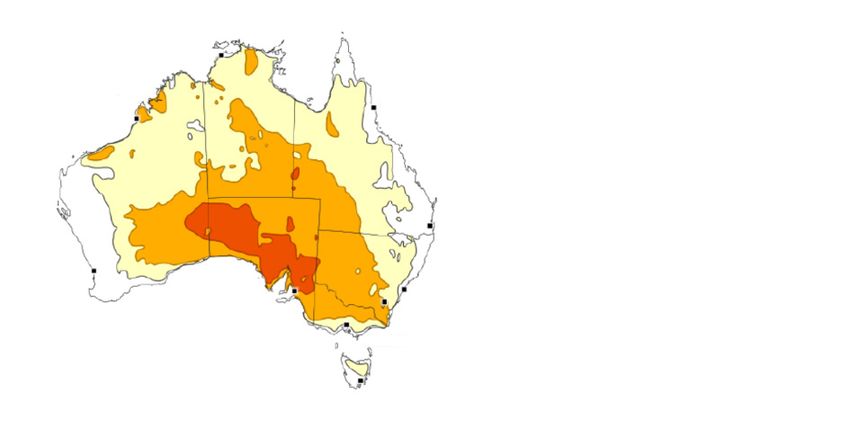
R E P O RT

Other hazard services that had not been agreed originally were          services and extreme weather and hazard-impact services. The
addressed by the forum and by March 2019, forum members                 intergovernmental agreement established roles in the warning
and specialised working groups had completed 98 of the 131              process, established over 100 agreed standards for services and
standardisation actions.                                                created a governance framework centred around the Hazards
                                                                        Services Forum to oversee the agreement and ensure the
The National Flood Warning Infrastructure Working Group was
                                                                        completion of the harmonisation and standardisation of the over
very active and in 2019 met its 3 year timeline for completion of
                                                                        100 services. This means that the forecasts and warnings are
its work. The National Flash Flood Information Repository was
                                                                        in the same form and provide the same detail no matter where
developed by the Bureau in consultation with state and territory
                                                                        the service is provided. The national arrangements are also
flood stakeholders.
                                                                        more efficient in building new services on a national basis that is
                                                                        based on the latest technology and expertise, and communities
The intergovernmental agreement                                         will receive similar types of warning independent of where
The intergovernmental agreement was endorsed by the ANZEMC              in the country they live. With workforces being more mobile
and the LCCSC in 2015 and was agreed by COAG in 2017–18                 in emergency services and populations continuing to move,
after extensive consultation, over 2 years, between the Bureau          such standardisation across jurisdictional boundaries simplifies
(Canterford, personal communication) and all state and territory        community education and understanding of particular warnings.
senior officials and emergency services ministers and federal           However, the agreement recognises that jurisdictions do not
ministers. The agreement sets the roles and responsibilities and        always have uniform requirements for weather services and
implementation of standards for meteorological and hydrological         products. Queensland, for example, makes extensive use of
services across governments in Australia. It also added clarity         tropical cyclone products, whereas Tasmania may rely heavily
on agency responsibilities and roles within total warnings              on frost warnings. When states or territories receive the same
systems. Although this may have appeared to be a relatively             service, it is now delivered in accordance with an agreed
simple problem to solve, over 100 years of Bureau operations,           standard. The agreement also identifies supplementary services
forecast and warnings services had grown organically to over 129        that can be provided on a cost-recovered basis for specific
variations of services across the country. Additionally, products       demands.
and outputs from emergency service agencies were at times
divergent and the taskforce addressed many of those.
                                                                        Outcomes of the intergovernmental
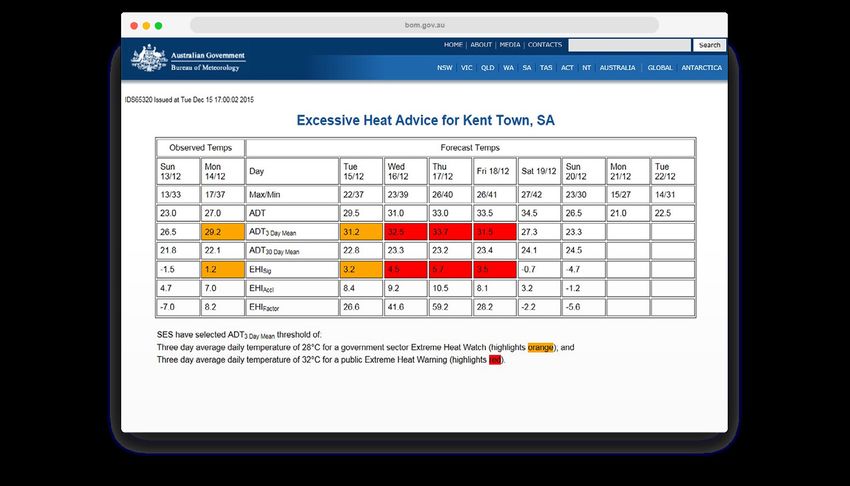
To illustrate, while the Bureau undertakes a national heatwave
forecast service (www.bom.gov.au/australia/heatwave/) that
                                                                        agreement
provides maps (see Figure 2) of the next 5 3-day periods,               For fire weather services, as well as the Bureau progressing its
which show the heatwave forecast areas and intensities, more            own services, the Hazards Services Forum supported the AFAC
'detailed high-resolution advisory' services are undertaken in          Predictive Services Group to progress several fire weather
collaboration with jurisdictions. However, Figure 3 is an example       service improvements. This was valuable and successful in
of one of these bespoke extreme heat 'detailed high-resolution          agreeing common products across borders (firefighters need
advisory' services, which was developed and used by South               consistent national products for firefighting) and the Bureau
Australia from 2010 until 2019 to support all heatwave warnings         improved its special fire weather forecasts. The main features of
within only one jurisdiction. Heatwaves are Australia’s most            improvement were:
deadly and costly disaster, and because of the non-standard             ·   hourly time steps
approaches in each state and territory for detailed high-
                                                                        ·   spatial variation information
resolution advisories, work initiated by the Hazards Services
Forum is currently being progressed by a time-limited National          ·   forecast uncertainty information
Heatwave Working Group. It was established by ANZEMC at the             ·   focus on wind changes.
request of the forum to finalise a national heatwave warning
                                                                        A range of other fire weather services have also been
framework to bring a consistent approach and consensus to
                                                                        standardised, developed and implemented across all
heatwave public information and warnings in all Australian
                                                                        jurisdictions, in partnership with emergency services agencies.
jurisdictions.
                                                                        These include improved fire weather danger indices and ratings.
Other examples of jurisdictional variations and Bureau
                                                                        Flooding in Australia causes significant direct and intangible
variations that have been addressed by the intergovernmental
                                                                        costs. Floods have major financial and social impacts on
agreement and the forum include the resolution of variations of
                                                                        individuals, communities and businesses (Department of Home
jurisdictional input to fire danger ratings, such as grassland curing
                                                                        Affairs 2018). The agreement formalises the responsibilities of
and fuel mapping, cell-based thunderstorm warning services
                                                                        the Bureau, state, territory and local governments for flood
(now available in all capital cities) and major advances and
                                                                        management. It also leads to increased cooperation among
standardisation of flood infrastructure and warning services.
                                                                        agencies for flood warnings and river gauge networks.
Having so many unique services at the jurisdictional level created
                                                                        The intergovernmental agreement recognises the role of Flood
community misunderstanding and uncertainty and risk. These
                                                                        Warning Consultative Committees in developing service-level
services were analysed in the categories of fire weather, flood

                                              Australian Journal of Emergency Management        Volume 36      No. 1   January 2021      47
REPORT

                                   DARWIN
                                                                                          Heatwave situation for Tuesday,
                                                                                          Wednesday, & Thursday (3 days
                                                                CAIRNS                    starting 17/12/2019)
                    BROOME
                                                                                          Low-intensity heatwave conditions with areas
                                                                                          of severe heatwave are indicated across the
                                                                                          tropical northern parts of Australia with more
                                                                                          widespread severe heatwave conditions across
                                                                                          central to southern Australia, including large
                                                                         BRISBANE         parts of NSW and Victoria. Areas of extreme
                                                                                          heatwave dominate South Australia.
               PERTH
                                                                    SYDNEY
                                             ADELAIDE             CANBERRA                Heatwave severity

                                                               MELBOURNE                      Extreme heatwave
                                                                                              Severe heatwave
     Three-day heatwave forecast                               HOBART                         Low-intensity heatwave
     for Tuesday, Wednesday and Thursday
                                                                                              No heatwave
     starting TUESDAY 17/12/2019
     Prouct of the Bureau of Meteorology

Figure 2: Output map from the Bureau of Meteorology National Three-Day Heatwave Forecast Service.
Source: www.bom.gov.au/australia/heatwave/

Figure 3: Example of a bespoke heatwave warning service developed for South Australia.

48       © 2021 Australian Institute for Disaster Resilience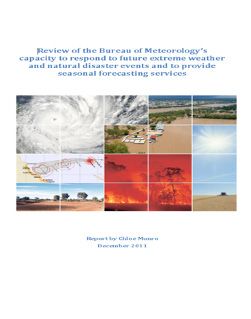
R E P O RT

specifications and describes the responsibilities of all parties for   new services, established a new flash flood information portal
flood arrangements, including riverine and flash flooding.             and enabled advanced flood planning and standardisation of risk-
                                                                       based national networks, instruments and infrastructure.
The National Flood Warning Infrastructure Working Group
undertook an extensive investigation of networks and has
detailed the gaps and variable processes across the nation.
                                                                         Acknowledgments
This work showed that further national leadership is necessary
to ensure effective sustainable investment at all levels of              The dedication and vision of the taskforce senior
government. The group’s report provides recommendations on               emergency experts from all jurisdictions and many Bureau
what is required to achieve effective uplift of networks, their          of Meteorology specialists who contributed over several
maintenance and where investment is best targeted. All states            years is acknowledged, particularly, Shoni Maguire, Bureau
and territories and the Bureau have undertaken considerable              of Meteorology for his essential support, Stewart Ellis, AM,
analysis of their networks as a pathway for this national network        CEO of AFAC and his AFAC colleagues as well as Robert
uplift.                                                                  Cameron, OAM, retired Director-General Emergency
                                                                         Management Australia for his support and co-chairing of
Another major achievement of the National Flood Warning                  the Hazards Services Forum. Additionally, the lead author
Infrastructure Working is a national technical performance               acknowledges the current Bureau leadership for their
standard for flood forecasting and warning and an agreed path to         continuing support of the intergovernmental agreement
consistently improve networks across all jurisdictions, including        and advancement of its outcomes in partnership with state
those of the Bureau.                                                     and territory emergency services agencies, EMA and AFAC.
                                                                         The authors also acknowledge the invaluable review and
The Bureau’s flood services have also been enhanced by a flash
                                                                         editing by Christine Belcher. The author may be contacted
flood information portal requested by all jurisdictions. The             at Ray.Canterford@icloud.com.
National Flash Flood Information Repository, renamed the Flash
Flood Advisory Resource (FLARE) (Bureau of Meteorology 2020),
was initially funded by the Disaster Resilience Australia Package
and supported further by the Bureau. Since its launch, over 50         References
activities were completed in all states and territories. In 2018,      Australian Institute for Disaster Resilience 2021, Australian Warning
the number of registered FLARE users had increased by 150 per          System. At: https://knowledge.aidr.org.au/resources/australian-warning-
cent (86 to 207) and the number of registered organisations            system.
increased by 100 per cent (42 to 86). Consultants have access to       Australia-New Zealand Emergency Management Committee (ANZEMC)
the repository and FLARE services are managed by the Bureau’s          2020, Australia-New Zealand Emergency Management Committee.
flood services teams.                                                  At: www.homeaffairs.gov.au/help-and-support/how-to-engage-us/
                                                                       committees-and-fora/australia-new-zealand-emergency-management-
For extreme weather and high-impact services, all 48                   committee.
jurisdictional variations of services were agreed to be
                                                                       Bureau of Meteorology 2013, Australian Government Response to the
standardised. Achievements include thunderstorm warnings that
                                                                       review of the Bureau of Meteorology’s capacity to respond to future
provide a threat of severe thunderstorms and graphical content,        extreme weather and national disaster events and to provide seasonal
and tsunami threat bulletins and warnings that are consistent.         forecasting services, Australian Government.At: www.bom.gov.au/
                                                                       governmentresponse/doc/munro-review.pdf.
Other services that have been standardised include coastal
wind warnings, hazardous surf warnings, ocean wind warnings,           Bureau of Meteorology 2020, Annual Report 2019–20. At: www.
extreme heat advice, pre-season briefings and tropical cyclone         transparency.gov.au/annual-reports/bureau-meteorology/reporting-
                                                                       year/2019-20.
services, including updated frequencies and bulletins.
                                                                       Bureau of Meteorology 2020, FLARE – Flash Flood Advisory Resource. At:
                                                                       www.bom.gov.au/australia/flood/flashfloodadvisoryresource/.
Conclusions
                                                                       Council of Australian Governments 2018, Intergovernmental Agreement
Through a review of Bureau services and an intergovernmental           on the Provision of Bureau of Meteorology Hazard Services to the States
agreement, Australia now experiences improved standardised             and Territories, 22 January 2018 update. At: www.coag.gov.au/about-
services and a higher level of cooperation and collaboration in        coag/agreements/intergovernmental-agreement-provision-bureau-
forecasting and warnings and in preparing for and responding           meteorology-hazard-services-0.
to disasters. The major outcomes of this collaborative                 Department of Home Affairs 2018, National Disaster Risk Reduction
approach with the Bureau are due to the level of attention and         Framework, At: www.homeaffairs.gov.au/emergency/files/national-
understanding provided by emergency services commissioners             disaster-risk-reduction-framework.pdf.
and chief officers, together with Emergency Management
Australia, AFAC and ALGA.
This work, initiated to harmonise and standardise, has resulted
in benefits and services across Australia. It has improved Bureau
services and collaboration with emergency agencies, provided a
high-level national forum to maintain standards and incorporate

                                               Australian Journal of Emergency Management        Volume 36      No. 1    January 2021         49
You can also read


