Black-footed Rock-wallabies Petrogale lateralis - Parks and ...
←
→
Page content transcription
If your browser does not render page correctly, please read the page content below

Black-footed Rock-wallabies Petrogale lateralis
                                                                Conservation Status: Endangered and Vulnerable
Identification
There are four subspecies of black-footed rock wallabies
Petrogale lateralis that occur in Western Australia: black-
flanked rock-wallaby Petrogale lateralis lateralis,
Recherche rock-wallaby Petrogale lateralis hacketti,
MacDonnell Range rock-wallaby Petrogale lateralis subsp.
(MacDonnell Ranges) and West Kimberley rock-wallaby
Petrogale lateralis subsp. (West Kimberley).
The species Petrogale lateralis is widespread but the
subspecies are geographically separated which has
resulted in them being morphologically and/or genetically
distinct. In general, they are a small wallaby with a thick
                                                                  Petrogale lateralis lateralis in Ningaloo. Photos: David Pearson/DBCA
and woolly coat of dark grey-brown fur with a paler chest.
They have distinct markings including a white to sandy cheek-stripe, a dark brown to black dorsal stripe from
between the ears to beyond the shoulders, and a white and a black lateral stripe from the armpit to the hip. The paws
are dark brown to black. The long tail ends in a slight black brush.
It is important to note that the western brush wallaby Macropus irma also has a distinct white facial stripe and black
paws. Consider the other distinctive features, as well as the location and habitat of the sighting, when trying to
identify the animal.
Head and Body Length: 45-52cm
Tail Length: 44-61cm
Weight: 4.7kg (males) and 3.4kg (females)

Taxonomy
Family: Macropodidae
Genus: Petrogale
Species: lateralis
Other common names: warru
There is some taxonomic uncertainty about                                     (now extinct)

whether the MacDonnell Range and West
Kimberley rock-wallabies are subspecies or races of
Petrogale lateralis.

Distribution and Habitat
The black-flanked rock wallaby was historically
widespread but patchily distributed in central and
southern Western Australia but is now restricted to
parts of Cape Range, Calvert Range in the Little
Sandy Desert, granite rocks in the Avon Wheatbelt
area, gorges in Kalbarri National Park, and Barrow
and Salisbury Islands. The McDonnell Range rock-
wallaby was historically distributed across a large                 A map with the general distributions of the various subspecies of the
area of central Australia, but is now known only                           black-footed rock-wallaby (Parks and Wildlife, 2013).
from a small number of scattered and isolated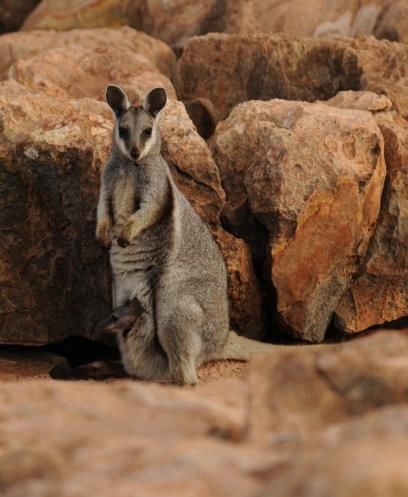
FAUNA PROFILE – Black-footed Rock-wallabies Petrogale lateralis
ranges in Western Australia, South Australia and the Northern Territory. The Recherche rock-wallaby is known to
occur on only three islands off the coast of Esperance in the Recherche Archipelago, and the West Kimberley rock-
wallaby is known to occur on only a small number of scattered ranges and rocky outcrops in the west Kimberley.
As the common name suggests, rock-wallabies have a preference for rocky habitats. They occur on a wide variety of
rock types but require complex caves and crevices as opposed to large, smooth surfaces. Permanent water does
appear to be an essential component of rock-wallaby habitat.
For further information regarding the species distribution, please refer to www.naturemap.dpaw.wa.gov.au.
Community Involvement
If you think you have seen a rock wallaby, fill out a fauna report form and send it to the Department’s Species and
Communities Branch at fauna@dbca.wa.gov.au.The Department keeps track of the distributions of threatened
species to help monitor population trends and inform management decisions.
The Department runs a variety of volunteer projects across WA including scientific research, community education
and manual labour. Further information about these opportunities can be found on the Department’s webpage.
Biology and Behaviour
Rock-wallabies are generally crepuscular and nocturnal, meaning they are most active at twilight and at night. They
spend daylight hours sheltering in deep and multi-entranced caves, crevices, cliffs, overhangs or boulder piles. These
complex rocky habitats provide cool refuge from hot temperatures and shelter from predators. At twilight, they
emerge to feed on a variety of grasses, herbs, forbs, leaves, seeds and fruit. They tend to browse close to rocky
refuges to provide a quick escape from predators. Rock-wallabies are extremely agile, and they have strong hind legs
and feet with textured pads, allowing them to bound quickly and easily across their rocky habitats.
Breeding can occur year-round, but with peaks during high rainfall seasons. They give birth to one young, which
remain in the pouch for 6-7 months. Breeding commences from 18 months of age, and the life span is up to 12 years.
Conservation Status
All four Western Australian subspecies of Petrogale lateralis are recognised as a threatened species under State and
Commonwealth legislation. In Western Australia all four subspecies are listed as fauna that is ‘likely to become
extinct’ in the wild (Specially Protected) under the Wildlife Conservation Act 1950 and have been assigned the threat
status rankings of Endangered (black-flanked and West Kimberley rock-wallabies) and Vulnerable (Recherche and
MacDonnell Ranges rock-wallabies) using International Union for Conservation of Nature (IUCN) criteria. Nationally
the species are listed as Endangered (black-flanked rock-wallaby) and Vulnerable (Recherche, MacDonnell Ranges and
West Kimberley rock-wallabies) under the Commonwealth Environment Protection and Biodiversity Conservation Act
1999.
The main current threats to all four subspecies include:
Fox, wild dog and feral cat predation;
Competition for food and shelter with introduced herbivores;
Habitat loss and degradation from land clearing, mining and weed incursion;
Limited genetic variation due to small population size and population fragmentation; and
Climate change leading to a decline in rainfall and higher summer temperatures.
Management
Recovery Plan
A national recovery plan has been produced for five species of rock wallabies that occur in Western Australia, South
Australia and the Northern Territory: black-footed rock wallaby Petrogale lateralis, short-eared rock wallaby
Petrogale brachyotis, monjon Petrogale burbidgei, nabarlek Petrogale concinna and Rothschild rock wallaby Petrogale
rothschildi. This plan outlines the recovery actions required to ensure the survival of populations and improve the
conservation status of the five species. Recommended actions for Petrogale lateralis from this plan include:
Conduct feral predator control, manage feral herbivores and manage habitat, and monitor management
actions to determine effectiveness.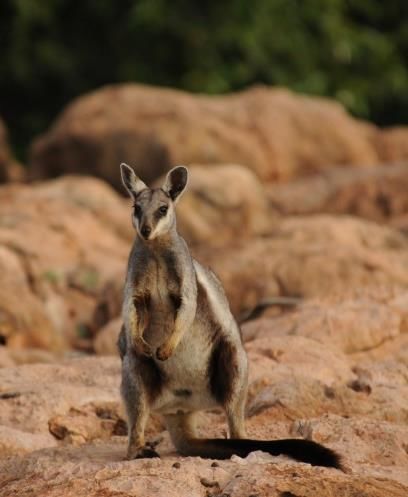
FAUNA PROFILE – Black-footed Rock-wallabies Petrogale lateralis
Prevent the introduction of feral predators, competitors, weeds or disease to islands
Conduct translocations and captive breeding to establish new populations or supplement existing
populations.
Survey and monitor populations.
Undertake research to improve understanding of biology, management and monitoring techniques.
Existing Conservation Measures
The Rock Wallaby Recovery Team, led by the Department of Biodiversity, Conservation and Attractions, has been
assisting with the implementation of recovery actions as outlined in the current recovery plan since 2012.
The Department’s Western Shield wildlife recovery program conducts feral fox baiting at a range of known rock-
wallaby locations, and intensive fox and feral cat baiting is undertaken at the Wheatbelt sites. The Department, often
in partnership with Aboriginal ranger groups and NRMs, also undertakes other introduced predator, goat and rabbit
control activities, prescribed burning and habitat rehabilitation at various rock-wallaby locations. Regular monitoring
is also conducted of known rock-wallaby locations and surveys undertaken for new populations.
The Department, in partnership with WWF, constructed a predator-proof fence in 2013 around Nangeen Hill, a nature
reserve in the Wheatbelt, to protect the subpopulation of black-flanked rock-wallabies. AWC also has a small
subpopulation of black-flanked rock-wallabies within their Paruna Sanctuary in the Avon Valley.
Black-flanked rock-wallabies had been considered extinct from Kalbarri National Park for 20 years, but two were
sighted in a gorge in 2015. Following the rediscovery, the Department and WWF have translocated black-flanked
rock-wallabies from the Wheatbelt in an effort to re-establish the Kalbarri population.
Citation
Department of Biodiversity, Conservation and Attractions. (2017). Fauna Profile - Black-footed Rock Wallabies
Petrogale lateralis. Retrieved from http://www.dbca.wa.gov.au/
Key References and Further Reading
Department of the Environment and Energy. (2016). SPRAT Profiles. Retrieved from
http://www.environment.gov.au/sprat
Department of Parks and Wildlife (2013). Recovery Plan for five species of rock wallabies – WA Wildlife Management
Program No. 55. Perth, WA: Parks and Wildlife. Retrieved from: http://www.environment.gov.au
Pentland, C. (2014). Behavioural ecology of the black-flanked rock-wallaby (Petrogale lateralis lateralis); refuge
importance in a variable environment (Doctoral dissertation). Edith Cowan University.
Van Dyck, S. and Strahan, R. (Eds.) (2008). The Mammals of Australia (3rd ed.). Sydney, NSW: New Holland Publishers.
Woinarski, J., Burbidge, A. and Harrison, P. (2014). The Action Plan for Australian Mammals 2012. Collingwood, VIC:
CSIRO Publishing.
Disclaimer
The State of Western Australia and its employees do not guarantee that this publication is without flaw of any kind or
is wholly appropriate for your particular purposes and therefore disclaims all liability for any error, loss or other
consequence that may arise from you relying on any information in this publication.
You can also read


