BLINDS & WINDOW COVERINGS - A Pathway to Sustainability - Architecture & Design
←
→
Page content transcription
If your browser does not render page correctly, please read the page content below

BLINDS & WINDOW
COVERINGS
A Pathway to Sustainability

                              norfolkblinds.com.au
INTRODUCTION

According to recent estimates, buildings generate nearly 40% of
annual global CO2 emissions.1
Of those total emissions, building operations contribute 28%
annually, while building materials and construction are responsible
for 11%.

To meet the goals of the Paris Agreement by 2030, humanity
must cut its carbon emissions by half – a daunting but necessary
task to avoid dangerous climate change impacts. It is critical that
design and construction professionals understand their role in
reducing the built environment’s carbon footprint, and the tools
available to assist them.

With their ability to block, screen or limit sunlight, blinds play a
significant role in improving the thermal efficiency of buildings.
By helping users manage heat gain, blinds can reduce the
energy consumption associated with artificial heating and cooling
systems, thus enabling buildings to reduce their carbon footprint
over their lifespan. Blinds can also be digitally connected and
operated via building management systems to achieve even
greater sustainability outcomes.

In addition to their contributions to energy efficiency, evaluation
of different blinds and window coverings should consider several
environmental factors, including the manufacturing process
and its associated waste, raw materials, packaging, transport,
and more. It must also factor in embodied carbon, referring to
the CO2 emissions associated with materials and construction
processes throughout the whole lifecycle of a product or building.

In this whitepaper, we take a close look at how architects,
designers and specifiers should evaluate the sustainability of
blinds and what tools are available to help them do so.

By blocking sunlight and preventing heat
 loss, blinds are able to limit the need for
            artificial heating and cooling.
EMBODIED CARBON

For years now, the industry has focused its climate efforts on   environmental impact data on their products, often with third-
operational-energy consumption with great improvements in        party verification. There are also new tools that make it possible
the efficiency of modern lighting, heating and cooling systems   to compare life cycle analyses and environmental product
and a shift towards renewable energy supplies. Embodied          declarations (EPD) during the course of a building project.
carbon is a sometimes overlooked source of emissions
within the built environment. Building products are extracted,   The range of third-party environmental certifications includes
manufactured, transported, installed and used, with each         Global GreenTag, Health Product Declaration, LEED, GECA,
stage of the process consuming resources and energy,             Ecospecifier, Greenguard, Life Cycle Analysis (LCA), C2C
and generating CO2 emissions. There are also emissions           (Cradle to Cradle), ISO 14001, and Green Tick, and more.
associated with the end-of-life of a product or material.2       The certification process typically involves considering the
                                                                 net environmental impact of a product or building over its
Determining the embodied carbon of any building material         lifespan, with some relevant factors including responsible
is impossible from the finished product alone. It requires       sourcing, sustainable material choice, health impacts, waste,
detailed self-assessment and process transparency on the         pollution, and socioeconomic concerns, in addition to
part of the manufacturer. To assist with product selection,      embodied carbon emissions.
more manufacturers and industry groups are publishing
IMPROVING ENERGY EFFICIENCY

Improving energy efficiency of buildings in operation leads            its heat gained through them.3 In summer, blinds reduce heat
to reduced carbon emissions. ‘Thermal efficiency’ refers to            gain by reflecting the heat back out of the window (especially if
the building’s ability to retain warmth during colder weather          the external surface is white or near white). In winter, a well-fitted
and keep cool during warmer weather thus requiring less                blind can trap still air in the space between the blind and the
energy to artificially or cool the building all-year round. Certain    window, preventing heat loss. Blinds can also allow permissible
design features, such as blinds, can help improve a building’s         heat gains from the low-angle sun thus reducing space heating
thermal efficiency.                                                    and cooling loads.

A thermally-efficient building envelope has far-reaching benefits.     Building modelling conducted by the National Energy
First, by reducing a building’s energy consumption, it also            Foundation (UK) using a model office highlighted that internal
reduces its carbon footprint significantly. Second, while a            shading by a venetian blind could save 10% of HVAC energy
thermally-efficient design can sometimes cost more upfront,            and a roller screen up to 23%.4 The savings in HVAC energy
operational costs will decrease in the long-term. Third, an interior   increased to 43% and 47% respectively if the window
environment that is maintained at a comfortable temperature has        coverings are installed externally.5
positive effects on the overall wellbeing of its occupants.
                                                                       Operable blinds and window coverings offer greater flexibility,
Blinds and window coverings are among the tools designers and          giving users the choice to keep window coverings open or
specifiers can utilise to improve thermal efficiency. The Australian   closed for privacy, to maximise natural light or control glare, take
Window Association (AWA) estimates up to 40% of a home’s               advantage of heat from the sun in the winter, and reduce heat
heating energy can be lost through windows and up to 87% of            gain in the summer.

BMS INTEGRATION

Despite the benefits of operable blinds and window coverings,          systems that continuously monitor the environment and adjust
one study found that 75% of residential window coverings               the window covering for optimal thermal performance.
remain in the same position every day.6 This practice decreases
potential energy savings as it does not account for the changing       Through automation it is possible to ensure window coverings
position of the sun and variations in temperature and weather          or blinds are drawn during the warmest and brightest parts of
conditions during the day.                                             the day or open to allow the sun to warm the interior space
                                                                       or provide natural light. Studies have demonstrated significant
Blinds and window coverings that are automated and controlled          improvement in both the thermal performance of adjustable
via a BMS (building management system) can be optimised to             window attachment operation as well as reduced lighting energy
maximise energy savings. Each operable window covering can             consumption when automation is employed.7
be controlled using a range of environmental sensors and control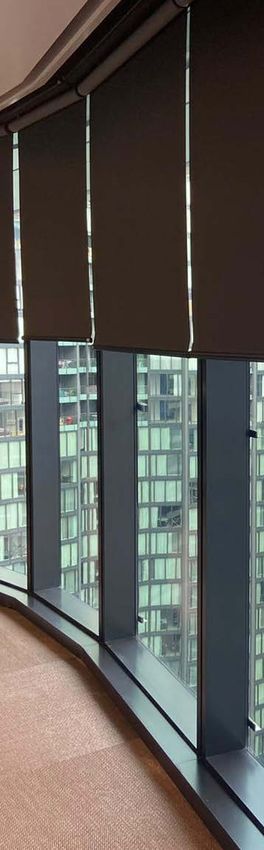
CREATING HEALTHY INTERIORS

Earlier we noted that the use of blinds to enhance the thermal      both factors contributing to ‘sick building syndrome’ (SBS), a
quality of an indoor environment leads to better health and         condition caused by being in a specific building or other type of
wellbeing outcomes for occupants. It is well established            enclosed space.
that thermal comfort is linked to our health, well-being and
productivity. Lack of thermal comfort results in ‘environmental     SBS symptoms are associated with acute discomfort, such
stress’,9 negatively impacting our experience of the indoor         as eye and nose irritation, headache, dry cough, dry or itching
environment. In some cases it can lead to more significant          skin, and difficulty in concentration or fatigue. According
health issues such as heat stroke, or poor sleep quality.10         to various studies, the risk factors for SBS include lower
                                                                    ventilation rates, presence of air conditioning, and higher
Several studies indicate that even small differences in             indoor air temperatures.
temperature can influence workers’ speed or accuracy by 2%
to 20% in tasks.11 Improvements in work performance can             For designers and specifiers, it is important to select blinds
also be achieved with better natural lighting, with benefits most   that meet Australian health and safety standards for VOCs.
apparent for visually-demanding work. Several studies also          Avoid shades and curtains made of PVC (Polyvinyl chloride),
link between thermal comfort and student learning, making           any products highly treated with flame retardants and other
temperature control a key requirement for schools, libraries and    chemicals, and wood and aluminum blinds with finishes that
other learning spaces.12                                            may off-gas VOCs.

Temperature and light control are not the only factors              The manufacture of PVC blinds can result in the creation of
contributing to a healthy indoor environment. Some blinds           toxic byproducts such as hydrochloric acid, vinyl chloride,
can contain harmful substances that can emit volatile organic       mercury, cadmium, lead and dioxin. Designers and specifiers
compounds (VOCs), which reduce indoor air quality. Poor             should assess the lifecycle environmental im
temperature regulation and products that emit VOCs are
ARENA HONEYCOMB BLINDS BY TURNILS
THE MOST ENERGY-EFFICIENT BLIND colours and fabric designs, Arena Honeycomb Shades also
Available from Norfolk Blinds, Arena Honeycomb Shades are a feature different light filtration options for light control, view-
stylish, functional, versatile, energy-efficient window covering through, privacy and protection including Sheer, Translucent
solution. Suited for any size or shaped window, these shades and Blockout.
offer insulating properties to control room temperature without
compromising on style. The cellular design of honeycomb There are also a number of different operating systems and
shades means that hot air is trapped in the honeycomb cells, design options to choose from: Glideshift, a sliding cordless
slowing down the transfer of hot air from outside-to-in and system ideal for patio doors and wide expanses; Motorisation,
inside-to-out. a fully motorised control system; Cordless, for a clean
uncluttered look; and EasyRise, with an endless (continuous)
The back of all Arena honeycomb fabrics is white, creating cord loop operation. You can upgrade to a fully-automated
a uniform streetside appearance. The white backing also Momenta motorised system that offers the ultimate in child
provides light reflection and UV protection, which reduces heat safety, convenience and ease of operation.
passing through the shade into the room
Arena is GREENGUARD® certified for healthier indoor air
With these energy-efficient features, Arena Honeycomb Shades quality. Healthier indoor air fabrics are anti-static and dust
can reduce your heating costs by up to: repellent making them low maintenance.
• 17%* with 10mm Single Cell translucent fabric *Savings are based on the installation of fully-recessed, reveal mounted Turnils
• 28%* with 10mm Single Cell blockout fabric Arena Honeycomb Shades in an average home in Sydney, compared with the
House Energy Rating standard of Holland Blinds from AccuRate, in that home.
• 26%* with 20mm Single Cell translucent fabric
These calculations have been modelled by an independent third party. Savings
• 32%* with 20mm Single Cell blockout fabric
will vary based on window type and installation.
Arena Honeycomb Shades offer a variety of fabrics in a range
of cell sizes, colours and styles, which provide for a wide
choice of design possibilities. In addition to the variety of
Through automation, it is possible to ensure window
coverings or blinds are drawn during the warmest and
brightest parts of the day or open to allow the sun to
warm the interior space or provide natural light.REFERENCES
1 Architecture 2030. “Why the building sector?” Architecture 2030. https://architecture2030.org/why-the-building-sector (accessed 18 March 2022).
2 McKinsey & Company. “Data to the rescue: Embodied carbon in buildings and the urgency of now.” McKinsey.
https://www.mckinsey.com/business-functions/operations/our-insights/data-to-the-rescue-embodied-carbon-in-buildings-and-the-urgency-of-now accessed 18 March 2022).
3 Turner, Lance. “Windows that perform: A window and film buyers guide.” Renew Magazine.
https://renew.org.au/renew-magazine/buyers-guides/window-buyers-guide (accessed 18 March 2022).
4 Blind Manufacturers’ Association Australia, “Energy Savings.” BMAA. http://bmaa.net.au/energy-savings-in-buildings (accessed 18 March 2022).
5 Ibid.
6 Department of Energy. “Energy Efficient Window Coverings.” Energy.gov.
https://www.energy.gov/energysaver/energy-efficient-window-coverings (accessed 18 March 2022).
7 Lawrence Berkeley National Laboratory and Building Green Inc. “Window coverings and attachments.” Efficient Window Coverings.
https://efficientwindowcoverings.org/understanding-window-coverings/attachment-automation (accessed 18 March 2022).
8 isk, William. “How IEQ Affects Health, Productivity.” ASHRAE Journal, Issue 5 (2002): 56-60.
9 Bueno, AM, AA Xavier de Paula and EE Broday. “Evaluating the Connection between Thermal Comfort and Productivity in Buildings:
A Systematic Literature Review.” Buildings, Vol. 11, No. 6 (2021): 244.
10 Okamoto-Mizuno, Kazue and Koh Mizuno. “Effects of thermal environment on sleep and circadian rhythm.”
Journal of Physiological Anthropology, Vol. 31, No. 1 (2012): 14.
11 Above n 8.
12 Jiang, H, M Iandoli, S Dessel, Shichao Liu and J Whitehill. “Measuring students’ thermal comfort and its impact on learning.” EDM (2009).
https://users.wpi.edu/~jrwhitehill/JiangEtAl_EDM2019.pdf (accessed 18 March 2022).
All information provided correct as of April 2022
norfolkblinds.com.auYou can also read


