BOWEL SCREENING PROGRAMME 2021
←
→
Page content transcription
If your browser does not render page correctly, please read the page content below
BOWEL SCREENING
PROGRAMME 2021

         1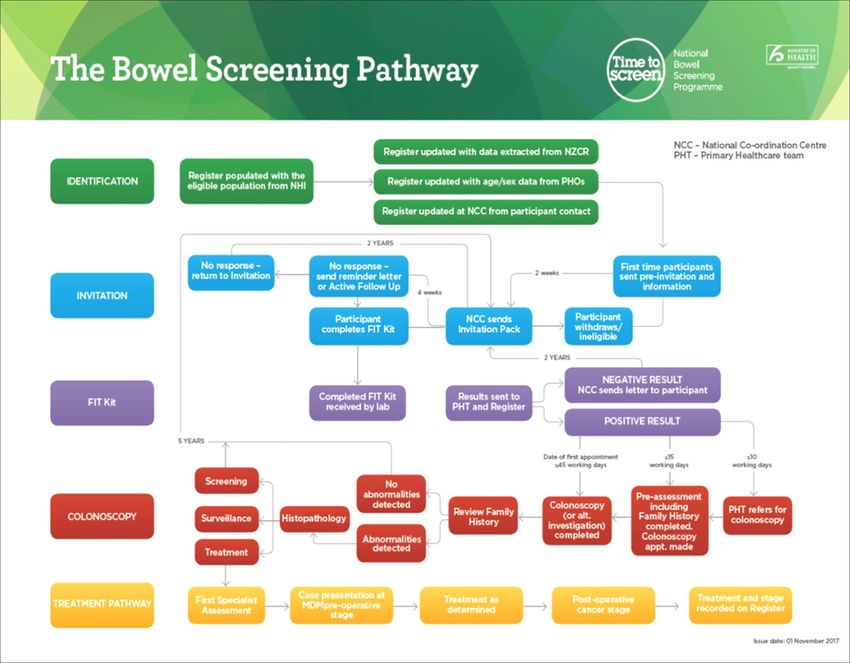
Why NZ needs a National Bowel
            Screening Programme
Bowel cancer is the second most
common cause of cancer death in
              NZ.

    3081              1267
new cases per year   deaths in 2015

                                      The earlier bowel cancer is diagnosed,
                                        the higher the chance of survival.

                                          over     90%               10%
                                            chance of survival    chance of survival
                                          after early diagnosis   after late diagnosis

                                      2
National Bowel Screening Programme
• Waikato will start screening as part of the free National
  Bowel Screening Programme on 2 March 2021

• Eligible people – men and women – are invited every
  two years

• Age range 60–74 years

• Population eligibility – 66,000 of which 10,000 are Maori
  and 1300 Pasifika

• Automatic invitation from a population register – no
  registration required

                              3
What happens….
• Patients age 60-74 are sent a test kit from the
  national screening unit around their birthday month
  every 2nd year

• GP is advised of result

• If positive, GP is responsible for notifying patient and
  sending a referral to DHB

• DHB will arrange colonoscopy/CT colonography

                            4
National Bowel Screening Programme -
              Statistics
1100 colonoscopies per year: 4 persons per list; 5 lists per
week

•    70 - 80% will have polyps; range from 1 to 22
           Tend to have more and bigger polyps

• 6 – 8 % will have Cancers. = 80 cancers per year

• Cancers are identified earlier. Stage 1
   Screening 38% versus Symptomatic 11%

Note: Data has been provided from the National Bowel Screening team and are anticipated
volumes/statistics only.

                                                5
How many participants in the NBSP will
be found at colonoscopy to have
polyps or cancer?

• Approximately 7 in 10 people will have polyps – if
  removed may prevent cancer developing

• Approximately 7 in 100 people will be found to
  have cancer and will require treatment

Note: National Bowel Screening statistics/modelling

                                           6
7
Equity
• Framework has been built around achieving equity for
  Maaori, Pasifika and vulnerable populations
• Promotion of early access to kits
• Promotional video’s for Maaori and Pasifika -
  https://vimeo.com/467910658/34f31025b4
• Pre-assessment closer to home options
• Bowel Screening team is 80% Maaori
• Attending as many community based events as invited
  to by Maaori and Pasifika communities
• Streamlining systems and processes that will better
  support Maaori and Pasifika communities
• Alignment of pathways in secondary care for
  symptomatic, surveillance and Screening services
• Patient focused bookings

                           8
Iwi and Pacific Engagement
Communication and Community involvement with
• Waikato Tainui
• Te Korowai o Hauraki
• Ngati Raukawa
• Kokiri Trust
• Te Kohao Health
• NASC – Disability Support Link Maaori
• Rauawaawa – Kaumatua and Kuia services
• Te Puna Oranga (inpatient services)
• Kaute Pasifika
• SWIPC
• Churches
• Pacific Business Network
9Other Community Engagement
• Department of Corrections
• The Deaf Community
• NASC – Rest Homes
• I Hub
In progress
• The Blind Community
• Mental Health Services
• Disability Services (through support link)
10Role of Primary Care is Important
• Encourage participation
• Support appropriate participation
– Asymptomatic
– Average/ slightly above average risk
• Advise patients of positive results and send e-
referral
The Waikato DHB has a primary care liaison who will be working closely with
the GP practices supporting and trouble shooting any issues of access
between primary and secondary care for patients.
11Encourage Participation
Passive reminders in Patient Management System
Examples of reminder prompts:
BOWEL CANCER Fit Result: Unknown
Screening recommended: Discussed with Patient? Yes No
Patient Declined NBSP Yes No
BOWEL CANCER FiT Result: Decline 15/05/2019
Screening recommended: Discussed with Patient? Yes No
Patient Declined NBSP Yes No
There is extra benefit in promotion from the primary care team
people know and trust
12Do we have the capacity?
We have increased capacity in
• Thames Hospital (additional two days per week/four
sessions)
• Waikato Hospital (opened 4th room/two sessions)
Compilation of services through the unit (including
Thames)
• 50 sessions available per week
– 6 ERCP sessions per week
– 4 Respiratory/Bronch sessions per week
– 5 Acute sessions per week
– 35 Endoscopy sessions per week
13Do we have the operators?
• Gastroenterologists (10) – all able to do bowel screening
• General Surgeons (12) – all able to do bowel screening
• Nurse Endoscopists (3)
• Fellow (1)
• Registrars (4)
Of concern is our facility capacity having only 5 operating rooms (including Thames).
Mitigation is if required we will look to purchase facility space for our clinicians to operate. At
present we have ability to backfill all Waikato sessions and fully utilise Thames sessions
(excluding annual leave).
There is a expectation based on previous DHBs go live that there will be an influx of
symptomatic referrals from GP practices as bowel screening awareness takes place in our
communities. We are projecting an approximate 400 additional referrals coming in from
March- August 2021. We are anticipating this and our mitigation is to accommodate as much
as possible internally within timeframes set by the Ministry Bowel Screening Team and set up
facility lists to support the overflow.
14Programme Launch
Launch
• On 2 March 2021 we will have “colin the colon”
(inflatable bowel) on display on Level 1 MCC -
IHUB for week 1-5 March 2021. Opportunity for our
CE and Commissioners to meet with Bowel
Screening Staff and National Bowel Screening
Clinical Lead Dr Susan Parry.
• Will have “launch month” across our Waikato region
in partnership with our community providers and GP
practices.
15Communications for March 2021
• Publications in newspapers/magazines
• Social Media – Community Groups
• Waikato DHB Bowel Screening face book page
• Back of Bus
• London Street Billboard
• Digital Works
• Media Talks
– The breeze
– The sound
– Magic talk
– Coromandel FM
– Nga Iwi FM
– Radio Tainui
– Raukawa FM
1617
18
19
“Mahia te mahi, painga mo te iwi”
Do the work for the good of the people.

                          - PrincessTe Puea Herangi

                    20
You can also read


