Breaking and fixing DNS implementations - JSOF Shlomi Oberman Moshe Kol - Forescout
←
→
Page content transcription
If your browser does not render page correctly, please read the page content below
NAME:WRECK | RESEARCH REPORT

Breaking and fixing DNS implementations

Published by Forescout Research Labs & JSOF

Forescout Research Labs
Daniel dos Santos
Stanislav Dashevskyi
Amine Amri
Jos Wetzels

JSOF
Shlomi Oberman
Moshe Kol

RESEARCH REPORT | NAME:WRECK

Contents
1.   Executive Summary                                                                      3

2.   Main Findings                                                                          5

     2.1. Analyzed stacks and new vulnerabilities                                           6

3.   Exploitation                                                                          11

     3.1. About DNS message parsing                                                        12

     3.2. Technical details                                                                12

4.   An attack scenario leveraging NAME:WRECK                                              16

5.   The impact of NAME:WRECK                                                              17

6.   It’s You Again: Recurrent Anti-Patterns                                               21

     6.1. AP#1 – Lack of TXID validation, insufficiently random TXID and source UDP port   21

     6.2. AP#2 – Lack of domain name character validation                                  21

     6.3. AP#3 – Lack of label and name lengths validation                                 22

     6.4. AP#4 – Lack of NULL-termination validation                                       22

     6.5. AP#5 – Lack of the record count fields validation                                22

     6.6. AP#6 – Lack of domain name compression pointer and offset validation             22

7.   Mitigation Recommendations                                                            24

8.   Conclusions and Final Remarks                                                         26

FORESCOUT RESEARCH LABS
RESEARCH REPORT | NAME:WRECK | Executive summary
1. Executive summary
• In the third study of Project Memoria – NAME:WRECK • Of particular interest is that to exploit NAME:WRECK
– Forescout Research Labs and JSOF Research Labs vulnerabilities, an attacker should adopt a similar
joined forces to understand underlying problems related procedure for any TCP/IP stack. This means that the
to Domain Name System (DNS) implementations, to dis- same detection technique used to identify exploitation
close a set of 9 vulnerabilities affecting 4 popular TCP/ of NAME:WRECK also will work to detect exploitation
IP stacks and to propose solutions for the community. on other TCP/IP stacks and products that we could not
yet analyze.
• The new vulnerabilities appear in well-known IT soft-
ware (FreeBSD) and in popular IoT/OT firmware, such • As part of the NAME:WRECK disclosure, Forescout
as Siemens’ Nucleus NET. FreeBSD is widely known to Research Labs shares with the cybersecurity commu-
be used for high-performance servers in millions of IT nity the following artifacts:
networks, including major websites such as Netflix and
• This report, in which we discuss six DNS anti-pat-
Yahoo. FreeBSD is also the basis for other well-known
terns (implementation problems common in dif-
open-source projects. Nucleus NET has been used for
ferent TCP/IP stacks) and provide researchers
decades in several critical OT and IoT devices.
and developers around the world with tools and
• Not all devices running Nucleus RTOS or FreeBSD are vul- knowledge enabling them to tackle the issue in
nerable to NAME:WRECK. However, if we conservatively other stacks.
assume that 1% of the more than 10 billion deployments
are vulnerable, we can estimate that at least 100 million • An updated open-source script to identify possible
devices are impacted by NAME:WRECK. vulnerable devices on a network.
• The new vulnerabilities allow for either Denial of Service • A library of open-source Joern queries to be used
or Remote Code Execution. The widespread deployment by researchers and software developers to (partially)
and often external exposure of vulnerable DNS clients automate the finding of DNS-related vulnerabilities.
leads to a dramatically increased attack surface.
• Samples of malicious traffic captures (available
• NAME:WRECK illustrates the security cost of RFC com- upon request) to be used by researchers and secu-
plexity. We analyzed the implementation of DNS message rity analysists to test their intrusion detection sys-
compression in 7 new TCP/IP stacks and found that tems.
50% of them are vulnerable. This is in addition to similar
vulnerabilities in previous research (one in Ripple20 and • A draft of an informational RFC discussing the
two in AMNESIA:33) and other major vulnerabilities identified anti-patterns to guide developers in avoid-
affecting DNS servers (SIGRed, DNSpooq, and several ing making the same mistakes while writing future
others disclosed over the years). DNS implementations.
• General recommended mitigations for NAME:WRECK • This research is further proof that DNS protocol com-
include limiting the network exposure of critical vul- plexity leads to several vulnerable implementations and
nerable devices via network segmentation, relying on that the community should act to fix a problem that we
internal DNS servers and patching devices whenever believe is more widespread of what we currently know.
vendors release advisories.
FORESCOUT RESEARCH LABS 3RESEARCH REPORT | NAME:WRECK | Executive summary
INFORMATIONAL
A Recap on TCP/IP stacks and Project
Memoria
A TCP/IP stack is a piece of software that implements basic • Ripple20, a set of 19 vulnerabilities on the Treck TCP/IP
network communication for all IP-connected devices, includ- stack released by JSOF in June 2020. Forescout Research
ing Internet of Things (IoT), operational technology (OT) and Labs worked in close collaboration with JSOF to identify
information technology (IT). Not only are TCP/IP stacks wide- vendors and devices potentially affected by Ripple20.
spread; they also are notoriously vulnerable due to (i) codebases
• AMNESIA:33, a set of 33 vulnerabilities affecting 4 open-
created decades ago and (ii) an attractive attack surface,
source TCP/IP stacks released in December 2020 by
including protocols that cross network perimeters and lots of
Forescout Research Labs.
unauthenticated functionality.
• NUMBER:JACK, a set of 9 vulnerabilities affecting the Initial
Noticing the impact of these foundational components,
Sequence Number (ISN) implementation in 9 TCP/IP stacks
Forescout Research Labs has launched Project Memoria
disclosed in February 2021 by Forescout Research Labs.
with the goal of collaborating with industry peers and research
institutes to provide the cybersecurity community with the • NAME:WRECK, discussed in this report, a set of 9 vulnera-
largest study on the security of TCP/IP stacks. bilities affecting DNS clients of 4 TCP/IP stacks disclosed
by Forescout Research Labs and JSOF. The vulnerabilities
The latest examples of TCP/IP stack vulnerabilities include:
included in NAME:WRECK range in potential impact from
Denial of Service to Remote Code Execution.
A note on the title of this report
“NAME:WRECK” refers to how the parsing of domain names on “fixing” these types of issues by finding and patching similar
can break – “wreck” – DNS implementations in TCP/IP stacks, vulnerabilities in other stacks as well as avoiding the identified
leading to denial of service or remote code execution. However, anti-patterns in future implementations.
this research focuses not only on the “breaking” part, but also
FORESCOUT RESEARCH LABS 4RESEARCH REPORT | NAME:WRECK | Main Findings
2. Main Findings
Domain names are character strings that identify assets on Advertisement Options for DNS Configuration”). Also, while
the internet. The Domain Name System (DNS), informally some protocols do not officially support compression, many
known as the “phonebook of the internet,” is a decentralized implementations still do support it because of code reuse
system and protocol created by Paul Mockapetris in 1983 or a specific understanding of the specifications.
that allows a requesting device to resolve desired domain
DNS compression is neither the most efficient compression
names (such as “google.com”) to specific IP addresses
method nor the easiest to implement. As evidenced by the
(such as “172.217.6.78”) by querying a hierarchy of servers
historical vulnerabilities shown in Table 1, this compression
(such as Google’s Public DNS).
mechanism has been problematic to implement for 20 years
Recently, there have been major vulnerabilities on DNS on a diverse range of products, such as DNS servers, enter-
implementations that raised attention to this protocol as prise devices (e.g., the Cisco IP phone) and, more recently,
an important attack vector, such as SIGRed (CVE-2020- the TCP/IP stacks Treck, uIP and PicoTCP.
1350) allowing attackers to take over machines running
the Windows DNS server and SAD DNS (CVE-2020-25705),
which revived the DNS cache poisoning attack that can
redirect millions of devices to attacker-controlled domains.
The most recent example of major vulnerability on a DNS
implementation is DNSpooq, a set of 7 critical CVEs affect-
ing the DNS forwarder dnsmasq, which is used by major
networking vendors to cache the results of DNS requests.
This kind of research shows that DNS is a complex protocol
that tends to yield vulnerable implementations, and these
vulnerabilities can often be leveraged by external attackers
to take control of millions of devices simultaneously.
One particularly interesting class of vulnerabilities in DNS
implementations is related to a protocol feature called
“message compression.” Since DNS response packets often
include the same domain name or a part of it several times,
RFC 1035 (“Domain Names – Implementation and Spec-
ification”) specifies a compression mechanism to reduce
the size of DNS messages in its section 4.1.4 (“Message
compression”). This type of encoding is used not only in DNS
resolvers but also in multicast DNS (mDNS), DHCP clients
as specified in RFC 3397 (“Dynamic Host Configuration
Protocol (DHCP) Domain Search Option”) and IPv6 router
advertisements as specified in RFC8106 (“IPv6 Router
FORESCOUT RESEARCH LABS 5RESEARCH REPORT | NAME:WRECK | Main Findings
Table 1 – 20 years of vulnerabilities related to DNS message compression
# Vulnerability Affected Products Year
1 CVE-2000-0333 tcpdump, ethereal 2000
2 CVE-2002-0163 Squid 2002
3 CVE-2004-0445 Symantec DNS client 2004
4 CVE-2005-0036 Cisco IP Phone+ 2005
5 CVE-2006-6870 Avahi 2006
6 CVE-2011-0520 MaraDNS 2011
7 CVE-2017-2909 Mongoose 2017
8 CVE-2018-20994 TrustDNS 2018
9 CVE-2020-6071 VLC 2020
10 CVE-2020-6072 VLC 2020
11 CVE-2020-12663 Unbound 2020
12 CVE-2020-11901 Treck TCP/IP stack (Ripple20) 2020
13 CVE-2020-24335 uIP TCP/IP stack (AMNESIA:33) 2020
14 CVE-2020-24339 PicoTCP TCP/IP stack (AMNESIA:33) 2020
2.1. Analyzed stacks and new
vulnerabilities
While working on Ripple20 and AMNESIA:33, we had already pression vulnerabilities under Ripple20, AMNESIA:33 and
found and disclosed three vulnerabilities related to message NAME:WRECK, as well as whether or not they are vulner-
compression (see Table 1). During that research, we hypoth- able. As shown in the table, Treck TCP/IP, uIP, PicoTCP,
esized that this type of vulnerability could represent a general FreeBSD, IPNet, NetX and Nucleus NET are vulnerable to
problem that is common to other stacks as well. For this rea- the DNS compression bug. FNET, cycloneTCP, uC/TCP-IP,
son, we decided to focus on other TCP/IP stacks. Including FreeRTOS+TCP, Zephyr and OpenThread were found to
some of our previous work and this research, we evaluated implement message compression securely, hence, not to
15 stacks for message compression vulnerabilities: 1 stack be vulnerable. Nut/Net and lwIP did not support message
under Ripple20 (Treck), 7 stacks under AMNESIA:33 (uIP, compression, which makes them not vulnerable by design.
PicoTCP, FNET, Nut/Net, lwIP, cycloneTCP and uC/TCP-IP)
Table 3 focuses on the new vulnerabilities found under
and 7 new stacks under NAME:WRECK (FreeBSD’s DHCP,
NAME:WRECK. As shown in Table 3, these vulnerabilities
IPnet, NetX, Nucleus NET, FreeRTOS+TCP, OpenThread and
can be exploited by attackers to achieve Remote Code
Zephyr). We found 7 of the analyzed stacks to be vulnerable.
Execution (RCE) via out-of-bounds write or Denial of Service
Table 2 lists all the stacks analyzed for message com- (DoS) via out-of-bounds read.
FORESCOUT RESEARCH LABS 6RESEARCH REPORT | NAME:WRECK | Main Findings
Table 2 – Overview of the TCP/IP stacks scrutinized for DNS message compression vulnerabilities. Rows are colored according to whether the stack
is vulnerable: yellow for known vulnerable from previous research, red for found vulnerable in NAME:WRECK and green for not vulnerable.
Stack Description Versions Analyzed Vulnerable Research
TCP/IP stack actively developed by Treck Inc. since
Treck TCP/IP 1997 for real-time embedded devices. The stack is also 6.0.1.66 Vulnerable Ripple20
known as Elmic KASAGO in Asia.
Released in 2001 as an open-source project and
uIP 1.0
extended by Cisco in 2008 with IPv6. Its development
Contiki 3.0
uIP (microIP) has been halted as a standalone project, but it continues Vulnerable AMNESIA:33
Contiki-NG
as part of the Contiki OS, which in turn has a new version
4.5
called Contiki-NG.
Developed by Altran Intelligent Systems and made open picoTCP 1.7.0
PicoTCP source in 2013. The stack continues to be developed as picoTCP-NG Vulnerable AMNESIA:33
picoTCP-NG, which is no longer supported by Altran. 2.0.0
Open-source Unix-like operating system with its own
FreeBSD TCP/IP stack, developed since 1993. Currently the most 12.1 Vulnerable NAME:WRECK
popular OS in the BSD family. DHCP stack analyzed.
Embedded TCP/IP stack developed originally by
Interpeak and acquired by Wind River in 2006. It is used
IPnet VxWorks 6.6 Vulnerable NAME:WRECK
commonly by the VxWorks RTOS and was previously
used with other OSes, such as OSE and INTEGRITY.
Developed by Express Logic as part of the ThreadX
RTOS since 1997 and purchased by Microsoft in 2019.
NetX 6.0.1 Vulnerable NAME:WRECK
It is currently an open-source project maintained by
Microsoft and has been renamed Azure RTOS NetX.
TCP/IP stack of the Nucleus RTOS, maintained by
Nucleus NET Siemens EDA. Developed since 1993, originally by 4.3 Vulnerable NAME:WRECK
Accelerated Technology.
Developed originally at Freescale in 2003 and made
Not
FNET public in 2009. It is currently maintained by Andrey 4.6.3 AMNESIA:33
Vulnerable
Butok.
TCP/IP stack used by NutOS, which has been Not
Nut/Net 5.1 AMNESIA:33
developed by the Ethernut project since 2002. Vulnerable
Developed in 2000 by Adam Dunkels and now
maintained by a large group of developers. lwIP has Not
lwIP 2.1.2 AMNESIA:33
become very popular as part of FreeRTOS or as a Vulnerable
standalone stack.
FORESCOUT RESEARCH LABS 7RESEARCH REPORT | NAME:WRECK | Main Findings
Stack Description Versions Analyzed Vulnerable Research
Developed by Oryx Embedded and distributed in source Not
cycloneTCP 1.9.6 AMNESIA:33
code form since 2013. Vulnerable
Developed originally by Micrium in 2002 and open
Not
uC/TCP-IP sourced in February 2020. uC/OS, which typically relies 3.06.00 AMNESIA:33
Vulnerable
on the stack, is very popular in mission-critical devices..
FreeRTOS Open-source stack developed as part of the widely Not
2.2.2 NAME:WRECK
+TCP used FreeRTOS project. Vulnerable
Open-source implementation of the Thread networking
Not
OpenThread technology developed by Google originally for Nest 20191113 NAME:WRECK
Vulnerable
products.
Modern RTOS with its own TCP/IP stack (originally
based on uIP). Developed by Wind River in 2015 Not
Zephyr 2.3.0 NAME:WRECK
and open sourced in 2016 as a project of the Linux Vulnerable
Foundation.
FORESCOUT RESEARCH LABS 8RESEARCH REPORT | NAME:WRECK | Main Findings
Table 3 – New vulnerabilities in NAME:WRECK. Rows are colored according to the CVSS score: yellow for medium or high and red for critical.
Affected Potential CVSSv3.1
CVE ID Stack Description
feature Impact Score
The vulnerability exists due to a boundary error when parsing
option 119 data in DHCP packets in dhclient(8). A remote
2020- Message
FreeBSD attacker on the local network can send specially crafted data RCE 7.7
7461 compression
to the DHCP client, trigger heap-based buffer overflow and
execute arbitrary code on the target system.
The DNS client has a stack-based overflow on the message
decompression function leading to a potential RCE. We found
this independently but it turned out to be a bug collision with
an issue previously reported by Exodus Intelligence, fixed
2016- by Wind River in 2016 and that never got assigned a CVE. Message
IPnet RCE 9.8
20009 We discussed the matter with Wind River and the CERT CC compression
in November 2020, who agreed that CVE IDs with an end-
of-life tag should be issued. After months without further
action from Wind River, we asked the original finders of the
vulnerability to request the IDs in January 2021.
The DNS domain name label parsing functionality does not
properly validate the names in DNS responses. The parsing
of malformed responses could result in a write past the
2020- Nucleus Domain name
end of an allocated structure. An attacker with a privileged RCE 8.1
15795 NET label parsing
position in the network could leverage this vulnerability to
execute code in the context of the current process or cause a
denial-of-service condition.
The DNS domain name record decompression functionality
does not properly validate the pointer offset values. The
parsing of malformed responses could result in a write past
2020- Nucleus Message
the end of an allocated structure. An attacker with a privileged RCE 8.1
27009 NET compression
position in the network could leverage this vulnerability to
execute code in the context of the current process or cause a
denial-of-service condition.
The DNS domain name label parsing functionality does not
properly validate the name in DNS responses. The parsing of
2020- Nucleus malformed responses could result in a read past the end of Domain name
DoS 6.5
27736 NET an allocated structure. An attacker with a privileged position label parsing
in the network could leverage this vulnerability to cause a
denial-of-service condition.
FORESCOUT RESEARCH LABS 9RESEARCH REPORT | NAME:WRECK | Main Findings
Affected Potential CVSSv3.1
CVE ID Stack Description
feature Impact Score
The DNS response parsing functionality does not properly
validate various length and counts of the records. The
2020- Nucleus parsing of malformed responses could result in a read Domain name
DoS 6.5
27737 NET past the end of an allocated structure. An attacker with label parsing
a privileged position in the network could leverage this
vulnerability to cause a denial-of-service condition.
The DNS domain name record decompression functionality
does not properly validate the pointer offset values. The
2020- Nucleus parsing of malformed responses could result in a read Message
DoS 6.5
27738 NET access past the end of an allocated structure. An attacker compression
with a privileged position in the network could leverage
this vulnerability cause a denial-of-service condition.
The DNS client does not properly randomize DNS
DNS
2021- Nucleus transaction ID (TXID) and UDP port numbers, allowing
Transaction ID cache 5.3
25677 NET attackers to perform DNS cache poisoning/spoofing
poisoning
attacks.
In the DNS resolver component, functions
_nx_dns_name_string_unencode and
_nx_dns_resource_name_real_size_calculate
do not check that the compression pointer does
not equal the same offset currently being parsed,
which could lead to an infinite loop. In the function Message
* NetX DoS 6.5
_nx_dns_resource_name_real_size_calculate compression
the pointer can also point forward and there is no out-of-
bounds check on the packet buffer.
Microsoft has classified these issues as leading to DoS. We
believe they could lead to a difficult to exploit RCE.
*We are waiting for a CVE ID to be assigned to this issue.
FORESCOUT RESEARCH LABS 10RESEARCH REPORT | NAME:WRECK | Exploitation
INFORMATIONAL
A note on the Nucleus NET vulnerabilities
Notice that CVE-2020-15795, CVE-2020-27736, CVE- bilities are often found with other DNS-related issues in TCP/
2020-27737 and CVE-2021-25677 on Nucleus NET are IP stacks and that typically a combination of vulnerabilities
not related to message compression. These vulnerabilities can be exploited together to achieve an RCE. For example,
were found as by-products of the analysis of the imple- we previously used a combination of CVE-2020-25107 (lack
mentation of message compression and, as discussed of NULL-termination validations) and CVE-2020-25108 (lack
in Section 3, they can be used in conjunction with CVE- of length validation) to create a proof-of-concept for Remote
2020-27009 or CVE-2020-27738 to amplify their effects. Code Execution in the Nut/Net stack (see our AMNESIA:33
This is representative of the facts that compression vulnera- report for more details).
A note on the Nordic nRF5 Software
Development Kit
We also analyzed the DNS implementation of the Nordic nRF5 These issues were reported to Nordic, acknowledged and
SDK v15.2.0 (file dns6.c in amazon-freertos/vendors/ patched, but never issued CVE IDs because the vendor con-
nordic/nRF5_SDK_15.2.0/components/iot/ipv6_stack/ sidered that this is experimental code that should not be used
dns6). We found two out-of-bounds reads, potentially leading to in production devices. We believe this is dangerous since,
denial-of-service, in the DNSv6 resolver component within func- in many cases, reference code included with SDKs ends up
tions skip_compressed_hostname and server_response. forming the basis for products developed with that SDK.
3. Exploitation
In this section, we discuss how an attacker could get remote 2020-15795, allows the attacker to craft meaningful code to
control of a device by leveraging three vulnerabilities in be injected by abusing very large domain name records in
NAME:WRECK to inject malicious code on a target. the malicious packet. Finally, to deliver the malicious packet
to the target, the attacker can bypass DNS query-response
With the first vulnerability, CVE-2020-27009, the attacker can
matching using CVE-2021-25667.
craft a DNS response packet with a combination of invalid
compression pointer offsets that allows them to write arbi- In Section 4, we discuss how this exploitation fits in a real-
trary data into sensitive parts of a device’s memory, where istic attack scenario.
they will then inject the code. The second vulnerability, CVE-
FORESCOUT RESEARCH LABS 11RESEARCH REPORT | NAME:WRECK | Exploitation
TECHNICAL DIVE IN
3.1. About DNS message parsing
Before discussing the technical details of the exploitation, several vulnerabilities that may lead to a successful Remote
we briefly present the format of domain names transmitted Code Execution attack: CVE-2020-27736, CVE-2020-27738,
in network packets. This is mostly specified in RFC 1035. CVE-2020-15795 and CVE-2020-27009.
A domain name is encoded as a sequence of labels ter-
minated by the NULL byte (0x00). Each label is preceded
by a byte specifying its length (with a maximum length of
63 bytes). For example, the domain name “google.com” is
encoded as follows: it starts with the byte 0x06 that indi-
cates the length of the first label, followed by the bytes that
correspond to the first label itself (0x67 0x6f 0x6f 0x67
0x6c 0x65 == “google”), continues with the length of the
second label (0x03), the bytes that correspond to the second
label (0x63 0x6f 0x6d == “com”) and ends with the NULL
terminator byte (0x00). Since DNS response packets often
include the same domain name several times, RFC 1035
specifies a compression mechanism to reduce the size
of DNS messages by replacing a sequence of labels with
a pointer to a previous occurrence of the same sequence.
The pointer is encoded in two bytes, the first of them begins
with two high bits 11 and the other 14 bits specify an offset
from the start of the DNS header. Continuing the example
above, and supposing there is a label “google.com” at offset
0x10 of a DNS response packet, the domain “www.google.
com” could be encoded as 0x03 0x77 0x77 0x77 0xC0
0x10 (length 3, then “www”, then 0b1100000000010000, Figure 1 – The DNS_Unpack_Domain_Name() function in Nucleus NET
which is the two first bits 0b11 and the offset 0x10). A
parser in a DNS server or client would then have to read
this packet and when encountering the bits 0b11, shall
The function is called whenever a domain name must be
follow the pointer to offset 0x10 to be able to expand the
retrieved from a DNS answer record. The first parameter
data into the desired result (“www.google.com”).
of the function (dst) is a pointer to a buffer into which the
parsed domain name will be copied. The second parameter
3.2. Technical details
(src) initially points to the first byte of a domain name. The
Figure 1 shows the DNS_Unpack_Domain_Name() function third parameter (buf_begin) is a pointer to the first byte
from Nucleus NET. Despite its small size, this function has of the DNS header.
FORESCOUT RESEARCH LABS 12RESEARCH REPORT | NAME:WRECK | Exploitation
TECHNICAL DIVE IN
The code parses a domain name in a while loop (line 8) This directly violates RFC1035 because “… [compression
moving the src pointer within the packet so that it points to pointer is] a pointer to a prior occurrence of the same name”.
a byte currently being parsed. The while loop stops when The actual problem with this code is that the compres-
the src pointer encounters the NULL byte, which means sion offset value is not validated and, therefore, is under
the end of the domain name. Before entering the parsing complete control of the attackers. We have reported this
loop, the code saves the original src pointer into a different vulnerability as CVE-2020-27009. This issue has several
variable called savesrc. This pointer is used for calculating consequences:
the length of an uncompressed portion of the domain name.
• If we choose a compression offset such that src jumps
Within the loop, the code fetches the first byte of the domain back to the same compression pointer, the while loop on
name on its first iteration. This byte must be the size of lines 11-18 will never terminate and the TCP/IP stack will
the first label of the name, which will be stored in the size reach a Denial-of-Service condition. Consider the example
variable (line 9). Next, the most significant two bits of this shown in Figure 8. In this case, we would have to set
length byte are checked to determine whether it is a normal the compression pointer and the next byte to 0xc01e so
length byte or a compression pointer (line 11). If at this that the offset in this case will be 30, and this is exactly
point size is a normal label length, src is moved one byte the offset at which this compression pointer is located.
forward (line 21) and the number of bytes equal to size are
copied into the buffer using the pointer dst (lines 23-27). • If we choose a large enough value such as 0xffff (the
Note that the code truncates the value of size to 63 bytes offset will be 16383), src will jump forward within the
packet instead of pointing “to a prior occurrence of the
as per RFC1035 (line 23). The variable retval (line 33) will
hold the total length of the retrieved domain name. same name” as per RFC1035. The code at lines 23-24
will eventually read out of bounds of the packet. The
Let us consider the compression pointer check at line 11 immediate impact may be a Denial-of-Service condition
again. If at this point size holds a compression pointer, the and/or an information leak.
code will add 2 bytes to the resulting name length retval
if it is the first compression pointer encountered (lines • By carefully choosing a combination of invalid compres-
12-13). Then, the compression offset will be calculated and sion offset placed in a DNS packet, attackers can perform
src will be moved from the first byte of the DNS payload controlled out-of-bounds writes into the destination buffer
(buf_begin) according to that offset (lines 16-17); the size dst, potentially achieving Remote Code Execution. The
variable will then hold the label length byte of a domain name exploitation nuances depend on the implementation spe-
to which src now points (line 18). Then, the code should cifics of a TCP/IP stack (e.g., how domain name buffers
process this domain label as shown before (lines 21-27). are allocated, what other issues present, among others).
The assumption here may be that a byte pointed at a com-
pression offset will be the length of an uncompressed label.
However, if it is another compression pointer, the while loop
at line 11 will perform another iteration and src will jump to
another location specified by the new compression offset.
FORESCOUT RESEARCH LABS 13RESEARCH REPORT | NAME:WRECK | Exploitation
TECHNICAL DIVE IN
Below, we discuss how the third point can be achieved by function that processes DNS response packets and that
leveraging other vulnerabilities present in Nucleus NET. eventually calls the DNS_Unpack_Domain_Name() func-
tion shown on Figure 1 (lines 27 and 41). The buffer name
Figure 1 shows the code containing CVE-2020-15795: There
into which a domain name is copied is allocated in the
are no checks that ensure that a domain name extracted
heap (line 19) with the NU_Allocate_Memory()¹ function
from a DNS record is within the 255 bytes limit (as required
call. The size of the name buffer is limited to 255 bytes
by RFC1035).
with the constant DNS_MAX_NAME_SIZE (as per RFC1035).
Figure 2 shows an excerpt from the DNS_Extract_Data()
Figure 2 – An excerpt from the DNS_Extract_Data() function in Nucleus NET
1
The way the memory allocated may be platform-specific, which may influence the exploitation nuances.
FORESCOUT RESEARCH LABS 14RESEARCH REPORT | NAME:WRECK | Exploitation
TECHNICAL DIVE IN
The domain label length in the DNS_Unpack_Domain_ To illustrate this, we construct such a domain name that
Name() function (Figure 1) is limited to 63 bytes, respect- consists of only four bytes: a single label of length 1 and
ing RFC1035. The expression (size & 0x3f) on line 23 a compression pointer that points back on the length
ensures that the code copies at most 63 bytes inside byte of this label (e.g., 0x01 0x41 0xc0 0xe1). These
name at a time. However, there is no actual check that four bytes will cause DNS_Unpack_Domain_Name() to
limits the number of bytes copied into name. Moreover, overwrite all 255 bytes of name with a sequence of “A”
the code of DNS_Unpack_Domain_Name() relies on the and “.” characters and to write this sequence past name,
presence of a NULL terminator in a domain name to stop corrupting the memory. Eventually, the code may crash
copying more bytes (Figure 1, line 8). This is a mistake (if there is a memory protection mechanism in place) at
because the NULL byte can be placed at any offset within line 24 of DNS_Unpack_Domain_Name() when the dst
the name (or not placed at all). We reported this issue pointer attempts to dereference memory at an invalid
under CVE-2020-15795. address.
These two issues may lead to controlled out-of-bounds
This is a simple example of how to abuse vulnerable
writes causing either a Denial-of-Service condition
DNS decompression functions. Details about creating
through dereferencing or writing to unmapped or pro-
more complex payloads are available in the CVE-2020-
tected memory or leading to Remote Code Execution.
Specifically, out-of-bounds writes can occur during either 11901 whitepaper released by JSOF.
of the two calls of DNS_Unpack_Domain_Name() shown
Finally, to deliver the malicious DNS response packet,
on Figure 2 (lines 27 or 41), corrupting the metadata of
attackers must be able to pass the DNS query-response
heap memory chunks adjacent to the memory chunk
matching. CVE-2021-25667 simplifies this bit: Nucleus
allocated for name. This is a classic heap overflow, which
is very similar to CVE-2020-25111, whose exploitation is NET stack did not generate sufficiently random val-
described in the AMNESIA:33 report. ues of TXID (in fact this value was not even used for
query-response matching) and the source UDP port
The easiest way to construct a payload that will overflow
number for DNS query packets, allowing to perform
name and overwrite heap metadata is to chain multiple
low-effort DNS spoofing attacks and to force the stack
domain labels of size 63 together so that the total sum
into accepting malicious DNS responses.
of the bytes copied inside name will be larger than 255.
However, this is not very practical since it means that
the DNS packet may be overly large to hold such a large
sequence of bytes (and may be flagged by an IDS). This
is where the compression pointer vulnerability comes in
handy, allowing attackers to wreak havoc even with tiny
sequences of bytes.
FORESCOUT RESEARCH LABS 15RESEARCH REPORT | NAME:WRECK | An attack scenario leveraging NAME:WRECK
4. An attack scenario
leveraging NAME:WRECK
Domain name parsing vulnerabilities may expose both scenario we describe is based on real-world attacks that
internet-connected and internal devices to attacks since have happened in the past and that have seen IoT devices
they affect exposed DNS clients, as well as local DHCP being used both as entry points and for data exfiltration.
clients (although DHCP broadcasts can also be transported These past attacks include the data exfiltration at NASA JPL
across networks via relay agents, as described in RFC1542). using a Raspberry Pi, the Las Vegas casino hack exploiting
an internet-connected thermometer and the oil and gas
An attack scenario leveraging NAME:WRECK vulnerabilities
company that had internet-connected exercise bicycles
on internal and external targets is shown in Figure 3. The
sending corporate data to the internet.
3
2
INTERNAL NETWORK
DNS DHCP
Internet
1
DNS Server Exposed IoT Internal
IT server
Figure 3 - Attack scenario
In our scenario, the attacker obtains Initial Access into an reply or by exploiting the queried DNS servers. Servers or
organization’s network (step 1 in the figure) by compro- forwarders vulnerable to DNSpooq and similar vulnerabilities
mising a device issuing DNS requests to a server on the on the way between the target device and a more authori-
internet. To obtain initial access, the attacker can exploit tative DNS server, for instance, could be exploited to reply
one of the RCEs affecting Nucleus NET. The compromise with malicious messages carrying a weaponized payload.
can happen, for instance, by weaponizing the exploitation
After the initial access, the attacker can use the compro-
discussed briefly in Section 3.
mised entry point to set up an internal DHCP server and
The caveat about DNS-based vulnerabilities is that they do a Lateral Movement (step 2) by executing malicious
require the attacker to reply to a legitimate DNS request with code on vulnerable internal FreeBSD servers broadcasting
a malicious packet. That can be achieved via a man-in-the- DHCP requests.
middle somewhere in the path between the request and the
FORESCOUT RESEARCH LABS 16RESEARCH REPORT | NAME:WRECK | The impact of NAME:WRECK
Finally, the attacker can use those internal compromised affected. We focus our analysis on three stacks: Nucleus
servers to Persist on the target network or to Exfiltrate data NET, NetX and FreeBSD. Nucleus NET and NetX have been
(step 3) via the internet-exposed IoT device. used for decades in several critical OT and embedded
devices. FreeBSD’s network stack is the one that stands out
Another exploitation scenario involves setting up a DNS
because, although it is used in some embedded devices,
server in the internal network and exploiting devices broad-
it has its origins in general-purpose computing and is still
casting mDNS requests. We did not discuss specific mDNS
today popular in several IT servers and network appliances.
vulnerabilities in this report, but there are two prominent
DoS examples in AMNESIA:33 – CVE-2020-17469 affecting The Nucleus NET TCP/IP stack is affected by two vulnera-
FNET and CVE-2020-24340 affecting picoTCP. These can bilities that could lead to RCE, CVE-2020-15795 and CVE-
be used to Impact internal IoT/OT devices by taking them 2020-27009. According to the website of Nucleus RTOS
offline, thus stopping critical operations. (which runs the Nucleus TCP/IP stack), it is deployed in more
than 3 billion devices. A quick look at Siemens’ page listing
One important note is that although this type of vulnerability
customer success stories reveals its use in scenarios such
appears both in typical IT software (FreeBSD) and typical OT/
as healthcare (ZOLL defibrillators and ZONARE ultrasound
IoT embedded software (Nucleus NET and NetX), exploita-
machines), IT (BDT AG storage systems) and critical sys-
tion in each case is very different. Embedded OSes usually
tems (Garmin avionics navigation). But we believe that most
have no support for modern exploit mitigations, such as
of those 3 billion are actually device components such as
non-executable data memory (also known as ESP, DEP, NX
MediaTek IoT chipsets and baseband processors used in
and W^X), address space layout randomization (ASLR) and
smartphones and other wireless devices (which is similar
stack canaries for protection against memory corruption
to the distribution seen below for ThreadX).
exploitation. A modern OS such as FreeBSD, on the other
hand, implements not only those standard mitigations, but FreeBSD (also vulnerable to NAME:WRECK) is widely known
also advanced concepts such as capabilities and sandbox- to be used for high-performance servers in millions of IT
ing. The affected FreeBSD DHCP client (dhclient) is one of networks, including major websites such as Netflix and
the applications that runs under a sandbox in the OS. Yahoo. FreeBSD is also the basis for other well-known
open-source projects, such as the m0n0wall and pfSense
firewalls, as well as several commercial network appliances,
such as Check Point IPSO and McAfee SecurOS.
5. The impact of
Another vulnerable stack is NetX, usually run by the ThreadX
NAME:WRECK RTOS. According to their website, the stack might be used in
As discussed at length in the Ripple20 and AMNESIA:33 HTC wearable fitness products, Welch Allyn wearable patient
works, understanding the full impact of vulnerabilities on monitors, Broadcom SoCs, Autotalks automotive solutions
TCP/IP stacks is difficult because identifying affected ven- and the NASA Mars Reconnaissance Orbiter. Several HP
dors and devices using specific IP stack components is very printer models, old versions of Intel’s Management Engine,
challenging given the absence of a software bill of materials. popular WiFi SoCs and cellular basebands also run ThreadX.
ThreadX was known to have 6.2 billion deployments in 2017
This research uncovered vulnerabilities on very popular with the following distribution of product categories:
stacks, and below we discuss some of their uses to give an
idea of where they can be found and how many devices are
FORESCOUT RESEARCH LABS 17RESEARCH REPORT | NAME:WRECK | The impact of NAME:WRECK
Table 4 – Deployments of ThreadX across products categories [Source: BusinessWire, 2017]
Product category ThreadX deployments
Mobile Phones 3.4 billion
Consumer Electronics 1.4 billion
Office/Business Automation 923 million
Retail Automation 195 million
Industrial Automation & Energy/Power 161 million
Communication & Networking 86 million
Aerospace & Defense 19 million
Other & General Purpose 12 million
Automotive & Transportation 12 million
Medical Devices 12 million
HIGHLIGHTS
A note on actual affected devices
Note that not all devices running ThreadX, Nucleus RTOS or the case of FreeBSD) client, and not all versions of the clients
FreeBSD are vulnerable to NAME:WRECK. Baxter infusion are vulnerable. However, if we conservatively assume that 1%
pumps, for instance, use Digi’s Net+OS, which is based on of the more than 10 billion deployments discussed above are
ThreadX but runs the Treck TCP/IP stack. In addition, not all vulnerable, we can estimate that at least 100 million devices
devices using a vulnerable stack enable a DNS (or DHCP in are impacted by NAME:WRECK.
To have a better picture of what these impacted devices are • Forescout Device Cloud. Device Cloud is a closed repos-
and how they are deployed, we looked at two data sources : 2
itory of information coming from devices monitored by
Forescout appliances. We queried it for information such
• Online devices. We queried Shodan for devices having
as OS classification and application banners, similar to
banners indicating the use of the OSes associated with
what was done for Ripple20 and AMNESIA:33.
the stacks, for instance the “FreeBSD” string on SSH,
HTTP, NTP and other servers.
2
All numbers in this section are up to date as of January 27, 2021.
FORESCOUT RESEARCH LABS 18RESEARCH REPORT | NAME:WRECK | The impact of NAME:WRECK
Shodan searches (shown in Figures 4, 5, 6 and 7) reveal that firewalls), whereas those running embedded RTOSes are not
there are more than 1 million internet-connected instances of supposed to be remotely accessible. Interestingly, a search
FreeBSD, more than 2,500 running Nucleus RTOS and more for “Nucleus/4.3” returns more than 700,000 instances,
than 600 running ThreadX. The big difference can be partially but they seem to be mostly honeypots containing several
explained by the fact that devices running FreeBSD are often disconnected application banners.
supposed to be internet-exposed (such as web servers and
TOTAL RESULTS TOTAL RESULTS
1,052,162 1,345
TOP COUNTRIES TOP COUNTRIES
United States 201,818 France 264
Japan 103,653 United States 172
France 57,304 Italy 134
Germany 55,354 Canada 113
Canada 47,603 Germany 102
Figure 4 – Exposed devices running FreeBSD Figure 5 – Exposed devices running Nucleus RTOS
(“220 Nucleus FTP”)
TOTAL RESULTS TOTAL RESULTS
1,453 621
TOP COUNTRIES TOP COUNTRIES
Germany 261 Belgium 140
Italy 143 Sweden 85
Spain 127 Italy 72
France 113 United States 59
Czechia 102 Greece 54
Figure 6 – Exposed devices running Nucleus RTOS Figure 7 – Exposed devices running ThreadX RTOS
(“Operating System: Nucleus PLUS”)
FORESCOUT RESEARCH LABS 19RESEARCH REPORT | NAME:WRECK | The impact of NAME:WRECK
To further identify and classify the impacted devices, we devices running those OSes per industry vertical. More than
analyzed the Forescout Device Cloud, which contains infor- 230,000 devices were found running FreeBSD. Similarly,
mation about more than 13 million devices in customer more than 4,000 devices were found running Nucleus RTOS
networks. Figure 8 shows a breakdown of the number of and more than 2500 running ThreadX RTOS.
Figure 8 - Devices running the affected IP stack/OSes in Forescout Device Cloud: Top verticals
Vertical FreeBSD devices
21%
29%
Entertainment 50,012
Healthcare 37,358
Government 32,047
16%
9% Manufacturing 26,975
11% 14% Retail 20,254
Others 69,055
Vertical Nucleus RTOS devices
17%
Healthcare 1,726
6% Government 670
43%
8%
Financial Services 364
Technology 328
9%
Manufacturing 232
17%
Others 711
Vertical ThreadX RTOS devices
14%
Retail 1,152
5%
Healthcare 461
44%
8%
Government 320
12% Manufacturing 210
Services 125
17%
Others 357
FORESCOUT RESEARCH LABS 20RESEARCH REPORT | NAME:WRECK | It’s You Again: Recurrent Anti-Patterns
6. It’s You Again: Recurrent
Anti-Patterns
In this Section, we discuss several recurring implemen- To remediate this anti-pattern, a vulnerable implementation
tation issues within DNS message parsers, which we should use a secure pseudo-random number generator
call anti-patterns (AP). These anti-patterns were identi- algorithm for creating less predictable TXIDs and source
fied as the common causes of vulnerabilities present in UDP ports, use different TXID and UDP port values for each
NAME:WRECK and in our previous research. Often, these outgoing DNS query and implement proper DNS query-re-
issues can be exploited individually, but their combined sponse matching logic.
presence can give more freedom to the attacker when it
comes to exploitation. 6.2. AP#2 – Lack of domain name
character validation
6.1. AP#1 – Lack of TXID validation,
insufficiently random TXID and source RFC1035 recommends that domain labels should only con-
sist of the alphabetic characters from “A” to “Z” digits and
UDP port the hyphen character. For example, example-demo112.com
The DNS header begins with the DNS transaction ID (TXID) conforms to this recommendation, while ex@mple_demo.
field (see RFC6895). The source UDP port of the outgoing com does not. However, as stated in RFC2181, this is not
DNS query is used in conjunction with TXID as a synchro- a strong requirement (unlike maximum domain name and
nization mechanism between DNS clients and servers to label lengths), so DNS implementations must not place
match outgoing DNS queries to incoming DNS responses. any restrictions on the label characters that can be used.
Similar to initial sequence numbers (ISN) for TCP connec-
This contradiction may stem from the confusion between
tions, both source UDP port and TXID must be difficult to
domain names3 and hostnames4. As stated in RFC2181, “…
predict, otherwise attackers can forge DNS replies that will
[the fact that] any binary label can have a MX record does not
be accepted by a vulnerable DNS client (DNS spoofing).
imply that any binary name can be used as the host part of an
Even if only one of these two values can be easily pre-
e-mail address… ” Therefore, while certain DNS records may
dicted, it would significantly reduce the effort required for
have any set of characters as a part of the domain name,
the attackers to “brute-force” the other one and to perform
internet hosts must conform to RFC1035. In practice, we
DNS spoofing.
rarely see these checks implemented, and to keep things
We have observed cases in which TXID of incoming DNS simple, any character will be accepted as a valid part of a
replies is not validated (e.g., CVE-2020-17439 in uIP) and domain name of any record type. While this is not a vulner-
cases in which TXID of outgoing DNS requests will be always ability per se, the consequence is that attackers have more
set to a constant value (e.g., CVE-2020-17470 in FNET). freedom in creating exploit payloads because any character
CVE-2021-25677 in Nucleus NET combines both cases: will be accepted by a vulnerable DNS parser.
The TXID has a constant value which is not even used for
query-reply matching, and the source UDP port value is
predictable.
3
Domain name – an identifier of a network/resource in a DNS database.
4
Hostname – a specific kind of domain name which is used to identify internet hosts.
FORESCOUT RESEARCH LABS 21RESEARCH REPORT | NAME:WRECK | It’s You Again: Recurrent Anti-Patterns
6.3. AP#3 – Lack of label and name lengths 6.5. AP#5 – Lack of the record count fields
validation validation
RFC1035 restricts the length of individual domain name RFC6895 provides the format for DNS query/response
labels to 63 characters and the length of domain names headers: Every header contains four 2-byte fields that spec-
to 255 characters. Some implementations do not restrict ify the number of questions (QCOUNT), answers (ANCOUNT),
domain labels and names to these lengths, allowing attack- authorities (NSCOUNT) and additional information records
ers to craft longer payloads for facilitating exploitation of (ARCOUNT). After the DNS header, there must be present
other vulnerabilities in DNS parsers. Another related issue the data that can be parsed into individual records (e.g.,
occurs when these length values are copied directly from answers, questions, among others).
a network packet and not checked with respect to the data
We have observed a recurring implementation error in which
present. For example, even though the maximum domain
record count fields (e.g., QCOUNT and ANCOUNT) are taken
label and name lengths were respected in Nucleus NET,
directly from the DNS packet, but there are no checks that
there was no check whether the reported lengths were
validate whether the packet has enough data to hold the
correct with respect to the actual number of bytes present
specified numbers of records. While RFC5625 mentions that
in a domain name. This resulted in CVE-2020-27736 and
DNS packets with incorrect QCOUNT/ANCOUNT/NSCOUNT/
CVE-2020-15795.
ARCOUNT values should be dropped, developers of TCP/
Often, these length values correspond to the size of some IP stacks may fail to do so.
internal buffers that will hold domain names or labels, and
CVE-2020-27737 in Nucleus NET and several other vulnera-
they are allocated in heap or stack regions of the memory.
bilities within AMNESIA:33 are examples of this issue. Here,
The absence of bounds checks here allows the attackers
by setting a bogus value to ANCOUNT and by providing
to control the allocation of these buffers.
no answer records within the packet (or fewer than set in
6.4. AP#4 – Lack of NULL-termination ANCOUNT), attackers may cause a Denial-of-Service con-
dition when the code attempts to read out of bounds of the
validation
packet when it tries to parse the answer records that do not
RFC1035 states that domain names must end with a NULL exist. The code that implements the parsing of DNS records
byte (0x00) that signifies the end of a name. Some imple- must first validate that the specified number of records exist
mentations may just assume that domain names in incom- within the packet, before attempting to parse it.
ing DNS messages are terminated with NULL, but they make
no checks for it. This issue is closely related to the absence 6.6. AP#6 – Lack of domain name com-
of name and response data length checks. Attackers can pression pointer and offset validation
control the placement of a NULL byte at a certain offset in a
RFC1035 defines that whenever a domain label length byte
domain name, which in combination with lax domain name
has the value such that the two highest bits are set to 1, this
and label length checks may result in controlled memory
byte is treated as a compression pointer. The compression
reads and writes.
offset is specified in the next 14 bits (beginning at the third
Even when the domain name boundary checks are imple- most significant bit of the compression pointer). The value
mented correctly, the absence of explicit checks for the of the compression offset represents the offset in bytes
NULL byte placement may lead to memory-related off-by-one starting from the beginning of the DNS header, at which
errors, causing a Denial-of-Service condition. CVE-2020- a non-compressed domain name is located. Consider the
27736 in Nucleus NET and CVE-2020-17440 in uIP (part example shown on Figure 9.
of AMNESIA:33) are good examples of such a vulnerability.
FORESCOUT RESEARCH LABS 22RESEARCH REPORT | NAME:WRECK | It’s You Again: Recurrent Anti-Patterns
Figure 9 – DNS packet with a compressed domain name
Here, the first row represents the DNS header (the bytes should be present in some previous record. We must now
from 1 to 12). Let us assume that this packet is a reply to a compute the compression offset which holds the position
DNS query and its QCOUNT and ANCOUNT are both equal of this name in the DNS payload.
to 1. The next 18 bytes correspond to the question record:
The compression offset is computed as follows (the process
14 bytes of the domain name that the DNS client requested,
is illustrated on Figure 10): The two most significant bits of
followed by 4 bytes of TYPE and CLASS fields. The last 4
the compression pointer byte are set to 0, and it is shifted
bytes correspond to the answer record.
left by 8 bits so that the lower byte of the resulting 2-byte
The domain name in the question record is www.test.com. value becomes 0x00. Next, this 2-byte value is added to
The bytes that correspond to the domain label lengths and the second byte that comes after the pointer. The resulting
the NULL terminator are shown in bold. When we look at 2-byte value will be the offset in the DNS payload at which
the bytes of the answer, we notice the byte 0xc0 – it is a the domain name starts. For the case illustrated on Figure
compression pointer because the two highest bits of this 9 the compression offset is 12, and the byte at that offset
value are set to 1 (the binary representation of 0xc0 is is 0x03 (the first byte of the domain name in the question
0b11000000). This means that the record does not contain record), and the domain name in the answer record is also
a domain name, but it refers an uncompressed name that “www.test.com”.
Figure 10 – Computing the compression offset
FORESCOUT RESEARCH LABS 23RESEARCH REPORT | NAME:WRECK | Mitigation Recommendations
RFC1035 discusses domain name compression very briefly and 01 are reserved for special use and must not be pres-
and does not warn about some non-obvious mistakes that ent in a domain name), and while this is not a vulnerability
the developers of TCP/IP stacks may make when imple- per se, it may be beneficial to attackers. For example, an
menting this logic. The value of the compression pointer is intrusion detection system that has a rule for detecting
often unchecked in the code of TCP/IP stacks and, since it invalid compression offsets may not flag specific malformed
is a 14-bit value, it can in theory point to 16383 (0x3fff) packets because 0x80 is not a compression pointer, but
bytes past the beginning of the DNS header (which makes some vulnerable implementations treat this value as such.
it quite unlikely that it points to a valid domain name in this
case). Simply put, if the packet is shorter than this value 7. Mitigation
(consider our example on Figure 9), the code might read
out of bounds of the packet. If the pointer points to itself
Recommendations
(e.g., we set the two relevant bytes to 0xc01e so that the Complete protection against NAME:WRECK requires patch-
compression points again to 0xc0), we might cause the ing devices running the vulnerable versions of the IP stacks.
parsing code to enter an infinite loop. FreeBSD, Nucleus NET and NetX have been patched recently,
and device vendors using this software should provide their
In fact, the devil is in the details, as RFC1035 states that “…
own updates to customers.
[in compression scheme] an entire domain name or a list of
labels at the end of a domain name is replaced with a pointer However, patching devices is not always possible, and the
to a prior occurrence of the same name.” This means that required effort changes drastically whether the device is a
there must be checks in place to ensure that a compression standard IT server or an IoT device, as we discuss briefly
offset in an incoming packet points “backwards” within the below.
packet and lands on a valid uncompressed domain name.
When such checks do not exist, it is possible to craft offset • If security operators intend to patch vulnerable FreeBSD
values at which the offset will be pointing “forward,” allowing servers or network appliances, they ‘just’ need to (1) iden-
the attackers to “hijack” the vulnerable DNS parser with tify what operating system is running on their devices,
carefully crafted compression pointers and offsets. (2) obtain the versions of currently installed packages
(such as dhclient) and (3) update the vulnerable systems.
RFC5625 gives a hint about “invalid compression pointers” These operations can even be automated and parallelized
as “… those that point outside of the current packet or that in case the servers support remote management via
might cause a parsing loop”, mentioning them as “examples SSH, for instance. The official patch for the FreeBSD
of malformed packets that MAY be dropped”. As we have vulnerability makes it very clear that an administrator
found during our research, such packets MUST be dropped, must simply run three commands to patch the system.
as parsing them may result in a variety of security issues, Usually, these servers are even deployed with high avail-
depending on how a particular DNS response parser in a ability and load balancing, which means they can be
TCP/IP stack is implemented. rebooted without major problems while other servers
provide a similar service.
Another typical mistake with compression pointers that we
have seen in the past (e.g., uIP and PicoTCP in AMNESIA:33) • If security operators intend to patch vulnerable IoT
is to check only that either of the two most significant bits devices running vulnerable Nucleus NET- or NetX-based
of a label length is 0b1. In this case, label lengths such as firmware, the situation becomes more complex. First, the
0x80 and 0x40 will also be considered valid compression user (and sometimes even the device vendor) is unsure
pointers. This violates RFC1035 (high bit combinations 10 of what TCP/IP stack runs on a device, which means that
FORESCOUT RESEARCH LABS 24RESEARCH REPORT | NAME:WRECK | Mitigation Recommendations
identifying vulnerable devices and issuing patches takes • Discover and inventory devices running the vulnera-
longer. Second, even when security patches trickle down ble stacks. Forescout Research Labs has released an
from the stack vendor to the firmware of the device, it is open-source script that uses active fingerprinting to
more difficult for the user to apply those patches because detect devices running the affected stacks. The script
the devices are not centrally managed (so patches must is updated constantly with new signatures to follow the
be manually applied to each device), and sometimes they latest development of our research.
cannot be taken offline due to their mission-critical nature
• Enforce segmentation controls and proper network
(such as medical devices or industrial control systems).
hygiene to mitigate the risk from vulnerable devices.
Even worse, we found that new firmware sometimes runs Restrict external communication paths and isolate or
unsupported versions of an RTOS that may have known contain vulnerable devices in zones as a mitigating con-
vulnerabilities. This is extremely concerning since assuming trol if they cannot be patched or until they can be patched.
that a new firmware is not vulnerable might lead to serious
• Monitor progressive patches released by affected device
blind spots in network risk assessment. An example of this
vendors and devise a remediation plan for your vulnerable
is the case of CVE-2016-20009, which affects older versions
asset inventory balancing business risk and business
of VxWorks that are not officially supported anymore, unless
continuity requirements.
under a paid extended support program. Even without having
a CVE assigned before NAME:WRECK, this issue was silently • Configure devices to rely on internal DNS servers as
fixed (a practice that is unfortunately common among much as possible and closely monitor external DNS
certain vendors) in at least some devices, such as Huawei traffic since exploitation require a malicious DNS server
firewalls. The currently supported versions of VxWorks are to reply with malicious packets.
6.9 and 7. However, versions of the RTOS as old as 5.x, which
was released more than 20 years ago, still seem to be very • Monitor all network traffic for malicious packets that
popular. There is supporting evidence that old versions of try to exploit known vulnerabilities or possible 0-days
the OS are still used. For instance, according to the results affecting DNS, mDNS and DHCP clients. Anomalous and
of our Shodan searches, there are more than 4,000 results malformed traffic should be blocked, or at least alert its
for “vxworks5.4.2” and close to 1,500 for “vxworks5.5.1”. presence to network operators.
Additionally, there are several devices with newly released
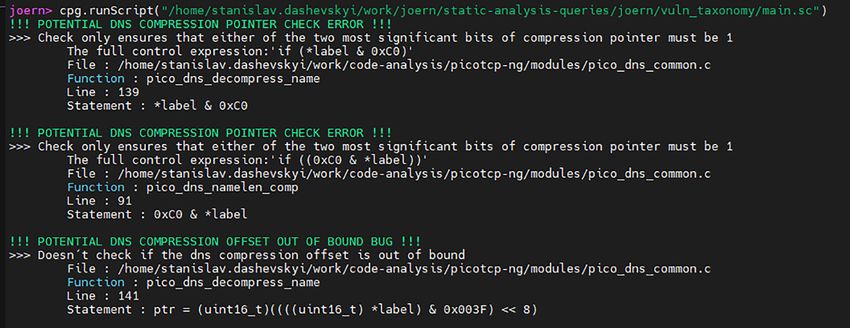
Following the anti-patterns described in Section 6, below
firmware based on old VxWorks, such as Dell PowerConnect
we discuss a general set of features of malicious packets
IT switches, Siemens SCALANCE ICS switches and Echelon
that may indicate exploitation attempts for the vulnerabil-
i.LON 600 IP routers for building automation. There are
ities outlined in this report. TCP/IP stacks should properly
also other vulnerabilities (unrelated to domain name pars-
detect and drop malformed packets within their code, but
ing) affecting VxWorks back to 5.5 (e.g., CVE-2020-11440)
since this is not the case as exemplified by the multiple
that seem to be fixed only for versions 6.9 and 7. We have
vulnerabilities in this report, we recommend implementing
not checked that any of these firmware are vulnerable. In
the rules outlined below in a network IDS.
conversation with WindRiver, they informed us that older
versions may also be patched, but this depends on their • Invalid compression pointer. A compression pointer (a
customer having special support agreements. byte with the 2 highest bits set to 1) must resolve to a
byte within a DNS record with the value that is greater
Given the challenges described above, we also recommend
than 0 (it must not be a NULL terminator) and is less
the following mitigation strategy in case pathing is not
than 64. The offset at which this byte is located must
possible.
be smaller than the offset at which the compression
FORESCOUT RESEARCH LABS 25You can also read


