Business Plan 2021-2022 - The Bar Standards Board
←
→
Page content transcription
If your browser does not render page correctly, please read the page content below
Business Plan
    2021-2022

The Bar Standards Board regulates barristers
and specialised legal services businesses in England and
Wales, in the public interest.

If you would like a version of this document in hard copy, or in an alternative format,
please contact the Equality and Access to Justice Team by telephone on 020 7611
1444 or:equality@barstandardsboard.org.uk

                                                                                          1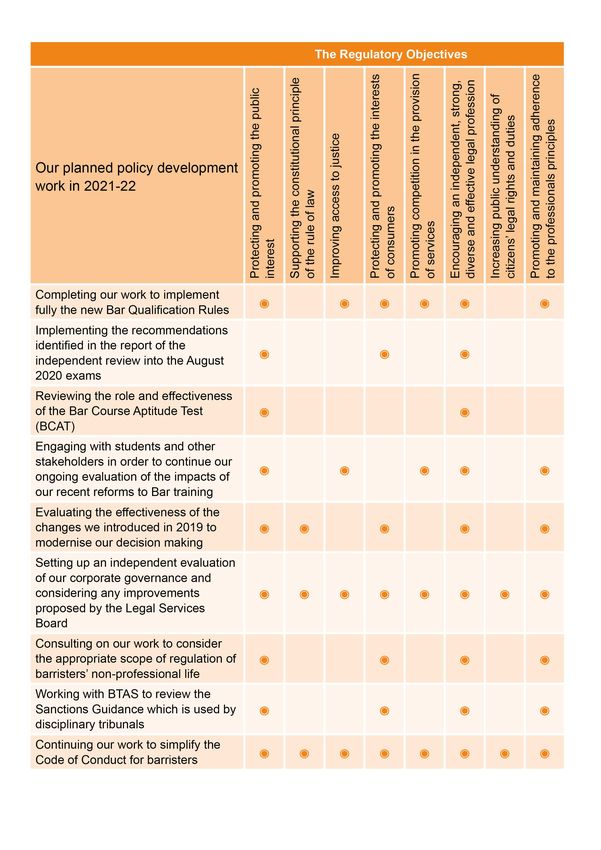
BSB Business Plan 2021-22

Foreword by the Chair
                            I am pleased to       This is the third and final year of our 2019-
                            introduce the Bar     22 Strategic Plan. Our focus over this period
                            Standards Board’s     has also been to ensure that our recent policy
                            (BSB’s) Business      initiatives, such as our reforms to the rules
                            Plan for 2021-22.     governing Bar training and to our disciplinary
                                                  and enforcement processes, have been
                              We know that        successfully implemented and evaluated. This
                              everyone            remains the case despite the effects of the
                              working at the      pandemic.
                             Bar continues to
face unprecedented challenges. Like many          This Business Plan outlines the specific
organisations, the coronavirus pandemic has       activities that we will undertake during 2021-22
had a significant effect on our work. For a       against each of our strategic aims.
number of reasons explained in this Plan, it
has also reduced our capacity as we move into     Our budget for the year ahead reflects our
2021-22, so in developing our Business Plan       prudent approach to financial management
for the year ahead, we have had to strike a       during a time when the health emergency has
realistic balance between what we would like to   had a serious effect on the incomes of many
do and what we are capable of delivering.         of the barristers who fund us. The budget for
                                                  2020-21 is £6,948k. In addition, we contribute
In 2021-22, we will continue to prioritise        £3,871k to the common services (such as IT
our core, day-to-day regulatory work which        and Finance) which we share with the Bar
includes overseeing the education and             Council.
training requirements for becoming a barrister,
monitoring the standards of conduct of            You will be able to read more about how we
barristers and compliance with the rules in our   performed against this Business Plan in our
Handbook, including the new transparency          2022 Annual Report.
rules, and ensuring that everyone we authorise
to practise is competent to do so. Where
necessary, that will also mean temporarily
putting on hold some of our longer-term
policy development projects. We want to be        Baroness Blackstone, Chair of The Bar
certain that we have the resource and focus to    Standards Board
undertake our core regulatory activities to the
standard expected of us.

The policy development which will remain
important includes continuing our work to raise
standards at the Bar; completing the final
implementation of our Bar training reforms;
working with the Bar Tribunals Adjudication
Service to review their Sanctions Guidance;
and promoting equality and access to justice
including tackling bullying, discrimination and
harassment at the Bar.

                                                                                                 2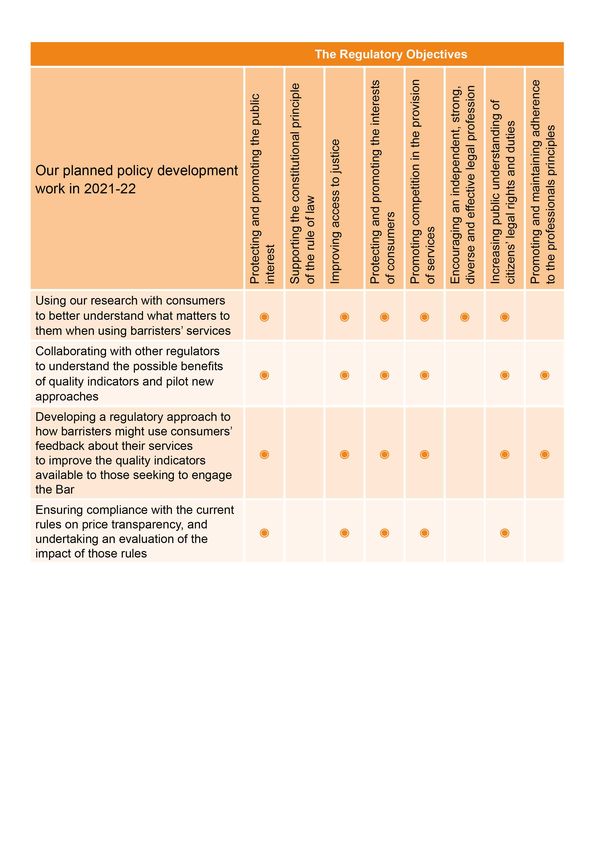
BSB Business Plan 2021-22

Introduction
In this section, we have listed our planned        Clearly, the risks facing the profession
activities in 2021-22 under our three Strategic    and within the legal services market look
Aims for this period. These aims are:              significantly different now given the coronavirus
                                                   pandemic and this year’s Business Plan
  ●   delivering risk-based, targeted and          reflects this.
      effective regulation;
                                                   In this Plan, we have listed our core regulatory
  ●   encouraging an independent, strong,          activities which we conduct every year as well
      diverse and effective legal profession;      as providing an overview of the specific policy,
      and                                          and other, work which we will carry out this
                                                   year. Our focus in 2021-22 will be to deliver our
  ●   advancing access to justice in a             core regulatory work effectively and efficiently
      changing market.                             in the public interest.

You can read more about these aims in our          As the regulator of the Bar in England and
2019-22 Strategic Plan which explains why we       Wales, our core “business-as-usual” activities
have them and the outcomes which we hope to        include:
achieve by the end of this strategic period.
                                                     ●   overseeing the education and training
Our website and the Strategic Plan also                  requirements for becoming a barrister in
explain how our regulatory priorities are set by         line with the new Bar Qualification Rules
conducting a risk-based analysis of the market           which we introduced in April 2019;
for barristers’ services. Our 2019 Risk Outlook
describes the key risk themes which we have          ●   monitoring the standards of conduct of
identified and which our regulatory activities –         barristers; and
including those described in this Business Plan
– are designed to address. The risk themes in        ●   ensuring that everyone we authorise to
the Outlook are:                                         practise is competent to do so.

  ●   working cultures and professional            We do this by supervising the practice of
      environment inhibit an independent,          barristers and the specialist legal services
      strong, diverse and effective profession;    businesses whom we regulate. We deal
                                                   with any information we receive which might
  ●   innovation and disruption in the legal       indicate that those we regulate may not be
      services market offer threats and            following our rules and where necessary, we
      opportunities for the profession and for     take appropriate regulatory action.
      the public; and
                                                   This day-to-day core work accounts for most
  ●   the public’s access to justice is            of what we do, so it is important that we
      threatened by affordability constraints      undertake this work effectively and efficiently in
      and by the complexity and lack of            the public interest.
      transparency of legal services.

                                                                                                               3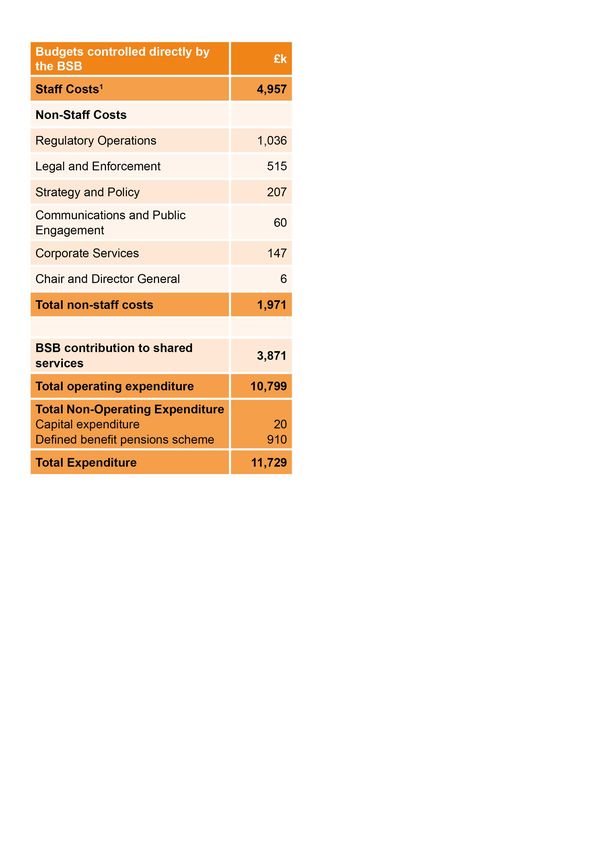
BSB Business Plan 2021-22

For a number of reasons, the health emergency          ●   working alongside the profession
has left us in a position of reduced capacity.             to ensure there remain sufficient
These reasons include an increase in work                  opportunities for students to progress to
as a direct result of the pandemic such as                 the work-based learning component of
having to administer more exam sittings and                training in light of the fall in the number of
having to process more authorisation waivers               pupillages registered in 2020 due to the
from a profession also coping with the impact              pandemic;
of the health emergency. We have also seen
a reduction in available staff resource due to         ●   completing our work to implement fully
increased sickness and staff having to balance             the new Bar Qualification Rules including
work and caring responsibilities.                          the introduction of new centralised
                                                           assessments to take place during
So, when developing this Plan for 2021-22, we              pupillage, and to learn the lessons
needed to be certain that we had the resources             identified by the independent review into
to undertake these core day-to-day regulatory              the August 2020 exams;
activities and to deliver them to a high standard.
This meant that we had to think carefully about        ●   reviewing the role and effectiveness of
which of our policy development projects were              the Bar Course Aptitude Test (BCAT)
the most urgent and to make some difficult                 in ensuring that those considering Bar
decisions about those which we are going to                training courses have the aptitude to
prioritise this year. The key projects which we            succeed;
are going to undertake this year include:
                                                       ●   analysing the responses we received
  ●   continuing our work to raise standards at            from the 2020 Regulatory Return,
      the Bar. This will include implementing              following up where necessary with
      targeted regulation to improve standards             individual practices and determining
      of advocacy in Coroners’ Courts, looking             appropriate regulatory policy action for
      at how we can improve flows of evidence              the future depending on what trends the
      from the judiciary and others about areas            returns might show;
      of concern, and how we can improve
      feedback to individual barristers from a         ●   continuing our review of the Code of
      range of stakeholders to inform their self-          Conduct for barristers (formerly referred
      reflection and continuing professional               to in our Business Plans as a review
      development;                                         of the full BSB Handbook, but now
                                                           only constituting a review of the Code),
  ●   continuing to challenge the Bar to                   although this will now proceed more
      promote anti-racism and to tackle                    slowly; and
      discriminatory practices, including by
      ensuring that barristers’ practices have         ●   preparing to publish our next three-year
      completed the four important actions we              Strategic Plan for 2022-25.
      asked them to undertake in our recent
      Anti-racist Statement;                         As well as having a three-year Strategic Plan,
                                                     we also have a dedicated Equality and Diversity
  ●   delivering a robust regulatory approach        Strategy in which we report on our progress
      to tackle bullying, discrimination and         towards fulfilling our statutory objectives under
      harassment within the profession;              the Equality Act 2010, both as an employer
                                                     and as the regulator of barristers in England
                                                     and Wales. This document also sets out our
                                                     Equality and Diversity objectives.

                                                                                                     4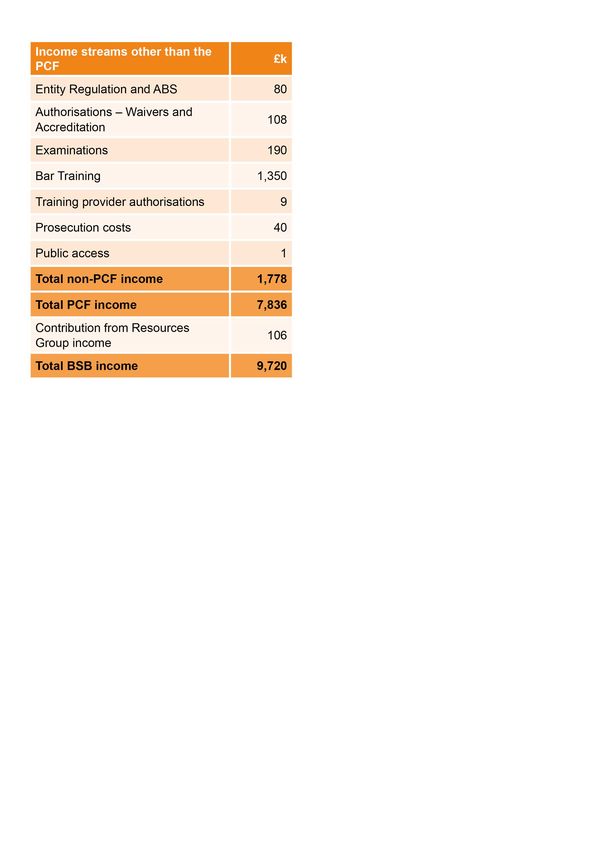
BSB Business Plan 2021-22

This Business Plan also provides information
about how we are governed and outlines our
planned income and expenditure for 2021-
22. This shows that the cost of regulation in
2021-22, including our share of the costs of
services which we share with the Bar Council,
is currently planned to be £11,729k. For
comparison, the cost of regulation in 2020-21
was £11,885k. This figure for 2020-21 differs
from that published last year as it has been
revised to include our capital expenditure (as
does the figure for the 2021-22 year, so that
they are directly comparable).

Our income and expenditure for the 2021-
22 year leaves us with a deficit of £2,009k,
given our forecasts of reduced income. Our
expenditure in 2021-22 will therefore be funded
through the PCF collection along with use of
reserves (supplemented by a Coronavirus
Business Interruption Loan Scheme (CBILS)
loan).

                                                                              5
BSB Business Plan 2021-22
Activities for 2021-22
The work which we plan to undertake during
2021-22 can be categorised into the core
regulatory activities which our role as the
regulator of barristers in England and Wales
requires us to do on a day-to-day basis, and the
policy and other project work which we will
complete in order either to improve the way in
which we regulate or to review, evaluate and,
where necessary, change our rules.
Each of these activities has been listed under
one of our three Strategic Aims, so that you can
see what we are doing to help us achieve each
aim. They are categorised under the strategic
aim to which they primarily relate, but some
might also contribute to the achievement of
desired outcomes under another strategic aim.
Unlike in previous Business Plans, this year we
have not published any quarterly milestones.
This is partly because of the strong focus
on core regulatory activities which by their
very nature happen throughout the year, and
also because we expect to be flexible with
our allocation of resources in the light of the
uncertainty of knowing if, how, and how quickly
the country and the profession will recover from
lockdown.
Previously announced regulatory project work
which is not mentioned in this Plan has not
been abandoned. If capacity permits this year,
or if we are able to engage additional resource,
it will be conducted around the activities listed
within this Plan. Otherwise, it will be undertaken
in subsequent years.
6BSB Business Plan 2021-22
Strategic Aim 1 – Delivering risk-based, effective and targeted
regulation
The core work that we will conduct through the ● regularly reviewing and reporting to the
year: Board about our evidence of changing
risk in the market. We use this to
● authorising organisations that provide understand how to prioritise our work
the vocational and work-based learning as a regulator and to look for ways to
components of Bar training and continuously improve.
managing our relationship with them;
The policy development or other activity that we
● authorising business entities (legal will undertake this year:
services businesses owned and
managed by lawyers or owned and ● completing our work to implement
managed by lawyers and non-lawyers); fully the new Bar Qualification
Rules introduced in 2019 including
● managing centralised examinations; the introduction of new centralised
assessments to take place during
● assessing and authorising applications pupillage;
for waivers and exemptions, and
applications from transferring qualified ● implementing the recommendations
lawyers; identified in the report of the independent
review into the August 2020 exams;
● assessing all the incoming information
we receive to determine whether ● reviewing the role and effectiveness of
regulatory action is required to address the Bar Course Aptitude Test (BCAT)
risks to the regulatory objectives; in ensuring that those undertaking Bar
Training Courses have the aptitude to
● proactively supervising those whom succeed on the course, and if relevant,
we regulate, including considering the to implement any changes in time for
information we receive about them; student applications in 2022;
● investigating allegations of breaches of ● engaging with students and other
the professional obligations within the stakeholders in order to continue our
BSB Handbook and taking enforcement ongoing evaluation of the impacts of our
action where necessary; recent reforms to Bar training;
● reporting data and statistics on regulatory ● evaluating the effectiveness of the
decision making; changes we introduced in 2019 to
modernise our decision making;
● fulfilling our duties under the Money
Laundering and Terrorist Funding ● setting up an independent evaluation
Regulations; of our corporate governance and
considering any improvements proposed
● monitoring and reporting on our along with any suggestions from the
performance as a regulator to ensure recent review of our governance by the
that we are efficient and effective; Legal Services Board;
● communicating and engaging with
stakeholders; and
7BSB Business Plan 2021-22
● consulting on our work to consider
the appropriate scope of regulation of
barristers’ non-professional life;
● working with BTAS to review the
Sanctions Guidance which is used by
disciplinary tribunals;
● implementing our internally-focused
initiatives to understand better the
working culture within the BSB and to
improve learning and development;
● developing and publishing our Strategic
Plan for 2022-25; and
● as capacity permits, continuing our
work to simplify the Code of Conduct for
barristers, to make sure that it remains fit
for purpose and to ensure that any future
changes to the Code are evolutionary
rather than revolutionary.
8BSB Business Plan 2021-22
The table below shows which of our planned policy development activities under Strategic Aim 1
relate to which of our Regulatory Objectives. Our core day-to-day regulatory work spans all the
Regulatory Objectives.
9BSB Business Plan 2021-22
Strategic Aim 2 – Encouraging an independent, strong, diverse and
effective legal profession
The core work that we will conduct through the ● scoping our work in relation to our
year: regulation of barristers in their early years
of practice to assure their competence
● collecting and publishing diversity data and their continuing professional
on the profession; development – work which amongst
other things may result in future years
● supervising barristers’ practices; in changes to Continuing Professional
Development (CPD) for newly qualified
● working with others to understand the practitioners;
factors that influence diversity within the
profession; ● continuing to challenge the Bar to
promote anti-racism and to tackle
● undertaking research activity to improve discriminatory practices, including by
understanding of the legal services ensuring that barristers’ practices have
market and the impact on the market of completed the four important actions
BSB regulation; and we asked them to undertake in our
recent Anti-racist Statement and where
● monitoring barristers’ Continuing necessary to work with practices to make
Professional Development (CPD). sure their commitments in this area are
met;
The policy development or other activity that we
will undertake this year: ● working alongside stakeholders to
deliver robust improvements to our
● working alongside the profession to regulatory approach in tackling bullying,
ensure the future of pupillage in light discrimination and harassment at the
of the fall in the number of pupillages Bar;
registered in 2020 due to the pandemic;
● analysing the responses we received
● continuing our work to raise standards from the 2020 Regulatory Return,
at the Bar by reviewing how we can following up where necessary with
improve flows of evidence from the individual practices, and determining
judiciary and others about areas of appropriate regulatory policy action for
concern, and how we can improve the future depending on what trends the
feedback to individual barristers from a Returns might show; and
range of stakeholders to inform their self-
reflection and continuing professional ● as capacity permits, continuing our
development; review of the Equality Rules within the
BSB Handbook to ensure that they
● implementing our joint work with remain fit for the purpose of delivering
the Solicitors Regulation Authority the equality and diversity objectives for
in relation to advocacy within the the profession as a whole.
Coroners’ Courts including publishing
expected competences and a toolkit of
resources for barristers (and other legal
professionals) who undertake this work;
10BSB Business Plan 2021-22
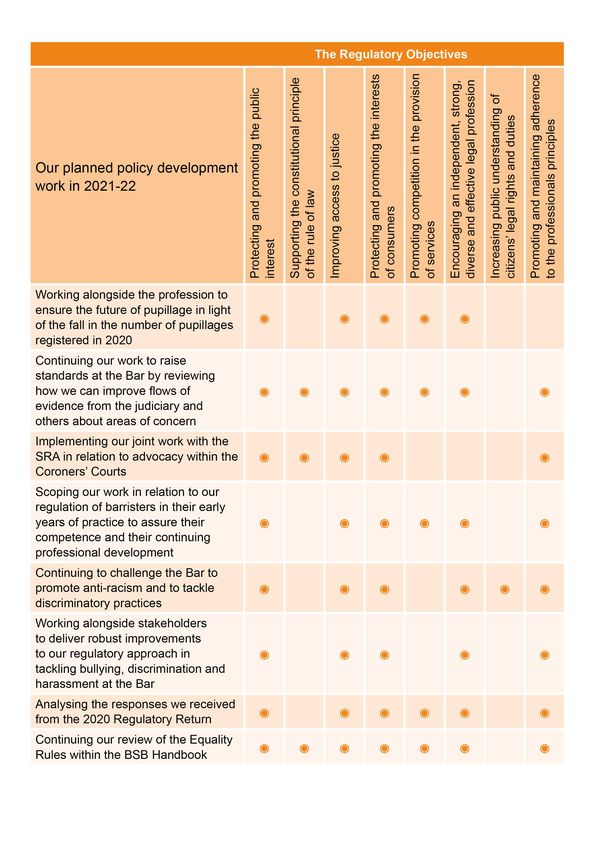
The table below shows which of our planned policy development activities under Strategic Aim 2 relate
to which of our Regulatory Objectives. Our core day-to-day regulatory work spans all the Regulatory
Objectives.
11BSB Business Plan 2021-22
Strategic Aim 3 – Advancing access to justice in a changing market
The core work that we will conduct through the The policy development or other activity that we
year: will undertake this year:
● providing information to the public about ● using our research with consumers to
barristers and legal services; better understand what matters to them
when using barristers’ services;
● working with our stakeholders and other
regulators and agencies to understand ● collaborating with other regulators
some of the barriers to accessing justice. to understand the possible benefits
This includes the reduced availability of quality indicators and pilot new
of Legal Aid, and the increased approaches;
prevalence of remote hearings and other
consequences of the health emergency; ● developing a regulatory approach to
how barristers might use consumers’
● sharing information with the public to feedback about their services to improve
help them overcome these barriers; the quality indicators available to those
seeking to engage the Bar; and
● continuing to implement our public
engagement strategy to increase public ● ensuring compliance with the current
understanding about legal services, and rules on price transparency, and
in particular those offered by barristers, in undertaking an evaluation of the impact
partnership with consumer organisations; of those rules.
and
● providing ongoing assurance of
professional competence.
12BSB Business Plan 2021-22
The table below shows which of our planned policy development activities under Strategic Aim 3
relate to which of our Regulatory Objectives. Our core day-to-day regulatory work spans all the
Regulatory Objectives.
13BSB Business Plan 2021-22
The role and work of the BSB
The Bar Standards Board is made up of a controls are maintained. The Committee
combination of lay people and barristers. It has keeps under review, and advises the
a lay majority and a lay chair, Baroness Tessa Board on, all matters relating to the risk
Blackstone. management framework and our internal
audit function.
Leadership
● The Strategic Planning and Resources
Committee (SPR) is responsible for
The Board is responsible for leading the
work relating to development of our
organisation. It sets our direction and approves
strategic direction and plans. It advises
policy and strategy. The Board supports
the Board on developments to the
the Executive in representing the BSB with
planning and resource setting processes.
external stakeholders and accepts collective
It also considers whether financial and
accountability for the organisation’s work in
operational resources are properly
regulating barristers in the public interest.
and effectively allocated and efficiently
managed across our organisation.
Accountability, assurance and
oversight The Board has also established the
Independent Decision-making Body (IDB)
The Board, and its standing committees, which is made up of 31 decision makers, 13 of
monitor the work and performance of the whom are barristers and 18 are members of
organisation. It holds the executive to account the public who are not solicitors or barristers.
for: It makes decisions by sitting in panels about
cases passed to the Legal and Enforcement
● the commitments made in this Business Department for investigation that may require
Plan; disciplinary action. It also makes decisions
about appeals that have been made against
● the BSB’s agreed service standards; and a decision not to license a body to provide
legal services, or appeals against decisions
● the delivery of key milestones to time and about whether or not barristers or authorised
to budget. bodies need to meet specific BSB Handbook
requirements.
Strategy Our work is also overseen by the Legal
Services Board, in accordance with the Legal
The Board sets and approves the strategy for
Services Act 2007.
the organisation, taking account of the wider
regulatory and risk landscape. When approving
its strategy, it takes account of short-term
pressures but also maintains sight of broader
long-term trends.
Our Board discharges some of its functions
through the following standing committees:
● The Governance, Risk and Audit
Committee (GRA) is responsible
for ensuring the Board’s corporate
governance standards and internal
14BSB Business Plan 2021-22
Our 2021-22 budget
Our budget year runs from 1 April 2021 to 31 commitments in 2021-22 have been adjusted
March 2022. accordingly.
How is the BSB funded?
Most of our funding comes from Practising
Certificate Fees (PCF) and Bar Council
reserves. These income streams are not
within our direct control but are forecast using
the latest available market data. Our income
streams other than the PCF come from charges
we make for specific services we provide to
individuals and organisations, and we use
historical and market data to forecast what
we expect to receive. These income streams
include, for example, the fees from Authorised
Education and Training Organisations
(AETOs), and the Bar Transfer Test (BTT). We
independently set our own budget with regard
to the forecasts for both PCF income and
income streams other than the PCF.
The Practising Certificate Fee (PCF)
The PCF is collected by the General Council
of the Bar (GCB). The GCB’s income from the
PCF is divided between:
● the BSB for regulation (58% £6,926k)
● the Bar Council for some of its functions
(as permitted under s51 of the Legal
Services Act) (24% £2,878k) and
● the remaining 18% (£2,144k) is paid to
fund GCB pensions (£1,300k) and to
the Legal Ombudsman and the Legal
Services Board (£844k) to fund their
services.
The 58% of PCF income which we receive
for regulation accounts for 72% of our total
funding. The BSB and the GCB have consulted
on our budgets and PCF proposals with the
profession and have received approval from the
Legal Services Board. This year’s budget was
determined with reference to the fact that we
know 2020 was a financially very challenging
year for many parts of the Bar, and our financial
15BSB Business Plan 2021-22
Regulation – the costs explained How will we spend our budget?
The BSB has direct control of a budget of
£6,948k for 2021-22. We formulate our own
budget in accordance with our priorities and
strategy. However, this budget does not reflect
the full cost of the BSB. We share the costs of
common services with the Bar Council including
a share of the premises at 289-293 High
Holborn as well as relying upon the shared
Resources Group to carry out support work
(IT, Finance, and certain Human Resource and
Project Management functions).
The Resources Group budget, which includes
our share of the costs of our shared premises,
is managed separately and part of that budget
(£3,871k) is apportioned to the BSB. We will
as always look to ensure that our expenditure
is allocated wisely and in a way that delivers
maximum value-for-money for those who fund
us. The organisation undertakes rigorous
prioritisation exercises as part of business
planning. Only activity deemed essential is
agreed and included in the Business Plan.
The deficit of £2.009 million we project for
2021-22 will be financed by the use of reserves,
supplemented by a Coronavirus Business
Interruption Loan Scheme (CBILS) loan.
1 As well as salary and associated on-costs, “Staff Costs” includes provision for temporary staff, recruitment,
training, and the expenses incurred by staff in the course of performing their duties.
16BSB Business Plan 2021-22
Further reading
To obtain a fuller picture of who we are, what
we do, and the context in which this Business
Plan was produced, please visit the following
pages on our website:
● Risk-based regulation is an integral part
of how we regulate the Bar and how we
develop our strategy. You should read
our Risk Outlook, our Risk Framework
and our Risk Index to understand more
about this aspect of our work and to gain
a better understanding of how we arrived
at the strategic aims described in this
Plan.
● This Business Plan is designed to be
in read in conjunction with our 2019-22
Strategic Plan which you can read on our
website.
● More information about our work around
equality and diversity can be found there.
● Our organisational values describe the
way in which we conduct all our work
including the activities described in this
Plan.
17Contact us:
Bar Standards Board
289-293 High Holborn
London WC1V 7HZ
Tel: 020 7611 1444
Email: ContactUs@BarStandardsBoard.org.uk
Twitter: @BarStandards
Youtube: /barstandardsboard
LinkedIn: /thebarstandardsboardYou can also read


