Case Study: Assessment report, Red Cross Multifunctional Centre of Thessaloniki - Community engagement and accountability
←
→
Page content transcription
If your browser does not render page correctly, please read the page content below
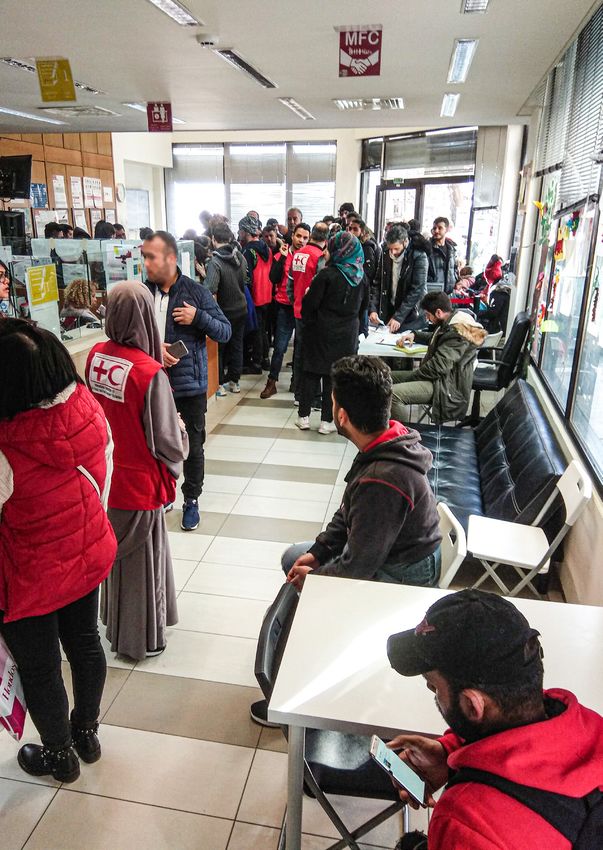
Community engagement and accountability
Case Study: Assessment report, Red Cross
Multifunctional Centre of Thessaloniki
Since May 2015 the International Federation of Red Cross
  and Red Crescent Societies along with the Hellenic Red
  Cross have worked with local communities on the frontline
  of the migration response to provide relief and assistance
  to people seeking safety in Europe. Assistance included
  primary health care, hygiene promotion, food and relief
  distribution, first aid, psychosocial support, Restoring
  Family Links and cash assistance.

MultiFunctional Centre
of Thessaloniki

Greece, Thessaloniki
Ionos Dragoumi & Vamvaka 1,
54631
Telephone: +30 2310 270 914
Email: mfc-thes@redcross.gr
                                                               created by MFC information officer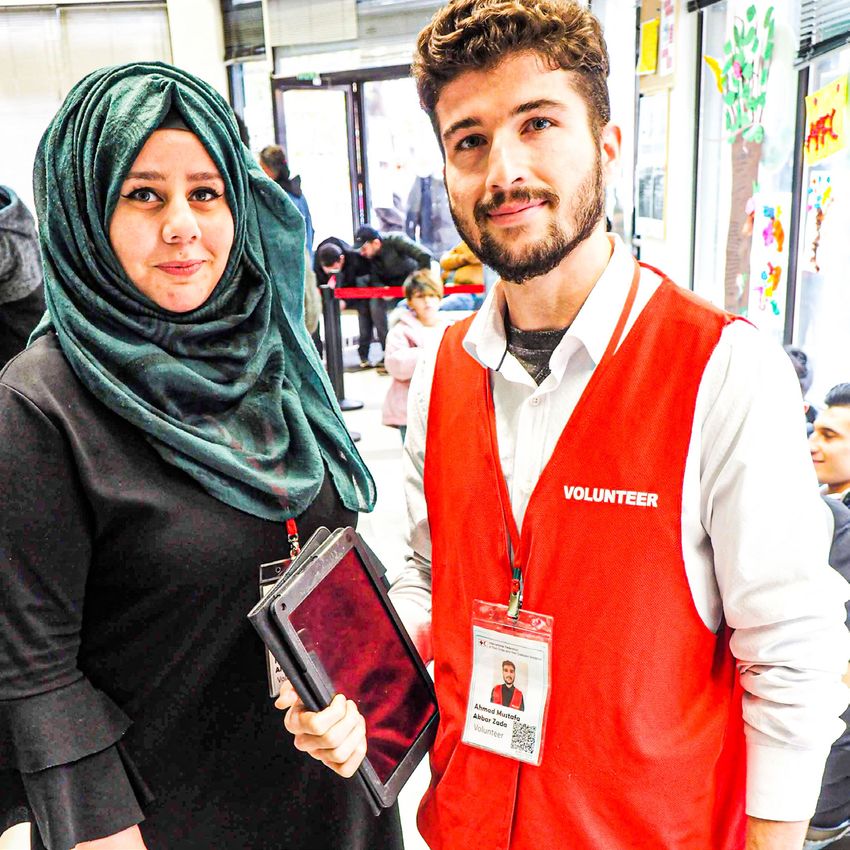
Contents

Introduction                                               4

Methodology (pilot process, implementation, challenges)    6

Questions related to general data                          8

Questions related to cash transfer program                10

Questions related to transparency and participation       11

Questions related to interests, hobbies and activities    14
Introduction

4Multi Functional Centre
Introduction

        The Red Cross Multifunctional Centre       The MFC has established a system to
        (MFC) in Thessaloniki has been running     listen, collect, analyse, respond to and
        since November 2017 as a social centre     act on feedback to understand better
        that strives to accommodate a holistic     the aspect of the challenges that the
        range of services by providing timely      migrants and refugees face in their daily
        and reliable information to the migrant    life in Thessaloniki. This is designed with
        and refugee communities by facilitating    input from the community and staff and
                                                   volunteers properly trained to manage it.
        Integration, Social Services (Casework,
        Greek language lessons, Orientation
                                                   To achieve the above mentioned, the
        Services), Restoring Family Links (RFL)
                                                   MFC is supported by a set of Community
        and Cash Transfer Programming. The         Engagement and Accountability (CEA)
        main goal of the community center is       activities (suggestion box, focus group
        to reduce vulnerability of refugee and     discussions, assessment survey) that
        migrant communities by enhancing           help put communities at the centre of what
        capacity towards self-sustainability,      MFC does, by integrating communication
        providing access to proper and effective   and participation.
        information, navigating the Greek public
        systems and providing cash assistance
        to meet basic needs while fostering
        integration and resilience through
        trainings and social support groups.

                                                                                                  5
                                                                              CEA:Assessment Report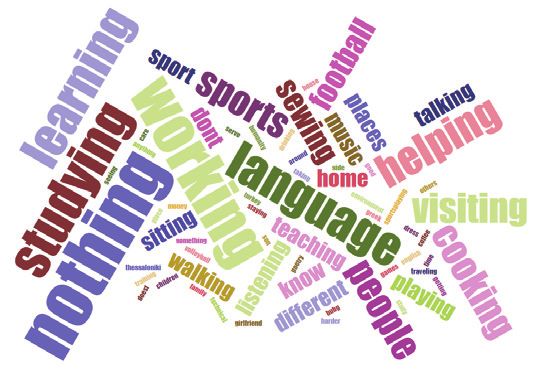
Methodology

                           An assessment of MFC services was conducted in November 2019
                           and provided insight into services from a beneficiary perspective, with
                           a view to informing future service improvements and new integration
                           activities.

                           The survey had the following objectives:
                           • Check beneficiaries are aware of MFC services and know how to
                              access them
                           • Test understanding of specific cash assistance processes, including
                              certification; help-desk and understanding of when cash assistance
                              will finish
                           • Check awareness of feedback and complaints process in MFC
                           • Identify preferred communication channels for MFC service updates
                           • Identify themes for future multi-cultural activities to assist with
                              cultural integration

                           The MFC has over ten working languages, and therefore the challenge
                           was to design an assessment that could be utilised without losing detail
                           in translation. It was decided to design the questionnaire in English,
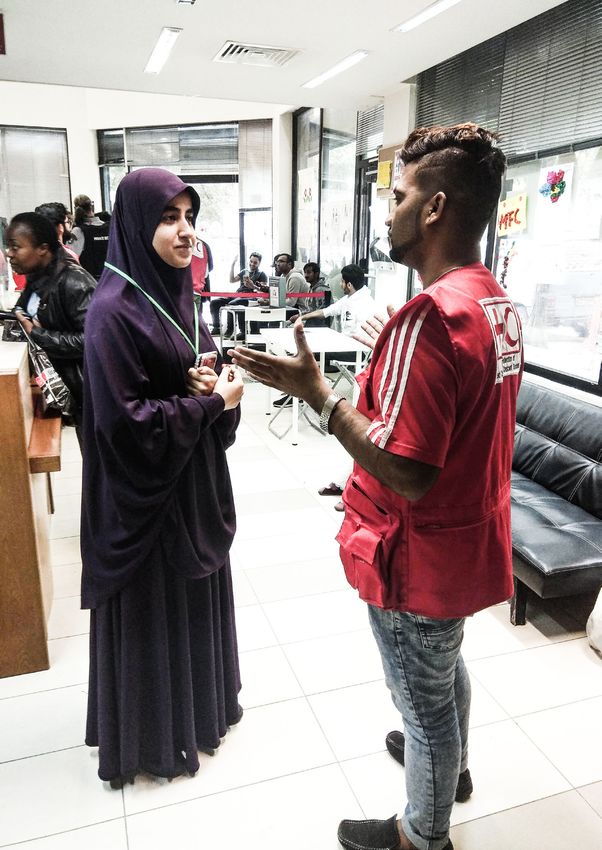
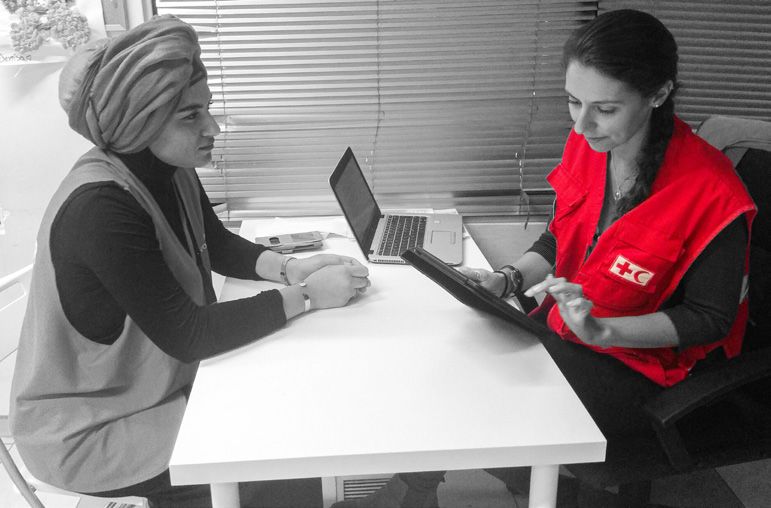
                           and train the MFC volunteers, themselves former asylum seekers
                           and refugees, to conduct the survey by asking the beneficiary the
                           questions in their first language. The volunteer would then record the
                           answers in English, using tablets provided. This method ensured that
                           beneficiaries fully understood the question and were able to participate
                           in the process irrespective of their literacy level.

                           The additional advantage of this method was the wealth of cultural
                           knowledge and understanding that the volunteers brought, in
                           communicating fluently with the beneficiaries, re-phrasing and
                           explaining the questions as required, and providing insight into the
                           answers and feedback that they gave.

6Multi Functional Centre
Methodology
Pilot process                                                Implementation

The questions were initially created combining two           After a week of development and training, the
draft surveys, one from the cash assistance staff and        assessment was implemented by the MFC volunteers
one from the social services team.                           with beneficiaries waiting to access MFC services. A
                                                             staff member was on hand to provide support and
There were two broad stages in developing the                answer any queries the volunteers had. Staff also
assessment:                                                  monitored the data collected, to ensure that it was
1. refining the questions and                                relevant and clear for the purpose of meeting the
2. identifying and training the volunteers.                  assessment’s objectives.

In the first stage the questions were trialled by staff in   Challenges
interviews with MFC volunteers. After five interviews
the question wording was amended based on                    •   Many different spoken languages at the MFC.
feedback from the volunteers. After three interviews         •   The pilot process required the continuous
with the new questions, including thorough feedback              presence of two staff (facilitators) for one week.
from the volunteers on their understanding of the                Ten volunteers and three staff participated in the
questions, they were further refined and reworded                pilot interviews.
until they reached the clearest possible format for          •   Five times the questionnaire changed, rephrasing
non-native English language speakers.                            the questions.
                                                             •   Identifying volunteers with good understanding of
In the second stage, volunteers with a high level of             English, communication skills and adequate use
English were identified and asked to test the questions          of KOBO in tablets.
on the staff. By reversing the process, it was possible      •   The assessment was running daily for one month
to train the volunteers in how to conduct the surveys,           simultaneously with the provision of the MFC’s
the purpose of the questions and the range of answer             services.
options. This training ensured that the volunteers           •   Daily coordination of the volunteers to identify
were confident in the meaning of the question and                gaps and issues.
understood the reason behind the choice of wording,
so as to accurately be able to translate and explain
the questions to the beneficiaries.

                            Cash
                           Support
                      Social
                     Services

                      creation of
                      questions

                                                                                          CEA:Assessment Report 7
GeneralGeneral
Data Data
Daily Records
one hundred twenty four total interviews
1st week 2nd week 3nd week 4th week
4 5 6 7 8 12 13 14 15 18 20 21 22 25 26 27
female
male
TOTAL records 71 21 13 19
Daily records
1 22
Gender Language of the interviews
7%
31% 14%
female Urdu
Farsi
69%
male
5%
Turkish
23% 23% 4%
English* Sorani Kurmanji
1%
Greek
*second language in 21%
case of lack of translator
Arabic
8Multi Functional CentreType of accommodation Reasons visiting the MFC
Homeless Cash card
Hosted 5%
problem
UNHCR Accommodation
36%
UNHCR
appointent UNHCR accommodation
IOM hotel
Other
Site
Greek
Self Accommodated lessons
29%
23%
Casework More than half of the reasons
IOM Hotel Site (>51%) that people (accommodated
5% 2% RFL under an organisation) are coming
Address to MFC, are related with the Cash
change Transfer Program.
Under an
Independent
organisation
The below alluvial diagram shows the flows and correlation between four different categories from
the people that are under an organisation: 1) Language 2) Gender 3) Type of Accommodation and 4)
the reason someone came to the Muti Functional Centre. The correlation is readable through each
neighboring category only.
Cash card problem
Sorani
UNHCH Accommodation
Male
Arabic
Other
appointment
Farsi
UNHCR
Site IOM Hotel
Female
English
Casework
Greek language lesson
Kurmanji Address change
Turkish RFL
CEA:Assessment Report 9Questions related
Questions related to toprogram
cash transfer cash transfer program
Do you know how...
1. how to use the cash card? 3. when to come to sign?
2. when your cash assistance will end? 4. what to do if you have a cash card problem?
1 2 3 4
yes no
From 15% of the people From the 43% of the From the 22% of the From the 30% of the
that do not know how people that do not people that do not people that do not know
to use the cash card: know when the cash know when to come what to do in case of
88% are homeless, 50% assistance will end: 48% to sign: 50% are self cash card problem: 63%
speak Sorani and 25% are homeles and 48% accommodated and 42% are self accommodated.
Urdu. 75% are male. self accommodated. homeless. 25% speak 31% speak Urdu, 31%
30% speak Urdu, 22% Urdu and 25% English. English, 13% Sorani and
English and 17% Sorani. 67% are male. 13% Kurmanji. 69% are
70% are male male.
From 86 responders,57 (46%) receives cash assistance. From them 54 are the cash holders
(focal points). Four questions were asked to them about cash service:
70% of the Urdu speakers don’t know when the cash assistance will end, and 50% do not
know what to do in case of cash card problem. Similar information gaps appear to Sorani
and Farsi speakers while the English and Arabic speakers are well informed.
52% of the homeless people and 38% of the self accommodated do not know when the
cash assistance will end. One big difference appears in the use of the card while the self
accommodated know better (97%) how to use the card. Respectively only the 67% of the
homeless know how to use the cash card. The hosted people appear well informed.
It seems that the men are more informed than women in all above questions. 54% of women
do not know when the cash assistance will end and 39% do not know how to use the cash
card, while the men are 39% and 27% respectively.
10
Multi Functional CentreQuestions
Questions related related to and
to transparency transparency
participation and participation
What do you know about the
activities in the Red Cross centre?
RFL 1%
Orientation
6%
Cash
35%
Language
Lessons
13%
Casework 19%
Don’t Know 25%
Do you know how to use the Are you interested in sharing
feedback mechanism of MFC? your opinion with Red Cross?
yes no not sure
11
CEA:Assessment ReportWhat are the best two ways for the Red
Cross to provide you with information?
1st channel 2nd channel
Face to Face Do not know
Phone Cals & SMS Phone Cals & SMS
Do not know What’s App
What’s App Face to Face
Social Media Viber
Viber Social Media
Website Email
Self Accommodated Hosted Homeless
Αlluvial diagram that shows the flows and correlation between the two channels of communication.
1st Channel 2nd Channel
Do not know
Face to Face
Phone call & SMS
What’s App
Phone call & SMS
Face to Face
Do not know
What’s App Viber
Social Media
Viber Social Media
Website EmailWhat are the two most important things that you
need to get information about at the moment?
1st choice
records
Financial Suport
Accommodation
public services
Health System
less more
Employability
Support with
Education
Food Aid
Nothing
Asylum
Asylum Each box in the heat map
2nd choice
Education represents a frequence of
responses. The darker the
Employability color the more the responses
Financial Suport for each topic.
Food Aid
The Accommodation has a
Health System strong correlation with almost
Accommodation all the other topics as first and
Non Food Items as second choice.
Nothing
Support with
public services
1st choice 2nd choice
Accommodation Accommodation
Homeless
Nothing
Asylum
Health System
Financial Support
Employability
Self Accommodated
Health System
Asylum
Education
Employability Financial Support
Nothing Education
Hosted
Support with public services Food aid
Food aid Support with public services
Other Non Food ItemsInterests
Interests HobiesHobbies
Activities Activities
How do you spend your free time? What you would like to do
different in your free time?
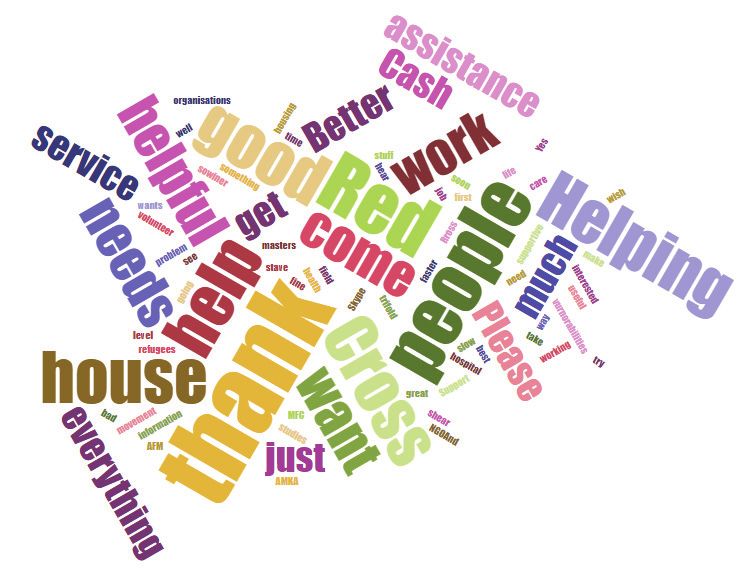
Many people answered that they don’t have
free time or that they do not do anything
because they are searching for house.
Is there a general comment that you want to share?
14
Multi Functional CentreHumanity
The 7 Fundamental Principles of the InternationalRed Cross and Red Crescent Movement
The International Red Cross and Red Crescent
Movement, born of a desire to bring assistance
without discrimination to the wounded on the
battlefield,endeavours, in its international and national
capacity, to prevent and alleviate human suffering
wherever it may be found. Its purpose is to protect
life and health and to ensure respect for the human
being. It promotes mutual understanding, friendship,
cooperation and lasting peace amongst all peoples.
Impartiality
It makes no discrimination as to nationality, race, religious
beliefs, class or political opinions. It endeavours to
relieve the suffering of individuals, being guided solely
by their needs, and to give priority to the most urgent
cases of distress.
Neutrality
In order to enjoy the confidence of all, the Movement
may not take sides in hostilities or engage at any
time in controversies of a political, racial, religious or
ideological nature.
Independence
The Movement is independent. The National Societies,
while auxiliaries in the humanitarian services of their
governments and subject to the laws of their respective
countries, must always maintain their autonomy so that
they may be able at all times to act in accordance with
the principles of the Movement.
Voluntary service
It is a voluntary relief movement not prompted in any
manner by desire for gain.
Unity
There can be only one Red Cross or Red Crescent
Society in any one country. It must be open to all. It must
carry on its humanitarian work throughout its territory.
Universality
The International Red Cross and Red Crescent
Movement, in which all societies have equal status and
share equal responsibilities and duties in helping each
other, is worldwide.
15
CEA:Assessment ReportYou can also read


