CERTEST SARS-COV-2 + FLU A - ONE STEP SARS-COV-2 AND INFLUENZA TYPE A AG COMBO CARD
←
→
Page content transcription
If your browser does not render page correctly, please read the page content below
CERTEST
FO

                       SARS-CoV-2 + Flu A
  R
      IN
        FO

                        ONE STEP SARS-CoV-2 and
                        Influenza type A Ag COMBO CARD
          RM

                        TEST
             A
             TI

                        CERTEST BIOTEC S.L.
                    ON
                                PU
                                        RP
                                                OS
                                                       ES
                                                                   ON
                                                                              LY

             The test should be used by professional trained in IVD devices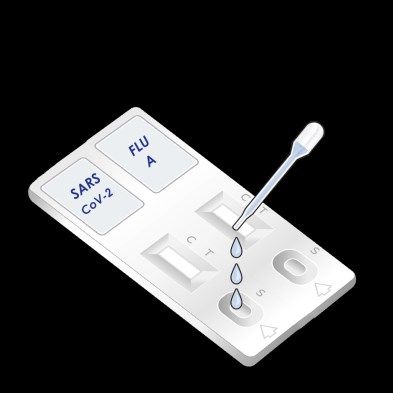
LY
                                  ON
                             ES
                           OS
                        RP
                      PU
                 ON
             ATI
          RM
        FO
      IN
  R
FO
CERTEST SARS-CoV-2 + Flu A
One Step test to detect SARS-CoV-2 and Influenza A antigens in combo card format/
Prueba combo de un solo paso para detección de SARS-CoV-2 e Influenza A antígenos en formato cassette
ENGLISH
INTENDED USE
CerTest SARS-CoV-2 + Flu A one step combo card test is a coloured chromatographic immunoassay for the simultaneous qualitative detection
of nucleoprotein antigen of SARS-CoV-2 and Influenza type A from nasopharyngeal swab samples from patients suspected of COVID-19
infection and/or Influenza A infection.
CerTest SARS-CoV-2 + Flu A combo card test offers a simple and highly sensitive screening assay as aid in the diagnosis of SARS-CoV-2
FO
and/or Influenza type A infection.
INTRODUCTION
R
An unseen pneumonia spread swiftly in Wuhan, China, in December 2019. Scientists sequenced and recognized a novel β-coronavirus.
The disease, caused by the Severe Acute Respiratory Syndrome Corona Virus 2 (SARS-CoV-2), is called as Coronavirus disease 2019
(COVID-19).
IN
Coronaviruses (CoVs) are RNA, enveloped viruses, with a large genome (29.9 kb), amongst which β-CoVs and α-CoVs can infect mammals.
Viruses belonging to the Coronaviridae family have the most abundant membrane protein (M) among other proteins, i.e. spike glycoprotein (S),
nucleocapsid protein (N) and an envelope protein (E). Spike glycoprotein (S) is one of the targets of T cell response in the immune system. The
FO
S protein also promotes the binding of the virus envelope to the ACE2 receptor and the entry of the virus into the cell target. ACE2 receptors are
present in cells of the arteries, veins, smooth muscles, small intestine, alveoli of the lungs, hair follicles, cardiac myofibroblasts, skin, brain, and
kidney, thus SARS-CoV-2 could potentially infect these tissues.
RM
Clinical forms of this disease comprise from mild to very severe symptoms: pneumonia, fever and respiratory symptoms are the most frequents.
Other symptoms of the viral infection include a sore throat, aches, pains, and shortness of breath. In some cases, runny nose, nausea, and
A
diarrhea also occur.
The outbreak of newly discovered coronavirus begins mainly via discharge from the nose or droplets of saliva, once an infected individual
TI
sneezes or coughs, and the estimated time for incubation is within 2 weeks. Due to the high infectious rate of SARS-CoV-2, detection of
asymptomatic positive patients is probably one of the key points to controlling the outbreak.
Influenza is caused by a virus that attacks mainly the upper respiratory tract - the nose, throat and bronchi and rarely also the lungs. The
ON
infection usually lasts for about a week. It is characterized by sudden onset of high fever, myalgia, headache and severe malaise, non-
productive cough, sore throat, and rhinitis. Most people recover within one to two weeks without requiring any medical treatment. In the very
young, the elderly and people suffering from medical conditions such as lung diseases, diabetes, cancer, kidney or heart problems, Influenza
poses a serious risk. In these people, the infection may lead to severe complications of underlying diseases, pneumonia and death.
PU
The currently circulating influenza viruses that cause human disease are divided into two groups: A and B. Influenza A has 3 subtypes which are
important for humans: A (H3N2), A (H1N1) and A (H5N1), of which the former is currently associated with most deaths. Influenza viruses are
RP
defined by 2 different protein components, known as antigens, on the surface of the virus. They are spike-like features called haemagglutinin (H)
and neuraminidase (N) components.
TEST PRINCIPLE
OS
CerTest SARS-CoV-2 + Flu A one step combo card test is a coloured chromatographic immunoassay for the simultaneous qualitative detection
of nucleoprotein antigen of SARS-CoV-2 and Influenza type A from nasopharyngeal swab samples from patients suspected of COVID-19
ES
infection and/or Influenza A infection.
Strip A consists of a nitrocellulose membrane pre-coated with mouse monoclonal antibodies on the test line (T), in the results window, against
SARS-CoV-2 and with rabbit polyclonal antibodies, on the control line (C), against a specific protein. The label/sample absorbent pad is sprayed
with test label solution (mouse monoclonal antibodies anti-SARS-CoV-2) conjugated to red polystyrene latex and control label solution (specific
ON
binding protein) conjugated to green polystyrene latex, forming coloured conjugate complexes.
Strip B consists of a nitrocellulose membrane pre-coated with mouse monoclonal antibodies on the test line (T), in the results window, against
Influenza type A and with rabbit polyclonal antibodies, on the control line (C), against a specific protein. The label/sample absorbent pad is
LY
sprayed with test label solution (mouse monoclonal antibodies anti-type A) conjugated to red polystyrene latex and control label solution
(specific binding protein) conjugated to green polystyrene latex, forming coloured conjugate complexes.
If the sample is SARS-CoV-2 positive, the antigens of the diluted sample react with the red-coloured conjugate complex (anti-SARS-CoV-2
monoclonal antibodies-red polystyrene microspheres) in the strip A, and if the sample is Influenza A positive, the antigens of the diluted sample
react with the red-coloured conjugate complex (anti-Influenza type A monoclonal antibodies-red polystyrene microspheres) in the strip B, which
were previously pre-dried on the absorbent pad. The mixture then moves upward on the membrane by capillary action. As the sample flows
through the test membrane, the binding conjugate complexes migrate. The anti-SARS-CoV-2 antibodies present on the membrane of strip A
1 IU-SZ88 v 02 December 2020 Version 02 1
Pol. Industrial Río Gállego II, Calle J, Nº 1,
CerTest 50840, San Mateo de Gállego, Zaragoza (SPAIN)
BIOTEC S.L. www.certest.es.CERTEST SARS-CoV-2 + Flu A
One Step test to detect SARS-CoV-2 and Influenza A antigens in combo card format/
Prueba combo de un solo paso para detección de SARS-CoV-2 e Influenza A antígenos en formato cassette
(test line) and the anti-Influenza type A antibodies present on the membrane of strip B (test line) capture the coloured conjugate and the one red
line will be visible in both strips. These bands are used to interpret the result.
If the sample is negative, there is no SARS-CoV-2 and Influenza type A antigens presence and yet, the antigens may be present in a
concentration lower than the detection limit value, for which the reaction will not take place with any red-coloured conjugate complex. The anti-
SARS-CoV-2 and anti-Influenza type A antibodies present on the membranes (test lines) will not capture the antigen-red-coloured conjugate
complex (not formed), for which the red lines will not appear.
Whether the sample is positive or not, in both strips, the mixture continues to move across the membranes to the immobilized specific
FO
antibodies placed in the control lines. The anti-specific protein antibodies present on both membranes will capture control green-conjugate
complex and both control lines will always appear. The presence of these green lines serves as: 1) verification that sufficient volume is added,
R
2) that proper flow is obtained and 3) an internal control for the reagents.
STORAGE AND STABILITY
IN
Store as packaged in the sealed pouch at 2-30ºC. The test is stable until the expiration date marked on its sealed pouch. The test must remain
in the sealed pouch until use. Do not freeze.
PRECAUTIONS
FO
- For professional in vitro diagnostic use.
- Do not use after expiration date.
RM
- All the specimens should be considered potentially hazardous (especially samples from patients suspected of SARS-CoV-2 infection) and
handled in the same manner as an infectious agent. A new test must be used for each sample to avoid contamination errors.
- Use proper infection control practices when collecting and handling specimens. These practices should include, but are not limited to,
A
personal protective equipment (PPE), such as a laboratory coat, surgical or appropriate mask, or face shield, disposable gloves, and eye
TI
protection. Follow local or national regulations regarding collecting and handling specimens.
- The tests (swabs, testing tubes, pipettes, positive control swab and devices) should be discarded in a proper biohazard container after testing.
These containers should be discarded in accordance with local or national laws or regulations.
ON
- Clean up spills thoroughly using an appropriate disinfectant.
- Reagents contain preservatives. Avoid any contact with skin or mucous membrane. Consult safety data sheet, available on request.
- Components provide in the kit are approved for use in the CerTest SARS-CoV-2 + Flu A test. Do not use any other commercial kit component.
- Sterile swabs provided in the kits should be only used for taking the nasopharyngeal sample collection. They cannot be reuse.
PU
- Do not touch the head of the sterile swabs provided when opening their primary packaging to avoid contamination.
- The presence of yellow lines in the results window (control line zone and test line zone), before using the test, is completely normal and does
not imply failure of the test functionality.
RP
All positive results should be processed following local or national laws and regulations
SPECIMEN COLLECTION AND PREPARATION
OS
Samples should be process as soon as possible after collection. Follow proper infection control practices. If this is not possible, the samples can
be stored in the refrigerator (2-8 ºC) for a maximum of 8 hours prior to testing. If the samples are preserved in validated transport media (VTM,
UTM o Saline Buffer) could be preserved on it until 6 hours at room temperature or in the refrigerator (2-8ºC).
ES
Specimen preparation (see illustration):
Nasopharyngeal swab method:
1. Remove the sterile swab from its packing.
ON
2. Collect specimen with a sterile swab from one nostril.
3. Insert the swab into the nostril to the nasopharynx, rotating against the wall.
(to ensure swab contains cells as well as mucus). Remove the swab from the nostril carefully.
LY
4. Consider repeating procedure using other nostril only if the protocol of the professional taking the sample
required do it.
5. Process the swab as soon as possible after collecting the specimen.
Follow the test procedure (samples). Specimen collection
Nasopharyngeal samples previously extracted by transport media:
Even while using direct nasopharyngeal swab is the preferred protocol, the device can be also used with samples from nasopharyngeal swabs
previously diluted in transport media such as: VTM, UTM or Saline Buffer.
2 IU-SZ88 v 02 December 2020 Version 02 2
Pol. Industrial Río Gállego II, Calle J, Nº 1,
CerTest 50840, San Mateo de Gállego, Zaragoza (SPAIN)
BIOTEC S.L. www.certest.esCERTEST SARS-CoV-2 + Flu A
One Step test to detect SARS-CoV-2 and Influenza A antigens in combo card format/
Prueba combo de un solo paso para detección de SARS-CoV-2 e Influenza A antígenos en formato cassette
1. Use the minimum volume of transport media in order to avoid loss in sensitivity. Example: 1.0 mL. Using higher volumes will affect
sensitivity of the system.
2. Dilute the extracted sample 1:1 in Reagent Respiratory (sample diluent) provided.
Follow immediately with the point 3 of test procedure (samples).
MATERIALS
MATERIALS PROVIDED MATERIALS REQUIRED BUT NO PROVIDED
FO
- CerTest SARS-CoV-2 + Flu A combo card tests - Disposable gloves (other personal protective
- Reagent Respiratory (sample and controls diluent) equipment that will be considered necessary)
- Sterile swabs - Timer
R
- Disposable pipettes
- Testing tubes
- Instructions for use
IN
- Plastic caps
- Laboratory rack
FO
- CerTest SARS-CoV-2 Positive Control
- CerTest Influenza A Positive Control
RM
TEST PROCEDURE (SAMPLES)
Follow proper infection control practices. Allow tests, samples to reach room temperature (15-30ºC) prior to testing. Do not open
A
pouches until the performance of the assay.
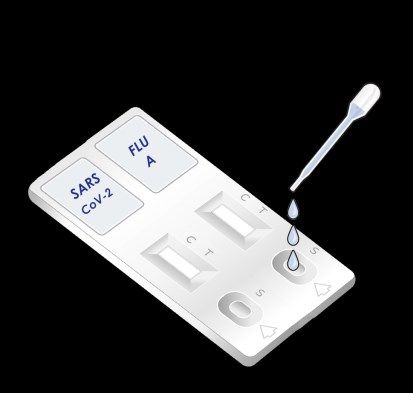
1. Put the tubes in the laboratory rack (identify properly samples from the different patients). Add 15 drops (approx. 500µL) (1) Reagent
TI
Respiratory and immediately put the swab into the tube.
2. Mix and homogenize the solution by rotating the swab forcefully against the side of the tube to allow the solution to mix for 15 seconds
(2). Best results are obtained when it is mixed to extract as much liquid as possible from the swab avoiding splashes and aerosols.
ON
Rotate the swab against the side of the tube as the swab is withdrawn to extract as much liquid as possible. Discard the swab.
3. Remove the CerTest SARS-CoV-2 + Flu A combo card test from its sealed bag just before using it.
4. Take the sample from the tube with the pipette (3). Close the tube with the plastic cap (4) and dispense 3 drops (approx. 100-120µL)
from the pipette, into the circular window marked with the letter A (5) and 3 drops (approx. 100-120µL), using the same tube and
PU
pipette, into the circular window marked with the letter B (6).
5. Read the results at 10 minutes. Do not read the test result later than 10 minutes.
If the test does not run (it means that liquid -sample+ diluent- does not rise through the strip -reaction zone or result window- due to the type of
RP
sample), mix the liquid added in the sample window (S) with the pipette. If it doesn´t work (test does not run), dispense a drop of Reagent
Respiratory until seeing the liquid running through the reaction zone.
OS
The Sample diluent buffer (Reagent Respiratory) has SARS-CoV-2 inactivation capability: 99.68% after 1 minute and 99.98% after 10 minutes.
ES
Results Windows (A/B)
Control Line (C)
Test Line (T)
ON
Sample (S) circular
windows (A/B)
(1) (2)
LY
Add 15 drops Put the swab into the tube, rotating
SARS- Flu of Reagent Respiratory 15 seconds and extract the liquid.
CoV-2 A
3 IU-SZ88 v 02 December 2020 Version 02 3
Pol. Industrial Río Gállego II, Calle J, Nº 1,
CerTest 50840, San Mateo de Gállego, Zaragoza (SPAIN)
BIOTEC S.L. www.certest.es.CERTEST SARS-CoV-2 + Flu A
One Step test to detect SARS-CoV-2 and Influenza A antigens in combo card format/
Prueba combo de un solo paso para detección de SARS-CoV-2 e Influenza A antígenos en formato cassette
FO
(3) (4)
Take the sample with the After taking the sample with the
pipette from the tube. pipette from the tube.
R
Close de tube with the plastic cap.
IN
SARS-CoV-2 Strip A-procedure Influenza type A Strip B-procedure
Add 3 drops in A-circular window Add 3 drops in B-circular window
FO
RM
Control line Control line
Test line Test line
A TI
(5) (6)
INTERPRETATION OF THE RESULTS (please refer to the illustration below)
ON
1. 2. 3. 4.
C C C C
T T T T
PU
A B A B A B A B
A: Green→Negative SARS-CoV-2 A: Green/Red→Positive SARS-CoV-2 A: Green/Red→Positive SARS-CoV-2 A: Green→ Negative SARS-CoV-2
B: Green→Negative Flu A B: Green/Red→Positive Flu A B: Green →Negative Flu A B: Green/Red→Positive Flu A
RP
INVALID RESULTS
5.
OS
C C C C C C
T T T T T T
ES
A B A B A B A B A B A B
C C C C C C
T T T T T T
ON
A B A B A B A B A B A B
LY
A B
Interpretation of the results
(SARS-CoV-2) (Flu A)
1. - - There is no SARS-CoV-2, Influenza type A antigens presence in
GREEN GREEN the sample.
2. + + There is SARS-CoV-2 and Influenza type A antigens presence in
the sample. The presence of these lines (control green line and
GREEN-RED GREEN-RED test red line), independent of their intensity should be considered
as a positive result.
4 IU-SZ88 v 02 December 2020 Version 02 4
Pol. Industrial Río Gállego II, Calle J, Nº 1,
CerTest 50840, San Mateo de Gállego, Zaragoza (SPAIN)
BIOTEC S.L. www.certest.esCERTEST SARS-CoV-2 + Flu A
One Step test to detect SARS-CoV-2 and Influenza A antigens in combo card format/
Prueba combo de un solo paso para detección de SARS-CoV-2 e Influenza A antígenos en formato cassette
3. + - There is SARS-CoV-2 antigen presence in the sample. There is no
GREEN-RED GREEN Influenza type A antigens presence in the sample.
4. - + There is Influenza type A presence in the sample. There is no
GREEN GREEN-RED SARS-CoV-2 antigens presence in the sample.
Invalid result either A or B, we recommend repeating the assay
5. Any other result Any other result
using the same sample with another test.
INVALID: Total absence of any control coloured line (GREEN) regardless the appearance or not of the test lines (RED). Insufficient specimen
FO
volume, incorrect procedural techniques or deterioration of the reagents are mostly the main reasons for control lines failure. Review the
procedure and repeat the assay with a new test. If the symptoms or situation still persists, discontinue using the test kit and contact your local
R
distributor.
NOTES ON THE INTERPRETATION OF RESULTS
The intensity of the red coloured bands in the test lines (T) in the results windows will vary depending on the concentration of antigens present
IN
in the specimen. However, neither the quantitative value nor the rate of increase in antigens can be determined by this qualitative test.
QUALITY CONTROL
FO
The CerTest SARS-CoV-2 + Flu A test presents two controls:
Internal control: internal procedural control is included in the test. A green line appearing in the control line (C) in the results window is an
internal control, which confirms sufficient specimen volume and correct procedural technique.
RM
External control: Positive control swabs.
EXTERNAL CONTROL
A
The CerTest SARS-CoV-2 Positive Control is an external quality control for CerTest SARS-CoV-2 + Flu A combo card test. Only for the strip
A (SARS-CoV-2).
TI
The CerTest Influenza A Positive Control is an external quality control for CerTest SARS-CoV-2 + Flu A combo card test. Only for the strip B
(Influenza A).
Use those control swabs to check that the extraction reagents and the test are working properly.
ON
Store as packaged in the sealed pouch at 2-30ºC. The positive control swab is stable through the expiration date printed on the sealed
pouch. The positive control swab must remain in the sealed pouch until use. Do not freeze.
POSITIVE CONTROL PROCEDURE
PU
Allow tests and positive control swabs to reach room temperature (15-30ºC) prior to testing. Do not open the package until the
performance of the assay.
1. Remove the CerTest SARS-CoV-2 + Flu A combo card test from its sealed bag just before using.
RP
2. The Reagent Respiratory is the same for both positive control swabs and for the samples. Use a separate pipette and testing
tube for each control.
OS
CerTest SARS-CoV-2 Positive Control swab procedure
3. Add 15 drops (approx. 500µL) (1) of Reagent Respiratory and immediately introduce the SARS-CoV-2 positive control swab into the
testing tube.
ES
4. Mix the solution by rotating the positive control swab forcefully against the side of the testing tube at least 15 seconds. Extract as much
liquid as possible from the swab rotating the swab against the side of the tube as the swab is withdrawn (2). Discard the swab.
5. Use a separate pipette and test for each control. Take the sample from the tube with the pipette (3). Close the tube with the plastic cap
(4) and dispense 3 drops (approx. 100-120µL) from the pipette into the circular window marked with the letter A (5).
6. Read the result at 10 minutes. Do not read the test result later than 10 minutes.
ON
LY
5 IU-SZ88 v 02 December 2020 Version 02 5
Pol. Industrial Río Gállego II, Calle J, Nº 1,
CerTest 50840, San Mateo de Gállego, Zaragoza (SPAIN)
BIOTEC S.L. www.certest.es.CERTEST SARS-CoV-2 + Flu A
One Step test to detect SARS-CoV-2 and Influenza A antigens in combo card format/
Prueba combo de un solo paso para detección de SARS-CoV-2 e Influenza A antígenos en formato cassette
(5) Add 3 drops in the circular
window SARS-CoV-2 (strip A)
FO
R
Control line
(1) (2) (3) (4)
Introduce the SARS-CoV-2 Test line
Take the sample with the pipette
Add 15 drops of positive control swab into the from the tube. Close the tube with
reagent Respiratory. testing tube, rotating 15 seconds the plastic cap.
IN
and extract the liquid. Wait 10 minutes
CerTest Influenza A Positive Control swab procedure
7. Take the Reagent Respiratory (the same used in the CerTest SARS-CoV-2 Positive Control procedure and samples procedure), add 15
FO
drops (approx. 500µL) (6) of Reagent Respiratory into a different testing tube and immediately introduce the Influenza A Positive Control
swab into the testing tube.
8. Mix the solution by rotating the positive control swab forcefully against the side of the testing tube at least 15 seconds. Extract as much
RM
liquid as possible from the swab rotating the swab against the side of the tube as the swab is withdrawn (7). Discard the swab.
9. Use a separate pipette and test for each control. Take the sample from the tube with the pipette (8). Close the tube with the plastic cap (9)
and dispense 3 drops (approx. 100-120µL) from the pipette into the circular window marked with the letter B (10).
A
10. Read the result at 10 minutes. Do not read the test result later than 10 minutes.
TI
(10) Add 3 drops in the circular
window Influenza A (strip B)
ON
PU
Control line
Test line
(6) (7) (8) (9)
RP
Introduce the Influenza A Take the sample with the pipette
Add 15 drops of positive control swab into the from the tube. Close the tube with
reagent Respiratory. testing tube, rotating 15 seconds the plastic cap.
and extract the liquid. Wait 10 minutes
OS
Positive controls could be tested once for each new test kit opened and as otherwise required by your laboratory’s standard quality control
procedures.
ES
INTERPRETATION POSITIVE CONTROL PROCEDURE
SARS-CoV-2 Influenza A
Interpretation of the results
Positive Control Positive Control
ON
1. SARS-CoV-2 (A) POSITIVE and Influenza
POSITIVE
A (B) POSITIVE: A GREEN line (control
GREEN-RED GREEN-RED
C line (C) and a RED line (test line (T)) in
LY
T both strips, in the results window, appear
A B at the same time due to presence of
antigens in the SARS-CoV-2 Positive
Control swab in strip A and presence of
antigens in Influenza A Positive Control
swab in strip B.
6 IU-SZ88 v.02 December 2020 Version 02 6
Pol. Industrial Río Gállego II, Calle J, Nº 1,
CerTest 50840, San Mateo de Gállego, Zaragoza (SPAIN)
BIOTEC S.L. www.certest.esCERTEST SARS-CoV-2 + Flu A
One Step test to detect SARS-CoV-2 and Influenza A antigens in combo card format/
Prueba combo de un solo paso para detección de SARS-CoV-2 e Influenza A antígenos en formato cassette
2. INVALID
C C C
T T T
A B A B A B
Invalid result, we recommend repeating the
C C C C C C assay with another test and positive control
Any other T T T T T T
swabs.
FO
result A B A B A B A B A B A B
C C C C C BC
T T T T T T
R
A B A B A B A B A B A B
IN
RECOMMENDATIONS
Recommendations World Health Organization: Antigen-detection in the diagnosis of SARS-CoV-2 infection using rapid immunoassays- 11
FO
September 2020.
1. To optimize performance, testing should be conducted by trained operators in strict accordance with the test procedure and within the first 5-7
days following the onset of symptoms.
RM
2. Where possible, all positive samples giving positive results should be transported to laboratories with NAAT (Nucleic Acid Amplification Test)
capability for confirmatory testing.
3. This test could be used to screen at-risk individuals and rapidly isolate positive cases in NAAT- confirmed COVID-19 outbreaks.
A
4. To monitor trends in disease incidence in communities.
TI
5. For early detection and isolation of positive cases in health facilities, where there is widespread community transmission.
6. A negative result cannot completely exclude an active COVID-19 infection, repeat testing or preferably confirmatory testing should be
performed (NAAT) whenever possible, particularly in symptomatic patients.
ON
7. Even CerTest SARS-CoV-2 + Flu A test was not validated using samples from asymptomatic contacts of cases, asymptomatic cases have
been demonstrated to have viral loads similar to symptomatic cases, so CerTest SARS-CoV-2 + Flu A could detect as positive.
LIMITATIONS
PU
1. The test must be carried out within 2 hours after opening the sealed bag.
2. CerTest SARS-CoV-2 + Flu A should be used only with nasopharyngeal swab samples. The use of swab specimens taken from other sites or
the use of other samples such as saliva, sputum or urine has not been established. The quality of the test depends on the quality of the
RP
sample; proper nasopharyngeal specimens must be obtained.
3. The intensity of test line may vary from very strong at high antigens concentration to faint when the antigens concentration is close to the
detection limit value of the test.
OS
4. Positive results determine the presence of SARS-CoV-2 and/or Influenza type A antigens. A diagnosis of SARS-CoV-2 and/or Influenza type
A infection should only be made by a physician after all clinical and laboratory findings have been evaluated and must be based in the
correlation of the results with further clinical observations.
ES
5. Positive results do not rule out co-infections with other pathogens.
6. Only VTM, UTM and Saline buffer transport media has been validated with CerTest SARS-CoV-2 + Flu A test. When using transport media,
the test sensitivity can be reduced due to excessive dilution of sample.
7. A negative result is not meaningful because of it is possible the antigens concentration in the nasopharyngeal samples is lower than the
ON
detection limit value. If the symptoms or situation still persist, it is recommended that all negative results undergo confirmatory testing using
other method and/or virus identification by cell culture, PCR u other technique.
LY
EXPECTED VALUES
On January 30, 2020, the World Health Organization declared COVID-19 a public health emergency of international concern. Since the onset of
the pandemic, SARS-CoV-2 has affected millions of people, causing thousands of victims worldwide.
Recent studies have shown that the primary viral infection found in symptomatic patients was identical to that seen in asymptomatic patients,
suggesting that COVID-19 patients with asymptomatic infections are capable of transmitting SARS-CoV-2. During the incubation period,
asymptomatic patients are also likely to transmit the virus to healthy people.
7 IU-SZ88 v.02 December 2020 Version 02 7
Pol. Industrial Río Gállego II, Calle J, Nº 1,
CerTest 50840, San Mateo de Gállego, Zaragoza (SPAIN)
BIOTEC S.L. www.certest.esCERTEST SARS-CoV-2 + Flu A
One Step test to detect SARS-CoV-2 and Influenza A antigens in combo card format/
Prueba combo de un solo paso para detección de SARS-CoV-2 e Influenza A antígenos en formato cassette
Although SARS-CoV-2 infection can affect people of any age, children and the elderly with asthma are in a higher risk category for the disease.
Those with underlying health problems such as cancer, chronic respiratory diseases, cardiovascular diseases, and diabetes are also reported to
have a higher chance of developing serious illnesses.
Yearly Influenza epidemics can seriously affect all age groups, but the highest risk of complications occur among children younger than age two,
adults age 65 or older and people of any age with certain medical conditions, such as chronic heart, lung, kidney, liver, blood or metabolic
diseases (such as diabetes) or weakened immune systems.
Influenza affects between 20% and 30% of the United States population annually. Three fourths of the infected individuals develop an acute
FO
respiratory illness and one third of these seek medical attention. In a typical year, more than 20,000 to 40,000 Americans die and more than
100,000 are hospitalized because of complications related to influenza.
R
PERFORMANCE CHARACTERISTICS
Clinical sensitivity and specificity
IN
Analytical sensitivity (detection limit)
Detection limit value (typical) of CerTest SARS-CoV-2 + Flu A (strip A: SARS-CoV-2) is 1.00 ng/mL of SARS-CoV-2 recombinant protein or
1x10³ TCID50/mL of 2019nCoV/USA-WA1/2020.
FO
Detection limit value (typical) of CerTest SARS-CoV-2 + Flu A (strip B: Influenza A) is 6.25 ng/mL of Influenza A recombinant nucleoprotein.
Evaluations for SARS-CoV-2 + Flu A (strip A: SARS-CoV-2)
RM
An external evaluation (Hospital Universitario Principe de Asturias, Madrid (Spain)), with nasopharyngeal samples from people suspected of
infection by SARS-CoV-2 virus, was performed comparing the results obtained by an immunochromatographic test (CerTest SARS-CoV-2 + Flu
A, Certest (SARS-CoV-2 strip) vs qPCR technique (VIASURE). The results were as follows:
A
qPCR technique
TI
+ - Total
IC test:
+ 79 0 79
CerTest SARS-CoV-2 +
ON
Flu A (SARS-CoV-2) - 5 150 155
Total 84 150 234
PU
CerTest SARS-CoV-2 + Flu A (SARS-CoV-2) vs qPCR technique
Mean Value 95% confidence interval
Sensitivity (*) 94.0% 86.7–98.0%
RP
Specificity 100.0% 97.6–100.0%
PPV 100.0% 95.4–100.0%
OS
NPV 96.8% 92.6-98.9%
(*) Taking into account the recommendations for Antigen-detection in the diagnosis of SARS-CoV-2 infection using rapid immunoassays (11
ES
September 2020) from the WHO, the sensitivity of the test was calculated with nasopharyngeal samples with high viral load (high viral loads is
expected in early symptomatic phases of the illness (with the first 5-7 days of illness) in the range of Ag-RDT test detection).
An external evaluation (Laboratoire de Virologie CHU Amiens-Picardie, Amiens (Francia)), with nasopharyngeal samples from people suspected
ON
of infection by SARS-CoV-2 virus, was performed comparing the results obtained by an immunochromatographic test (CerTest SARS-CoV-2 +
Flu A, Certest (SARS-CoV-2 strip) vs qPCR technique. The results were as follows:
LY
qPCR technique
+ - Total
IC test:
+ 88 0 88
CerTest SARS-CoV-2 +
Flu A (SARS-CoV-2) - 8 62 70
Total 96 62 158
8 IU-SZ88 v.02 December 2020 Version 02 8
Pol. Industrial Río Gállego II, Calle J, Nº 1,
CerTest 50840, San Mateo de Gállego, Zaragoza (SPAIN)
BIOTEC S.L. www.certest.esCERTEST SARS-CoV-2 + Flu A
One Step test to detect SARS-CoV-2 and Influenza A antigens in combo card format/
Prueba combo de un solo paso para detección de SARS-CoV-2 e Influenza A antígenos en formato cassette
CerTest SARS-CoV-2 + Flu A (SARS-CoV-2)vs qPCR technique
Mean Value 95% confidence interval
Sensitivity (*) 91.7% 84.2–96.3%
Specificity 100.0% 94.2–100.0%
PPV 100.0% 95.9–100.0%
FO
NPV 88.6% 78.7-94.9%
(*) Taking into account the recommendations for Antigen-detection in the diagnosis of SARS-CoV-2 infection using rapid immunoassays (11
September 2020) from the WHO, the sensitivity of the test was calculated with nasopharyngeal samples with high viral load (high viral loads is
R
expected in early symptomatic phases of the illness (with the first 5-7 days of illness) in the range of Ag-RDT test detection).
An evaluation, with nasopharyngeal samples from people suspected of infection by SARS-CoV-2 virus, was performed comparing the results
IN
obtained by an immunochromatographic test (CerTest SARS-CoV-2 + Flu A, Certest (SARS-CoV-2 strip) vs qPCR technique (VIASURE). The
results were as follows:
FO
qPCR technique
+ - Total
IC test:
+ 26 1 27
CerTest SARS-CoV-2 +
RM
Flu A (SARS-CoV-2) - 2 233 235
Total 28 234 262
A
CerTest SARS-CoV-2 + Flu A (SARS-CoV-2)vs qPCR technique
TI
Mean Value 95% confidence interval
Sensitivity (*) 92.9% 76.5–99.1%
Specificity 99.6% 97.6–100.0%
ON
PPV 96.3% 81.0–99.9%
NPV 99.1% 97.0-99.9%
(*) Taking into account the recommendations for Antigen-detection in the diagnosis of SARS-CoV-2 infection using rapid immunoassays (11
PU
September 2020) from the WHO, the sensitivity of the test was calculated with nasopharyngeal samples with high viral load (high viral loads is
expected in early symptomatic phases of the illness (with the first 5-7 days of illness) in the range of Ag-RDT test detection).
Evaluations for SARS-CoV-2 + Flu A (strip B: Influenza A)
RP
Results showed in tables below have been obtained from several evaluations developed using an immunochromatographic (CerTest SARS-
CoV-2 + Flu A, CerTest (Influenza A)) and others commercial test kit.
OS
1574 respiratory samples have been used for Influenza A evaluation (130 positive samples, 11 false positives, 1402 negatives samples and 31
false negatives). The results were as follows:
Evaluation number True Positives False Negatives True Negatives False Positives
ES
CerTest SARS-CoV-2 + Flu
A (Influenza A) vs XPECT I 7 0 85 1
FLU A&B (Remel)
CerTest SARS-CoV-2 + Flu
A (Influenza A) vs Instand II 101 26 955 3
EQAS program (March 2016)
ON
CerTest SARS-CoV-2 + Flu
A (Influenza A) vs Binax
NOW® Influenza A&B Card
III 11 2 87 0
(Alere)
CerTest SARS-CoV-2 + Flu
LY
A (Influenza A) vs SD Bioline,
Influenza Ag A/B/A (H1N1)
IV 1 0 97 0
(SD Bioline)
CerTest SARS-CoV-2 + Flu
A (Influenza A) vs MariPOC® V 10 3 178 7
respi (ArcDia International)
Total 130 31 1402 11
9 IU-SZ88 v.02 December 2020 Version 02 9
Pol. Industrial Río Gállego II, Calle J, Nº 1,
CerTest 50840, San Mateo de Gállego, Zaragoza (SPAIN)
BIOTEC S.L. www.certest.esCERTEST SARS-CoV-2 + Flu A
One Step test to detect SARS-CoV-2 and Influenza A antigens in combo card format/
Prueba combo de un solo paso para detección de SARS-CoV-2 e Influenza A antígenos en formato cassette
CerTest SARS-CoV-2 + Flu A (Influenza A) vs other test used in evaluation (I, II, III, IV,
V) for Influenza A
Mean Value 95% confidence interval
Sensitivity 80.7% 73.8 – 86.5%
Specificity 99.2% 98.6 – 99.6%
PPV
FO
92.2% 86.5 – 96.0%
NPV 97.8% 96.9 – 98.5%
R
The results showed a high sensitivity and specificity to detect SARS-CoV-2 and Influenza type A using CerTest SARS-CoV-2 + Flu A.
Hook Effect
CerTest SARS-CoV-2 + Flu A test does not show inhibitory hook effect at concentration higher than 100,000xLoD for Strip A: SARS-CoV-2 and
IN
at concentrations higher than 30,000xLoD for Strip B: Influenza A.
Cross reactivity
FO
An evaluation was performed to determine the cross reactivity of CerTest SARS-CoV-2 + Flu A; no cross reactivity against organisms,
pathogens, substances that cause infections:
RM
For Strip A. SARS-CoV-2
Adenovirus Cryptosporidium parvum Influenza type B Salmonella typhi
A
Astrovirus Entamoeba histolytica Legionella pneumophila Salmonella typhimurium
TI
Bovine Haemoglobin Escherichia coli O157 Listeria monocytogenes Shigella boydii
Campylobacter jejuni Giardia Norovirus GI Shigella dysenteriae
Clostridium difficile antigen GDH Helicobacter pylori Norovirus GII Shigella flexneri
ON
Clostridium difficile Toxin A Human Calprotectin Pig Haemoglobin Shigella sonnei
Clostridium difficile Toxin B Human Haemoglobin Rotavirus Streptococcus pneumococcal
Coronavirus strain 229E Human Lactoferrin Respiratory Syncytial Virus Streptococcus pyogenes
Coronavirus strain NL63 Human Transferrin Salmonella enteritidis Yersinia Enterocolitica O:3
PU
Coronavirus strain OC43 Influenza type A Salmonella paratyphi A Yersinia Enterocolitica O:9
Five positive samples for Human coronavirus HKU1 were tested in an external evaluation carried out with CerTest SARS-CoV-2 + Flu A (SARS-
RP
CoV-2, strip A) and the results obtained were negative. This suggest that there is no cross reactivity with HKU1. In addition, even though the
percentage identity of the nucleocapsid protein sequence of HKU1 with the nucleocapsid protein sequence of SARS-CoV-2 is about 35% that is
OS
considered as very low homology. This suggest that there is no cross reactivity with HKU1.
Three positive samples for Rhinovirus were tested in an external evaluation carried out with CerTest SARS-CoV-2 + Flu A (SARS-CoV-2, strip
A) test and the results obtained were negative. This suggest that there is no cross reactivity with Rhinovirus.
ES
CerTest SARS-CoV-2 + Flu A (SARS-CoV-2, strip A) showed some cross reaction with SARS and very low with MERS.
For Strip B. Influenza A
Adenovirus Coronavirus strain OC43 Legionella pneumophila Salmonella typhi
ON
Astrovirus Entamoeba histolytica Listeria monocytogenes Salmonella typhimurium
Bovine Haemoglobin Escherichia coli O157 MERS Shigella boydii
LY
Campylobacter jejuni Giardia Norovirus GI Shigella dysenteriae
Clostridium difficile antigen GDH Helicobacter pylori Norovirus GII Shigella flexneri
Clostridium difficile Toxin A Human Calprotectin Pig Haemoglobin Shigella sonnei
Clostridium difficile Toxin B Human Haemoglobin Rotavirus Streptococcus pneumococcal
Coronavirus SARS-1 (SARS) Human Lactoferrin Respiratory Syncytial Virus Streptococcus pyogenes
Coronavirus SARS-2 (SARS-CoV-2) Human Transferrin Salmonella enteritidis Yersinia Enterocolitica O:3
10 IU-SZ88 v.02 December 2020 Version 02 10
Pol. Industrial Río Gállego II, Calle J, Nº 1,
CerTest 50840, San Mateo de Gállego, Zaragoza (SPAIN)
BIOTEC S.L. www.certest.esCERTEST SARS-CoV-2 + Flu A
One Step test to detect SARS-CoV-2 and Influenza A antigens in combo card format/
Prueba combo de un solo paso para detección de SARS-CoV-2 e Influenza A antígenos en formato cassette
Coronavirus strain 229E Influenza type B Salmonella paratyphi A Yersinia Enterocolitica O:9
Coronavirus strain NL63
Interferences
An evaluation was performed to determine the possible interferences of CerTest SARS-CoV-2 + Flu A.; no interferences against the substances
tested were detected:
Potencial interfering substance Concentration Results Potencial interfering substance Concentration Results
FO
Metronidazole 3.0 mg/mL Negative Loperamide hydrochloride (Fortasec) 0.15 mg/mL Negative
Ampicillin 3.0 mg/mL Negative Heparin (Hibor) 350.0 IU/mL Negative
Oseltamivir 3.0·10-2 mg/mL Negative Almagato (Almax) 3.0 mg/mL Negative
R
Amantadine 0.3 mg/mL Negative Fosfamycin (Monurol) 3.0·10-3 mg/mL Negative
Ribavirin 3.0 mg/mL Negative Aceltylcysteine (Fluimucil) 3.0·10-2 mg/mL Negative
Codeine (Toseina) 0.2 mg/mL Negative Dexketoprofen trometamol (Enantyum) 0.3 mg/mL Negative
IN
-2 -2
Benzocaine (Angileptol) 3.0·10 mg/mL Negative Levofloxacin 3.0·10 mg/mL Negative
Cloperastine (Flutox) 0.3 mg/mL Negative Ciprofloxacin 0.3 mg/mL Negative
Carbocisteine (Iniston mucolítico) 3.0·10-2 mg/mL Negative Rifampicin (Rifaldin) 0.3 mg/mL Negative
FO
Loratadine 0.3 mg/mL Negative Phenoxymethylpenicillin potassium 3.0 mg/mL Negative
Dexchloropheniramine (Polaramine) 0.3 mg/mL Negative Ambroxol hydrochloride (Mucosan) 0.3 mg/mL Negative
Ebastine (Ebastel) 3.0 mg/mL Negative Macrogol 3350 (Movicol) 3.0 mg/mL Negative
RM
Acetyl Salicylic (Adiro) 0.3 mg/mL Negative Lysine Carbocysteinate (Pectox) 3.0·10-2 mg/mL Negative
Ibuprofen (Espidifen) 0.3 mg/mL Negative Hydroxyzine dihydrochloride 0.3 mg/mL Negative
Paracetamol (Dolocatil) 5.0 mg/mL Negative Lorazepam 3.0·10-3 mg/mL Negative
A
Metamizole (Nolotil) 5.0 mg/mL Negative Amoxicillin 3.0 mg/mL Negative
TI
Prednisone 0.3 mg/mL Negative Mercaptopurine 0.3 mg/mL Negative
Omeprazole 2.0·10-3 mg/mL Negative Biotine 100.0 µg/mL Negative
Human haemoglobin 5.0 µg/mL Negative Human lactoferrin 5.0 µg/mL Negative
ON
Human transferrin 0.5 µg/mL Negative Mucine 5.0 mg/mL Negative
Human calprotectin 5.0 µg/mL Negative Human blood 50.0 mg/mL Negative
PU
RP
OS
ES
ON
LY
11 IU-SZ88 v.02 December 2020 Version 02 11
Pol. Industrial Río Gállego II, Calle J, Nº 1,
CerTest 50840, San Mateo de Gállego, Zaragoza (SPAIN)
BIOTEC S.L. www.certest.esCERTEST SARS-CoV-2 + Flu A
One Step test to detect SARS-CoV-2 and Influenza A antigens in combo card format/
Prueba combo de un solo paso para detección de SARS-CoV-2 e Influenza A antígenos en formato cassette
ESPAÑOL
USO PREVISTO
CerTest SARS-CoV-2 + Flu A combo card test es una prueba inmunocromatográfica de un solo paso para la detección cualitativa simultánea
de antígenos de nucleoproteína de SARS-CoV-2 e Influenza tipo A a partir de muestras de hisopos nasofaríngeos procedentes de pacientes
sospechosos de infección por COVID-19 y/o infección por Influenza A.
CerTest SARS-CoV-2 + Flu A combo card test ofrece un ensayo de cribado sencillo y de alta sensibilidad como ayuda en el diagnóstico de
FO
infección causada por SARS-CoV-2 y/o Influenza tipo A.
INTRODUCCIÓN
R
Una neumonía invisible se propagó rápidamente en Wuhan, China, en diciembre de 2019. Los científicos secuenciaron y reconocieron un
nuevo coronavirus β. La enfermedad, causada por el virus corona del síndrome respiratorio agudo severo 2 (SARS-CoV-2), se denomina
enfermedad de coronavirus 2019 (COVID-19).
IN
Los coronavirus (CoV) son ARN, virus envueltos, con un genoma grande (29,9 kb), entre los que los β-CoV y α-CoV pueden infectar a los
mamíferos. Los virus que pertenecen a la familia Coronaviridae tienen la proteína de membrana (M) más abundante entre otras proteínas, es
FO
decir, la glicoproteína de pico (S), la proteína de la nucleocápside (N) y una proteína de la envoltura (E). La glicoproteína de pico (S) es uno de
los objetivos de la respuesta de las células T en el sistema inmunológico. La proteína S también promueve la unión de la envoltura del virus al
receptor ACE2 y la entrada del virus en la célula diana. Los receptores ACE2 están presentes en las células de las arterias, venas, músculos
RM
lisos, intestino delgado, alvéolos de los pulmones, folículos pilosos, miofibroblastos cardíacos, piel, cerebro y riñón, por lo que el SARS-CoV-2
podría potencialmente infectar estos tejidos.
Las formas clínicas de esta enfermedad comprenden desde síntomas leves hasta muy graves: la neumonía, la fiebre y los síntomas
A
respiratorios son los más frecuentes. Otros síntomas de la infección viral incluyen dolor de garganta, molestias, dolores y dificultad para
TI
respirar. En algunos casos, también se presenta secreción nasal, náuseas y diarrea.
El brote de coronavirus recién descubierto comienza principalmente a través de secreciones nasales o gotitas de saliva, una vez que un
individuo infectado estornuda o tose, y el tiempo estimado de incubación es de 2 semanas. Debido a la alta tasa de infección del SARS-CoV-2,
ON
la detección de pacientes positivos asintomáticos es probablemente uno de los puntos clave para controlar el brote.
La gripe está causada por un virus (Influenza) que ataca principalmente el tracto respiratorio superior-nariz, garganta y bronquios y también,
aunque más raramente a los pulmones. La infección normalmente dura una semana. Está caracterizada en su inicio por fiebre elevada,
mialgia, dolores de cabeza y gran malestar, tos no productiva, dolor de garganta y rinitis. La mayoría de la gente se recupera en una o dos
PU
semanas sin requerir ningún tratamiento médico. Para los niños, ancianos y personas que padecen afecciones pulmonares, diabetes, cáncer,
afecciones de riñón o problemas de corazón, Influenza puede ocasionar un riesgo serio. En estas personas esta infección puede provocar
graves complicaciones de otras enfermedades, neumonía y muerte.
RP
Normalmente los virus de Influenza que causan enfermedad en humanos se dividen en dos grupos: A y B. Influenza A tienen 2 subtipos que
son importantes para humanos: A (H3N2) y A (H1N1), de los cuales el primero es el que está directamente asociado a la mayor parte de las
muertes. Los virus de Influenza se caracterizan por 2 componentes proteicos diferentes, conocidos como antígenos, localizados en la superficie
OS
del virus, llamados hemaglutinina (H) y neuraminidasa (N).
FUNDAMENTO DEL TEST
ES
CerTest SARS-CoV-2 + Flu A combo card test es una prueba inmunocromatográfica de un solo paso para la detección cualitativa simultánea
de antígenos de nucleoproteína de SARS-CoV-2 e Influenza tipo A a partir de muestras de hisopos nasofaríngeos procedentes de pacientes
sospechosos de infección por COVID-19 y/o infección por Influenza A.
Tira A consiste en una membrana de nitrocelulosa fijada previamente con anticuerpos monoclonales de ratón frente a SARS-CoV-2 en la línea
ON
de test (T), en la ventana de resultados, y en la línea de control (C), con anticuerpos policlonales de conejo frente a una proteína específica. En
el material absorbente para la muestra se han dispensado una preparación de reactivos para la línea de test (anticuerpos monoclonales de
ratón frente a SARS-CoV-2) conjugada con látex de poliestireno rojo y otra preparación para la línea de control (proteína específica de unión)
LY
conjugada con látex de poliestireno verde, formando dos complejos coloreados conjugados.
Tira B consiste en una membrana de nitrocelulosa fijada previamente con anticuerpos monoclonales de ratón frente a Influenza tipo A en la
línea de test (T), en la ventana de resultados, y en la línea de control (C), con anticuerpos policlonales de conejo frente a una proteína
específica. En el material absorbente para la muestra se han dispensado una preparación de reactivos para la línea de test (anticuerpos
monoclonales de ratón frente a Influenza tipo A) conjugada con látex de poliestireno rojo y otra preparación para la línea de control (proteína
específica de unión) conjugada con látex de poliestireno verde, formando dos complejos coloreados conjugados.
12 IU-SZ88 v.02 December 2020 Version 02 12
Pol. Industrial Río Gállego II, Calle J, Nº 1,
CerTest 50840, San Mateo de Gállego, Zaragoza (SPAIN)
BIOTEC S.L. www.certest.esCERTEST SARS-CoV-2 + Flu A
One Step test to detect SARS-CoV-2 and Influenza A antigens in combo card format/
Prueba combo de un solo paso para detección de SARS-CoV-2 e Influenza A antígenos en formato cassette
Si la muestra es SARS-CoV-2 positiva, los antígenos de la muestra diluida reaccionan con el complejo conjugado coloreado rojo (anticuerpos
monoclonales anti-SARS-CoV-2-microesferas rojas de látex) en la tira A, y si la muestra es Influenza A positiva, los antígenos de la muestra
diluida reaccionan con el complejo conjugado coloreado rojo (anticuerpos monoclonales anti-Influenza tipo A-microesferas rojas de látex) en la
tira B, los cuales han sido secados previamente en el material absorbente. Esta mezcla avanza por capilaridad a través de la membrana.
Conforme la muestra va migrando también lo hacen los complejos conjugados. Los anticuerpos anti-SARS-CoV-2 presentes en la membrana
de la tira A (línea de test) y los anticuerpos anti-Influenza tipo A presentes en la membrana de la tira B (línea de test) capturarán el complejo
coloreado del test y una línea roja aparecerá en las tiras. Estas líneas se usarán para interpretación del resultado.
FO
Si la muestra es negativa, no presenta antígenos de SARS-CoV-2 ni de Influenza tipo A o los antígenos están presentes en una concentración
inferior al límite de detección y no se produce reacción con ningún complejo coloreado rojo. Los anticuerpos anti-SARS-CoV-2 y anti-Influenza
R
tipo A presentes en las membranas (líneas de test) no capturarán el antígeno-complejo coloreado rojo (no formado) y no aparecerán las líneas
rojas.
Independientemente de que la muestra sea positiva o no, en ambas tiras, la mezcla continuará moviéndose a través de las membranas hacia
IN
los anticuerpos inmovilizados frente a la proteína específica localizados en las líneas de control. Estos anticuerpos anti-proteína específica
presentes en ambas membranas capturarán el complejo conjugado de control y las líneas de control verdes siempre aparecerán. La aparición
de estas líneas se utiliza: 1) para verificar que se ha añadido el volumen de muestra suficiente, 2) que el flujo ha sido apropiado y 3) como
FO
control interno de los reactivos.
CONDICIONES DE ALMACENAMIENTO
RM
El producto debe ser almacenado entre 2 y 30ºC en su envase original sellado, para conseguir un óptimo funcionamiento hasta la fecha de
caducidad impresa en el envase. No debe abrirse hasta el momento de su uso. No congelar.
A
PRECAUCIONES
TI
- Sólo para uso profesional in vitro.
- No utilizar después de la fecha de caducidad.
- Las muestras se deben considerar potencialmente peligrosas (especialmente las muestras procedentes de pacientes sospechosos de
ON
infección por SARS-CoV-2) y deben ser manipuladas de la misma forma que a un agente infeccioso. Un nuevo test deberá utilizarse para
cada una de las muestras para evitar errores de contaminación.
- Utilice prácticas adecuadas de control de infecciones al recolectar y manipular las muestras. Estas prácticas deben incluir, pero no se limitan
a, equipo de protección personal (EPP), bata de laboratorio, mascarilla quirúrgica u otro tipo de mascara que se considere apropiada,
PU
guantes desechables y protección para los ojos. Siga las reglamentaciones locales o nacionales sobre la recolección y manipulación de
muestras.
- Los tests (hisopos, tubitos, pipetas, hisopos control positivo y carcasas), deben ser desechados en un contenedor adecuado de bioseguridad
RP
después de ser usados. Estos contenedores deben desecharse de acuerdo con las leyes o regulaciones locales o nacionales.
- Limpiar los posibles derrames con un desinfectante adecuado.
- Los reactivos contienen conservantes. Debe evitarse cualquier contacto con la piel o las mucosas. Consultar fichas de seguridad, disponibles
OS
bajo petición.
- Los componentes proporcionados con el kit son aprobados para su uso con CerTest SARS-CoV-2 + Flu A test. No se deben usar con
componentes de otros kits comercializados.
ES
- Los hisopos estériles suministrados en los kits deben ser usados solamente para la toma de muestra nasofaríngea. No pueden reutilizarse.
- No tocar la cabeza del hisopo estéril suministrado cuando se saque de su envase primario para evitar contaminación.
- La presencia de líneas amarillentas en la ventana de resultados (zona línea de control y zona línea de test), antes de utilizar el test, es
completamente normal y no supone fallo de funcionalidad del test.
ON
- Todos los resultados positivos deberían procesarse siguiendo las leyes y regulaciones locales.
RECOGIDA DE MUESTRAS Y PREPARACIÓN
LY
Las muestras deben ser procesadas lo antes posible tras su recolección. Siga las prácticas adecuadas de control de infecciones. Si esto no
fuera posible las muestras pueden ser almacenadas en el frigorífico (2-8ºC) como máximo 8 horas antes de realizar la prueba. Si las muestras
son conservadas en los medios de transporte validados (VTM, UTM o Buffer salino) podrían conservarse hasta 6 horas a temperatura ambiente
o en nevera (2-8ºC).
13 IU-SZ88 v.02 December 2020 Version 02 13
Pol. Industrial Río Gállego II, Calle J, Nº 1,
CerTest 50840, San Mateo de Gállego, Zaragoza (SPAIN)
BIOTEC S.L. www.certest.esCERTEST SARS-CoV-2 + Flu A
One Step test to detect SARS-CoV-2 and Influenza A antigens in combo card format/
Prueba combo de un solo paso para detección de SARS-CoV-2 e Influenza A antígenos en formato cassette
Preparación de la muestra (ver dibujo):
Método de hisopo nasofaríngeo:
1. Sacar el hisopo de su envase.
2. Tomar la muestra con un hispo estéril a partir de un orificio nasal.
3. Introducir el hisopo dentro del orificio hacia la nasofaringe, rotando contra la pared.
(asegurarse de que el hisopo contenga células, así como mocos). Sacar el hisopo del orificio
nasal cuidadosamente.
FO
4. Considerar repetir el procedimiento con el otro orificio nasal solo si el protocolo del profesional
que toma la muestra lo requiere. Toma de muestra
R
5. Procesar el hisopo tan pronto como sea posible tras la recolección de la muestra.
Seguir apartado de Procedimiento (muestras).
Muestras nasofaríngeas previamente extraídas en medio de transporte:
IN
Incluso cuando el uso de muestras directas de hisopo nasofaríngeo es el protocolo preferido a seguir, el test puede ser utilizado con hisopos de
muestras nasofaríngeas previamente diluidas en medios de transporte como: VTM, UTM o Bufer salino.
1. Utilizar el mínimo volumen de medio de transporte para evitar pérdidas en la sensibilidad. Ejemplo: 1.0 mL. El uso de mayores volúmenes
FO
afecta a la sensibilidad del sistema.
2. Diluir las muestras extraídas 1:1 en el reactivo Respiratory (diluyente de muestra) suministrado en el kit.
Seguir inmediatamente con el punto 3 del apartado Procedimiento (muestras).
RM
MATERIALES
A
MATERIALES SUMINISTRADOS MATERIALES NECESARIOS NO SUMINISTRADOS
TI
- CerTest SARS-CoV-2 + Flu A combo card tests - Guantes desechables (otros equipos de protección
- Reactivo Respiratory (diluyente de muestra y controles) personal que se consideren necesarios).
- Hisopos estériles - Cronómetro
ON
- Pipetas desechables
- Tubos de ensayo
- Instrucciones de uso
- Gradilla de laboratorio
PU
- Tapones de plástico
- CerTest SARS-CoV-2 Positive Control
- CerTest Influenza A Positive Control
RP
PROCEDIMIENTO (MUESTRAS)
OS
Siga las prácticas adecuadas de control de infecciones. Previamente los tests y las muestras se deben acondicionar a la temperatura
ambiente (15-30ºC). No abrir los envases hasta el momento de la prueba.
1. Poner los tubos en la gradilla de laboratorio (identificar aduadamente las muestras de los diferentes pacientes). Añadir 15 gotas
ES
(aprox. 500µL) (1) del Reactivo Respiratory y poner inmediatamente el hisopo dentro del tubo.
2. Mezclar y homogeneizar haciendo rotar el hisopo contra las paredes del tubo para permitir que se mezcle la solución, durante 15
segundos (2). Se obtendrán mejores resultados si la muestra es mezclada vigorosamente para extraer la máxima cantidad del líquido
del hisopo evitando salpicaduras y aerosoles. Rotar el hisopo contra las paredes del tubo mientras se retira del tubo para extraer la
ON
mayor cantidad de liquido posible. Tirar el hisopo.
3. Sacar el test CerTest SARS-CoV-2 + Flu A de su envase en el momento antes de utilizarlo.
4. Usar una pipeta y un test diferente para cada muestra. Tomar la muestra del tubo de ensayo con la pipeta (3). Cerrar el tubo con el
LY
tapón (4) y dispensar 3 gotas (aprox. 100-120µL) con la pipeta en la ventana circular marcada con la letra A (3) y 3 gotas (aprox. 100-
120µL), usando el mismo tubo y pipeta, en la ventana circular marcada con la letra B (4).
5. Leer el resultado a los 10 minutos. No leer el resultado superados los 10 minutos.
Si se diera el caso de que el test no corre (significa que el líquido -muestras+diluyente- no avanza a través de la tira -zona de reacción o
ventana de resultados- debido al tipo de muestra), mezclar el líquido añadido en la ventana de muestra (S) con la pipeta. Si el test siguiera sin
correr, añadir una gota de Reactivo Respiratory hasta que se vea correr el líquido por la zona de reacción.
14 IU-SZ88 v.02 December 2020 Version 02 14
Pol. Industrial Río Gállego II, Calle J, Nº 1,
CerTest 50840, San Mateo de Gállego, Zaragoza (SPAIN)
BIOTEC S.L. www.certest.esCERTEST SARS-CoV-2 + Flu A
One Step test to detect SARS-CoV-2 and Influenza A antigens in combo card format/
Prueba combo de un solo paso para detección de SARS-CoV-2 e Influenza A antígenos en formato cassette
El diluyente de muestra (Reactivo Respiratory) tiene capacidad de inactivar al SARS-CoV-2: 99.68% después de 1 minuto y 99.98% después
de 10 minutos.
Ventanas de Resultados (A/B)
Línea de Control (C)
FO
Línea de Test (T)
Ventanas (S) circulares para
la muestra (A/B)
R
(1)
(2)
Añadir 15 gotas Introducir el hisopo en el tubo y rotarlo
de Reactivo Respiratory 15 segundos para extraer el líquido.
SARS- Flu
CoV-2 A
IN
FO
RM
(4)
(3) Después de tomar la muestra con
A
Tomar la muestra con la pipeta la pipeta desde el tubo.
desde el tubo. Cerrar el tubo con el tapón.
TI
Procedimiento para la tira A de SARS-CoV-2 Procedimiento para la tira B de Influenza tipo A
ON
Añadir 3 gotas en la ventana circular (A) Añadir 3 gotas en la ventana circular (B)
PU
Línea control Línea control
Línea test Línea test
RP
(5) (6)
OS
INTERPRETACIÓN DE RESULTADOS (por favor, fíjese en el siguiente dibujo)
1. 2. 3. 4.
ES
C C C C
T T T T
A B A B A B A B
A: Verde→Negativo SARS-CoV-2 A: Verde/Rojo→Positivo SARS-CoV-2 A: Verde/Rojo→Positivo SARS-CoV-2 A: Verde→ Negativo SARS-CoV-2
ON
B: Verde→Negativo FLU A B: Verde/Rojo→Positivo FLU A B: Verde →Negativo FLU A B: Verde/Rojo→Positivo FLU A
LY
15 IU-SZ88 v.02 December 2020 Version 02 15
Pol. Industrial Río Gállego II, Calle J, Nº 1,
CerTest 50840, San Mateo de Gállego, Zaragoza (SPAIN)
BIOTEC S.L. www.certest.esYou can also read


