Chronic Pain Management - 707-624-3328: wwww.kp.orgvacaville/painmanagement - Kaiser Permanente Thrive
←
→
Page content transcription
If your browser does not render page correctly, please read the page content below

Chronic Pain Management

707-624-3328: wwww.kp.org/vacaville/painmanagement
* Come Every Week, Be On Time (>15 minutes late, please reschedule)

* Be Active and Involved

* Respect Others and Shared Information

* Dress Comfortably, Be Comfortable, Be Kind & Courteous with Any
 Self Selected Odor Use

*Knowledge is Treatment
*Noticing, Pacing, Helpful Tools

*Session 2:
 *Pain Physiology, Tissue Issues & Brain Mapping

 *Neurotags/Brain Bundling & Central Sensitization

 *Thoughts, Emotions and Behavior Change

 *Relaxation, Meditation & Pain Experience
*Online Resources (See packet)
*Noticing
 *Notice your symptoms
 *Notice things that make symptoms worse or better
 *Tracking safe/threatening activity
*Pacing
 *Find your baseline and respectfully nudge it
 *Stay sore but safe
*Movement Practice:
 *Diaphragmatic Breathing + Relaxation 4-7-8 Breathing
*An unpleasant sensory or emotional experience
 associated with actual or potential tissue
 damage, OR described in terms of such damage.

*Pain is a NORMAL human experience designed to
 protect our wellbeing and elicit change

*Multisystem process

*Can ABSOLUTELY change
* Acute Pain (duration less than          * Chronic pain (duration more
 3 - 6 months)                             than 3 – 6 months)
  * Identifiable damage or injury (i.e.      * Pain ≠ further damage
    broken bone, ankle sprain)               * No longer serves a clear
  * Serves as a temporary warning              biological purpose: Warning sign
    sign                                     * Continues or gets worse over
  * Heals in about 3-6 months                  time
  * Treatment: Rest, appropriate             * Treatment: Keep functional
    reintroduction to function
                                          * * X-Rays and MRIs: Do not explain the
                                           continued pain & the impairments you
                                           experience.
* Acute vs Chronic Butler & Moseley, Explain Pain Workbook
* This is the old way of thinking
* We have to move away from this
* Pain = damage
* Chronic pain must mean persistent
damage or tissue not healing
* Pain is an input
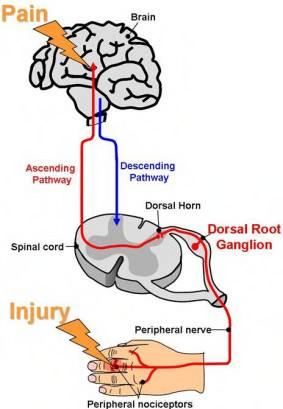
* Simple transmission*Nociceptors = fancy word for stimulus input from the body to the brain that indicate potential danger/alarm signals *Does not guarantee a pain result! *>400 nerves in a human body= 45 miles =100 billion synapses *~25% blood flow is distributed to nerves *We have enough electricity running in our body at any given time to power a light bulb *Sensors on nerves turnover every 24-48 hours
*Please understand that your brain is 100% in control of what is happening with your pain experience *Acute or chronic *Your brain will make a logical decision on pain response with reference to: *Cumulative previous experience *Knowledge *Perceived threat
* Stimulus will be evaluated by the brain * The brain will then establish and execute a pain response if threat/perceived threat is valid * Red: Afferent/Sensory information TO the brain * Blue: Efferent/Action information FROM the brain
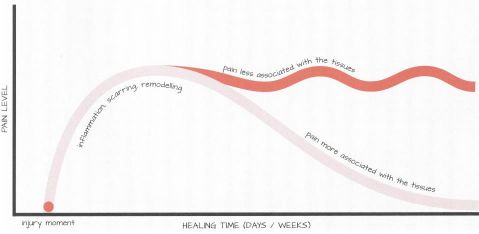
* Pain ≠ Tissue damage * Tissue damage ≠ Pain * Intensity of Pain ≠ Extent of damage * Tissues Heal
* ABSOLUTELY NOT!! *Your pain is 100% real and in some circumstances REAL BAD
* Acute vs Chronic

Butler & Moseley, Explain Pain Workbook
*Mechanical or Movement Dysfunction
 *Most people have some sort of mechanical
  dysfunction (back to norms with imaging)

 *Many do not have pain

 *Some have progressive pain experience
  over time
  *Multiple micro trauma over time
*An unpleasant sensory or emotional experience
 associated with actual or potential tissue
 damage

*Pain is a NORMAL human experience designed
 to protect our wellbeing and elicit change

*Based on perceived threat

*Multisystem process

*Can ABSOLUTELY change
* Toothache
                      * Agonizing Foot Pain

              *Pain is not a true
               reflection of your
               tissue state of health
* Add imaging with story
*80% of people experience back pain
  * Up to 64% of people without pain have bulging disk(s)

* Low back pain:
  * Majority have degenerative changes on imaging ages 20+
  * Bulging discs are often 50% smaller than initial scan 2 months
   later and fully resolved in 9 months
  * Consider the supine vs other positions for scans
  * 40% of individual have disc protrusions with NO Pain
  * 80% NFL /85% NBA who under go back surgery return to play
  * Majority of post op patients DO NOT need to restrict movement
*Some findings are so common in healthy volunteers that
 they must be interpreted within the clinical context.
  * Among those aged under 40 years with no back pain, MRI
   will find that:
    * ~50% have disk degeneration
    * ~40% have a bulging disk
    * ~30% have disk height loss, signal loss or protrusion

  * Among those aged over 60 years with no back pain, an x-ray will
   find that:
    * ~90% have disk degeneration
    * ~80% have disk height loss
    * ~40% have facet degeneration
    * ~30% have spondylolisthesis
                                                       * On Kaiser imaging
* Rotator Cuff:
* 1 in 3 people 30+ have abnormal findings on imaging
* 2 in 3 people 70+ have abnormal findings on imaging
* After successful surgical intervention >2 to 3 people have
abnormal findings on diagnostic imaging
* Knee:
* Only 50% arthritic knees have pain
* Some have NO ACL and don’t know it
* 1 in 3 collegiate basketball players have abnormal findings on
diagnostic imaging with no symptoms*Imaging results frequently do not correlate with your pain
Butler & Moseley, Explain Pain

* Otherwise known as
   the virtual body
   imprint in/on the
   brain
* Don’t wait to feel better to do, Do to feel better
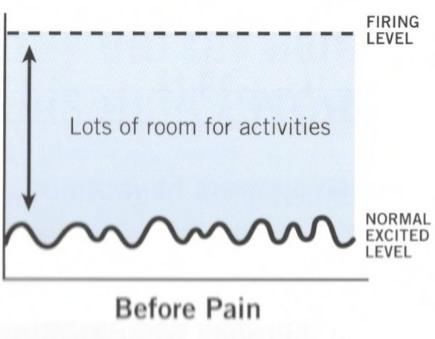
  * Minding your thresholds

* Refresh your homunculus
  * Anything new can be perceived
    by the brain as a threat/danger
* Pelvis Only
Institute of Physical Art, Specialized Educational Services* Circles, diagonals, both at the same time or individually
* Your choice, As tolerated
Institute of Physical Art, Specialized Educational Services* Belly or Abdominal Breathing
Institute of Physical Art, Specialized Educational Services
* Relaxation
* 4-7-8 Breathing
* In for 4 seconds, Hold for 7 seconds and Exhale for 8 seconds*KNOW PAIN, KNOW GAIN
*KNOW PAIN or NO GAIN
*If you have been practicing, your brain is already changing: it
takes ~8 weeks to identify a lasting change in a neural
pathway
* Know Apply Pain
Knowing is not enough, we must apply. Willing is not enough, we must do.
-Bruce Lee* Movement exercises as tolerated :
* Pelvic clocks
* Scapular clocks
* Diaphragmatic breathing
* 4/7/8 Breathing
707-624-3328: wwww.kp.org/vacaville/painmanagementYou can also read


