CNN FOR OBJECT DETECTION - DOMINIK LEWY 1 - MINI PW
←
→
Page content transcription
If your browser does not render page correctly, please read the page content below
1

            CNN for object detection
                    Dominik Lewy

5/23/2018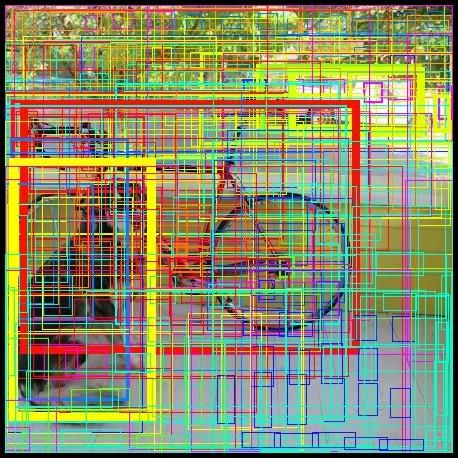
Slide 2 of 50

Agenda

1.    What is object detection?
2.    Traditional approach
3.    R-CNN
4.    Other methods
5.    Transfer Learning
6.    Experiments
7.    Future plans

     5/23/2018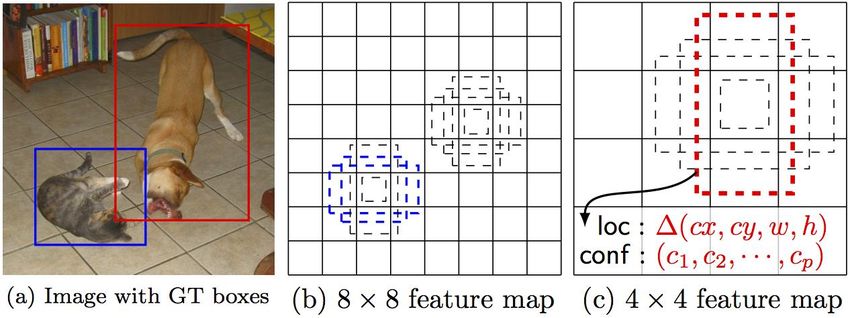
Slide 3 of 50

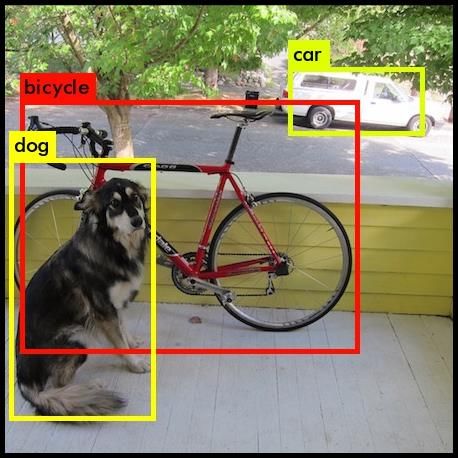
Object Detection – what is it

                        True Image       Semantic Segmentation

                                          CAR, BACKGROUND
                                     • No objects, just pixels

  5/23/2018                                                      Own content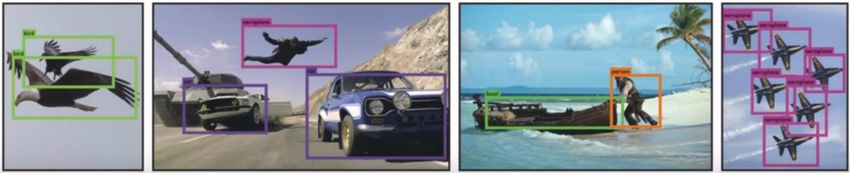
Slide 4 of 50

Object Detection – what is it

                Classification + Localization           Object Detection
              CAR

              • Single object                   • Multiple objects

  5/23/2018                                                                Own content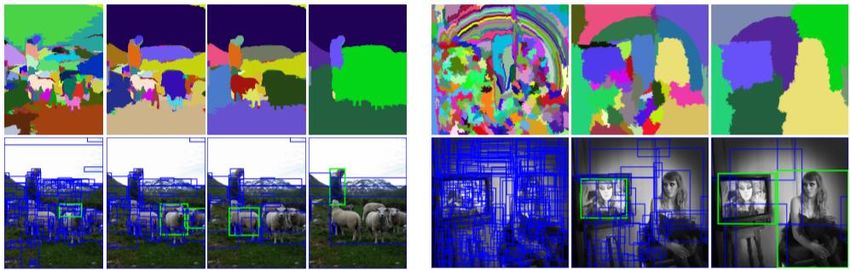
Slide 5 of 50

Object Detection – what is it

                                           Instance Segmentation

                           • Multiple objects                      CAR

  5/23/2018                                                              Own content
Slide 6 of 50

Object Detection – history – HOG
Histogram of Oriented Gradients
Method of feature selection consisting in the following steps:
1. Gradient calculation                                                                               Histograms
2. Calculation of gradient magnitude and direction
3. Histogram creation
4. Block normalization

                              Input image

  5/23/2018                                                      https://www.learnopencv.com/histogram-of-oriented-gradients/
Slide 7 of 50

Object Detection – history – HOG
1. Gradient calculation
Gradient calculation in case of images is equivalent to filtering the image with the following filters, which are
actually called Sobel filters.

Sobel filters                                                          Gradients in x and y directions

                            -1

  -1          0   1          0

                             1

  5/23/2018                                                           https://www.learnopencv.com/histogram-of-oriented-gradients/
Slide 8 of 50

Object Detection – history – HOG
2. Calculation of gradient magnitude and direction
This step unifies the information coming from gradients in x and y directions providing the strength and the
direction of the gradient.

Magnitude and direction equations                              Gradients magnitude and direction

  5/23/2018                                                        https://www.learnopencv.com/histogram-of-oriented-gradients/
Slide 9 of 50

Object Detection – history – HOG
3. Histogram creation
This step is the clue of the HOG method. Here the
gradients of the image are transformed into a
histogram. This step aims at:
• Making the representation more compact
• Denoising the representation

  5/23/2018                                         https://www.learnopencv.com/histogram-of-oriented-gradients/
Slide 10 of 50

Object Detection – history – HOG
4. Block normalization
Concatenating vectors for all of the histograms and normalizing them with the L2
norm (vector length).

Summary/key takeaways:
• Both the cell size and block size are hyperparameters that can be optimized

  5/23/2018                                                            https://www.learnopencv.com/histogram-of-oriented-gradients/
Slide 11 of 50

Object Detection – regional convolutional neural networks
1. Input Image                                3. CNN feature computation

                 2. Region of Interest proposal                     4. Classification of regions

                                                                           Airplane? No.

                                                                             Car? Yes

                                                                            Person? No

  5/23/2018                                                                                        Own content
12
CNN architectures
5/23/2018Slide 13 of 50
History of CNN for classification - AlexNet
Architecture:
CONV1
MAX POOL1
NORM1
CONV2
MAX POOL2
NORM2
CONV3
CONV4
CONV5
Max POOL3
FC6 Interesting details: • SGD Momentum
FC7 • First use of ReLU • Adaptive Learning rate
FC8 • Heavy data augmentation • L2 weight decay
• Dropout 0.5 • 7 Ensambles
• Batch size
5/23/2018 http://papers.nips.cc/paper/4824-imagenet-classification-with-deep-convolutional-neural-networks.pdfSlide 14 of 50
History of CNN for classification - VGG Net
Goal:
• Building deeper network with smaller filters
Motivation:
• Stacking multiple small filters can:
• have the same effective receptive field as one bigger filter
• have much less parameters
• introduce more nonlinearities
5/23/2018 http://cs231n.stanford.edu/slides/2017/cs231n_2017_lecture9.pdfSlide 15 of 50 History of CNN for classification - VGG Net Parameter number: 3*(3x3) – 3*3^2 = 27 (7x7) – 7^2 = 49 This difference grows with the number of filters in each layer and the number of channels. 5/23/2018 (Left) Own (Right) http://cs231n.stanford.edu/slides/2017/cs231n_2017_lecture9.pdf
Slide 16 of 50

History of CNN for classification - GoogleNet
Goal:
• Computational efficiency

How did they achieve it:
• Inception module
• No fully connected layers

Inception module:
• Various operations (convolutions and
   pooling) concatenated depth-wise (zero
   padding and stride adjusted to maintain
   spatial dimension)

  5/23/2018                                     http://cs231n.stanford.edu/slides/2017/cs231n_2017_lecture9.pdf
Slide 17 of 50

History of CNN for classification - GoogleNet
Additional auxiliary classification outputs help backpropagation.

• 12x less parameters than AlexNet

  5/23/2018                                                         http://cs231n.stanford.edu/slides/2017/cs231n_2017_lecture9.pdf
Slide 18 of 50

History of CNN for classification - ResNet
Properties:
• Extremely deep (152 layer)

Motivation:
• Underlying assumption that deep model should perform at least
  as good as shallower models (or even better as by depth we
  increase model complexity and we expect at least training error
  to be lower)
• Experimentally it was not confirmed – probably an optimization
  problem

Solution:
• Residual connection – instead of calculating the full activation
   map we only calculate the delta (residual)
                                             H(x) = F(x) + x
• How do we need to modify the input to resolve our problem

  5/23/2018                                                          http://cs231n.stanford.edu/slides/2017/cs231n_2017_lecture9.pdf
19
Region of Interest proposal
methods
5/23/2018Slide 20 of 50
Object Detection – Region of Interest proposal
Sliding window
BACKGROUND
5/23/2018 Own contentSlide 21 of 50
Object Detection – Region of Interest proposal
Sliding window
CAR
Main problems:
• The search space has to be reduced by using a regular grid, fixed scales, and fixed aspect ratios
• Most of the boxes selected this way do not contain any object
5/23/2018 Own contentSlide 22 of 50
Object Detection – Region of Interest proposal
Selective Search
Motivation:
• Hierarchical relation of object in an image
• Differences in a single aspect of the image and
similarity in others
• Texture
• Color
• Enclosing of some objects by other
Solution:
• Using a data-driven approach to steer the sampling
5/23/2018 https://koen.me/research/pub/uijlings-ijcv2013-draft.pdfSlide 23 of 50 Object Detection – Region of Interest proposal Selective Search Design consideration: • Capture all scales • Diversification • Fast to compute 5/23/2018 https://koen.me/research/pub/uijlings-ijcv2013-draft.pdf
Slide 24 of 50

Object Detection – Region of Interest proposal
Selective Search
Complementary Similarity Measures
• Color
• Texture
• Size
• Fill
Full Score = C+T+S+F

  5/23/2018                                      Own content
25

            R-CNN architectures

5/23/2018
Slide 26 of 50
Object Detection – overview – Regional CNN
1. Input Image 3. CNN feature computation
Alex Net
2. Region of Interest proposal 4. Classification of regions
Airplane? No.
Car? Yes
Person? No
Class specific
Selective Search
SVMs
5/23/2018 Own contentSlide 27 of 50
Object Detection – overview – Regional CNN
CNN SVMs
CNN SVMs
SVMs
CNN
5/23/2018 Own contentSlide 28 of 50
Object Detection – overview – Fast Regional CNN vol.2
1. Input Image 2&3. CNN feature computation
VGG16
2&3. Region of Interest proposal 4. Classification of regions
Airplane? No.
Car? Yes
Person? No
Selective Search SoftMax
5/23/2018 Own contentSlide 29 of 50
Object Detection – overview – Fast Regional CNN vol.2
FC classification
CNN
FC bounding box
5/23/2018 Own contentSlide 30 of 50
Object Detection – overview – Faster Regional CNN vol.3
1. Input Image 2. CNN feature computation
VGG16
3. Region of Interest proposal 4. Classification of regions
Airplane? No.
Car? Yes
Person? No
Selective Search SoftMax
5/23/2018 Own contentSlide 31 of 50
Object Detection – overview – Fast Regional CNN vol.2
FC
classificat
Region Proposal Network ion
FC
bounding
box
FC
CNN classificat
ion
FC
bounding
box
5/23/2018 Own contentSlide 32 of 50 Object Detection – overview – SSD Single Shot MultiBox Detector 5/23/2018
Slide 33 of 50

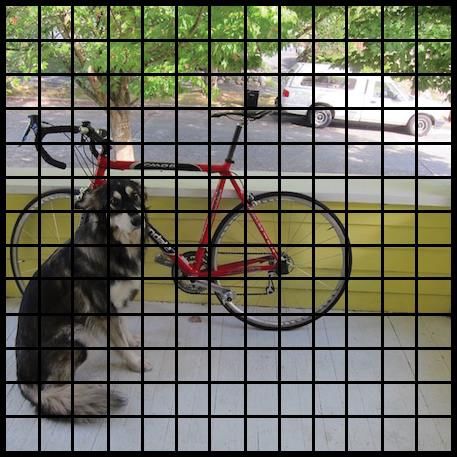
Object Detection – overview – SSD
1. Input Image                      2. CNN feature computation   3. Classification of regions

                                                                                  Detections
       Grid + anchor
                                                     SSD
           boxes

                                                                               7x7x(5*B+C)
  5/23/2018                                                                                    Own content
Slide 34 of 50 Object Detection – overview – YOLO • YOLO = You Only Look Once S × S × (5 + C) x,y,w,h,conf 5/23/2018 Slide 34 of 50
35

            Transfer Learning

5/23/2018
Slide 36 of 50
Object Detection – Transfer Learning
• ConvNet as fixed feature extractor. Take a ConvNet pretrained on ImageNet, remove the last fully-connected layer
(this layer’s outputs are the 1000 class scores for a different task like ImageNet), then treat the rest of the ConvNet
as a fixed feature extractor for the new dataset. In an AlexNet, this would compute a 4096-D vector for every image
that contains the activations of the hidden layer immediately before the classifier. We call these features CNN codes.
It is important for performance that these codes are ReLUd (i.e. thresholded at zero) if they were also thresholded
during the training of the ConvNet on ImageNet (as is usually the case). Once you extract the 4096-D codes for all
images, train a linear classifier (e.g. Linear SVM or Softmax classifier) for the new dataset.
• Fine-tuning the ConvNet. The second strategy is to not only replace and retrain the classifier on top of the ConvNet
on the new dataset, but to also fine-tune the weights of the pretrained network by continuing the backpropagation. It
is possible to fine-tune all the layers of the ConvNet, or it’s possible to keep some of the earlier layers fixed (due to
overfitting concerns) and only fine-tune some higher-level portion of the network. This is motivated by the
observation that the earlier features of a ConvNet contain more generic features (e.g. edge detectors or color blob
detectors) that should be useful to many tasks, but later layers of the ConvNet becomes progressively more specific
to the details of the classes contained in the original dataset. In case of ImageNet for example, which contains many
dog breeds, a significant portion of the representational power of the ConvNet may be devoted to features that are
specific to differentiating between dog breeds.
• Black-box off the shelf model. Using model that was already trained on a different data to resolve the same
problem on the data at hand.
5/23/2018 http://cs231n.github.io/transfer-learning/Slide 37 of 50
Object Detection – Transfer Learning
Part responsible for feature extraction Categorization layer
At initial layers the net extracts features like edges and colors. The deeper into the This is a problem specific layer that uses the
net we will go the more high level feature will be extracted. Examples of high level features extracted earlier to solve current
features: faces, wheels or text. problem.
Alex Krizhevsky, Ilya Sutskever, and Geoffrey Hinton. Imagenet classification with deep
5/23/2018 convolutional neural network. In Advances in Neural Information Processing Systems, 2012.Slide 38 of 50
Object Detection – Transfer Learning
New classification layer
New classes
972
Part responsible for feature extraction Classification layer
• Using information extracted from millions of images • Retrained for the problem at
• Possibility to fine-tune this part to extract specific features hand
connected to problem at hand
Alex Krizhevsky, Ilya Sutskever, and Geoffrey Hinton. Imagenet classification with deep
5/23/2018 convolutional neural network. In Advances in Neural Information Processing Systems, 2012.39
Experiment
5/23/2018Slide 40 of 50
Object Detection – Experiment Design
1. DATA PREPARATION
Generate TFRecord format
&
Create Label Map
• Haar cascade classifier
2. CONFIGURATION & TRAINING
Pipeline configuration Training
3. VALIDATION
Graph export Results
5/23/2018 Own ContentSlide 41 of 50
Object Detection – Experiment Data preparation
• HAAR FEATURES RELEVANT FEATURES
RAW DATA LABELED DATA
[125,26] face
[232,133]
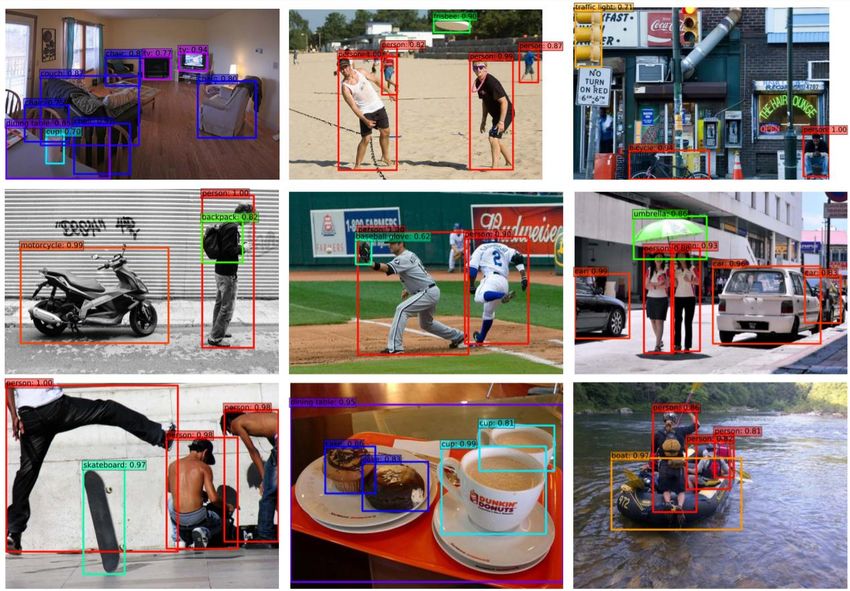
5/23/2018 Own ContentSlide 42 of 50 Object Detection – Experiment Configuration & training • COCO dataset – Common Objects in Context • 80 classes • 123,287 images • 886,284 instances (labeled objects) 5/23/2018 http://cocodataset.org/#explore
Slide 43 of 50

Object Detection – Experiment SSD results on COCO dataset

  5/23/2018
Slide 44 of 50

Object Detection – Experiment Results Test dataset

              Category                               Accuracy
              Face                                   ~96% (93/97 test
                                                     observations)

  5/23/2018                                                             Own Content
Slide 45 of 50 Experiment 2 Real Life Test
Slide 46 of 50

Object Detection – Experiment Learnings
Observations
• Scale of the class in the training images
• Different angels/views of the training class

  5/23/2018                                      Own Content
47

            Future plans

5/23/2018
Slide 48 of 50 Object Detection – Transfer Learning Adding new class to a previously trained object detection network. Experiment design Comparison of 3 different object detection networks: • Original SSD network trained on COCO dataset • SSD network from point 1 retrained with images of faces and chairs • SSD network from point 1 retrained with images of faces 5/23/2018
Slide 49 of 50

Detection comparison
                       Original SSD                       Face+Chair retrained SSD

                                      ONLY Face retrained SSD

  5/23/2018                                                                          Own content
Slide 50 of 50
Detection comparison
Original SSD Face+Chair retrained SSD
ONLY Face retrained SSD
5/23/2018 Own contentSlide 51 of 50
Detection comparison
Original SSD Face+Chair retrained SSD
5/23/2018 Own contentSlide 52 of 50 Detection comparison - Summary The object detection net trained on images of both faces and chairs: • Performed worse as a face detector than the object detection net trained on images of faces alone • Did not detect any of the chairs 5/23/2018
Slide 53 of 50

Check for correct bbox position extraction

  5/23/2018                                  Own content
Slide 54 of 50

Check if any chairs are found if we only train for chair detection

                  Only one chair was found in test images.

  5/23/2018                                                          Own content
Slide 55 of 50 Learning curves comparison 5/23/2018 Own content
Slide 56 of 50

Detection comparison - Summary

The object detection net trained on images of both faces and chairs:
• Performed worse as a face detector than the object detection net trained on images of faces alone
• Did not detect any of the chairs

Conclusions & thoughts:
• Length of the learning process
• Incorrect input data – more suitable for localization & classification problem

  5/23/2018
Slide 57 of 50

Sources

• https://blog.athelas.com/a-brief-history-of-cnns-in-image-segmentation-from-r-cnn-to-mask-r-cnn-
  34ea83205de4
• Alexnet: https://papers.nips.cc/paper/4824-imagenet-classification-with-deep-convolutional-neural-networks
• VGG: https://arxiv.org/pdf/1409.1556.pdf
• ResNet: https://arxiv.org/pdf/1512.03385.pdf
• R-CNN: https://arxiv.org/abs/1311.2524
• Fast R-CNN: https://arxiv.org/abs/1504.08083
• Faster R-CNN: https://arxiv.org/abs/1506.01497
• SDD: https://arxiv.org/pdf/1512.02325.pdf
• YOLO: https://pjreddie.com/media/files/papers/yolo.pdf

  5/23/2018
You can also read


