COMMERCIAL AVIATION COORDINATING COMMISSION - ONLINE VIRTUAL MEETING DAVID FLECKENSTEIN - WSDOT
←
→
Page content transcription
If your browser does not render page correctly, please read the page content below
Commercial Aviation
 Coordinating Commission
 Online virtual meeting

DAVID FLECKENSTEIN
Commercial Aviation Coordinating Commission Chair
July 22, 2020
Agenda
I. Welcome
Introductions/Virtual ground rules
Review of meeting objectives
II. Project update to the public and commission
members
III. Adopt strategic approach
IV. Adopt screening criteria
V. Review potential sites
VI. Adopt evaluation criteria
VII. Adjustment to timeline
2Our Legislative Mandate
Detailed in Substitute Senate Bill 5370, effective 7/28/2019
“The legislature finds that with the increase in air traffic operations, combined with
the projections for the rapid expansion of these operations in both the short and the
long term, concerns regarding the environmental, health, social, and economic
impacts of air traffic are increasing as well.
The legislature also finds that advancing Washington's position as a national and
international trading leader is dependent upon the development of a highly
competitive, statewide passenger and cargo air transportation system.
Therefore, the legislature seeks to identify a location for a new primary commercial
aviation facility in Washington, taking into consideration the data and conclusions of
appropriate air traffic studies, community representatives, and industry experts.”
The impacts from COVID-19 and transportation demand may result in
changes to the commissions work. “Have we bought ourselves more
time or will people’s preferences truly change?”
3By Our Charter
The Commission’s basic requirements:
1. Recommend a short list of no more than six airports by January 1, 2021
2. Identify the top two airports by September 1, 2021
3. Identify the single preferred location by January 1, 2022, by 60% majority vote
Research for each potential site must include the feasibility of constructing a
commercial aviation facility in that location and its potential environmental,
community, and economic impacts.
The Commission must also project a timeline for developing an additional
commercial aviation facility that is completed and functional by 2040. The
Commission must also make recommendations on future Washington State long-
range commercial facility needs.
…take into consideration data and conclusions of prior aviation policy documents, air
space studies, and case studies of best practices. It will also consider the input of
community representatives and industry experts. Options for a new facility in
Washington may include expansion or modification of an existing airport facility.
…delivery of the final report to the legislature, no later than January 1, 2022.
4Guiding Principles
1. Environmental responsibility: defined as the responsible interaction
with the environment to avoid depletion or degradation of natural
resources and allow for long-term environmental quality. The practice
of environmental sustainability helps to ensure that the needs of
today's population are met without jeopardizing the ability of future
generations to meet their needs.
2. Economic feasibility: defined as the degree to which the economic
advantages of something to be made, done, or achieved are greater
than the economic costs. Can we fund it?
3. Social equity: defined as fair access to opportunity, livelihood and
the full participation in the political and cultural life of a community.
How do we ensure underrepresented individuals have a voice?
4. Public benefit: is defined as benefiting the greater good, or the
broader public, over an individual entity or group.
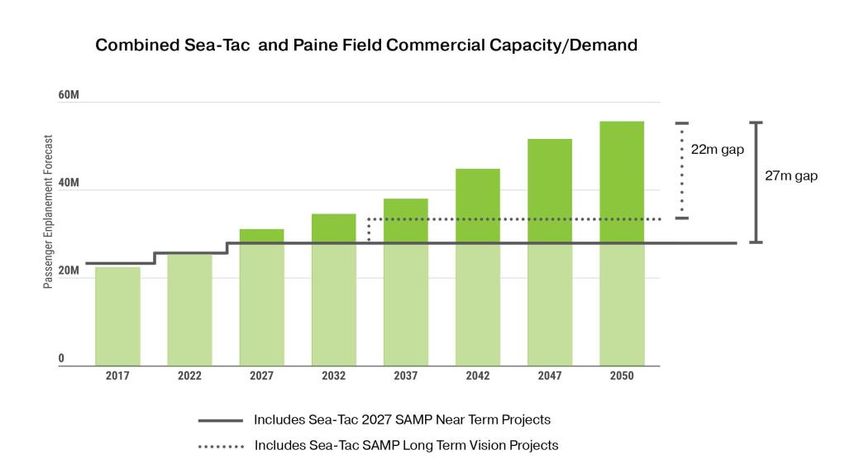
5Defining the Challenge - Passengers
• Dissecting the Capacity Gap
– Growing capacity gap over
time.
– Future gap in 2050?
SeaTac 2018
enplanements =
24,024,908
2050 gap estimated
between 22 and 27
million enplanements
Future gap the equivalent
of SeaTac demand today
As of 8 July,
enplanements were down
75%
6Defining the Challenge - Growth
Projections
• Growth is projected to continue over the next 20 years
• Top five counties all exceed statewide growth projections
• Four of the five fastest growing counties are in the Puget Sound region
20-year Percent 20-year Numerical
2020 Population 2040 Population Increase Change
State 7,065,384 7,920,676 12.1% 855,292
1 King 2,110,642 2,439,025 15.6% 328,383
2 Snohomish 766,672 905,221 18.1% 138,549
3 Pierce 819,122 927,797 13.3% 108,675
4 Clark 472,573 540,963 14.5% 68,390
5 Thurston 266,796 312,061 17.0% 45,265
*Source: WA State Office of Financial Management; High, Medium and Low estimates available -
Low-estimate numbers displayed
7Site Decision Process
Phase I: Phase II: Evaluation Phase III:
Initial Screening Recommendation
• Develop • Obtain public • Identify
screening criteria input advantages and
• Screen and • Weight evaluation disadvantages
eliminate criteria • Develop solutions
unfeasible options • Conduct to disadvantages
• Develop evaluation • Obtain public
evaluation criteria • Rank options input
• Select six initial • Select two sites • Conduct 2nd
round evaluation
sites
• Obtain public • Select preferred
site
input
• Make additional
recommendations
We are here Legislature and FAA process would follow Phase III
8Airport Site Selection Factors
• Available Land: A supplemental airport would require 1,000-2,000 acres,
and a replacement, or more likely a SeaTac-equivalent sized airport could
require as much as 4,600 acres.
• Existing Facilities: Runway length, available land on one or both ends of
the runway, adequate space to add a runway.
• Environmental Constraints: Known concerns or protections for habitat and
species, wetlands, weather patterns and similar topics.
• Proximity to Population Centers: Travel time calculations that demonstrate
good access for citizens.
• Airport Sponsor: Governance; Local government commitment for both
development and operation, and liaison with the public, local governments,
industry and others.
• Multimodal Transportation: Access to roadways, and public transportation.
9Informational Briefings:
Conducted to Date
Used for: Provided to:
- Informing stakeholders - Port of Olympia
- Discerning interest among potential - Thurston County BOCC
sponsors - Lewis County BOCC
- Helping inform the public about the - Port of Bremerton
CACC’s work - Port of Shelton
- Des Moines Normandy Park Rotary Club
- Thurston Regional Planning Council
Yet to be Conducted:
- Snohomish County Council (August 11th)
- Tumwater City Council (August 11th)
10Current Potential Sponsor Level
of Interest
• Lewis County BOCC: Strongly encourage the Commercial Aviation Coordinating
Commission to consider expansion of the Ed Carlson Memorial Airport as an option
when evaluating the potential locations and in preparation of the short list of locations.
• Port of Bremerton: Interested in continuing to be part of your discussion as you
analyze the opportunities of future aviation in this area, and the structure that the
Bremerton National Airport may be able to participate in to meet some of those
requirements.
• Port of Olympia: No interest in being considered as a sponsor of a greenfield site or
expansion of Olympia Regional Airport to meet future aviation capacity needs.
Potentially interested in partnering with another Port to meet future needs.
• Port of Shelton: Extremely high level of interest in Sanderson Field being
considered for future expansion.
• Thurston County BOCC: Voted unanimously not to be listed as a sponsor to
explore the development of a green field airport in Thurston County.
11Communications Plan: Goals and
Implementation
GOAL WAYS TO ACHIEVE IT
Provide the CACC with the benefit of public perspectives to Public comment at beginning of each CACC meeting;
inform their decision-making. CACC members at public engagement forums; Formal
period of public comment on draft reports of Commission;
Listen to what people want. Survey research
Provide meaningful ways for people who will want to be Public involvement in multiple formats—regional public
included and provide input to the CACC. meetings, presentations, communication partners, on-line
open houses, ADA compliance, multi-lingual information;
Develop ways for people to participate. user-friendly graphics; summer fairs and information booths
Provide a logical and factual framework for public Posting of meeting materials and summaries on webpage;
understanding the issues that must be addressed by the clear explanation of decision process; Informational folios;
CACC and for being informed of the decisions made. Video to be used at community presentations, at Regional
Public Meetings, posted on social media and distributed to
Make information available to the public. community access television stations.
Assure that major stakeholders, such as local Stakeholder email updates
governments, the aviation industry, airports, and regional Organizational briefings
planning agencies have timely information to assure Participation in CACC and Technical Working Group (TWG)
meaningful input.
Keep major stakeholders informed.Public Engagement in the Time of COVID • CACC Operating Guidelines and Public Involvement Plan stress the need for community engagement, but we neither anticipated the need for “social distancing” nor were we able to predict how long it would last • Our intention is to set aside a portion of each meeting of the Commission to allow for public comment—at this meeting we will be summarizing comment received to date, and at future meetings we will try to have a way for members of the public to comment in real time
Recent Public Input
•   Emails expressing support for the concept of the CACC

•   Emails requesting improvements at specific airports or service to specific
    areas

•   Support for airport expansion at specific airports (Bremerton, Everett)

•   Suggestions about transportation improvements necessary if there is an
    airport expansion (rail, highway)

•   Questions about whether a new airport is needed

•   Recent media coverage resulted in several emails expressing concerns
    about a new airport in Thurston County, and one supporting the idea. The
    Aviation Division’s responses include a clarification of the CACC decision
    process and the role of the CACC in making recommendations related to
    the aviation system
Moving Forward
• Aviation Division has prepared a folio that outlines the Commission’s
decision process and encourages community engagement
• The Division has also prepared a Frequently Asked Questions
document that answers common questions about the CACC and its
deliberations
• Both are posted on the Commission website, which is regularly
updated www.wsdot.wa.gov/aviation/commission/home.htm
• In the coming months we will be sponsoring electronic town-halls
and on-line surveys to help inform and engage members of the
public
• We will continue to respond to questions from the public and media
• We will provide commissioners with copies of all public commentRecent staff activities
1. Reviewed Studies
– Compiled a list of Puget Sound airports that could be
considered for a primary commercial aviation facility (20
airports)
– Combined with list from PSRC Baseline Study (28
airports)
– Reviewed the JTC Air Cargo study for possible capacity
opportunities
– Reviewed the PSRC Baseline Study for possible
airspace constraints
– Considered known environmental concerns at possible
airports
16Recent staff activities, cont’d
2. Conducted Analysis
– Explored Sea-Tac’s east-Cascades catchment and connecting
flights data
– Explored emerging aviation technology opportunities
– Considered alternate aviation bio-fuels to help reduce emissions
– Explored aircraft performance data to understand runway length,
aircraft load factors and possible destinations
– Examined enplanement potential from expanding existing Puget
Sound region airports
– Conducted initial analysis of existing airside and landside
infrastructure at possible Puget Sound airports
– Templated possible three-runway airport expansion at Toledo
– Considered the Aviation Trust Fund and possible impacts of
COVID federal funding availability
17Recent staff activities, cont’d
3. Conducted Outreach
– Conducted outreach to capture General Aviation needs
– Consulted with WSDOT rail colleagues to understand the
outlook for high-speed rail options
– Briefed potential sponsors
4. Developed Criteria
– Developed preliminary screening criteria and obtain
Commissioner informal input
– Conducted preliminary screening to identify seven existing
airports with potential to meet legislative directives
18Strategic Approaches
One very large Sea-Tac Expand/improve one or Both a large airport AND
sized airport more existing airports expand/improve existing
airports
• Would likely require a • Necessitates an existing • May require a greenfield
greenfield solution facility or facilities that can solution
• Would take X years to come truly accommodate • Lends itself to phased
on-line, possibly after Sea- projected demand solutions
Tac capacity threshold is • Lends itself to a phased • Would require coordinated
exceeded solution action across several
• Would require a significant • Requires coordinated action locations
sponsor across several locations • Leverages near term
capacity while pursuing a
longer-term option
• Allows more time to identify
primary major facility needs
while meeting immediate
capacity shortfalls
19Initial Feedback on Strategic
Approach
Option Preferences
Develop one large Sea-Tac-sized airport 0 commission members said they preferred this
option
Expand and/or improve one or more existing airports, 7 commission members preferred this option
to provide commercial and freight service
Combine these strategies to meet near-term capacity 14 commission members preferred this option
needs from existing airports while conducting the
processes necessary for a large new airport
I don't know 0 commission members said they preferred this
option
No answer 4 commission members did not respond to the
questionnaire
20Discussion on
Strategic Approach
• What was your reasoning for your strategic choice preference?
• How strongly do you feel about your choice over others?
• Are members of the commission comfortable with Option 3?
21Screening Criteria Feedback
• Derived from Airport Site Selection Factors
Question CACC Input
Are proposed screening criteria suitable? 95% answered Yes
Are there other screening criteria that should be Suggestions are a better fit for
considered to eliminate a site from further evaluation criteria:
consideration? - Passenger demand
- Proximity to other commercial
Note: service airports (not too close to
- Screening criteria are used to eliminate a possible SeaTac)
site. - Land use/zoning
- Evaluation criteria are used to rank possible sites.
- Community support
- Economic growth and vitality
Discussion: Does this approach make sense?
22Staff Analysis of Potential Sites
Airport Sites Feedback Received
Question CACC Input
Are there any additional sites that should be Tri-cities (Pasco)
considered as part of the catalog of potential Yakima
solutions? Spokane
• A specific greenfield site has yet to be identified. Staff recommends that suggested
additional airport sites may be more suited to be considered as system airports,
rather than primary facilities.
• A system airport could serve as a satellite airport in the Puget Sound region or an
additional airport outside the region that could offer passenger service and/or air
cargo capacity elsewhere in the state.
SSB 5370: Staff Interpretation – System Airports
“Recommendations to the legislature on future Washington state long-range
commercial aviation facility needs including possible additional aviation facilities or
expansion of current aviation facilities… to meet anticipated commercial aviation,
general aviation, and air cargo demands.”
Discussion: Do you agree with the System Airport approach for airports
not considered for the Primary Commercial Aviation Facility?
23Staff Analysis of Potential Sites
Traffic
Transit Miles to Congestion Possible
Travel Time Land (Acres) Runway Agency Lead Service Interstate Exit Issues Concerns WSDOT Assessment PSRC Assessment List
North Seattle, Nearing Unlikely due to runway Potential to accommodate
Arlington 3 1200 5332’ City No 3 High Capacity, Runway length constraints commercial air service Possible
Runway length, acreage, Unlikely due to land and Unable to accommodate
Auburn 5 111 3400’ City Yes 6 High available off-airport land runway commercial air service
Bellingham 1 1200 6700’ Port Yes 2 High Proximity to population Unlikely due to travel time Not considered
Bremerton National Runway length; road Potential to accommodate
Airport 3 1172 6000’ Port No 30 High congestion Possible commercial air service Possible
Chehalis-Centralia Runway length, acreage, Unlikely due to land and
Airport 2 438 5000' City No 3 Low available off-airport land runway Not considered
Potential to accommodate
Everett/ Paine Field 4 1250 9010' County Yes 4 High Environmental limitations Possible commercial air service Possible
Runway length, acreage, Unlikely due to land and Unable to accommodate
Kent/ Norman Grier 4 66 3288' Private No 13 High available off-airport land runway commercial air service
Moses Lake/Grant 13503’ and
County 0 4700 10000’ Port Yes 8 Low Proximity to population Unlikely due to travel time Not considered
Unlikely due to lack of
Olympia (Black Lake) 4 N/A N/A County No ~5 Periodic Greenfield sponsor Not considered
Runway length,
Environmental, Road Unlikely due to lack of
Olympia Regional Airport 4 1385 5500’ Port Yes 2 Periodic congestion sponsor Not considered
Port Angeles 0 800 6347' Port Yes 108 Low Proximity to population Unlikely due to travel time Not considered
Runway length, acreage, Unlikely due to land and Unable to accommodate
Puyallup/ Thun Field 5 200 3651' County Yes 13 High available off-airport land runway commercial air service
Runway length, Acreage, Unlikely due to land and Unable to accommodate
Renton 5 170 5382' City Yes 2 High available off-airport land runway; King county commercial air service
Acreage, available off-airport Unable to accommodate
Seattle/ Boeing Field 4 594 10007‘ County Yes 4 High land Unlikely - King County commercial air service
Shelton/ Sanderson Field 4 1054 5005' Port Yes 22 Low Runway length Possible Not considered Possible
Proximity to population,
Skagit 2 761 5478' Port Yes 5 High runway length, acreage Unlikely due to travel time Not considered
Runway length, Acreage, Unlikely due to runway Potential to accommodate
Tacoma Narrows 5 568 5002' County No 8 High Available land constraints commercial air service Possible
Unlikely due to
congressional concerns Unable to accommodate
Tacoma/ McChord Field 5 3000 10108’ Military No 1 High Military use, Governance and lack of sponsor commercial air service
Possible but restricted by
Toledo Airport 2 94 4479' County No 5 Low Runway length, acreage proximity to population Not considered Possible
24Airport Site Concerns
Airport Site Concerns Feedback Received
Question CACC Input
Do any of the sites that have Respondents shared the following types of concerns:
been identified as possible a. Multiple sites may not be desirable to airlines
give you concern? b. Multiple sites may not be financially feasible
c. Existing sites offer limited expansion due to potential
encroachment
Specific site concerns:
• Arlington is too close to Paine Field and is not a good
choice
• Toledo is too far from the population
• JBLM is not supported by the military or
congressional delegates
• Bremerton is too far from the population and the
Puget Sound is a barrier to access
• Shelton is too far from the population
• Tacoma Narrows has strong community opposition,
and the Puget Sound is a barrier to access
Discussion: Are there any other thoughts regarding these sites?
25Evaluation Criteria
Commission members indicated strong Topics that scored the highest
support for proposed evaluation criteria
High
importance
Operational Suitability
Operational suitability 80% Clear airspace 64.71%
Runway length 76.47%
Site suitability 91%
Site Suitability
Partners/sponsors/community 86% Electrical power 64.71%
support Telecommunications 64.71%
Market factors 66% Partners/sponsors/community that
should be considered
Public benefit 72% Airport sponsor support 64.71%
Market factors
Economic feasibility 80% Geographic accessibility for
passengers 64.71%
Environmental stewardship 88%
Economic Feasibility
Social equity 80% Potential of federal funding 82.35%
Potential costs 70.59%
Environmental Stewardship
Noise impacts 64.71%
Air quality impacts 76.47%
26Suggested Additional Evaluation
Criteria
Commission members were asked to provide recommendations for
additional evaluation criteria, summarized below:
• Accessibility of services such as aircraft fuel
• Airside infrastructure to support aviation activities
• Consideration for airspace constraints
• Noise impacts on communities
• Land-use, terrain and soil suitability for infrastructure
• Transportation connections
• PPP, business community, and environmental group support
• Impacts to General Aviation
• Technology advancements and automation
• Air carrier support
• Role in contributing to the transportation system
• Contribution to improving aviation capacity
• Benefit to all segments of communities
• Contribution to meeting each aviation segment; commercial service, air cargo and GA
• Archeological and Historical Preservation
27Proposed Changes to Evaluation
Criteria
• Editorial (spelling and clarification) • Address during environmental
• Covered as screening criteria process
– Capacity improvements – Potential for mitigation
– Drive times – Archeological and historical
• Address during Phase III preservation
– Terrain/soil – Sustainable building
– Storm water detention opportunities
– Jet fuel storage
– Public private partnerships
• DISCUSS TODAY
– Affordability to airport customers
– Interaction with overall – Regarding measures for
transportation system Partners/Sponsors/
– Demand management Communities, how should we
think about support from various
– Potential revenues
sectors?Discussion on
Evaluation Criteria
• Are there any other major categories for evaluation criteria that should be considered
besides:
– Operational suitability
– Site suitability
– Sponsor and community support
– Market factors
– Public benefit
– Economic feasibility
– Environmental responsibility
• Are there other measures that should be considered for any of the evaluation criteria
besides those proposed by staff? Are there any measured that should be changed or
deleted?
29Discussion: Adjustment to
CACC Timeline
• Commission Members and the public have expressed a concern about the current
timeline
• Issues:
– Social distancing requirements have made it difficult for the Commission to do its
business and for the public to be able to provide input to the Commission’s
recommendations
– Disruptions created by the COVID pandemic include:
• Major economic downturns throughout the economy
• Changes in travel behavior and work patterns
• Airline industry disruptions
– State budget shortfalls may impact the ability for the CACC to do additional
technical analysis and public outreach
• Options
1. Stay the course
2. Request legislature to delay recommendations by one year to provide more time
for CACC and staff to do additional analysis and outreach
30Next steps
• Next steps in analysis
- Community/sponsor engagement on potential primary aviation facility sites
- Develop a broader understanding of public and industry preferences (traveling
public and shippers, air service and air cargo providers, General Aviation)
- Explore and develop possible System Airport roles/contribution to capacity
- Revise and update Evaluation Criteria
- Conduct research to support Evaluation Criteria
• October 2020 CACC Meeting, Potential Dates:
- 13th, Tuesday
- 19th, Monday
- 20th, Tuesday
- 21st, Wednesday
- 22nd, Thursday
- 26th, Monday
31Questions?
For additional information regarding the
Commercial Aviation Coordinating Commission, please
contact:
The WSDOT Aviation Division
or go to
https://www.wsdot.wa.gov/aviation/commission/home.htm
38You can also read


