Airspace Introduction - FAA
←
→
Page content transcription
If your browser does not render page correctly, please read the page content below
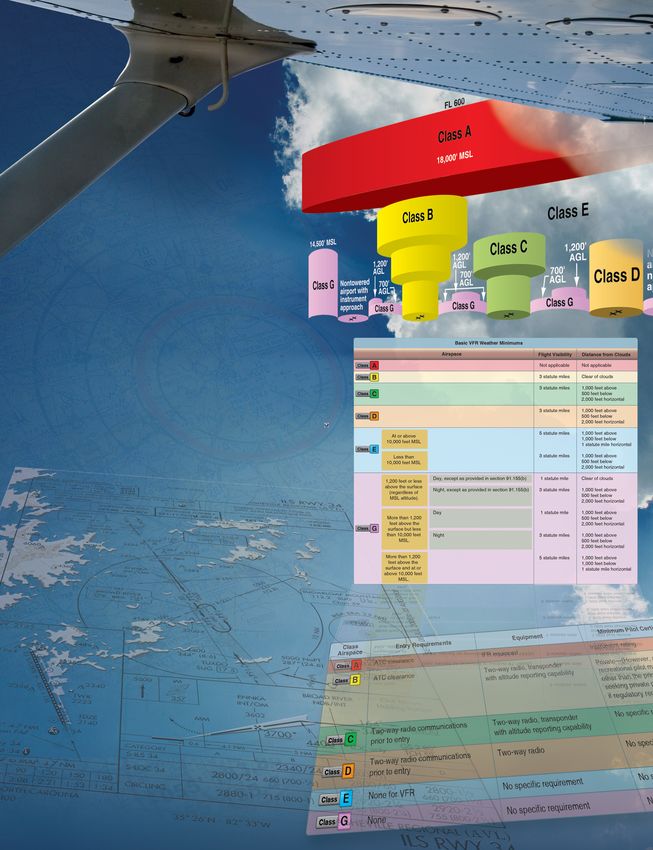
Chapter 15

Airspace
Introduction
The two categories of airspace are: regulatory and
nonregulatory. Within these two categories, there are four
types: controlled, uncontrolled, special use, and other
airspace. The categories and types of airspace are dictated
by the complexity or density of aircraft movements, nature
of the operations conducted within the airspace, the level of
safety required, and national and public interest. Figure 15-1
presents a profile view of the dimensions of various classes
of airspace. Also, there are excerpts from sectional charts
that are discussed in Chapter 16, Navigation, that are used
to illustrate how airspace is depicted.

                                                                 15-1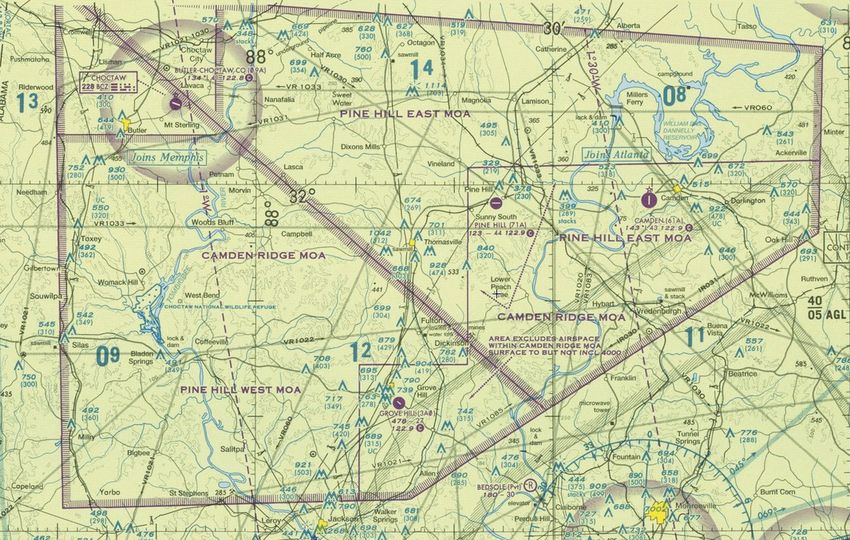
FL 600

                                                             Class   A
                                                            18,000' MSL

                                                Class   B
      14,500' MSL                                                                                  Class    E

                                   1,200'                       1,200'          Class   C            1,200'
                                   AGL                          AGL                                   AGL                   Nontowered
       Class   G    Nontowered       700'                          700'                          700'                       airport with
                    airport with     AGL                          AGL                            AGL            Class   D   no instrument
                    instrument                                                                                              approach
                    approach        Class   G                    Class   G                      Class   G

Figure 15-1. Airspace profile.

Controlled Airspace                                                      Class C Airspace
Controlled airspace is a generic term that covers the                    Class C airspace is generally airspace from the surface to
different classifications of airspace and defined dimensions             4,000 feet above the airport elevation (charted in MSL)
within which air traffic control (ATC) service is provided               surrounding those airports that have an operational control
in accordance with the airspace classification. Controlled               tower, are serviced by a radar approach control, and have a
airspace consists of:                                                    certain number of IFR operations or passenger enplanements.
                                                                         Although the configuration of each Class C area is
  •      Class A                                                         individually tailored, the airspace usually consists of a surface
  •      Class B                                                         area with a five NM radius, an outer circle with a ten NM
                                                                         radius that extends from 1,200 feet to 4,000 feet above the
  •      Class C
                                                                         airport elevation. Each aircraft must establish two-way radio
  •      Class D                                                         communications with the ATC facility providing air traffic
  •      Class E                                                         services prior to entering the airspace and thereafter must
                                                                         maintain those communications while within the airspace.
Class A Airspace
Class A airspace is generally the airspace from 18,000 feet              Class D Airspace
mean sea level (MSL) up to and including flight level (FL)               Class D airspace is generally airspace from the surface to
600, including the airspace overlying the waters within 12               2,500 feet above the airport elevation (charted in MSL)
nautical miles (NM) of the coast of the 48 contiguous states             surrounding those airports that have an operational control
and Alaska. Unless otherwise authorized, all operation in Class          tower. The configuration of each Class D airspace area is
A airspace is conducted under instrument flight rules (IFR).             individually tailored and, when instrument procedures are
                                                                         published, the airspace is normally designed to contain the
Class B Airspace                                                         procedures. Arrival extensions for instrument approach
Class B airspace is generally airspace from the surface to               procedures (IAPs) may be Class D or Class E airspace. Unless
10,000 feet MSL surrounding the nation’s busiest airports in             otherwise authorized, each aircraft must establish two-way
terms of airport operations or passenger enplanements. The               radio communications with the ATC facility providing air
configuration of each Class B airspace area is individually              traffic services prior to entering the airspace and thereafter
tailored, consists of a surface area and two or more layers              maintain those communications while in the airspace.
(some Class B airspace areas resemble upside-down wedding
cakes), and is designed to contain all published instrument              Class E Airspace
procedures once an aircraft enters the airspace. ATC                     Class E airspace is the controlled airspace not classified as
clearance is required for all aircraft to operate in the area,           Class A, B, C, or D airspace. A large amount of the airspace
and all aircraft that are so cleared receive separation services         over the United States is designated as Class E airspace.
within the airspace.

15-2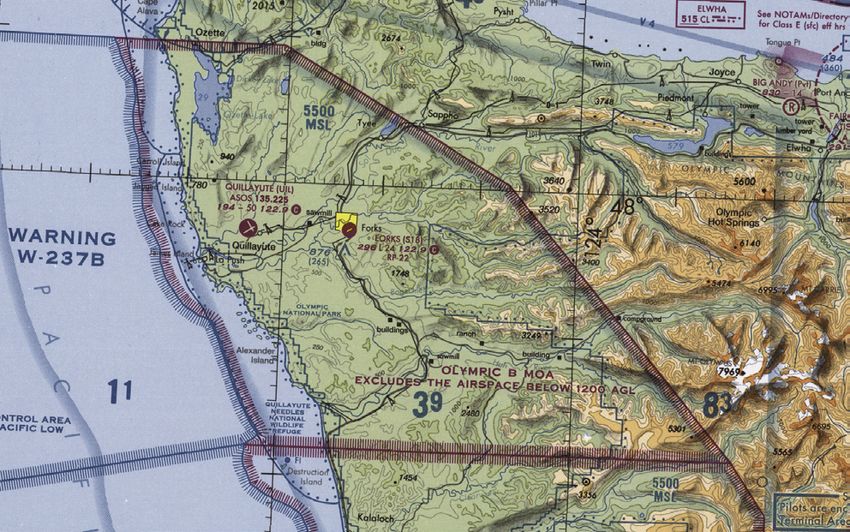
This provides sufficient airspace for the safe control and          Prohibited Areas
separation of aircraft during IFR operations. Chapter 3 of          Prohibited areas contain airspace of defined dimensions
the Aeronautical Information Manual (AIM) explains the              within which the flight of aircraft is prohibited. Such areas
various types of Class E airspace.                                  are established for security or other reasons associated with
                                                                    the national welfare. These areas are published in the Federal
Sectional and other charts depict all locations of Class E          Register and are depicted on aeronautical charts. The area is
airspace with bases below 14,500 feet MSL. In areas where           charted as a “P” followed by a number (e.g., P-40). Examples
charts do not depict a class E base, class E begins at 14,500       of prohibited areas include Camp David and the National
feet MSL.                                                           Mall in Washington, D.C., where the White House and the
                                                                    Congressional buildings are located. [Figure 15-2]
In most areas, the Class E airspace base is 1,200 feet AGL. In
many other areas, the Class E airspace base is either the surface   Restricted Areas
or 700 feet AGL. Some Class E airspace begins at an MSL             Restricted areas are areas where operations are hazardous to
altitude depicted on the charts, instead of an AGL altitude.        nonparticipating aircraft and contain airspace within which
                                                                    the flight of aircraft, while not wholly prohibited, is subject
Class E airspace typically extends up to, but not including,        to restrictions. Activities within these areas must be confined
18,000 feet MSL (the lower limit of Class A airspace). All          because of their nature, or limitations may be imposed upon
airspace above FL 600 is Class E airspace.                          aircraft operations that are not a part of those activities, or
                                                                    both. Restricted areas denote the existence of unusual, often
Uncontrolled Airspace                                               invisible, hazards to aircraft (e.g., artillery firing, aerial
Class G Airspace                                                    gunnery, or guided missiles). IFR flights may be authorized
Uncontrolled airspace or Class G airspace is the portion of         to transit the airspace and are routed accordingly. Penetration
the airspace that has not been designated as Class A, B, C,         of restricted areas without authorization from the using
D, or E. It is therefore designated uncontrolled airspace.          or controlling agency may be extremely hazardous to the
Class G airspace extends from the surface to the base of the        aircraft and its occupants. ATC facilities apply the following
overlying Class E airspace. Although ATC has no authority           procedures when aircraft are operating on an IFR clearance
or responsibility to control air traffic, pilots should remember    (including those cleared by ATC to maintain VFR on top) via
there are visual flight rules (VFR) minimums that apply to          a route that lies within joint-use restricted airspace:
Class G airspace.                                                     1.     If the restricted area is not active and has been released
                                                                             to the Federal Aviation Administration (FAA), the
Special Use Airspace                                                         ATC facility allows the aircraft to operate in the
Special use airspace or special area of operation (SAO)                      restricted airspace without issuing specific clearance
is the designation for airspace in which certain activities                  for it to do so.
must be confined, or where limitations may be imposed                 2.     If the restricted area is active and has not been released
on aircraft operations that are not part of those activities.                to the FAA, the ATC facility issues a clearance that
Certain special use airspace areas can create limitations on                 ensures the aircraft avoids the restricted airspace.
the mixed use of airspace. The special use airspace depicted
on instrument charts includes the area name or number,
effective altitude, time and weather conditions of operation,
the controlling agency, and the chart panel location. On
National Aeronautical Charting Group (NACG) en route
charts, this information is available on one of the end panels.
Special use airspace usually consists of:
  •    Prohibited areas
  •    Restricted areas
  •    Warning areas
  •    Military operation areas (MOAs)
  •    Alert areas
                                                                    Figure 15-2. An example of a prohibited area, P-40 around Camp
  •    Controlled firing areas (CFAs)                               David.

                                                                                                                                 15-3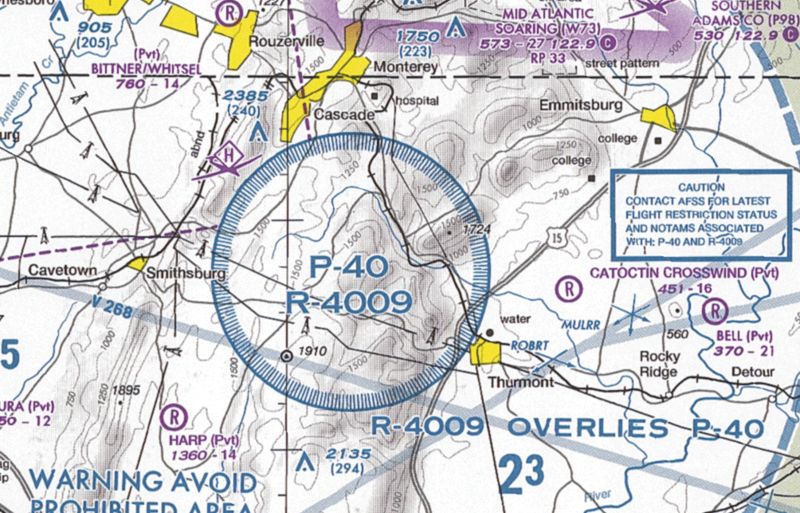
Restricted areas are charted with an “R” followed by a
number (e.g., R-4401) and are depicted on the en route
chart appropriate for use at the altitude or FL being flown.
[Figure 15-3] Restricted area information can be obtained
on the back of the chart.

Warning Areas
Warning areas are similar in nature to restricted areas;
however, the United States government does not have sole
jurisdiction over the airspace. A warning area is airspace of
defined dimensions, extending from 3 NM outward from
the coast of the United States, containing activity that may
be hazardous to nonparticipating aircraft. The purpose of
                                                                 Figure 15-4. Requirements for airspace operations.
such areas is to warn nonparticipating pilots of the potential
danger. A warning area may be located over domestic or
international waters or both. The airspace is designated with    pilots of areas that may contain a high volume of pilot training
a “W” followed by a number (e.g., W-237). [Figure 15-4]          or an unusual type of aerial activity. Pilots should exercise
                                                                 caution in alert areas. All activity within an alert area shall
Military Operation Areas (MOAs)                                  be conducted in accordance with regulations, without waiver,
MOAs consist of airspace with defined vertical and lateral       and pilots of participating aircraft, as well as pilots transiting
limits established for the purpose of separating certain         the area, shall be equally responsible for collision avoidance.
military training activities from IFR traffic. Whenever an       [Figure 15-6]
MOA is being used, nonparticipating IFR traffic may be
cleared through an MOA if IFR separation can be provided by      Controlled Firing Areas (CFAs)
ATC. Otherwise, ATC reroutes or restricts nonparticipating       CFAs contain activities that, if not conducted in a controlled
IFR traffic. MOAs are depicted on sectional, VFR terminal        environment, could be hazardous to nonparticipating aircraft.
area, and en route low altitude charts and are not numbered      The difference between CFAs and other special use airspace
(e.g., “Camden Ridge MOA”). [Figure 15-5] However, the           is that activities must be suspended when a spotter aircraft,
MOA is also further defined on the back of the sectional         radar, or ground lookout position indicates an aircraft might
charts with times of operation, altitudes affected, and the      be approaching the area. There is no need to chart CFAs
controlling agency.                                              since they do not cause a nonparticipating aircraft to change
                                                                 its flight path.
Alert Areas
Alert areas are depicted on aeronautical charts with an “A”      Other Airspace Areas
followed by a number (e.g., A-211) to inform nonparticipating    “Other airspace areas” is a general term referring to the
                                                                 majority of the remaining airspace. It includes:
                                                                   •    Local airport advisory (LAA)
                                                                   •    Military training route (MTR)
                                                                   •    Temporary flight restriction (TFR)
                                                                   •    Parachute jump aircraft operations
                                                                   •    Published VFR routes
                                                                   •    Terminal radar service area (TRSA)
                                                                   •    National security area (NSA)
                                                                   •    Air Defense Identification Zones (ADIZ) land and
                                                                        water based and need for Defense VFR (DVFR) flight
                                                                        plan to operate VFR in this airspace
                                                                   •    Intercept Procedures and use of 121.5 for
                                                                        communication if not on ATC already

Figure 15-3. Restricted areas on a sectional chart.

15-4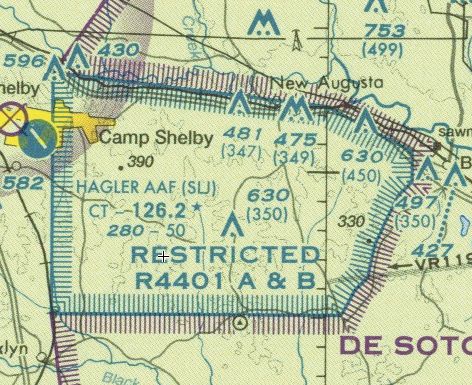
Figure 15-5. Camden Ridge MOA is an example of a military operations area.

Figure 15-6. Alert area (A-211).

                                                                             15-5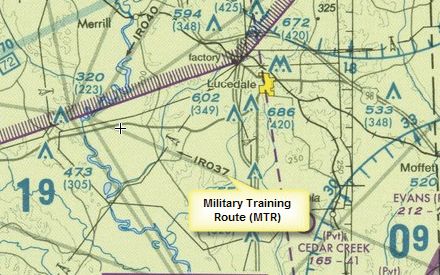
•    Flight Restricted Zones (FRZ) in vicinity of Capitol        accommodate operations above 1,500 feet AGL. IR routes
       and White House                                             are conducted in accordance with IFR regardless of weather
  •    Special Awareness Training required by                      conditions. VFR sectional charts depict military training
       14 CFR 91.161 for pilots to operate VFR within 60           activities, such as IR, VR, MOA, restricted area, warning
       NM of the Washington, DC VOR/DME                            area, and alert area information.

  •    Wildlife Areas/Wilderness Areas/National Parks and          Temporary Flight Restrictions (TFR)
       request to operate above 2,000 AGL                          A flight data center (FDC) Notice to Airmen (NOTAM)
  •    National Oceanic and Atmospheric Administration             is issued to designate a TFR. The NOTAM begins with
       (NOAA) Marine Areas off the coast with requirement          the phrase “FLIGHT RESTRICTIONS” followed by the
       to operate above 2,000 AGL                                  location of the temporary restriction, effective time period,
                                                                   area defined in statute miles, and altitudes affected. The
  •    Tethered Balloons for observation and weather
                                                                   NOTAM also contains the FAA coordination facility and
       recordings that extend on cables up to 60,000
                                                                   telephone number, the reason for the restriction, and any other
Local Airport Advisory (LAA)                                       information deemed appropriate. The pilot should check the
                                                                   NOTAMs as part of flight planning.
An advisory service provided by Flight Service Station
(FSS) facilities, which are located on the landing airport,
                                                                   Some of the purposes for establishing a TFR are:
using a discrete ground-to-air frequency or the tower
frequency when the tower is closed. LAA services include             •    Protect persons and property in the air or on the surface
local airport advisories, automated weather reporting with                from an existing or imminent hazard.
voice broadcasting, and a continuous Automated Surface               •    Provide a safe environment for the operation of
Observing System (ASOS)/Automated Weather Observing                       disaster relief aircraft.
Station (AWOS) data display, other continuous direct reading
instruments, or manual observations available to the specialist.     •    Prevent an unsafe congestion of sightseeing aircraft
                                                                          above an incident or event, that may generate a high
Military Training Routes (MTRs)                                           degree of public interest.
MTRs are routes used by military aircraft to maintain                •    Protect declared national disasters for humanitarian
proficiency in tactical flying. These routes are usually                  reasons in the State of Hawaii.
established below 10,000 feet MSL for operations at speeds           •    Protect the President, Vice President, or other public
in excess of 250 knots. Some route segments may be defined                figures.
at higher altitudes for purposes of route continuity. Routes
are identified as IFR (IR), and VFR (VR), followed by                •    Provide a safe environment for space agency
a number. [Figure 15-7] MTRs with no segment above                        operations.
1,500 feet AGL are identified by four number characters
(e.g., IR1206, VR1207). MTRs that include one or more              Since the events of September 11, 2001, the use of TFRs has
segments above 1,500 feet AGL are identified by three              become much more common. There have been a number of
number characters (e.g., IR206, VR207). IFR low altitude           incidents of aircraft incursions into TFRs that have resulted
en route charts depict all IR routes and all VR routes that        in pilots undergoing security investigations and certificate
                                                                   suspensions. It is a pilot’s responsibility to be aware of TFRs
                                                                   in their proposed area of flight. One way to check is to visit
                                                                   the FAA website, www.tfr.faa.gov, and verify that there is
                                                                   not a TFR in the area.

                                                                   Parachute Jump Aircraft Operations
                                                                   Parachute jump aircraft operations are published in the Chart
                                                                   Supplement U.S. (formerly Airport/Facility Directory). Sites
                                                                   that are used frequently are depicted on sectional charts.
                           Military Training
                            Route (MTR)
                                                                   Published VFR Routes
                                                                   Published VFR routes are for transitioning around, under, or
                                                                   through some complex airspace. Terms such as VFR flyway,
                                                                   VFR corridor, Class B airspace VFR transition route, and
Figure 15-7. Military training route (MTR) chart symbols.
                                                                   terminal area VFR route have been applied to such routes.

15-6
These routes are generally found on VFR terminal area 1. A deviation is necessary to conform to ICAO
planning charts. Documents, National Rules of the Air, or special
agreements where the United States provides ATC
Terminal Radar Service Areas (TRSAs) service in airspace outside the country and its
TRSAs are areas where participating pilots can receive possessions
additional radar services. The purpose of the service is 2. Other procedures/minima are prescribed in a letter of
to provide separation between all IFR operations and agreement, FAA directive, or a military document
participating VFR aircraft.
3. A deviation is necessary to assist an aircraft when an
The primary airport(s) within the TRSA become(s) Class D emergency has been declared
airspace. The remaining portion of the TRSA overlies other
controlled airspace, which is normally Class E airspace Coordinating the Use of Airspace
beginning at 700 or 1,200 feet and established to transition to/ ATC is responsible for ensuring that the necessary
from the en route/terminal environment. TRSAs are depicted coordination has been accomplished before allowing an
on VFR sectional charts and terminal area charts with a solid aircraft under their control to enter another controller’s area
black line and altitudes for each segment. The Class D portion of jurisdiction.
is charted with a blue segmented line. Participation in TRSA
services is voluntary; however, pilots operating under VFR Before issuing control instructions directly or relaying
are encouraged to contact the radar approach control and take through another source to an aircraft that is within another
advantage of TRSA service. controller’s area of jurisdiction that will change that
aircraft’s heading, route, speed, or altitude, ATC ensures
National Security Areas (NSAs) that coordination has been accomplished with each of the
NSAs consist of airspace of defined vertical and lateral controllers listed below whose area of jurisdiction is affected
dimensions established at locations where there is a by those instructions unless otherwise specified by a letter
requirement for increased security and safety of ground of agreement or a facility directive:
facilities. Flight in NSAs may be temporarily prohibited by 1. The controller within whose area of jurisdiction the
regulation under the provisions of Title 14 of the Code of control instructions are issued
Federal Regulations (14 CFR) part 99, and prohibitions are 2. The controller receiving the transfer of control
disseminated via NOTAM. Pilots are requested to voluntarily
avoid flying through these depicted areas. 3. Any intervening controller(s) through whose area of
jurisdiction the aircraft will pass
Air Traffic Control and the National
Airspace System If ATC issues control instructions to an aircraft through a
source other than another controller (e.g., Aeronautical Radio,
The primary purpose of the ATC system is to prevent a
Incorporated (ARINC), FSS, another pilot), they ensure that
collision between aircraft operating in the system and to
the necessary coordination has been accomplished with any
organize and expedite the flow of traffic. In addition to
controllers listed above, whose area of jurisdiction is affected
its primary function, the ATC system has the capability to
by those instructions unless otherwise specified by a letter
provide (with certain limitations) additional services. The
of agreement or a facility directive.
ability to provide additional services is limited by many
factors, such as the volume of traffic, frequency congestion,
Operating in the Various Types of Airspace
quality of radar, controller workload, higher priority duties,
It is important that pilots be familiar with the operational
and the pure physical inability to scan and detect those
requirements for each of the various types or classes of
situations that fall in this category. It is recognized that these
airspace. Subsequent sections cover each class in sufficient
services cannot be provided in cases in which the provision
detail to facilitate understanding regarding weather, type of
of services is precluded by the above factors.
pilot certificate held, and equipment required.
Consistent with the aforementioned conditions, controllers
shall provide additional service procedures to the extent
Basic VFR Weather Minimums
permitted by higher priority duties and other circumstances. No pilot may operate an aircraft under basic VFR when the
The provision of additional services is not optional on the flight visibility is less, or at a distance from clouds that is
part of the controller, but rather is required when the work less, than that prescribed for the corresponding altitude and
situation permits. Provide ATC service in accordance with class of airspace. [Figure 15-8] Except as provided in 14 CFR
the procedures and minima in this order except when: part 91, section 91.157, “Special VFR Weather Minimums,”
15-7Basic VFR Weather Minimums
Airspace Flight Visibility Distance from Clouds
Class A Not applicable Not applicable
Class B 3 statute miles Clear of clouds
3 statute miles 1,000 feet above
Class C 500 feet below
2,000 feet horizontal
3 statute miles 1,000 feet above
Class D 500 feet below
2,000 feet horizontal
5 statute miles 1,000 feet above
At or above
1,000 feet below
10,000 feet MSL
1 statute mile horizontal
Class E
Less than 3 statute miles 1,000 feet above
10,000 feet MSL 500 feet below
2,000 feet horizontal
Day, except as provided in section 91.155(b) 1 statute mile Clear of clouds
1,200 feet or less
above the surface
Night, except as provided in section 91.155(b) 3 statute miles 1,000 feet above
(regardless of
500 feet below
MSL altitude).
2,000 feet horizontal
Day 1 statute mile 1,000 feet above
More than 1,200 500 feet below
feet above the 2,000 feet horizontal
Class G surface but less
than 10,000 feet Night 3 statute miles 1,000 feet above
MSL. 500 feet below
2,000 feet horizontal
More than 1,200 5 statute miles 1,000 feet above
feet above the 1,000 feet below
surface and at or 1 statute mile horizontal
above 10,000 feet
MSL.
Figure 15-8. Visual flight rule weather minimums.
no person may operate an aircraft beneath the ceiling under All aircraft operating in today’s National Airspace System
VFR within the lateral boundaries of controlled airspace (NAS) has complied with the CFR governing its certification
designated to the surface for an airport when the ceiling is and maintenance; all pilots operating today have completed
less than 1,000 feet. Additional information can be found in rigorous pilot certification training and testing. Of equal
14 CFR part 91, section 91.155(c). importance is the proper execution of preflight planning,
aeronautical decision-making (ADM) and risk management.
Operating Rules and Pilot/Equipment Requirements ADM involves a systematic approach to risk assessment
The safety of flight is a top priority of all pilots and the and stress management in aviation, illustrates how personal
responsibilities associated with operating an aircraft attitudes can influence decision-making, and how those
should always be taken seriously. The air traffic system attitudes can be modified to enhance safety in the flight
maintains a high degree of safety and efficiency with strict deck. More detailed information regarding ADM and
regulatory oversight of the FAA. Pilots fly in accordance risk mitigation can be found in Chapter 2, “Aeronautical
with regulations that have served the United States well, as Decision-Making.”
evidenced by the fact that the country has the safest aviation
system in the world.
15-8Pilots also comply with very strict FAA general operating 2. A recreational pilot certificate and all requirements
and flight rules as outlined in the CFR, including the FAA’s contained within 14 CFR part 61, section 61.101(d), or
important “see and avoid” mandate. These regulations provide the requirements for a student pilot seeking a recreational
the historical foundation of the FAA regulations governing pilot certificate in 14 CFR part 61, section 61.94.
the aviation system and the individual classes of airspace. 3. A sport pilot certificate and all requirements contained
Figure 15-9 lists the operational and equipment requirements within 14 CFR part 61, section 61.325, or the
for these various classes of airspace. It is helpful to refer to this requirements for a student pilot seeking a recreational
figure as the specific classes are discussed in greater detail. pilot certificate in 14 CFR part 61, section 61.94, or
the aircraft is operated by a student pilot who has met
Class A the requirements of 14 CFR part 61, sections 61.94
Pilots operating an aircraft in Class A airspace must conduct and 61.95, as applicable.
that operation under IFR and only under an ATC clearance
received prior to entering the airspace. Unless otherwise Unless otherwise authorized by ATC, all aircraft within Class
authorized by ATC, each aircraft operating in Class A B airspace must be equipped with the applicable operating
airspace must be equipped with a two-way radio capable of transponder and automatic altitude reporting equipment
communicating with ATC on a frequency assigned by ATC. specified in 14 CFR part 91, section 91.215(a) and an
Unless otherwise authorized by ATC, all aircraft within operable two-way radio capable of communications with
Class A airspace must be equipped with the appropriate ATC on appropriate frequencies for that Class B airspace
transponder equipment meeting all applicable specifications area. Additionally, beginning January 1, 2020, aircraft
found in 14 CFR part 91, section 91.215. Additionally, operating in the Class B airspace described in 14 CFR part 91,
beginning January 1, 2020, aircraft operating in the Class section 91.225, must have ADS-B Out equipment installed,
A airspace described in 14 CFR part 91, section 91.225, which meets the performance requirements of 14 CFR part
must have ADS-B Out equipment installed, which meets the 91, section 91.227.
performance requirements of 14 CFR part 91, section 91.227.
Class C
Class B For the purpose of this section, the primary airport is the
All pilots operating an aircraft within a Class B airspace area airport for which the Class C airspace area is designated. A
must receive an ATC clearance from the ATC facility having satellite airport is any other airport within the Class C airspace
jurisdiction for that area. The pilot in command (PIC) may area. No pilot may take off or land an aircraft at a satellite
not take off or land an aircraft at an airport within a Class airport within a Class C airspace area except in compliance
B airspace unless he or she has met one of the following with FAA arrival and departure traffic patterns.
requirements:
1. A private pilot certificate Two-way radio communications must be established and
maintained with the ATC facility providing air traffic services
Class
Airspace Entry Requirements Equipment* Minimum Pilot Certificate
Class A ATC clearance IFR equipped Instrument rating
Class B ATC clearance Two-way radio, transponder Private—(However, a student or
with altitude reporting capability recreational pilot may operate at
other than the primary airport if
seeking private pilot certification and
if regulatory requirements are met.)
Two-way radio communications Two-way radio, transponder No specific requirement
Class C prior to entry with altitude reporting capability
Two-way radio communications Two-way radio No specific requirement
Class D prior to entry
Class E None for VFR No specific requirement No specific requirement
Class G None No specific requirement No specific requirement
*Beginning January 1, 2020, ADS-B Out equipment may be required in accordance with 14 CFR part 91, section 91.225.
Figure 15-9. Requirements for airspace operations.
15-9prior to entering the airspace and thereafter maintained while If the aircraft radio fails in flight under VFR, the PIC may
within the airspace. operate that aircraft and land if weather conditions are at or
above basic VFR weather minimums, visual contact with
A pilot departing from the primary airport or satellite airport the tower is maintained, and a clearance to land is received.
with an operating control tower must establish and maintain
two-way radio communications with the control tower, Class E
and thereafter as instructed by ATC while operating in the Unless otherwise required by 14 CFR part 93 or unless
Class C airspace area. If departing from a satellite airport otherwise authorized or required by the ATC facility having
without an operating control tower, the pilot must establish jurisdiction over the Class E airspace area, each pilot
and maintain two-way radio communications with the ATC operating an aircraft on or in the vicinity of an airport in a
facility having jurisdiction over the Class C airspace area as Class E airspace area must comply with the requirements
soon as practicable after departing. of Class G airspace. Each pilot must also comply with any
traffic patterns established for that airport in 14 CFR part 93.
Unless otherwise authorized by the ATC having jurisdiction
over the Class C airspace area, all aircraft within Class C Unless otherwise authorized or required by ATC, no person
airspace must be equipped with the appropriate transponder may operate an aircraft to, from, through, or on an airport
equipment meeting all applicable specifications found in 14 having an operational control tower unless two-way radio
CFR part 91, section 91.215. Additionally, beginning January communications are maintained between that aircraft and the
1, 2020, aircraft operating in the Class C airspace described control tower. Communications must be established within
in 14 CFR part 91, section 91.225, must have ADS-B four nautical miles from the airport, up to and including 2,500
Out equipment installed, which meets the performance feet AGL. However, if the aircraft radio fails in flight, the PIC
requirements of 14 CFR part 91, section 91.227. may operate that aircraft and land if weather conditions are at
or above basic VFR weather minimums, visual contact with
Class D the tower is maintained, and a clearance to land is received.
No pilot may take off or land an aircraft at a satellite airport
within a Class D airspace area except in compliance with If the aircraft radio fails in flight under IFR, the pilot should
FAA arrival and departure traffic patterns. A pilot departing continue the flight by the route assigned in the last ATC
from the primary airport or satellite airport with an operating clearance received; or, if being radar vectored, by the direct
control tower must establish and maintain two-way radio route from the point of radio failure to the fix, route, or
communications with the control tower, and thereafter as airway specified in the vector clearance. In the absence of
instructed by ATC while operating in the Class D airspace an assigned route, the pilot should continue by the route
area. If departing from a satellite airport without an operating that ATC advised may be expected in a further clearance;
control tower, the pilot must establish and maintain two- or, if a route had not been advised, by the route filed in the
way radio communications with the ATC facility having flight plan. Additionally, beginning January 1, 2020, aircraft
jurisdiction over the Class D airspace area as soon as operating in the Class E airspace described in 14 CFR part 91,
practicable after departing. section 91.225, must have ADS-B Out equipment installed,
which meets the performance requirements of 14 CFR part
Two-way radio communications must be established and 91, section 91.227.
maintained with the ATC facility providing air traffic services
prior to entering the airspace and thereafter maintained while Class G
within the airspace. When approaching to land at an airport without an operating
control tower in Class G airspace:
If the aircraft radio fails in flight under IFR, the pilot should
1. Each pilot of an airplane must make all turns of that
continue the flight by the route assigned in the last ATC
airplane to the left unless the airport displays approved
clearance received; or, if being radar vectored, by the direct
light signals or visual markings indicating that turns
route from the point of radio failure to the fix, route, or
should be made to the right, in which case the pilot
airway specified in the vector clearance. In the absence of
must make all turns to the right.
an assigned route, the pilot should continue by the route
that ATC advised may be expected in a further clearance; 2. Each pilot of a helicopter or a powered parachute must
or, if a route had not been advised, by the route filed in the avoid the flow of fixed-wing aircraft.
flight plan.
15-10Unless otherwise authorized or required by ATC, no person Unmanned Free Balloons
may operate an aircraft to, from, through, or on an airport Unless otherwise authorized by ATC, no person may operate
having an operational control tower unless two-way radio an unmanned free balloon below 2,000 feet above the surface
communications are maintained between that aircraft and the within the lateral boundaries of Class B, Class C, Class D,
control tower. Communications must be established within or Class E airspace designated for an airport. (See 14 CFR
four nautical miles from the airport, up to and including 2,500 part 101.)
feet AGL. However, if the aircraft radio fails in flight, the PIC
may operate that aircraft and land if weather conditions are at Unmanned Aircraft Systems
or above basic VFR weather minimums, visual contact with
Regulations regarding unmanned aircraft systems (UAS) are
the tower is maintained, and a clearance to land is received.
currently being developed and are expected to be published
by summer 2016 as 14 CFR part 107.
If the aircraft radio fails in flight under IFR, the pilot should
continue the flight by the route assigned in the last ATC
Parachute Jumps
clearance received; or, if being radar vectored, by the direct
route from the point of radio failure to the fix, route, or airway No person may make a parachute jump, and no PIC may
specified in the vector clearance. In the absence of an assigned allow a parachute jump to be made from an aircraft, in or
route, the pilot should continue by the route that ATC advised into Class A, Class B, Class C, or Class D airspace without,
may be expected in a further clearance; or, if a route had not or in violation of, the terms of an ATC authorization issued
been advised, by the route filed in the flight plan. by the ATC facility having jurisdiction over the airspace.
(See 14 CFR part 105.)
Uncontrolled Airspace
It is possible for some airports within Class G airspace to Chapter Summary
have a control tower (Lake City, FL, for example). Be sure to This chapter introduces the various classifications of airspace
check the Chart Supplement U.S. (formerly Airport/Facility and provides information on the requirements to operate in
Directory) to be familiar with the airport and associated such airspace. For further information, consult the AIM and
airspace prior to flight. 14 CFR parts 71, 73, and 91.
Ultralight Vehicles
No person may operate an ultralight vehicle within Class A,
Class B, Class C, or Class D airspace or within the lateral
boundaries of the surface area of Class E airspace designated
for an airport unless that person has prior authorization from
the ATC facility having jurisdiction over that airspace. (See
14 CFR part 103.)
15-1115-12
You can also read


